
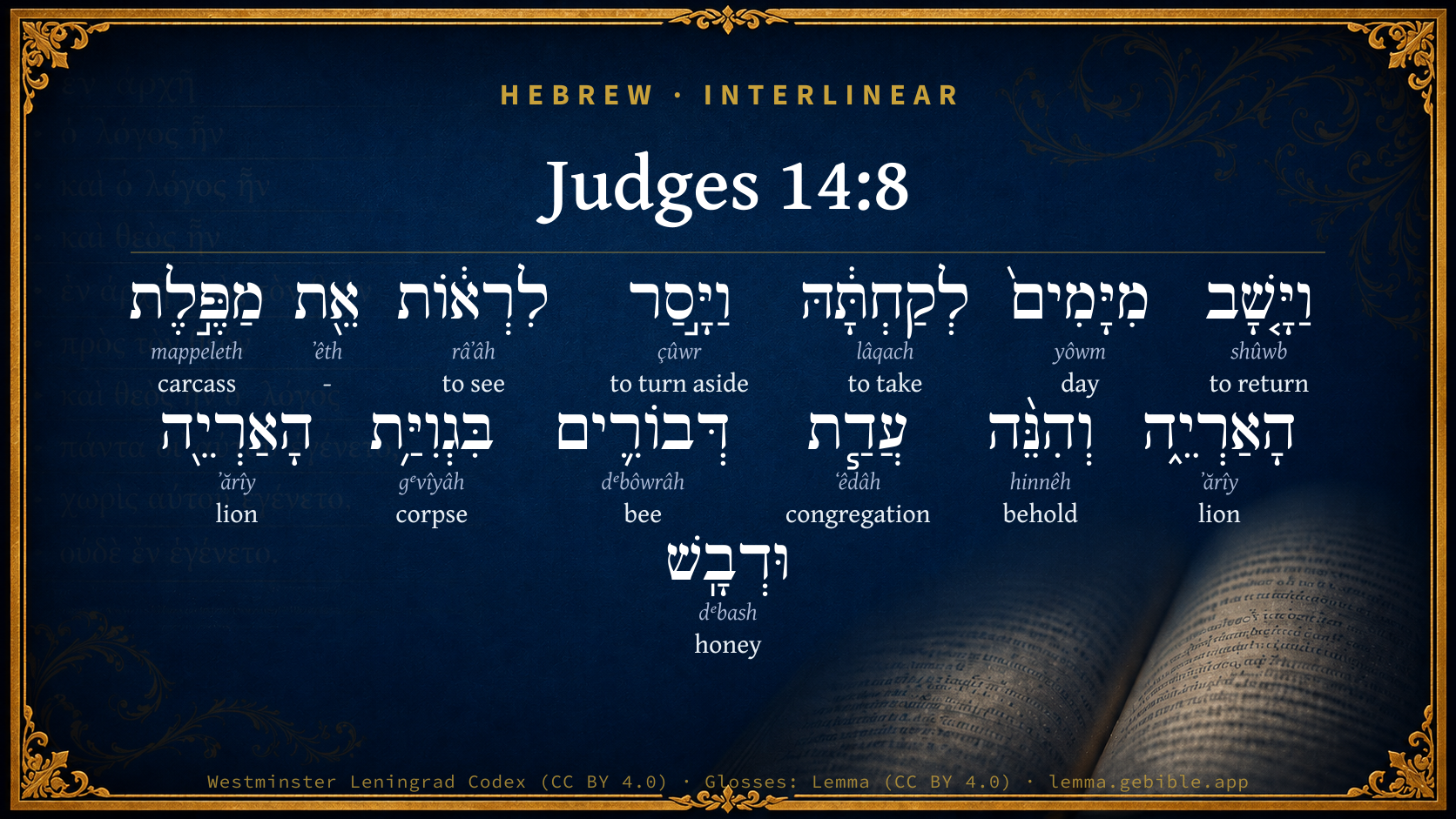
Judges 14:8

Hebrew (Westminster Leningrad Codex) Judges 14:8 appears in the Hebrew Old Testament. The text above is from the Westminster Leningrad Codex. Each word links to its Strong’s number, a concise gloss, and parsing drawn from the Open Scriptures Hebrew Bible morphology. Click any word for its full Brown-Driver-Briggs (BDB) entry.
Download image
Cite this verse

Judges 14:8 (World English Bible). Public Domain. Lemma interlinear Bible study tool, https://lemma.gebible.app/v/judges/14/8.

Show BibTeX & RIS
BibTeX
RIS
English Translation
After a while he returned to take her; and he turned aside to see the carcass of the lion: and, behold, there was a swarm of bees in the body of the lion, and honey.
World English Bible · Public Domain
Highlights
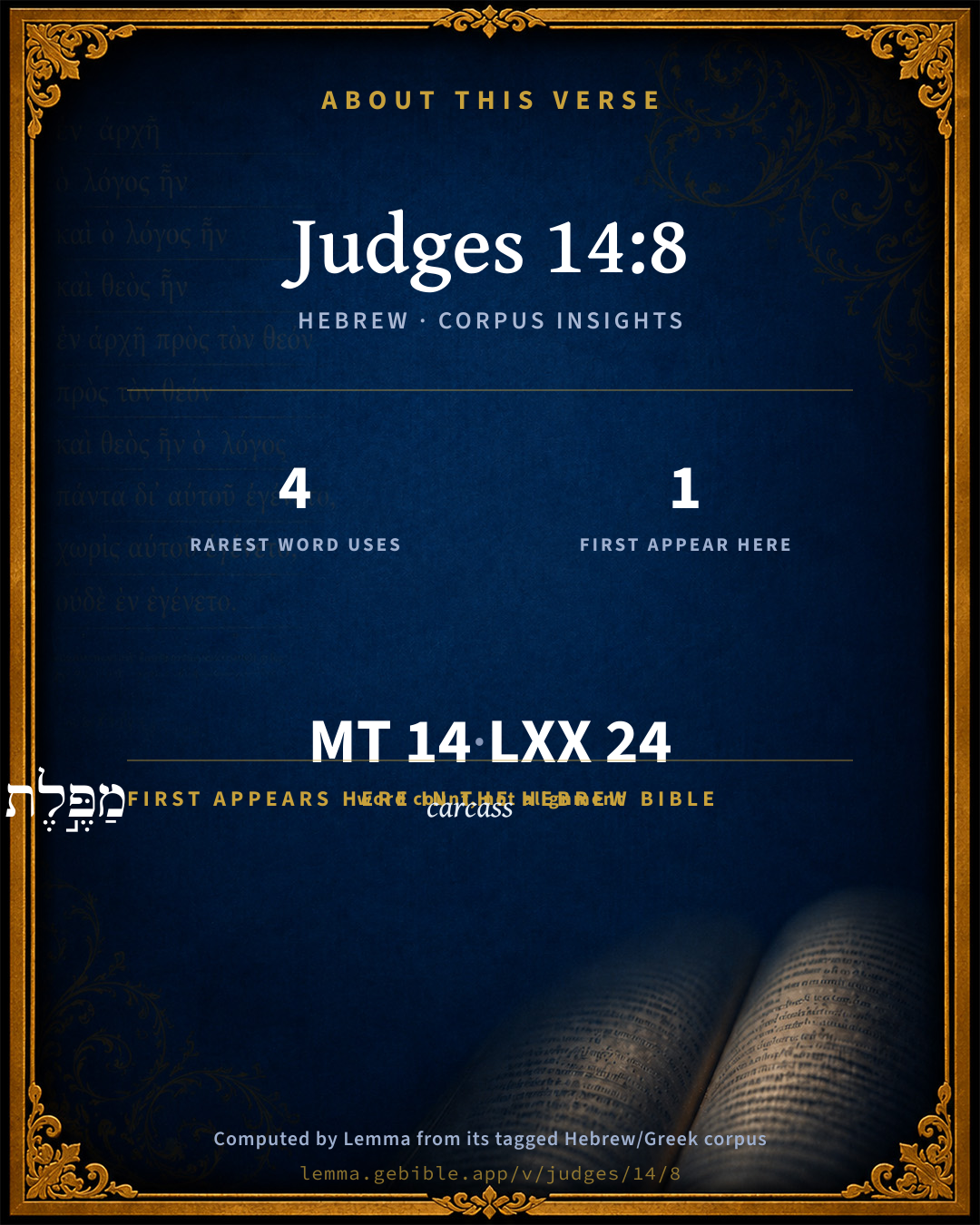
  • 1 first appearance in the Hebrew Bible
Full analysis ↓
Download a study sheet

One document with this verse’s original text, its word-by-word gloss line, the meaning frame, cross-references with their text, attributed commentary, and full source and license credits — printable, and it pastes into notes with its structure intact.

This verse Autodidact and up

Study sheet (.html) Plain text (.txt)

A passage Seminary Student

Up to 50 verses in one chapter. A passage sheet keeps up to 6 commentary sources and 12 cross-references per verse, in the order this page ranks them, and says so on the sheet whenever that leaves anything out. Ask for a single verse and you get the Autodidact verse sheet above.

Everything on this page stays free to read, with no account — the sheet is a download of what is already on screen, not access to it.

Want to remove ads? Support Godless Engineer
Compare translations 3

The same verse in 3 English versions, stacked beneath the original-language interlinear above. Click any original word for its lexicon entry.

Each is an independent rendering of the whole verse — the interlinear is not word-aligned to these translations.

Highlighted words mark where these versions differ — a whole-verse word diff, not a word-by-word alignment.

  • World English Bible Public Domain
    After a while he returned to take her; and he turned aside to see the carcass of the lion: and, behold, there was a swarm of bees in the body of the lion, and honey.
  • King James Version Public Domain
    And after a time he returned to take her, and he turned aside to see the carcass of the lion: and, behold, there was a swarm of bees and honey in the carcass of the lion.
  • unfoldingWord Literal Text CC BY-SA 4.0
    And he returned after some days to take her, and he turned to see the carcass of the lion, and behold, a swarm of bees was the body of the lion, and honey.

unfoldingWord Literal Text — © unfoldingWord, licensed CC BY-SA 4.0. Word-aligned USFM3 via Door43 (git.door43.org/unfoldingWord/en_ult).

Versions to compare (up to 4)

3 of 4 selected

Show all 18 translations

Every available English version of this verse, each an independent rendering of the whole verse.

  • World English Bible Public Domain
    After a while he returned to take her; and he turned aside to see the carcass of the lion: and, behold, there was a swarm of bees in the body of the lion, and honey.
  • Berean Standard Bible Public Domain
    When Samson returned later to take her, he left the road to see the lion’s carcass, and in it was a swarm of bees, along with their honey.
  • Majority Standard Bible Public Domain
    When Samson returned later to take her, he left the road to see the lion’s carcass, and in it was a swarm of bees, along with their honey.
  • King James Version Public Domain
    And after a time he returned to take her, and he turned aside to see the carcass of the lion: and, behold, there was a swarm of bees and honey in the carcass of the lion.
  • American Standard Version (1901) Public Domain
    And after a while he returned to take her; and he turned aside to see the carcass of the lion: and, behold, there was a swarm of bees in the body of the lion, and honey.
  • Revised Version (1885) Public Domain
    And after a while he returned to take her, and he turned aside to see the carcase of the lion: and, behold, there was a swarm of bees in the body of the lion, and honey.
  • Geneva Bible (1599) Public Domain
    And within a fewe dayes, when he returned to receiue her, he went aside to see the karkeis of the Lion: and behold, there was a swarme of bees, and hony in the body of the Lyon.
  • Douay-Rheims (1899) Public Domain
    And after some days returning to take her, he went aside to see the carcass of the lion, and behold there was a swarm of bees in the mouth of the lion and a honeycomb.
  • Young's Literal Translation Public Domain
    and he turneth back after `some' days to take her, and turneth aside to see the carcase of the lion, and lo, a company of bees `are' in the body of the lion -- and honey.
  • Literal Standard Version CC BY-SA 4.0
    and he turns back after [some] days to take her, and turns aside to see the carcass of the lion, and behold, a swarm of bees [are] in the body of the lion—and honey.
  • Unlocked Literal Bible CC BY-SA 4.0
    A few days later when he returned to marry her, he turned aside to look for the carcass of the lion. And, look, there was a swarm of bees and honey in what was left of the lion's body.
  • unfoldingWord Literal Text CC BY-SA 4.0
    And he returned after some days to take her, and he turned to see the carcass of the lion, and behold, a swarm of bees was the body of the lion, and honey.
  • Darby Bible Public Domain
    And after a while he returned to take her; and he turned aside to see the carcass of the lion, and behold, there was a swarm of bees in the body of the lion, and honey.
  • World Messianic Bible Public Domain
    After a while he returned to take her, and he went over to see the carcass of the lion; and behold, there was a swarm of bees in the body of the lion, and honey.
  • Webster's Bible Public Domain
    And after a time he returned to take her, and he turned aside to see the carcass of the lion: and behold, there was a swarm of bees and honey in the carcass of the lion.
  • Free Bible Version CC BY-SA 4.0
    Later on when Samson returned to marry her, he turned off the road to look for the lion's carcass. Inside the body was a swarm of bees and their honey.
  • Bible in Basic English Public Domain
    Then after a time he went back to take her; and turning from the road to see the dead body of the lion, he saw a mass of bees in the body of the lion, and honey there.
  • JPS Tanakh (1917) Public Domain
    And after a while he returned to take her, and he turned aside to see the carcass of the lion; and, behold, there was a swarm of bees in the body of the lion, and honey.

Literal Standard Version (2020), Covenant Press — licensed CC BY-SA 4.0. Text via the HelloAO Bible API (eBible.org). Unlocked Literal Bible (unfoldingWord) — licensed CC BY-SA 4.0. Text via the HelloAO Bible API (eBible.org). unfoldingWord Literal Text — © unfoldingWord, licensed CC BY-SA 4.0. Word-aligned USFM3 via Door43 (git.door43.org/unfoldingWord/en_ult). Free Bible Version, Dr. Jonathan Gallagher — licensed CC BY-SA 4.0. Text via the HelloAO Bible API (eBible.org).

Word by word

More ways to search: Search by grammar → Find every occurrence → Compare this word →

Practice this passage: Drill this verse → Learn its vocabulary →

דְּבוֹרִ֛ים
dᵉbôwrâh
H1682
“bees”
Noun, Common, Feminine, Plural, Absolute
Part of Speech
Noun
Type
Common
Gender
Feminine
Number
Plural
State
Absolute
Full BDB Definition

Origin: from H1696 (in the sense of orderly motion)

TWOT: 399f

bee
  1. וַיָּ֤שָׁב shûwb H7725 “and · to return” Conjunction + Verb, Qal, Sequential Imperfect, 3rd Person, Masculine, Singular
  2. מִיָּמִים֙ yôwm H3117 “from · days” Preposition + Noun, Common, Masculine, Plural, Absolute
  3. לְקַחְתָּ֔הּ lâqach H3947 “to take · her” Preposition + Verb, Qal, Infinitive Construct + Suffix, Personal, 3rd Person, Feminine, Singular
  4. וַיָּ֣סַר çûwr H5493 “and · to turn aside” Conjunction + Verb, Qal, Sequential Imperfect, 3rd Person, Masculine, Singular
  5. לִרְא֔וֹת râʼâh H7200 “to see” Preposition + Verb, Qal, Infinitive Construct
  6. אֵ֖ת ʼêth H853 “-” Particle, Direct Object
  7. מַפֶּ֣לֶת mappeleth H4658 “carcass of” Noun, Common, Feminine, Singular, Construct
  8. הָאַרְיֵ֑ה ʼărîy H738 “the · lion” Particle, Definite Article + Noun, Common, Masculine, Singular, Absolute
  9. וְהִנֵּ֨ה hinnêh H2009 “and · behold” Conjunction + Particle, Demonstrative
  10. עֲדַ֧ת ʻêdâh H5712 “congregation of” Noun, Common, Feminine, Singular, Construct
  11. בִּגְוִיַּ֥ת gᵉvîyâh H1472 “in/at · corpse of” Preposition + Noun, Common, Feminine, Singular, Construct
  12. הָאַרְיֵ֖ה ʼărîy H738 “the · lion” Particle, Definite Article + Noun, Common, Masculine, Singular, Absolute
  13. וּדְבָֽשׁ dᵉbash H1706 “and · honey” Conjunction + Noun, Common, Masculine, Singular, Absolute

About this verse

These counts appear in no published source. They are computed here, from the morphology-tagged text and Lemma’s own curated glosses. What Lemma adds →

14
words
13
distinct lemmas
Historical
section

Notable vocabulary

The rarest word here is דְּבוֹרִ֛ים bee H1682 — appearing just 4 times in the whole Hebrew Bible.

First appearance in Scripture

This word makes its first canonical appearance in the Hebrew Bible here:

  • מַפֶּ֣לֶת carcass H4658

Shared distinctive vocabulary

דְּבוֹרִ֛ים bee H1682 occurs in 4 verses of the Hebrew Bible. Also found in:

Grammatical profile

  • 4 verbs
  • 8 nouns
  • 2 particles

Verb forms

  • וַיָּ֤שָׁב Qal · Sequential Imperfect
  • לְקַחְתָּ֔הּ Qal · Infinitive Construct
  • וַיָּ֣סַר Qal · Sequential Imperfect
  • לִרְא֔וֹת Qal · Infinitive Construct

Repetition

A word recurs within this verse — often emphatic in Hebrew:

  • הָאַרְיֵ֑ה lion H738 ×2

Hebrew & Septuagint length

In English translation the verse runs 35 words from the Hebrew and 35 from the Septuagint (LXX English) — the same length.

A rough comparison of the two English renderings, which tokenize alike — not a word-level alignment.

Word counts can differ between the Hebrew and the Greek without any difference in meaning — e.g. the Hebrew direct-object marker אֵת has no separate Greek word, and Greek often adds the article ὁ.

In the original languages it is 14 Hebrew tokens and 24 Greek tokens — but the two are counted differently (Hebrew bundles its prefixes and suffixes into one token; the Greek is in lemma form), so that isn’t a like-for-like length.

Cross-references

2

Topical passages linked to Judges 14:8 in the Treasury of Scripture Knowledge — connected by theme and wording, ordered by reader-vote popularity; previews shown in the World English Bible.

  • Genesis 29:21 Jacob said to Laban, "Give me my wife, for my days are fulfilled, that I may go in to her."
  • Matthew 1:20 But when he thought about these things, behold, an angel of the Lord appeared to him in a dream, saying, "Joseph, son of David, don't be afraid to take to yourself Mary, your wife, for that which is conceived in her is of the Holy Spirit.

Cross-references courtesy of OpenBible.info (CC BY 4.0).

Hebrew and Greek witnesses Masoretic Hebrew ↔ Greek Septuagint

The same verse in the two great witnesses to the Old Testament, shown verse-for-verse.

These are two independent witnesses, not word-aligned to each other, and the Septuagint is shown in lemma (dictionary) form.

Hebrew Judges 14:8 Masoretic · Westminster Leningrad Codex

וַיָּ֤שָׁב מִיָּמִים֙ לְקַחְתָּ֔הּ וַיָּ֣סַר לִרְא֔וֹת אֵ֖ת מַפֶּ֣לֶת הָאַרְיֵ֑ה וְהִנֵּ֨ה עֲדַ֧ת דְּבוֹרִ֛ים בִּגְוִיַּ֥ת הָאַרְיֵ֖ה וּדְבָֽשׁ

After a while he returned to take her; and he turned aside to see the carcass of the lion: and, behold, there was a swarm of bees in the body of the lion, and honey.

World English Bible · Public Domain

Greek LXX Judges 14:8 Septuagint · lemma form

καί ὑποστρέφω μετά ἡμέρα λαμβάνω αὐτός καί ἐκκλίνω ὁράω ὁ πτῶμα ὁ λέων καί ἰδού συναγωγή μέλισσα ἐν ὁ στόμα ὁ λέων καί μέλι

And after some time he returned to take her, and he turned aside to see the carcass of the lion; and behold, a swarm of bees, and honey were in the mouth of the lion.

LXX2012 (modern English Septuagint) · Public Domain

Hebrew: Westminster Leningrad Codex (CC BY 4.0). Greek: Septuagint (public domain); English from LXX2012 (modern English Septuagint) (Public Domain). How the Septuagint differs from the Hebrew →

Targum (Aramaic paraphrase)

1

The Targum is the ancient Jewish Aramaic paraphrase of the Hebrew Scriptures — an interpretive translation, not the Hebrew text itself. Onkelos (literal) and Pseudo-Jonathan (expansive) render the Torah, and Jonathan the Prophets. Coverage is partial: where no permissively-licensed English translation exists for a verse, only the Aramaic is shown. This is verse-level text, not a word-by-word alignment to the Hebrew.

  1. Targum Jonathan Prophets (Joshua–Malachi)
    וְתַב לִזְמַן יוֹמִין לְמִסְבָּהּ וְסָר לְמֶחֱזֵי יַת פִּגְרָא דְאַרְיָא וְהָא קִינָא דְדַבַּרְיָתָא בְּפִגְרָא דְאַרְיָא וּבֵיהּ דוּבְשָׁא:

    (no public-domain English translation for this verse)

    Targum Jonathan — Aramaic: “Mikraot Gedolot” (public domain). English: “Sefaria Community Translation” (CC0 1.0 (public-domain dedication)); “London "Chaldee Paraphrase," 1871” (public domain). Text via Sefaria.

Commentary

Notes on Judges 14:8 from classic Christian and Jewish commentators (each source and its license shown beneath its notes). The classic Christian expositions comment on the surrounding passage and are grouped to its opening verse, so a note may address several verses; the Jewish commentaries on the Tanakh (Rashi and others) are per-verse, so they appear only where the commentator wrote on this verse.

Lemma curates 59 commentaries, every one of them public domain or Creative Commons licensed, each selected and text-cleaned for this edition rather than reprinted as found. About our sources →

Trapp's Complete Commentary

John Trapp

Jdg 14:8 And after a time he returned to take her, and he turned aside to see the carcase of the lion: and, behold, [there was] a swarm of bees and honey in the carcase of the lion.

Ver. 8. And after a time.] Some convenient time there must be betwixt the contract and the wedding, but let it not be over long, for many reasons; whereof elsewhere.

And he turned aside to see the carcass of the lion.] That he might recognise God’s goodness to him in so great a deliverance, and be accordingly thankful. Unto true thankfulness for mercies received, there must concur recognition, estimation, and retribution. He was also brought hither again by a secret instinct of the Spirit for a further purpose, as it followeth in the history; and that he might see another wonder, for his further confirmation.

And, behold, there was a swarm of bees.] Prodigiosum est quod mellifiearunt in cadavere, saith one. {a} It was wondrous strange that bees should breed and make honey so soon in such a place: since they are naturally driven away by an ill smell, as abhorring all stinking things. Some think that the carcass was consumed to the bare bones, and so stank not. {b}

{a} Lav.

{b} Pliny, Columella.

John Trapp, A Commentary or Exposition upon All the Books of the Old and New Testament (1647–1656) — public domain. Text from a community e-Sword module.

Joseph Benson's Commentary

Jdg 14:8-9. After a time — Hebrew, after days; that is, either after some days, or rather, after a year, as that word often signifies; when the flesh of the lion (which, by its strong smell, is offensive to bees) was wholly consumed, and nothing was left but the bones. Bees — Settling themselves there, as they have sometimes done in a man’s scull, or in a sepulchre. Came to his father and mother — From whom he had turned aside for a season, Jdg 14:8.

Joseph Benson's Commentary on the Old and New Testaments (1811–1818) — public domain. Text from a community e-Sword module.

Geneva Bible (1599)

Geneva Bible translators

Or, to take her to his wife.

Geneva Bible (1599) marginal notes — public domain. Text via Bolls.life.

Jamieson, Fausset & Brown

Robert Jamieson, A. R. Fausset & David Brown

after a time he returned to take her--probably after the lapse of a year, the usual interval between the ceremonies of betrothal and marriage. It was spent by the bride elect with her parents in preparation for the nuptials; and at the proper time the bridegroom returned to take her home.

he turned aside to see the carcass of the lion: and, behold, there was a swarm of bees and honey in the carcass of the lion--In such a climate, the myriads of insects and the ravages of birds of prey, together with the influences of the solar rays, would, in a few months, put the carcass in a state inviting to such cleanly animals as bees.

Jamieson, Fausset & Brown — Commentary Critical and Explanatory on the Whole Bible (1871) — public domain (CC PDM 1.0). Text via the HelloAO Bible API.

Adam Clarke's Commentary

Verse 8. After a time] Probably about one year; as this was the time that generally elapsed between espousing and wedding.

A swarm of bees and honey in the carcass] By length of time the flesh had been entirely consumed off the bones, and a swarm of bees had formed their combs within the region of the thorax, nor was it an improper place; nor was the thing unfrequent, if we may credit ancient writers; the carcasses of slain beasts becoming a receptacle for wild bees. The beautiful espisode in the 4th Georgic of Virgil, beginning at ver. 317, proves that the ancients believed that bees might be engendered in the body of a dead ox: -

Pastor Aristaeus fugiens Peneia Tempe ___

Quatuor eximios praestanti corpore tauros

Ducit, et intacta totidem cervice juvencas.

Post, ubi nona suos Aurora induxerat ortus.

Inferias Orphei mittit, lucumque revisit.

Hic ver o subitum, ac dietu mirabile monstrum

Adspiciunt, liquefacta bourn per viscera toto

Stridere apes utero, et ruptis effervere costis;

Immensasque trahi nubes, jamque arbore summa

Confluere, et lentis uvam demittere ramis.

VIRG. Geor. lib. iv., ver. 550.

"Sad Aristaeus from fair Tempe fled,

His bees with famine or diseases dead ___

Four altars raises, from his herd he culls

For slaughter four the fairest of his bulls;

Four heifers from his female store he took,

All fair, and all unknowing of the yoke.

Nine mornings thence, with sacrifice and prayers,

The powers atoned, he to the grove repairs.

Behold a prodigy! for, from within

The broken bowels, and the bloated skin,

A buzzing noise of bees his ears alarms,

Straight issuing through the sides assembling swarms!

Dark as a cloud, they make a wheeling flight,

Then on a neighbouring tree descending light,

Like a large cluster of black grapes they show,

And make a large dependance from the bough.

DRYDEN.

Adam Clarke's Commentary on the Bible (1810–1826) — public domain. Text from a community e-Sword/MySword module.

Ellicott's Commentary for English Readers

(8) After a time.—There is nothing to show how long this time was. A betrothal might last a year. In Jdg_11:4 the same phrase (“after days “) is used of many years.

To take her.—To lead her to his own home after the bridal feast.

A swarm of bees and honey in the carcase of the lion.—This incident has been questioned, because it is truly said that bees hate all putrescence and decomposition, and that the notion of bees being generated in the rotting bodies of oxen (which we find in Virgil, Georgic 4, &c.) is a vulgar error. But it is overlooked that the word “carcase” here means (as the Syriac renders it) “skeleton.” The fierce sun of the East dries up all the animal moisture of a dead body, and reduces it to a skeleton with extreme rapidity, and bees have no dislike to dried bones as a place in which to swarm. Thus Herodotus tells us (v. 114) that when the Amathusians cut off the head of Onesilus, because he besieged them, and hung it over their gates, a swarm of bees filled the skull with their combs and honey. Rosenmüller also quotes the authority of the physician Aldrovand for the story that swarms of bees built their combs between the skeletons of two sisters who were buried in the Church of Santa Croce, at Verona, in 1566. (Comp. Plin. H. N., xi. 24; Varro, R. R., 3:16.)

A Bible Commentary for English Readers, edited by Charles John Ellicott (1878–1897) — public domain. Text from a community e-Sword module.

The Cambridge Bible for Schools and Colleges

gen. ed. J. J. S. Perowne

8. he returned] i.e. to Zorah; the woman stays in her father’s house, as was the rule in a mot‘a marriage. The natural sense of the narrative is destroyed by the expression to take her, i.e. to marry her (a single word in the Hebr.); obviously it has been inserted. The marriage does not begin till later, Jdg_14:10.

a swarm of bees] Though in a hot country the carcase would quickly decay and shrivel up, some time must have elapsed before the bees could hive in it and form honey-comb. But in a popular story, so full of marvels, this matter-of-fact detail would not be considered. The tale of Onesilus told by Herodotus, 14:114, has been quoted to illustrate the incident. If we wish to look for the origin of this popular story, Stahn (l.c. on p. 140) offers an explanation which is certainly plausible. The connexion between the lion and the honey may be founded on the observed fact that when the sun stands in the sign of Leo, i.e. in the month of May–June, bees in Palestine produce their honey. This would be common knowledge, and would suggest an answer to the riddle in Jdg_14:14, which the Philistines might have answered if they had used their wits.

The Cambridge Bible for Schools and Colleges (gen. ed. J. J. S. Perowne; Cambridge University Press, 1878–1918) — public domain. Text from a community e-Sword module.

John Gill's Exposition

And after a time he returned to take her,.... Matters being agreed on, and settled on both sides, and the espousals made, he and his parents returned, and, at the proper usual time for the consummation of the marriage, he went again to Timnath for that purpose. It is in the Hebrew text, "after days" (c), which sometimes signifies a year, see Gen 4:3 and so Ben Gersom interprets it, that a year after this woman became Samson's wife (i.e. betrothed to him) he returned to take her to himself to wife; and it seems, adds he, that twelve months were given her to prepare herself; and some considerable time must have elapsed, as appears from what had happened to the carcass of the lion, next related:

and he turned aside to see the carcass of the lion: just before he came to Timnath he thought of the lion he had slain some time ago, and he went a little out of the way to see what was become of it, or had happened to it. Josephus says (d), when he slew it he threw it into a woody place, perhaps among some bushes, a little out of the road; for which reason it had not been seen and removed, and was in a more convenient place for what was done in it:

and, behold, there was a swarm of bees and honey in the carcass of the lion; and though naturalists (e) tell us that bees are averse to flesh, and will not touch any, yet in the course of time that the carcass of this lion had lain, its flesh might have been clean eaten off by the fowls of the air, or was quite dried away and consumed, so that it was nothing but a mere skeleton; a bony carcass, as the Syriac version. Josephus (f) says, the swarm was in the breast of the lion; and it is no more unlikely that a swarm of bees should settle in it, and continue and build combs, and lay up their honey there, than that the like should be done in the skull of Onesilus king of Cyprus, when hung up and dried, as Herodotus (g) relates. Besides, according to Virgil (h), this was a method made use of to produce a new breed of bees, even from the corrupt gore and putrid bowels of slain beasts; and Pythagoras (i) observes, they are produced from thence. This may be an emblem of those sweet blessings of grace, which come to the people of Christ through his having destroyed Satan the roaring lion, and all his works; particularly which came to the poor Gentiles, when the devil was cast out from them, and his empire there demolished.

(c) "a diebus", Montanus; "post dies", Vatablus. (d) Ut supra. (Antiqu. l. 5. c. 8. sect. 5.) (e) Aristot. Hist. Animal. l. 9. c. 40. Plin. Nat. Hist. l. 11. c. 21. (f) Ut supra, (Antiqu. l. 5. c. 8.) sect. 6. (g) Terpsichore, sive, l. 5. c. 114. (h) "----quoquo modo caesis", &c. Georgic. l. 4. ver. 284, &c. "Liguefacta boum per viscera", &c. Ib ver. 555. (i) Apud Ovid. Melamorph. l. 15. fab. 4. ver. 365, 366.

John Gill's Exposition of the Whole Bible (1746–1763) — public domain (CC PDM 1.0). Text via the HelloAO Bible API.

Albert Barnes' Notes on the Bible

The formal dowry and gifts having been given by Samson’s father, an interval, varying according to the Oriental custom, from a few days to a full year, elapsed between the betrothal and the wedding, during which the bride lived with her friends. Then came the essential part of the marriage ceremony, namely, the removal of the bride from her father’s house to that of the bridegroom or his father.

The carcase of the lion - The lion, slain by him a year or some months before, had now become a mere skeleton, fit for bees to swarm into. It was a universal notion among the ancients that bees were generated from the carcass of an ox.

Albert Barnes' Notes on the Bible (1834–1885) — public domain. Text from a community e-Sword/MySword module.

Haydock's Catholic Bible Commentary

A honeycomb. There was a very remarkable providence in this particular of the history of Samson. From which also in the mystical sense we may learn what spiritual sweetness and nourishment our souls will acquire from slaying the lions of our passions and vices. (Challoner) --- Samson waited some time before he went to celebrate his marriage. The Rabbins say a full year was the usual term after the espousals; (Esther ii. 12,) and many have translated "after a year." (Chaldean, Arabic, &c.) During this space the flesh of the lion would be consumed, and bees might make honey in its skeleton. Herodotus (v. 114,) informs us that a swarm lodged in the skull of Onesylus, the tyrant of Cyprus, which had been suspended for a long time. They keep at a distance from carrion and every fetid smell. Some say that they were produced form the corrupted flesh of the lion, in the same manner as Virgil (iv.) describes the proceeding from a young ox beaten to death, and covered with boughs, in a place closely shut up. The bees might have laid their eggs upon these boughs, and the grass upon which an ox feeds, &c. But none of these precautions were taken with the lion which Samson tore in pieces. (Calmet)

George Leo Haydock (1774–1849), Haydock's Catholic Family Bible and Commentary, 1859 edition — public domain. Excludes Psalms (Douay-Rheims chapter numbering differs from Protestant) and Deuterocanonical books (Catholic canon only).

Matthew Poole's English Annotations

After a time, Heb. after days, i.e. either after some days; or rather, after a year, as that word oft signifies; as Exo 13:10; Lev 25:29; Num 9:22; Jdg 17:10; 1Sa 1:3 27:7; when the flesh of the lion, which by its strong smell is offensive to and avoided by bees, was wholly consumed, and nothing was left but the bones.

There was a swarm of bees; not generated of the dead lion’s body, but elsewhere, and settling themselves there, as they have sometimes done in a man’s skull, and in a sepulchre, and such-like places.

Matthew Poole's English Annotations on the Holy Bible (1683–1685) — public domain. Text from a community e-Sword/MySword module.

Whedon's Commentary on the Bible

Daniel D. Whedon

8. After a time he returned to take her — That is, to consummate the marriage. Several months, often a year, elapsed between the betrothal and the wedding.

A swarm of bees and honey in the carcass of the lion — “This, it must be confessed,” says Dr. Thomson, “is an extraordinary occurrence. The word for bees is the Arabic for hornets, and these we know are very fond of flesh, and devour it with the greatest avidity. I have myself seen a swarm of hornets build their comb in the skull of a dead camel, and this would incline me to believe that it was really our debabir — hornets — that had settled in the carcass of Samson’s lion, if it were known that they manufactured honey enough to meet the demands of the story. However, we find that not long after this bees were so abundant in a wood at no great distance from this spot that the honey dropped down from the trees on the ground, (1Sa_14:26;) and I have explored densely-wooded gorges on Hermon and southern Lebanon where wild bees are still found, both in trees and in clefts of the rocks. It keeps up the verisimilitude of the narrative that these are just the places where wild beasts still abound, and though bees ordinarily avoid dead carcasses, it is possible that they on this occasion selected that of the lion for their hive.” Rosenmuller in his “Bible Archaeology” says: “In the desert of Arabia the heat of a sultry season will often dry up all the moisture of men or camels that have fallen dead, within twenty-four hours of their decease, without their passing into a state of decomposition and putrefaction, so that they remain for a long time like mummies, without change and without stench.” In such a case it would be very possible and likely that a swarm of bees would take up their abode in what more resembled a crust of rock than a decayed carcass. Or we may suppose that the carcass had become a dry and naked skeleton, and that some sort of wild bees had formed their nest and combs within it. On this point we may well add the weighty testimony of Dr. Kitto: “In the East, vultures and insects, particularly numerous swarms of ants — and these abound in vineyards — will, in an astonishingly short time, clean completely out all the soft parts of any carcass, leaving the skeleton entire, covered by its integuments, for, the flesh having been picked out, the skin would not be rent and destroyed. All the softer parts being thus removed, the bones and skin will rapidly be deprived of all their moisture by the heat of the sun; and the skeleton, covered over with the dry parchment into which the skin has been turned, becomes a sweet and very convenient habitation, in which a swarm of bees would be very likely to settle, especially in a secluded spot, among the shrub-like vines. In the East, bees establish themselves in situations little thought of by us; many wild swarms, being left to find homes for themselves, fix in any hollow which seems to them suited to their wants.”

Daniel D. Whedon (gen. ed.), Commentary on the Old and New Testaments (1874–1909) — public domain. Text from a community e-Sword module.

The Pulpit Commentary

He returned to take her. All the preliminaries being settled between the parents, he returned to Timnath to take his bride by the same road which he and his parents had travelled by before, and, remembering his feat in killing the lion, very naturally turned aside to see what had become of the carcase. And, behold, there was a swarm of bees, etc.

This has been objected to as improbable, because bees are very dainty, and would not approach a putrefying body. But as a considerable time had elapsed, it is very possible that either the mere skeleton was left, or that the heat of the sun had dried up the body and reduced it to the state of a mummy without decomposition, as is said to happen often in the desert of Arabia.

Vers. 8, 9. Recalling past deliverances.

In this case Samson is led to do so either by curiosity or the impulse of God"s Spirit. He revisits the scene of the exploit, and meets with welcome but unexpected refreshment. There are various ways of recalling spiritual experiences of God"s saving power in the past. Sometimes an accident(?) may bring up vividly some forgotten circumstance of Divine grace, and we are overwhelmed with the recollections that crowd upon the mind. Soldiers who have fought side by side in famous battles have their anniversaries of fellowship and celebration. Are there no circumstances that justify these amongst Christians? It is a spiritual education and confirmation to recall circumstances and revisit scenes of God"s saving mercies.

I THE DUTY OF THANKFUL RECOLLECTION OF DIVINE INTERPOSITIONS.

II THE SECRET AND UNSHARED COMMUNION OF THE SUBJECT OF GRACE WITH HIS SAVIOUR.

III ITS ADVANTAGE AND BLESSING. M.

The Pulpit Commentary (1880–1919), ed. H.D.M. Spence-Jones & Joseph S. Exell — public domain. Text from a community e-Sword module.

John Wesley's Explanatory Notes

After a time - Hebrew. after days; that is, either after some days: or, rather, after a year, as that word often signifies; when the flesh of the lion, (which by its strong smell is offensive to bees) was wholly consumed, and nothing was left but the bones. Bees - Settling themselves there, as they have sometimes done in a man's skull, or in a sepulchre.

John Wesley, Explanatory Notes Upon the Whole Bible (1754–1765) — public domain. Text via the GEBible commentary corpus.

Keil & Delitzsch

C. F. Keil & F. Delitzsch

When some time had elapsed after the betrothal, he came again to fetch her (take her home, marry her), accompanied, as we learn from Jdg 14:9, by his parents. On the way "he turned aside (from the road) to see the carcase of the lion; and behold a swarm of bees was in the body of the lion, also honey." The word מפּלת, which only occurs here, is derived from נפל, like πτῶμα from πίπτω, and is synonymous with נבלה, cadaver, and signifies not the mere skeleton, as bees would not form their hive in such a place, but the carcase of the lion, which had been thoroughly dried up by the heat of the sun, without passing into a state of putrefaction. "In the desert of Arabia the heat of a sultry season will often dry up all the moisture of men or camels that have fallen dead, within twenty-four hours of their decease, without their passing into a state of decomposition and putrefaction, so that they remain for a long time like mummies, without change and without stench" (Rosenmller, Bibl. Althk. iv. 2, p. 424). In a carcase dried up in this way, a swarm of bees might form their hive, just as well as in the hollow trunks of trees, or clefts in the rock, or where wild bees are accustomed to form them, notwithstanding the fact that bees avoid both dead bodies and carrion (see Bochart, Hieroz, ed. Ros. iii. p. 355).

Keil & Delitzsch — Biblical Commentary on the Old Testament (1861–1891) — public domain (CC PDM 1.0). Text via the HelloAO Bible API. (Old Testament only.)

Rashi

Rabbi Shlomo Yitzchaki (Rashi)

A colony of bees. A beehive—a swarm of bees.

Rashi on the Tanakh — English translations: “The Judaica Press complete Tanach with Rashi, translated by A. J. Rosenberg” (CC BY 4.0); “Pentateuch with Rashi's commentary by M. Rosenbaum and A.M. Silbermann, 1929-1934” (public domain); “The Metsudah Tanach series, Lakewood, N.J” (CC BY 4.0); and “The Book of Joshua, Metsudah Publications, 1997” (CC BY 4.0). Text via Sefaria.

Lesson kit

Teaching starters — assembled from the data on this page, not authored interpretation. Every prompt links to the verse data it draws on. Edit before teaching.

Judges, in the Historical, opens this verse with 14 words (13 distinct Hebrew lemmas). Its most distinctive word is dᵉbôwrâh (“bee”). A historical commentator’s framing appears above. Read the whole chapter for the surrounding context.

Discussion questions

  1. How does “bee” (dᵉbôwrâh) shape what this verse is saying?
  2. This is the first place “carcass” appears in Scripture (first appears here). What does its debut here establish?
  3. How does Deuteronomy 1:44, which shares the word «bee», read alongside this verse?
  4. What does the repetition of “lion” (2× in this one verse) do in this verse?
  5. These translations render this verse differently; the difference is in the English rendering, not the original. What questions does that raise?
  6. «וַיָּ֤שָׁב» is a Qal Sequential Imperfect verb. How does that grammatical form shape the action described?
  7. Compare how Trapp's Complete Commentary and Joseph Benson's Commentary read this verse. Where do they agree or differ?

Things to notice

Reading settings

Reading text

Shown beneath each verse's original-language words.

Old Testament
Old Testament edition

Read the OT as the Masoretic Hebrew (MT) or the Greek Septuagint (LXX).

English shown for the Greek Septuagint (in the Hebrew ↔ Greek comparison).

Comparing translations? Open the Compare panel on any verse page to stack up to four side by side.