
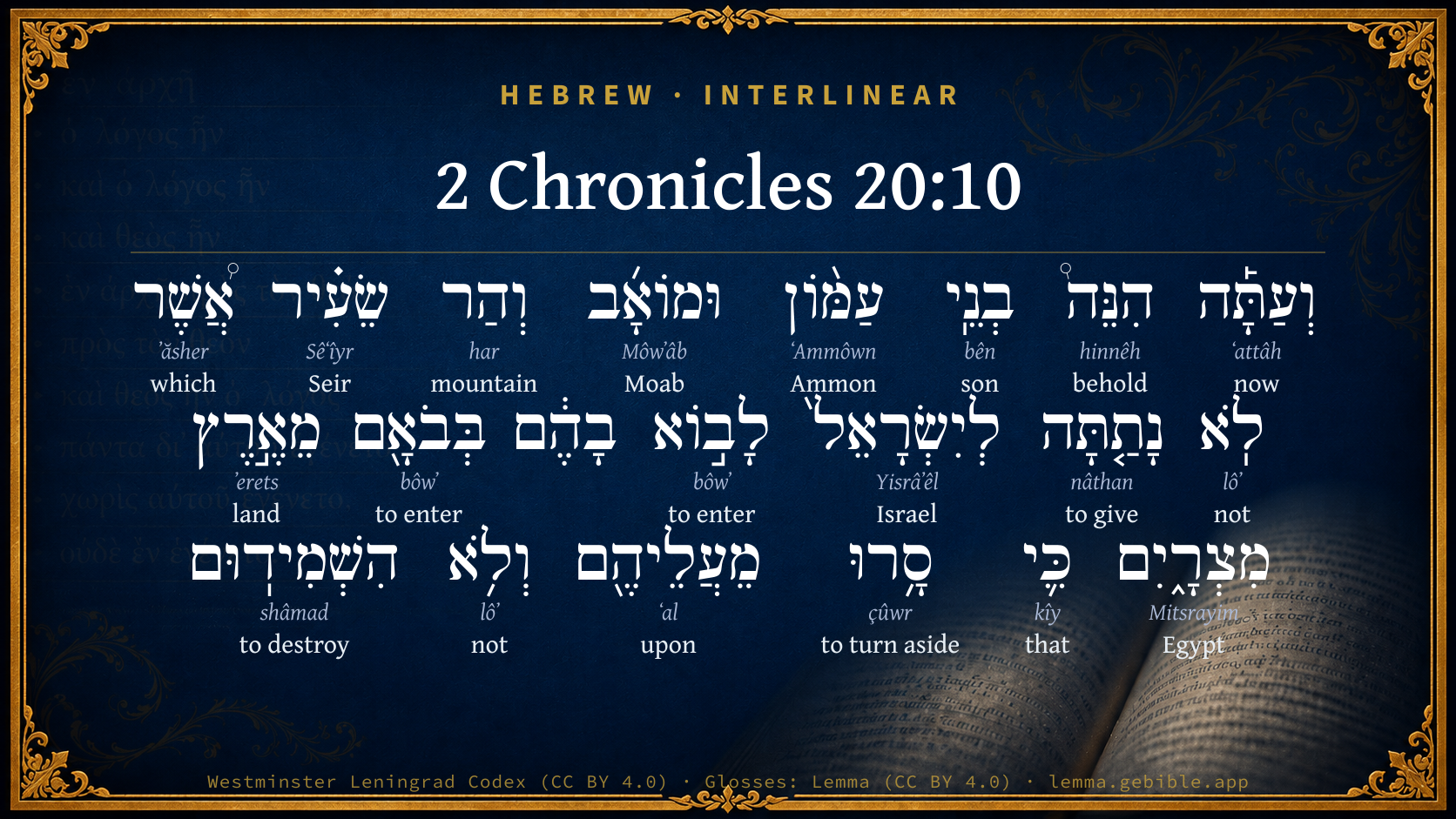
2 Chronicles 20:10

Hebrew (Westminster Leningrad Codex) 2 Chronicles 20:10 appears in the Hebrew Old Testament. The text above is from the Westminster Leningrad Codex. Each word links to its Strong’s number, a concise gloss, and parsing drawn from the Open Scriptures Hebrew Bible morphology. Click any word for its full Brown-Driver-Briggs (BDB) entry.
Download image
Cite this verse

2 Chronicles 20:10 (World English Bible). Public Domain. Lemma interlinear Bible study tool, https://lemma.gebible.app/v/2-chronicles/20/10.

Show BibTeX & RIS
BibTeX
RIS
English Translation
Now, behold, the children of Ammon and Moab and Mount Seir, whom you would not let Israel invade, when they came out of the land of Egypt, but they turned aside from them, and didn't destroy them;
World English Bible · Public Domain
Download a study sheet

One document with this verse’s original text, its word-by-word gloss line, the meaning frame, cross-references with their text, attributed commentary, and full source and license credits — printable, and it pastes into notes with its structure intact.

This verse Autodidact and up

Study sheet (.html) Plain text (.txt)

A passage Seminary Student

Up to 50 verses in one chapter. A passage sheet keeps up to 6 commentary sources and 12 cross-references per verse, in the order this page ranks them, and says so on the sheet whenever that leaves anything out. Ask for a single verse and you get the Autodidact verse sheet above.

Everything on this page stays free to read, with no account — the sheet is a download of what is already on screen, not access to it.

Want to remove ads? Support Godless Engineer
Compare translations 3

The same verse in 3 English versions, stacked beneath the original-language interlinear above. Click any original word for its lexicon entry.

Each is an independent rendering of the whole verse — the interlinear is not word-aligned to these translations.

Highlighted words mark where these versions differ — a whole-verse word diff, not a word-by-word alignment.

  • World English Bible Public Domain
    Now, behold, the children of Ammon and Moab and Mount Seir, whom you would not let Israel invade, when they came out of the land of Egypt, but they turned aside from them, and didn't destroy them;
  • King James Version Public Domain
    And now, behold, the children of Ammon and Moab and mount Seir, whom thou wouldest not let Israel invade, when they came out of the land of Egypt, but they turned from them, and destroyed them not;
  • unfoldingWord Literal Text CC BY-SA 4.0
    And now behold the sons of Ammon and Moab and Mount Seir whom you did not give to Israel to enter against them when they were coming from the land of Egypt, for they turned from against them, and they did not destroy them.

unfoldingWord Literal Text — © unfoldingWord, licensed CC BY-SA 4.0. Word-aligned USFM3 via Door43 (git.door43.org/unfoldingWord/en_ult).

Versions to compare (up to 4)

3 of 4 selected

Show all 18 translations

Every available English version of this verse, each an independent rendering of the whole verse.

  • World English Bible Public Domain
    Now, behold, the children of Ammon and Moab and Mount Seir, whom you would not let Israel invade, when they came out of the land of Egypt, but they turned aside from them, and didn't destroy them;
  • Berean Standard Bible Public Domain
    And now, here are the men of Ammon, Moab, and Mount Seir, whom You did not let Israel invade when they came out of the land of Egypt; but Israel turned away from them and did not destroy them.
  • Majority Standard Bible Public Domain
    And now, here are the men of Ammon, Moab, and Mount Seir, whom You did not let Israel invade when they came out of the land of Egypt. So Israel turned away from them and did not destroy them.
  • King James Version Public Domain
    And now, behold, the children of Ammon and Moab and mount Seir, whom thou wouldest not let Israel invade, when they came out of the land of Egypt, but they turned from them, and destroyed them not;
  • American Standard Version (1901) Public Domain
    And now, behold, the children of Ammon and Moab and mount Seir, whom thou wouldest not let Israel invade, when they came out of the land of Egypt, but they turned aside from them, and destroyed them not;
  • Revised Version (1885) Public Domain
    And now, behold, the children of Ammon and Moab and mount Seir, whom thou wouldest not let Israel invade, when they came out of the land of Egypt, but they turned aside from them, and destroyed them not;
  • Geneva Bible (1599) Public Domain
    And now beholde, the children of Ammon and Moab, and mount Seir, by whome thou wouldest not let Israel goe, when they came out of the land of Egypt: but they turned aside from them, and destroyed them not:
  • Douay-Rheims (1899) Public Domain
    Now therefore behold the children of Ammon, and of Moab, and mount Seir, through whose lands thou didst not allow Israel to pass, when they came out of Egypt, but they turned aside from them, and slew them not,
  • Young's Literal Translation Public Domain
    `And now, lo, sons of Ammon, and Moab, and mount Seir, whom Thou didst not grant to Israel to go in against in their coming out of the land of Egypt, for they turned aside from off them and destroyed them not,
  • Literal Standard Version CC BY-SA 4.0
    And now, behold, sons of Ammon, and Moab, and Mount Seir, whom You did not grant to Israel to go in against in their coming out of the land of Egypt, for they turned aside from off them and did not destroy them,
  • Unlocked Literal Bible CC BY-SA 4.0
    See now, here are the people of Ammon, Moab, and Mount Seir whom you would not let Israel invade when they came out of the land of Egypt; instead, Israel turned away from them and did not destroy them.
  • unfoldingWord Literal Text CC BY-SA 4.0
    And now behold the sons of Ammon and Moab and Mount Seir whom you did not give to Israel to enter against them when they were coming from the land of Egypt, for they turned from against them, and they did not destroy them.
  • Darby Bible Public Domain
    And now, behold, the children of Ammon and Moab, and those of mount Seir, amongst whom thou wouldest not let Israel go when they came out of the land of Egypt, (for they turned from them, and destroyed them not,)
  • World Messianic Bible Public Domain
    Now, behold, the children of Ammon and Moab and Mount Seir, whom you would not let Israel invade when they came out of the land of Egypt, but they turned away from them, and didn’t destroy them;
  • Webster's Bible Public Domain
    And now, behold, the children of Ammon and Moab and mount Seir, whom thou wouldst not let Israel invade, when they came from the land of Egypt, but they turned from them, and destroyed them not;
  • Free Bible Version CC BY-SA 4.0
    Look, here come the armies of Ammon, Moab, and Mount Seir, those very countries you did not let Israel invade when they came out of Egypt. Israel left them alone and did not destroy them.
  • Bible in Basic English Public Domain
    And now, see, the children of Ammon and Moab and the people of Mount Seir, whom you kept Israel from attacking when they came out of Egypt, so that turning to one side they did not send destruction on them:
  • JPS Tanakh (1917) Public Domain
    And now, behold, the children of Ammon and Moab and mount Seir, whom Thou wouldest not let Israel invade, when they came out of the land of Egypt, but they turned aside from them, and destroyed them not;

Literal Standard Version (2020), Covenant Press — licensed CC BY-SA 4.0. Text via the HelloAO Bible API (eBible.org). Unlocked Literal Bible (unfoldingWord) — licensed CC BY-SA 4.0. Text via the HelloAO Bible API (eBible.org). unfoldingWord Literal Text — © unfoldingWord, licensed CC BY-SA 4.0. Word-aligned USFM3 via Door43 (git.door43.org/unfoldingWord/en_ult). Free Bible Version, Dr. Jonathan Gallagher — licensed CC BY-SA 4.0. Text via the HelloAO Bible API (eBible.org).

Word by word

More ways to search: Search by grammar → Find every occurrence → Compare this word →

Practice this passage: Drill this verse → Learn its vocabulary →

שֵׂעִ֗יר
Sêʻîyr
H8165
“Seir”
Noun, Proper
Part of Speech
Noun
Type
Proper
Full BDB Definition

Origin: formed like H8163

TWOT: 2274h , 2274g

Seir = "hairy" or " shaggy" - patriarch of the Horites, the inhabitants of Edom before the descendants of Esau, the Edomites (noun proper masculine) - the land of Edom, south of the Dead Sea (noun proper territorial) - a mountain range in Edom extending from the Dead Sea to the Elanitic Gulf (noun proper mountain) - apparently also called 'Mount Seir' and extending most of the distance of the mountain range itself - a mountain in northern Judah lying westward from Kirjath-jearim (noun proper mountain)
  1. וְעַתָּ֡ה ʻattâh H6258 “and · now” Conjunction + Adverb
  2. הִנֵּה֩ hinnêh H2009 “behold” Particle, Demonstrative
  3. בְנֵֽי bên H1121 “sons of” Noun, Common, Masculine, Plural, Construct
  4. עַמּ֨וֹן ʻAmmôwn H5983 “Ammon” Noun, Proper
  5. וּמוֹאָ֜ב Môwʼâb H4124 “and · Moab” Conjunction + Noun, Proper
  6. וְהַר har H2022 “and · mountain of” Conjunction + Noun, Common, Masculine, Singular, Construct
  7. אֲ֠שֶׁר ʼăsher H834 “which” Particle, Relative
  8. לֹֽא lôʼ H3808 “not” Particle, Negative
  9. נָתַ֤תָּה nâthan H5414 “to give” Verb, Qal, Perfect, 2nd Person, Masculine, Singular
  10. לְיִשְׂרָאֵל֙ Yisrâʼêl H3478 “to/for · Israel” Preposition + Noun, Proper
  11. לָב֣וֹא bôwʼ H935 “to enter” Preposition + Verb, Qal, Infinitive Construct
  12. בְּבֹאָ֖ם bôwʼ H935 “in/at · to enter · them” Preposition + Verb, Qal, Infinitive Construct + Suffix, Personal, 3rd Person, Masculine, Plural
  13. מֵאֶ֣רֶץ ʼerets H776 “from · land of” Preposition + Noun, Common, Both, Singular, Construct
  14. מִצְרָ֑יִם Mitsrayim H4714 “Egypt” Noun, Proper
  15. כִּ֛י kîy H3588 “that” Conjunction
  16. סָ֥רוּ çûwr H5493 “to turn aside” Verb, Qal, Perfect, 3rd Person, Common, Plural
  17. מֵעֲלֵיהֶ֖ם ʻal H5921 “from · upon · them” Preposition + Preposition + Suffix, Personal, 3rd Person, Masculine, Plural
  18. וְלֹ֥א lôʼ H3808 “and · not” Conjunction + Particle, Negative
  19. הִשְׁמִידֽוּם shâmad H8045 “to destroy · them” Verb, Hiphil, Perfect, 3rd Person, Common, Plural + Suffix, Personal, 3rd Person, Masculine, Plural

About this verse

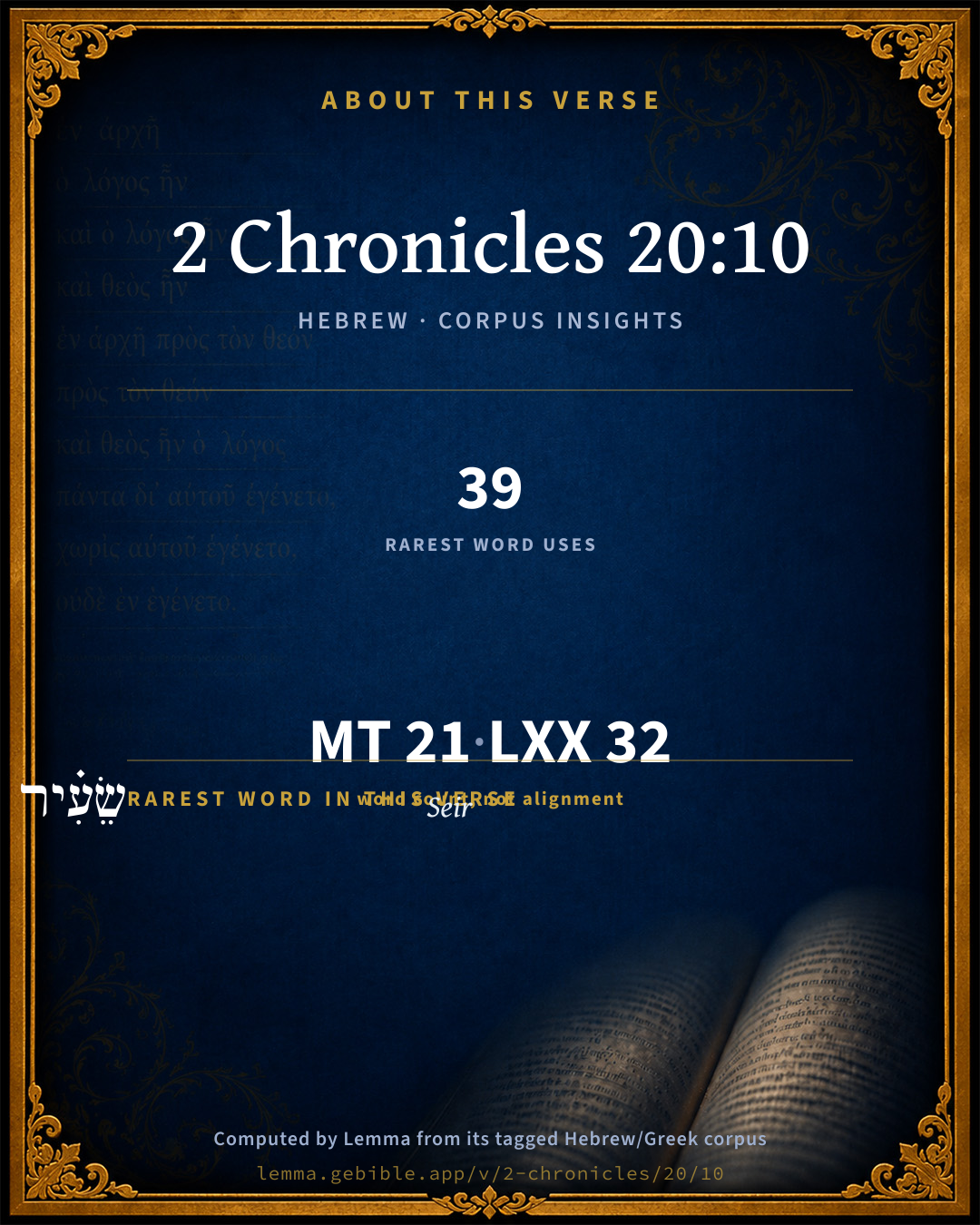
These counts appear in no published source. They are computed here, from the morphology-tagged text and Lemma’s own curated glosses. What Lemma adds →

21
words
18
distinct lemmas
Historical
section

Shared distinctive vocabulary

שֵׂעִ֗יר Seir H8165 occurs in 38 verses of the Hebrew Bible. Also found in:

Grammatical profile

  • 5 verbs
  • 8 nouns
  • 2 prepositions
  • 1 conjunction
  • 1 adverb
  • 4 particles

Verb forms

  • נָתַ֤תָּה Qal · Perfect
  • לָב֣וֹא Qal · Infinitive Construct
  • בְּבֹאָ֖ם Qal · Infinitive Construct
  • סָ֥רוּ Qal · Perfect
  • הִשְׁמִידֽוּם Hiphil · Perfect

Repetition

Words recur within this verse — often emphatic in Hebrew:

  • לָב֣וֹא to enter H935 ×2
  • לֹֽא not H3808 ×2

Hebrew & Septuagint length

In English translation the verse runs 37 words from the Hebrew and 47 from the Septuagint (LXX English) — closely comparable.

A rough comparison of the two English renderings, which tokenize alike — not a word-level alignment.

Word counts can differ between the Hebrew and the Greek without any difference in meaning — e.g. the Hebrew direct-object marker אֵת has no separate Greek word, and Greek often adds the article ὁ.

In the original languages it is 21 Hebrew tokens and 32 Greek tokens — but the two are counted differently (Hebrew bundles its prefixes and suffixes into one token; the Greek is in lemma form), so that isn’t a like-for-like length.

Cross-references

7

Topical passages linked to 2 Chronicles 20:10 in the Treasury of Scripture Knowledge — connected by theme and wording, ordered by reader-vote popularity; previews shown in the World English Bible.

  • Deuteronomy 2:4–5 Command you the people, saying, You are to pass through the border of your brothers the children of Esau, who dwell in Seir; and they will be afraid of you: take good heed to yourselves therefore;
  • Deuteronomy 2:19 and when you come near over against the children of Ammon, don't bother them, nor contend with them; for I will not give you of the land of the children of Ammon for a possession; because I have given it to the children of Lot for a possession.
  • Deuteronomy 2:9 Yahweh said to me, Don't bother Moab, neither contend with them in battle; for I will not give you of his land for a possession; because I have given Ar to the children of Lot for a possession.
  • Numbers 20:17–21 Please let us pass through your land: we will not pass through field or through vineyard, neither will we drink of the water of the wells: we will go along the king's highway; we will not turn aside to the right hand nor to the left, until we have passed your border.
  • Judges 11:15–18 and he said to him, Thus says Jephthah: Israel didn't take away the land of Moab, nor the land of the children of Ammon,
  • 2 Chronicles 20:1 It happened after this, that the children of Moab, and the children of Ammon, and with them some of the Ammonites, came against Jehoshaphat to battle.
  • 2 Chronicles 20:22 When they began to sing and to praise, Yahweh set liers-in-wait against the children of Ammon, Moab, and Mount Seir, who had come against Judah; and they were struck.

Cross-references courtesy of OpenBible.info (CC BY 4.0).

Hebrew and Greek witnesses Masoretic Hebrew ↔ Greek Septuagint

The same verse in the two great witnesses to the Old Testament, shown verse-for-verse.

These are two independent witnesses, not word-aligned to each other, and the Septuagint is shown in lemma (dictionary) form.

Hebrew 2 Chronicles 20:10 Masoretic · Westminster Leningrad Codex

וְעַתָּ֡ה הִנֵּה֩ בְנֵֽי עַמּ֨וֹן וּמוֹאָ֜ב וְהַר שֵׂעִ֗יר אֲ֠שֶׁר לֹֽא נָתַ֤תָּה לְיִשְׂרָאֵל֙ לָב֣וֹא בָהֶ֔ם בְּבֹאָ֖ם מֵאֶ֣רֶץ מִצְרָ֑יִם כִּ֛י סָ֥רוּ מֵעֲלֵיהֶ֖ם וְלֹ֥א הִשְׁמִידֽוּם

Now, behold, the children of Ammon and Moab and Mount Seir, whom you would not let Israel invade, when they came out of the land of Egypt, but they turned aside from them, and didn't destroy them;

World English Bible · Public Domain

Greek LXX 2 Chronicles 20:10 Septuagint · lemma form

καί νῦν ἰδού υἱός αμμων καί μωαβ καί ὄρος σηιρ εἰς ὅς οὐ δίδωμι ὁ ἰσραήλ διαἔρχομαι διά αὐτός ἐκἔρχομαι αὐτός ἐκ γῆ αἴγυπτος ὅτι ἐκκλίνω ἀπό αὐτός καί οὐ ἐκὀλεθρεύω αὐτός

And now, behold, the children of Ammon, and Moab, and mount Seir, with regard to whom you did not permit Israel to pass through their border, when they had come out of the land of Egypt, (for they turned away from them, and did not destroy them;)—

LXX2012 (modern English Septuagint) · Public Domain

Hebrew: Westminster Leningrad Codex (CC BY 4.0). Greek: Septuagint (public domain); English from LXX2012 (modern English Septuagint) (Public Domain). How the Septuagint differs from the Hebrew →

Commentary

Notes on 2 Chronicles 20:10 from classic Christian and Jewish commentators (each source and its license shown beneath its notes). The classic Christian expositions comment on the surrounding passage and are grouped to its opening verse, so a note may address several verses; the Jewish commentaries on the Tanakh (Rashi and others) are per-verse, so they appear only where the commentator wrote on this verse.

Lemma curates 59 commentaries, every one of them public domain or Creative Commons licensed, each selected and text-cleaned for this edition rather than reprinted as found. About our sources →

Trapp's Complete Commentary

John Trapp

2Ch 20:10 And now, behold, the children of Ammon and Moab and mount Seir, whom thou wouldest not let Israel invade, when they came out of the land of Egypt, but they turned from them, and destroyed them not;

Ver. 10. Whom thou wouldest not let Israel invade.] Deu 2:5; Deu 2:9; Deu 2:19 Num 20:21. So that they are thine and our beneficiaries; but ungrateful ones.

John Trapp, A Commentary or Exposition upon All the Books of the Old and New Testament (1647–1656) — public domain. Text from a community e-Sword module.

Joseph Benson's Commentary

2Ch 20:10-11. Whom thou wouldest not let Israel invade, &c. — Or give them any disturbance. He pleads the ingratitude and injustice of his enemies, and intimates that it would be for God’s glory to appear against them, and for the people whom they had so ill requited for the kindness shown them. We may comfortably appeal to God against those who render us evil for good. Behold how they reward us, to come and cast us out of thy possession — And seize our land for themselves, which indeed is thy land. Their crime was aggravated in this, that they made an attempt, not only upon the rights of the Israelites, but of God himself; whose land this was, which his people held of him as their Lord.

Joseph Benson's Commentary on the Old and New Testaments (1811–1818) — public domain. Text from a community e-Sword module.

Tyndale Open Study Notes

Tyndale Open Resources

20:10 Mount Seir was another name for Edom (see Gen 32:3 and the study note on Gen 25:25).

Tyndale Open Study Notes — © Tyndale Open Resources, licensed CC BY-SA 4.0. Text via the HelloAO Bible API.

Ellicott's Commentary for English Readers

(10) And (the children of) mount Seir.—The Maonites are here so called apparently, and thus identified as an Edomite people. (See on 2Ch_20:1.)

Whom thou wouldest not let Israel invade.—See the respective prohibitions (Deu_2:4; Deu_2:9; Deu_2:19.) Comp. also (Num_20:14-21) the king of Edom’s refusal of a passage through his territory (Jdg_11:15, seq.) These tribes were recognised as the kindred of Israel, as being sons of Esau and sons of Lot. (The Syriac has “mount Gebel,” i.e., Gebâl, the name of a tribe living in the northern part of mount Seir, Psa_73:8.)

A Bible Commentary for English Readers, edited by Charles John Ellicott (1878–1897) — public domain. Text from a community e-Sword module.

The Cambridge Bible for Schools and Colleges

gen. ed. J. J. S. Perowne

10. mount Seir] Here and in 2Ch_20:23 in the enumeration of the allied peoples “Mount Seir” takes the place of the “Meunim” of 2Ch_20:1, yet no doubt the same contingent is meant. Mount Seir was indeed part of the territory of the Edomites, and the Meunim (Minaeans) were Arabians, but the two peoples were cognate and moreover were neighbours, so that Minaean invaders would probably bring along with them Edomite kinsmen in passing through Mount Seir. Mount Seir extended from the south of the Dead Sea to the head of the Gulf of Akaba.

whom thou wouldest not etc.] Cp. Deu_2:4-5; Deu_2:9; Deu_2:19; see also Num_20:14-21.

but they turned] R.V. but they turned aside.

The Cambridge Bible for Schools and Colleges (gen. ed. J. J. S. Perowne; Cambridge University Press, 1878–1918) — public domain. Text from a community e-Sword module.

John Gill's Exposition

And now, behold, the children of Ammon, and Moab, and Mount Seir, whom thou wouldest not let Israel invade, when they came out of the land of Egypt,.... Charging them not to meddle with them, nor take any of their lands from them, Deu 2:5,

but they turned from them, and destroyed them not; in obedience to the divine command, when it was in their power to have done it.

John Gill's Exposition of the Whole Bible (1746–1763) — public domain (CC PDM 1.0). Text via the HelloAO Bible API.

Albert Barnes' Notes on the Bible

The Maonites of 2Ch 20:1 are here, and in 2Ch 20:22-23, called the “children” or inhabitants “of mount Seir.” Hence, we may gather that they were a tribe of Edomites, the inhabitants, probably of a city Maon (now Ma’an) on the eastern side of the Wady el-Arabah.

Albert Barnes' Notes on the Bible (1834–1885) — public domain. Text from a community e-Sword/MySword module.

Keil & Delitzsch

C. F. Keil & F. Delitzsch

ועתּה, and now, the contrary of this has occurred. Peoples into whose midst (בהם לבוא...אשׁר) Thou didst not allow Israel to come, i.e., into whose land Thou didst not allow Israel to enter when they came out of the land of Egypt, for they (the Israelites under Moses) turned from them and destroyed them not (cf. as to the fact, Num 20:14.; Deu 2:4; Deu 9:19); behold, these peoples recompense us by coming to cast us out of our possession which Thou hast given us (הורישׁ, to give as a possession, as in Jdg 11:24). There follows hereupon in Ch2 20:12 the prayer: "Our God, wilt Thou not judge," i.e., do right upon them, for we have not strength before (to withstand) this multitude? We know not what to do, sc. against so many enemies; but our eyes are turned to Thee, i.e., to Thee we look for help; cf. Psa 123:2; Psa 141:8.

Keil & Delitzsch — Biblical Commentary on the Old Testament (1861–1891) — public domain (CC PDM 1.0). Text via the HelloAO Bible API. (Old Testament only.)

unfoldingWord translationNotes

Door43 World Missions Community

Mount Seir

This was a place where the Edomites lived. (See: How to Translate Names)

See how they are rewarding us; they are coming to drive us out of your land

Here Jehoshaphat speaks of the ironic situation. AT: "This is how they 'repay' us for the mercy we showed to them; they are coming to drive us out of your land" (See: Irony)

See how

The word "see" here is used as an idiom to emphasize what is said next. (See: Idiom)

translationWords

Ammon

Moab

Israel

Egypt

inherit

unfoldingWord translationNotes — © Distant Shores Media and the Door43 World Missions Community, licensed CC BY-SA 4.0. Source: git.door43.org/Door43/en_tn.

Rashi

Rabbi Shlomo Yitzchaki (Rashi)

And now about all that You promised us to save us from our enemies who are coming upon us.

behold the children of Ammon and Moab and Mount Seir, against whom You did not permit Israel to come to wage war.

when they came out of the land of Egypt and they should have remembered the kindness [we performed] and come to our aid, but they - not only did they not remember our kindness, to be with us in all our troubles, but they repayed us with evil and attacked us.

Rashi on the Tanakh — English translations: “The Judaica Press complete Tanach with Rashi, translated by A. J. Rosenberg” (CC BY 4.0); “Pentateuch with Rashi's commentary by M. Rosenbaum and A.M. Silbermann, 1929-1934” (public domain); “The Metsudah Tanach series, Lakewood, N.J” (CC BY 4.0); and “The Book of Joshua, Metsudah Publications, 1997” (CC BY 4.0). Text via Sefaria.

Lesson kit

Teaching starters — assembled from the data on this page, not authored interpretation. Every prompt links to the verse data it draws on. Edit before teaching.

2 Chronicles, in the Historical, opens this verse with 21 words (18 distinct Hebrew lemmas). Its most distinctive word is Sêʻîyr (“Seir”). A historical commentator’s framing appears above. Read the whole chapter for the surrounding context.

Discussion questions

  1. How does “Seir” (Sêʻîyr) shape what this verse is saying?
  2. How does Genesis 14:6, which shares the word «Seir», read alongside this verse?
  3. What does the repetition of “to enter” (2× in this one verse) do in this verse?
  4. These translations render this verse differently; the difference is in the English rendering, not the original. What questions does that raise?
  5. «נָתַ֤תָּה» is a Qal Perfect verb. How does that grammatical form shape the action described?
  6. Compare how Trapp's Complete Commentary and Joseph Benson's Commentary read this verse. Where do they agree or differ?

Things to notice

Reading settings

Reading text

Shown beneath each verse's original-language words.

Old Testament
Old Testament edition

Read the OT as the Masoretic Hebrew (MT) or the Greek Septuagint (LXX).

English shown for the Greek Septuagint (in the Hebrew ↔ Greek comparison).

Comparing translations? Open the Compare panel on any verse page to stack up to four side by side.