
Job 34:27

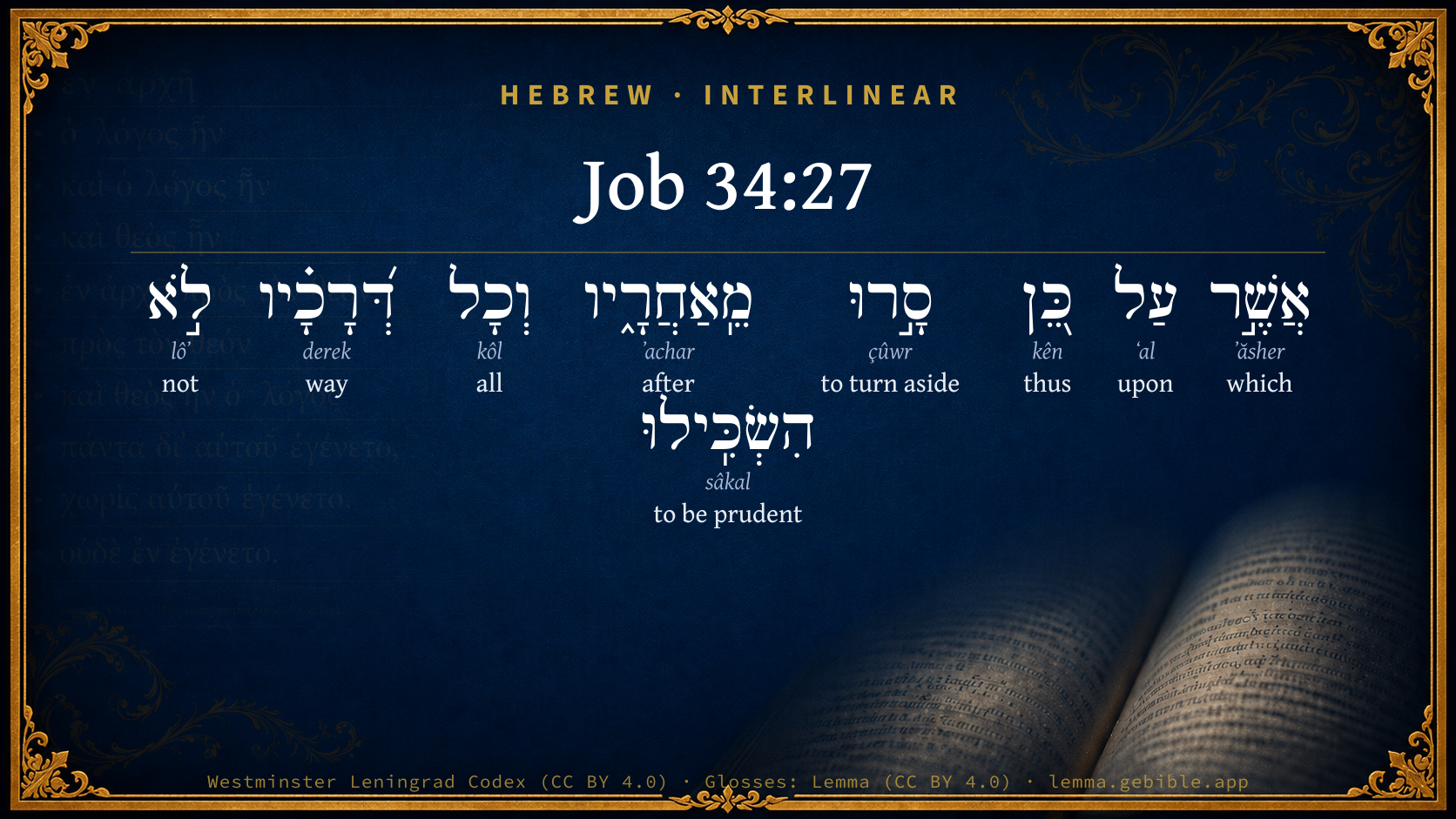
Hebrew (Westminster Leningrad Codex) Job 34:27 appears in the Hebrew Old Testament. The text above is from the Westminster Leningrad Codex. Each word links to its Strong’s number, a concise gloss, and parsing drawn from the Open Scriptures Hebrew Bible morphology. Click any word for its full Brown-Driver-Briggs (BDB) entry.
Download image
Cite this verse

Job 34:27 (World English Bible). Public Domain. Lemma interlinear Bible study tool, https://lemma.gebible.app/v/job/34/27.

Show BibTeX & RIS
BibTeX
RIS
English Translation
Because they turned aside from following him, And wouldn't have regard in any of his ways:
World English Bible · Public Domain
Download a study sheet

One document with this verse’s original text, its word-by-word gloss line, the meaning frame, cross-references with their text, attributed commentary, and full source and license credits — printable, and it pastes into notes with its structure intact.

This verse Autodidact and up

Study sheet (.html) Plain text (.txt)

A passage Seminary Student

Up to 50 verses in one chapter. A passage sheet keeps up to 6 commentary sources and 12 cross-references per verse, in the order this page ranks them, and says so on the sheet whenever that leaves anything out. Ask for a single verse and you get the Autodidact verse sheet above.

Everything on this page stays free to read, with no account — the sheet is a download of what is already on screen, not access to it.

Want to remove ads? Support Godless Engineer
Compare translations 3

The same verse in 3 English versions, stacked beneath the original-language interlinear above. Click any original word for its lexicon entry.

Each is an independent rendering of the whole verse — the interlinear is not word-aligned to these translations.

Highlighted words mark where these versions differ — a whole-verse word diff, not a word-by-word alignment.

  • World English Bible Public Domain
    Because they turned aside from following him, And wouldn't have regard in any of his ways:
  • King James Version Public Domain
    Because they turned back from him, and would not consider any of his ways:
  • unfoldingWord Literal Text CC BY-SA 4.0
    that because they turned from after him and they did not consider any of his ways,

unfoldingWord Literal Text — © unfoldingWord, licensed CC BY-SA 4.0. Word-aligned USFM3 via Door43 (git.door43.org/unfoldingWord/en_ult).

Versions to compare (up to 4)

3 of 4 selected

Show all 18 translations

Every available English version of this verse, each an independent rendering of the whole verse.

  • World English Bible Public Domain
    Because they turned aside from following him, And wouldn't have regard in any of his ways:
  • Berean Standard Bible Public Domain
    because they turned aside from Him and had no regard for any of His ways.
  • Majority Standard Bible Public Domain
    because they turned aside from Him and had no regard for any of His ways.
  • King James Version Public Domain
    Because they turned back from him, and would not consider any of his ways:
  • American Standard Version (1901) Public Domain
    Because they turned aside from following him, And would not have regard in any of his ways:
  • Revised Version (1885) Public Domain
    Because they turned aside from following him, and would not have regard to any of his ways:
  • Geneva Bible (1599) Public Domain
    Because they haue turned backe from him, and would not consider all his wayes:
  • Douay-Rheims (1899) Public Domain
    Who as it were on purpose have revolted from him, and would not understand all his ways:
  • Young's Literal Translation Public Domain
    Because that against right They have turned aside from after Him, And none of His ways have considered wisely,
  • Literal Standard Version CC BY-SA 4.0
    Because that against right || They have turned aside from after Him, || And have considered none of His ways,
  • Unlocked Literal Bible CC BY-SA 4.0
    because they turned away from following him and refused to acknowledge any of his ways.
  • unfoldingWord Literal Text CC BY-SA 4.0
    that because they turned from after him and they did not consider any of his ways,
  • Darby Bible Public Domain
    Because they have turned back from him, and would consider none of his ways;
  • World Messianic Bible Public Domain
    because they turned away from following him, and wouldn’t pay attention to any of his ways,
  • Webster's Bible Public Domain
    Because they turned back from him, and would not consider any of his ways:
  • Free Bible Version CC BY-SA 4.0
    because they turned away from following him, disregarding all his ways.
  • Bible in Basic English Public Domain
    Because they did not go after him, and took no note of his ways,
  • JPS Tanakh (1917) Public Domain
    Because they turned aside from following Him, and would not have regard to any of His ways;

Literal Standard Version (2020), Covenant Press — licensed CC BY-SA 4.0. Text via the HelloAO Bible API (eBible.org). Unlocked Literal Bible (unfoldingWord) — licensed CC BY-SA 4.0. Text via the HelloAO Bible API (eBible.org). unfoldingWord Literal Text — © unfoldingWord, licensed CC BY-SA 4.0. Word-aligned USFM3 via Door43 (git.door43.org/unfoldingWord/en_ult). Free Bible Version, Dr. Jonathan Gallagher — licensed CC BY-SA 4.0. Text via the HelloAO Bible API (eBible.org).

Word by word

More ways to search: Search by grammar → Find every occurrence → Compare this word →

Practice this passage: Drill this verse → Learn its vocabulary →

הִשְׂכִּֽילוּ
sâkal
H7919
“to be prudent”
Verb, Hiphil, Perfect, 3rd Person, Common, Plural
Part of Speech
Verb
Stem
Hiphil
Form
Perfect
Person
3rd Person
Gender
Common
Number
Plural
Full BDB Definition

Origin: a primitive root

TWOT: 2263 , 2264

to be prudent, be circumspect, wisely understand, prosper - (Qal) to be prudent, be circumspect - (Hiphil) - to look at or upon, have insight - to give attention to, consider, ponder, be prudent - to have insight, have comprehension - insight, comprehension (substantive) - to cause to consider, give insight, teach - the teachers, the wise - to act circumspectly, act prudently, act wisely - to prosper, have success - to cause to prosper - (Piel) to lay crosswise, cross (hands)
  1. אֲשֶׁ֣ר ʼăsher H834 “which” Particle, Relative
  2. עַל ʻal H5921 “upon” Preposition
  3. כֵּ֭ן kên H3651 “thus” Particle, Demonstrative
  4. סָ֣רוּ çûwr H5493 “to turn aside” Verb, Qal, Perfect, 3rd Person, Common, Plural
  5. מֵֽאַחֲרָ֑יו ʼachar H310 “from · after · him” Preposition + Preposition + Suffix, Personal, 3rd Person, Masculine, Singular
  6. וְכָל kôl H3605 “and · all of” Conjunction + Noun, Common, Masculine, Singular, Construct
  7. דְּ֝רָכָ֗יו derek H1870 “ways · his” Noun, Common, Both, Plural, Construct + Suffix, Personal, 3rd Person, Masculine, Singular
  8. לֹ֣א lôʼ H3808 “not” Particle, Negative

About this verse

These counts appear in no published source. They are computed here, from the morphology-tagged text and Lemma’s own curated glosses. What Lemma adds →

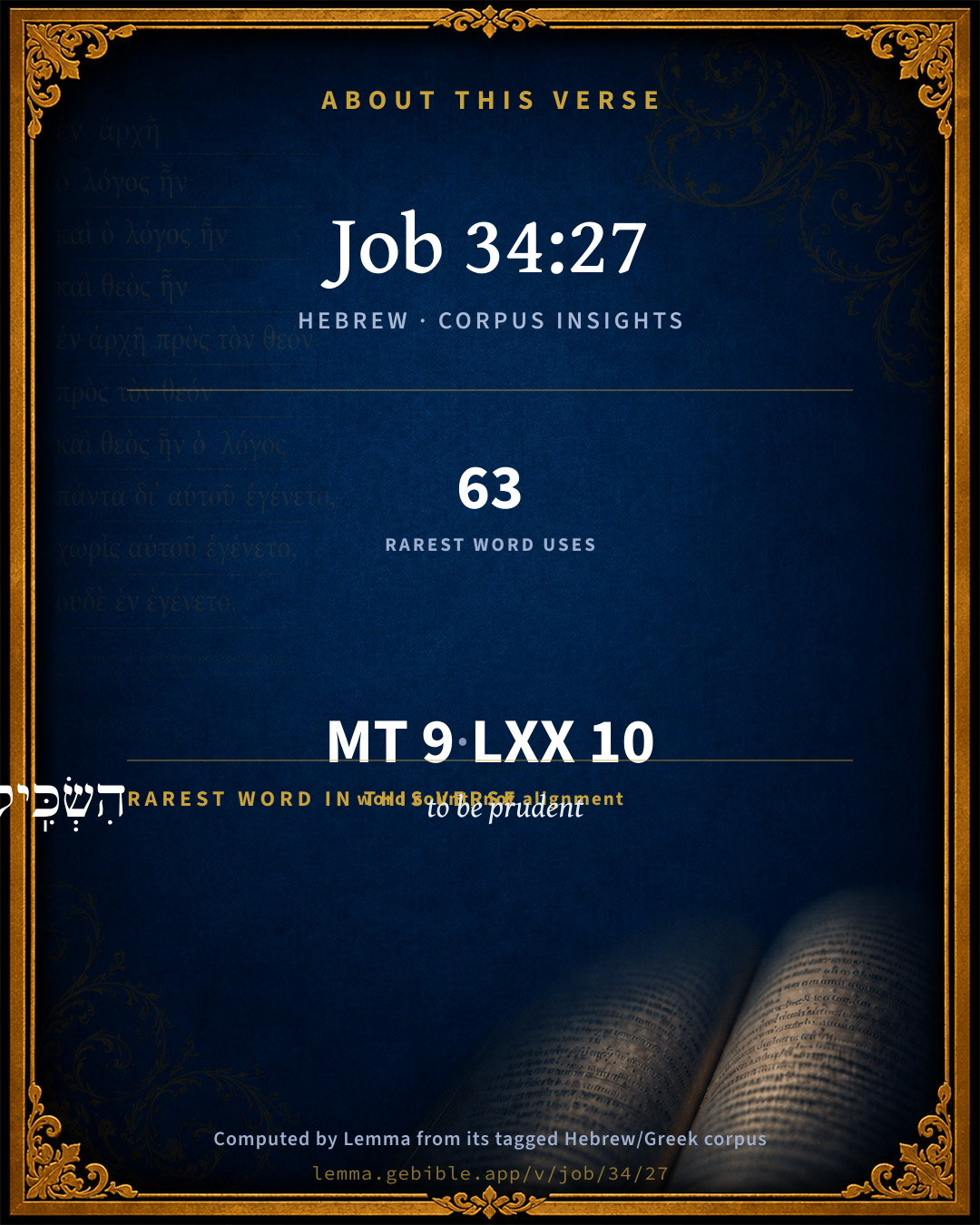
9
words
9
distinct lemmas
Wisdom
section

Grammatical profile

  • 2 verbs
  • 2 nouns
  • 2 prepositions
  • 3 particles

Verb forms

  • סָ֣רוּ Qal · Perfect
  • הִשְׂכִּֽילוּ Hiphil · Perfect

Hebrew & Septuagint length

In English translation the verse runs 16 words from the Hebrew and 15 from the Septuagint (LXX English) — closely comparable.

A rough comparison of the two English renderings, which tokenize alike — not a word-level alignment.

Word counts can differ between the Hebrew and the Greek without any difference in meaning — e.g. the Hebrew direct-object marker אֵת has no separate Greek word, and Greek often adds the article ὁ.

In the original languages it is 9 Hebrew tokens and 10 Greek tokens — but the two are counted differently (Hebrew bundles its prefixes and suffixes into one token; the Greek is in lemma form), so that isn’t a like-for-like length.

Cross-references

13

Topical passages linked to Job 34:27 in the Treasury of Scripture Knowledge — connected by theme and wording, ordered by reader-vote popularity; previews shown in the World English Bible.

  • 1 Samuel 15:11 It repents me that I have set up Saul to be king; for he is turned back from following me, and has not performed my commandments. Samuel was angry; and he cried to Yahweh all night.
  • Psalms 28:5 Because they don't regard the works of Yahweh, Nor the operation of his hands, He will break them down and not build them up.
  • Isaiah 5:12 The harp, lyre, tambourine, and flute, with wine, are at their feasts; But they don't regard the work of Yahweh, Neither have they considered the operation of his hands.
  • Hebrews 10:39 But we are not of those who shrink back to destruction, but of those who have faith to the saving of the soul.
  • Psalms 107:43 Whoever is wise will pay attention to these things. They will consider the loving kindnesses of Yahweh.
  • Psalms 125:5 But as for those who turn aside to their crooked ways, Yahweh will lead them away with the workers of iniquity. Peace be on Israel.
  • Proverbs 1:29–30 Because they hated knowledge, And didn't choose the fear of Yahweh.
  • Isaiah 1:3 The ox knows his owner, And the donkey his master's crib; But Israel doesn't know, My people don't consider.
  • Zephaniah 1:6 those who have turned back from following Yahweh, and those who haven't sought Yahweh nor inquired after him.
  • Haggai 2:15–19 Now, please consider from this day and backward, before a stone was laid on a stone in the temple of Yahweh.
  • Luke 17:31–32 In that day, he who will be on the housetop, and his goods in the house, let him not go down to take them away. Let him who is in the field likewise not turn back.
  • Acts 15:38 But Paul didn't think that it was a good idea to take with them someone who had withdrawn from them in Pamphylia, and didn't go with them to do the work.
  • 2 Timothy 4:10 for Demas left me, having loved this present world, and went to Thessalonica; Crescens to Galatia, and Titus to Dalmatia.

Cross-references courtesy of OpenBible.info (CC BY 4.0).

Hebrew and Greek witnesses Masoretic Hebrew ↔ Greek Septuagint

The same verse in the two great witnesses to the Old Testament, shown verse-for-verse.

These are two independent witnesses, not word-aligned to each other, and the Septuagint is shown in lemma (dictionary) form.

Hebrew Job 34:27 Masoretic · Westminster Leningrad Codex

אֲשֶׁ֣ר עַל כֵּ֭ן סָ֣רוּ מֵֽאַחֲרָ֑יו וְכָל דְּ֝רָכָ֗יו לֹ֣א הִשְׂכִּֽילוּ

Because they turned aside from following him, And wouldn't have regard in any of his ways:

World English Bible · Public Domain

Greek LXX Job 34:27 Septuagint · lemma form

ὅτι ἐκκλίνω ἐκ νόμος θεός δικαίωμα δέ αὐτός οὐ ἐπιγιγνώσκω

Because they turned aside from the law of God, and did not regard his ordinances,

LXX2012 (modern English Septuagint) · Public Domain

On this verse, John Gill's Exposition discusses the Septuagint’s reading. Read the note in Commentary ↓

Hebrew: Westminster Leningrad Codex (CC BY 4.0). Greek: Septuagint (public domain); English from LXX2012 (modern English Septuagint) (Public Domain). How the Septuagint differs from the Hebrew →

Commentary

Notes on Job 34:27 from classic Christian and Jewish commentators (each source and its license shown beneath its notes). The classic Christian expositions comment on the surrounding passage and are grouped to its opening verse, so a note may address several verses; the Jewish commentaries on the Tanakh (Rashi and others) are per-verse, so they appear only where the commentator wrote on this verse.

Lemma curates 59 commentaries, every one of them public domain or Creative Commons licensed, each selected and text-cleaned for this edition rather than reprinted as found. About our sources →

Trapp's Complete Commentary

John Trapp

Job 34:27 Because they turned back from him, and would not consider any of his ways:

Ver. 27. Because they have turned back from him] To pursue after lying vanities, broken cisterns; which whosoever do, as they fall into two foul sins at once (such as heaven and earth have cause to be astonished at and afraid of), Jer 2:12-13, so they are miserable by their own election, Jon 2:8.

And would not consider any of his ways] Wisely consider them, as David did, Psa 119:168. All God’s laws were in his sight; and all his ways in God’s sight. This was the general cause of their destruction. The special followeth.

John Trapp, A Commentary or Exposition upon All the Books of the Old and New Testament (1647–1656) — public domain. Text from a community e-Sword module.

Joseph Benson's Commentary

Job 34:27-28. Because they turned back from him — From God, whom they or their progenitors had owned; and from his laws, which God had written on their minds, Rom 2:14; and from the practice of true religion, to sin and folly. And would not consider any of his ways — So as to walk in them. Hebrew, לא השׂכילו, lo hischilu, they would not understand, or consider them wisely, so as to make a proper and wise use of their knowledge of them. They cause the cry of the poor to come to him — To God, as the following words imply, it being God’s work to hear the cry, and plead the cause, of the afflicted or oppressed. Their case is bad who have the prayers and tears of the poor against them; for these will draw down vengeance, sooner or later, on the heads of their oppressors.

Joseph Benson's Commentary on the Old and New Testaments (1811–1818) — public domain. Text from a community e-Sword module.

Jamieson, Fausset & Brown

Robert Jamieson, A. R. Fausset & David Brown

The grounds of their punishment in Job 34:26. Job 34:28 states in what respect they "considered not God's ways," namely, by oppression, whereby "they caused the cry," &c.

Jamieson, Fausset & Brown — Commentary Critical and Explanatory on the Whole Bible (1871) — public domain (CC PDM 1.0). Text via the HelloAO Bible API.

Adam Clarke's Commentary

Verse 27. Because they turned back] This is the reason why he has dealt with them in judgment. They had departed from him in their hearts, their moral conduct, and their civil government. He is speaking of corrupt and tyrannical rulers. And they did not, would not, understand any of his ways.

Adam Clarke's Commentary on the Bible (1810–1826) — public domain. Text from a community e-Sword/MySword module.

Ellicott's Commentary for English Readers

(27) Because they turned back from him.—Elihu, therefore, as well as Job’s other friends, believed in the direct execution of God’s judgments.

A Bible Commentary for English Readers, edited by Charles John Ellicott (1878–1897) — public domain. Text from a community e-Sword module.

John Gill's Exposition

When he giveth quietness, who then can make trouble?.... Quietness or peace is of God; external peace to bodies of men, to communities, civil and religious, and to particular persons; quietness and contentment in outward enjoyments, peace and safety at home, and from enemies abroad; inward spiritual peace, this is of God, is in Christ, and from him; is the fruit of his righteousness, spoke by his blood, comes through faith in Christ, and is enjoyed in his ordinances, and continues as long as it is the pleasure of God to give it, and cannot be disturbed by men or devils; a national peace, when God gives it, cannot be broke in upon; nor the peace of churches, though there are always some inclined to be troublers of the Israel of God; nor the peace of particular persons, not their outward peace and quietness, when God sets an hedge of providence about them; nor their inward peace, not by all the afflictions and persecutions they meet with in the world; nor by all the temptations of Satan, and the corruptions of their own hearts. The Targum is, "who shall condemn?" and so the Septuagint, Vulgate Latin, Syriac, and Arabic versions; when God acquits, absolves, and justifies men, who can condemn them? see Rom 8:33. When God pronounces the sentence of justification by the righteousness of Christ in the conscience of a sinner, it produces peace solid and substantial, and this being done, who shall condemn? or of what avail will their condemnation be? whether of the law, or of Satan, or of the world, or of themselves, of their own hearts;

and when he hideth his face, who then can behold him? whether it be done against a nation, or against a man only; whether God hides his face from a nation, as he sometimes did from the nation of Israel, because of their sins; when he would not hear their prayers, nor assist them against their enemies, nor arise for their help and deliverance out of their hands: or from his church and people, his spiritual Jacob and Israel, as when they complain, their way is hid from the Lord, and the Lord has forgotten and forsaken them; or from particular persons, as from David, Heman, and others; and who, of the Lord's people, but at one time or another are under the hidings of his face? and then there is no finding him, no looking to him with comfort and confidence; no looking into and beholding the works and ways of God, and the causes of his dealings with them; these are out of sight, his ways are in the deep, and his footsteps are not known. Some refer this to men; who will show favour to him whom God frowns upon? who will look at him in a pleasant manner, when God hides his face from him?

John Gill's Exposition of the Whole Bible (1746–1763) — public domain (CC PDM 1.0). Text via the HelloAO Bible API.

Albert Barnes' Notes on the Bible

Because they turned back from him - Margin, “from after him.” That is, they receded, or went away from God.

And would not consider any of his ways - They would not regard or attend to any of his commands. The word way, in the Scriptures, is often used to denote “religion.” A “way” denotes the course of life which one leads; the path in which he walks. The “ways of God” denote his course or plan, his precepts or laws; and to depart from them, or to disregard them, is only another mode of saying that a man has no religion.

Albert Barnes' Notes on the Bible (1834–1885) — public domain. Text from a community e-Sword/MySword module.

Haydock's Catholic Bible Commentary

All. Protestants, "Any of." The wicked observed none of God’s commandments as they ought. He that offends in one become guilty of all, James ii. 10.

George Leo Haydock (1774–1849), Haydock's Catholic Family Bible and Commentary, 1859 edition — public domain. Excludes Psalms (Douay-Rheims chapter numbering differs from Protestant) and Deuterocanonical books (Catholic canon only).

Matthew Poole's English Annotations

From him; from the God, whom they or their progenitors had owned; and his laws, which God hath written in the minds of all men, Rom 2:14,15; and, it may be, from the practice of the true religion, which sometimes they professed;

Would not consider, or understand. They did not desire nor endeavour to know them, at least practically, or to any good purpose.

His ways; either,

1. God’s providential ways. They did not lay to heart any of God’s judgments inflicted upon such oppressors as themselves, which should have given them warning, but boldly persisted in the same wicked courses. Or,

2. His precepts; oft called his ways, because he hath appointed them for us to walk in. For these ways they were in a special manner obliged to consider and practise; and the next verse giveth us an instance of their backsliding from these ways.

Matthew Poole's English Annotations on the Holy Bible (1683–1685) — public domain. Text from a community e-Sword/MySword module.

Whedon's Commentary on the Bible

Daniel D. Whedon

27. Compare Psa_28:5. From him — The margin is more exact, and teaches us that God expects close following.

Daniel D. Whedon (gen. ed.), Commentary on the Old and New Testaments (1874–1909) — public domain. Text from a community e-Sword module.

The Pulpit Commentary

Because they turned back from him (On the sin of "turning back," see 2Ki_17:15, 16 Pro_26:11 2Pe_2:22) And would not consider any of his ways. (comp. Psa_28:5 Isa_5:12) The folly and wickedness of such conduct is reproved by Solomon in the strongest terms, "Because I have called, and ye refused: I have stretched out my hand, and no man regarded; but ye have set at nought all my counsel, and would none of my reproof: I also will laugh at your calamity; I will mock when your fear cometh; when your fear cometh as desolation, and your destruction cometh as a whirlwind; when distress and anguish cometh upon you. Thou shall they call upon me, but I will not answer; they shall seek me early, but they shall not find me: for that they hated knowledge, and did not choose the fear of the Lord: they would none of my counsel: they despised all my reproof. Therefore shall they eat the fruit of their own way, and be filled with their Own devices. For the turning away of the simple shall slay them, and the prosperity of fools shall destroy them". (Pro_1:24-32)

The Pulpit Commentary (1880–1919), ed. H.D.M. Spence-Jones & Joseph S. Exell — public domain. Text from a community e-Sword module.

Rashi

Rabbi Shlomo Yitzchaki (Rashi)

Because they turned away from following Him Heb. אשר על-כן as in (Num. 10:31), “because (על- כן) you knew our camping in the desert.” [This is] like: because (מפני אשר) they turned away from following Him, and they brought before Him and upon Him the cry of the poor.

Rashi on the Tanakh — English translations: “The Judaica Press complete Tanach with Rashi, translated by A. J. Rosenberg” (CC BY 4.0); “Pentateuch with Rashi's commentary by M. Rosenbaum and A.M. Silbermann, 1929-1934” (public domain); “The Metsudah Tanach series, Lakewood, N.J” (CC BY 4.0); and “The Book of Joshua, Metsudah Publications, 1997” (CC BY 4.0). Text via Sefaria.

Lesson kit

Teaching starters — assembled from the data on this page, not authored interpretation. Every prompt links to the verse data it draws on. Edit before teaching.

Job, in the Wisdom, opens this verse with 9 words (9 distinct Hebrew lemmas). Its most distinctive word is sâkal (“to be prudent”). A historical commentator’s framing appears above. Read the whole chapter for the surrounding context.

Discussion questions

  1. How does “to be prudent” (sâkal) shape what this verse is saying?
  2. How does 1 Samuel 15:11, which shares this passage’s theme, read alongside this verse?
  3. These translations render this verse differently; the difference is in the English rendering, not the original. What questions does that raise?
  4. «סָ֣רוּ» is a Qal Perfect verb. How does that grammatical form shape the action described?
  5. Compare how Trapp's Complete Commentary and Joseph Benson's Commentary read this verse. Where do they agree or differ?

Things to notice

Reading settings

Reading text

Shown beneath each verse's original-language words.

Old Testament
Old Testament edition

Read the OT as the Masoretic Hebrew (MT) or the Greek Septuagint (LXX).

English shown for the Greek Septuagint (in the Hebrew ↔ Greek comparison).

Comparing translations? Open the Compare panel on any verse page to stack up to four side by side.