2 Kings 24:3

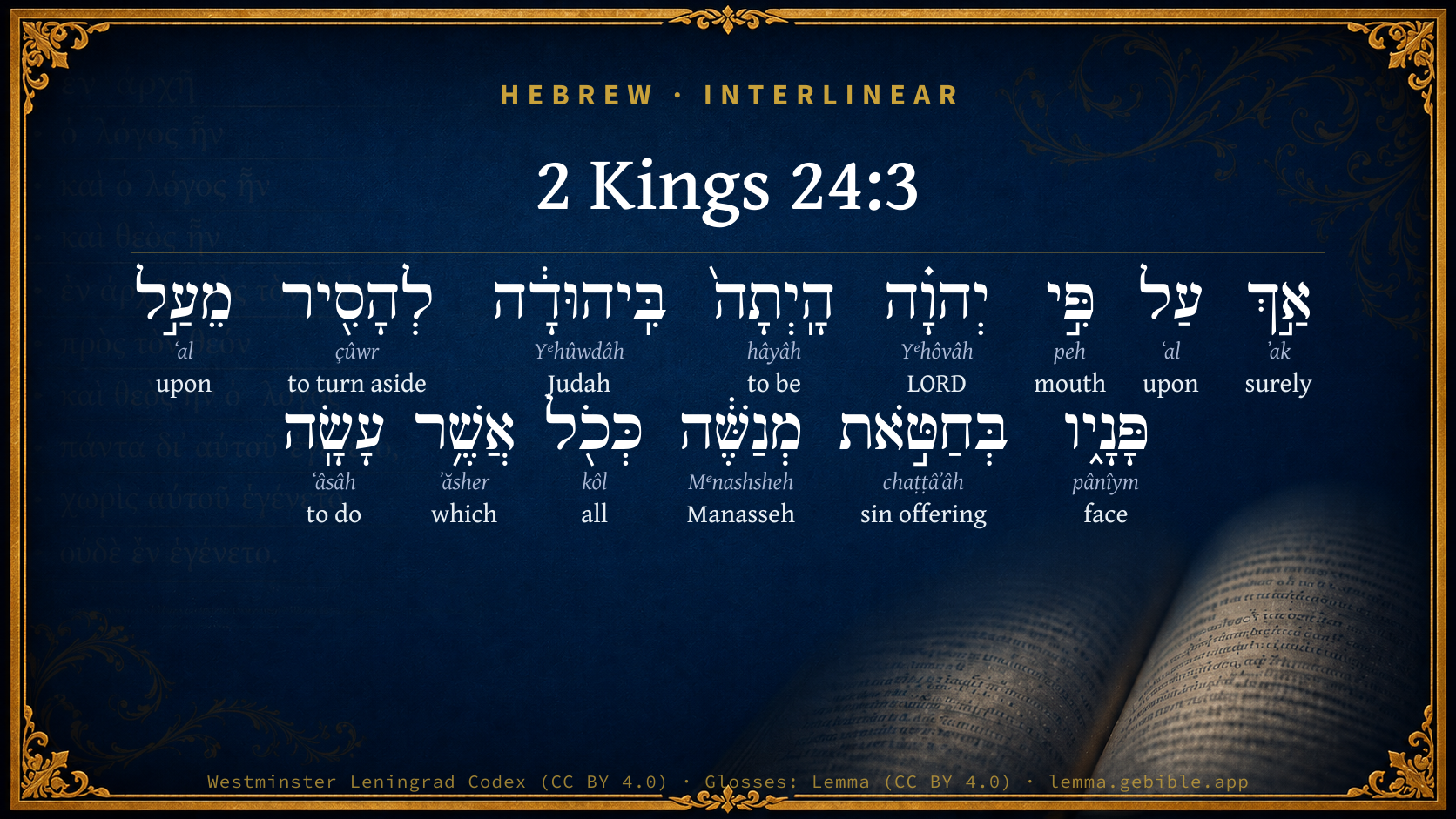
Hebrew (Westminster Leningrad Codex) 2 Kings 24:3 appears in the Hebrew Old Testament. The text above is from the Westminster Leningrad Codex. Each word links to its Strong’s number, a concise gloss, and parsing drawn from the Open Scriptures Hebrew Bible morphology. Click any word for its full Brown-Driver-Briggs (BDB) entry.
Download image
Cite this verse

2 Kings 24:3 (World English Bible). Public Domain. Lemma interlinear Bible study tool, https://lemma.gebible.app/v/2-kings/24/3.

Show BibTeX & RIS
BibTeX
RIS
English Translation
Surely at the commandment of Yahweh came this on Judah, to remove them out of his sight, for the sins of Manasseh, according to all that he did,
World English Bible · Public Domain
Download a study sheet

One document with this verse’s original text, its word-by-word gloss line, the meaning frame, cross-references with their text, attributed commentary, and full source and license credits — printable, and it pastes into notes with its structure intact.

This verse Autodidact and up

Study sheet (.html) Plain text (.txt)

A passage Seminary Student

Up to 50 verses in one chapter. A passage sheet keeps up to 6 commentary sources and 12 cross-references per verse, in the order this page ranks them, and says so on the sheet whenever that leaves anything out. Ask for a single verse and you get the Autodidact verse sheet above.

Everything on this page stays free to read, with no account — the sheet is a download of what is already on screen, not access to it.

Want to remove ads? Support Godless Engineer
Compare translations 3

The same verse in 3 English versions, stacked beneath the original-language interlinear above. Click any original word for its lexicon entry.

Each is an independent rendering of the whole verse — the interlinear is not word-aligned to these translations.

Highlighted words mark where these versions differ — a whole-verse word diff, not a word-by-word alignment.

  • World English Bible Public Domain
    Surely at the commandment of Yahweh came this on Judah, to remove them out of his sight, for the sins of Manasseh, according to all that he did,
  • King James Version Public Domain
    Surely at the commandment of the LORD came this upon Judah, to remove them out of his sight, for the sins of Manasseh, according to all that he did;
  • unfoldingWord Literal Text CC BY-SA 4.0
    Surely at the mouth of Yahweh it was against Judah, to remove away from his face for the sins of Manasseh, according to all that he did,

unfoldingWord Literal Text — © unfoldingWord, licensed CC BY-SA 4.0. Word-aligned USFM3 via Door43 (git.door43.org/unfoldingWord/en_ult).

Versions to compare (up to 4)

3 of 4 selected

Show all 18 translations

Every available English version of this verse, each an independent rendering of the whole verse.

  • World English Bible Public Domain
    Surely at the commandment of Yahweh came this on Judah, to remove them out of his sight, for the sins of Manasseh, according to all that he did,
  • Berean Standard Bible Public Domain
    Surely this happened to Judah at the LORD’s command, to remove them from His presence because of the sins of Manasseh and all that he had done,
  • Majority Standard Bible Public Domain
    Surely this happened to Judah at the LORD’s command, to remove them from His presence because of the sins of Manasseh and all that he had done,
  • King James Version Public Domain
    Surely at the commandment of the LORD came this upon Judah, to remove them out of his sight, for the sins of Manasseh, according to all that he did;
  • American Standard Version (1901) Public Domain
    Surely at the commandment of Jehovah came this upon Judah, to remove them out of his sight, for the sins of Manasseh, according to all that he did,
  • Revised Version (1885) Public Domain
    Surely at the commandment of the LORD came this upon Judah, to remove them out of his sight, for the sins of Manasseh, according to all that he did;
  • Geneva Bible (1599) Public Domain
    Surely by the commandement of the Lord came this vpon Iudah, that he might put them out of his sight for the sinnes of Manasseh, according to all that he did,
  • Douay-Rheims (1899) Public Domain
    And this came by the word of the Lord against Juda, to remove them from before him for all the sins of Manasses which he did.
  • Young's Literal Translation Public Domain
    only, by the command of Jehovah it hath been against Judah to turn `them' aside from His presence, for the sins of Manasseh, according to all that he did,
  • Literal Standard Version CC BY-SA 4.0
    only, by the command of YHWH it has been against Judah to turn [them] aside from His presence, for the sins of Manasseh, according to all that he did,
  • Unlocked Literal Bible CC BY-SA 4.0
    It was certainly at the mouth of Yahweh that this came on Judah, to remove them out of his sight, because of the sins of Manasseh, all that he did,
  • unfoldingWord Literal Text CC BY-SA 4.0
    Surely at the mouth of Yahweh it was against Judah, to remove away from his face for the sins of Manasseh, according to all that he did,
  • Darby Bible Public Domain
    Verily, at the commandment of Jehovah it came to pass against Judah, that they should be removed out of his sight, for the sins of Manasseh, according to all that he had done;
  • World Messianic Bible Public Domain
    Surely at the commandment of the LORD this came on Judah, to remove them out of his sight for the sins of Manasseh, according to all that he did,
  • Webster's Bible Public Domain
    Surely at the commandment of the LORD came this upon Judah, to remove them out of his sight, for the sins of Manasseh, according to all that he did;
  • Free Bible Version CC BY-SA 4.0
    The Lord spoke against Judah to banish them from his presence because of all the sins that Manasseh had committed, and the innocent people he had killed,
  • Bible in Basic English Public Domain
    Only by the word of the Lord did this fate come on Judah, to take them away from before his face; because of the sins of Manasseh and all the evil he did;
  • JPS Tanakh (1917) Public Domain
    Surely at the commandment of the LORD came this upon Judah, to remove them out of His sight, for the sins of Manasseh, according to all that he did;

Literal Standard Version (2020), Covenant Press — licensed CC BY-SA 4.0. Text via the HelloAO Bible API (eBible.org). Unlocked Literal Bible (unfoldingWord) — licensed CC BY-SA 4.0. Text via the HelloAO Bible API (eBible.org). unfoldingWord Literal Text — © unfoldingWord, licensed CC BY-SA 4.0. Word-aligned USFM3 via Door43 (git.door43.org/unfoldingWord/en_ult). Free Bible Version, Dr. Jonathan Gallagher — licensed CC BY-SA 4.0. Text via the HelloAO Bible API (eBible.org).

Word by word

More ways to search: Search by grammar → Find every occurrence → Compare this word →

Practice this passage: Drill this verse → Learn its vocabulary →

מְנַשֶּׁ֔ה
Mᵉnashsheh
H4519
“Manasseh”
Noun, Proper
Part of Speech
Noun
Type
Proper
Full BDB Definition

Origin: from H5382

TWOT: 1217

Manasseh = "causing to forget" - the eldest son of Joseph and progenitor of the tribe of Manasseh - the tribe descended from Manasseh - the territory occupied by the tribe of Manasseh - son of king Hezekiah of Judah and himself king of Judah; he was the immediate and direct cause for the exile - a descendant of Pahath-moab who put away a foreign wife in the time of Ezra - a descendant of Hashum who put away a foreign wife in the time of Ezra
  1. אַ֣ךְ ʼak H389 “surely” Particle, Accusative
  2. עַל ʻal H5921 “upon” Preposition
  3. פִּ֣י peh H6310 “mouth of” Noun, Common, Masculine, Singular, Construct
  4. יְהוָ֗ה Yᵉhôvâh H3068 “LORD” Noun, Proper
  5. הָֽיְתָה֙ hâyâh H1961 “to be” Verb, Qal, Perfect, 3rd Person, Feminine, Singular
  6. בִּֽיהוּדָ֔ה Yᵉhûwdâh H3063 “in/at · Judah” Preposition + Noun, Proper
  7. לְהָסִ֖יר çûwr H5493 “to turn aside” Preposition + Verb, Hiphil, Infinitive Construct
  8. מֵעַ֣ל ʻal H5921 “from · upon” Preposition + Preposition
  9. פָּנָ֑יו pânîym H6440 “face(s) · his” Noun, Common, Both, Plural, Construct + Suffix, Personal, 3rd Person, Masculine, Singular
  10. בְּחַטֹּ֣את chaṭṭâʼâh H2403 “in/at · sin offerings of” Preposition + Noun, Common, Feminine, Plural, Construct
  11. כְּכֹ֖ל kôl H3605 “like/as · all” Preposition + Noun, Common, Masculine, Singular, Absolute
  12. אֲשֶׁ֥ר ʼăsher H834 “which” Particle, Relative
  13. עָשָֽׂה ʻâsâh H6213 “to do” Verb, Qal, Perfect, 3rd Person, Masculine, Singular

About this verse

These counts appear in no published source. They are computed here, from the morphology-tagged text and Lemma’s own curated glosses. What Lemma adds →

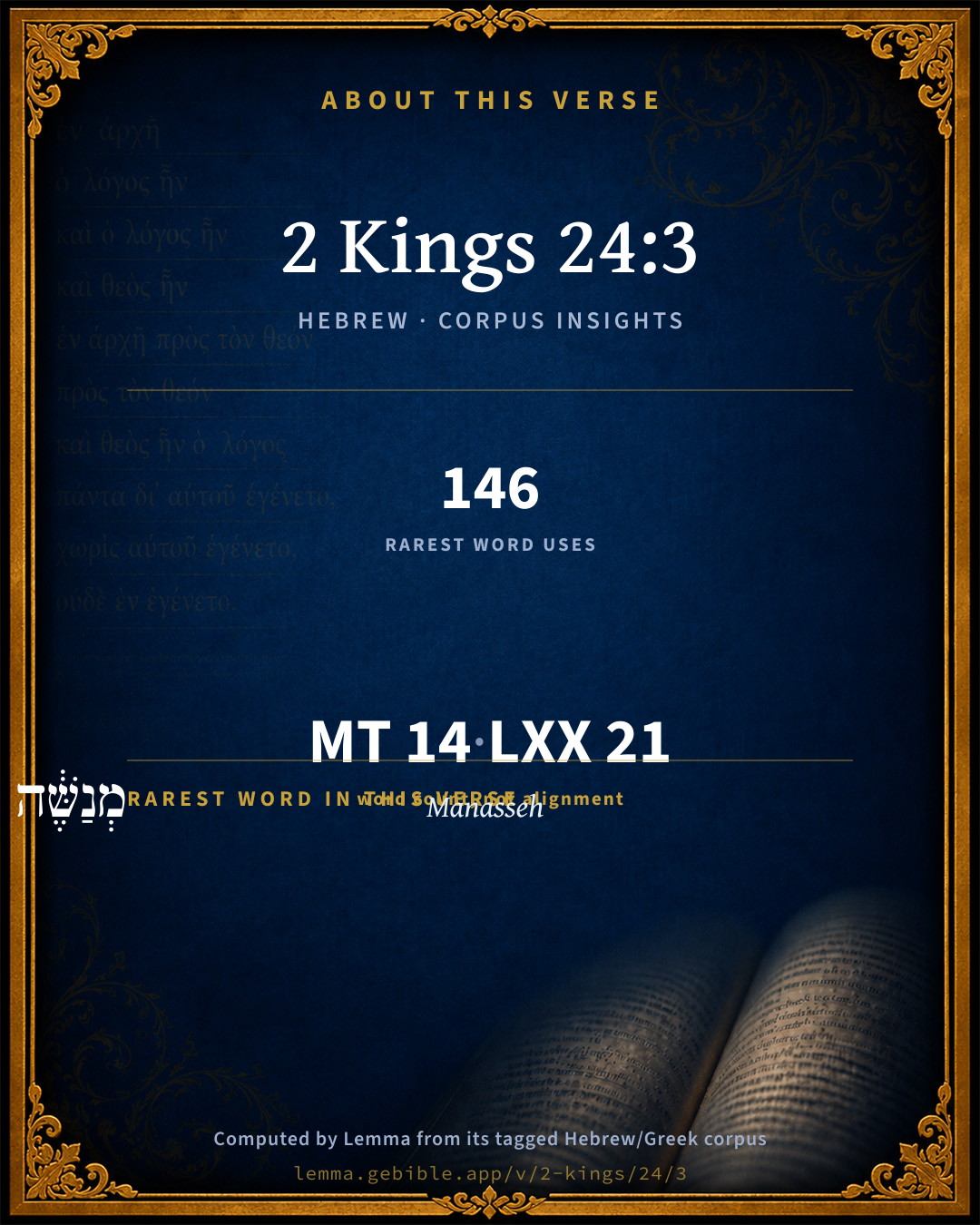
14
words
13
distinct lemmas
Historical
section

Grammatical profile

  • 3 verbs
  • 7 nouns
  • 2 prepositions
  • 2 particles

Verb forms

  • הָֽיְתָה֙ Qal · Perfect
  • לְהָסִ֖יר Hiphil · Infinitive Construct
  • עָשָֽׂה Qal · Perfect

Repetition

A word recurs within this verse — often emphatic in Hebrew:

Hebrew & Septuagint length

In English translation the verse runs 28 words from the Hebrew and 28 from the Septuagint (LXX English) — the same length.

A rough comparison of the two English renderings, which tokenize alike — not a word-level alignment.

Word counts can differ between the Hebrew and the Greek without any difference in meaning — e.g. the Hebrew direct-object marker אֵת has no separate Greek word, and Greek often adds the article ὁ.

In the original languages it is 14 Hebrew tokens and 21 Greek tokens — but the two are counted differently (Hebrew bundles its prefixes and suffixes into one token; the Greek is in lemma form), so that isn’t a like-for-like length.

Cross-references

18

Topical passages linked to 2 Kings 24:3 in the Treasury of Scripture Knowledge — connected by theme and wording, ordered by reader-vote popularity; previews shown in the World English Bible.

  • 2 Kings 18:25 Am I now come up without Yahweh against this place to destroy it? Yahweh said to me, Go up against this land, and destroy it.
  • 2 Kings 23:26–27 Notwithstanding, Yahweh didn't turn from the fierceness of his great wrath, with which his anger was kindled against Judah, because of all the provocation with which Manasseh had provoked him.
  • 2 Kings 21:2–11 He did that which was evil in the sight of Yahweh, after the abominations of the nations whom Yahweh cast out before the children of Israel.
  • Genesis 50:20 As for you, you meant evil against me, but God meant it for good, to bring to pass, as it is this day, to save many people alive.
  • Exodus 20:5 you shall not bow yourself down to them, nor serve them, for I, Yahweh your God, am a jealous God, visiting the iniquity of the fathers on the children, on the third and on the fourth generation of those who hate me,
  • Leviticus 26:33–35 I will scatter you among the nations, and I will draw out the sword after you: and your land will be a desolation, and your cities shall be a waste.
  • Deuteronomy 4:26–27 I call heaven and earth to witness against you this day, that you shall soon utterly perish from off the land whereunto you go over the Jordan to possess it; you shall not prolong your days on it, but shall utterly be destroyed.
  • Deuteronomy 28:63 It shall happen that as Yahweh rejoiced over you to do you good, and to multiply you, so Yahweh will rejoice over you to cause you to perish, and to destroy you; and you shall be plucked from off the land where you go in to possess it.
  • Deuteronomy 29:28 and Yahweh rooted them out of their land in anger, and in wrath, and in great indignation, and cast them into another land, as at this day.
  • Joshua 23:15 It shall happen, that as all the good things are come on you of which Yahweh your God spoke to you, so will Yahweh bring on you all the evil things, until he have destroyed you from off this good land which Yahweh your God has given you.
  • 2 Chronicles 24:24 For the army of the Syrians came with a small company of men; and Yahweh delivered a very great host into their hand, because they had forsaken Yahweh, the God of their fathers. So they executed judgment on Joash.
  • 2 Chronicles 25:16 It happened, as he talked with him, that [the king] said to him, Have we made you of the king's counsel? Stop! Why should you be struck down? Then the prophet stopped, and said, I know that God has determined to destroy you, because you have done this, and have not listened to my counsel.
  • Isaiah 10:5–6 Ho Assyrian, the rod of my anger, the staff in whose hand is my indignation!
  • Isaiah 45:7 I form the light, and create darkness; I make peace, and create evil. I am Yahweh, who does all these things.
  • Isaiah 46:10–11 declaring the end from the beginning, and from ancient times things that are not [yet] done; saying, My counsel shall stand, and I will do all my pleasure;
  • Jeremiah 15:1–4 Then said Yahweh to me, Though Moses and Samuel stood before me, yet my mind would not be toward this people: cast them out of my sight, and let them go forth.
  • Amos 3:6 Does the trumpet alarm sound in a city, Without the people being afraid? Does evil happen to a city, And Yahweh hasn't done it?
  • Micah 2:10 Arise, and depart! For this is not your resting place, Because of uncleanness that destroys, Even with a grievous destruction.

Cross-references courtesy of OpenBible.info (CC BY 4.0).

Hebrew and Greek witnesses Masoretic Hebrew ↔ Greek Septuagint

The same verse in the two great witnesses to the Old Testament, shown verse-for-verse.

These are two independent witnesses, not word-aligned to each other, and the Septuagint is shown in lemma (dictionary) form.

Hebrew 2 Kings 24:3 Masoretic · Westminster Leningrad Codex

אַ֣ךְ עַל פִּ֣י יְהוָ֗ה הָֽיְתָה֙ בִּֽיהוּדָ֔ה לְהָסִ֖יר מֵעַ֣ל פָּנָ֑יו בְּחַטֹּ֣את מְנַשֶּׁ֔ה כְּכֹ֖ל אֲשֶׁ֥ר עָשָֽׂה

Surely at the commandment of Yahweh came this on Judah, to remove them out of his sight, for the sins of Manasseh, according to all that he did,

World English Bible · Public Domain

Greek LXX 2 Kings 24:3 Septuagint · lemma form

πλήν ἐπί ὁ θυμός κύριος εἰμί ἐν ὁ ιουδα ἀποἵστημι αὐτός ἀπό πρόσωπον αὐτός ἐν ἁμαρτία μανασσῆς κατά πᾶς ὅσος ποιέω

Moreover it was the purpose of the Lord concerning Juda, to remove them from his presence, because of the sins of Manasses, according to all that he did.

LXX2012 (modern English Septuagint) · Public Domain

On this verse, Ellicott's Commentary for English Readers discusses the Septuagint’s reading. Read the note in Commentary ↓

Hebrew: Westminster Leningrad Codex (CC BY 4.0). Greek: Septuagint (public domain); English from LXX2012 (modern English Septuagint) (Public Domain). How the Septuagint differs from the Hebrew →

Targum (Aramaic paraphrase)

1

The Targum is the ancient Jewish Aramaic paraphrase of the Hebrew Scriptures — an interpretive translation, not the Hebrew text itself. Onkelos (literal) and Pseudo-Jonathan (expansive) render the Torah, and Jonathan the Prophets. Coverage is partial: where no permissively-licensed English translation exists for a verse, only the Aramaic is shown. This is verse-level text, not a word-by-word alignment to the Hebrew.

  1. Targum Jonathan Prophets (Joshua–Malachi)
    בְּרַם עַל דְאַרְגִיזוּ קֳדָם יְיָ הֲוַת דָא בִּדְבֵית יְהוּדָה לְאַגְלָיוּתְהוֹן מֵאַרְעָא בֵּית שְׁכִינְתֵּיהּ בְּחוֹבֵי מְנַשֶׁה כְּכָל דַעֲבָד:

    (no public-domain English translation for this verse)

    Targum Jonathan — Aramaic: “Mikraot Gedolot” (public domain). English: “Sefaria Community Translation” (CC0 1.0 (public-domain dedication)); “London "Chaldee Paraphrase," 1871” (public domain). Text via Sefaria.

Commentary

Notes on 2 Kings 24:3 from classic Christian and Jewish commentators (each source and its license shown beneath its notes). The classic Christian expositions comment on the surrounding passage and are grouped to its opening verse, so a note may address several verses; the Jewish commentaries on the Tanakh (Rashi and others) are per-verse, so they appear only where the commentator wrote on this verse.

Lemma curates 59 commentaries, every one of them public domain or Creative Commons licensed, each selected and text-cleaned for this edition rather than reprinted as found. About our sources →

Trapp's Complete Commentary

John Trapp

2Ki 24:3 Surely at the commandment of the LORD came [this] upon Judah, to remove [them] out of his sight, for the sins of Manasseh, according to all that he did;

Ver. 3. Surely at the commandment of the Lord.] Heb., At the mouth, i.e., Ex praestituto. God’s holy hand is in all the miseries that befall his people. {Amo 3:6}

For the sins of Manasseh, according to all that he did.] Or, For the like sins to those which Manasseh had done, as Tremellius rendereth it, Traiectio, as in Gen 5:29 Jdg 18:31.

John Trapp, A Commentary or Exposition upon All the Books of the Old and New Testament (1647–1656) — public domain. Text from a community e-Sword module.

Joseph Benson's Commentary

2Ki 24:3-4. To remove them out of his sight for the sins of Manasseh — Properly and directly for their own sins, and remotely for the sins of Manasseh; who had so corrupted the whole body of the people, that they were become incurable, and Josiah’s reformation had no lasting influence to recover them: for, immediately upon his death, they relapsed into their old idolatry, and other vices. Manasseh’s personal sins, although, as he was their chief ruler, they were to be considered as national sins, and merited national punishment, yet would never have been charged on the nation, unless they had made them their own by their impenitency for them, and repetition of them. And for the innocent blood which he shed — Namely, of those prophets and saints, who either reproved, or would not comply with his idolatrous worship. Which the Lord would not pardon — That is, would not remit the temporal punishment of the land, though he did pardon it so as not to inflict eternal punishment upon his own person, for from that God undoubtedly exempted him upon his repentance. God is the righteous governor of the world, and the guardian of civil society, and in it order could not be preserved, if he did not interpose in his providence, and, on proper occasions, cause signal and national judgments to follow public and national crimes.

Joseph Benson's Commentary on the Old and New Testaments (1811–1818) — public domain. Text from a community e-Sword module.

Tyndale Open Study Notes

Tyndale Open Resources

24:3 because of the Lord’s command: The root of Judah’s problems was its incorrigible spiritual infidelity. Despite Josiah’s reforms, the sins of Manasseh permeated Judah so that divine judgment was inevitable.

Tyndale Open Study Notes — © Tyndale Open Resources, licensed CC BY-SA 4.0. Text via the HelloAO Bible API.

Geneva Bible (1599)

Geneva Bible translators

Though God used these wicked tyrants to execute his just judgments, yet they are not to be excused, because they proceeded of ambition and malice.

Geneva Bible (1599) marginal notes — public domain. Text via Bolls.life.

Ellicott's Commentary for English Readers

(3) Surely at the commandment.—Literally, Only (i.e., upon no other ground than) upon the mouth (i.e., at the command of; 2Ki_23:35) of Jehovah did it happen in Judah. The LXX. and Syriac read wrath instead of mouth, which Ewald prefers (so 2Ki_24:20).

Out of his sight.—From before his face, i.e., as the Targum explains, from the land where he was present in his Temple.

For the sins of Manasseh.—Comp. 2Ki_21:11 seq., 2Ki_23:26 seq.; Jer_15:4.

A Bible Commentary for English Readers, edited by Charles John Ellicott (1878–1897) — public domain. Text from a community e-Sword module.

The Cambridge Bible for Schools and Colleges

gen. ed. J. J. S. Perowne

3. for the sins of Manasseh] See above on 2Ki_23:26. The fifty-five years of Manasseh’s rule sealed the nation’s fate.

The Cambridge Bible for Schools and Colleges (gen. ed. J. J. S. Perowne; Cambridge University Press, 1878–1918) — public domain. Text from a community e-Sword module.

John Gill's Exposition

Surely at the commandment of the Lord came this upon Judah, to remove them out of his sight,.... It was the sure and certain decree of God they should be carried captive, and therefore he stirred up the spirit of Nebuchadnezzar, and gave him orders to go against it:

for the sins of Manasseh, according to all that he did; which were still continued among the Jews, and committed by them, though repented of by Manasseh, and he returned from them.

John Gill's Exposition of the Whole Bible (1746–1763) — public domain (CC PDM 1.0). Text via the HelloAO Bible API.

Matthew Poole's English Annotations

For the sins of Manasseh; properly and directly for their own sins, and occasionally for the sins of Manasseh, which had never been charged upon them, if they had not made them their own by their impenitency for them, and repetition of them.

Matthew Poole's English Annotations on the Holy Bible (1683–1685) — public domain. Text from a community e-Sword/MySword module.

Whedon's Commentary on the Bible

Daniel D. Whedon

3. For the sins of Manasseh — The judgment came not merely for the actual sins of that one idolatrous king, but, as the whole course of the history shows, because the nation persisted in a class of sins of which those of Manasseh were most conspicuous representatives.

Daniel D. Whedon (gen. ed.), Commentary on the Old and New Testaments (1874–1909) — public domain. Text from a community e-Sword module.

The Pulpit Commentary

Surely at the commandment of the Lord came this upon Judah; literally, only at the mouth of the Lord did this come upon Judah; i.e. there was no other cause for it but the simple "mouth" or "word" of the Lord. The LXX, who translate plhn qumoou h=n ejpi todan, seem to have had instead of ypi in their copies. To remove them out of his sight. (comp. 2Ki_23:27; and see also the comment (2Ki_17:18) for the sins of Manasseh, according to all that he did. The meaning is not that the nation was punishes for the personal sins and crimes of the wicked Manseseh forty or fifty years previously, but that the class of sins introduced by Manasseh, being persisted in by the people, brought the stern judgments of God upon them. As W. G. Sumner well observes, "The sins of Manasseh had become a designation for a certain class of offences, and a particular form of public and social depravity, which was introduced by Manassseh, but of which generation after generation continued to be guilty." The special sins were

(1) idolatry, accompanied by licentious rites;

(2) child-murder, or sacrifice to Moloch;

(3) sodomy; (2Ki_23:7) and

(4) the use of enchantments and the practice of magical arts. (2Ki_21:6)

The Pulpit Commentary (1880–1919), ed. H.D.M. Spence-Jones & Joseph S. Exell — public domain. Text from a community e-Sword module.

John Wesley's Explanatory Notes

The sins - Properly and directly for their own sins, and occasionally for the sins of Manasseh, which had never been charged upon them, if they had not made them their own by their repetition of them.

John Wesley, Explanatory Notes Upon the Whole Bible (1754–1765) — public domain. Text via the GEBible commentary corpus.

unfoldingWord translationNotes

Door43 World Missions Community

It was certainly at the mouth of Yahweh

Some versions have, "It was certainly because of the wrath of Yahweh," which is just as good a reading of the original text. If translators have access to versions in major languages in their region, they should probably follow their choice.

at the mouth of Yahweh

Here "mouth" represents Yahweh's command. AT: "as Yahweh had commanded" (See: Metonymy)

remove them out of his sight

"get rid of them" or "destroy them"

innocent blood that he shed

Blood is a metonym for innocent life, and shedding blood is a metonym for killing innocent people. AT: "innocent people whom he killed" (See: Metonymy)

he filled Jerusalem with innocent blood

Blood is a metonym for innocent life, and shedding blood is a metonym for killing innocent people. AT: "he killed many innocent people in Jerusalem" (See: Metonymy)

translationWords

sin

Manasseh

innocent

blood

Jerusalem

forgive

unfoldingWord translationNotes — © Distant Shores Media and the Door43 World Missions Community, licensed CC BY-SA 4.0. Source: git.door43.org/Door43/en_tn.

Rashi

Rabbi Shlomo Yitzchaki (Rashi)

Indeed, it was by the order of Adonoy. All the calamity that befell Yehudah through these bands.

Rashi on the Tanakh — English translations: “The Judaica Press complete Tanach with Rashi, translated by A. J. Rosenberg” (CC BY 4.0); “Pentateuch with Rashi's commentary by M. Rosenbaum and A.M. Silbermann, 1929-1934” (public domain); “The Metsudah Tanach series, Lakewood, N.J” (CC BY 4.0); and “The Book of Joshua, Metsudah Publications, 1997” (CC BY 4.0). Text via Sefaria.

Lesson kit

Teaching starters — assembled from the data on this page, not authored interpretation. Every prompt links to the verse data it draws on. Edit before teaching.

2 Kings, in the Historical, opens this verse with 14 words (13 distinct Hebrew lemmas). Its most distinctive word is Mᵉnashsheh (“Manasseh”). A historical commentator’s framing appears above. Read the whole chapter for the surrounding context.

Discussion questions

  1. The word Mᵉnashsheh carries the sense “Manasseh.” How does it shape the verse?
  2. How does 2 Kings 18:25, which shares this passage’s theme, read alongside this verse?
  3. What does the repetition of “upon” (2× in this one verse) do in this verse?
  4. These translations render this verse differently. What is at stake in choosing one wording over another?
  5. «הָֽיְתָה֙» is a Qal Perfect verb. How does that grammatical form shape the action described?
  6. Compare how Trapp's Complete Commentary and Joseph Benson's Commentary read this verse. Where do they agree or differ?

Things to notice

Reading settings

Reading text

Shown beneath each verse's original-language words.

Old Testament
Old Testament edition

Read the OT as the Masoretic Hebrew (MT) or the Greek Septuagint (LXX).

English shown for the Greek Septuagint (in the Hebrew ↔ Greek comparison).

Comparing translations? Open the Compare panel on any verse page to stack up to four side by side.