Judges 20:8

Hebrew (Westminster Leningrad Codex) Judges 20:8 appears in the Hebrew Old Testament. The text above is from the Westminster Leningrad Codex. Each word links to its Strong’s number, a concise gloss, and parsing drawn from the Open Scriptures Hebrew Bible morphology. Click any word for its full Brown-Driver-Briggs (BDB) entry.
Download image
Cite this verse

Judges 20:8 (World English Bible). Public Domain. Lemma interlinear Bible study tool, https://lemma.gebible.app/v/judges/20/8.

Show BibTeX & RIS
BibTeX
RIS
English Translation
All the people arose as one man, saying, We will not any of us go to his tent, neither will we any of us turn to his house.
World English Bible · Public Domain
Download a study sheet

One document with this verse’s original text, its word-by-word gloss line, the meaning frame, cross-references with their text, attributed commentary, and full source and license credits — printable, and it pastes into notes with its structure intact.

This verse Autodidact and up

Study sheet (.html) Plain text (.txt)

A passage Seminary Student

Up to 50 verses in one chapter. A passage sheet keeps up to 6 commentary sources and 12 cross-references per verse, in the order this page ranks them, and says so on the sheet whenever that leaves anything out. Ask for a single verse and you get the Autodidact verse sheet above.

Everything on this page stays free to read, with no account — the sheet is a download of what is already on screen, not access to it.

Want to remove ads? Support Godless Engineer
Compare translations 3

The same verse in 3 English versions, stacked beneath the original-language interlinear above. Click any original word for its lexicon entry.

Each is an independent rendering of the whole verse — the interlinear is not word-aligned to these translations.

Highlighted words mark where these versions differ — a whole-verse word diff, not a word-by-word alignment.

  • World English Bible Public Domain
    All the people arose as one man, saying, We will not any of us go to his tent, neither will we any of us turn to his house.
  • King James Version Public Domain
    And all the people arose as one man, saying, We will not any of us go to his tent, neither will we any of us turn into his house.
  • unfoldingWord Literal Text CC BY-SA 4.0
    And all of the people arose as one man, saying, “We will not go back, a man to his tent, and we will not return, a man to his house!

unfoldingWord Literal Text — © unfoldingWord, licensed CC BY-SA 4.0. Word-aligned USFM3 via Door43 (git.door43.org/unfoldingWord/en_ult).

Versions to compare (up to 4)

3 of 4 selected

Show all 18 translations

Every available English version of this verse, each an independent rendering of the whole verse.

  • World English Bible Public Domain
    All the people arose as one man, saying, We will not any of us go to his tent, neither will we any of us turn to his house.
  • Berean Standard Bible Public Domain
    Then all the people stood as one man and said, “Not one of us will return to his tent or to his house.
  • Majority Standard Bible Public Domain
    Then all the people stood as one man and said, “Not one of us will return to his tent or to his house.
  • King James Version Public Domain
    And all the people arose as one man, saying, We will not any of us go to his tent, neither will we any of us turn into his house.
  • American Standard Version (1901) Public Domain
    And all the people arose as one man, saying, We will not any of us go to his tent, neither will we any of us turn unto his house.
  • Revised Version (1885) Public Domain
    And all the people arose as one man, saying, We will not any of us go to his tent, neither will we any of us turn unto his house.
  • Geneva Bible (1599) Public Domain
    Then all the people arose as one man, saying, There shall not a man of vs goe to his tent, neither any turne into his house.
  • Douay-Rheims (1899) Public Domain
    And all the people standing, answered as by the voice of one man: We will not return to our tents, neither shall any one of us go into his own house:
  • Young's Literal Translation Public Domain
    And all the people rise as one man, saying, `None of us doth go to his tent, and none of us doth turn aside to his house;
  • Literal Standard Version CC BY-SA 4.0
    And all the people rise as one man, saying, “None of us goes to his tent, and none of us turns aside to his house;
  • Unlocked Literal Bible CC BY-SA 4.0
    All the people arose together as one man, and they said, “None of us will go to his tent, and none of us will return to his house!
  • unfoldingWord Literal Text CC BY-SA 4.0
    And all of the people arose as one man, saying, “We will not go back, a man to his tent, and we will not return, a man to his house!
  • Darby Bible Public Domain
    And all the people arose as one man, saying, "We will not any of us go to his tent, and none of us will return to his house.
  • World Messianic Bible Public Domain
    All the people arose as one man, saying, “None of us will go to his tent, neither will any of us turn to his house.
  • Webster's Bible Public Domain
    And all the people arose as one man, saying, We will not any of us go to his tent, neither will we any of us turn into his house:
  • Free Bible Version CC BY-SA 4.0
    Everyone stood up and unitedly declared, “None of us are going home to our tents! None of us are going home to our houses!
  • Bible in Basic English Public Domain
    Then all the people got up as one man and said, Not one of us will go to his tent or go back to his house:
  • JPS Tanakh (1917) Public Domain
    And all the people arose as one man, saying: 'We will not any of us go to his tent, neither will we any of us turn unto his house.

Literal Standard Version (2020), Covenant Press — licensed CC BY-SA 4.0. Text via the HelloAO Bible API (eBible.org). Unlocked Literal Bible (unfoldingWord) — licensed CC BY-SA 4.0. Text via the HelloAO Bible API (eBible.org). unfoldingWord Literal Text — © unfoldingWord, licensed CC BY-SA 4.0. Word-aligned USFM3 via Door43 (git.door43.org/unfoldingWord/en_ult). Free Bible Version, Dr. Jonathan Gallagher — licensed CC BY-SA 4.0. Text via the HelloAO Bible API (eBible.org).

Word by word

More ways to search: Search by grammar → Find every occurrence → Compare this word →

Practice this passage: Drill this verse → Learn its vocabulary →

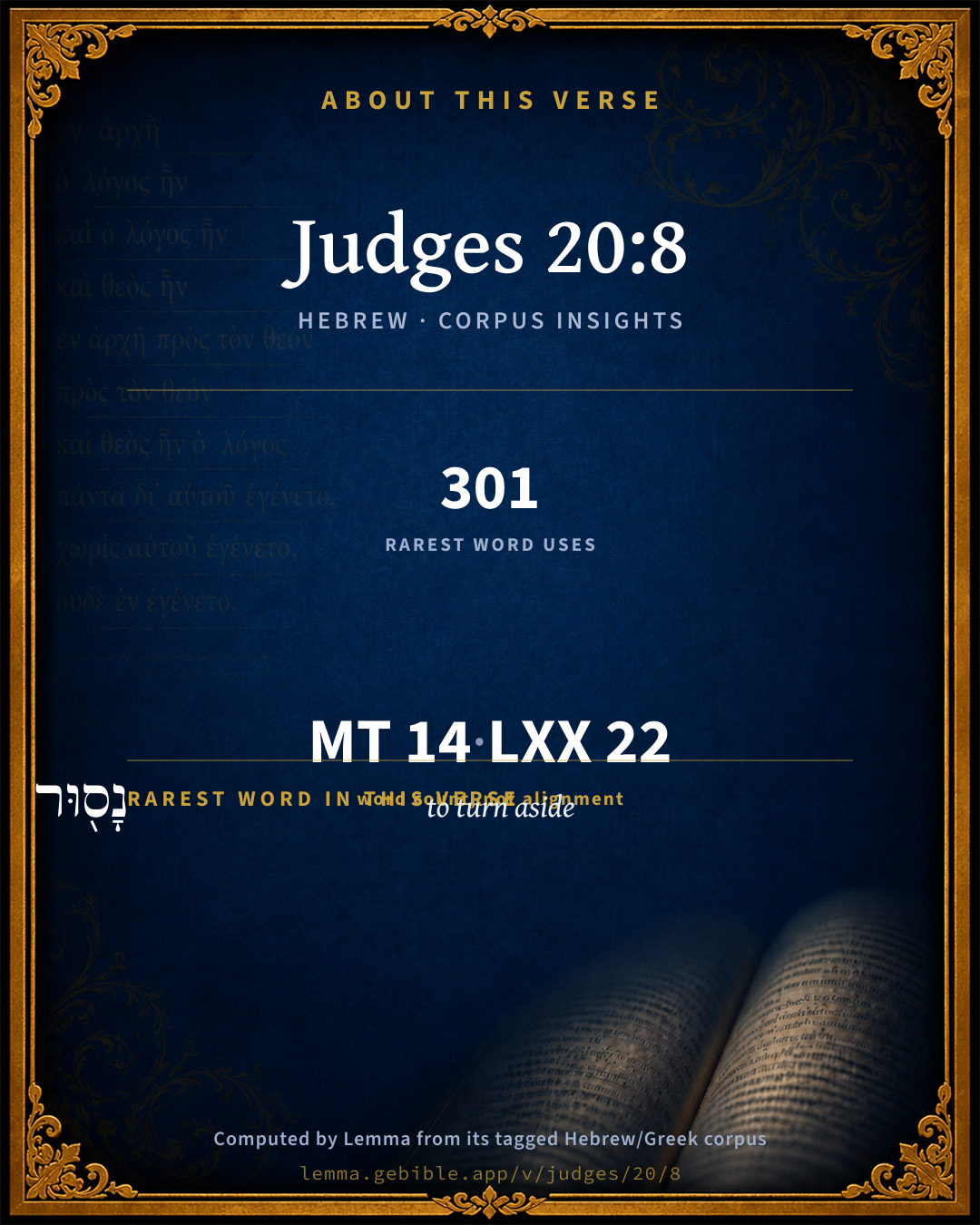
נָס֖וּר
çûwr
H5493
“to turn aside”
Verb, Qal, Imperfect, 1st Person, Common, Plural
Part of Speech
Verb
Stem
Qal
Form
Imperfect
Person
1st Person
Gender
Common
Number
Plural
Full BDB Definition

Origin: a primitive root

TWOT: 1480

to turn aside, depart - (Qal) - to turn aside, turn in unto - to depart, depart from way, avoid - to be removed - to come to an end - (Polel) to turn aside - (Hiphil) - to cause to turn aside, cause to depart, remove, take away, put away, depose - to put aside, leave undone, retract, reject, abolish - (Hophal) to be taken away, be removed
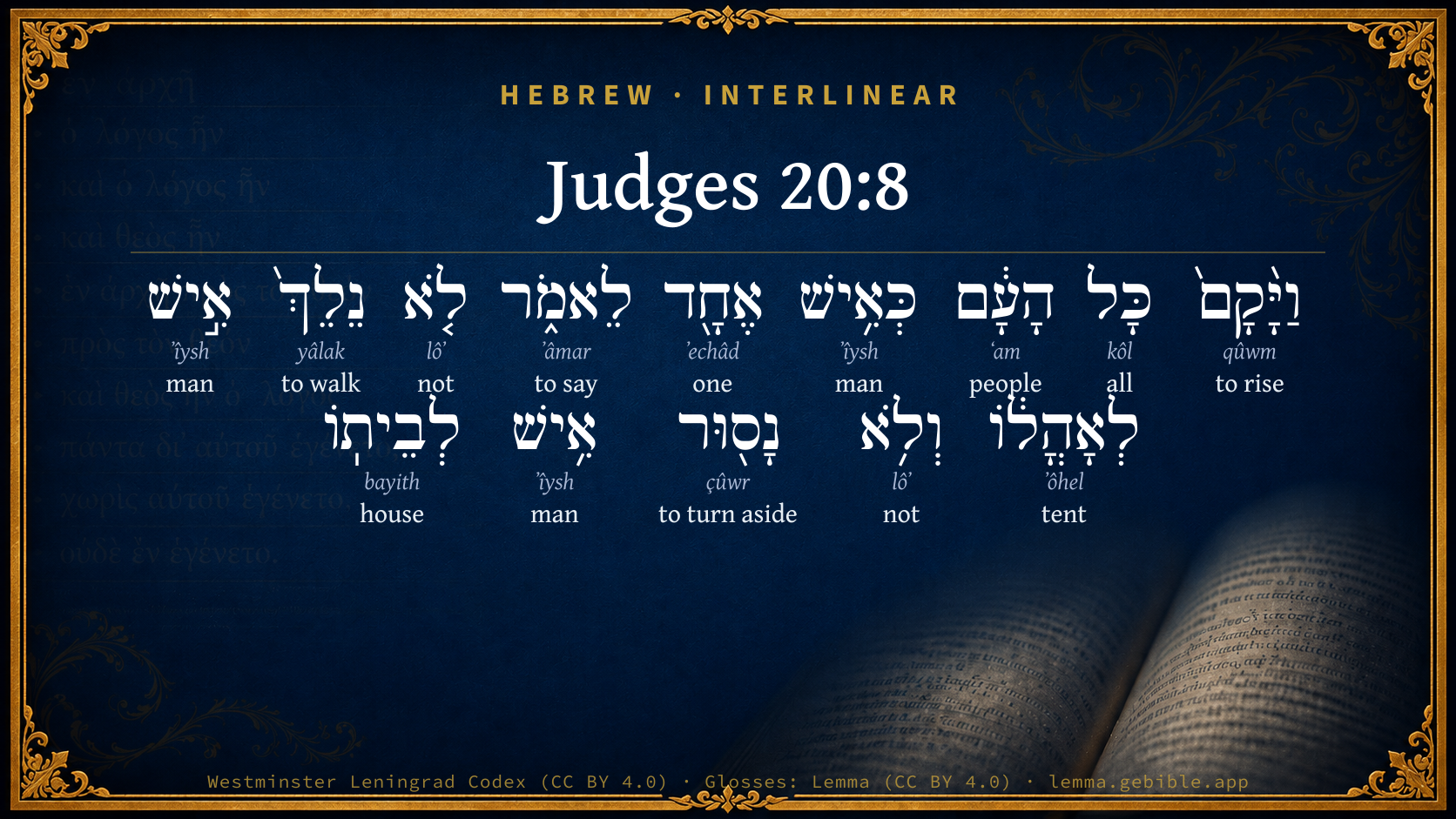
  1. וַיָּ֨קָם֙ qûwm H6965 “and · to rise” Conjunction + Verb, Qal, Sequential Imperfect, 3rd Person, Masculine, Singular
  2. כָּל kôl H3605 “all of” Noun, Common, Masculine, Singular, Construct
  3. הָעָ֔ם ʻam H5971 “the · people” Particle, Definite Article + Noun, Common, Masculine, Singular, Absolute
  4. כְּאִ֥ישׁ ʼîysh H376 “like/as · man” Preposition + Noun, Common, Masculine, Singular, Absolute
  5. אֶחָ֖ד ʼechâd H259 “one” Adjective, Cardinal number, Masculine, Singular, Absolute
  6. לֵאמֹ֑ר ʼâmar H559 “to say” Preposition + Verb, Qal, Infinitive Construct
  7. לֹ֤א lôʼ H3808 “not” Particle, Negative
  8. נֵלֵךְ֙ yâlak H3212 “to walk” Verb, Qal, Imperfect, 1st Person, Common, Plural
  9. אִ֣ישׁ ʼîysh H376 “man” Noun, Common, Masculine, Singular, Absolute
  10. לְאָהֳל֔וֹ ʼôhel H168 “to/for · tent · his” Preposition + Noun, Common, Masculine, Singular, Construct + Suffix, Personal, 3rd Person, Masculine, Singular
  11. וְלֹ֥א lôʼ H3808 “and · not” Conjunction + Particle, Negative
  12. אִ֥ישׁ ʼîysh H376 “man” Noun, Common, Masculine, Singular, Absolute
  13. לְבֵיתֽוֹ bayith H1004 “to/for · house · his” Preposition + Noun, Common, Masculine, Singular, Construct + Suffix, Personal, 3rd Person, Masculine, Singular

About this verse

These counts appear in no published source. They are computed here, from the morphology-tagged text and Lemma’s own curated glosses. What Lemma adds →

14
words
11
distinct lemmas
Historical
section

Grammatical profile

  • 4 verbs
  • 7 nouns
  • 1 adjective
  • 2 particles

Verb forms

  • וַיָּ֨קָם֙ Qal · Sequential Imperfect
  • לֵאמֹ֑ר Qal · Infinitive Construct
  • נֵלֵךְ֙ Qal · Imperfect
  • נָס֖וּר Qal · Imperfect

Repetition

Words recur within this verse — often emphatic in Hebrew:

  • כְּאִ֥ישׁ man H376 ×3
  • לֹ֤א not H3808 ×2

Hebrew & Septuagint length

In English translation the verse runs 28 words from the Hebrew and 29 from the Septuagint (LXX English) — closely comparable.

A rough comparison of the two English renderings, which tokenize alike — not a word-level alignment.

Word counts can differ between the Hebrew and the Greek without any difference in meaning — e.g. the Hebrew direct-object marker אֵת has no separate Greek word, and Greek often adds the article ὁ.

In the original languages it is 14 Hebrew tokens and 22 Greek tokens — but the two are counted differently (Hebrew bundles its prefixes and suffixes into one token; the Greek is in lemma form), so that isn’t a like-for-like length.

Cross-references

6

Topical passages linked to Judges 20:8 in the Treasury of Scripture Knowledge — connected by theme and wording, ordered by reader-vote popularity; previews shown in the World English Bible.

  • Ecclesiastes 9:10 Whatever your hand finds to do, do it with your might; for there is no work, nor device, nor knowledge, nor wisdom, in Sheol, where you are going.
  • Judges 20:1 Then all the children of Israel went out, and the congregation was assembled as one man, from Dan even to Beersheba, with the land of Gilead, to Yahweh at Mizpah.
  • Proverbs 21:3 To do righteousness and justice Is more acceptable to Yahweh than sacrifice.
  • Judges 20:11 So all the men of Israel were gathered against the city, knit together as one man.
  • Judges 21:1 Now the men of Israel had sworn in Mizpah, saying, There shall not any of us give his daughter to Benjamin as wife.
  • Judges 21:5 The children of Israel said, Who is there among all the tribes of Israel who didn't come up in the assembly to Yahweh? For they had made a great oath concerning him who didn't come up to Yahweh to Mizpah, saying, He shall surely be put to death.

Cross-references courtesy of OpenBible.info (CC BY 4.0).

Hebrew and Greek witnesses Masoretic Hebrew ↔ Greek Septuagint

The same verse in the two great witnesses to the Old Testament, shown verse-for-verse.

These are two independent witnesses, not word-aligned to each other, and the Septuagint is shown in lemma (dictionary) form.

Hebrew Judges 20:8 Masoretic · Westminster Leningrad Codex

וַיָּ֨קָם֙ כָּל הָעָ֔ם כְּאִ֥ישׁ אֶחָ֖ד לֵאמֹ֑ר לֹ֤א נֵלֵךְ֙ אִ֣ישׁ לְאָהֳל֔וֹ וְלֹ֥א נָס֖וּר אִ֥ישׁ לְבֵיתֽוֹ

All the people arose as one man, saying, We will not any of us go to his tent, neither will we any of us turn to his house.

World English Bible · Public Domain

Greek LXX Judges 20:8 Septuagint · lemma form

καί ἀναἵστημι πᾶς ὁ λαός ὡς ἀνήρ εἷς λέγω οὐ ἀποἔρχομαι ἀνήρ εἰς σκήνωμα αὐτός καί οὐ ἐπιστρέφω ἀνήρ εἰς οἶκος αὐτός

And all the people rose up as one man, saying, No one of us shall return to his tent, and no one of us shall return to his house.

LXX2012 (modern English Septuagint) · Public Domain

Hebrew: Westminster Leningrad Codex (CC BY 4.0). Greek: Septuagint (public domain); English from LXX2012 (modern English Septuagint) (Public Domain). How the Septuagint differs from the Hebrew →

Targum (Aramaic paraphrase)

1

The Targum is the ancient Jewish Aramaic paraphrase of the Hebrew Scriptures — an interpretive translation, not the Hebrew text itself. Onkelos (literal) and Pseudo-Jonathan (expansive) render the Torah, and Jonathan the Prophets. Coverage is partial: where no permissively-licensed English translation exists for a verse, only the Aramaic is shown. This is verse-level text, not a word-by-word alignment to the Hebrew.

  1. Targum Jonathan Prophets (Joshua–Malachi)
    וְקָם כָּל עַמָא כְּגַבְרָא חָד לְמֵימָר לָא נֵיזִיל גְבַר לְמַשְׁכְּנֵיהּ וְלָא נְזוּר גְבַר לְבֵיתֵיהּ:

    (no public-domain English translation for this verse)

    Targum Jonathan — Aramaic: “Mikraot Gedolot” (public domain). English: “Sefaria Community Translation” (CC0 1.0 (public-domain dedication)); “London "Chaldee Paraphrase," 1871” (public domain). Text via Sefaria.

Commentary

Notes on Judges 20:8 from classic Christian and Jewish commentators (each source and its license shown beneath its notes). The classic Christian expositions comment on the surrounding passage and are grouped to its opening verse, so a note may address several verses; the Jewish commentaries on the Tanakh (Rashi and others) are per-verse, so they appear only where the commentator wrote on this verse.

Lemma curates 59 commentaries, every one of them public domain or Creative Commons licensed, each selected and text-cleaned for this edition rather than reprinted as found. About our sources →

Jamieson, Fausset & Brown

Robert Jamieson, A. R. Fausset & David Brown

THEIR DECREE. (Jdg 20:8-17)

all the people arose as one man--The extraordinary unanimity that prevailed shows, that notwithstanding great disorders had broken out in many parts, the people were sound at the core; and remembering their national covenant with God, they now felt the necessity of wiping out so foul a stain on their character as a people. It was resolved that the inhabitants of Gibeah should be subjected to condign punishment. But the resolutions were conditional. For as the common law of nature and nations requires that an inquiry should be made and satisfaction demanded, before committing an act of hostility or vengeance, messengers were despatched through the whole territory of Benjamin, demanding the immediate surrender or execution of the delinquents. The request was just and reasonable; and by refusing it the Benjamites virtually made themselves a party in the quarrel. It must not be supposed that the people of this tribe were insensible or indifferent to the atrocious character of the crime that had been committed on their soil. But their patriotism or their pride was offended by the hostile demonstration of the other tribes. The passions were inflamed on both sides; but certainly the Benjamites incurred an awful responsibility by the attitude of resistance they assumed.

Jamieson, Fausset & Brown — Commentary Critical and Explanatory on the Whole Bible (1871) — public domain (CC PDM 1.0). Text via the HelloAO Bible API.

Trapp's Complete Commentary

John Trapp

Jdg 20:8 And all the people arose as one man, saying, We will not any [of us] go to his tent, neither will we any [of us] turn into his house.

Ver. 8. And all the people arose as one man, saying.] For the punishment of foul offences serio et sedulo ineumbendnm est, men must do their utmost; and not as Popish councils, which make a show only of reformation. Luther truly and trimly compared them to a company of foxes, which sweeping a foul room with their tails, raise a great dust, but remove none.

John Trapp, A Commentary or Exposition upon All the Books of the Old and New Testament (1647–1656) — public domain. Text from a community e-Sword module.

Geneva Bible (1599)

Geneva Bible translators

Before we have revenged this wickedness.

Geneva Bible (1599) marginal notes — public domain. Text via Bolls.life.

Adam Clarke's Commentary

Verse 8. We will not any of us go to his tent] We will have satisfaction for this wickedness before we return home.

Adam Clarke's Commentary on the Bible (1810–1826) — public domain. Text from a community e-Sword/MySword module.

Ellicott's Commentary for English Readers

(8) Arose as one man.—The same words are rendered “with one consent” in 1Sa_11:7.

To his tent . . . . into his house.—Possibly many of the Trans-jordanic Israelites, who were chiefly graziers, were obliged by the necessities of nomadic life to live in tents, not in villages or cities.

A Bible Commentary for English Readers, edited by Charles John Ellicott (1878–1897) — public domain. Text from a community e-Sword module.

The Cambridge Bible for Schools and Colleges

gen. ed. J. J. S. Perowne

8. tent] As the parallelism shews, equivalent to house, cf. Jdg_19:9 mg., 1Ki_8:66, Psa_132:3 tent of my house; a survival from the time when the Israelites actually lived in tents. The resolution is expressed in poetical parallelism, cf. 1Ki_12:16, 2Sa_20:1; we are to supply in thought ‘until the crime be avenged.’ The same resolution, differently expressed, follows in Jdg_20:9 ff.

The Cambridge Bible for Schools and Colleges (gen. ed. J. J. S. Perowne; Cambridge University Press, 1878–1918) — public domain. Text from a community e-Sword module.

John Gill's Exposition

And all the people arose as one man,.... Either the heads of the people assembled in council, all agreed unanimously in one vote or resolution, or all the 400,000 men were of the same mind, when the case was reported to them:

saying, we will not any of us go to his tent, neither will we any of us turn into his house; that is, they would not return home, to take one nights rest in their houses, or attend to the business of their callings or to any affair of life, however urgent, till satisfaction was made for the evil committed.

John Gill's Exposition of the Whole Bible (1746–1763) — public domain (CC PDM 1.0). Text via the HelloAO Bible API.

Albert Barnes' Notes on the Bible

They bound themselves not to break up and disperse until they had punished the wickedness of Gibeah.

Albert Barnes' Notes on the Bible (1834–1885) — public domain. Text from a community e-Sword/MySword module.

Matthew Poole's English Annotations

We will not any of us go to his tent, i.e. his habitation, to wit, until we have revenged this injury.

Matthew Poole's English Annotations on the Holy Bible (1683–1685) — public domain. Text from a community e-Sword/MySword module.

The Pulpit Commentary

The people with the emphatic meaning of the whole people of Israel, the assembly of the people of God, as in ver. 2. As one man.

There was but one resolve, and one sentiment, and one expression of opinion, in that vast multitude. Not one would go home till due punishment had been inflicted upon Gibeah of Benjamin. To his tent, i.e. home, as in Jud_1:19:9.

The Pulpit Commentary (1880–1919), ed. H.D.M. Spence-Jones & Joseph S. Exell — public domain. Text from a community e-Sword module.

John Wesley's Explanatory Notes

His tent - That is, his habitation, until we have revenged this injury.

John Wesley, Explanatory Notes Upon the Whole Bible (1754–1765) — public domain. Text via the GEBible commentary corpus.

unfoldingWord translationNotes

Door43 World Missions Community

as one

This simile speaks of the group as acting as a single person. They all acted together in exactly the same way. AT: "as if they were a single man" (See: Simile)

None of us will go to his tent ... none of us will return to his house

These two clauses say basically the same thing twice for emphasis. They can be combined. The words "none ... go" and "none ... return" emphasizes how the people will continue to stay there. They can be stated in positive form. AT: "We will all stay here" (See: Parallelism and Litotes)

But now

These words introduce the main portion of what the people say after the initial exclamation.

as the lot directs

This involved tossing or rolling small marked stones to determine what God wants.

translationWords

tent

Gibeah

lots

unfoldingWord translationNotes — © Distant Shores Media and the Door43 World Missions Community, licensed CC BY-SA 4.0. Source: git.door43.org/Door43/en_tn.

Lesson kit

Teaching starters — assembled from the data on this page, not authored interpretation. Every prompt links to the verse data it draws on. Edit before teaching.

Judges, in the Historical, opens this verse with 14 words (11 distinct Hebrew lemmas). Its most distinctive word is çûwr (“to turn aside”). A historical commentator’s framing appears above. Read the whole chapter for the surrounding context.

Discussion questions

  1. The word çûwr carries the sense “to turn aside.” How does it shape the verse?
  2. Ecclesiastes 9:10 shares this passage’s theme. How do the two illuminate each other?
  3. “man” occurs 3× in this one verse. What is the effect of the repetition?
  4. The translations on this page render this verse differently — a whole-verse word diff, not a word-by-word alignment. What might account for the different wordings?
  5. The verb «וַיָּ֨קָם֙» is Qal Sequential Imperfect. How does its form color the action?
  6. Reading how Jamieson, Fausset & Brown and Trapp's Complete Commentary read this verse, where do the two commentators agree and where do they part?

Things to notice

Reading settings

Reading text

Shown beneath each verse's original-language words.

Old Testament
Old Testament edition

Read the OT as the Masoretic Hebrew (MT) or the Greek Septuagint (LXX).

English shown for the Greek Septuagint (in the Hebrew ↔ Greek comparison).

Comparing translations? Open the Compare panel on any verse page to stack up to four side by side.