2 Kings 3:2

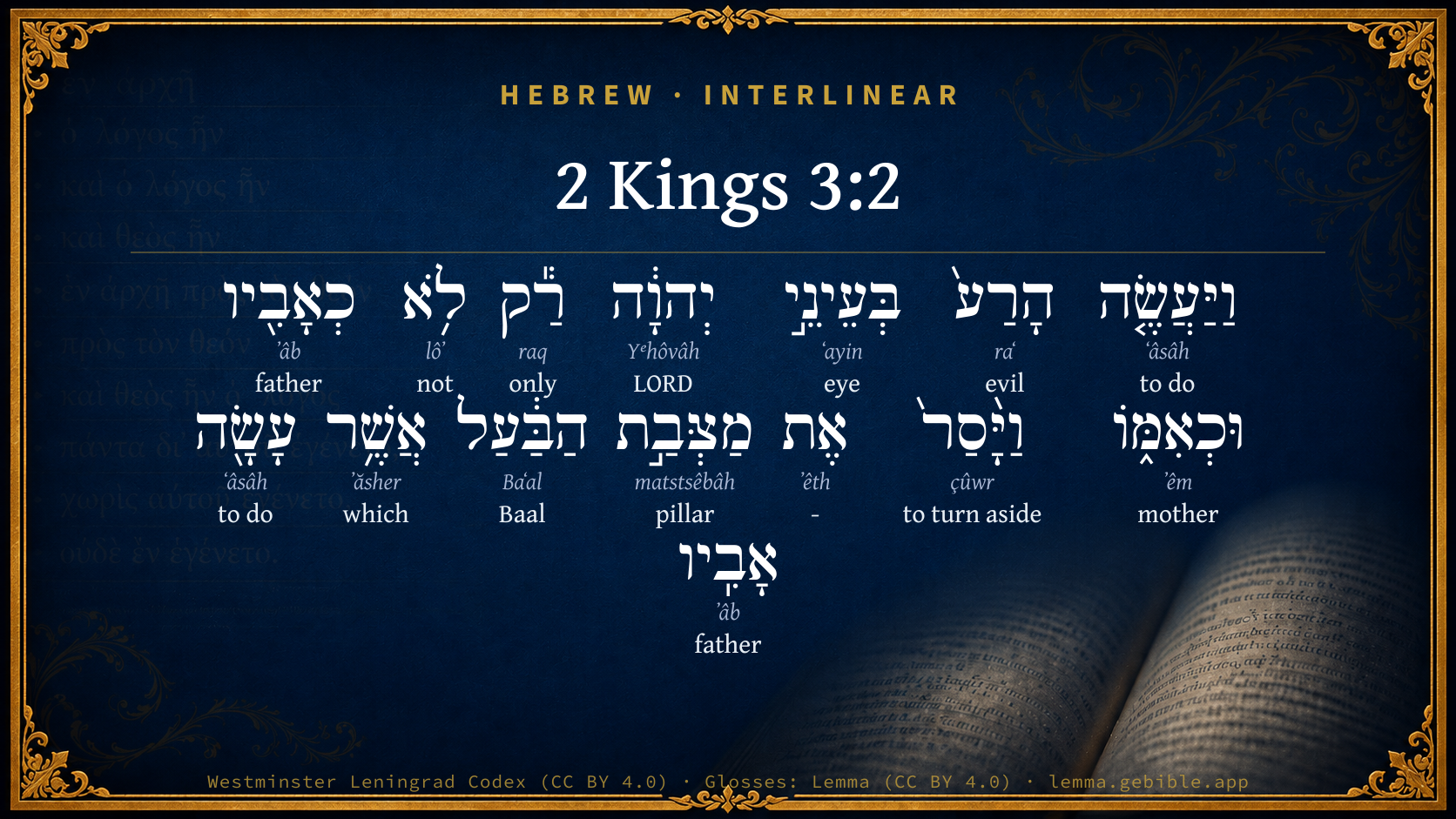
Hebrew (Westminster Leningrad Codex) 2 Kings 3:2 appears in the Hebrew Old Testament. The text above is from the Westminster Leningrad Codex. Each word links to its Strong’s number, a concise gloss, and parsing drawn from the Open Scriptures Hebrew Bible morphology. Click any word for its full Brown-Driver-Briggs (BDB) entry.
Download image
Cite this verse

2 Kings 3:2 (World English Bible). Public Domain. Lemma interlinear Bible study tool, https://lemma.gebible.app/v/2-kings/3/2.

Show BibTeX & RIS
BibTeX
RIS
English Translation
He did that which was evil in the sight of Yahweh, but not like his father, and like his mother; for he put away the pillar of Baal that his father had made.
World English Bible · Public Domain
Download a study sheet

One document with this verse’s original text, its word-by-word gloss line, the meaning frame, cross-references with their text, attributed commentary, and full source and license credits — printable, and it pastes into notes with its structure intact.

This verse Autodidact and up

Study sheet (.html) Plain text (.txt)

A passage Seminary Student

Up to 50 verses in one chapter. A passage sheet keeps up to 6 commentary sources and 12 cross-references per verse, in the order this page ranks them, and says so on the sheet whenever that leaves anything out. Ask for a single verse and you get the Autodidact verse sheet above.

Everything on this page stays free to read, with no account — the sheet is a download of what is already on screen, not access to it.

Want to remove ads? Support Godless Engineer
Compare translations 3

The same verse in 3 English versions, stacked beneath the original-language interlinear above. Click any original word for its lexicon entry.

Each is an independent rendering of the whole verse — the interlinear is not word-aligned to these translations.

Highlighted words mark where these versions differ — a whole-verse word diff, not a word-by-word alignment.

  • World English Bible Public Domain
    He did that which was evil in the sight of Yahweh, but not like his father, and like his mother; for he put away the pillar of Baal that his father had made.
  • King James Version Public Domain
    And he wrought evil in the sight of the LORD; but not like his father, and like his mother: for he put away the image of Baal that his father had made.
  • unfoldingWord Literal Text CC BY-SA 4.0
    And he did evil in the eyes of Yahweh, however, not like his father or like his mother. For he removed the pillar of Baal that his father had made.

unfoldingWord Literal Text — © unfoldingWord, licensed CC BY-SA 4.0. Word-aligned USFM3 via Door43 (git.door43.org/unfoldingWord/en_ult).

Versions to compare (up to 4)

3 of 4 selected

Show all 18 translations

Every available English version of this verse, each an independent rendering of the whole verse.

  • World English Bible Public Domain
    He did that which was evil in the sight of Yahweh, but not like his father, and like his mother; for he put away the pillar of Baal that his father had made.
  • Berean Standard Bible Public Domain
    And he did evil in the sight of the LORD, but not as his father and mother had done. He removed the sacred pillar of Baal that his father had made.
  • Majority Standard Bible Public Domain
    And he did evil in the sight of the LORD, but not as his father and mother had done. He removed the sacred pillar of Baal that his father had made.
  • King James Version Public Domain
    And he wrought evil in the sight of the LORD; but not like his father, and like his mother: for he put away the image of Baal that his father had made.
  • American Standard Version (1901) Public Domain
    And he did that which was evil in the sight of Jehovah, but not like his father, and like his mother; for he put away the pillar of Baal that his father had made.
  • Revised Version (1885) Public Domain
    And he did that which was evil in the sight of the LORD; but not like his father, and like his mother: for he put away the pillar of Baal that his father had made.
  • Geneva Bible (1599) Public Domain
    And he wrought euill in the sight of the Lord, but not like his father nor like his mother: for he tooke away the image of Baal that his father had made.
  • Douay-Rheims (1899) Public Domain
    And he did evil before the Lord, but not like his father and his mother: for he took away the statues of Baal, which his father had made.
  • Young's Literal Translation Public Domain
    and doth the evil thing in the eyes of Jehovah, only not like his father, and like his mother, and he turneth aside the standing-pillar of Baal that his father made;
  • Literal Standard Version CC BY-SA 4.0
    and does evil in the eyes of YHWH, only not like his father, and like his mother, and he turns aside the standing-pillar of Ba‘al that his father made;
  • Unlocked Literal Bible CC BY-SA 4.0
    He did what was evil in the sight of Yahweh, but not like his father and his mother; for he removed the sacred stone pillar of Baal that his father had made.
  • unfoldingWord Literal Text CC BY-SA 4.0
    And he did evil in the eyes of Yahweh, however, not like his father or like his mother. For he removed the pillar of Baal that his father had made.
  • Darby Bible Public Domain
    And he wrought evil in the sight of Jehovah, but not like his father, and like his mother; and he took away the column of Baal that his father had made.
  • World Messianic Bible Public Domain
    He did that which was evil in the LORD’s sight, but not like his father and like his mother, for he put away the pillar of Baal that his father had made.
  • Webster's Bible Public Domain
    And he wrought evil in the sight of the LORD; but not like his father, and like his mother: for he put away the image of Baal that his father had made.
  • Free Bible Version CC BY-SA 4.0
    He did evil in the Lord's sight, but not like his father and mother had done, for he got rid of the stone image of Baal that his father had made.
  • Bible in Basic English Public Domain
    He did evil in the eyes of the Lord; but not like his father and his mother, for he put away the stone pillar of Baal which his father had made.
  • JPS Tanakh (1917) Public Domain
    And he did that which was evil in the sight of the LORD; but not like his father, and like his mother; for he put away the pillar of Baal that his father had made.

Literal Standard Version (2020), Covenant Press — licensed CC BY-SA 4.0. Text via the HelloAO Bible API (eBible.org). Unlocked Literal Bible (unfoldingWord) — licensed CC BY-SA 4.0. Text via the HelloAO Bible API (eBible.org). unfoldingWord Literal Text — © unfoldingWord, licensed CC BY-SA 4.0. Word-aligned USFM3 via Door43 (git.door43.org/unfoldingWord/en_ult). Free Bible Version, Dr. Jonathan Gallagher — licensed CC BY-SA 4.0. Text via the HelloAO Bible API (eBible.org).

Word by word

More ways to search: Search by grammar → Find every occurrence → Compare this word →

Practice this passage: Drill this verse → Learn its vocabulary →

מַצְּבַ֣ת
matstsêbâh
H4676
“pillar of”
Noun, Common, Feminine, Singular, Construct
Part of Speech
Noun
Type
Common
Gender
Feminine
Number
Singular
State
Construct
Full BDB Definition

Origin: (causatively) participle of H5324

TWOT: 1398g

pillar, mastaba, stump - pillar - as monument, personal memorial - with an altar - (Hophal) stock, stump (of tree)
  1. וַיַּעֲשֶׂ֤ה ʻâsâh H6213 “and · to do” Conjunction + Verb, Qal, Sequential Imperfect, 3rd Person, Masculine, Singular
  2. הָרַע֙ raʻ H7451 “the · evil” Particle, Definite Article + Adjective, Adjective, Masculine, Singular, Absolute
  3. בְּעֵינֵ֣י ʻayin H5869 “in/at · eyes of” Preposition + Noun, Common, Both, Dual, Construct
  4. יְהוָ֔ה Yᵉhôvâh H3068 “LORD” Noun, Proper
  5. רַ֕ק raq H7535 “only” Particle, Accusative
  6. לֹ֥א lôʼ H3808 “not” Particle, Negative
  7. כְאָבִ֖יו ʼâb H1 “like/as · father · his” Preposition + Noun, Common, Masculine, Singular, Construct + Suffix, Personal, 3rd Person, Masculine, Singular
  8. וּכְאִמּ֑וֹ ʼêm H517 “and · like/as · mother · his” Conjunction + Preposition + Noun, Common, Feminine, Singular, Construct + Suffix, Personal, 3rd Person, Masculine, Singular
  9. וַיָּ֨סַר֙ çûwr H5493 “and · to turn aside” Conjunction + Verb, Hiphil, Sequential Imperfect, 3rd Person, Masculine, Singular
  10. אֶת ʼêth H853 “-” Particle, Direct Object
  11. הַבַּ֔עַל Baʻal H1168 “the · Baal” Particle, Definite Article + Noun, Proper
  12. אֲשֶׁ֥ר ʼăsher H834 “which” Particle, Relative
  13. עָשָׂ֖ה ʻâsâh H6213 “to do” Verb, Qal, Perfect, 3rd Person, Masculine, Singular
  14. אָבִֽיו ʼâb H1 “father · his” Noun, Common, Masculine, Singular, Construct + Suffix, Personal, 3rd Person, Masculine, Singular

About this verse

These counts appear in no published source. They are computed here, from the morphology-tagged text and Lemma’s own curated glosses. What Lemma adds →

15
words
13
distinct lemmas
Historical
section

Shared distinctive vocabulary

מַצְּבַ֣ת pillar H4676 occurs in 31 verses of the Hebrew Bible. Also found in:

Grammatical profile

  • 3 verbs
  • 7 nouns
  • 1 adjective
  • 4 particles

Verb forms

  • וַיַּעֲשֶׂ֤ה Qal · Sequential Imperfect
  • וַיָּ֨סַר֙ Hiphil · Sequential Imperfect
  • עָשָׂ֖ה Qal · Perfect

Repetition

Words recur within this verse — often emphatic in Hebrew:

  • וַיַּעֲשֶׂ֤ה to do H6213 ×2
  • כְאָבִ֖יו father H1 ×2

Hebrew & Septuagint length

In English translation the verse runs 33 words from the Hebrew and 34 from the Septuagint (LXX English) — closely comparable.

A rough comparison of the two English renderings, which tokenize alike — not a word-level alignment.

Word counts can differ between the Hebrew and the Greek without any difference in meaning — e.g. the Hebrew direct-object marker אֵת has no separate Greek word, and Greek often adds the article ὁ.

Cross-references

14

Topical passages linked to 2 Kings 3:2 in the Treasury of Scripture Knowledge — connected by theme and wording, ordered by reader-vote popularity; previews shown in the World English Bible.

  • 2 Kings 10:18 Jehu gathered all the people together, and said to them, Ahab served Baal a little; but Jehu will serve him much.
  • 1 Kings 21:25 (But there was none like Ahab, who did sell himself to do that which was evil in the sight of Yahweh, whom Jezebel his wife stirred up.
  • 2 Kings 10:26–28 They brought forth the pillars that were in the house of Baal, and burned them.
  • Exodus 23:24 You shall not bow down to their gods, nor serve them, nor follow their practices, but you shall utterly overthrow them and demolish their pillars.
  • 1 Samuel 15:19 Why then didn't you obey the voice of Yahweh, but flew on the spoil, and did that which was evil in the sight of Yahweh?"
  • 1 Kings 16:19 for his sins which he sinned in doing that which was evil in the sight of Yahweh, in walking in the way of Jeroboam, and in his sin which he did, to make Israel to sin.
  • 1 Kings 16:31–33 It happened, as if it had been a light thing for him to walk in the sins of Jeroboam the son of Nebat, that he took as wife Jezebel the daughter of Ethbaal king of the Sidonians, and went and served Baal, and worshiped him.
  • 1 Kings 21:5–15 But Jezebel his wife came to him, and said to him, Why is your spirit so sad, that you eat no bread?
  • 1 Kings 21:20 Ahab said to Elijah, Have you found me, my enemy? He answered, I have found you, because you have sold yourself to do that which is evil in the sight of Yahweh.
  • 2 Kings 6:31–32 Then he said, God do so to me, and more also, if the head of Elisha the son of Shaphat shall stand on him this day.
  • 2 Kings 9:22 It happened, when Joram saw Jehu, that he said, Is it peace, Jehu? He answered, What peace, so long as the prostitution of your mother Jezebel and her witchcraft abound?
  • 2 Kings 9:34 When he was come in, he ate and drink; and he said, See now to this cursed woman, and bury her; for she is a king's daughter.
  • 2 Kings 21:6 He made his son to pass through the fire, and practiced sorcery, and used enchantments, and dealt with those who had familiar spirits, and with wizards: he worked much evil in the sight of Yahweh, to provoke him to anger.
  • 2 Kings 21:20 He did that which was evil in the sight of Yahweh, as did Manasseh his father.

Cross-references courtesy of OpenBible.info (CC BY 4.0).

Hebrew and Greek witnesses Masoretic Hebrew ↔ Greek Septuagint

The same verse in the two great witnesses to the Old Testament, shown verse-for-verse.

These are two independent witnesses, not word-aligned to each other, and the Septuagint is shown in lemma (dictionary) form.

Hebrew 2 Kings 3:2 Masoretic · Westminster Leningrad Codex

וַיַּעֲשֶׂ֤ה הָרַע֙ בְּעֵינֵ֣י יְהוָ֔ה רַ֕ק לֹ֥א כְאָבִ֖יו וּכְאִמּ֑וֹ וַיָּ֨סַר֙ אֶת מַצְּבַ֣ת הַבַּ֔עַל אֲשֶׁ֥ר עָשָׂ֖ה אָבִֽיו

He did that which was evil in the sight of Yahweh, but not like his father, and like his mother; for he put away the pillar of Baal that his father had made.

World English Bible · Public Domain

Greek LXX 2 Kings 3:2 Septuagint · lemma form

καί ποιέω ὁ πονηρός ἐν ὀφθαλμός κύριος πλήν οὐ ὡς ὁ πατήρ αὐτός καί οὐ ὡς ὁ μήτηρ αὐτός καί μεταἵστημι ὁ στήλη ὁ βααλ ὅς ποιέω ὁ πατήρ αὐτός

And he did that which was evil in the sight of the Lord, only not as his father, nor as his mother: and he removed the pillars of Baal which his father had made.

LXX2012 (modern English Septuagint) · Public Domain

On this verse, Ellicott's Commentary for English Readers discusses the Septuagint’s reading. Read the note in Commentary ↓

Hebrew: Westminster Leningrad Codex (CC BY 4.0). Greek: Septuagint (public domain); English from LXX2012 (modern English Septuagint) (Public Domain). How the Septuagint differs from the Hebrew →

Targum (Aramaic paraphrase)

1

The Targum is the ancient Jewish Aramaic paraphrase of the Hebrew Scriptures — an interpretive translation, not the Hebrew text itself. Onkelos (literal) and Pseudo-Jonathan (expansive) render the Torah, and Jonathan the Prophets. Coverage is partial: where no permissively-licensed English translation exists for a verse, only the Aramaic is shown. This is verse-level text, not a word-by-word alignment to the Hebrew.

  1. Targum Jonathan Prophets (Joshua–Malachi)
    וַעֲבַד דְבִישׁ קֳדָם יְיָ לְחוֹד לָא כַאֲבוּהִי וּכְאִמֵיהּ וְאַעְדֵי יַת קָמַת בְּעָלָא דַעֲבַד אֲבוּהִי:

    (no public-domain English translation for this verse)

    Targum Jonathan — Aramaic: “Mikraot Gedolot” (public domain). English: “Sefaria Community Translation” (CC0 1.0 (public-domain dedication)); “London "Chaldee Paraphrase," 1871” (public domain). Text via Sefaria.

Commentary

Notes on 2 Kings 3:2 from classic Christian and Jewish commentators (each source and its license shown beneath its notes). The classic Christian expositions comment on the surrounding passage and are grouped to its opening verse, so a note may address several verses; the Jewish commentaries on the Tanakh (Rashi and others) are per-verse, so they appear only where the commentator wrote on this verse.

Lemma curates 59 commentaries, every one of them public domain or Creative Commons licensed, each selected and text-cleaned for this edition rather than reprinted as found. About our sources →

Trapp's Complete Commentary

John Trapp

2Ki 3:2 And he wrought evil in the sight of the LORD; but not like his father, and like his mother: for he put away the image of Baal that his father had made.

Ver. 2. But not like his father, and like his mother.] Not all out so bad; and yet not very much better than they. Optimi putantur si vel leviter mali sint, saith a Popish writer concerning the Popes of Rome, vel minus boni quam caeteri mortales esse solent. They are held very good popes if they be not grossly evil; or if somewhat less good than other men use to be. Think the same of the kings of Israel.

For he put away the image of Baal.] This was somewhat toward a reformation, and he was drawn to it by good Jehoshaphat’s persuasion likely, who hoping to work further with him, was content to be his confederate, as it followeth.

John Trapp, A Commentary or Exposition upon All the Books of the Old and New Testament (1647–1656) — public domain. Text from a community e-Sword module.

Joseph Benson's Commentary

2Ki 3:2-3. He put away the image of Baal — It was much that his mother, who had brought this worship with her from the Zidonians, should suffer him to remove this image; but she was probably a little daunted at the many disasters which had befallen their family, and was contented with worshipping Baal in private. Nevertheless, he cleaved unto the sins of Jeroboam — Though he put away the image and worship of Baal, resolving to worship Jehovah only, yet he continued to worship him under the representation of a calf, which was idolatry, though in a less degree. This kind of worship all the kings of Israel kept up, as a wall of partition between their subjects and those of Judah. They intended hereby to keep their people from going up to worship at Jerusalem, lest, if they did so, they might, by degrees, be brought to submit again to the kings of Judah. Thus Jehoram: he had a little religion, such as it was, but not enough to overrule his policy.

Joseph Benson's Commentary on the Old and New Testaments (1811–1818) — public domain. Text from a community e-Sword module.

Tyndale Open Study Notes

Tyndale Open Resources

3:2 Ahab apparently erected the sacred pillar (or stela) of Baal when instituting Baal worship (see 1 Kgs 16:32-33). Similar stones were also erected to pagan deities in Judah (1 Kgs 14:23); such pillars were later purged by Jehu (2 Kgs 10:26-27) and Josiah (23:13-15).

Tyndale Open Study Notes — © Tyndale Open Resources, licensed CC BY-SA 4.0. Text via the HelloAO Bible API.

Adam Clarke's Commentary

Verse 2. He put away the image of Baal] He abolished his worship; but he continued that of the calves at Dan and Beth-el.

Adam Clarke's Commentary on the Bible (1810–1826) — public domain. Text from a community e-Sword/MySword module.

Ellicott's Commentary for English Readers

(2) Wrought evil.—Did the evil in the eyes, &c., i.e., maintained the illicit worship of the bullock at Beth-el (2Ki_3:3).

Like his mother.—Jezebel lived throughout his reign (2Ki_9:30), which explains why he did not eradicate the Baal-worship (2Ki_10:18-28).

For he put away.—And he removed, scil., from its place in the temple of Baal. (Comp. 1Ki_16:31-32.) It must have been afterwards restored, probably by the influence of Jezebel. (Comp. 2Ki_10:26-27, and Notes.)

The image.—Pillar. (Comp. 2Ch_34:4.) The LXX., Vulg., and Arabic read “pillars” (a different pointing); and the LXX. adds at the end, “and brake them in pieces.” This seems original. Ahab would be likely to set up more than one pillar to Baal.

A Bible Commentary for English Readers, edited by Charles John Ellicott (1878–1897) — public domain. Text from a community e-Sword module.

The Cambridge Bible for Schools and Colleges

gen. ed. J. J. S. Perowne

2. And he wrought evil] R.V. And he did that which was evil. The change made frequently that the same Hebrew phrase may be regularly rendered by the same English.

but not like his father, and like his mother] Jehoram was not so far gone in evil as his brother Ahaziah had been. He kept indeed to the calf-worship of Jeroboam, but put down the Baal-worship which had been introduced by Jezebel from Phœnicia. The writer makes a difference, as might be expected, between the sin of Jeroboam, grievous though that was, and the grosser idolatry which had been practised in the two last reigns.

he put away the image [R.V. pillar] of Baal] The Hebrew word [maççebah] is first used of the stone (Gen_28:18) which Jacob set up for a pillar at Bethel, and it seems likely, as it is used here and elsewhere in the accounts of Baal-worship, that these objects of worship were not figures, but of the nature of obelisks. They were probably for the most part of stone, though those mentioned as brought out of the house of Baal (2Ki_10:26) and burned must have been of wood. Perhaps those under cover were made of wood, and overlaid with precious metals (cf. Hos_2:8), while those out of doors were of stone.

that his father had made] This was no doubt some special pillar which the king had erected near his palace for his own and Jezebel’s worship. This open token of devotion to the idols of the nations Jehoram put away. But there remained pillars of Baal and a house of Baal still for Jehu to destroy. Jehoram found it difficult to go far in a reformation among persons given up as his subjects were to idolatry, and all the more difficult because his own father had been the founder and fosterer of the evil.

The Cambridge Bible for Schools and Colleges (gen. ed. J. J. S. Perowne; Cambridge University Press, 1878–1918) — public domain. Text from a community e-Sword module.

John Gill's Exposition

Nevertheless he cleaved unto the sins of Jeroboam the son of Nebat, which made Israel to sin,.... He closely adhered to the worship of the calves set up by him:

he departed not therefrom: that being a piece of state policy, to keep up the division of the two kingdoms.

John Gill's Exposition of the Whole Bible (1746–1763) — public domain (CC PDM 1.0). Text via the HelloAO Bible API.

Albert Barnes' Notes on the Bible

On the “evil” done by Ahab, see especially 1Ki 16:30-34. Jehoram, warned by the fate of his brother (2Ki 1:4 note), began his reign by a formal abolition of the Phoenician state religion introduced by Ahab - even if he connived at its continuance among the people 2Ki 10:26-27; and by a re-establishment of the old worship of the kingdom as arranged by Jeroboam.

Albert Barnes' Notes on the Bible (1834–1885) — public domain. Text from a community e-Sword/MySword module.

Haydock's Catholic Bible Commentary

Baal. This happened after his victory over Moab, ver. 13. (Calmet) --- Salien thinks rather that Josaphat refused to assist him, except he would destroy what had been lately introduced by his parents, as the league with Achab had been blamed. See 2 Paralipomenon xix. 2. The golden calves were of an older standing, and could not be so easily taken from the people. (Menochius) --- Joram was not so wicked as might have been expected. (Calmet)

George Leo Haydock (1774–1849), Haydock's Catholic Family Bible and Commentary, 1859 edition — public domain. Excludes Psalms (Douay-Rheims chapter numbering differs from Protestant) and Deuterocanonical books (Catholic canon only).

Matthew Poole's English Annotations

He put away the image of Baal; not from any principle of conscience (for that would have reached the calves also); but either because he was startled at the dreadful judgments of God inflicted upon his father and brother for Baal worship; or because he needed God’s help to subdue the Moabites, which he knew Baal could not do; or to gratify Jehoshaphat, whose help he meant to crave, which he knew he should never obtain without this; and for this reason, it seems, Jezebel was willing to connive at it, as a trick of state.

Matthew Poole's English Annotations on the Holy Bible (1683–1685) — public domain. Text from a community e-Sword/MySword module.

Whedon's Commentary on the Bible

Daniel D. Whedon

2. He put away the image of Baal — Discountenanced, and at least partially abolished, the Baal worship that had gained such strength in Israel during the reign of Ahab and Jezebel. At what particular period of his reign he did this does not appear, but perhaps it was after the war with Moab, and in consequence of the rebuke of Elisha given at 2Ki_3:13.

Daniel D. Whedon (gen. ed.), Commentary on the Old and New Testaments (1874–1909) — public domain. Text from a community e-Sword module.

The Pulpit Commentary

And he wrought evil in the sight of the Lord as did every other king of Israel both before him (1Ki_14:16 1Ki_15:25, 34 16:13, 19, 25, 30 22:52) and after him (2Ki_8:27 2Ki_10:31 2Ki_13:2, 11 14:24 15:9, 18, 24, 28 17:2) but not like his father, and like his mother i.e. Ahab and Jezebel, the introducers of the Baal-worship into Israel for he put away the image of Baal that his father had made. It had not been said previously that Ahab had actually set up an image of Baal, but only that he had "built him a house in Samaria, and reared him up an altar," and that he "served him and worshipped him". (1Ki_16:31, 1Ki_16:32) But an image of the god for whom a "house" was built was so much a matter of course in the idolatrous systems of the East, that it might have seemed superfluous to mention it. The actual existence of the image appears later, when its destruction is recorded. (2Ki_10:27) It seems that Jehoram, at the commencement of his reign, took warning by the fates of his father and brother, so far as to abolish the state worship of Baal, which his father had introduced, and to remove the image of Baal from the temple where it had been set up. The image, however, was not destroyed it was only "put away."

The Pulpit Commentary (1880–1919), ed. H.D.M. Spence-Jones & Joseph S. Exell — public domain. Text from a community e-Sword module.

Rashi

Rabbi Shlomo Yitzchaki (Rashi)

But not [as bad] as his father and mother. Who added the [worship of the ] Baal in order to provoke [God].

Rashi on the Tanakh — English translations: “The Judaica Press complete Tanach with Rashi, translated by A. J. Rosenberg” (CC BY 4.0); “Pentateuch with Rashi's commentary by M. Rosenbaum and A.M. Silbermann, 1929-1934” (public domain); “The Metsudah Tanach series, Lakewood, N.J” (CC BY 4.0); and “The Book of Joshua, Metsudah Publications, 1997” (CC BY 4.0). Text via Sefaria.

Lesson kit

Teaching starters — assembled from the data on this page, not authored interpretation. Every prompt links to the verse data it draws on. Edit before teaching.

2 Kings, in the Historical, opens this verse with 15 words (13 distinct Hebrew lemmas). Its most distinctive word is matstsêbâh (“pillar”). A historical commentator’s framing appears above. Read the whole chapter for the surrounding context.

Discussion questions

  1. How does “pillar” (matstsêbâh) shape what this verse is saying?
  2. How does Genesis 28:18, which shares the word «pillar», read alongside this verse?
  3. What does the repetition of “to do” (2× in this one verse) do in this verse?
  4. These translations render this verse differently; the difference is in the English rendering, not the original. What questions does that raise?
  5. «וַיַּעֲשֶׂ֤ה» is a Qal Sequential Imperfect verb. How does that grammatical form shape the action described?
  6. Compare how Trapp's Complete Commentary and Joseph Benson's Commentary read this verse. Where do they agree or differ?

Things to notice

Reading settings

Reading text

Shown beneath each verse's original-language words.

Old Testament
Old Testament edition

Read the OT as the Masoretic Hebrew (MT) or the Greek Septuagint (LXX).

English shown for the Greek Septuagint (in the Hebrew ↔ Greek comparison).

Comparing translations? Open the Compare panel on any verse page to stack up to four side by side.