
Judges 2:17

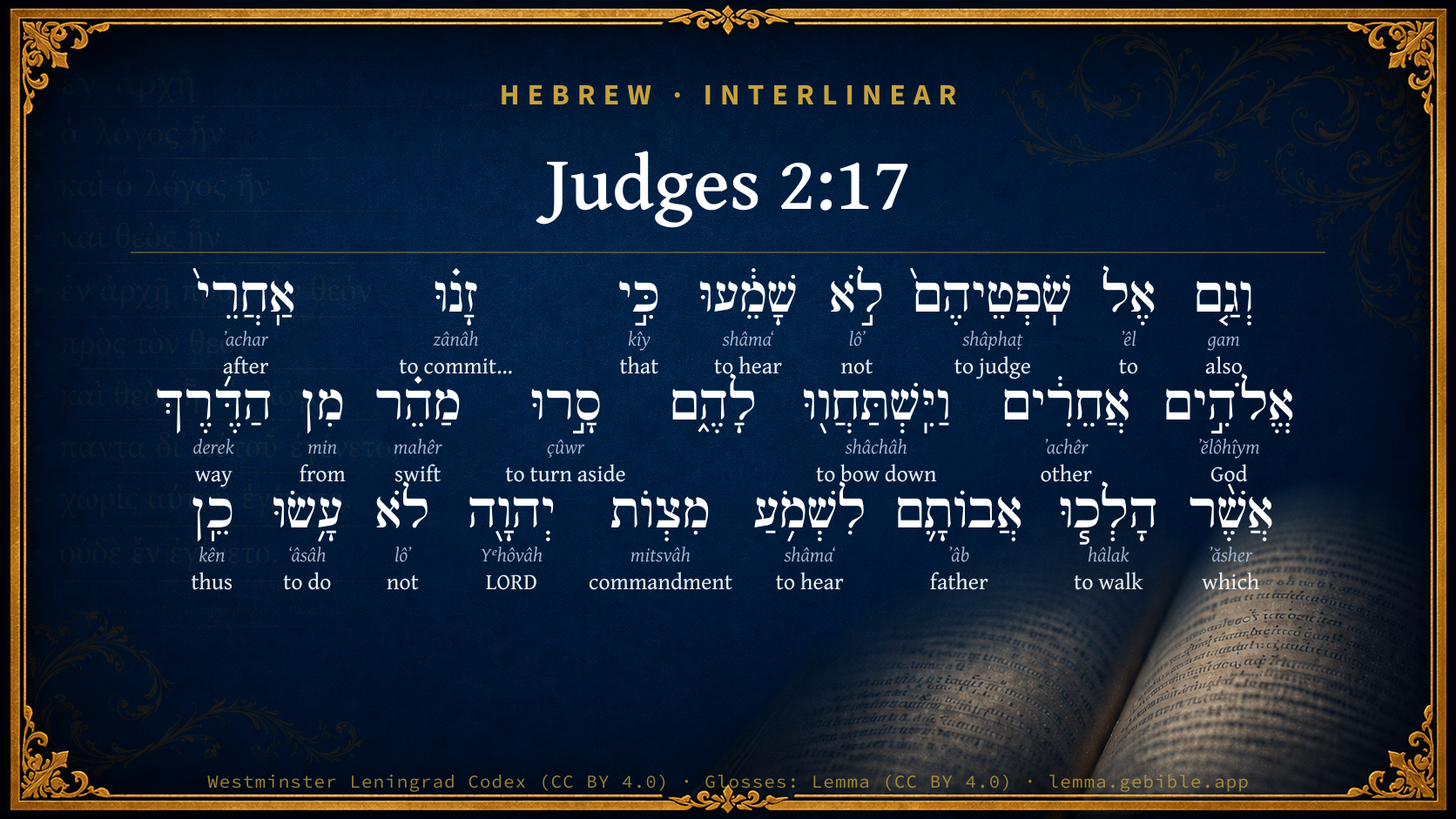
Hebrew (Westminster Leningrad Codex) Judges 2:17 appears in the Hebrew Old Testament. The text above is from the Westminster Leningrad Codex. Each word links to its Strong’s number, a concise gloss, and parsing drawn from the Open Scriptures Hebrew Bible morphology. Click any word for its full Brown-Driver-Briggs (BDB) entry.
Download image
Cite this verse

Judges 2:17 (World English Bible). Public Domain. Lemma interlinear Bible study tool, https://lemma.gebible.app/v/judges/2/17.

Show BibTeX & RIS
BibTeX
RIS
English Translation
Yet they didn't listen to their judges; for they played the prostitute after other gods, and bowed themselves down to them: they turned aside quickly out of the way in which their fathers walked, obeying the commandments of Yahweh; [but] they didn't do so.
World English Bible · Public Domain
Download a study sheet

One document with this verse’s original text, its word-by-word gloss line, the meaning frame, cross-references with their text, attributed commentary, and full source and license credits — printable, and it pastes into notes with its structure intact.

This verse Autodidact and up

Study sheet (.html) Plain text (.txt)

A passage Seminary Student

Up to 50 verses in one chapter. A passage sheet keeps up to 6 commentary sources and 12 cross-references per verse, in the order this page ranks them, and says so on the sheet whenever that leaves anything out. Ask for a single verse and you get the Autodidact verse sheet above.

Everything on this page stays free to read, with no account — the sheet is a download of what is already on screen, not access to it.

Want to remove ads? Support Godless Engineer
Compare translations 3

The same verse in 3 English versions, stacked beneath the original-language interlinear above. Click any original word for its lexicon entry.

Each is an independent rendering of the whole verse — the interlinear is not word-aligned to these translations.

Highlighted words mark where these versions differ — a whole-verse word diff, not a word-by-word alignment.

  • World English Bible Public Domain
    Yet they didn't listen to their judges; for they played the prostitute after other gods, and bowed themselves down to them: they turned aside quickly out of the way in which their fathers walked, obeying the commandments of Yahweh; [but] they didn't do so.
  • King James Version Public Domain
    And yet they would not hearken unto their judges, but they went a whoring after other gods, and bowed themselves unto them: they turned quickly out of the way which their fathers walked in, obeying the commandments of the LORD; but they did not so.
  • unfoldingWord Literal Text CC BY-SA 4.0
    But even to their judges they did not listen. For they whored after other gods and they bowed down to them. They turned quickly from the way that their fathers had walked, to hear the commandments of Yahweh. They did not do thus.

unfoldingWord Literal Text — © unfoldingWord, licensed CC BY-SA 4.0. Word-aligned USFM3 via Door43 (git.door43.org/unfoldingWord/en_ult).

Versions to compare (up to 4)

3 of 4 selected

Show all 18 translations

Every available English version of this verse, each an independent rendering of the whole verse.

  • World English Bible Public Domain
    Yet they didn't listen to their judges; for they played the prostitute after other gods, and bowed themselves down to them: they turned aside quickly out of the way in which their fathers walked, obeying the commandments of Yahweh; [but] they didn't do so.
  • Berean Standard Bible Public Domain
    Israel, however, did not listen to their judges. Instead, they prostituted themselves with other gods and bowed down to them. They quickly turned from the way of their fathers, who had walked in obedience to the LORD’s commandments; they did not do as their fathers had done.
  • Majority Standard Bible Public Domain
    Israel, however, did not listen to their judges. Instead, they prostituted themselves with other gods and bowed down to them. They quickly turned from the way of their fathers, who had walked in obedience to the LORD’s commandments; they did not do as their fathers had done.
  • King James Version Public Domain
    And yet they would not hearken unto their judges, but they went a whoring after other gods, and bowed themselves unto them: they turned quickly out of the way which their fathers walked in, obeying the commandments of the LORD; but they did not so.
  • American Standard Version (1901) Public Domain
    And yet they hearkened not unto their judges; for they played the harlot after other gods, and bowed themselves down unto them: they turned aside quickly out of the way wherein their fathers walked, obeying the commandments of Jehovah; `but' they did not so.
  • Revised Version (1885) Public Domain
    And yet they hearkened not unto their judges, for they went a whoring after other gods, and bowed themselves down unto them: they turned aside quickly out of the way wherein their fathers walked, obeying the commandments of the LORD; but they did not so.
  • Geneva Bible (1599) Public Domain
    But yet they would not obey their Iudges: for they went a whoring after other gods, and worshipped them, and turned quickly out of the way, wherein their fathers walked, obeying the commandements of the Lord: they did not so.
  • Douay-Rheims (1899) Public Domain
    Committing fornication with strange gods, and adoring them. They quickly forsook the way, in which their fathers had walked: and hearing the commandments of the Lord, they did all things contrary.
  • Young's Literal Translation Public Domain
    and also unto their judges they have not hearkened, but have gone a-whoring after other gods, and bow themselves to them; they have turned aside `with' haste out of the way `in' which their fathers walked to obey the commands of Jehovah -- they have not done so.
  • Literal Standard Version CC BY-SA 4.0
    and they have also not listened to their judges, but have gone whoring after other gods, and bow themselves to them; they have turned aside [with] haste out of the way [in] which their fathers walked to obey the commands of YHWH—they have not done so.
  • Unlocked Literal Bible CC BY-SA 4.0
    Yet they would not listen to their judges. They were unfaithful to Yahweh and gave themselves like prostitutes to other gods and worshiped them. They soon turned aside from the way their fathers had lived—those who had obeyed the commandments of Yahweh—but they themselves did not do so.
  • unfoldingWord Literal Text CC BY-SA 4.0
    But even to their judges they did not listen. For they whored after other gods and they bowed down to them. They turned quickly from the way that their fathers had walked, to hear the commandments of Yahweh. They did not do thus.
  • Darby Bible Public Domain
    And yet they did not listen to their judges; for they played the harlot after other gods and bowed down to them; they soon turned aside from the way in which their fathers had walked, who had obeyed the commandments of the LORD, and they did not do so.
  • World Messianic Bible Public Domain
    Yet they didn’t listen to their judges; for they prostituted themselves to other gods, and bowed themselves down to them. They quickly turned away from the way in which their fathers walked, obeying the LORD’s commandments. They didn’t do so.
  • Webster's Bible Public Domain
    And yet they would not hearken to their judges, but they went astray after other gods, and bowed themselves to them: they turned quickly out of the way which their fathers walked in, obeying the commandments of the LORD; but they did not so.
  • Free Bible Version CC BY-SA 4.0
    But even so, they refused to listen to their judges, and prostituted themselves by following other gods, bowing down in worship to them. They quickly abandoned the way their forefathers had followed, and they did not obey the Lord's commandments as their forefathers had.
  • Bible in Basic English Public Domain
    But still they would not give ear to their judges, but went after other gods and gave them worship; quickly turning from the way in which their fathers had gone, keeping the orders of the Lord; but they did not do so.
  • JPS Tanakh (1917) Public Domain
    And yet they hearkened not unto their judges, for they went astray after other gods, and worshipped them; they turned aside quickly out of the way wherein their fathers walked, obeying the commandments of the LORD; they did not so.

Literal Standard Version (2020), Covenant Press — licensed CC BY-SA 4.0. Text via the HelloAO Bible API (eBible.org). Unlocked Literal Bible (unfoldingWord) — licensed CC BY-SA 4.0. Text via the HelloAO Bible API (eBible.org). unfoldingWord Literal Text — © unfoldingWord, licensed CC BY-SA 4.0. Word-aligned USFM3 via Door43 (git.door43.org/unfoldingWord/en_ult). Free Bible Version, Dr. Jonathan Gallagher — licensed CC BY-SA 4.0. Text via the HelloAO Bible API (eBible.org).

Word by word

More ways to search: Search by grammar → Find every occurrence → Compare this word →

Practice this passage: Drill this verse → Learn its vocabulary →

מַהֵ֗ר
mahêr
H4118
“swift”
Verb, Piel, Infinitive Absolute
Part of Speech
Verb
Stem
Piel
Form
Infinitive Absolute
Full BDB Definition

Origin: from H4116

TWOT: 1152a , 1152b

hurrying, speedy, swift, hastening (adjective) - quickly, speedily (adverb)
  1. וְגַ֤ם gam H1571 “and · also” Conjunction + Particle, Accusative
  2. אֶל ʼêl H413 “to” Preposition
  3. שֹֽׁפְטֵיהֶם֙ shâphaṭ H8199 “judging · them” Verb, Qal, Participle Active, Masculine, Plural, Construct + Suffix, Personal, 3rd Person, Masculine, Plural
  4. לֹ֣א lôʼ H3808 “not” Particle, Negative
  5. שָׁמֵ֔עוּ shâmaʻ H8085 “to hear” Verb, Qal, Perfect, 3rd Person, Common, Plural
  6. כִּ֣י kîy H3588 “that” Conjunction
  7. זָנ֗וּ zânâh H2181 “to commit fornication” Verb, Qal, Perfect, 3rd Person, Common, Plural
  8. אַֽחֲרֵי֙ ʼachar H310 “after” Preposition
  9. אֱלֹהִ֣ים ʼĕlôhîym H430 “God(s)” Noun, Common, Masculine, Plural, Absolute
  10. אֲחֵרִ֔ים ʼachêr H312 “other” Adjective, Adjective, Masculine, Plural, Absolute
  11. וַיִּֽשְׁתַּחֲו֖וּ shâchâh H7812 “and · to bow down” Conjunction + Verb, Hithpael, Sequential Imperfect, 3rd Person, Masculine, Plural
  12. סָ֣רוּ çûwr H5493 “to turn aside” Verb, Qal, Perfect, 3rd Person, Common, Plural
  13. מִן min H4480 “from” Preposition
  14. הַדֶּ֜רֶךְ derek H1870 “the · way” Particle, Definite Article + Noun, Common, Both, Singular, Absolute
  15. אֲשֶׁ֨ר ʼăsher H834 “which” Particle, Relative
  16. הָלְכ֧וּ hâlak H1980 “to walk” Verb, Qal, Perfect, 3rd Person, Common, Plural
  17. אֲבוֹתָ֛ם ʼâb H1 “fathers · their” Noun, Common, Masculine, Plural, Construct + Suffix, Personal, 3rd Person, Masculine, Plural
  18. לִשְׁמֹ֥עַ shâmaʻ H8085 “to hear” Preposition + Verb, Qal, Infinitive Construct
  19. מִצְוֺת mitsvâh H4687 “commandments of” Noun, Common, Feminine, Plural, Construct
  20. יְהוָ֖ה Yᵉhôvâh H3068 “LORD” Noun, Proper
  21. לֹא lôʼ H3808 “not” Particle, Negative
  22. עָ֥שׂוּ ʻâsâh H6213 “to do” Verb, Qal, Perfect, 3rd Person, Common, Plural
  23. כֵֽן kên H3651 “thus” Adverb

About this verse

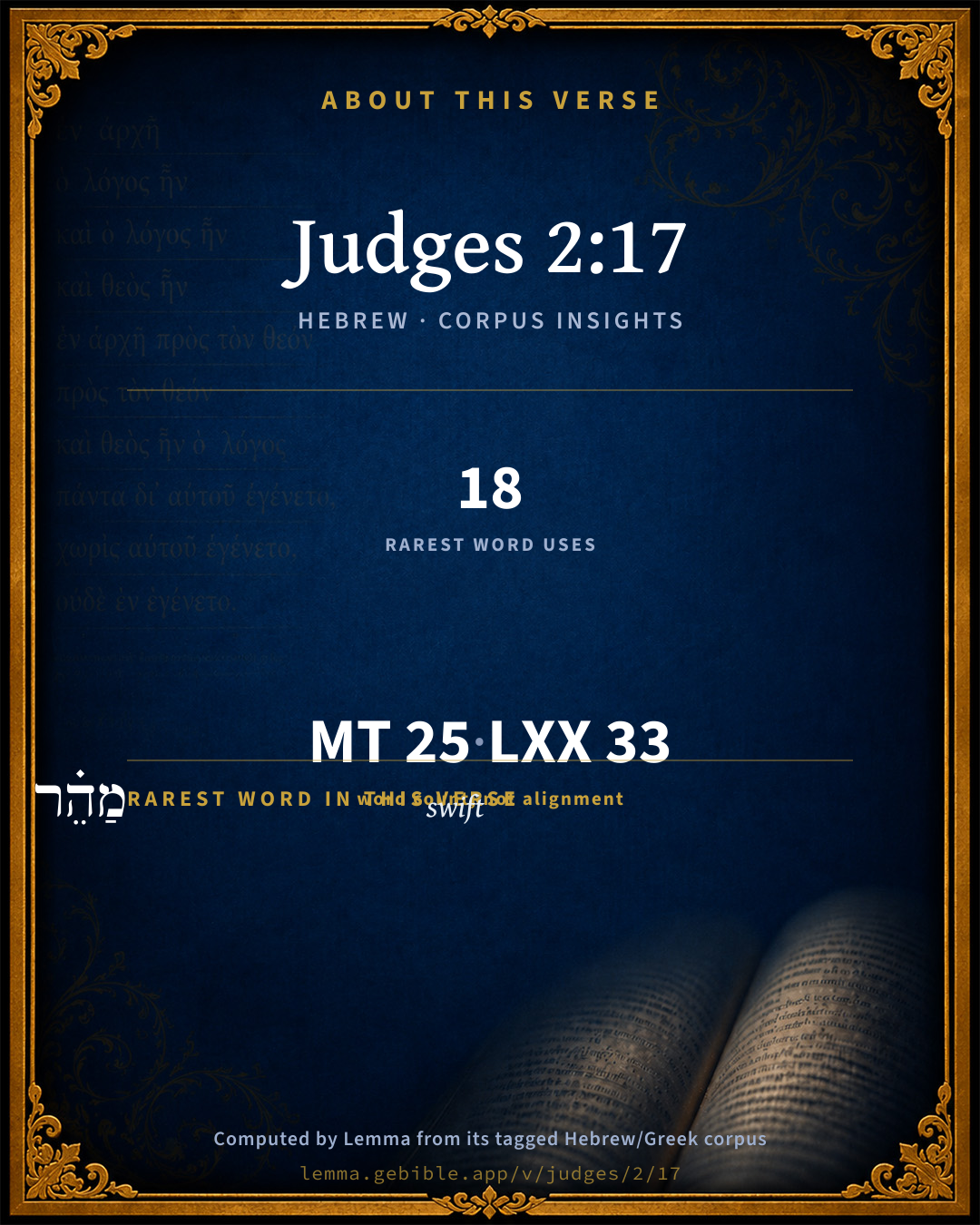
These counts appear in no published source. They are computed here, from the morphology-tagged text and Lemma’s own curated glosses. What Lemma adds →

25
words
22
distinct lemmas
Historical
section

Notable vocabulary

The rarest word here is מַהֵ֗ר swift H4118 — appearing just 18 times in the whole Hebrew Bible.

Shared distinctive vocabulary

מַהֵ֗ר swift H4118 occurs in 17 verses of the Hebrew Bible. Also found in:

Grammatical profile

  • 9 verbs
  • 5 nouns
  • 1 adjective
  • 4 prepositions
  • 1 conjunction
  • 1 adverb
  • 4 particles

Verb forms

  • שֹֽׁפְטֵיהֶם֙ Qal · Participle Active
  • שָׁמֵ֔עוּ Qal · Perfect
  • זָנ֗וּ Qal · Perfect
  • וַיִּֽשְׁתַּחֲו֖וּ Hithpael · Sequential Imperfect
  • סָ֣רוּ Qal · Perfect
  • מַהֵ֗ר Piel · Infinitive Absolute
  • הָלְכ֧וּ Qal · Perfect
  • לִשְׁמֹ֥עַ Qal · Infinitive Construct
  • עָ֥שׂוּ Qal · Perfect

Repetition

Words recur within this verse — often emphatic in Hebrew:

  • שָׁמֵ֔עוּ to hear H8085 ×2
  • לֹ֣א not H3808 ×2

Hebrew & Septuagint length

In English translation the verse runs 44 words from the Hebrew and 36 from the Septuagint (LXX English) — closely comparable.

A rough comparison of the two English renderings, which tokenize alike — not a word-level alignment.

Word counts can differ between the Hebrew and the Greek without any difference in meaning — e.g. the Hebrew direct-object marker אֵת has no separate Greek word, and Greek often adds the article ὁ.

In the original languages it is 25 Hebrew tokens and 33 Greek tokens — but the two are counted differently (Hebrew bundles its prefixes and suffixes into one token; the Greek is in lemma form), so that isn’t a like-for-like length.

Cross-references

19

Topical passages linked to Judges 2:17 in the Treasury of Scripture Knowledge — connected by theme and wording, ordered by reader-vote popularity; previews shown in the World English Bible.

  • Deuteronomy 9:12 Yahweh said to me, Arise, get you down quickly from hence; for your people whom you have brought forth out of Egypt have corrupted themselves; they have quickly turned aside out of the way which I commanded them; they have made them a molten image.
  • Galatians 1:6 I marvel that you are so quickly deserting him who called you in the grace of Christ to a different gospel;
  • Judges 2:7 The people served Yahweh all the days of Joshua, and all the days of the elders who outlived Joshua, who had seen all the great work of Yahweh that he had worked for Israel.
  • Hosea 2:2 Contend with your mother! Contend, for she is not my wife, Neither am I her husband; And let her put away her prostitution from her face, And her adulteries from between her breasts;
  • Revelation 17:1–5 One of the seven angels who had the seven bowls came and spoke with me, saying, "Come here. I will show you the judgment of the great prostitute who sits on many waters,
  • Exodus 32:8 They have turned aside quickly out of the way which I commanded them. They have made themselves a molten calf, and have worshiped it, and have sacrificed to it, and said, 'These are your gods, Israel, which brought you up out of the land of Egypt.'"
  • Exodus 34:15–16 Don't make a covenant with the inhabitants of the land, lest they play the prostitute after their gods, and sacrifice to their gods, and one call you and you eat of his sacrifice;
  • Leviticus 17:7 They shall no more sacrifice their sacrifices to the goat idols, after which they play the prostitute. This shall be a statute forever to them throughout their generations.'
  • Deuteronomy 9:16 I looked, and, behold, you had sinned against Yahweh your God; you had made you a molten calf: you had turned aside quickly out of the way which Yahweh had commanded you.
  • Joshua 24:24 The people said to Joshua, Yahweh our God will we serve, and to his voice will we listen.
  • Joshua 24:31 Israel served Yahweh all the days of Joshua, and all the days of the elders who outlived Joshua, and had known all the work of Yahweh, that he had worked for Israel.
  • 1 Samuel 8:5–8 and they said to him, Behold, you are old, and your sons don't walk in your ways: now make us a king to judge us like all the nations.
  • 1 Samuel 12:12 When you saw that Nahash the king of the children of Ammon came against you, you said to me, No, but a king shall reign over us; when Yahweh your God was your king.
  • 1 Samuel 12:17 Isn't it wheat harvest today? I will call to Yahweh, that he may send thunder and rain; and you shall know and see that your wickedness is great, which you have done in the sight of Yahweh, in asking you a king.
  • 1 Samuel 12:19 All the people said to Samuel, Pray for your servants to Yahweh your God, that we not die; for we have added to all our sins [this] evil, to ask us a king.
  • 2 Chronicles 36:15–16 Yahweh, the God of their fathers, sent to them by his messengers, rising up early and sending, because he had compassion on his people, and on his dwelling-place:
  • Psalms 73:27 For, behold, those who are far from you shall perish. You have destroyed all those who are unfaithful to you.
  • Psalms 106:39 Thus were they defiled with their works, And prostituted themselves in their deeds.
  • Psalms 106:43 Many times he delivered them, But they were rebellious in their counsel, And were brought low in their iniquity.

Cross-references courtesy of OpenBible.info (CC BY 4.0).

Hebrew and Greek witnesses Masoretic Hebrew ↔ Greek Septuagint

The same verse in the two great witnesses to the Old Testament, shown verse-for-verse.

These are two independent witnesses, not word-aligned to each other, and the Septuagint is shown in lemma (dictionary) form.

Hebrew Judges 2:17 Masoretic · Westminster Leningrad Codex

וְגַ֤ם אֶל שֹֽׁפְטֵיהֶם֙ לֹ֣א שָׁמֵ֔עוּ כִּ֣י זָנ֗וּ אַֽחֲרֵי֙ אֱלֹהִ֣ים אֲחֵרִ֔ים וַיִּֽשְׁתַּחֲו֖וּ לָהֶ֑ם סָ֣רוּ מַהֵ֗ר מִן הַדֶּ֜רֶךְ אֲשֶׁ֨ר הָלְכ֧וּ אֲבוֹתָ֛ם לִשְׁמֹ֥עַ מִצְוֺת יְהוָ֖ה לֹא עָ֥שׂוּ כֵֽן

Yet they didn't listen to their judges; for they played the prostitute after other gods, and bowed themselves down to them: they turned aside quickly out of the way in which their fathers walked, obeying the commandments of Yahweh; [but] they didn't do so.

World English Bible · Public Domain

Greek LXX Judges 2:17 Septuagint · lemma form

καί γέ ὁ κριτής οὐ ὑποἀκούω ὅτι ἐκπορνεύω ὀπίσω θεός ἕτερος καί προςκυνέω αὐτός καί ἐκκλίνω ταχύς ἐκ ὁ ὁδός ὅς πορεύομαι ὁ πατήρ αὐτός ὁ εἰςἀκούω ὁ λόγος κύριος οὐ ποιέω οὕτως

for they went a whoring after other gods, and worshipped them; and they turned quickly out of the way in which their fathers walked to listen to the words of the Lord; they did not so.

LXX2012 (modern English Septuagint) · Public Domain

On this verse, Haydock's Catholic Bible Commentary discusses the Septuagint’s reading. Read the note in Commentary ↓

Hebrew: Westminster Leningrad Codex (CC BY 4.0). Greek: Septuagint (public domain); English from LXX2012 (modern English Septuagint) (Public Domain). How the Septuagint differs from the Hebrew →

Targum (Aramaic paraphrase)

1

The Targum is the ancient Jewish Aramaic paraphrase of the Hebrew Scriptures — an interpretive translation, not the Hebrew text itself. Onkelos (literal) and Pseudo-Jonathan (expansive) render the Torah, and Jonathan the Prophets. Coverage is partial: where no permissively-licensed English translation exists for a verse, only the Aramaic is shown. This is verse-level text, not a word-by-word alignment to the Hebrew.

  1. Targum Jonathan Prophets (Joshua–Malachi)
    וְאַף מִן נְגִידֵיהוֹן לָא קַבִּילוּ אֲרֵי טָעוּ בָּתַר טַעֲוַת עַמְמַיָא וּסְגִידוּ לְהוֹן סָטוּ בִּפְרִיעַ מִן אוֹרְחָא דַאֲזַלוּ אֲבָהַתְהוֹן לְקַבָּלָא פִּקוּדַיָא דַייָ לָא עֲבַדוּ כֵן:

    (no public-domain English translation for this verse)

    Targum Jonathan — Aramaic: “Mikraot Gedolot” (public domain). English: “Sefaria Community Translation” (CC0 1.0 (public-domain dedication)); “London "Chaldee Paraphrase," 1871” (public domain). Text via Sefaria.

Commentary

Notes on Judges 2:17 from classic Christian and Jewish commentators (each source and its license shown beneath its notes). The classic Christian expositions comment on the surrounding passage and are grouped to its opening verse, so a note may address several verses; the Jewish commentaries on the Tanakh (Rashi and others) are per-verse, so they appear only where the commentator wrote on this verse.

Lemma curates 59 commentaries, every one of them public domain or Creative Commons licensed, each selected and text-cleaned for this edition rather than reprinted as found. About our sources →

Trapp's Complete Commentary

John Trapp

Jdg 2:17 And yet they would not hearken unto their judges, but they went a whoring after other gods, and bowed themselves unto them: they turned quickly out of the way which their fathers walked in, obeying the commandments of the LORD; [but] they did not so.

Ver. 17. But they went a whoring.] Carried on by a spirit of fornication, a strong inclination, a vehement impetus to whoredom; so that they care not how they waste all upon it, and will not be reclaimed: so idolaters.

They turned quickly out of the way.] See Gal 1:6, with the note.

Which their fathers walked in.] Grace is not hereditary. Good progenitors may have a degenerate and unregenerate offspring.

John Trapp, A Commentary or Exposition upon All the Books of the Old and New Testament (1647–1656) — public domain. Text from a community e-Sword module.

Geneva Bible (1599)

Geneva Bible translators

Meaning, from the true religion.

Geneva Bible (1599) marginal notes — public domain. Text via Bolls.life.

Adam Clarke's Commentary

Verse 17. Went a whoring after other gods] Idolatry, or the worship of strange gods, is frequently termed adultery, fornication, and whoredom, in the sacred writings. As many of their idolatrous practices were accompanied with impure rites, the term was not only metaphorically but literally proper.

Adam Clarke's Commentary on the Bible (1810–1826) — public domain. Text from a community e-Sword/MySword module.

Ellicott's Commentary for English Readers

(17) Went a whoring.—Idolatry throughout the Bible is regarded as a spiritual adultery. (Exo_34:15; Isa_54:5; Jer_3:8; Eze_23:37; Hos_2:7; 2Co_11:2, &c.)

The way which their fathers walked in.—As described in Jdg_2:7.

A Bible Commentary for English Readers, edited by Charles John Ellicott (1878–1897) — public domain. Text from a community e-Sword module.

The Cambridge Bible for Schools and Colleges

gen. ed. J. J. S. Perowne

17. they went a whoring after other gods] As notoriously after the death of Gideon Jdg_8:33 (cf. Jdg_8:27). This figurative expression occurs in the Pent., and especially in the prophets Hos. and Ezek., to denote forcibly Israel’s unfaithfulness to Jehovah. As prostitution was a common feature of Semitic cults, the words may have been used originally in a literal sense, and afterwards metaphorically.

their fathers] i.e. Joshua and his contemporaries, Jdg_2:7.

This verse interrupts the connexion between Jdg_2:16; Jdg_2:18, and the phraseology and thought are not so distinctly Deuteronomic as the rest of the passage. The verse “seems to be the exclamation of a reader rather than the reflexion of a compiler” (Lagrange).

The Cambridge Bible for Schools and Colleges (gen. ed. J. J. S. Perowne; Cambridge University Press, 1878–1918) — public domain. Text from a community e-Sword module.

John Gill's Exposition

And yet they would not hearken unto their judges,.... Afterwards, or not always; but when they admonished them of their sins, and advised them to walk in the good ways of God, and serve him only; they turned a deaf ear to them, and went on in their own ways, which is a sad aggravation of their iniquities:

but they went a whoring after their gods, and bowed themselves unto them; committing spiritual adultery, for such idolatry is, and is often so represented in Scripture; for by it they broke the covenant God made with them, which had the nature of a matrimonial contract, and in which God was an husband to them; and therefore serving other gods was rejecting him as such, and committing whoredom with others; than which nothing was more provoking to God, jealous of his honour and glory:

they turned quickly out of the way which their fathers walked in; as soon as ever Joshua and the elders were dead, they departed from the God of their fathers, and the way in which they worshipped him; and so likewise quickly after they had been delivered by the judges, or however as soon as they were dead:

obeying the commandments of the Lord; serving him at his tabernacle, according to the laws, commands, and ordinances he gave to Moses, which is to be understood of their fathers:

but they did not so; did not walk in the same way, nor serve the Lord, and obey his commands, as their fathers did; but all the reverse.

John Gill's Exposition of the Whole Bible (1746–1763) — public domain (CC PDM 1.0). Text via the HelloAO Bible API.

Haydock's Catholic Bible Commentary

Quickly. They had persevered in virtue under the government of Josue and of the elders, for the space of forty years, according to Marsham and Houbigant. The former places the first state of anarchy and of idolatry 34 years after Josue, allowing 15 years for the administration of the surviving ancients, and the remainder to bring the nation to such a pitch of wickedness as to force God to abandon it to the dominion of Chusan, for eight years. --- Walked. Hebrew and Septuagint, "walked, obeying the commands of the Lord: they did not so."

George Leo Haydock (1774–1849), Haydock's Catholic Family Bible and Commentary, 1859 edition — public domain. Excludes Psalms (Douay-Rheims chapter numbering differs from Protestant) and Deuterocanonical books (Catholic canon only).

Matthew Poole's English Annotations

Their judges admonished them of their sin and folly, and of the danger and misery which would certainly befall them.

Matthew Poole's English Annotations on the Holy Bible (1683–1685) — public domain. Text from a community e-Sword/MySword module.

Whedon's Commentary on the Bible

Daniel D. Whedon

17. And yet they would not hearken unto their judges — It is natural that they who have redeemed a nation should be its first rulers. Against the commands of these, the ungrateful people ran headlong into those idolatries for which they had just been suffering punishment.

Went a whoring after other gods — The covenant of God is regarded as sacred as the marriage tie. To break that covenant, and worship another god, corresponds to an act of infidelity on the part of a wife. Hence idolatry is spiritual adultery.

They turned quickly out of the way — The leaven of idolatry, with its moral abominations, was brought into contact with the people at so many points that the whole commonwealth was quickly pervaded with the dreadful abomination. Worship is a powerful assimilator. Men become like their gods.

Daniel D. Whedon (gen. ed.), Commentary on the Old and New Testaments (1874–1909) — public domain. Text from a community e-Sword module.

John Wesley's Explanatory Notes

Their Judges - Who admonished them of their sin and folly, and of the danger and misery which would certainly befall them.

John Wesley, Explanatory Notes Upon the Whole Bible (1754–1765) — public domain. Text via the GEBible commentary corpus.

Lesson kit

Teaching starters — assembled from the data on this page, not authored interpretation. Every prompt links to the verse data it draws on. Edit before teaching.

Judges, in the Historical, opens this verse with 25 words (22 distinct Hebrew lemmas). Its most distinctive word is mahêr (“swift”). A historical commentator’s framing appears above. Read the whole chapter for the surrounding context.

Discussion questions

  1. The word mahêr carries the sense “swift.” How does it shape the verse?
  2. Exodus 32:8 shares the word «swift» with this verse. How do the two illuminate each other?
  3. “to hear” occurs 2× in this one verse. What is the effect of the repetition?
  4. The translations on this page render this verse differently — a whole-verse word diff, not a word-by-word alignment. What might account for the different wordings?
  5. The verb «שֹֽׁפְטֵיהֶם֙» is Qal Participle Active. How does its form color the action?
  6. Reading how Trapp's Complete Commentary and Geneva Bible (1599) read this verse, where do the two commentators agree and where do they part?

Things to notice

Reading settings

Reading text

Shown beneath each verse's original-language words.

Old Testament
Old Testament edition

Read the OT as the Masoretic Hebrew (MT) or the Greek Septuagint (LXX).

English shown for the Greek Septuagint (in the Hebrew ↔ Greek comparison).

Comparing translations? Open the Compare panel on any verse page to stack up to four side by side.