Judges 10:16

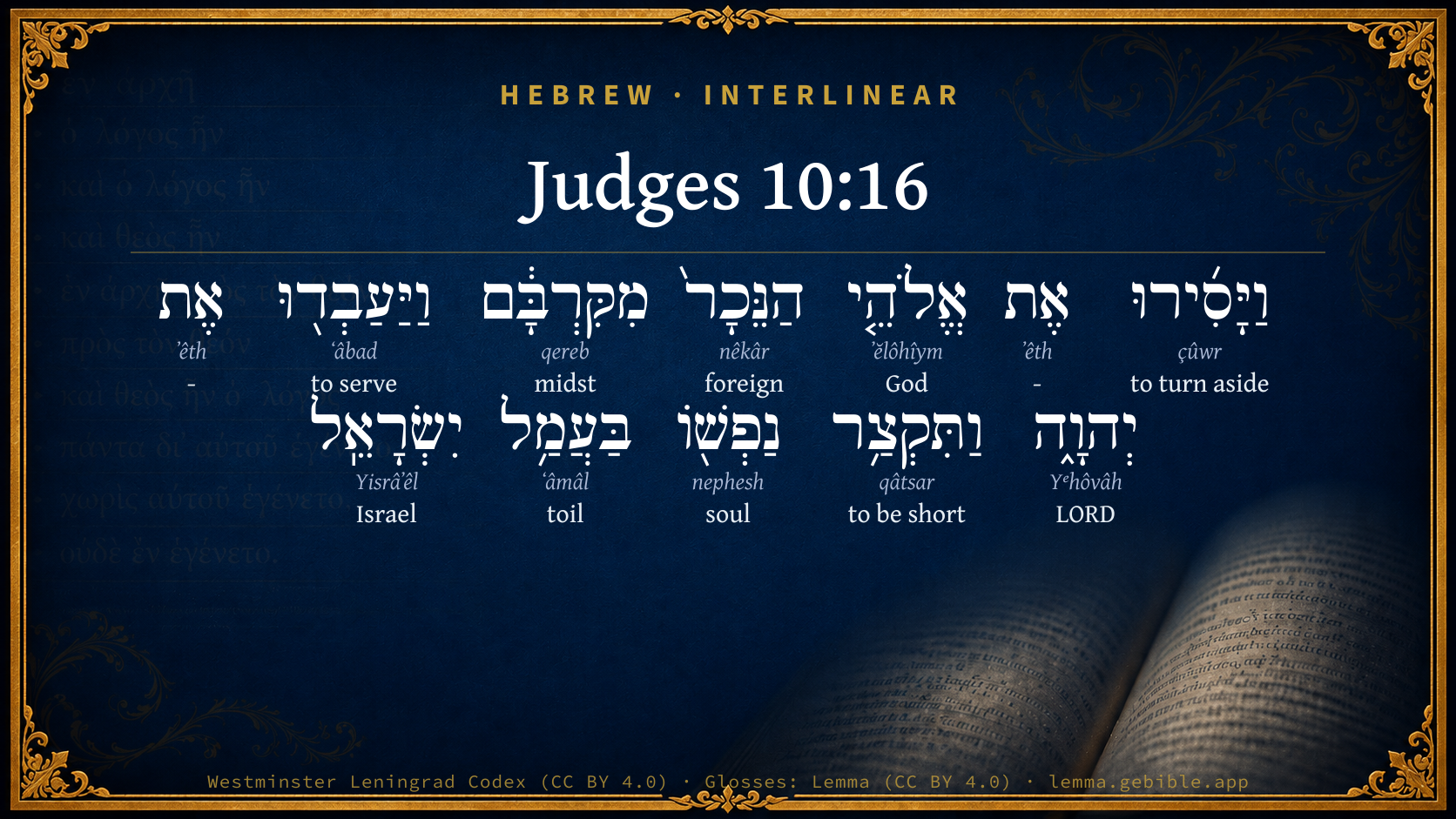
Hebrew (Westminster Leningrad Codex) Judges 10:16 appears in the Hebrew Old Testament. The text above is from the Westminster Leningrad Codex. Each word links to its Strong’s number, a concise gloss, and parsing drawn from the Open Scriptures Hebrew Bible morphology. Click any word for its full Brown-Driver-Briggs (BDB) entry.
Download image
Cite this verse

Judges 10:16 (World English Bible). Public Domain. Lemma interlinear Bible study tool, https://lemma.gebible.app/v/judges/10/16.

Show BibTeX & RIS
BibTeX
RIS
English Translation
They put away the foreign gods from among them, and served Yahweh; and his soul was grieved for the misery of Israel.
World English Bible · Public Domain
Download a study sheet

One document with this verse’s original text, its word-by-word gloss line, the meaning frame, cross-references with their text, attributed commentary, and full source and license credits — printable, and it pastes into notes with its structure intact.

This verse Autodidact and up

Study sheet (.html) Plain text (.txt)

A passage Seminary Student

Up to 50 verses in one chapter. A passage sheet keeps up to 6 commentary sources and 12 cross-references per verse, in the order this page ranks them, and says so on the sheet whenever that leaves anything out. Ask for a single verse and you get the Autodidact verse sheet above.

Everything on this page stays free to read, with no account — the sheet is a download of what is already on screen, not access to it.

Want to remove ads? Support Godless Engineer
Compare translations 3

The same verse in 3 English versions, stacked beneath the original-language interlinear above. Click any original word for its lexicon entry.

Each is an independent rendering of the whole verse — the interlinear is not word-aligned to these translations.

Highlighted words mark where these versions differ — a whole-verse word diff, not a word-by-word alignment.

  • World English Bible Public Domain
    They put away the foreign gods from among them, and served Yahweh; and his soul was grieved for the misery of Israel.
  • King James Version Public Domain
    And they put away the strange gods from among them, and served the LORD: and his soul was grieved for the misery of Israel.
  • unfoldingWord Literal Text CC BY-SA 4.0
    And they removed the foreign gods from the midst of them, and they served Yahweh. And his soul wore out with the trouble of Israel.

unfoldingWord Literal Text — © unfoldingWord, licensed CC BY-SA 4.0. Word-aligned USFM3 via Door43 (git.door43.org/unfoldingWord/en_ult).

Versions to compare (up to 4)

3 of 4 selected

Show all 18 translations

Every available English version of this verse, each an independent rendering of the whole verse.

  • World English Bible Public Domain
    They put away the foreign gods from among them, and served Yahweh; and his soul was grieved for the misery of Israel.
  • Berean Standard Bible Public Domain
    So they put away the foreign gods from among them and served the LORD, and He could no longer bear the misery of Israel.
  • Majority Standard Bible Public Domain
    So they put away the foreign gods from among them and served the LORD, and He could no longer bear the misery of Israel.
  • King James Version Public Domain
    And they put away the strange gods from among them, and served the LORD: and his soul was grieved for the misery of Israel.
  • American Standard Version (1901) Public Domain
    And they put away the foreign gods from among them, and served Jehovah; and his soul was grieved for the misery of Israel.
  • Revised Version (1885) Public Domain
    And they put away the strange gods from among them, and served the LORD: and his soul was grieved for the misery of Israel.
  • Geneva Bible (1599) Public Domain
    Then they put away the strange gods from among them and serued the Lord: and his soule was grieued for the miserie of Israel.
  • Douay-Rheims (1899) Public Domain
    And saying these things, they cast away out of their coasts all the idols of strange gods and served the Lord their God: and he was touched with their miseries.
  • Young's Literal Translation Public Domain
    And they turn aside the gods of the stranger out of their midst, and serve Jehovah, and His soul is grieved with the misery of Israel.
  • Literal Standard Version CC BY-SA 4.0
    And they turn aside the gods of the stranger out of their midst, and serve YHWH, and His soul is grieved with the misery of Israel.
  • Unlocked Literal Bible CC BY-SA 4.0
    They got rid of the foreign gods among them and they worshiped Yahweh. Then Yahweh could bear Israel's misery no longer.
  • unfoldingWord Literal Text CC BY-SA 4.0
    And they removed the foreign gods from the midst of them, and they served Yahweh. And his soul wore out with the trouble of Israel.
  • Darby Bible Public Domain
    So they put away the foreign gods from among them and served the LORD; and he became indignant over the misery of Israel.
  • World Messianic Bible Public Domain
    They put away the foreign gods from among them and served the LORD; and his soul was grieved for the misery of Israel.
  • Webster's Bible Public Domain
    And they put away the strange gods from among them, and served the LORD: and his soul was grieved for the misery of Israel.
  • Free Bible Version CC BY-SA 4.0
    So they got rid of the foreign gods they had and worshiped the Lord. And the Lord couldn't stand Israel's misery any longer.
  • Bible in Basic English Public Domain
    So they put away the strange gods from among them, and became the Lord's servants; and his soul was angry because of the sorrows of Israel.
  • JPS Tanakh (1917) Public Domain
    And they put away the strange gods from among them, and served the LORD; and His soul was grieved for the misery of Israel.

Literal Standard Version (2020), Covenant Press — licensed CC BY-SA 4.0. Text via the HelloAO Bible API (eBible.org). Unlocked Literal Bible (unfoldingWord) — licensed CC BY-SA 4.0. Text via the HelloAO Bible API (eBible.org). unfoldingWord Literal Text — © unfoldingWord, licensed CC BY-SA 4.0. Word-aligned USFM3 via Door43 (git.door43.org/unfoldingWord/en_ult). Free Bible Version, Dr. Jonathan Gallagher — licensed CC BY-SA 4.0. Text via the HelloAO Bible API (eBible.org).

Word by word

More ways to search: Search by grammar → Find every occurrence → Compare this word →

Practice this passage: Drill this verse → Learn its vocabulary →

הַנֵּכָר֙
nêkâr
H5236
“the · foreign”
Particle, Definite Article + Noun, Common, Masculine, Singular, Absolute
Part of Speech
Particle + Noun
Type
Common
Gender
Masculine
Number
Singular
State
Absolute
Full BDB Definition

Origin: from H5234

TWOT: 1368b

foreign, alien, foreignness, that which is foreign - foreignness, foreign gods - alien, foreigner - foreign (vanities)
  1. וַיָּסִ֜ירוּ çûwr H5493 “and · to turn aside” Conjunction + Verb, Hiphil, Sequential Imperfect, 3rd Person, Masculine, Plural
  2. אֶת ʼêth H853 “-” Particle, Direct Object
  3. אֱלֹהֵ֤י ʼĕlôhîym H430 “God(s) of” Noun, Common, Masculine, Plural, Construct
  4. מִקִּרְבָּ֔ם qereb H7130 “from · midst · their” Preposition + Noun, Common, Masculine, Singular, Construct + Suffix, Personal, 3rd Person, Masculine, Plural
  5. וַיַּעַבְד֖וּ ʻâbad H5647 “and · to serve” Conjunction + Verb, Qal, Sequential Imperfect, 3rd Person, Masculine, Plural
  6. אֶת ʼêth H853 “-” Particle, Direct Object
  7. יְהוָ֑ה Yᵉhôvâh H3068 “LORD” Noun, Proper
  8. וַתִּקְצַ֥ר qâtsar H7114 “and · to be short” Conjunction + Verb, Qal, Sequential Imperfect, 3rd Person, Feminine, Singular
  9. נַפְשׁ֖וֹ nephesh H5315 “soul · his” Noun, Common, Both, Singular, Construct + Suffix, Personal, 3rd Person, Masculine, Singular
  10. בַּעֲמַ֥ל ʻâmâl H5999 “in/at · toil of” Preposition + Noun, Common, Both, Singular, Construct
  11. יִשְׂרָאֵֽל Yisrâʼêl H3478 “Israel” Noun, Proper

About this verse

These counts appear in no published source. They are computed here, from the morphology-tagged text and Lemma’s own curated glosses. What Lemma adds →

12
words
11
distinct lemmas
Historical
section

Shared distinctive vocabulary

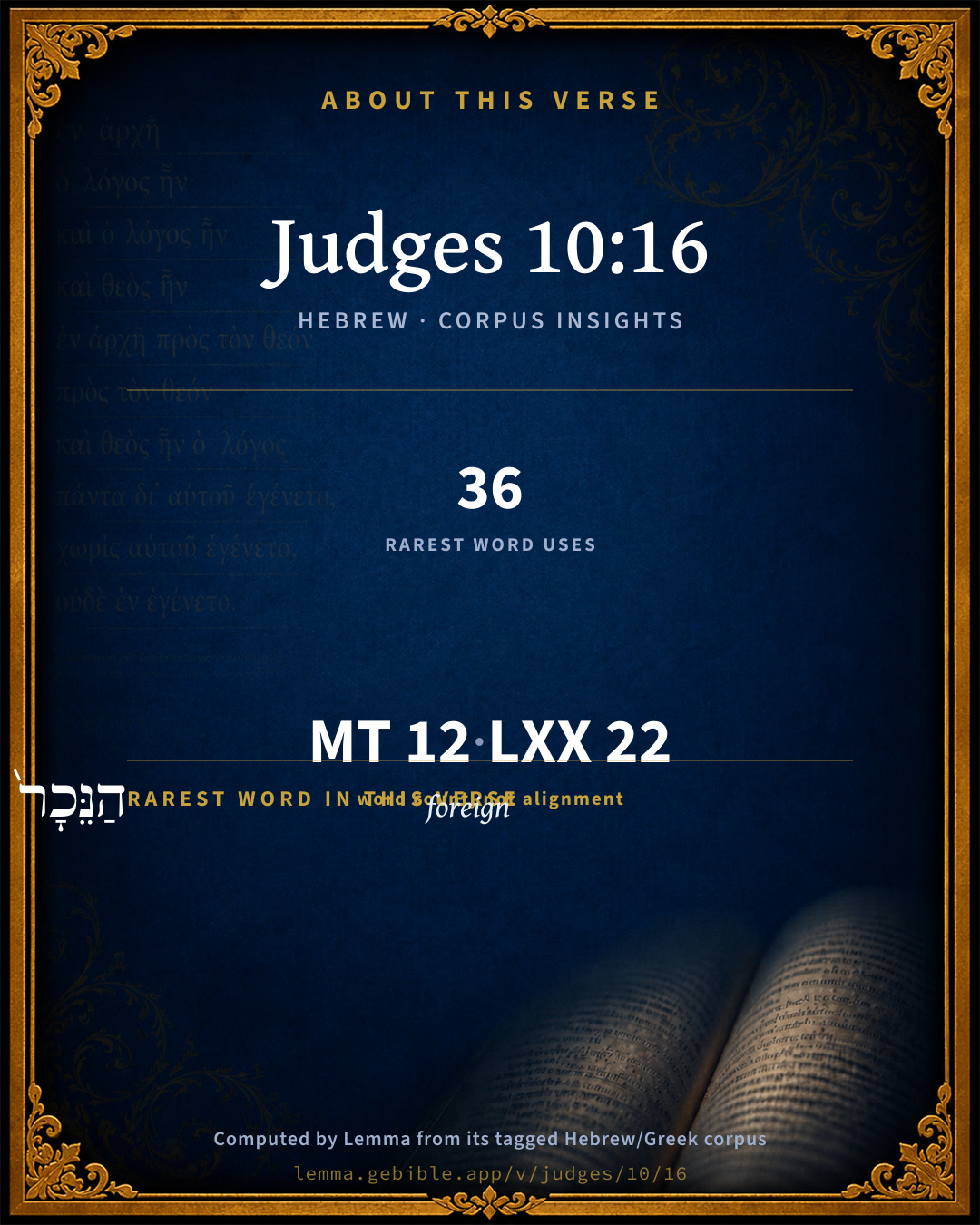
הַנֵּכָר֙ foreign H5236 occurs in 35 verses of the Hebrew Bible. Also found in:

Grammatical profile

  • 3 verbs
  • 7 nouns
  • 2 particles

Verb forms

  • וַיָּסִ֜ירוּ Hiphil · Sequential Imperfect
  • וַיַּעַבְד֖וּ Qal · Sequential Imperfect
  • וַתִּקְצַ֥ר Qal · Sequential Imperfect

Hebrew & Septuagint length

In English translation the verse runs 22 words from the Hebrew and 27 from the Septuagint (LXX English) — closely comparable.

A rough comparison of the two English renderings, which tokenize alike — not a word-level alignment.

Word counts can differ between the Hebrew and the Greek without any difference in meaning — e.g. the Hebrew direct-object marker אֵת has no separate Greek word, and Greek often adds the article ὁ.

In the original languages it is 12 Hebrew tokens and 22 Greek tokens — but the two are counted differently (Hebrew bundles its prefixes and suffixes into one token; the Greek is in lemma form), so that isn’t a like-for-like length.

Cross-references

20

Topical passages linked to Judges 10:16 in the Treasury of Scripture Knowledge — connected by theme and wording, ordered by reader-vote popularity; previews shown in the World English Bible.

  • Isaiah 63:9 In all their affliction he was afflicted, and the angel of his presence saved them: in his love and in his pity he redeemed them; and he bore them, and carried them all the days of old.
  • Psalms 106:44–45 Nevertheless he regarded their distress, When he heard their cry.
  • Jeremiah 31:20 Is Ephraim my dear son? is he a darling child? for as often as I speak against him, I do earnestly remember him still: therefore my heart yearns for him; I will surely have mercy on him, says Yahweh.
  • Hosea 11:8 "How can I give you up, Ephraim? How can I hand you over, Israel? How can I make you like Admah? How can I make you like Zeboiim? My heart is turned within me, My compassion is aroused.
  • Deuteronomy 32:36 For Yahweh will judge his people, Repent himself for his servants; When he sees that [their] power is gone, There is none [remaining], shut up or left at large.
  • 2 Chronicles 15:8 When Asa heard these words, and the prophecy of Oded the prophet, he took courage, and put away the abominations out of all the land of Judah and Benjamin, and out of the cities which he had taken from the hill-country of Ephraim; and he renewed the altar of Yahweh, that was before the porch of Yahweh.
  • Ezekiel 18:30–32 Therefore I will judge you, house of Israel, everyone according to his ways, says the Lord Yahweh. Return you, and turn yourselves from all your transgressions; so iniquity shall not be your ruin.
  • Luke 19:41 When he drew near, he saw the city and wept over it,
  • Ephesians 4:32 And be kind to one another, tenderhearted, forgiving each other, just as God also in Christ forgave you.
  • Genesis 6:6 Yahweh was sorry that he had made man on the earth, and it grieved him in his heart.
  • Joshua 24:23 Now therefore put away, [said he], the foreign gods which are among you, and incline your heart to Yahweh, the God of Israel.
  • 2 Chronicles 7:14 if my people, who are called by my name, shall humble themselves, and pray, and seek my face, and turn from their wicked ways; then will I hear from heaven, and will forgive their sin, and will heal their land.
  • 2 Chronicles 33:15 He took away the foreign gods, and the idol out of the house of Yahweh, and all the altars that he had built in the mountain of the house of Yahweh, and in Jerusalem, and cast them out of the city.
  • Jeremiah 18:7–8 At what instant I shall speak concerning a nation, and concerning a kingdom, to pluck up and to break down and to destroy it;
  • Hosea 14:1–3 Israel, return to Yahweh your God; For you have fallen because of your sin.
  • Hosea 14:8 Ephraim, what have I to do any more with idols? I answer, and will take care of him. I am like a green fir tree; From me your fruit is found."
  • Luke 15:20 "He arose, and came to his father. But while he was still far off, his father saw him, and was moved with compassion, and ran, and fell on his neck, and kissed him.
  • Hebrews 3:10 Therefore I was displeased with that generation, And said, 'They always err in their heart, But they didn't know my ways;'
  • Hebrews 4:15 For we don't have a high priest who can't be touched with the feeling of our infirmities, but one who has been in all points tempted like we are, yet without sin.
  • John 11:34 and said, "Where have you laid him?" They told him, "Lord, come and see."

Cross-references courtesy of OpenBible.info (CC BY 4.0).

Hebrew and Greek witnesses Masoretic Hebrew ↔ Greek Septuagint

The same verse in the two great witnesses to the Old Testament, shown verse-for-verse.

These are two independent witnesses, not word-aligned to each other, and the Septuagint is shown in lemma (dictionary) form.

Hebrew Judges 10:16 Masoretic · Westminster Leningrad Codex

וַיָּסִ֜ירוּ אֶת אֱלֹהֵ֤י הַנֵּכָר֙ מִקִּרְבָּ֔ם וַיַּעַבְד֖וּ אֶת יְהוָ֑ה וַתִּקְצַ֥ר נַפְשׁ֖וֹ בַּעֲמַ֥ל יִשְׂרָאֵֽל

They put away the foreign gods from among them, and served Yahweh; and his soul was grieved for the misery of Israel.

World English Bible · Public Domain

Greek LXX Judges 10:16 Septuagint · lemma form

καί ἐκκλίνω ὁ θεός ὁ ἀλλότριος ἐκ μέσος αὐτός καί δουλεύω ὁ κύριος μόνος καί ὀλιγόω ὁ ψυχή αὐτός ἐν κόπος ἰσραήλ

And they put away the strange gods from the midst of them, and served the Lord only, and his soul was pained for the trouble of Israel.

LXX2012 (modern English Septuagint) · Public Domain

Hebrew: Westminster Leningrad Codex (CC BY 4.0). Greek: Septuagint (public domain); English from LXX2012 (modern English Septuagint) (Public Domain). How the Septuagint differs from the Hebrew →

Targum (Aramaic paraphrase)

1

The Targum is the ancient Jewish Aramaic paraphrase of the Hebrew Scriptures — an interpretive translation, not the Hebrew text itself. Onkelos (literal) and Pseudo-Jonathan (expansive) render the Torah, and Jonathan the Prophets. Coverage is partial: where no permissively-licensed English translation exists for a verse, only the Aramaic is shown. This is verse-level text, not a word-by-word alignment to the Hebrew.

  1. Targum Jonathan Prophets (Joshua–Malachi)
    וְאַעֲדִיאוּ יַת טַעֲוַת עַמְמַיָא מִבֵּינֵיהוֹן וּפְלָחוּ קֳדָם יְיָ וְעָקַת נַפְשֵׁיהּ בַּעֲמַל יִשְׂרָאֵל:

    (no public-domain English translation for this verse)

    Targum Jonathan — Aramaic: “Mikraot Gedolot” (public domain). English: “Sefaria Community Translation” (CC0 1.0 (public-domain dedication)); “London "Chaldee Paraphrase," 1871” (public domain). Text via Sefaria.

Commentary

Notes on Judges 10:16 from classic Christian and Jewish commentators (each source and its license shown beneath its notes). The classic Christian expositions comment on the surrounding passage and are grouped to its opening verse, so a note may address several verses; the Jewish commentaries on the Tanakh (Rashi and others) are per-verse, so they appear only where the commentator wrote on this verse.

Lemma curates 59 commentaries, every one of them public domain or Creative Commons licensed, each selected and text-cleaned for this edition rather than reprinted as found. About our sources →

Jamieson, Fausset & Brown

Robert Jamieson, A. R. Fausset & David Brown

THEY REPENT; GOD PITIES THEM. (Jdg 10:16-18)

they put away the strange gods . . . and served the Lord; and his soul was grieved for the misery of Israel--On their abandonment of idolatry and return to purity of worship, God graciously abridged the term of national affliction and restored times of peace.

Jamieson, Fausset & Brown — Commentary Critical and Explanatory on the Whole Bible (1871) — public domain (CC PDM 1.0). Text via the HelloAO Bible API.

Trapp's Complete Commentary

John Trapp

Jdg 10:16 And they put away the strange gods from among them, and served the LORD: and his soul was grieved for the misery of Israel.

Ver. 16. And they put away the strange gods from among them.] This was it that completed their repentance. What is humiliation without reformation? Optima et aptissima poenitentia est nova vita, saith Luther. Ephraim never repented indeed till he said, "What have I to do any more with idols?" When these words once fell from him, then "God heard him, and observed him," {Hos 14:8} yea, God melted over him, and said, "I will surely have mercy upon him." {Jer 31:20} And the like he did here, for

His soul was grieved for the misery of Israel.] O gracious God, what could have been spoken more for the honour of thy goodness, and for the comfort of thy poor afflicted! God’s soul was shortened, he could hold in no longer; Postquam poenitentitiara egerunt, totus ipsorum factus est; now that they had repented, they might have but what they would of him.

“ Flectitur oratus voce rogante Deus. ” - Ovid.

John Trapp, A Commentary or Exposition upon All the Books of the Old and New Testament (1647–1656) — public domain. Text from a community e-Sword module.

Joseph Benson's Commentary

Jdg 10:16. They put away the strange gods — As an evidence of the sincerity of their sorrow, and that they did not only confess their sins, but also forsake them. And it is probable that, for the present, a thorough reformation took place, and that they entirely quitted the worship of strange gods, and served the Lord alone. His soul was grieved for the misery of Israel — That is, upon their repentance and reformation he turned away his anger, had compassion upon them on account of their miseries, and acted toward them like one that felt their sufferings. He changed his carriage toward them, and punished their enemies as sorely as if they had grieved and injured his own person. From this chapter we may learn the amazing depravity of human nature, and how readily it falls from one degree of degeneracy to another. God, who knows what our nature is, foresaw that apostacy to idolatry would be the certain consequence of the Israelites dwelling among the heathen nations, and therefore had strictly commanded them to expel those nations entirely out of Canaan, and to have no communication with them. But the Israelites did not obey his commands in this; and, in neglecting this one thing, fell into all the errors, crimes, and miseries, which God had forewarned them would be the consequence. They thought there was but little harm in letting the Canaanites remain among them as long as they lived peaceably with them. But, alas! evil communication unavoidably corrupts good manners; they could not converse and traffic with the Canaanites without, by degrees, contracting a friendship with them, perhaps thinking they should be strengthened by these alliances with the inhabitants of the land. This naturally produced at least a complaisant deference to their customs and religious ceremonies, and, in a little longer time, the adjoining some of those customs and ceremonies with their own; till at last they fell into all the abominations of the nations; to deliver them from which, the true God had done so many wondrous works. From hence we may learn how we may, by offending in a single point only, and that not seeming in itself absolutely immoral, or of any great consequence, be by degrees carried entirely out of the paths of piety, and brought to the greatest degeneracy. We may further observe, from the circumstances of the Israelites, related in this chapter, that afflictions are of great use, and are employed by God to bring men to a right sense of their duty, and into the paths of righteousness, from which they had wandered by their follies. And we may also learn, that God is always ready to receive us with forgiveness and mercy whenever we return to him.

Joseph Benson's Commentary on the Old and New Testaments (1811–1818) — public domain. Text from a community e-Sword module.

Geneva Bible (1599)

Geneva Bible translators

This is true repentance, to put away the evil, and to serve God aright.

Or, he pitied.

Geneva Bible (1599) marginal notes — public domain. Text via Bolls.life.

Adam Clarke's Commentary

Verse 16. And his soul was grieved for the misery of Israel.] What a proof of the philanthropy of God! Here his compassions moved on a small scale; but it was the same principle that led him to give his Son Jesus Christ to be a sacrifice for the sins of the WHOLE world. God grieves for the miseries to which his creatures are reduced by their own sins. Be astonished, ye heavens, at this; and shout for joy, all ye inhabitants of the earth! for, through the love whence this compassion flowed, God has visited and redeemed a lost world!

Adam Clarke's Commentary on the Bible (1810–1826) — public domain. Text from a community e-Sword/MySword module.

Ellicott's Commentary for English Readers

(16) They put away the strange gods.—The moment the sincerity of their repentance was proved, God hears them (Gen_35:1; 1Sa_7:3; 2Ch_15:8).

His soul was grieved.—Literally, was shortened. (Comp. Zec_11:8.)

A Bible Commentary for English Readers, edited by Charles John Ellicott (1878–1897) — public domain. Text from a community e-Sword module.

The Cambridge Bible for Schools and Colleges

gen. ed. J. J. S. Perowne

16. The first half of the verse resembles Gen_35:2 E, Jos_24:20-23 E, 1Sa_7:3.

strange gods] i.e. foreign gods, E’s expression: Jos_24:20; Jos_24:23, etc.; contrast other gods, Jdg_10:13.

was grieved] lit. was shortened, cf. Jdg_16:16, Exo_6:9, Num_21:4, Zec_11:8; i.e. He lost patience, He could bear Israel’s distress no longer. Jehovah’s impatience (cf. Mic_2:7 RVm.) is aroused by mingled pity and indignation.

The Cambridge Bible for Schools and Colleges (gen. ed. J. J. S. Perowne; Cambridge University Press, 1878–1918) — public domain. Text from a community e-Sword module.

John Gill's Exposition

And they put away the strange gods from among them,.... Which was an evidence of the truth of their repentance, and showed their confessions and humiliations to be genuine:

and served the Lord; and him only, both in private and public; in the observance of duties, both moral and ceremonial; in an attendance on the service of the sanctuary, and by offering sacrifices to God there, according to his will:

and his soul was grieved for the misery of Israel; which is to be understood after the manner of men; for grief properly does not belong to God, there being no passion in him; but it denotes a carriage or behaviour of his, which shows what looks like sympathy in men; a love and affection for Israel, notwithstanding their ill behaviour to him, and a change of his dispensations Providence towards them, according to his unchangeable will; so Maimonides (b) understands it of the good will and pleasure of God, to cease from afflicting the people of Israel; but Abarbinel is of opinion that this refers to the soul of Israel, which was shortened and contracted, as the word signifies, because of the labour of servitude, the affliction and distress they were in.

(b) Moreh Nevochim, par. 1. c. 41.

John Gill's Exposition of the Whole Bible (1746–1763) — public domain (CC PDM 1.0). Text via the HelloAO Bible API.

Haydock's Catholic Bible Commentary

Touched. Literally, "grieved." Hebrew, "his soul was straitened," as in joy it is said to be enlarged. He speaks of God in a human manner. (Calmet) (Genesis vi. 6.) (Menochius)

George Leo Haydock (1774–1849), Haydock's Catholic Family Bible and Commentary, 1859 edition — public domain. Excludes Psalms (Douay-Rheims chapter numbering differs from Protestant) and Deuterocanonical books (Catholic canon only).

Matthew Poole's English Annotations

They put away the strange gods: this was an evidence of the sincerity of their sorrow, that they did not only confess and bewail their sins, but also forsake them, and loathe themselves for them.

His soul was grieved; not properly, or as to inward affection; for God being infinitely happy, is not capable of grieving; but figuratively, and as to outward expression. He acted towards them like one that felt their sufferings; he had pity upon them, repented of his severe proceedings against them, and quite changed his carriage towards them, and punished their enemies as sorely as if they had grieved and injured his own person.

Matthew Poole's English Annotations on the Holy Bible (1683–1685) — public domain. Text from a community e-Sword/MySword module.

Whedon's Commentary on the Bible

Daniel D. Whedon

16. Put away the strange gods — They no longer repented in words only, by a mere confession of their guilt, but proceeded to bring forth fruit worthy of repentance. So in every genuine conversion there must be added to confession an earnest revolt and turning away from the old sins.

His soul was grieved — Literally, was shortened; that is, thrilled with the most intense emotions of distress and anxiety. Compare the similar sense of the verb קצר, in Jdg_16:16; Num_21:4; Job_21:4; Zec_11:8. This text shows that Jehovah’s nature is profoundly emotional, which fact, instead of detracting from our reverence of him, should serve to give us a more affecting view of the divine character. See notes on Jdg_2:14; Jdg_2:18, and 1Sa_15:11.

Daniel D. Whedon (gen. ed.), Commentary on the Old and New Testaments (1874–1909) — public domain. Text from a community e-Sword module.

The Pulpit Commentary

And they put away the strange gods. Here at length were "the fruits meet for repentance," and "the returning to the Lord their God;" the intended result of the severe but loving correction. (see Homiletics, Jud 6:25-32) Cf. Gen_35:2 1Sa_7:3, in which passages, as here, the phrase the strange gods is the correct rendering; not, as in the margin, gods of strangers. The Hebrew phrase here rendered his soul was grieved occurs Num_21:4 Jud_1:16:16 Zec_11:2; it means was impatient literally, was shortened, i.e. he could bear it no longer. A somewhat similar description of the Divine relenting is contained in the beautiful passage Hos_11:7-9.

The Pulpit Commentary (1880–1919), ed. H.D.M. Spence-Jones & Joseph S. Exell — public domain. Text from a community e-Sword module.

John Wesley's Explanatory Notes

They put away - This was an evidence of the sincerity of their sorrow, that they did not only confess their sins, but also forsake them. His soul, &c. - He acted towards them, like one that felt their sufferings; he had pity upon them, quite changed his carriage towards them, and punished their enemies as sorely as if they had grieved and injured his own person.

John Wesley, Explanatory Notes Upon the Whole Bible (1754–1765) — public domain. Text via the GEBible commentary corpus.

Rashi

Rabbi Shlomo Yitzchaki (Rashi)

Could not contain Himself at [Yisroel's] anguish. As if one could depict God as lacking the space to bear and encompass His pain at Yisroel's anguish.

Rashi on the Tanakh — English translations: “The Judaica Press complete Tanach with Rashi, translated by A. J. Rosenberg” (CC BY 4.0); “Pentateuch with Rashi's commentary by M. Rosenbaum and A.M. Silbermann, 1929-1934” (public domain); “The Metsudah Tanach series, Lakewood, N.J” (CC BY 4.0); and “The Book of Joshua, Metsudah Publications, 1997” (CC BY 4.0). Text via Sefaria.

Lesson kit

Teaching starters — assembled from the data on this page, not authored interpretation. Every prompt links to the verse data it draws on. Edit before teaching.

Judges, in the Historical, opens this verse with 12 words (11 distinct Hebrew lemmas). Its most distinctive word is nêkâr (“foreign”). A historical commentator’s framing appears above. Read the whole chapter for the surrounding context.

Discussion questions

  1. The word nêkâr carries the sense “foreign.” How does it shape the verse?
  2. Genesis 17:12 shares the word «foreign» with this verse. How do the two illuminate each other?
  3. These translations render this verse differently; the difference is in the English rendering, not the original. What questions does that raise?
  4. The verb «וַיָּסִ֜ירוּ» is Hiphil Sequential Imperfect. How does its form color the action?
  5. Reading how Jamieson, Fausset & Brown and Trapp's Complete Commentary read this verse, where do the two commentators agree and where do they part?

Things to notice

Reading settings

Reading text

Shown beneath each verse's original-language words.

Old Testament
Old Testament edition

Read the OT as the Masoretic Hebrew (MT) or the Greek Septuagint (LXX).

English shown for the Greek Septuagint (in the Hebrew ↔ Greek comparison).

Comparing translations? Open the Compare panel on any verse page to stack up to four side by side.