
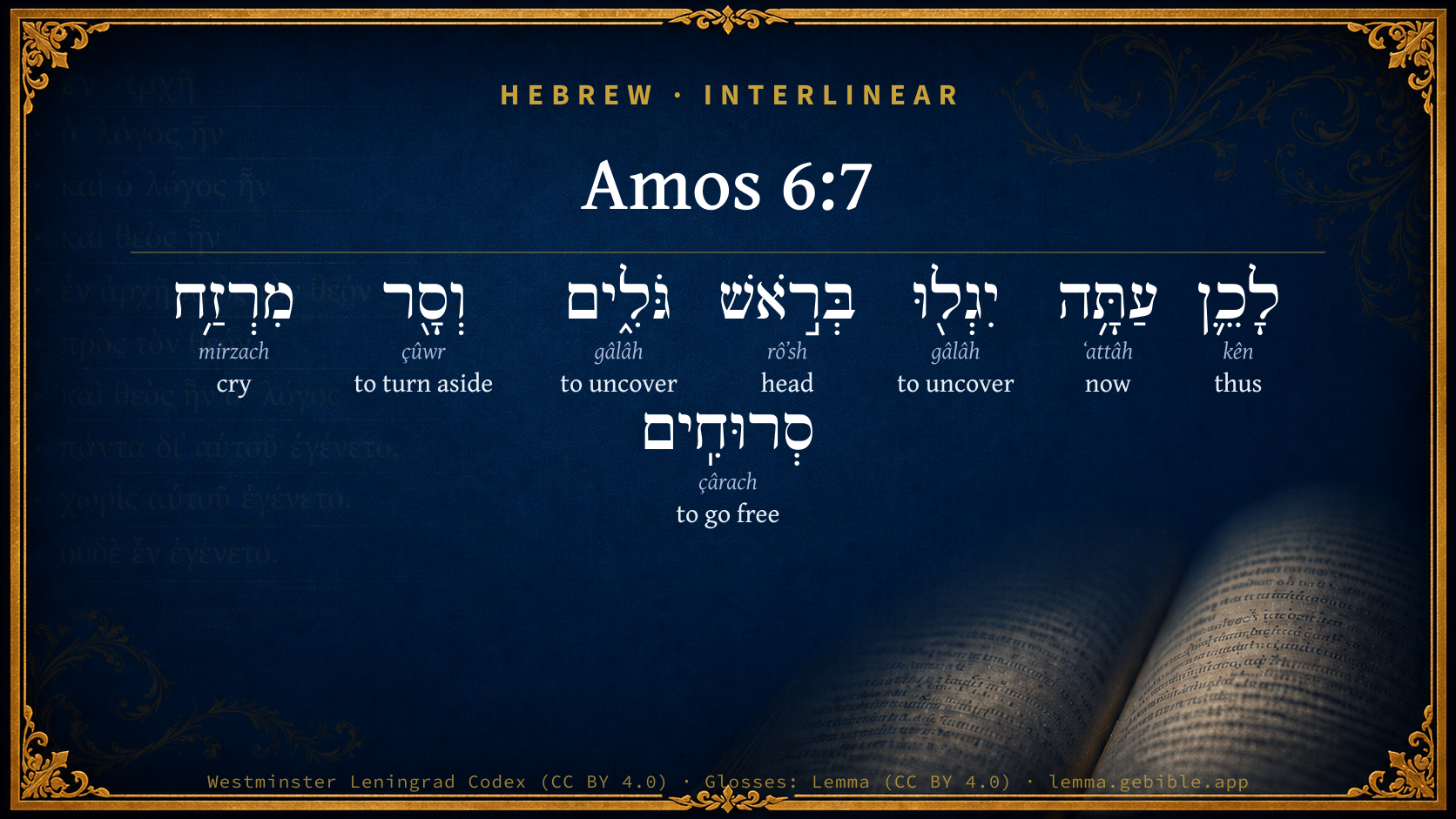
Amos 6:7

Hebrew (Westminster Leningrad Codex) Amos 6:7 appears in the Hebrew Old Testament. The text above is from the Westminster Leningrad Codex. Each word links to its Strong’s number, a concise gloss, and parsing drawn from the Open Scriptures Hebrew Bible morphology. Click any word for its full Brown-Driver-Briggs (BDB) entry.
Download image
Cite this verse

Amos 6:7 (World English Bible). Public Domain. Lemma interlinear Bible study tool, https://lemma.gebible.app/v/amos/6/7.

Show BibTeX & RIS
BibTeX
RIS
English Translation
Therefore they will now go captive with the first who go captive; And the feasting and lounging will end.
World English Bible · Public Domain
Highlights
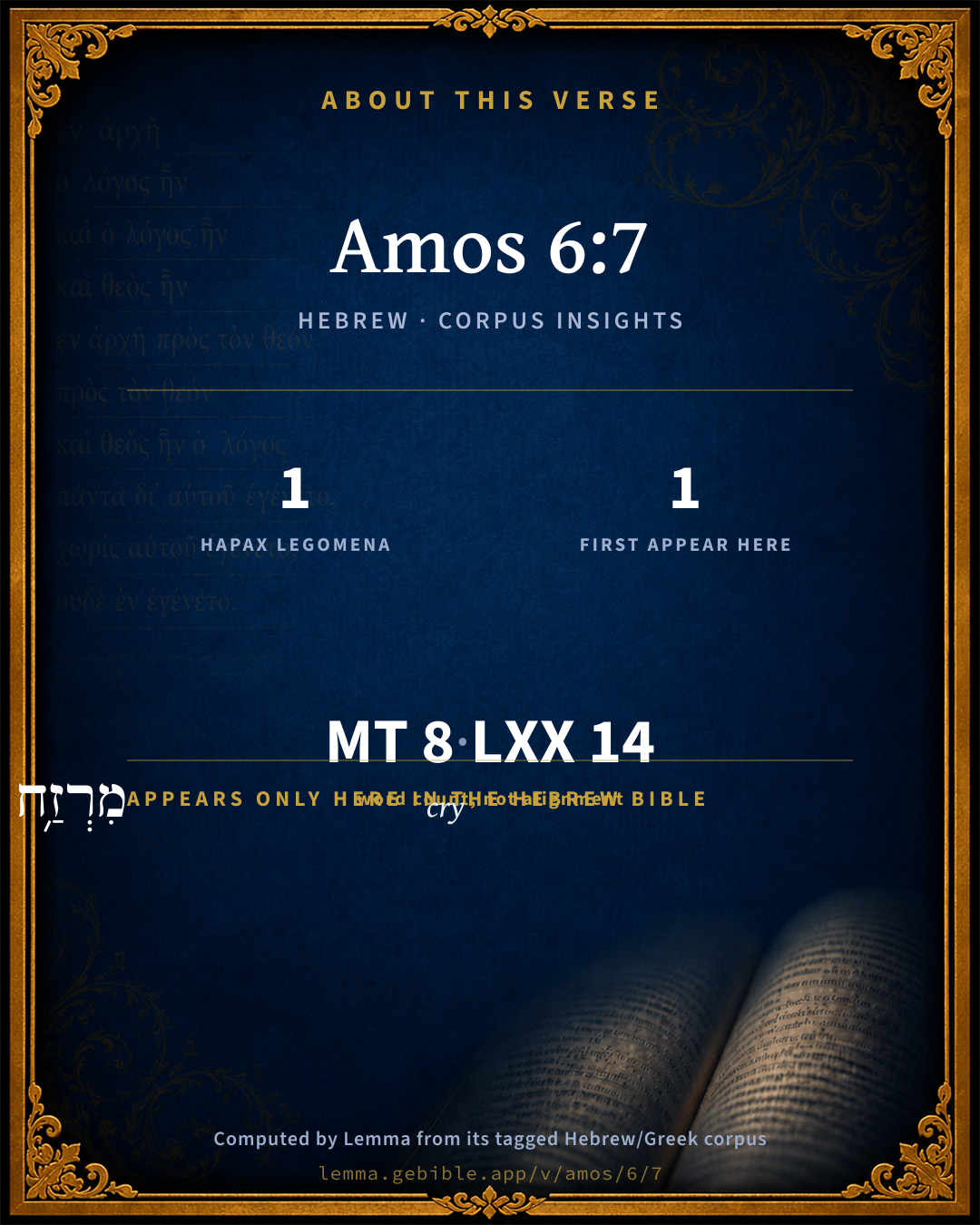
  • 1 hapax legomenon — only here in the Hebrew Bible
  • 1 first appearance in the Hebrew Bible
Full analysis ↓
Download a study sheet

One document with this verse’s original text, its word-by-word gloss line, the meaning frame, cross-references with their text, attributed commentary, and full source and license credits — printable, and it pastes into notes with its structure intact.

This verse Autodidact and up

Study sheet (.html) Plain text (.txt)

A passage Seminary Student

Up to 50 verses in one chapter. A passage sheet keeps up to 6 commentary sources and 12 cross-references per verse, in the order this page ranks them, and says so on the sheet whenever that leaves anything out. Ask for a single verse and you get the Autodidact verse sheet above.

Everything on this page stays free to read, with no account — the sheet is a download of what is already on screen, not access to it.

Want to remove ads? Support Godless Engineer
Compare translations 3

The same verse in 3 English versions, stacked beneath the original-language interlinear above. Click any original word for its lexicon entry.

Each is an independent rendering of the whole verse — the interlinear is not word-aligned to these translations.

Highlighted words mark where these versions differ — a whole-verse word diff, not a word-by-word alignment.

  • World English Bible Public Domain
    Therefore they will now go captive with the first who go captive; And the feasting and lounging will end.
  • King James Version Public Domain
    Therefore now shall they go captive with the first that go captive, and the banquet of them that stretched themselves shall be removed.
  • unfoldingWord Literal Text CC BY-SA 4.0
    Therefore, now they will go into exile with the first exiles, and the feasts of those who lounge about will pass away.

unfoldingWord Literal Text — © unfoldingWord, licensed CC BY-SA 4.0. Word-aligned USFM3 via Door43 (git.door43.org/unfoldingWord/en_ult).

Versions to compare (up to 4)

3 of 4 selected

Show all 18 translations

Every available English version of this verse, each an independent rendering of the whole verse.

  • World English Bible Public Domain
    Therefore they will now go captive with the first who go captive; And the feasting and lounging will end.
  • Berean Standard Bible Public Domain
    Therefore, you will now go into exile as the first of the captives, and your feasting and lounging will come to an end.
  • Majority Standard Bible Public Domain
    Therefore, you will now go into exile as the first of the captives, and your feasting and lounging will come to an end.
  • King James Version Public Domain
    Therefore now shall they go captive with the first that go captive, and the banquet of them that stretched themselves shall be removed.
  • American Standard Version (1901) Public Domain
    Therefore shall they now go captive with the first that go captive; and the revelry of them that stretched themselves shall pass away.
  • Revised Version (1885) Public Domain
    Therefore now shall they go captive with the first that go captive, and the revelry of them that stretched themselves shall pass away.
  • Geneva Bible (1599) Public Domain
    Therefore nowe shall they go captiue with the first that go captiue, and the sorow of them that stretched themselues, is at hand.
  • Douay-Rheims (1899) Public Domain
    Wherefore now they shall go captive at the head of them that go into captivity: and the faction of the luxurious ones shall be taken away.
  • Young's Literal Translation Public Domain
    Therefore now they remove at the head of the captives, And turned aside is the mourning-feast of stretched-out ones.
  • Literal Standard Version CC BY-SA 4.0
    Therefore they now go at the head of the captives, || And the mourning-feast of stretched-out ones is turned aside.
  • Unlocked Literal Bible CC BY-SA 4.0
    So they will now go into exile with the first exiles, and the feasts of those who lounge about will pass away.
  • unfoldingWord Literal Text CC BY-SA 4.0
    Therefore, now they will go into exile with the first exiles, and the feasts of those who lounge about will pass away.
  • Darby Bible Public Domain
    Therefore shall they now go captive, with the first that go captive, and the revelry of them that stretched themselves shall pass away.
  • World Messianic Bible Public Domain
    Therefore they will now go captive with the first who go captive. The feasting and lounging will end.
  • Webster's Bible Public Domain
    Therefore now shall they go captive with the first that go captive, and the banquet of them that stretched themselves shall be removed.
  • Free Bible Version CC BY-SA 4.0
    So you will be at the head of those led away into exile; the feasting and lazing around will be over.
  • Bible in Basic English Public Domain
    So now they will go away prisoners with the first of those who are made prisoners, and the loud cry of those who were stretched out will come to an end.
  • JPS Tanakh (1917) Public Domain
    Therefore now shall they go captive at the head of them that go captive, and the revelry of them that stretched themselves shall pass away.

Literal Standard Version (2020), Covenant Press — licensed CC BY-SA 4.0. Text via the HelloAO Bible API (eBible.org). Unlocked Literal Bible (unfoldingWord) — licensed CC BY-SA 4.0. Text via the HelloAO Bible API (eBible.org). unfoldingWord Literal Text — © unfoldingWord, licensed CC BY-SA 4.0. Word-aligned USFM3 via Door43 (git.door43.org/unfoldingWord/en_ult). Free Bible Version, Dr. Jonathan Gallagher — licensed CC BY-SA 4.0. Text via the HelloAO Bible API (eBible.org).

Word by word

More ways to search: Search by grammar → Find every occurrence → Compare this word →

Practice this passage: Drill this verse → Learn its vocabulary →

About this verse

These counts appear in no published source. They are computed here, from the morphology-tagged text and Lemma’s own curated glosses. What Lemma adds →

8
words
7
distinct lemmas
Prophets
section

Notable vocabulary

1 hapax legomenon — a word that appears only here in the entire Hebrew Bible:

  • מִרְזַ֥ח cry H4797

First appearance in Scripture

This word makes its first canonical appearance in the Hebrew Bible here:

  • מִרְזַ֥ח cry H4797

Shared distinctive vocabulary

סְרוּחִֽים to go free H5628 occurs in 7 verses of the Hebrew Bible. Also found in:

Grammatical profile

  • 4 verbs
  • 2 nouns
  • 2 adverbs

Verb forms

  • יִגְל֖וּ Qal · Imperfect
  • גֹּלִ֑ים Qal · Participle Active
  • וְסָ֖ר Qal · Sequential Perfect
  • סְרוּחִֽים Qal · Participle Passive

Repetition

A word recurs within this verse — often emphatic in Hebrew:

  • יִגְל֖וּ to uncover H1540 ×2

Hebrew & Septuagint length

In English translation the verse runs 19 words from the Hebrew and 23 from the Septuagint (LXX English) — closely comparable.

A rough comparison of the two English renderings, which tokenize alike — not a word-level alignment.

Word counts can differ between the Hebrew and the Greek without any difference in meaning — e.g. the Hebrew direct-object marker אֵת has no separate Greek word, and Greek often adds the article ὁ.

In the original languages it is 8 Hebrew tokens and 14 Greek tokens — but the two are counted differently (Hebrew bundles its prefixes and suffixes into one token; the Greek is in lemma form), so that isn’t a like-for-like length.

Cross-references

14

Topical passages linked to Amos 6:7 in the Treasury of Scripture Knowledge — connected by theme and wording, ordered by reader-vote popularity; previews shown in the World English Bible.

  • Amos 7:11 For Amos says, 'Jeroboam will die by the sword, and Israel shall surely be led away captive out of his land.'"
  • 1 Kings 20:16–20 They went out at noon. But Ben Hadad was drinking himself drunk in the pavilions, he and the kings, the thirty-two kings who helped him.
  • Daniel 5:4–6 They drank wine, and praised the gods of gold, and of silver, of brass, of iron, of wood, and of stone.
  • Amos 5:5 But don't seek Bethel, Nor enter into Gilgal, And don't pass to Beersheba: For Gilgal shall surely go into captivity, And Bethel shall come to nothing.
  • Deuteronomy 28:41 You shall father sons and daughters, but they shall not be yours; for they shall go into captivity.
  • Esther 5:8 if I have found favor in the sight of the king, and if it please the king to grant my petition, and to perform my request, let the king and Haman come to the banquet that I shall prepare for them, and I will do tomorrow as the king has said.
  • Esther 5:12–14 Haman said moreover, Yes, Esther the queen did let no man come in with the king to the banquet that she had prepared but myself; and tomorrow also am I invited by her together with the king.
  • Esther 7:1–2 So the king and Haman came to banquet with Esther the queen.
  • Esther 7:8–10 Then the king returned out of the palace garden into the place of the banquet of wine; and Haman was fallen on the couch whereon Esther was. Then said the king, Will he even force the queen before me in the house? As the word went out of the king's mouth, they covered Haman's face.
  • Isaiah 21:4 My heart flutters, horror has frightened me; the twilight that I desired has been turned into trembling to me.
  • Amos 5:27 Therefore will I cause you to go into captivity beyond Damascus," says Yahweh, whose name is the God of hosts.
  • Amos 7:17 Therefore thus says Yahweh: 'Your wife shall be a prostitute in the city, and your sons and your daughters shall fall by the sword, and your land shall be divided by line; and you yourself shall die in a land that is unclean, and Israel shall surely be led away captive out of his land.'"
  • Nahum 1:10 For entangled like thorns, and drunken as with their drink, they are consumed utterly like dry stubble.
  • Luke 21:24 They will fall by the edge of the sword, and will be led captive into all the nations. Jerusalem will be trampled down by the Gentiles, until the times of the Gentiles are fulfilled.

Cross-references courtesy of OpenBible.info (CC BY 4.0).

Hebrew and Greek witnesses Masoretic Hebrew ↔ Greek Septuagint

The same verse in the two great witnesses to the Old Testament, shown verse-for-verse.

These are two independent witnesses, not word-aligned to each other, and the Septuagint is shown in lemma (dictionary) form.

Hebrew Amos 6:7 Masoretic · Westminster Leningrad Codex

לָכֵ֛ן עַתָּ֥ה יִגְל֖וּ בְּרֹ֣אשׁ גֹּלִ֑ים וְסָ֖ר מִרְזַ֥ח סְרוּחִֽים

Therefore they will now go captive with the first who go captive; And the feasting and lounging will end.

World English Bible · Public Domain

Greek LXX Amos 6:7 Septuagint · lemma form

διά οὗτος νῦν αἰχμάλωτος εἰμί ἀπό ἀρχή δυνάστης καί ἐκαἴρω χρεμετισμός ἵππος ἐκ ἐφράιμ

Therefore now shall they depart into captivity from the dominion of princes, and the neighing of horses shall be cut off from Ephraim.

LXX2012 (modern English Septuagint) · Public Domain

On this verse, Haydock's Catholic Bible Commentary discusses the Septuagint’s reading. Read the note in Commentary ↓

Hebrew: Westminster Leningrad Codex (CC BY 4.0). Greek: Septuagint (public domain); English from LXX2012 (modern English Septuagint) (Public Domain). How the Septuagint differs from the Hebrew →

Targum (Aramaic paraphrase)

1

The Targum is the ancient Jewish Aramaic paraphrase of the Hebrew Scriptures — an interpretive translation, not the Hebrew text itself. Onkelos (literal) and Pseudo-Jonathan (expansive) render the Torah, and Jonathan the Prophets. Coverage is partial: where no permissively-licensed English translation exists for a verse, only the Aramaic is shown. This is verse-level text, not a word-by-word alignment to the Hebrew.

  1. Targum Jonathan Prophets (Joshua–Malachi)
    בְּכֵן כְּעַן יִגְלָן בְּרֵישׁ גָלָן וְיֶעְדוּן מִנְהוֹן מַרְזְחִין וּמַכִּיכִין:

    (no public-domain English translation for this verse)

    Targum Jonathan — Aramaic: “Mikraot Gedolot” (public domain). English: “Sefaria Community Translation” (CC0 1.0 (public-domain dedication)); “London "Chaldee Paraphrase," 1871” (public domain). Text via Sefaria.

Commentary

Notes on Amos 6:7 from classic Christian and Jewish commentators (each source and its license shown beneath its notes). The classic Christian expositions comment on the surrounding passage and are grouped to its opening verse, so a note may address several verses; the Jewish commentaries on the Tanakh (Rashi and others) are per-verse, so they appear only where the commentator wrote on this verse.

Lemma curates 59 commentaries, every one of them public domain or Creative Commons licensed, each selected and text-cleaned for this edition rather than reprinted as found. About our sources →

Trapp's Complete Commentary

John Trapp

Amo 6:7 Therefore now shall they go captive with the first that go captive, and the banquet of them that stretched themselves shall be removed.

Ver. 7. Therefore now shall they go captive with the first] Heb. in the head of those that go captive: as they have been first in the degrees of honour and of sin, so shall they be now of punishment, according to that saying of the Centurists, Ingentia beneficia, ingentia flagitia, ingentia supplicia vast blessings, immoderate disgraces, enormous punishments (Magdeburg). This they shall have of God’s hand, they shall lie down in sorrow, Isa 50:11; yea, many sorrows shall be to those wicked ones, Psa 32:10, these merciless men shall not have the least mercy shown to them, Jas 2:13. God will surely set off all hearts from such, as he did from Haman, for whom in his misery not one man openeth his mouth once to intercede, and he will punish, magnum luxum magno luctu, as one saith, great luxury with great necessity.

And the banquet of them that stretched themselves] They shall neither have mind nor money to make feasts, that were wont to lay on in all sorts of superfluities. That prodigal abovementioned was by a just hand of God reduced to extreme penury, and cast off by all his former acquaintance. That luxurious Roman, Apicius (the expenses of whose kitchen amounted to more than two millions of gold), having eaten up his estate, and fearing poverty, poisoned himself; leaving behind him ten books of direction how to furnish and set forth a feast with all manner of varieties, which now he could sooner talk of than take of. The word here rendered banquet is taken for a funeral feast, Jer 16:5, and so some think the sense here is; they shall be carried captive into a far country, and there be deprived of the honour of burials; which is a judgment elsewhere threatened, Jer 22:18-19. Aben Ezra rendereth it, facesset canticum, the song of the wanton shall be set packing; and for this he allegeth, that in the Arabic dialect the root word here used signifieth to lift up the voice, either for joy or grief. The Seventy render it the neighing of horses; as noting their immoderate lust, according to Jer 5:8. And this sense Ribera commendeth.

John Trapp, A Commentary or Exposition upon All the Books of the Old and New Testament (1647–1656) — public domain. Text from a community e-Sword module.

Joseph Benson's Commentary

Amo 6:7-8. Therefore now shall they go captive with the first, &c. — As they were reckoned the first among the people, and claimed the preference in every thing, so now shall they be the first that shall be carried into captivity. And the banquet of them that stretched themselves shall be removed — They who indulged themselves in ease and luxury shall have no more costly banquets spread before them: all their luxurious living shall be at an end. The Lord hath sworn by himself — And will not violate his oath; I abhor the excellency of Jacob — Whatever the kingdoms of Israel and Judah value themselves for is hateful to me, as having been abused by them, and made instrumental in dishonouring me. Or, the words should rather be rendered, I abhor the pride of Jacob. Inhumanity and hardness of heart, as well as many other vices, are generally the companions of pride; and therefore God always expresses, in the Scriptures, the utmost abhorrence of that sin. Therefore I will deliver up the city — Namely, the city of Samaria first, and then that of Jerusalem.

Joseph Benson's Commentary on the Old and New Testaments (1811–1818) — public domain. Text from a community e-Sword module.

The Preacher's Complete Homiletical Commentary

Joseph S. Exell (gen. ed.)

CRITICAL NOTES.]

Amo_6:7. Head] Chiefs in transgression must be first in the procession to captivity. Banquet] Lit. making merry with shouts.

Amo_6:8. Sworn] “Like ch. Amo_4:2, except that it is by himself instead of by his holiness, but the sense is the same, for the nephesh of Jehovah, i.e. his inmost self or being, is his holiness” [Keil].

Amo_6:9. Ten] A rare case (ch. Amo_5:3).

Amo_6:10. Uncle] Any relative who had to bury the dead (Gen_25:9 : Jdg_16:31). Burn.] in case of necessity. Bones] i.e. the dead body (Gen_50:25; Exo_13:19). Say] Ask one discovered if he is the only survivor. Hold] The burier bids the survivor be silent, lest by invocation God should make him a victim of death. All hope from God has utterly gone.

Amo_6:11.] Smite] by earthquake, or by pestilence and sword during siege; every house, great and small.

HOMILETICS

NATIONAL RETRIBUTION UPON SINFUL INDULGENCE.—Amo_6:7-11

The punishment is now threatened. Their “mighty sins” would bring heavy retribution. Those pre-eminent in crime would be pre-eminent in captivity. The nation must suffer by pestilence and plague. The ruin will be universal, and religious privileges would not avert it.

I. National captivity. Those who live in luxury often lose their liberty, and the most dignified are reduced to servitude.

1. Disgraceful captivity. The chief in rank were chief in sin, and first to go into captivity. Their disgrace was most conspicuous. Those who delight only in the pleasures of sense shall be removed from them. Those who think themselves secure, and put the evil day from them, will find it nearer than they imagine. The banquets of luxury and wantonness will be removed, and men who give themselves to mirth when God calls them to mourn will not go unpunished in their sin (Isa_22:14).

2. Mournful captivity. The shouting of wine-bibbers would cease. Feasting would end in weeping, and desolation would spread throughout the land. Carnal ease and sinful excess often end in hopeless misery.

II. National rejection. The cities and kingdom with all their wealth would be delivered into the hands of the enemy.

1. National glory abhorred. “I abhor the excellency of Jacob.” The house of God, rightly valued and properly used, was their glory and defence. Their priesthood, temple, and religious privileges raised them above other nations. But these were polluted and despised. God was dishonoured by idolatry and provoked to anger. The strength of “the city” and splendour of the “palaces” availed not. The glory departed. When God abhors he will soon abandon. External services are mere mockery. When national glory rivals God, and men blessed with distinguished excellency take pleasure in things base and inferior, God will reject them. “Therefore will I deliver up the city, with all that is therein.”

2. Dreadful mortality abounded. The inmates of some houses would be entirely swept away. “Ten men in one house shall die.” Few if any domestics were left to bury the dead. The uncle or distant relatives must bury or burn them. God’s arrows were so piercing, and his anger so fierce, that relatives and survivors were agreed to keep solemn silence under the rod. Pestilence overtook those who escaped the sword. Hopeless despair seized men. Cut off from God, there was no help in man. They had to submit to appointed doom.

3. Universal destruction prevailed.

(1) Destruction of the population. “In the multitude of the people is the strength of the prince,” and God Almighty cut off that strength.

(2) Destruction of the capital. The city or chief cities of the kingdom would be destroyed. They would therefore be robbed of defence, open to danger, and become an object of pity and contempt. “Like a city that is broken down, and without walls.”

(3) Destruction most terrible. “He will smite the great house with breaches,” &c. The mighty and the mean have sinned and must be punished. God will smite not some, but all families and societies. “Princes’ palaces are not above, the poor man’s cottage is not beneath the judgment of God.”

(4) Destruction most certain. “God hath sworn by himself” (Amo_6:7). Sensuality produces stupidity. God seeks to rouse men by an oath to end the controversy. “The Lord commandeth.” We should see God’s hand and purpose in great distress. He makes it effectual and irresistible. When nations are ripe for judgment foreign armies are only Divine instruments. How hopeless the condition of those who harden themselves under Divine chastisements, and whose ruin God has sworn to accomplish!

HOMILETIC HINTS AND OUTLINES

Mark the gradation of consequences in the whole paragraph. First the chiefs are punished. Then the people, influenced by their example, are drawn into captivity. The present generation are carried off by death, appointed ordinances are taken away, and the rod of God smites families great and small. “The Lord hath given a commandment concerning thee, that no more of thy name be sown” (Nah_1:14; Jer_47:6).

Amo_6:10. What a sad condition when men tremble at the name of God! What an exhibition of power upon an evil conscience, when men flee from instead of turning to God. Ten righteous men would have saved Sodom, but here all were destroyed.

He who has obstinately abused the intellectual powers given him by God to cavil against God’s truth, will be forsaken by him at the last, and will not be able to utter his name [Wordsworth].

ILLUSTRATIONS TO CHAPTER 3

Amo_6:7. Banquet.

“So comes a reckoning when the banquet’s o’er,

The dreadful reckoning, and men smile no more.” [Guy.]

Amo_6:9. Die. How terrible the features of this plague! The entire sweeping away of all the inmates of some houses. A solemn spectacle for others to witness, displaying the fierceness and power of God’s anger. In the great plague of Marseilles, 1720, and in that of the village of Eyam, 1666, we have similar scenes. “In 1813,” says one, “such was the violence with which the plague raged at Malta, such the certain destruction which attended the slightest contact with the infected, that at last every better feeling of the heart was extinguished in a desire of self-preservation, and nobody could be procured to perform the melancholy offices which make up the funeral train of sickness and death.”

Amo_6:11. Great and small.

“With equal pace impartial fate

Knocks at the palace as the cottage gate.” [Horace.]

The Preacher's Complete Homiletical Commentary (gen. ed. Joseph S. Exell; Funk & Wagnalls, c. 1892) — public domain (pre-1929). A full-Bible homiletical/sermon-outline anthology covering 65 of 66 books (2 John is absent from the source module). Text from a community e-Sword module.

Keil & Delitzsch

C. F. Keil & F. Delitzsch

Announcement of Punishment. - Amo 6:7. "Therefore will they now go into captivity at the head of the captives, and the shouting of the revellers will depart." Because these revellers do not trouble themselves about the ruin of Israel, they will now be obliged to wander into captivity at the head of the people (cf. Kg1 21:9), when the approaching shebher occurs. בּראשׁ גּלים is chosen with direct reference to ראשׁית שׁמנים, as Jerome has observed: "Ye who are first in riches will be the first to bear the yoke of captivity." Serūchı̄m also points back to Amo 6:4, "those who are stretched upon their couches" - that is, the revellers; and it forms a play upon words with mirzach. מרזח signifies a loud cry, here a joyous cry, in Jer 16:5 a cry of lamentation.

Keil & Delitzsch — Biblical Commentary on the Old Testament (1861–1891) — public domain (CC PDM 1.0). Text via the HelloAO Bible API. (Old Testament only.)

Geneva Bible (1599)

Geneva Bible translators

Some read, the joy of them that stretch themselves, shall depart.

Geneva Bible (1599) marginal notes — public domain. Text via Bolls.life.

Jamieson, Fausset & Brown

Robert Jamieson, A. R. Fausset & David Brown

Therefore . . . shall they go captive with the first--As they were first among the people in rank (Amo 6:1), and anointed themselves "with the chief ointments" (Amo 6:6), so shall they be among the foremost in going into captivity.

banquet--literally, the "merry-making shout of revellers"; from an Arabic root, "to cry out." In the Hebrew, marzeach; here, there is an allusion to mizraqu, "bowls" (Amo 6:6).

them that stretched themselves--on luxurious couches (Amo 6:4).

Jamieson, Fausset & Brown — Commentary Critical and Explanatory on the Whole Bible (1871) — public domain (CC PDM 1.0). Text via the HelloAO Bible API.

Adam Clarke's Commentary

Verse 7. With the first that go captive] The house of Israel shall be carried into captivity before the house of Judah.

Adam Clarke's Commentary on the Bible (1810–1826) — public domain. Text from a community e-Sword/MySword module.

John Calvin's Commentaries

We now then understand the full meaning of the Prophet; and hence he says, They shall emigrate at the head of the emigrants, that is, “when there shall be an emigration, they shall be the first in order of time. I have hitherto indulgently spared you; but as I see that you have abused my forbearance, ye shall certainly be the forerunners of others; for ye shall go first into captivity. And my rigor shall begin with you, because I see that I have hitherto lost all my labor in attempting, kindly and paternally to call you to repentance. Ye shall now then migrate at the head of the emigrants

And come shall the mourning of those who extend themselves, סרוחים, saruchim ; that is, “Ye indeed lie down, (as he had said before,) ye extend yourselves on your couches; but mourning shall come to you. Ye think that you can escape punishment, when ye repose quietly on your beds; but though your chambers be closed, though ye move not a finger, yet mourning shall come to you.” We now see the connection between the words, mourning and resting in idleness and indulgence. The word סרח, sarech, means indeed properly to recumb; and hence some render the passage, “Mourning shall rest on you:” but the more received meaning is, Mourning shall come on you while recumbing. Though then they stretched out themselves on their beds, that they might pleasantly and softly recumb and rest themselves, yet mourning would come to them, that is, would enter into their chambers.

John Calvin's Commentaries (1540-1563) — public domain. Text from the Calvin Translation Society English edition (1840s-50s) via the Christian Classics Ethereal Library (ccel.org). Calvin's coverage is partial (roughly two-thirds of the Bible); uncommented books and verses are honest gaps, never fabricated. The 19th-century editor's footnotes and remarks are omitted so the notes are faithfully Calvin's own voice.

Ellicott's Commentary for English Readers

(7) Therefore (as a punishment for this self-indulgence) they shall go into captivity at the head of the captives, and the shout of the loungers (rioting in their banquets) shall cease. All their loud merriment will come to a sorry end.

A Bible Commentary for English Readers, edited by Charles John Ellicott (1878–1897) — public domain. Text from a community e-Sword module.

The Cambridge Bible for Schools and Colleges

gen. ed. J. J. S. Perowne

7. The sentence. These nobles will indeed retain their preeminence, but it will be at the head of a procession of exiles.

Therefore now] i.e. as soon as the threatened disaster has arrived.

shall they go into exile at the head of them that go into exile] heading the procession.

banquet] revelry (R.V.). The word appears to denote properly a loud cry (though no corresponding root with this meaning is known in the Semitic languages[178]), here of the cry of revelry, in Jer_16:5 of the cry of grief (A.V., R.V., inadequately “mourning”)[179]. In the original there is an assonance between the word rendered “stretched out,” and that rendered “pass away,” the latter being formed by the first two letters of the former, which thus, as it were, ominously suggests it (wesâr mirzaḥ serûḥîm).

[178] See Fleischer in Levy’s Neu-Hebr. Wörterbuch, iii.317 f.

[179] Hçrîa‘ may have the same double application: contrast Isa_15:4, Mic_4:9, with Zep_3:14, Zec_9:9, &c.

The Cambridge Bible for Schools and Colleges (gen. ed. J. J. S. Perowne; Cambridge University Press, 1878–1918) — public domain. Text from a community e-Sword module.

John Gill's Exposition

Therefore now shall they go captive with the first that go captive,.... That is, these men, who were the first and chief in the nation, who would not believe the day of Israel's captivity would ever come; or, however, had very distant apprehensions of it; but indulged and gratified their several senses of tasting, hearing, smelling, in a carnal way, and had no sympathy with and compassion upon their afflicted brethren; these should be the first the enemy should lay hold upon, and carry captive; as we find the royal family, the princes and nobles, the courtiers and chief tradesmen, were the first that were carried captive of the Jews, in Jeconiah's captivity, Kg2 24:12;

and the banquet of them that stretched themselves shall be removed; that stretched themselves upon couches, Amo 6:4; they shall have no more banquets or feasting bouts to attend to, by stretching themselves out, and lying upon couches at their ease; these shall be taken from them; and be glad of bread and water in an enemy's country, without a couch to recline upon. Some understand this of a funeral banquet, as in Jer 16:5; and so the sense is, that when they die, they shall not have that honour done to their memory, as to have a funeral feast provided for those that attend their burial, as was customary. Kimchi interprets it, "the mourning of such shall draw nigh" (b); and according to his father, Joseph Kimchi, the word in the Arabic language signifies to lift up the voice, either in mourning or joy; and so may signify, that as all feasts, and the joy that attends them, should be removed, which is the sense of the Targum, instead of that, mourning should take place; or they should be deprived of the common ceremony at death of mourning men and women.

(b) "ad veniet", Munster; "appropinquabit", Mercerus; "veniet", Calvin. So R. Sol. Urbin. Ohel Moed, fol. 84. 2.

John Gill's Exposition of the Whole Bible (1746–1763) — public domain (CC PDM 1.0). Text via the HelloAO Bible API.

Albert Barnes' Notes on the Bible

Therefore now (that is, shortly) shall they go captive with the first (at the head) of those who go captive - They had sought eminence; they should have it. Jerome: “Ye who are first in riches, shall, the first, endure the yoke of captivity, as it is in Ezekiel, ‘begin from My sanctuary’ Eze 9:6, that is, from the destruction of the Temple which is holy. For ‘mighty men shall be mightily tormented’ (Wisdom Eze 6:6); and, ‘to whom men have committed much, of him they will ask the more’ Luk 12:48.”

And the banquet - Probably, “the screech.” The root, רדסח radsach, whose consonants contain most of those of our screech, signifies the loud sharp cry, which the mind cannot control, either in revelry or distress. Here it is probably, the drunken scream, or reckless cry of revelry, whose senseless shrillness is more piercing, in its way, than the scream of distress, of which Jeremiah Jer 16:5 uses it. For it is the scream of the death of the soul. Amos seems to have purposely joined together similar harsh sibilants or guttural sounds in order the more to express the harshness of that scream of luxurious self-indulgence. סרוּחים מרזח mı̂rezach seruchı̂ym, the screech of the outstretched.” Of this he says, “it shall depart,” and forever. “In that very day all his thoughts perish” Psa 146:4. It shall “depart;” but by what should it be replaced to those to whom it was their god and their all? On earth, by siege, pestilence, death or captivity: after death, by hell to the unrepentant.

Albert Barnes' Notes on the Bible (1834–1885) — public domain. Text from a community e-Sword/MySword module.

Haydock's Catholic Bible Commentary

Luxurious. Hebrew, "the feast of those who stretch themselves out, shall," &c. Septuagint, "the neighing shall be removed from Ephraim." His lusts shall be punished, Jeremias v. 8. --- Some translate [the] Hebrew, "the mourning of those who stretch themselves on their beds is at hand." Others, "their funeral feast is distant." None shall bewail their death. So ambiguous is the original. (Calmet)

George Leo Haydock (1774–1849), Haydock's Catholic Family Bible and Commentary, 1859 edition — public domain. Excludes Psalms (Douay-Rheims chapter numbering differs from Protestant) and Deuterocanonical books (Catholic canon only).

Matthew Poole's English Annotations

Therefore; for this sin of unseasonable feasting added to all former sins; much like that Isa 22:14.

Now shall they go captive, who ruled others, and whose character you have Amo 6:1-3, &c., who put far from them the evil day, &c., these shall certainly be carried captive.

With the first that go captive; and as they deserve by their sins, so shall they be carried away the first of any; God’s hand in punishing them shall be as eminent as their hand was in sinning.

The banquet, the feastings of voluptuous ones, shall cease.

That stretched themselves: see Amo 6:4.

Shall be removed; God will send the Assyrians to take away the banquet, and to bring in a bill, a reckoning, for these secure sinners, who shall be removed too, as well as their banquet is; they shall go into captivity, and there in sorrows dearly pay for all their luxury, inhumanity, and security.

Matthew Poole's English Annotations on the Holy Bible (1683–1685) — public domain. Text from a community e-Sword/MySword module.

The Pulpit Commentary

Vers. 7-11. Here follows the announce. merit of punishment for the crimes mentioned above: the people shall go into captivity; they shall be rejected of God, and given over to utter ruin.

With the first. They shall have a pre-eminence indeed, being the first to go into captivity. St Jerome, "Vos qui primi estis divitiis, primi captivitatis sustinebitis jugum, secundum illud quod in Ezechiele scriptum est: "a sanctuario meo incipite (Eze_9:6) With the first; literally, at the head, with reference doubtless to ver. 1. The banquet (mirzakh); the screech of revellers. The word is used of the scream of mourners in Jer_16:5; here of the cries and shouts of feasters at a banquet. Them that stretched themselves on couches, as ver. 4. The Septuagint, reading differently, has. "They shall depart into captivity from the dominion of princes, and the neighing of horses shall be taken away from Ephraim." From this passage of Amos St. Augustine takes occasion to show that the most untrained of the prophets possessed eloquence and literary skill ("De Doctr. Christ.," 4:7).

The Pulpit Commentary (1880–1919), ed. H.D.M. Spence-Jones & Joseph S. Exell — public domain. Text from a community e-Sword module.

John Wesley's Explanatory Notes

The banquet - The feastings of voluptuous ones shall cease.

John Wesley, Explanatory Notes Upon the Whole Bible (1754–1765) — public domain. Text via the GEBible commentary corpus.

Kretzmann's Popular Commentary

Paul E. Kretzmann

The Destruction of the Kingdom Foretold

v. 7. Therefore now shall they, those who indulged themselves in this manner while their country was getting ready for dissolution, go captive with the first that go captive, this being said in bitter irony concerning the position of the rulers in the procession of captives, and the banquet of them that stretched themselves, reclining in careless ease, shall be removed, so that they could no more indulge in feasts and drinking-bouts.

v. 8. The Lord God hath sworn by Himself, saith the Lord God of hosts, a most solemn oath, I abhor the excellency of Jacob, the pride which they exhibited regarding their prosperity and power, and hate his palaces, as one evidence of such pride; therefore will I deliver up the city with all that is therein, both houses and men being delivered into the hands of the enemy to be destroyed.

v. 9. And it shall come to pass, if there remain ten men in one house, that they shall die, that is, no matter how large the number, not one would escape.

v. 10. And a man’s uncle shall take him up, and he that burneth him, literally, "his cousin and his burier," that is, a near relative who had the duty of providing for his burial, to bring out the bones out of the house, and shall say unto him that is by the sides of the house, a last survivor hiding in the innermost recesses of the house, Is there yet any with thee? And he shall say, No. Then shall he say, Hold thy tongue, quickly cautioning him not to say any more; for we may not make mention of the name of the Lord, he should not utter Jehovah’s name, lest, by doing so, he call the Lord’s attention and bring down judgment upon himself.

v. 11. For, behold, the Lord commandeth, and He will smite the great house with breaches, so that it would become a total ruin, and the little house with clefts, so that it would be reduced to splinters. Such would be the punishment which would strike the people, which they would not be able to avert by any reliance upon their own might.

v. 12. Shall horses run upon the rock? Will one plow there with oxen? As little as either feat is possible, so little is it possible that one, by perverting right and justice into the opposite, can bring deliverance to himself and his country. For ye have turned judgment into gall, justice into poison, and the fruit of righteousness into hemlock, the tree which ought to prosper in their midst into wormwood;

v. 13. ye which rejoice in a thing of naught, depending upon something which does not exist, except in their own imagination, which say, Have we not taken to us horns by our own strength? trusting in the strength of their armies by which they hoped to overcome all enemies.

v. 14. But, behold, I will raise up against you a nation, O house of Israel, saith the Lord, the God of hosts, and they shall afflict you, by overthrowing and oppressing them, from the entering in of Hemath, the northernmost boundary, where the invading army of the Assyrians would enter, unto the river of the wilderness, literally, "the brook of the desert," here most likely that which formed the boundary between Moab and Edom, on the southeastern corner of the Dead Sea. Warfare is one means in the hands of the Lord by which He punishes the pride of nations.

Paul E. Kretzmann, Popular Commentary of the Bible (1921–1924) — public domain. Text from a community e-Sword module.

unfoldingWord translationNotes

Door43 World Missions Community

they will now go into exile with the first exiles

"they will be among the first ones to go into exile" or "I will send them into exile first"

the feasts of those who lounge about will pass away

"there will be no more feasts for people to lie around at ease"

this is the declaration of the Lord Yahweh, the God of hosts

Yahweh speaks of himself by name to express the certainty of what he is declaring. See how you translated this in Amos 3:13. AT: "this is what the Lord Yahweh, the God of hosts, has declared" or "this is what I, the Lord Yahweh, the God of hosts, have declared" (See: First, Second, or Third Person)

I detest the pride of Jacob

Here "Jacob" represents his descendants. AT: "I hate the descendants of Jacob because they have become arrogant" (See: Metonymy)

I hate his fortresses

It is implied that Yahweh hates the fortresses because the people believed the fortresses would keep them safe. AT: "I hate the people of Israel because they trust in their fortresses, not in me, to protect them" (See: Assumed Knowledge and Implicit Information)

translationWords

exile

feast

Lord Yahweh

oath

Yahweh of hosts

proud

Jacob

hand

unfoldingWord translationNotes — © Distant Shores Media and the Door43 World Missions Community, licensed CC BY-SA 4.0. Source: git.door43.org/Door43/en_tn.

Rashi

Rabbi Shlomo Yitzchaki (Rashi)

and the banquet of the haughty shall pass away Heb. וְסָר מִרְזָח סְרוּחִים. And the banquets of the aggrandized and the haughty shall be abolished. מִרְזָח is an expression of banquets. In Sifre, in the section commencing: (Num. 25:1) “And Israel sojourned in Shittim,” I found: And they returned to make מִרְזָחִים for them, and they would invite them, and they would eat.

Rashi on the Tanakh — English translations: “The Judaica Press complete Tanach with Rashi, translated by A. J. Rosenberg” (CC BY 4.0); “Pentateuch with Rashi's commentary by M. Rosenbaum and A.M. Silbermann, 1929-1934” (public domain); “The Metsudah Tanach series, Lakewood, N.J” (CC BY 4.0); and “The Book of Joshua, Metsudah Publications, 1997” (CC BY 4.0). Text via Sefaria.

Lesson kit

Teaching starters — assembled from the data on this page, not authored interpretation. Every prompt links to the verse data it draws on. Edit before teaching.

Amos, in the Prophets, opens this verse with 8 words (7 distinct Hebrew lemmas). Its most distinctive word is mirzach (“cry”). A historical commentator’s framing appears above. Read the whole chapter for the surrounding context.

Discussion questions

  1. The word mirzach carries the sense “cry.” How does it shape the verse?
  2. 1 word here appears nowhere else in the Hebrew Bible. Why might the author reach for such rare wording?
  3. This is the first place “cry” appears in Scripture (first appears here). What does its debut here establish?
  4. How does Exodus 26:12, which shares the word «to go free», read alongside this verse?
  5. What does the repetition of “to uncover” (2× in this one verse) do in this verse?
  6. The translations on this page render this verse differently — a whole-verse word diff, not a word-by-word alignment. What might account for the different wordings?
  7. «יִגְל֖וּ» is a Qal Imperfect verb. How does that grammatical form shape the action described?
  8. Compare how Trapp's Complete Commentary and Joseph Benson's Commentary read this verse. Where do they agree or differ?

Things to notice

  • 1 word in this verse appears nowhere else in the Hebrew Bible.
  • 1 word makes its first canonical appearance in Scripture here.
  • This verse counts 8 Hebrew ↔ 14 Greek words.
  • These translations choose different wording for 19 words in this verse.
  • “to uncover” occurs 2× in this single verse.

Reading settings

Reading text

Shown beneath each verse's original-language words.

Old Testament
Old Testament edition

Read the OT as the Masoretic Hebrew (MT) or the Greek Septuagint (LXX).

English shown for the Greek Septuagint (in the Hebrew ↔ Greek comparison).

Comparing translations? Open the Compare panel on any verse page to stack up to four side by side.