
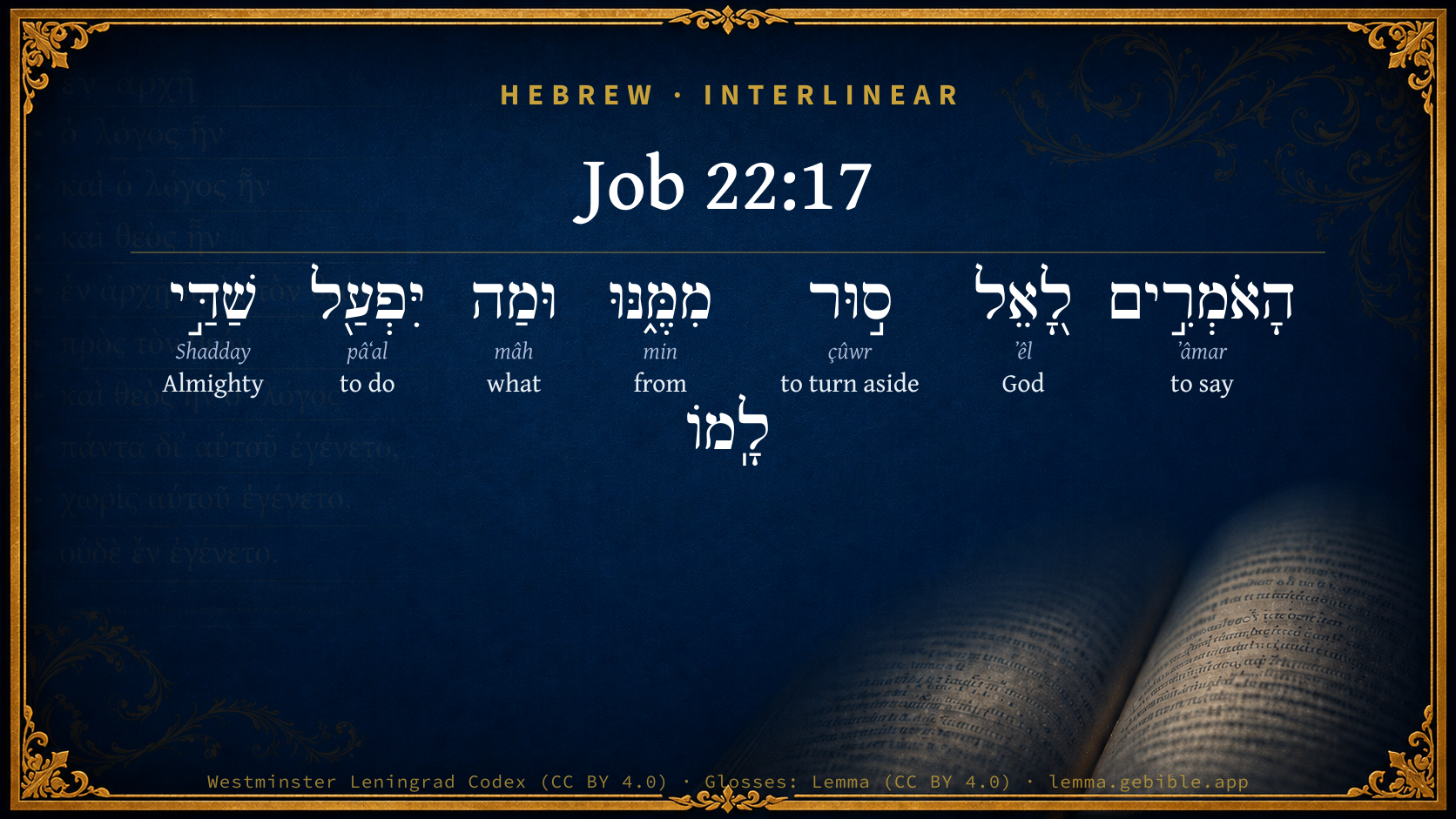
Job 22:17

Hebrew (Westminster Leningrad Codex) Job 22:17 appears in the Hebrew Old Testament. The text above is from the Westminster Leningrad Codex. Each word links to its Strong’s number, a concise gloss, and parsing drawn from the Open Scriptures Hebrew Bible morphology. Click any word for its full Brown-Driver-Briggs (BDB) entry.
Download image
Cite this verse

Job 22:17 (World English Bible). Public Domain. Lemma interlinear Bible study tool, https://lemma.gebible.app/v/job/22/17.

Show BibTeX & RIS
BibTeX
RIS
English Translation
Who said to God, 'Depart from us;' And, 'What can the Almighty do for us?'
World English Bible · Public Domain
Download a study sheet

One document with this verse’s original text, its word-by-word gloss line, the meaning frame, cross-references with their text, attributed commentary, and full source and license credits — printable, and it pastes into notes with its structure intact.

This verse Autodidact and up

Study sheet (.html) Plain text (.txt)

A passage Seminary Student

Up to 50 verses in one chapter. A passage sheet keeps up to 6 commentary sources and 12 cross-references per verse, in the order this page ranks them, and says so on the sheet whenever that leaves anything out. Ask for a single verse and you get the Autodidact verse sheet above.

Everything on this page stays free to read, with no account — the sheet is a download of what is already on screen, not access to it.

Want to remove ads? Support Godless Engineer
Compare translations 3

The same verse in 3 English versions, stacked beneath the original-language interlinear above. Click any original word for its lexicon entry.

Each is an independent rendering of the whole verse — the interlinear is not word-aligned to these translations.

Highlighted words mark where these versions differ — a whole-verse word diff, not a word-by-word alignment.

  • World English Bible Public Domain
    Who said to God, 'Depart from us;' And, 'What can the Almighty do for us?'
  • King James Version Public Domain
    Which said unto God, Depart from us: and what can the Almighty do for them?
  • unfoldingWord Literal Text CC BY-SA 4.0
    the ones saying to God, ‘Turn away from us,’ and, ‘What will the Almighty do to them?’

unfoldingWord Literal Text — © unfoldingWord, licensed CC BY-SA 4.0. Word-aligned USFM3 via Door43 (git.door43.org/unfoldingWord/en_ult).

Versions to compare (up to 4)

3 of 4 selected

Show all 18 translations

Every available English version of this verse, each an independent rendering of the whole verse.

  • World English Bible Public Domain
    Who said to God, 'Depart from us;' And, 'What can the Almighty do for us?'
  • Berean Standard Bible Public Domain
    They said to God, ‘Depart from us. What can the Almighty do to us?’
  • Majority Standard Bible Public Domain
    They said to God, ‘Depart from us. What can the Almighty do to us?’
  • King James Version Public Domain
    Which said unto God, Depart from us: and what can the Almighty do for them?
  • American Standard Version (1901) Public Domain
    Who said unto God, Depart from us; And, What can the Almighty do for us?
  • Revised Version (1885) Public Domain
    Who said unto God, Depart from us; and, What can the Almighty do for us?
  • Geneva Bible (1599) Public Domain
    Which sayd vnto God, Depart from vs, and asked what the Almightie could do for them.
  • Douay-Rheims (1899) Public Domain
    Who said to God: Depart from us: and looked upon the Almighty as if he could do nothing:
  • Young's Literal Translation Public Domain
    Those saying to God, `Turn aside from us,' And what doth the Mighty One to them?
  • Literal Standard Version CC BY-SA 4.0
    Those saying to God, Turn aside from us, || And what does the Mighty One do to them?
  • Unlocked Literal Bible CC BY-SA 4.0
    those who said to God, 'Depart from us'; those who said, 'What can the Almighty do to us?'
  • unfoldingWord Literal Text CC BY-SA 4.0
    the ones saying to God, ‘Turn away from us,’ and, ‘What will the Almighty do to them?’
  • Darby Bible Public Domain
    Who said unto ùGod, Depart from us! and what could the Almighty do to them?
  • World Messianic Bible Public Domain
    who said to God, ‘Depart from us!’ and, ‘What can the Almighty do for us?’
  • Webster's Bible Public Domain
    Who said to God, depart from us: and what can the Almighty do for them!
  • Free Bible Version CC BY-SA 4.0
    They had told God, ‘Get lost! What can the Almighty do to us?’
  • Bible in Basic English Public Domain
    Who said to God, Go away from us; and, What is the Ruler of all able to do to us?
  • JPS Tanakh (1917) Public Domain
    Who said unto God: 'Depart from us'; and what could the Almighty do unto them?

Literal Standard Version (2020), Covenant Press — licensed CC BY-SA 4.0. Text via the HelloAO Bible API (eBible.org). Unlocked Literal Bible (unfoldingWord) — licensed CC BY-SA 4.0. Text via the HelloAO Bible API (eBible.org). unfoldingWord Literal Text — © unfoldingWord, licensed CC BY-SA 4.0. Word-aligned USFM3 via Door43 (git.door43.org/unfoldingWord/en_ult). Free Bible Version, Dr. Jonathan Gallagher — licensed CC BY-SA 4.0. Text via the HelloAO Bible API (eBible.org).

Word by word

More ways to search: Search by grammar → Find every occurrence → Compare this word →

Practice this passage: Drill this verse → Learn its vocabulary →

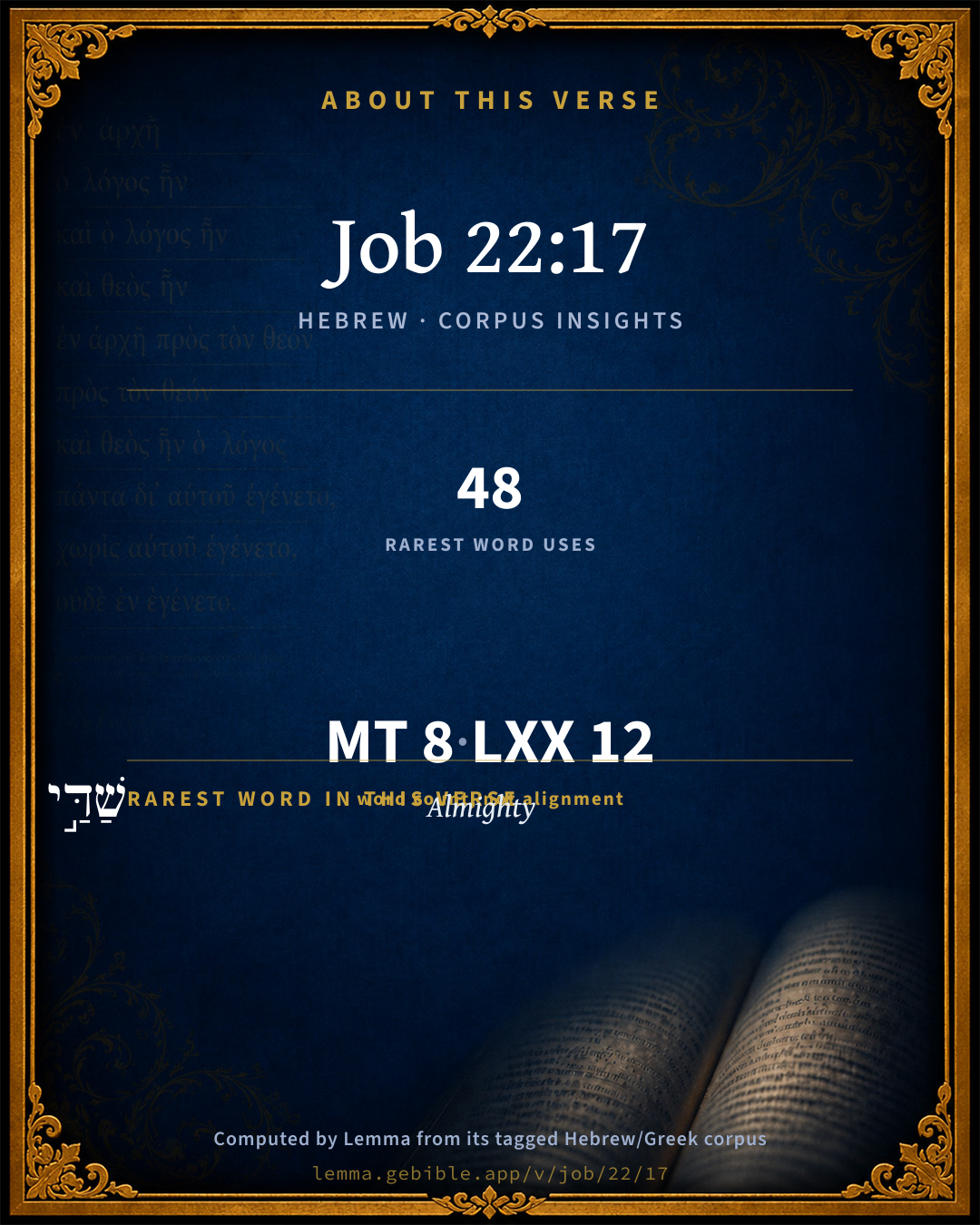
About this verse

These counts appear in no published source. They are computed here, from the morphology-tagged text and Lemma’s own curated glosses. What Lemma adds →

8
words
7
distinct lemmas
Wisdom
section

Shared distinctive vocabulary

שַׁדַּ֣י Almighty H7706 occurs in 48 verses of the Hebrew Bible. Also found in:

Grammatical profile

  • 3 verbs
  • 2 nouns
  • 2 prepositions
  • 1 particle

Verb forms

  • הָאֹמְרִ֣ים Qal · Participle Active
  • ס֣וּר Qal · Imperative
  • יִּפְעַ֖ל Qal · Imperfect

Hebrew & Septuagint length

In English translation the verse runs 15 words from the Hebrew and 17 from the Septuagint (LXX English) — closely comparable.

A rough comparison of the two English renderings, which tokenize alike — not a word-level alignment.

Word counts can differ between the Hebrew and the Greek without any difference in meaning — e.g. the Hebrew direct-object marker אֵת has no separate Greek word, and Greek often adds the article ὁ.

In the original languages it is 8 Hebrew tokens and 12 Greek tokens — but the two are counted differently (Hebrew bundles its prefixes and suffixes into one token; the Greek is in lemma form), so that isn’t a like-for-like length.

Cross-references

8

Topical passages linked to Job 22:17 in the Treasury of Scripture Knowledge — connected by theme and wording, ordered by reader-vote popularity; previews shown in the World English Bible.

  • Job 21:14–15 They tell God, 'Depart from us, For we don't want to know about your ways.
  • Psalms 4:6 Many say, "Who will show us any good?" Yahweh, let the light of your face shine on us.
  • Romans 1:28 Even as they refused to have God in their knowledge, God gave them up to a reprobate mind, to do those things which are not fitting;
  • Job 21:10 Their bulls breed without fail. Their cows calve, and don't miscarry.
  • Isaiah 30:11 get out of the way, turn aside out of the path, cause the Holy One of Israel to cease from before us."
  • Malachi 3:14 You have said, 'It is vain to serve God;' and 'What profit is it that we have kept his charge, and that we have walked mournfully before Yahweh of Hosts?
  • Matthew 8:29 Behold, they cried out, saying, "What do we have to do with you, Jesus, Son of God? Have you come here to torment us before the time?"
  • Matthew 8:34 Behold, all the city came out to meet Jesus. When they saw him, they begged that he would depart from their borders.

Cross-references courtesy of OpenBible.info (CC BY 4.0).

Hebrew and Greek witnesses Masoretic Hebrew ↔ Greek Septuagint

The same verse in the two great witnesses to the Old Testament, shown verse-for-verse.

These are two independent witnesses, not word-aligned to each other, and the Septuagint is shown in lemma (dictionary) form.

Hebrew Job 22:17 Masoretic · Westminster Leningrad Codex

הָאֹמְרִ֣ים לָ֭אֵל ס֣וּר מִמֶּ֑נּוּ וּמַה יִּפְעַ֖ל שַׁדַּ֣י לָֽמוֹ

Who said to God, 'Depart from us;' And, 'What can the Almighty do for us?'

World English Bible · Public Domain

Greek LXX Job 22:17 Septuagint · lemma form

ὁ λέγω κύριος τίς ποιέω ἐγώ ἤ τίς ἐπιἄγω ἐγώ ὁ παντοκράτωρ

Who say, What will the Lord do to us? or what will the Almighty bring upon us?

LXX2012 (modern English Septuagint) · Public Domain

Hebrew: Westminster Leningrad Codex (CC BY 4.0). Greek: Septuagint (public domain); English from LXX2012 (modern English Septuagint) (Public Domain). How the Septuagint differs from the Hebrew →

Commentary

Notes on Job 22:17 from classic Christian and Jewish commentators (each source and its license shown beneath its notes). The classic Christian expositions comment on the surrounding passage and are grouped to its opening verse, so a note may address several verses; the Jewish commentaries on the Tanakh (Rashi and others) are per-verse, so they appear only where the commentator wrote on this verse.

Lemma curates 59 commentaries, every one of them public domain or Creative Commons licensed, each selected and text-cleaned for this edition rather than reprinted as found. About our sources →

John Gill's Exposition

Yet he filled their houses with good things,.... With temporal good things, with this world's good, with plenty of providential goodness; earthly enjoyments are good things in themselves, and in their effects, when rightly used, and these wicked men have their share of; this is their portion, they have their good things in this life, and a large abundance of them oftentimes; their hearts are filled with food, and should be with gladness and thankfulness; their bellies are filled with hidden treasures; their barns with corn and wheat, and such like fruits of the earth; their shops with all manner of goods; their dwelling houses with gold and silver, with rich furniture, and all precious substance; and all this is from God, every good gift comes from him; the earth is full of his goodness; though these men say, "what can the Almighty do for them?" Job 22:17; this shows, that what they have they are not deserving of; and what is bestowed upon them is not from any merit in them, but according to the sovereign will and pleasure of God; find this is an aggravation of their wickedness, that notwithstanding he has loaded them with his benefits, and indulged them with such a plenty of good things, yet they spurn at him, rebel against him, and bid him depart from them; which conduct of theirs Eliphaz expresses his abhorrence of:

but the counsel of the wicked is far from me; such impious reasonings, and wicked practices, he was far from justifying; he had them in the utmost detestation, and could not but abhor such vile ingratitude; he makes use of Job's words, Job 21:16; which he thought he could do to better purpose, and with greater sincerity.

John Gill's Exposition of the Whole Bible (1746–1763) — public domain (CC PDM 1.0). Text via the HelloAO Bible API.

Trapp's Complete Commentary

John Trapp

Job 22:17 Which said unto God, Depart from us: and what can the Almighty do for them?

Ver. 17. Which said unto God, Depart from us] Atheists those antediluvians were; if not dogmatic, yet practical, such as Job had described, speaking the like language of hell, Job 21:14. Et malitiose eum Eliphazus talium atheorum numero accenset, saith Mercer: And maliciously doth Eliphaz reckon Job among those odious atheists, so thinking to cut his throat with his own sword, and confute him with his own words. Malice cares not how truly things are set forth, so it may gall or kill.

And what can the Almighty do for them?] That is, they asked, What can the Almighty do for them? As if God neither could nor would reward their services; as if he would do them neither good nor evil. The Seventy render it, τι επαξεται ημιν, What will he bring upon us? q.d. He threateneth us with a flood, but when, where, and how? Let the day of the Lord come! Isa 5:19. "Where is the promise of his coming?" &c., 2Pe 3:4. Thus they jeered when it was fitter they should have feared: but what was the issue?

John Trapp, A Commentary or Exposition upon All the Books of the Old and New Testament (1647–1656) — public domain. Text from a community e-Sword module.

Joseph Benson's Commentary

Job 22:17. Which said unto God, Depart from us — He repeats Job’s words, Job 21:14-15; but to a contrary purpose. Job alleged them to show that some men prospered, notwithstanding their professed wickedness, and Eliphaz produces them to show that they were cut off for it. And, What can the Almighty do for them? — Thus did that wicked generation, whom Noah had in vain called to repentance, as it were, defy God, contemning both his threatenings and his promises.

Joseph Benson's Commentary on the Old and New Testaments (1811–1818) — public domain. Text from a community e-Sword module.

Jamieson, Fausset & Brown

Robert Jamieson, A. R. Fausset & David Brown

Eliphaz designedly uses Job's own words (Job 21:14-15).

do for them--They think they can do everything for themselves.

Jamieson, Fausset & Brown — Commentary Critical and Explanatory on the Whole Bible (1871) — public domain (CC PDM 1.0). Text via the HelloAO Bible API.

Ellicott's Commentary for English Readers

(17) Which said unto God, Depart from us.—Here again he attributes to Job the very thoughts he had ascribed to the wicked (Job_20:14-15).

A Bible Commentary for English Readers, edited by Charles John Ellicott (1878–1897) — public domain. Text from a community e-Sword module.

The Cambridge Bible for Schools and Colleges

gen. ed. J. J. S. Perowne

17. do for them] Rather, do unto them.

The Cambridge Bible for Schools and Colleges (gen. ed. J. J. S. Perowne; Cambridge University Press, 1878–1918) — public domain. Text from a community e-Sword module.

Albert Barnes' Notes on the Bible

Which said unto God, Depart from us - Notes, Job 21:14. A very correct description of the old world. They had no wish to retain God in their knowledge. Probably Eliphaz here refers to what Job had said, Job 21:14-15. He had remarked, in describing the wicked, that they said unto God, “Depart from us,” and yet they lived prosperously. “But see,” says Eliphaz,’” a case” where they did this. It was done by the inhabitants of the world before the deluge, and their houses were filled, as you say the houses of the wicked are, with good things, but God swept them all suddenly away.”

And what can the Almighty do for them? - Margin, or,” to.” That is, they demanded what the Almighty could do for them. They did not feel their dependence on him; they did not admit that they needed his aid; they cast off all reliance on him. This whole passage is a most sarcastic retort on what Job had said in Job 21:14-15. He had affirmed that though wicked people used this language, yet that they prospered. Eliphaz takes the same language and applies it to the sinners before the deluge, and says that they expressed themselves just in this manner. The language which Job puts into the mouths of the wicked, had indeed, says Eliphaz, been used. But by whom? By those who lived in security and prosperity. “By the men before the deluge,” says he, “the race that was so wicked that it was necessary to cut them off by the flood. These are the people to whose sentiments Job appeals; these the people with whom he has sympathy!”

Albert Barnes' Notes on the Bible (1834–1885) — public domain. Text from a community e-Sword/MySword module.

Matthew Poole's English Annotations

He reports Job’s words, Job 21:14,15, (where they are explained,) but to a contrary purpose. Job alleged them to show that they prospered notwithstanding their professed wickedness, and Eliphaz produceth them to show that they were cut off for it.

Matthew Poole's English Annotations on the Holy Bible (1683–1685) — public domain. Text from a community e-Sword/MySword module.

Whedon's Commentary on the Bible

Daniel D. Whedon

17. Depart from us — Note, Job_21:14. Do for them — Do to them, as in the margin. To them, that is, to us; a poetical change of person. Job had spoken in these very terms of the defiant prosperity of the wicked. Eliphaz sarcastically ascribes the same language to the ungodly who lived at the time of the deluge. They reveled in luxury, as Job in general terms said the wicked do, and yet they were overwhelmed by the flood. The retort is both striking and logically complete.

Daniel D. Whedon (gen. ed.), Commentary on the Old and New Testaments (1874–1909) — public domain. Text from a community e-Sword module.

The Pulpit Commentary

Who said unto God, Depart from us. (comp. Job_21:14) Eliphaz tries, though with no very great success, to turn Job"s words against him. And, What can the Almighty do for them? i.e. and ask what the Almighty can do for them. A change from the second to the third person, without any change of subject, is not unusual in Hebrew. The wicked renounce God, and bid him depart from them conduct which they justify by asking what good he could do them if they acted otherwise. The idea is the same as that of Job_21:15, though not expressed so pointedly. What Eliphaz thinks to gain by echoing Job"s words is not very apparent.

The Pulpit Commentary (1880–1919), ed. H.D.M. Spence-Jones & Joseph S. Exell — public domain. Text from a community e-Sword module.

John Wesley's Explanatory Notes

Who - He repeats Job's words, chap. xxi, 14, 15, but to a contrary purpose. Job alleged them to shew that they prospered notwithstanding their wickedness; and Eliphaz produces them to shew that they were cut off for it.

John Wesley, Explanatory Notes Upon the Whole Bible (1754–1765) — public domain. Text via the GEBible commentary corpus.

Lesson kit

Teaching starters — assembled from the data on this page, not authored interpretation. Every prompt links to the verse data it draws on. Edit before teaching.

Job, in the Wisdom, opens this verse with 8 words (7 distinct Hebrew lemmas). Its most distinctive word is Shadday (“Almighty”). A historical commentator’s framing appears above. Read the whole chapter for the surrounding context.

Discussion questions

  1. What does “Almighty” (Shadday) contribute to the verse as a whole?
  2. How does Genesis 17:1, which shares the word «Almighty», read alongside this verse?
  3. These translations render this verse differently. What is at stake in choosing one wording over another?
  4. «הָאֹמְרִ֣ים» is a Qal Participle Active verb. How does that grammatical form shape the action described?
  5. Compare how John Gill's Exposition and Trapp's Complete Commentary read this verse. Where do they agree or differ?

Things to notice

Reading settings

Reading text

Shown beneath each verse's original-language words.

Old Testament
Old Testament edition

Read the OT as the Masoretic Hebrew (MT) or the Greek Septuagint (LXX).

English shown for the Greek Septuagint (in the Hebrew ↔ Greek comparison).

Comparing translations? Open the Compare panel on any verse page to stack up to four side by side.