
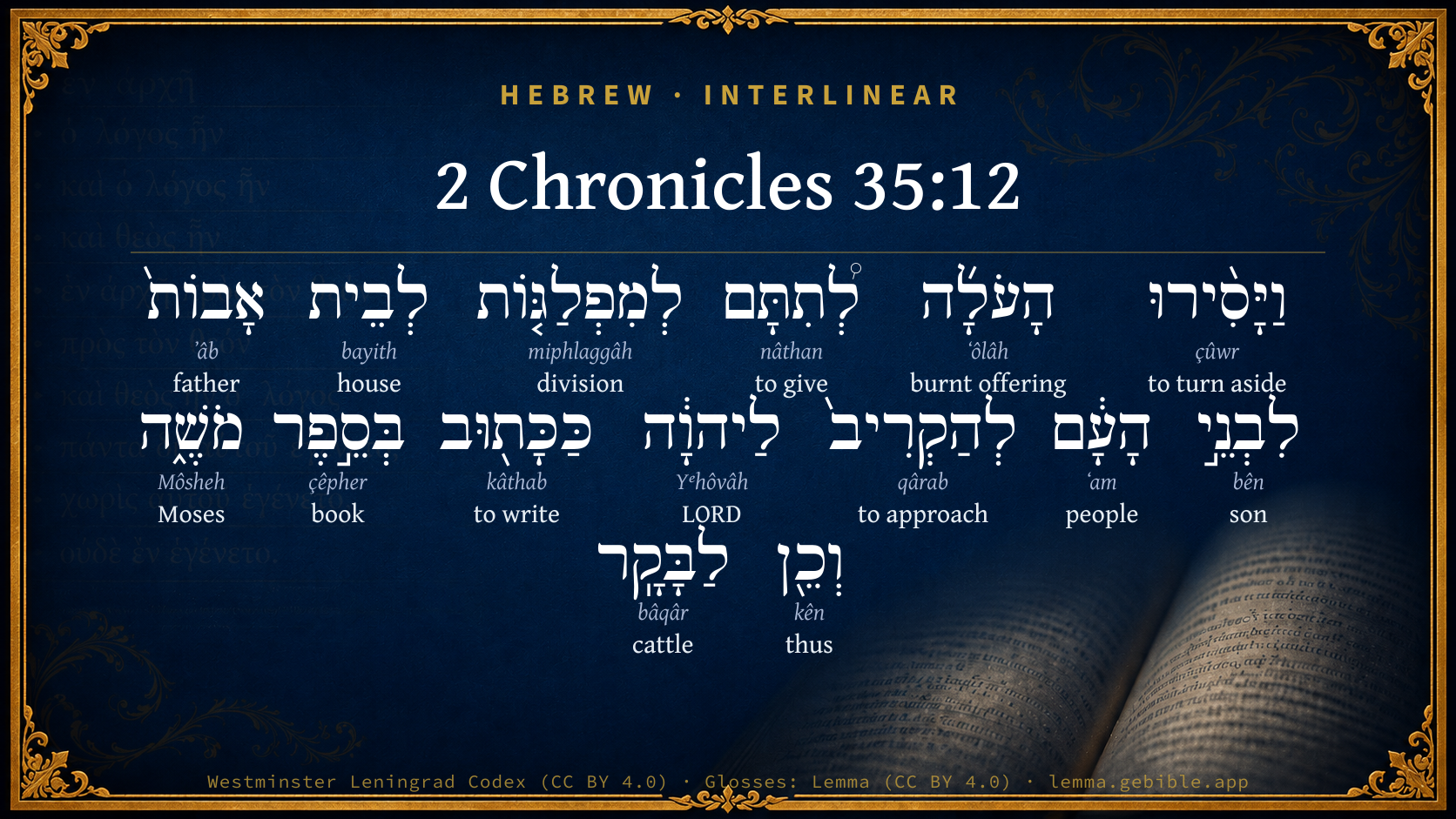
2 Chronicles 35:12

Hebrew (Westminster Leningrad Codex) 2 Chronicles 35:12 appears in the Hebrew Old Testament. The text above is from the Westminster Leningrad Codex. Each word links to its Strong’s number, a concise gloss, and parsing drawn from the Open Scriptures Hebrew Bible morphology. Click any word for its full Brown-Driver-Briggs (BDB) entry.
Download image
Cite this verse

2 Chronicles 35:12 (World English Bible). Public Domain. Lemma interlinear Bible study tool, https://lemma.gebible.app/v/2-chronicles/35/12.

Show BibTeX & RIS
BibTeX
RIS
English Translation
They removed the burnt offerings, that they might give them according to the divisions of the fathers' houses of the children of the people, to offer to Yahweh, as it is written in the book of Moses. So did they with the oxen.
World English Bible · Public Domain
Highlights
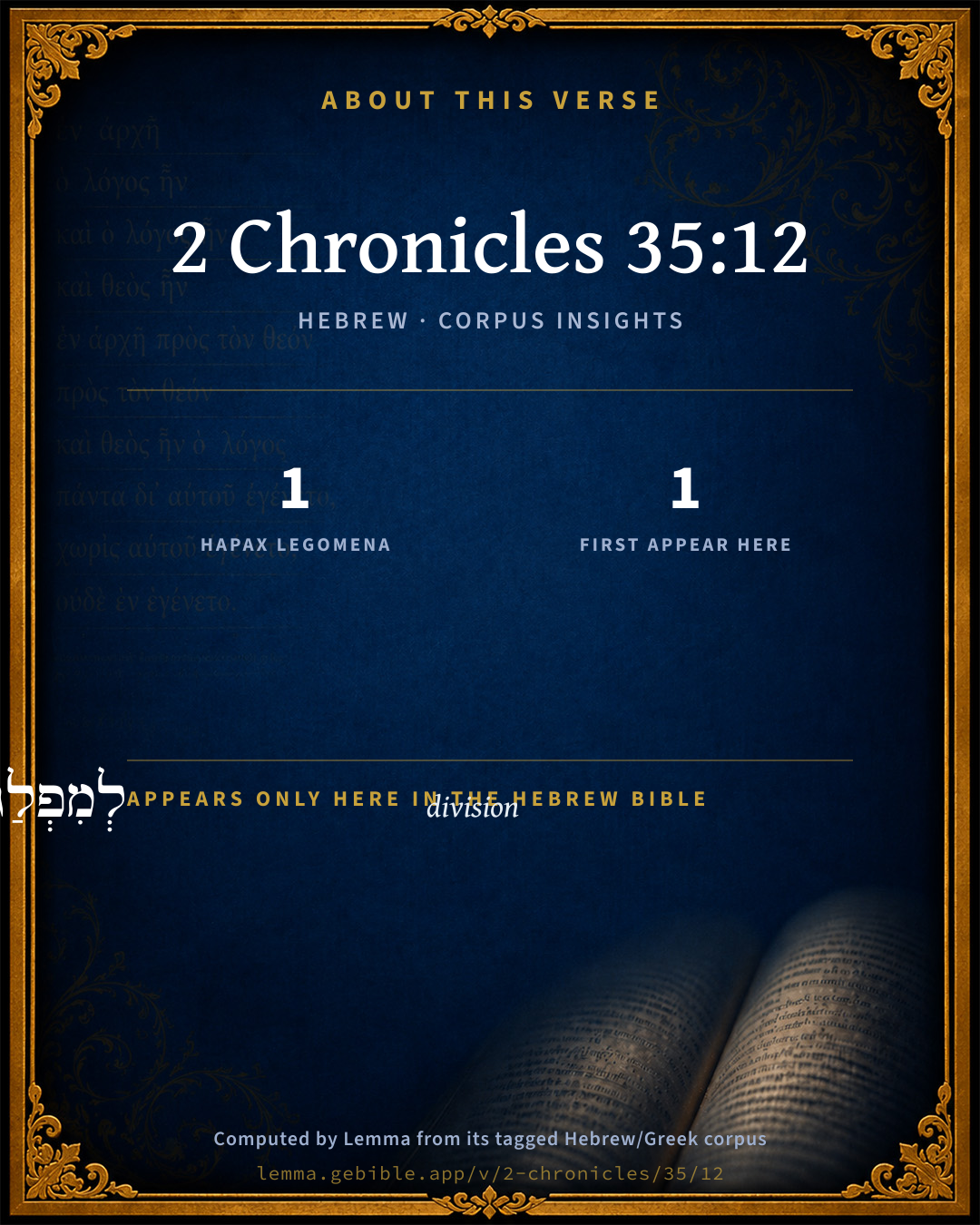
  • 1 hapax legomenon — only here in the Hebrew Bible
  • 1 first appearance in the Hebrew Bible
Full analysis ↓
Download a study sheet

One document with this verse’s original text, its word-by-word gloss line, the meaning frame, cross-references with their text, attributed commentary, and full source and license credits — printable, and it pastes into notes with its structure intact.

This verse Autodidact and up

Study sheet (.html) Plain text (.txt)

A passage Seminary Student

Up to 50 verses in one chapter. A passage sheet keeps up to 6 commentary sources and 12 cross-references per verse, in the order this page ranks them, and says so on the sheet whenever that leaves anything out. Ask for a single verse and you get the Autodidact verse sheet above.

Everything on this page stays free to read, with no account — the sheet is a download of what is already on screen, not access to it.

Want to remove ads? Support Godless Engineer
Compare translations 3

The same verse in 3 English versions, stacked beneath the original-language interlinear above. Click any original word for its lexicon entry.

Each is an independent rendering of the whole verse — the interlinear is not word-aligned to these translations.

Highlighted words mark where these versions differ — a whole-verse word diff, not a word-by-word alignment.

  • World English Bible Public Domain
    They removed the burnt offerings, that they might give them according to the divisions of the fathers' houses of the children of the people, to offer to Yahweh, as it is written in the book of Moses. So did they with the oxen.
  • King James Version Public Domain
    And they removed the burnt offerings, that they might give according to the divisions of the families of the people, to offer unto the LORD, as it is written in the book of Moses. And so did they with the oxen.
  • unfoldingWord Literal Text CC BY-SA 4.0
    And they took away the burnt offering, in order to place them according to the divisions of the house of fathers, for the sons of the people to bring near to Yahweh according to what is written in the scroll of Moses. And thus for the oxen.

unfoldingWord Literal Text — © unfoldingWord, licensed CC BY-SA 4.0. Word-aligned USFM3 via Door43 (git.door43.org/unfoldingWord/en_ult).

Versions to compare (up to 4)

3 of 4 selected

Show all 18 translations

Every available English version of this verse, each an independent rendering of the whole verse.

  • World English Bible Public Domain
    They removed the burnt offerings, that they might give them according to the divisions of the fathers' houses of the children of the people, to offer to Yahweh, as it is written in the book of Moses. So did they with the oxen.
  • Berean Standard Bible Public Domain
    They set aside the burnt offerings to be given to the divisions of the families of the people to offer to the LORD, as is written in the Book of Moses; and they did the same with the bulls.
  • Majority Standard Bible Public Domain
    They set aside the burnt offerings to be given to the divisions of the families of the people to offer to the LORD, as it is written in the Book of Moses. And they did the same with the bulls.
  • King James Version Public Domain
    And they removed the burnt offerings, that they might give according to the divisions of the families of the people, to offer unto the LORD, as it is written in the book of Moses. And so did they with the oxen.
  • American Standard Version (1901) Public Domain
    And they removed the burnt-offerings, that they might give them according to the divisions of the fathers' houses of the children of the people, to offer unto Jehovah, as it is written in the book of Moses. And so did they with the oxen.
  • Revised Version (1885) Public Domain
    And they removed the burnt offerings, that they might give them according to the divisions of the fathers’ houses of the children of the people, to offer unto the LORD, as it is written in the book of Moses. And so did they with the oxen.
  • Geneva Bible (1599) Public Domain
    And they tooke away from the burnt offering to giue it according to the deuisions of the families of the children of the people, to offer vnto the Lord, as it is written in the booke of Moses, and so of the bullockes.
  • Douay-Rheims (1899) Public Domain
    And they separated them to give them by the houses and families of every one, and to be offered to the Lord, as it is written in the book of Moses, and with the oxen they did in like manner.
  • Young's Literal Translation Public Domain
    and they turn aside the burnt-offering, to put them by the divisions of the house of the fathers of the sons of the people, to bring near to Jehovah, as it is written in the book of Moses -- and so to the oxen.
  • Literal Standard Version CC BY-SA 4.0
    and they turn aside the burnt-offering to put them by the divisions of the house of the fathers of the sons of the people, to bring near to YHWH, as it is written in the scroll of Moses—and so for the oxen.
  • Unlocked Literal Bible CC BY-SA 4.0
    They removed the burnt offerings, in order to distribute them to the divisions of the ancestral houses of the people, to offer them to Yahweh, as it is written in the Book of Moses. They did the same with the bulls.
  • unfoldingWord Literal Text CC BY-SA 4.0
    And they took away the burnt offering, in order to place them according to the divisions of the house of fathers, for the sons of the people to bring near to Yahweh according to what is written in the scroll of Moses. And thus for the oxen.
  • Darby Bible Public Domain
    And they set apart the burnt-offerings to give them to the classes of the fathers' houses of the children of the people, to present them to Jehovah, as it is written in the book of Moses. And so [did they] with the oxen.
  • World Messianic Bible Public Domain
    They removed the burnt offerings, that they might give them according to the divisions of the fathers’ houses of the children of the people, to offer to the LORD, as it is written in the book of Moses. They did the same with the cattle.
  • Webster's Bible Public Domain
    And they removed the burnt-offerings, that they might give according to the divisions of the families of the people, to offer to the LORD, as it is written in the book of Moses. And so did they with the oxen.
  • Free Bible Version CC BY-SA 4.0
    They put to one side the burnt offerings to be given to the families of the lay people, by division, to offer to the Lord, as required in the Book of Moses. They did the same thing with the bulls.
  • Bible in Basic English Public Domain
    And they took away the burned offerings, so that they might give them to be offered to the Lord for the divisions of the families of the people, as it is recorded in the book of Moses. And they did the same with the oxen.
  • JPS Tanakh (1917) Public Domain
    And they removed the portions that were to be burnt, that they might give them to the divisions of the fathers' houses of the children of the people, to present unto the LORD, as it is written in the book of Moses. And so did they with the oxen.

Literal Standard Version (2020), Covenant Press — licensed CC BY-SA 4.0. Text via the HelloAO Bible API (eBible.org). Unlocked Literal Bible (unfoldingWord) — licensed CC BY-SA 4.0. Text via the HelloAO Bible API (eBible.org). unfoldingWord Literal Text — © unfoldingWord, licensed CC BY-SA 4.0. Word-aligned USFM3 via Door43 (git.door43.org/unfoldingWord/en_ult). Free Bible Version, Dr. Jonathan Gallagher — licensed CC BY-SA 4.0. Text via the HelloAO Bible API (eBible.org).

Word by word

More ways to search: Search by grammar → Find every occurrence → Compare this word →

Practice this passage: Drill this verse → Learn its vocabulary →

לְמִפְלַגּ֤וֹת
miphlaggâh
H4653
“to/for · divisions”
Preposition + Noun, Common, Feminine, Plural, Absolute
Part of Speech
Preposition + Noun
Type
Common
Gender
Feminine
Number
Plural
State
Absolute
Full BDB Definition

Origin: from H6385

TWOT: 1769d

division (of priests for service)
  1. וַיָּסִ֨ירוּ çûwr H5493 “and · to turn aside” Conjunction + Verb, Hiphil, Sequential Imperfect, 3rd Person, Masculine, Plural
  2. הָעֹלָ֜ה ʻôlâh H5930 “the · burnt offering” Particle, Definite Article + Noun, Common, Feminine, Singular, Absolute
  3. לְ֠תִתָּם nâthan H5414 “to give · them” Preposition + Verb, Qal, Infinitive Construct + Suffix, Personal, 3rd Person, Masculine, Plural
  4. לְבֵית bayith H1004 “to/for · house of” Preposition + Noun, Common, Masculine, Singular, Construct
  5. אָבוֹת֙ ʼâb H1 “fathers” Noun, Common, Masculine, Plural, Absolute
  6. לִבְנֵ֣י bên H1121 “to/for · sons of” Preposition + Noun, Common, Masculine, Plural, Construct
  7. הָעָ֔ם ʻam H5971 “the · people” Particle, Definite Article + Noun, Common, Masculine, Singular, Absolute
  8. לְהַקְרִיב֙ qârab H7126 “to approach” Preposition + Verb, Hiphil, Infinitive Construct
  9. לַיהוָ֔ה Yᵉhôvâh H3068 “to/for · LORD” Preposition + Noun, Proper
  10. כַּכָּת֖וּב kâthab H3789 “like/as the · written” Preposition, Determined + Verb, Qal, Participle Passive, Masculine, Singular, Absolute
  11. בְּסֵ֣פֶר çêpher H5612 “in/at · book of” Preposition + Noun, Common, Masculine, Singular, Construct
  12. מֹשֶׁ֑ה Môsheh H4872 “Moses” Noun, Proper
  13. וְכֵ֖ן kên H3651 “and · thus” Conjunction + Particle, Demonstrative
  14. לַבָּקָֽר bâqâr H1241 “to/for the · cattle” Preposition, Determined + Noun, Common, Both, Singular, Absolute

About this verse

These counts appear in no published source. They are computed here, from the morphology-tagged text and Lemma’s own curated glosses. What Lemma adds →

15
words
15
distinct lemmas
Historical
section

Notable vocabulary

1 hapax legomenon — a word that appears only here in the entire Hebrew Bible:

  • לְמִפְלַגּ֤וֹת division H4653

First appearance in Scripture

This word makes its first canonical appearance in the Hebrew Bible here:

  • לְמִפְלַגּ֤וֹת division H4653

Grammatical profile

  • 4 verbs
  • 10 nouns
  • 1 particle

Verb forms

  • וַיָּסִ֨ירוּ Hiphil · Sequential Imperfect
  • לְ֠תִתָּם Qal · Infinitive Construct
  • לְהַקְרִיב֙ Hiphil · Infinitive Construct
  • כַּכָּת֖וּב Qal · Participle Passive

Hebrew & Septuagint length

In English translation the verse runs 43 words from the Hebrew and 41 from the Septuagint (LXX English) — closely comparable.

A rough comparison of the two English renderings, which tokenize alike — not a word-level alignment.

Word counts can differ between the Hebrew and the Greek without any difference in meaning — e.g. the Hebrew direct-object marker אֵת has no separate Greek word, and Greek often adds the article ὁ.

Cross-references

4

Topical passages linked to 2 Chronicles 35:12 in the Treasury of Scripture Knowledge — connected by theme and wording, ordered by reader-vote popularity; previews shown in the World English Bible.

  • Leviticus 3:3 He shall offer of the sacrifice of peace offerings an offering made by fire to Yahweh; the fat that covers the innards, and all the fat that is on the innards,
  • Leviticus 3:5 Aaron's sons shall burn it on the altar on the burnt offering, which is on the wood that is on the fire: it is an offering made by fire, of a sweet savor to Yahweh.
  • Leviticus 3:9–11 He shall offer from the sacrifice of peace offerings an offering made by fire to Yahweh; its fat, the entire tail fat, he shall take away close to the backbone; and the fat that covers the inwards, and all the fat that is on the inwards,
  • Leviticus 3:14–16 He shall offer from it as his offering, an offering made by fire to Yahweh; the fat that covers the innards, and all the fat that is on the innards,

Cross-references courtesy of OpenBible.info (CC BY 4.0).

Hebrew and Greek witnesses Masoretic Hebrew ↔ Greek Septuagint

The same verse in the two great witnesses to the Old Testament, shown verse-for-verse.

These are two independent witnesses, not word-aligned to each other, and the Septuagint is shown in lemma (dictionary) form.

Hebrew 2 Chronicles 35:12 Masoretic · Westminster Leningrad Codex

וַיָּסִ֨ירוּ הָעֹלָ֜ה לְ֠תִתָּם לְמִפְלַגּ֤וֹת לְבֵית אָבוֹת֙ לִבְנֵ֣י הָעָ֔ם לְהַקְרִיב֙ לַיהוָ֔ה כַּכָּת֖וּב בְּסֵ֣פֶר מֹשֶׁ֑ה וְכֵ֖ן לַבָּקָֽר

They removed the burnt offerings, that they might give them according to the divisions of the fathers' houses of the children of the people, to offer to Yahweh, as it is written in the book of Moses. So did they with the oxen.

World English Bible · Public Domain

Greek LXX 2 Chronicles 35:12 Septuagint · lemma form

καί ἑτοιμάζω ὁ ὁλοκαύτωσις παραδίδωμι αὐτός κατά ὁ διαίρεσις κατά οἶκος πατριά ὁ υἱός ὁ λαός ὁ προςἄγω ὁ κύριος ὡς γράφω ἐν βιβλίον μωυσῆς καί οὕτως εἰς ὁ πρωί

And they prepared the whole burnt offering to give to them, according to the division by the houses of families, even to the sons of the people, to offer to the Lord, as it is written in the book of Moses.

LXX2012 (modern English Septuagint) · Public Domain

Hebrew: Westminster Leningrad Codex (CC BY 4.0). Greek: Septuagint (public domain); English from LXX2012 (modern English Septuagint) (Public Domain). How the Septuagint differs from the Hebrew →

Commentary

Notes on 2 Chronicles 35:12 from classic Christian and Jewish commentators (each source and its license shown beneath its notes). The classic Christian expositions comment on the surrounding passage and are grouped to its opening verse, so a note may address several verses; the Jewish commentaries on the Tanakh (Rashi and others) are per-verse, so they appear only where the commentator wrote on this verse.

Lemma curates 59 commentaries, every one of them public domain or Creative Commons licensed, each selected and text-cleaned for this edition rather than reprinted as found. About our sources →

Trapp's Complete Commentary

John Trapp

2Ch 35:12 And they removed the burnt offerings, that they might give according to the divisions of the families of the people, to offer unto the LORD, as [it is] written in the book of Moses. And so [did they] with the oxen.

Ver. 12. To offer unto the Lord.] The burntofferings were wholly consumed on the altar; the skin and dung were "burnt without the camp." {Heb 13:12} Hereby was signified, (1.) Christ’s ardent love and zeal towards his people; (2.) His bitter passion in the whole man.

John Trapp, A Commentary or Exposition upon All the Books of the Old and New Testament (1647–1656) — public domain. Text from a community e-Sword module.

Joseph Benson's Commentary

2Ch 35:12. And they removed the burnt-offerings — That part of the paschal lambs which was to be burned, which they despatched as soon as possible, that they might give that part which was to be eaten to each family. And so they did with the oxen — All of which were not given for peace-offerings, but some for burnt-offerings: which they also offered as fast as they could, that they might give to each family a portion sufficient for them to feast on.

Joseph Benson's Commentary on the Old and New Testaments (1811–1818) — public domain. Text from a community e-Sword module.

Geneva Bible (1599)

Geneva Bible translators

They reserved for the people that which was not expedient to be offered, that every man might offer peace offerings, and so have his portion.

Geneva Bible (1599) marginal notes — public domain. Text via Bolls.life.

Jamieson, Fausset & Brown

Robert Jamieson, A. R. Fausset & David Brown

they removed the burnt offerings--Some of the small cattle being designed for burnt offerings were put apart by themselves, that they might not be intermingled with the paschal lambs, which were carefully selected according to certain rules, and intended to be sacramentally eaten; and the manner in which those burnt offerings were presented seems to have been the following: "All the subdivisions of the different fathers' houses came one after another to the altar in solemn procession to bring to the priests the portions which had been cut off, and the priests laid these pieces upon the fire of the altar of burnt offering."

Jamieson, Fausset & Brown — Commentary Critical and Explanatory on the Whole Bible (1871) — public domain (CC PDM 1.0). Text via the HelloAO Bible API.

Ellicott's Commentary for English Readers

(12) They removed.—Cut off those parts of the victims which had to be consumed on the altar of burnt offering. (Comp. Lev_3:9; Lev_4:31.) These parts are naturally called “the burnt offering,” although no special burnt offering was appointed for the evening of the Passover.

That they might give . . . people.—To give them to the sections of the father-houses of the sons of the people. After separating the proper pieces, the Levites gave them to the sections which they were serving, to be presented in turn to the priests for burning on the altar.

To Offer.—Haqrîb; as in Lev_3:9; Lev_3:14.

As it is written.—Referring to the rule that “all the fat is the Lord’s” (Lev_3:16).

And so did they.—And so for the oxen. The proper portions of these also were separated for consumption on the brazen altar; the rest of the carcases furnished food for the sacrificial festivities.

A Bible Commentary for English Readers, edited by Charles John Ellicott (1878–1897) — public domain. Text from a community e-Sword module.

The Cambridge Bible for Schools and Colleges

gen. ed. J. J. S. Perowne

12. that they might give according to the divisions of the families of the people] R.V. that they might give them according to the divisions of the fathers’ houses of the children of the people.

The Cambridge Bible for Schools and Colleges (gen. ed. J. J. S. Perowne; Cambridge University Press, 1878–1918) — public domain. Text from a community e-Sword module.

John Gill's Exposition

And they removed the burnt offerings,.... Either such of the lambs and kids as were designed for burnt offerings for the people; these they separated from those that were for the passover; or they removed from them what was to be burnt, the fat of the inwards, of the kidneys, and the caul on the liver:

that they might give; the rest for the passover:

according to the divisions of the families of the people, to offer unto the Lord; according to the number of them:

as it is written in the book of Moses; see Lev 3:3,

and so did they with the oxen; such of them as were appointed for burnt offerings were set apart by themselves, and such as were for peace offerings; what of them were to be burnt, as those before mentioned, were taken from them.

John Gill's Exposition of the Whole Bible (1746–1763) — public domain (CC PDM 1.0). Text via the HelloAO Bible API.

Albert Barnes' Notes on the Bible

They removed the burnt offerings - They separated from the Paschal lambs those parts which were to be burned on the altar. These parts they gave to the offerers, who took them up to the altar and handed them to the officiating priests.

Albert Barnes' Notes on the Bible (1834–1885) — public domain. Text from a community e-Sword/MySword module.

Haydock's Catholic Bible Commentary

Separated. Sept. "prepared the holocaust to give; having taken notice to whom the victims belonged, before they took off the skin, (M.) or rather, separating these from the other peace-offerings. Tournemine.

George Leo Haydock (1774–1849), Haydock's Catholic Family Bible and Commentary, 1859 edition — public domain. Excludes Psalms (Douay-Rheims chapter numbering differs from Protestant) and Deuterocanonical books (Catholic canon only).

Matthew Poole's English Annotations

They removed the burnt-offerings, i.e. those cattle which were to be offered for burnt-offerings, to wit, some of the lesser cattle; for these also might be offered as burnt-offerings, Lev 1:10. And hence it may seem that all these small cattle were not given to the people to be eaten by them for their paschal lambs, but that some of them were to be offered as burnt-offerings for the people. And these they put apart by themselves, partly lest they should be confounded with them which were for another use; and partly that they might not be hindered from that which was their present and more immediate work, as it follows,

that they might give, to wit, the paschal lambs or kids.

To offer unto the Lord: these words may belong either,

1. To the more remote words, the burnt-offerings, the other words being to be put within a parenthesis, or there being a trajection in the words, which is frequent in Scripture, and which is here observed by some learned interpreters. Or,

2. To the last words, and to the paschal lambs, which they were first to offer to the Lord, by killing them and sprinkling the blood, as was noted before, and then to be given to the people; though the giving be here mentioned before the offering, such transpositions being usual in Scripture and other authors. So did they with the oxen, to wit, as they did with the lesser cattle, of which see the first note on this verse. They removed those oxen which were to be offered as burnt-offerings, from those which were to be offered as peace-offerings.

Matthew Poole's English Annotations on the Holy Bible (1683–1685) — public domain. Text from a community e-Sword/MySword module.

Whedon's Commentary on the Bible

Daniel D. Whedon

12. They removed the burnt offerings — That is, removed from the slain animals such portions as were to be offered on the altar. “The burnt offerings here,” says Bertheau, “can only mean such portions of the paschal lamb as were to be burned upon the altar of burnt offerings; no doubt the same parts as were cut off and burned in the case of sheep and goats when they were offered as thank offerings. Lev_2:6-16. As those portions were burned in precisely the same manner as the burnt offerings, (Lev_1:9; Lev_1:17; Lev_3:11; Lev_3:16,) they might very well be called העלה, the burnt offering, so that this word is used here in the sense of אשׁה, offering, or sacrifice in general. This explanation is confirmed by the words at the end of the verse, and so did they with the oxen. The oxen themselves, therefore, were not offered as burnt offerings, but the parts appointed were cut off and burned, the rest of the flesh being cooked and eaten.” 2Ch_35:13.

Daniel D. Whedon (gen. ed.), Commentary on the Old and New Testaments (1874–1909) — public domain. Text from a community e-Sword module.

The Pulpit Commentary

Removed; i.e. cut off; the verso purporting that those who officiated cut off those portions of the animals slain which were of the nature of burnt offering, that they might be taken by the offering worshippers to the priests at the altars, there to be entirely consumed. Of the people; probably better, literally, to the children of the people, i.e. "to the people". (Lev_3:3-16)

The Pulpit Commentary (1880–1919), ed. H.D.M. Spence-Jones & Joseph S. Exell — public domain. Text from a community e-Sword module.

John Wesley's Explanatory Notes

Removed - Some of the lesser cattle; for these also might be offered as burnt-offerings, Lev. i, 10, and hence it may seem that all these small cattle were not given for paschal-lambs, but were to be offered as burnt-offerings for the people. And these they put apart lest they should be confounded with them which were for another use; and, that they might not be hindered from that which was their present work, that they might give, the paschal-lambs or kids. To offer - These words may belong to the last words, and to the paschal-lambs, which they were first to offer to the Lord, by killing them and sprinkling the blood, and then to give to the people; though the giving be here mentioned before the offering, such transpositions being usual in scripture. Oxen - As they did with the lesser cattle; they removed those oxen which were to be offered as burnt-offerings, from those which were to be offered as peace-offerings.

John Wesley, Explanatory Notes Upon the Whole Bible (1754–1765) — public domain. Text via the GEBible commentary corpus.

Lesson kit

Teaching starters — assembled from the data on this page, not authored interpretation. Every prompt links to the verse data it draws on. Edit before teaching.

2 Chronicles, in the Historical, opens this verse with 15 words (15 distinct Hebrew lemmas). Its most distinctive word is miphlaggâh (“division”). A historical commentator’s framing appears above. Read the whole chapter for the surrounding context.

Discussion questions

  1. The word miphlaggâh carries the sense “division.” How does it shape the verse?
  2. 1 word here appears nowhere else in the Hebrew Bible. Why might the author reach for such rare wording?
  3. This is the first place “division” appears in Scripture (first appears here). What does its debut here establish?
  4. How does Leviticus 3:3, which shares this passage’s theme, read alongside this verse?
  5. These translations render this verse differently; the difference is in the English rendering, not the original. What questions does that raise?
  6. «וַיָּסִ֨ירוּ» is a Hiphil Sequential Imperfect verb. How does that grammatical form shape the action described?
  7. Compare how Trapp's Complete Commentary and Joseph Benson's Commentary read this verse. Where do they agree or differ?

Things to notice

  • 1 word in this verse appears nowhere else in the Hebrew Bible.
  • 1 word makes its first canonical appearance in Scripture here.
  • These translations choose different wording for 25 words in this verse.
  • 15 distinct Hebrew lemmas span 15 words in this verse.

Reading settings

Reading text

Shown beneath each verse's original-language words.

Old Testament
Old Testament edition

Read the OT as the Masoretic Hebrew (MT) or the Greek Septuagint (LXX).

English shown for the Greek Septuagint (in the Hebrew ↔ Greek comparison).

Comparing translations? Open the Compare panel on any verse page to stack up to four side by side.