

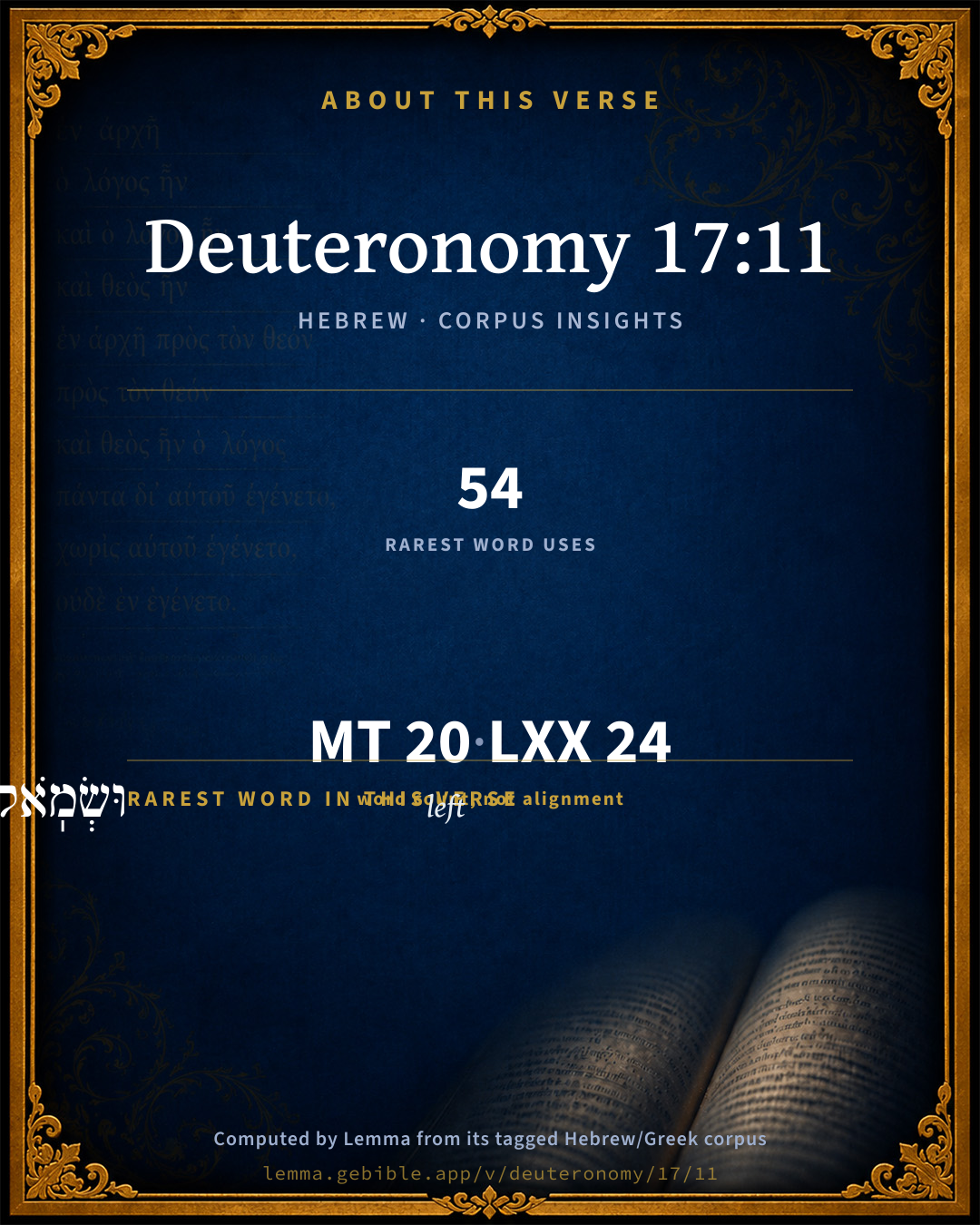
Deuteronomy 17:11

Hebrew (Westminster Leningrad Codex) Deuteronomy 17:11 appears in the Hebrew Old Testament. The text above is from the Westminster Leningrad Codex. Each word links to its Strong’s number, a concise gloss, and parsing drawn from the Open Scriptures Hebrew Bible morphology. Click any word for its full Brown-Driver-Briggs (BDB) entry.
Download image
Cite this verse

Deuteronomy 17:11 (World English Bible). Public Domain. Lemma interlinear Bible study tool, https://lemma.gebible.app/v/deuteronomy/17/11.

Show BibTeX & RIS
BibTeX
RIS
English Translation
according to the tenor of the law which they shall teach you, and according to the judgment which they shall tell you, you shall do; you shall not turn aside from the sentence which they shall show you, to the right hand, nor to the left.
World English Bible · Public Domain
Download a study sheet

One document with this verse’s original text, its word-by-word gloss line, the meaning frame, cross-references with their text, attributed commentary, and full source and license credits — printable, and it pastes into notes with its structure intact.

This verse Autodidact and up

Study sheet (.html) Plain text (.txt)

A passage Seminary Student

Up to 50 verses in one chapter. A passage sheet keeps up to 6 commentary sources and 12 cross-references per verse, in the order this page ranks them, and says so on the sheet whenever that leaves anything out. Ask for a single verse and you get the Autodidact verse sheet above.

Everything on this page stays free to read, with no account — the sheet is a download of what is already on screen, not access to it.

Want to remove ads? Support Godless Engineer
Compare translations 3

The same verse in 3 English versions, stacked beneath the original-language interlinear above. Click any original word for its lexicon entry.

Each is an independent rendering of the whole verse — the interlinear is not word-aligned to these translations.

Highlighted words mark where these versions differ — a whole-verse word diff, not a word-by-word alignment.

  • World English Bible Public Domain
    according to the tenor of the law which they shall teach you, and according to the judgment which they shall tell you, you shall do; you shall not turn aside from the sentence which they shall show you, to the right hand, nor to the left.
  • King James Version Public Domain
    According to the sentence of the law which they shall teach thee, and according to the judgment which they shall tell thee, thou shalt do: thou shalt not decline from the sentence which they shall show thee, to the right hand, nor to the left.
  • unfoldingWord Literal Text CC BY-SA 4.0
    According to the mouth of the law that they teach you, and according to the judgment that they say to you, you shall do. Do not turn aside from the word that they tell you, right or left.

unfoldingWord Literal Text — © unfoldingWord, licensed CC BY-SA 4.0. Word-aligned USFM3 via Door43 (git.door43.org/unfoldingWord/en_ult).

Versions to compare (up to 4)

3 of 4 selected

Show all 18 translations

Every available English version of this verse, each an independent rendering of the whole verse.

  • World English Bible Public Domain
    according to the tenor of the law which they shall teach you, and according to the judgment which they shall tell you, you shall do; you shall not turn aside from the sentence which they shall show you, to the right hand, nor to the left.
  • Berean Standard Bible Public Domain
    according to the terms of law they give and the verdict they proclaim. Do not turn aside to the right or to the left from the decision they declare to you.
  • Majority Standard Bible Public Domain
    according to the terms of law they give and the verdict they proclaim. Do not turn aside to the right or to the left from the decision they declare to you.
  • King James Version Public Domain
    According to the sentence of the law which they shall teach thee, and according to the judgment which they shall tell thee, thou shalt do: thou shalt not decline from the sentence which they shall show thee, to the right hand, nor to the left.
  • American Standard Version (1901) Public Domain
    according to the tenor of the law which they shall teach thee, and according to the judgment which they shall tell thee, thou shalt do; thou shalt not turn aside from the sentence which they shall show thee, to the right hand, nor to the left.
  • Revised Version (1885) Public Domain
    according to the tenor of the law which they shall teach thee, and according to the judgment which they shall tell thee, thou shalt do: thou shalt not turn aside from the sentence which they shall shew thee, to the right hand, nor to the left.
  • Geneva Bible (1599) Public Domain
    According to the Lawe, which they shall teach thee, and according to the iudgement which they shall tell thee, shalt thou doe: thou shalt not decline from the thing which they shall shew thee, neither to the right hand, nor to the left.
  • Douay-Rheims (1899) Public Domain
    According to his law; and thou shalt follow their sentence: neither shalt thou decline to the right hand nor to the left hand.
  • Young's Literal Translation Public Domain
    `According to the tenor of the law which they direct thee, and according to the judgment which they say to thee thou dost do; thou dost not turn aside from the word which they declare to thee, right or left.
  • Literal Standard Version CC BY-SA 4.0
    According to the tenor of the law which they direct you, and according to the judgment which they say to you, you do; you do not turn aside from the word which they declare to you [to] the right or left.
  • Unlocked Literal Bible CC BY-SA 4.0
    Follow the law they teach you, and do according to the decisions they give you. Do not turn aside from what they tell you, to the right hand or to the left.
  • unfoldingWord Literal Text CC BY-SA 4.0
    According to the mouth of the law that they teach you, and according to the judgment that they say to you, you shall do. Do not turn aside from the word that they tell you, right or left.
  • Darby Bible Public Domain
    according to the sentence of the law which they shall declare unto thee, and according to the judgment which they shall tell thee, thou shalt do: thou shalt not decline from the word which they shall declare unto thee, to the right hand, or the left.
  • World Messianic Bible Public Domain
    According to the decisions of the law which they shall teach you, and according to the judgment which they shall tell you, you shall do. You shall not turn away from the sentence which they announce to you, to the right hand, nor to the left.
  • Webster's Bible Public Domain
    According to the sentence of the law which they shall teach thee, and according to the judgment which they shall tell thee, thou shalt do: thou shalt not decline from the sentence which they shall show thee, to the right hand, nor to the left.
  • Free Bible Version CC BY-SA 4.0
    in accordance with the legal instructions they give you and the verdict they delivered. Don't deviate from the decision they give you.
  • Bible in Basic English Public Domain
    Acting in agreement with their teaching and the decision they give: not turning to one side or the other from the word they have given you.
  • JPS Tanakh (1917) Public Domain
    According to the law which they shall teach thee, and according to the judgment which they shall tell thee, thou shalt do; thou shalt not turn aside from the sentence which they shall declare unto thee, to the right hand, nor to the left.

Literal Standard Version (2020), Covenant Press — licensed CC BY-SA 4.0. Text via the HelloAO Bible API (eBible.org). Unlocked Literal Bible (unfoldingWord) — licensed CC BY-SA 4.0. Text via the HelloAO Bible API (eBible.org). unfoldingWord Literal Text — © unfoldingWord, licensed CC BY-SA 4.0. Word-aligned USFM3 via Door43 (git.door43.org/unfoldingWord/en_ult). Free Bible Version, Dr. Jonathan Gallagher — licensed CC BY-SA 4.0. Text via the HelloAO Bible API (eBible.org).

Word by word

More ways to search: Search by grammar → Find every occurrence → Compare this word →

Practice this passage: Drill this verse → Learn its vocabulary →

וּשְׂמֹֽאל
sᵉmôʼwl
H8040
“and · left”
Conjunction + Noun, Common, Masculine, Singular, Absolute
Part of Speech
Conjunction + Noun
Type
Common
Gender
Masculine
Number
Singular
State
Absolute
Full BDB Definition

Origin: a primitive word [rather perhaps from the same as H8071 (by insertion of the aleph) through the idea of wrapping up]

TWOT: 2267a

the left, the left hand, the left side - left - left hand - north (as one faces east)
  1. עַל ʻal H5921 “upon” Preposition
  2. פִּ֨י peh H6310 “mouth of” Noun, Common, Masculine, Singular, Construct
  3. הַתּוֹרָ֜ה tôwrâh H8451 “the · law” Particle, Definite Article + Noun, Common, Feminine, Singular, Absolute
  4. אֲשֶׁ֣ר ʼăsher H834 “which” Particle, Relative
  5. יוֹר֗וּךָ yârâh H3384 “to throw · you” Verb, Hiphil, Imperfect, 3rd Person, Masculine, Plural + Suffix, Personal, 2nd Person, Masculine, Singular
  6. וְעַל ʻal H5921 “and · upon” Conjunction + Preposition
  7. הַמִּשְׁפָּ֛ט mishpâṭ H4941 “the · judgment” Particle, Definite Article + Noun, Common, Masculine, Singular, Absolute
  8. אֲשֶׁר ʼăsher H834 “which” Particle, Relative
  9. יֹאמְר֥וּ ʼâmar H559 “to say” Verb, Qal, Imperfect, 3rd Person, Masculine, Plural
  10. תַּעֲשֶׂ֑ה ʻâsâh H6213 “to do” Verb, Qal, Imperfect, 2nd Person, Masculine, Singular
  11. לֹ֣א lôʼ H3808 “not” Particle, Negative
  12. תָס֗וּר çûwr H5493 “to turn aside” Verb, Qal, Imperfect, 2nd Person, Masculine, Singular
  13. מִן min H4480 “from” Preposition
  14. הַדָּבָ֛ר dâbâr H1697 “the · word” Particle, Definite Article + Noun, Common, Masculine, Singular, Absolute
  15. אֲשֶׁר ʼăsher H834 “which” Particle, Relative
  16. יַגִּ֥ידֽוּ nâgad H5046 “to make known” Verb, Hiphil, Imperfect, 3rd Person, Masculine, Plural
  17. יָמִ֥ין yâmîyn H3225 “right hand” Noun, Common, Feminine, Singular, Absolute

About this verse

These counts appear in no published source. They are computed here, from the morphology-tagged text and Lemma’s own curated glosses. What Lemma adds →

20
words
15
distinct lemmas
Pentateuch
section

Shared distinctive vocabulary

וּשְׂמֹֽאל left H8040 occurs in 53 verses of the Hebrew Bible. Also found in:

Grammatical profile

  • 5 verbs
  • 6 nouns
  • 5 prepositions
  • 4 particles

Verb forms

  • יוֹר֗וּךָ Hiphil · Imperfect
  • יֹאמְר֥וּ Qal · Imperfect
  • תַּעֲשֶׂ֑ה Qal · Imperfect
  • תָס֗וּר Qal · Imperfect
  • יַגִּ֥ידֽוּ Hiphil · Imperfect

Repetition

Words recur within this verse — often emphatic in Hebrew:

  • עַל upon H5921 ×2
  • אֲשֶׁ֣ר which H834 ×3

Hebrew & Septuagint length

In English translation the verse runs 46 words from the Hebrew and 38 from the Septuagint (LXX English) — closely comparable.

A rough comparison of the two English renderings, which tokenize alike — not a word-level alignment.

Word counts can differ between the Hebrew and the Greek without any difference in meaning — e.g. the Hebrew direct-object marker אֵת has no separate Greek word, and Greek often adds the article ὁ.

In the original languages it is 20 Hebrew tokens and 24 Greek tokens — but the two are counted differently (Hebrew bundles its prefixes and suffixes into one token; the Greek is in lemma form), so that isn’t a like-for-like length.

Cross-references

14

Topical passages linked to Deuteronomy 17:11 in the Treasury of Scripture Knowledge — connected by theme and wording, ordered by reader-vote popularity; previews shown in the World English Bible.

  • Joshua 1:7 Only be strong and very courageous, to observe to do according to all the law, which Moses my servant commanded you: don't turn from it to the right hand or to the left, that you may have good success wherever you go.
  • Deuteronomy 5:32 You shall observe to do therefore as Yahweh your God has commanded you: you shall not turn aside to the right hand or to the left.
  • Deuteronomy 17:20 that his heart not be lifted up above his brothers, and that he not turn aside from the commandment, to the right hand, or to the left: to the end that he may prolong his days in his kingdom, he and his children, in the midst of Israel.
  • Deuteronomy 25:1 If there be a controversy between men, and they come to judgment, and [the judges] judge them; then they shall justify the righteous, and condemn the wicked;
  • Deuteronomy 28:14 and shall not turn aside from any of the words which I command you this day, to the right hand, or to the left, to go after other gods to serve them.
  • Joshua 23:6 Therefore be you very courageous to keep and to do all that is written in the book of the law of Moses, that you not turn aside from it to the right hand or to the left;
  • 2 Samuel 14:19 The king said, Is the hand of Joab with you in all this? The woman answered, As your soul lives, my lord the king, none can turn to the right hand or to the left from anything that my lord the king has spoken; for your servant Joab, he bade me, and he put all these words in the mouth of your handmaid;
  • Proverbs 4:27 Don't turn to the right hand nor to the left. Remove your foot from evil.
  • Romans 13:1–6 Let every soul be in subjection to the higher authorities, for there is no authority except from God, and those who exist are ordained by God.
  • Titus 3:1 Remind them to be in subjection to rulers and to authorities, to be obedient, to be ready for every good work,
  • 1 Peter 2:13–15 Therefore subject yourselves to every ordinance of man for the Lord's sake: whether to the king, as supreme;
  • 2 Peter 2:10 but chiefly those who walk after the flesh in the lust of defilement, and despise authority. Daring, self-willed, they are not afraid to speak evil of dignitaries;
  • Jude 1:8 Yet in like manner these also in their dreaming defile the flesh, despise authority, and slander celestial beings.
  • Malachi 2:8–9 But you have turned aside out of the way. You have caused many to stumble in the law. You have corrupted the covenant of Levi," says Yahweh of Hosts.

Cross-references courtesy of OpenBible.info (CC BY 4.0).

Hebrew and Greek witnesses Masoretic Hebrew ↔ Greek Septuagint

The same verse in the two great witnesses to the Old Testament, shown verse-for-verse.

These are two independent witnesses, not word-aligned to each other, and the Septuagint is shown in lemma (dictionary) form.

Hebrew Deuteronomy 17:11 Masoretic · Westminster Leningrad Codex

עַל פִּ֨י הַתּוֹרָ֜ה אֲשֶׁ֣ר יוֹר֗וּךָ וְעַל הַמִּשְׁפָּ֛ט אֲשֶׁר יֹאמְר֥וּ לְךָ֖ תַּעֲשֶׂ֑ה לֹ֣א תָס֗וּר מִן הַדָּבָ֛ר אֲשֶׁר יַגִּ֥ידֽוּ לְךָ֖ יָמִ֥ין וּשְׂמֹֽאל

according to the tenor of the law which they shall teach you, and according to the judgment which they shall tell you, you shall do; you shall not turn aside from the sentence which they shall show you, to the right hand, nor to the left.

World English Bible · Public Domain

Greek LXX Deuteronomy 17:11 Septuagint · lemma form

κατά ὁ νόμος καί κατά ὁ κρίσις ὅς ἄν εἶπον σύ ποιέω οὐ ἐκκλίνω ἀπό ὁ ῥῆμα ὅς ἐάν ἀναἀγγέλλω σύ δεξιός οὐδέ ἀριστερός

You shall do according to the law and to the judgment which they shall declare to you: you shall not swerve to the right hand or to the left from any sentence which they shall report to you.

LXX2012 (modern English Septuagint) · Public Domain

Hebrew: Westminster Leningrad Codex (CC BY 4.0). Greek: Septuagint (public domain); English from LXX2012 (modern English Septuagint) (Public Domain). How the Septuagint differs from the Hebrew →

Targum (Aramaic paraphrase)

2

The Targum is the ancient Jewish Aramaic paraphrase of the Hebrew Scriptures — an interpretive translation, not the Hebrew text itself. Onkelos (literal) and Pseudo-Jonathan (expansive) render the Torah, and Jonathan the Prophets. Coverage is partial: where no permissively-licensed English translation exists for a verse, only the Aramaic is shown. This is verse-level text, not a word-by-word alignment to the Hebrew.

  1. Targum Onkelos Torah (Genesis–Deuteronomy)
    עַל מֵימַר אוֹרַיְתָא דִי יַלְפֻנָךְ וְעַל דִינָא דִי יֵימְרוּן לָךְ תַּעְבֵּד לָא תִסְטֵּי מִן פִּתְגָמָא דִי יְחַוּוּן לָךְ יַמִינָא וּשְׂמָאלָא

    (no public-domain English translation for this verse)

    Targum Onkelos — Aramaic: “Onkelos Genesis” (public domain); “Onkelos Exodus” (public domain); “Onkelos Leviticus” (public domain); “Onkelos Numbers” (public domain); “Onkelos Deuteronomy” (public domain). English: “Sefaria Community Translation” (CC0 1.0 (public-domain dedication)); “J.W. Etheridge. The Targums of Onkelos and Jonathan Ben Uzziel on the Pentateuch. London: Longmans, Green, 1862” (public domain). Text via Sefaria.

  2. Targum Pseudo-Jonathan Torah (Genesis–Deuteronomy)
    עַל מֵימַר אוֹרַיְיתָא דְיַלְפוּנְכוֹן וְעַל הִילְכַת דִּינָא דְיֵימְרוּן לְכוֹן תַּעַבְדוּן לָא תִסְטוּן מִן פִּתְגָמָא דִיחַוּוּן לְכוֹן יְמִינָא וּשְמָאלָא

    According to the word of the law that they will teach you, and the manner of judgment they pronounce, you shall do. You shall not turn aside from the sentence they will show you, to the right or to the left.

    Targum Pseudo-Jonathan — Aramaic: “Targum Jonathan on Genesis” (public domain); “Targum Jonathan on Exodus” (public domain); “Targum Jonathan on Leviticus” (public domain); “Targum Jonathan on Numbers” (public domain); “Targum Jonathan on Deuteronomy” (public domain). English: “The Targum of Jonathan ben Uzziel, trans. J. W. Etheridge, London, 1862” (public domain). Text via Sefaria.

Commentary

Notes on Deuteronomy 17:11 from classic Christian and Jewish commentators (each source and its license shown beneath its notes). The classic Christian expositions comment on the surrounding passage and are grouped to its opening verse, so a note may address several verses; the Jewish commentaries on the Tanakh (Rashi and others) are per-verse, so they appear only where the commentator wrote on this verse.

Lemma curates 59 commentaries, every one of them public domain or Creative Commons licensed, each selected and text-cleaned for this edition rather than reprinted as found. About our sources →

Tyndale Open Study Notes

Tyndale Open Resources

17:11 do not modify it: This Hebrew term envisions keeping on a straight path (cp. Prov 4:25-27; Heb 12:13). Once a verdict has been rendered, the sentence must be applied according to the law and the rules of evidence. Justice must be carried out on an unswerving path of fairness and righteousness.

Tyndale Open Study Notes — © Tyndale Open Resources, licensed CC BY-SA 4.0. Text via the HelloAO Bible API.

Geneva Bible (1599)

Geneva Bible translators

Thou shalt obey their sentence that the controversy may have an end.

Geneva Bible (1599) marginal notes — public domain. Text via Bolls.life.

The Cambridge Bible for Schools and Colleges

gen. ed. J. J. S. Perowne

11. law] Heb. torah, usually of the directions given by priests in questions of ritual, covers here their decisions in civil cases as well. Teach, rather direct, is the vb from which Torah is derived.

The Cambridge Bible for Schools and Colleges (gen. ed. J. J. S. Perowne; Cambridge University Press, 1878–1918) — public domain. Text from a community e-Sword module.

John Gill's Exposition

According to the sentence of the law which they shall teach thee,.... For they were not to make any new law, but to teach the law of God, and so far as their sense and opinion of things agreed with that law they were to be regarded:

and according to the judgment which they shall tell thee, thou shalt do; what were law and justice, what were fit and right to be done, according to the will of God, which they should declare unto them, that was carefully to be done by them:

thou shalt not decline from the sentence they shall show thee, to the right hand nor to the left; by setting up after, all their own judgments against theirs to whom they had applied for information and direction, which to have done would have been very insolent and affronting; they were not to depart from the determination they made of the case, on pretence of knowing better, nor even in any minute circumstance to deviate from it, but strictly and closely to keep unto it; though not to follow them so implicitly as to receive from them and embrace things the most absurd and unreasonable, as Jarchi suggests; who says, that their sense was to be abided by, even if they should say that the right hand is the left, and the left hand the right.

John Gill's Exposition of the Whole Bible (1746–1763) — public domain (CC PDM 1.0). Text via the HelloAO Bible API.

Haydock's Catholic Bible Commentary

According, &c. This law was to be the rule of the priests, in passing sentence. It was not left to the judgment of individuals to comply or not, according as they might explain the law for themselves. Such a proceeding would be nugatory, as they would thus be themselves the ultimate judges of their own cause. (Haydock) --- They shall seek the law at his (the priest’s) mouth, Malachias ii. 7. Protestants make, therefore, a very frivolous restriction, when they allow his sentence to bind only "so long as he is the true minister of God, and pronounceth according to his word." (Bible, 1603.) (Worthington) --- If any had been proud enough among the Jews, to persuade himself that he understood the law better than the high priest, he would not on that account have escaped death. (Haydock) --- The authority of the Christian Church is not inferior to that of the Synagogue, only, "instead of death, excommunication is now inflicted" on the rebellious. (St. Gregory, Matthew xviii. 17.; St. Augustine, q. 38.) In effect, St. Paul assures us that the priests of the law, serve unto the example and shadow of heavenly things. But now he (Christ)...is the mediator of the better covenant, which is established on better promises, Hebrews viii. 5. If therefore the privilege of deciding points of faith and morality, without danger of mistake, was granted to the synagogue, can any one doubt but that Christ would provide as ample a security to his Church, with which he has promised to remain for ever, and with his Holy Spirit to teach her all the truth? (Haydock) --- St. Augustine dwells upon this argument (Doct. 4.) and proves the infallibility both of the Jewish and of the Christian Church. Hence Christ said, with respect to the former, which was not yet rejected, All therefore whatsoever they shall say to you, observe and do: but according to their works, do ye not: for they say the truth, and do not practise what they require of others. If the heads of the Catholic Church should be equally immoral, their true doctrine must not therefore be despised, lest Christ and his Father be at the same time despised. For this is the express admonition of our heavenly lawgiver, hear the Church: (Matthew xvii. 17,) and this he does not require without giving us a full assurance, that we may do it without fear of being led astray. The sole command of God implies as much, if he had said no more. For can he order us to sin? The pretended reformers, who blushed not to make this blasphemous assertion, might easily swallow down the other, respecting the defection and fallibility of the whole Church; and might even believe, that the whole world had been drowned in abominable idolatry for eight hundred years and more. (Hom. on the peril of idolat. p. 3.) How much more they do not determine, lest they should be forced to tell when the religion of the Catholics began, and that they will never do without dating from Christ and the apostles, the foundations of the only true Church. (Haydock) --- The Jews had such a respect for the decisions of their Rabbins, in consequence of this command of God, that some hesitate not to assert, that if one of them should declare that the left hand was the right, they would believe him; and they condemn the refractory to most grievous torments in hell. (Buxtorf, Syn. i.) --- We must shew the most profound submission to the decrees of the Church. (Calmet) --- Yet we are not bound to assent to the decisions of every teacher. Only, when the Church speaks, we must not refuse to obey, nor pretend to appoint ourselves judges of what she teaches. A private doctor, however eminent, may fall into some absurdities, but the major part of the pastors of the Church, with the Pope at their head, never can. In vain have the records of nineteen centuries been ransacked, to find a single instance of such a general agreement in error. If the Synagogue passed a wicked sentence upon Jesus Christ, we must reflect that the forms here required (ver. 8,) were neglected; and it was then expiring, and giving place to a better covenant, as the prophets had foretold. Yet even in that sentence, which was so unjust on the part of Caiphas, St. John (xi. 51.) acknowledges the truth of God. And this he spoke not of himself: but being the high priest, that year, he prophesied that Jesus should die for the nation, and not only for the nation, but to gather together in one the children of God that were dispersed. The Synagogue could claim submission no longer, after the great prophet had come to abrogate the law of fear, and to substitute that of love. Hence while he was there to teach himself, (Hebrews i. 2,) there was no danger of deception for the people. But the covenant which he has established is to last for ever: no prophet or lawgiver is promised to introduce any change, or greater perfection, so that no one can plead for an excuse of his rebellion, that the Church may deceive and pass an erroneous judgment; or, if he do, he must be cut off from the society of the faithful, by the spiritual sword; and, dying in that state, without the Church for his mother, he need never expect that God will acknowledge him for his son. See St. Cyprian, Unity of the Catholic Church. If an individual pastor should pass such a perverse sentence, the case would be very different. Yet, even in such trying cases, an humble conduct will be the best security and proof of innocence, and God will reward those who have suffered unjustly. (Haydock)

George Leo Haydock (1774–1849), Haydock's Catholic Family Bible and Commentary, 1859 edition — public domain. Excludes Psalms (Douay-Rheims chapter numbering differs from Protestant) and Deuterocanonical books (Catholic canon only).

Matthew Poole's English Annotations

According to the sentence of the law which they shall teach thee: these words are a manifest limitation of the foregoing assertion, that they were to do according to all that the judge or judges informed him. And they seem to limit and regulate,

1. The judges in their sentence, that they shall not, upon pretence of this supreme authority put into their hands, presume to teach or direct otherwise than the law prescribes.

2. The people in their obedience; first they shall not simply obey them in all things, but so far forth as their sentence is according to the law and word of God, but not when their commands are evidently contrary to God’s laws, for then, say even popish commentators on this place, they must obey God rather than man. And this cannot be denied by any man of sense, upon supposition that this place speaks of, and this power given to the priest or judge reacheth to, all controversies or questions of faith and manners, as the papists would extend it: for put case these priests or judges’ should give a sentence directly contrary to the express words of God’s law, Thou shalt worship a graven image, as Aaron did in the case of the calf, thou shalt profane the sabbath, thou shalt dishonour thy father and mother, thou shalt murder, steal, commit adultery, &c., I ask, were the people in this case bound to do as the judge determined, or not? If any say they were, such a bold and wicked assertion must need strike all sober Christians with horror; and if they say they were not, then this must needs be taken for a limitation. But this place speaks only of particular suits between man and man, as is apparent from the notes on See Poole "Deu 17:8". And in all such cases, although the judge be hereby confined and tied to his rule in giving the sentence, yet it seems but fit and reasonable that people should be bound simply to acquiesce in the sentence of their last and highest judge, or else there would have been no end of strife.

Matthew Poole's English Annotations on the Holy Bible (1683–1685) — public domain. Text from a community e-Sword/MySword module.

John Wesley's Explanatory Notes

Thou shalt do - In particular suits between man and man, altho' the judge be hereby confined to his rule in giving the sentence, yet it seems but fit and reasonable that people should be bound simply to acquiesce in the sentence of their last and highest judge, or else there would have been no end of strife.

John Wesley, Explanatory Notes Upon the Whole Bible (1754–1765) — public domain. Text via the GEBible commentary corpus.

Rashi

Rabbi Shlomo Yitzchaki (Rashi)

ימין ושמאל [THOU SHALT NOT DEPART FROM THE WORD WHICH THEY SHALL TELL THEE] TO THE RIGHT NOR TO THE LEFT, even if he (the judge) tells you about what appears to you to be right that it is left, or about what appears to you to be left that it is right, you have to obey him; how much the more is this so if actually he tells you about what is evidently right that it is right and about what is left that it is left (cf. Sifrei Devarim 154:5).

Rashi on the Tanakh — English translations: “The Judaica Press complete Tanach with Rashi, translated by A. J. Rosenberg” (CC BY 4.0); “Pentateuch with Rashi's commentary by M. Rosenbaum and A.M. Silbermann, 1929-1934” (public domain); “The Metsudah Tanach series, Lakewood, N.J” (CC BY 4.0); and “The Book of Joshua, Metsudah Publications, 1997” (CC BY 4.0). Text via Sefaria.

Ramban (Nachmanides)

Rabbi Moshe ben Nachman (Ramban / Nachmanides)

THOU SHALT NOT DEPART FROM THE WORD WHICH THEY SHALL TELL THEE, TO THE RIGHT NOR TO THE LEFT. “Even if he [the judge of the Great Sanhedrin] tells you of the right that it is the left, or about the left that it is the right [you must obey him].” This is Rashi’s language. The purport thereof is that even if you think in your heart that they are mistaken, and the matter is simple in your eyes just as you know [the difference] between your right hand and your left hand, you must still do as they command you. You are not to say: “How can I [permit myself to] eat this real forbidden fat, or execute this innocent man;” instead you are to say, “The Lord Who enjoined the commandments commanded that I perform all His commandments in accordance with all that they, who stand before Him in the place that He shall choose, teach me to do. He gave me the Torah as taught by them, even if they were to err.” Such was the case of Rabbi Yehoshua and Rabban Gamaliel [Rabbi Yehoshua being instructed by Rabban Gamaliel to come before him with his walking stick] on the Day of Atonement that occurred according to his reckoning. reckon to be the Day of Atonement. The order caused Rabbi Yehoshua personal anguish because carrying is forbidden on the Day of Atonement. The affair ended with Rabbi Yehoshua obeying Rabban Gamaliel’s command. When Rabbi Yehoshua arrived, “Rabban Gamaliel stood up and kissed him on the head and said to him; ‘Come in peace, my master and my disciple’ — ‘my master’ in wisdom, and ‘my disciple’ because you accepted my words” (Rosh Hashanah 25a).Now the need for this commandment is very great, for the Torah was given to us in written form and it is known that not all opinions concur on newly arising matters. Disagreements would thus increase and the one Torah would become many Torahs. Scripture, therefore, defined the law that we are to obey the Great Court that stands before G-d in the place that He chose in whatever they tell us with respect to the interpretation of the Torah, whether they received its interpretation by means of witness from witness until Moses [who heard it] from the mouth of the Almighty, or whether they said so based on the implication [of the written words] of the Torah or its intent. For it was subject to their judgment that He gave them the Torah even if it [the judgment] appears to you to exchange right for left. And surely you are obligated to think that they say “right” what is truly right, because G-d’s spirit is upon the ministers of His Sanctuary, and He forsaketh not His saints; they are preserved forever from error and stumbling. In the language of the Sifre: 154. “Even if they show you before your own eyes that right is left and that left is right — obey them!”

Ramban (Nachmanides) on the Tanakh — English translation: “Commentary on the Torah by Ramban (Nachmanides). Translated and annotated by Charles B. Chavel. New York, Shilo Pub. House, 1971-1976” (CC BY 4.0). Text via Sefaria.

Lesson kit

Teaching starters — assembled from the data on this page, not authored interpretation. Every prompt links to the verse data it draws on. Edit before teaching.

Deuteronomy, in the Pentateuch, opens this verse with 20 words (15 distinct Hebrew lemmas). Its most distinctive word is sᵉmôʼwl (“left”). A historical commentator’s framing appears above. Read the whole chapter for the surrounding context.

Discussion questions

  1. The word sᵉmôʼwl carries the sense “left.” How does it shape the verse?
  2. How does Genesis 13:9, which shares the word «left», read alongside this verse?
  3. What does the repetition of “upon” (2× in this one verse) do in this verse?
  4. These translations render this verse differently. What is at stake in choosing one wording over another?
  5. «יוֹר֗וּךָ» is a Hiphil Imperfect verb. How does that grammatical form shape the action described?
  6. Compare how Tyndale Open Study Notes and Geneva Bible (1599) read this verse. Where do they agree or differ?

Things to notice

Reading settings

Reading text

Shown beneath each verse's original-language words.

Old Testament
Old Testament edition

Read the OT as the Masoretic Hebrew (MT) or the Greek Septuagint (LXX).

English shown for the Greek Septuagint (in the Hebrew ↔ Greek comparison).

Comparing translations? Open the Compare panel on any verse page to stack up to four side by side.