2 Kings 22:2

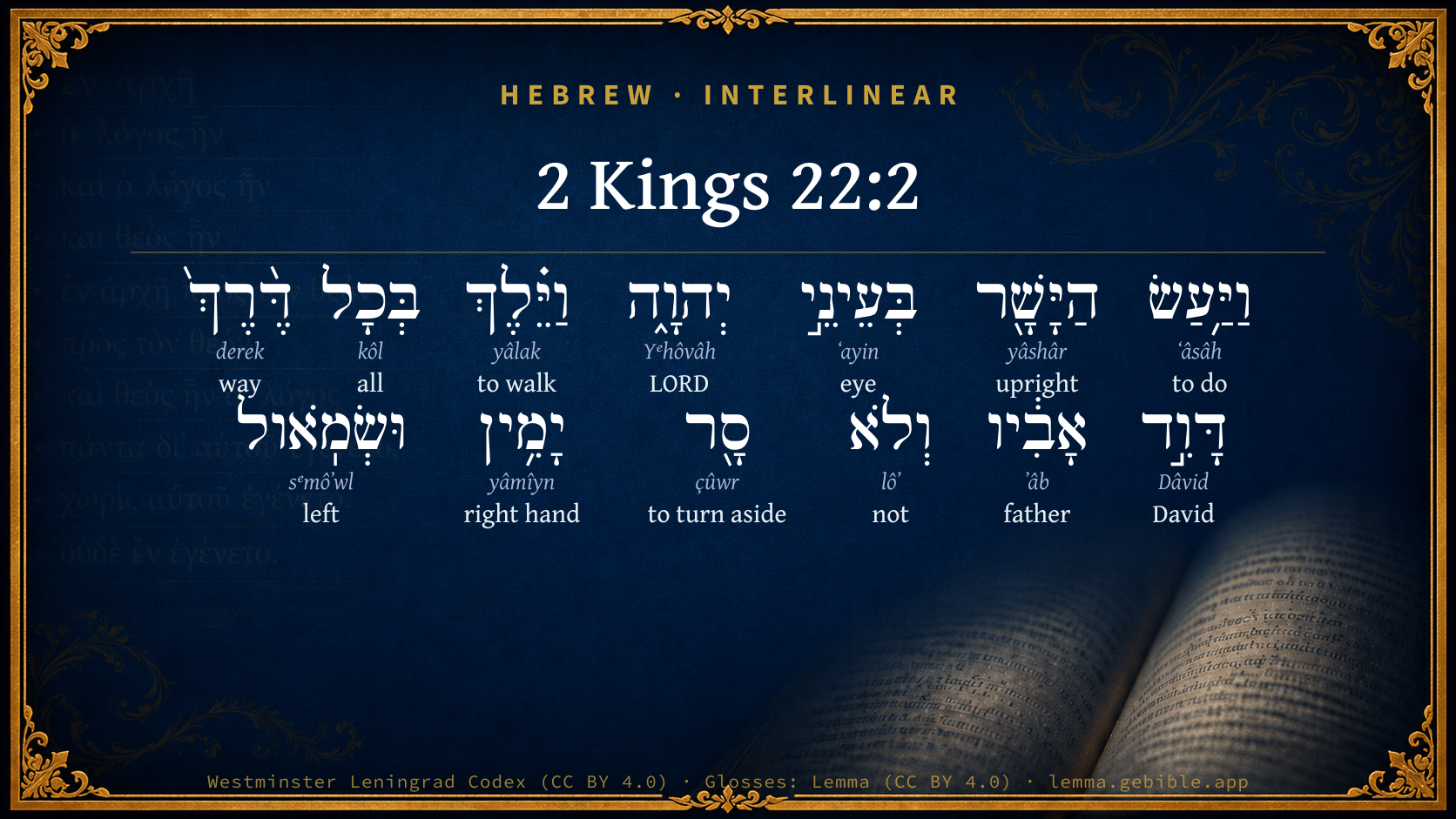
Hebrew (Westminster Leningrad Codex) 2 Kings 22:2 appears in the Hebrew Old Testament. The text above is from the Westminster Leningrad Codex. Each word links to its Strong’s number, a concise gloss, and parsing drawn from the Open Scriptures Hebrew Bible morphology. Click any word for its full Brown-Driver-Briggs (BDB) entry.
Download image
Cite this verse

2 Kings 22:2 (World English Bible). Public Domain. Lemma interlinear Bible study tool, https://lemma.gebible.app/v/2-kings/22/2.

Show BibTeX & RIS
BibTeX
RIS
English Translation
He did that which was right in the eyes of Yahweh, and walked in all the way of David his father, and didn't turn aside to the right hand or to the left.
World English Bible · Public Domain
Download a study sheet

One document with this verse’s original text, its word-by-word gloss line, the meaning frame, cross-references with their text, attributed commentary, and full source and license credits — printable, and it pastes into notes with its structure intact.

This verse Autodidact and up

Study sheet (.html) Plain text (.txt)

A passage Seminary Student

Up to 50 verses in one chapter. A passage sheet keeps up to 6 commentary sources and 12 cross-references per verse, in the order this page ranks them, and says so on the sheet whenever that leaves anything out. Ask for a single verse and you get the Autodidact verse sheet above.

Everything on this page stays free to read, with no account — the sheet is a download of what is already on screen, not access to it.

Want to remove ads? Support Godless Engineer
Compare translations 3

The same verse in 3 English versions, stacked beneath the original-language interlinear above. Click any original word for its lexicon entry.

Each is an independent rendering of the whole verse — the interlinear is not word-aligned to these translations.

Highlighted words mark where these versions differ — a whole-verse word diff, not a word-by-word alignment.

  • World English Bible Public Domain
    He did that which was right in the eyes of Yahweh, and walked in all the way of David his father, and didn't turn aside to the right hand or to the left.
  • King James Version Public Domain
    And he did that which was right in the sight of the LORD, and walked in all the way of David his father, and turned not aside to the right hand or to the left.
  • unfoldingWord Literal Text CC BY-SA 4.0
    And he did right in the eyes of Yahweh, and he walked in every way of David his father, and he did not turn away, right or left.

unfoldingWord Literal Text — © unfoldingWord, licensed CC BY-SA 4.0. Word-aligned USFM3 via Door43 (git.door43.org/unfoldingWord/en_ult).

Versions to compare (up to 4)

3 of 4 selected

Show all 18 translations

Every available English version of this verse, each an independent rendering of the whole verse.

  • World English Bible Public Domain
    He did that which was right in the eyes of Yahweh, and walked in all the way of David his father, and didn't turn aside to the right hand or to the left.
  • Berean Standard Bible Public Domain
    And he did what was right in the eyes of the LORD and walked in all the ways of his father David; he did not turn aside to the right or to the left.
  • Majority Standard Bible Public Domain
    And he did what was right in the eyes of the LORD and walked in all the ways of his father David; he did not turn aside to the right or to the left.
  • King James Version Public Domain
    And he did that which was right in the sight of the LORD, and walked in all the way of David his father, and turned not aside to the right hand or to the left.
  • American Standard Version (1901) Public Domain
    And he did that which was right in the eyes of Jehovah, and walked in all the way of David his father, and turned not aside to the right hand or to the left.
  • Revised Version (1885) Public Domain
    And he did that which was right in the eyes of the LORD, and walked in all the way of David his father, and turned not aside to the right hand or to the left.
  • Geneva Bible (1599) Public Domain
    And hee did vprightly in the sight of the Lord, and walked in all the wayes of Dauid his father, and bowed neither to the right hand, nor to the left.
  • Douay-Rheims (1899) Public Domain
    And he did that which was right in the sight of the Lord, and walked in all the ways of David his father: he turned not aside to the right hand, or to the left.
  • Young's Literal Translation Public Domain
    and he doth that which is right in the eyes of Jehovah, and walketh in all the way of David his father, and hath not turned aside -- right or left.
  • Literal Standard Version CC BY-SA 4.0
    and he does that which is right in the eyes of YHWH, and walks in all the way of his father David, and has not turned aside [to] the right or left.
  • Unlocked Literal Bible CC BY-SA 4.0
    He did what was right in the eyes of Yahweh. He walked in all the way of David his ancestor, and he did not turn away either to the right or to the left.
  • unfoldingWord Literal Text CC BY-SA 4.0
    And he did right in the eyes of Yahweh, and he walked in every way of David his father, and he did not turn away, right or left.
  • Darby Bible Public Domain
    And he did what was right in the sight of Jehovah, and walked in all the way of David his father, and turned not aside to the right hand nor to the left.
  • World Messianic Bible Public Domain
    He did that which was right in the LORD’s eyes, and walked in all the ways of David his father, and didn’t turn away to the right hand or to the left.
  • Webster's Bible Public Domain
    And he did that which was right in the sight of the LORD, and walked in all the way of David his father, and turned not aside to the right hand or to the left.
  • Free Bible Version CC BY-SA 4.0
    He did what was right in the Lord's sight, and followed all the ways of David his forefather—he did not deviate to the right or to the left.
  • Bible in Basic English Public Domain
    He did what was right in the eyes of the Lord, walking in the ways of David his father, without turning to the right hand or to the left.
  • JPS Tanakh (1917) Public Domain
    And he did that which was right in the eyes of the LORD, and walked in all the way of David his father, and turned not aside to the right hand or to the left.

Literal Standard Version (2020), Covenant Press — licensed CC BY-SA 4.0. Text via the HelloAO Bible API (eBible.org). Unlocked Literal Bible (unfoldingWord) — licensed CC BY-SA 4.0. Text via the HelloAO Bible API (eBible.org). unfoldingWord Literal Text — © unfoldingWord, licensed CC BY-SA 4.0. Word-aligned USFM3 via Door43 (git.door43.org/unfoldingWord/en_ult). Free Bible Version, Dr. Jonathan Gallagher — licensed CC BY-SA 4.0. Text via the HelloAO Bible API (eBible.org).

Word by word

More ways to search: Search by grammar → Find every occurrence → Compare this word →

Practice this passage: Drill this verse → Learn its vocabulary →

וּשְׂמֹֽאול
sᵉmôʼwl
H8040
“and · left”
Conjunction + Noun, Common, Masculine, Singular, Absolute
Part of Speech
Conjunction + Noun
Type
Common
Gender
Masculine
Number
Singular
State
Absolute
Full BDB Definition

Origin: a primitive word [rather perhaps from the same as H8071 (by insertion of the aleph) through the idea of wrapping up]

TWOT: 2267a

the left, the left hand, the left side - left - left hand - north (as one faces east)
  1. וַיַּ֥עַשׂ ʻâsâh H6213 “and · to do” Conjunction + Verb, Qal, Sequential Imperfect, 3rd Person, Masculine, Singular
  2. הַיָּשָׁ֖ר yâshâr H3477 “the · upright” Particle, Definite Article + Adjective, Adjective, Masculine, Singular, Absolute
  3. בְּעֵינֵ֣י ʻayin H5869 “in/at · eyes of” Preposition + Noun, Common, Both, Dual, Construct
  4. יְהוָ֑ה Yᵉhôvâh H3068 “LORD” Noun, Proper
  5. וַיֵּ֗לֶךְ yâlak H3212 “and · to walk” Conjunction + Verb, Qal, Sequential Imperfect, 3rd Person, Masculine, Singular
  6. בְּכָל kôl H3605 “in/at · all of” Preposition + Noun, Common, Masculine, Singular, Construct
  7. דֶּ֨רֶךְ֙ derek H1870 “way of” Noun, Common, Both, Singular, Construct
  8. דָּוִ֣ד Dâvid H1732 “David” Noun, Proper
  9. אָבִ֔יו ʼâb H1 “father · his” Noun, Common, Masculine, Singular, Construct + Suffix, Personal, 3rd Person, Masculine, Singular
  10. וְלֹא lôʼ H3808 “and · not” Conjunction + Particle, Negative
  11. סָ֖ר çûwr H5493 “to turn aside” Verb, Qal, Perfect, 3rd Person, Masculine, Singular
  12. יָמִ֥ין yâmîyn H3225 “right hand” Noun, Common, Feminine, Singular, Absolute

About this verse

These counts appear in no published source. They are computed here, from the morphology-tagged text and Lemma’s own curated glosses. What Lemma adds →

13
words
13
distinct lemmas
Historical
section

Shared distinctive vocabulary

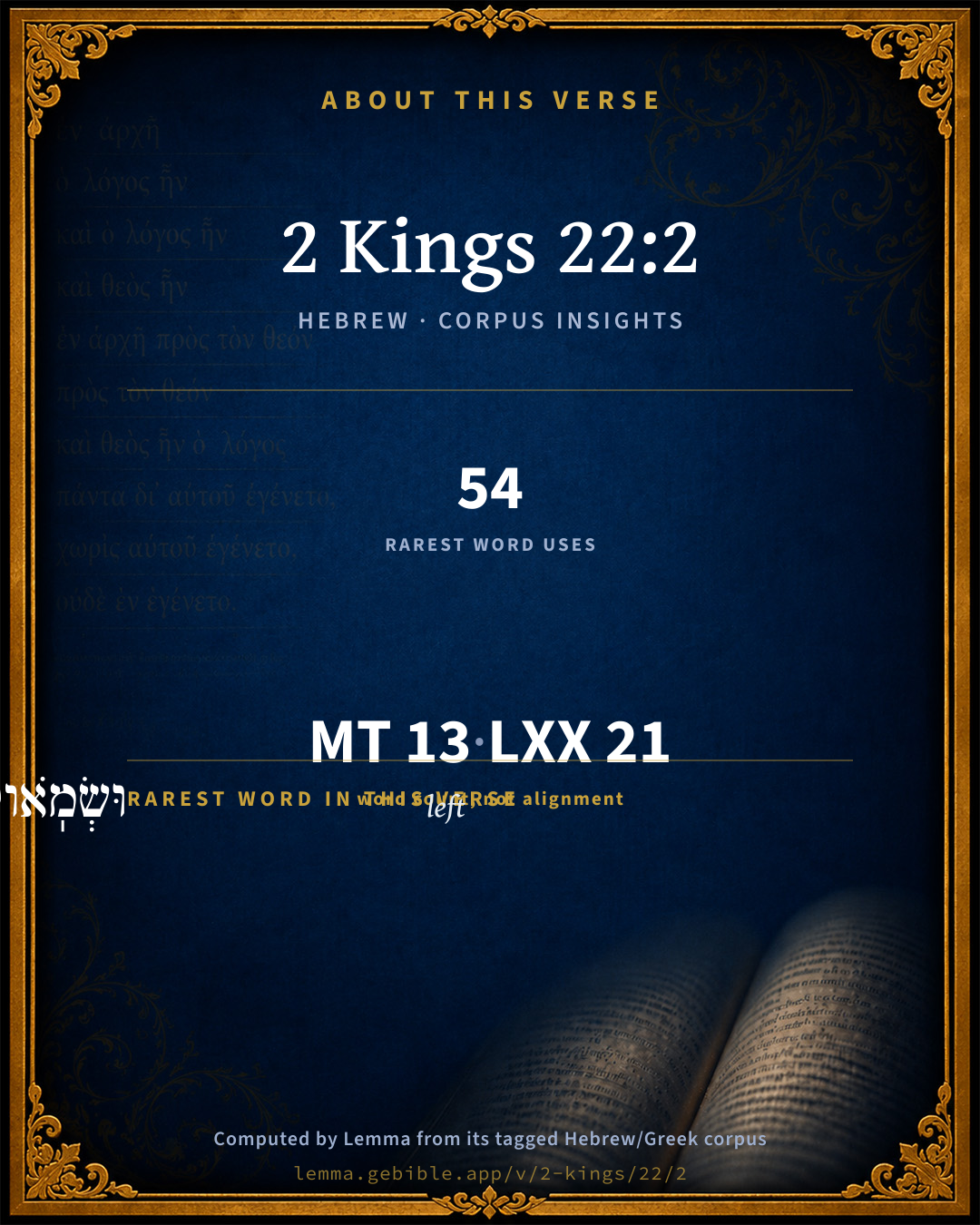
וּשְׂמֹֽאול left H8040 occurs in 53 verses of the Hebrew Bible. Also found in:

Grammatical profile

  • 3 verbs
  • 8 nouns
  • 1 adjective
  • 1 particle

Verb forms

  • וַיַּ֥עַשׂ Qal · Sequential Imperfect
  • וַיֵּ֗לֶךְ Qal · Sequential Imperfect
  • סָ֖ר Qal · Perfect

Hebrew & Septuagint length

In English translation the verse runs 33 words from the Hebrew and 35 from the Septuagint (LXX English) — closely comparable.

A rough comparison of the two English renderings, which tokenize alike — not a word-level alignment.

Word counts can differ between the Hebrew and the Greek without any difference in meaning — e.g. the Hebrew direct-object marker אֵת has no separate Greek word, and Greek often adds the article ὁ.

In the original languages it is 13 Hebrew tokens and 21 Greek tokens — but the two are counted differently (Hebrew bundles its prefixes and suffixes into one token; the Greek is in lemma form), so that isn’t a like-for-like length.

Cross-references

12

Topical passages linked to 2 Kings 22:2 in the Treasury of Scripture Knowledge — connected by theme and wording, ordered by reader-vote popularity; previews shown in the World English Bible.

  • Deuteronomy 5:32 You shall observe to do therefore as Yahweh your God has commanded you: you shall not turn aside to the right hand or to the left.
  • Joshua 1:7 Only be strong and very courageous, to observe to do according to all the law, which Moses my servant commanded you: don't turn from it to the right hand or to the left, that you may have good success wherever you go.
  • 2 Kings 18:3 He did that which was right in the eyes of Yahweh, according to all that David his father had done.
  • 1 Kings 3:6 Solomon said, You have shown to your servant David my father great loving kindness, according as he walked before you in truth, and in righteousness, and in uprightness of heart with you; and you have kept for him this great loving kindness, that you have given him a son to sit on his throne, as it is this day.
  • 1 Kings 11:38 It shall be, if you will listen to all that I command you, and will walk in my ways, and do that which is right in my eyes, to keep my statutes and my commandments, as David my servant did; that I will be with you, and will build you a sure house, as I built for David, and will give Israel to you.
  • 2 Kings 16:2 Twenty years old was Ahaz when he began to reign; and he reigned sixteen years in Jerusalem: and he didn't do that which was right in the eyes of Yahweh his God, like David his father.
  • 2 Chronicles 29:2 He did that which was right in the eyes of Yahweh, according to all that David his father had done.
  • Proverbs 4:27 Don't turn to the right hand nor to the left. Remove your foot from evil.
  • Proverbs 20:11 Even a child makes himself known by his doings, Whether his work is pure, and whether it is right.
  • 1 Kings 15:5 because David did that which was right in the eyes of Yahweh, and didn't turn aside from anything that he commanded him all the days of his life, except only in the matter of Uriah the Hittite.
  • 2 Chronicles 17:3 Yahweh was with Jehoshaphat, because he walked in the first ways of his father David, and didn't seek the Baals,
  • Ezekiel 18:14–17 Now, behold, if he fathers a son, who sees all his father's sins, which he has done, and fears, and does not such like;

Cross-references courtesy of OpenBible.info (CC BY 4.0).

Hebrew and Greek witnesses Masoretic Hebrew ↔ Greek Septuagint

The same verse in the two great witnesses to the Old Testament, shown verse-for-verse.

These are two independent witnesses, not word-aligned to each other, and the Septuagint is shown in lemma (dictionary) form.

Hebrew 2 Kings 22:2 Masoretic · Westminster Leningrad Codex

וַיַּ֥עַשׂ הַיָּשָׁ֖ר בְּעֵינֵ֣י יְהוָ֑ה וַיֵּ֗לֶךְ בְּכָל דֶּ֨רֶךְ֙ דָּוִ֣ד אָבִ֔יו וְלֹא סָ֖ר יָמִ֥ין וּשְׂמֹֽאול

He did that which was right in the eyes of Yahweh, and walked in all the way of David his father, and didn't turn aside to the right hand or to the left.

World English Bible · Public Domain

Greek LXX 2 Kings 22:2 Septuagint · lemma form

καί ποιέω ὁ εὐθής ἐν ὀφθαλμός κύριος καί πορεύομαι ἐν πᾶς ὁδός δαυίδ ὁ πατήρ αὐτός οὐ ἀποἵστημι δεξιός ἤ ἀριστερός

And he did that which was right in the sight of the Lord, and walked in all the way of David his father; he turned not aside to the right hand or to the left.

LXX2012 (modern English Septuagint) · Public Domain

Hebrew: Westminster Leningrad Codex (CC BY 4.0). Greek: Septuagint (public domain); English from LXX2012 (modern English Septuagint) (Public Domain). How the Septuagint differs from the Hebrew →

Targum (Aramaic paraphrase)

1

The Targum is the ancient Jewish Aramaic paraphrase of the Hebrew Scriptures — an interpretive translation, not the Hebrew text itself. Onkelos (literal) and Pseudo-Jonathan (expansive) render the Torah, and Jonathan the Prophets. Coverage is partial: where no permissively-licensed English translation exists for a verse, only the Aramaic is shown. This is verse-level text, not a word-by-word alignment to the Hebrew.

  1. Targum Jonathan Prophets (Joshua–Malachi)
    וַעֲבַד דְכָשַׁר קֳדָם יְיָ וַאֲזַל בְּכָל אוֹרַח דָוִד אֲבוּהִי וְלָא סְטָא לְיַמִינָא וְלִסְמָלָא:

    (no public-domain English translation for this verse)

    Targum Jonathan — Aramaic: “Mikraot Gedolot” (public domain). English: “Sefaria Community Translation” (CC0 1.0 (public-domain dedication)); “London "Chaldee Paraphrase," 1871” (public domain). Text via Sefaria.

Commentary

Notes on 2 Kings 22:2 from classic Christian and Jewish commentators (each source and its license shown beneath its notes). The classic Christian expositions comment on the surrounding passage and are grouped to its opening verse, so a note may address several verses; the Jewish commentaries on the Tanakh (Rashi and others) are per-verse, so they appear only where the commentator wrote on this verse.

Lemma curates 59 commentaries, every one of them public domain or Creative Commons licensed, each selected and text-cleaned for this edition rather than reprinted as found. About our sources →

Trapp's Complete Commentary

John Trapp

2Ki 22:2 And he did [that which was] right in the sight of the LORD, and walked in all the way of David his father, and turned not aside to the right hand or to the left.

Ver. 2. And he did that which was right.] Helped on, no doubt, by the holy prophets of his time, Zephaniah, Jeremiah, Huldah, &c.; as was our English Josiah, Edward VI, by Cranmer, Ridley, Latimer, Sir John Cheek, his tutor, and Dr Cox, his almoner. {a}

{a} An official distributor of the alms of another; the name of a functionary in a religious house, in the household of a bishop, prince, or other person of rank. Sometimes applied to the chaplain of a hospital, or other institution.

John Trapp, A Commentary or Exposition upon All the Books of the Old and New Testament (1647–1656) — public domain. Text from a community e-Sword module.

The Biblical Illustrator

Joseph S. Exell

2Ki_22:2

And he did that which was right in the sight of the Lord.

Josiah an example for young men

Of the young king, whose piety is thus described, it is also said in another place (2Ki_23:25), And like unto him was there no king before him, that turned to the Lord with all his heart, and with all his soul, and with all his might according to all the law of Moses; neither after him arose there any like him.

I. The piety of Josiah as illustrative of the power of a good example. He walked in all the ways of David his father. Few influences are more powerful than that of example. The child imitates his parent; the schoolboy his classmate; the youth his playfellows; and so on through every stage of life. Note in what recorded actions of Josiah there were marks of an imitation of Davids example.

1. The first of these in order of time was his attachment to Gods house, and his devotion to Gods service.

2. His love to the. Word of God. Turn to the narrative in 2Ch_34:14-21. David said of the man who is blessed, that his delight is in the law of the Lord. There is no book more valuable to the young,

3. His reverence for godly men (2Ki_23:15-18). We know enough of Davids life to recognise in this respect for a man of God an imitation of his example. The servants are to be revered; to be esteemed very highly for their works sake. Goodness is always worthy of regard; and he who does not respect it tells us that he has no goodness in himself to be respected.

II. The piety of Josiah as illustrative of the strict integrity of godliness. He turned not aside to the right hand, nor to the left. The man of the world may turn his creed and shape his course according to the fashion of the varying hour; but not the Christian. He must bear in mind the words of wisdom: Let thine eyes look right on, and let thine eyelids look straight before thee.

1. Josiah was not influenced by the force of ancient custom, when that custom ran counter to the course pointed out by conscience.

2. He was not influenced by any feeling of false shame. When the book of the law was found and read before him, he rent his clothes, feeling that he was a sinner.

III. The piety of Josiah illustrates the course of life that ensures Divine approval. He did that which was right in the sight of the Lord. It is comparatively easy to pursue a course that seems right to ourselves, or that may secure the applause of the world. It is a widely different matter so to live as to ensure the approval and commendation of God.

1. By far the greater part of men seem to live for self. They have no care or consideration for others. Selfishness is the vilest principle that ever spread in this world.

2. Others care most about the approval of the world. These are selfish coo. It is because that applause is gratifying to their selfish vanity. The man who would lick the dust to secure the favour of a fellow-mortal would sacrifice his dearest friend to gain.

3. They only are godlike who do and love that which is holy and true; who live not for themselves, but for others and for God. Application--Have an object in life! Live! Do not be content with mere existence. Remember, there is but one unfailing condition of true greatness and that is goodness. (Frederic Walstaff.)

Example for Royalty

There is at the top of the Queens staircase in Windsor Castle a statue from the studio of Baron Triqueti, of Edward VI. marking with his sceptre a passage in the Bible, which he holds in his left hand, and upon which he earnestly looks. The passage is that concerning Josiah: Josiah was eight years old when he began to reign, and he reigned thirty and one years in Jerusalem. And he did that which was right in the sight of the Lord, and walked in all the way of David his father, and turned not aside to the right hand or to the left. The statue was erected by the will of the late prince, who intended it to convey to his son the Divine principles by which the future governor of England should mould his life and reign on the throne of Great Britain. (T. Hughes.)

Traits of youthful religion

1. Josiah began to reign when he was eight years old, and he reigned thirty and one years in Jerusalem. He ascended the throne when vice had taken deep root in the people, and national faults had become stereotyped in the Jewish character. His character and his conduct are exactly those which, judging from reason or historical experience, we should expect from the freshness and energy of a religious boy. That character is thus briefly summed, up by Huldah the prophetess: His heart was tender, his humility was great, he had given a quick and childlike credit to Gods threats against the sins of the people, and had yielded a ready sympathy with penitential acts for sins in which he had taken no part, for under Gods threats he had shed tears, and rent his garments and done his utmost to avert Divine anger. The acts which illustrate this character are seven in number, and inasmuch as they have a natural coherence and agreement with each other, I will sum them up. His first work was to repair the temple, his second to read attentively the newly discovered Scriptures, till alarmed at the threats against sin, he, thirdly, abased himself openly. He then commanded the destruction of the idols and priests of Baal, and the professed profligates of the land. He, fifthly, ordered the public reading of the Scriptures, he brought out to public notice the remains of Gods saints, and lastly, proclaimed a public celebration of the Passover. Now these are just the acts of a fresh and rumple mind, and while many of them are the features of the early days of religion, which we would fain frequently copy, they are at the same time marks of the earlier stages of religion, and cannot be expected to exist in its later day. But while this is the case with regard to the individual character, these will be signs of the early days of a great religious revival, and will speak as much of the zeal of the social body as they do of the individual.

2. To reduce these reflections to some practical bearing, the following character is not uncommon amongst us. A child, a boy, a youth at home, at school, or the university is under the influence of religious principles; he studies attentively the Scriptures of God as they are presented to him through the received translations and interpretations of his day; he follows with earnestness and alacrity a pathway which he strikes out himself in which he has received his impetus from the wonderful coincidences of prophecy or the theological questions raised on the subject of faith and works; he is startled by the mention of the Judgment, and is so keenly sensitive to the subject, that the sublime awfulness of a thunderstorm, or the congregational singing of a hymn about the day of wonders will awaken the most sensible alarm in his mind, doter him from a fault, or drive him to an act of devotion and holiness; he will be so anxious lest he should be guilty of mixing too indiscriminately with the wicked and those that know not God that he will be inclined to draw far too rigidly the limits between good and evil, and will be inclined to decide on certain shibboleths of the world and the worldly minded, which will neither stand the tests of reason, scripture, or experience. Certain modes of amusement will be rapidly denounced as sinful which are merely made so by the unguarded or ungracious mind of him who uses them; and certain places and people are placed under bar and ban, which have in them no essential evil whatever. In proportion as the mind of such a youth is fresh in his religious career, he will be painfully conscious of the weight of a committed sin, and will find the flow of penitential tears spontaneous and natural Such will be the features of youthful religion, and such wore the features of the religion of Josiah. There are points in the earlier religion of the child which are ever to be kept in view through after life; lovely echoes of the sweet voice associated with the first can of God still sounding round us; as fresh water drops sprinkled with the kindly hand over the dim and dusty picture of the past; dreams of fresh and happy childhood rousing us to renewed vigour when we wake to the daily strife of life.

(1) And first, a quick and sensitive mind and conscience is to be valued and loved; if we have lost it, we must strive by all means to rekindle it; if we see it still existing in another we should do everything to retain, encourage, and preserve it.

(2) The second feature belonging to Josiah in common with youthful religious characters, is that which I called a deep and sometimes overwrought regard for the Scriptures of God according to their received translations and interpretations. It is natural that the young mind should rest with an exclusive attention on those means of ascertaining the knowledge of its own subject-matter which fall most objectively before its eye, and least dependently on experience and deeper philosophic reflection; consequently that means of knowing Gods will, the written Word, is the one to which it will pay the most unswerving attention; so much so, as at last to form into a certain idolatry its regard for it; while to the mind of the advancing man the analogy of Gods providence, the experience of passing life, the claims of the Church and human authority, the study of physical nature, and the lives of holy men gone by will afford at least equivalent grounds of satisfaction, if not deeper than that afforded by the written Word of God.

(3) But another feature of youthful religion which it is well that we should truly estimate and not allow to overstep its limits, is the drawing rigid lines between good and evil men, with a view to radically extirpating the tares from the wheat. One important practical lesson that we learn in studying such a character as Josiahs is that we should look out for and admire certain graces in youth wherever we see them, but should be by no means discouraged if we find a comparative lack of them in ourselves. Each age has its own peculiar graces, and what is lovely and true in the child may become transcendental in the youth, and unreal in the man. In short, the features of religion are different in different ages. To one the characteristics belong which I have just described as existing in Josiah. In another we shall find others, a trust in close self-examination, a watchful eye on the course of Gods dealing with the soul, and observation of His providential care and guidance, and of those deep inward visitations and communings which are so full of encouragement and comfort. In another we shall see the satisfaction arising from the study of holy men, their lives, their struggles, and their victories. In another, the strong dependence on the internal proofs of religion in the analogy of Gods Providence and the power and force of the moral sense of man. The features of religion will be different in each, and we must neither force the existence or expression of feelings which, natural to another age, do not belong to ours, nor on the other hand must we despond if we do not see in ourselves many of the features which we admire in another. (E. Monte.)

Early piety

King Josiah, it is said, at eight years feared the Lord. Polycarp, martyred at the age of ninety-five, declared that he had served God eighty-six years, showing that he was converted at nine years. It is commonly held that Jeremiah and John the Baptist, who are spoken of in Scripture as sanctified from their birth, were early children of grace. Coming down to more modern times it is easy to name many eminent servants of God who began to serve him in childhood, as Baxter, for instance, who said he did not remember the time when he did not love God and all that was good. Matthew Henry was converted before eleven. Mrs. Isabel Graham at ten. President Edwards probably at seven. Dr. Watts at nine. Bishop Hall and Robert Hall at eleven or twelve. (H. C. Fish)

The Biblical Illustrator, edited by Joseph S. Exell (c. 1880s–1900s) — public domain. Text from a community e-Sword module.

Geneva Bible (1599)

Geneva Bible translators

His zeal was prophesied of, and his name mentioned by Iddo the Prophet, more than three hundred years before, 1 Kings 13:2, and being but eight years old, he sought the God of his father David, 2 Chron. 34:3.

Geneva Bible (1599) marginal notes — public domain. Text via Bolls.life.

Ellicott's Commentary for English Readers

(2) And walked . . .—See Note on 2Ch_34:2.

A Bible Commentary for English Readers, edited by Charles John Ellicott (1878–1897) — public domain. Text from a community e-Sword module.

John Gill's Exposition

And he did that which was right in the sight of the Lord,.... In the affair of religious worship especially, as well as in other things:

and walked in all the ways of David his father; in his religious ways, in which he never departed from his God:

and turned not aside to the right hand or to the left; but kept an even, constant, path of worship and duty, according to the law of God.

John Gill's Exposition of the Whole Bible (1746–1763) — public domain (CC PDM 1.0). Text via the HelloAO Bible API.

The Pulpit Commentary

And he did that which was right in the sight of the Lord, and walked in the way of David his father. This is a stronger expression than any which has been used of any previous king of Judah except Hezekiah, and indicates a very high degree of approval. The son of Sirach says of Josiah, "The remembrance of Josias is like the composition of the perfume that is made by the art of the apothecary: it is sweet as honey in all mouths, and as music at a banquet of wine. He behaved himself uprightly in the conversion of the people, and took away the abominations of iniquity. He directed his heart unto the Lord, and in the time of the ungodly he established the worship of God. All, except David and Ezekias and Josias, were defective: for they forsook the Law of the Most High, even the kings of Judah failed" (see Ecc 49:1-4). And turned not aside to the right hand or to the left; i.e. he never deviated from the right path. (comp. Deu_5:32 Deu_17:11, 20 28:14; Jos_1:7 Jos_23:6)

The Pulpit Commentary (1880–1919), ed. H.D.M. Spence-Jones & Joseph S. Exell — public domain. Text from a community e-Sword module.

Lesson kit

Teaching starters — assembled from the data on this page, not authored interpretation. Every prompt links to the verse data it draws on. Edit before teaching.

2 Kings, in the Historical, opens this verse with 13 words (13 distinct Hebrew lemmas). Its most distinctive word is sᵉmôʼwl (“left”). A historical commentator’s framing appears above. Read the whole chapter for the surrounding context.

Discussion questions

  1. How does “left” (sᵉmôʼwl) shape what this verse is saying?
  2. Genesis 13:9 shares the word «left» with this verse. How do the two illuminate each other?
  3. These translations render this verse differently; the difference is in the English rendering, not the original. What questions does that raise?
  4. The verb «וַיַּ֥עַשׂ» is Qal Sequential Imperfect. How does its form color the action?
  5. Reading how Trapp's Complete Commentary and The Biblical Illustrator read this verse, where do the two commentators agree and where do they part?

Things to notice

Reading settings

Reading text

Shown beneath each verse's original-language words.

Old Testament
Old Testament edition

Read the OT as the Masoretic Hebrew (MT) or the Greek Septuagint (LXX).

English shown for the Greek Septuagint (in the Hebrew ↔ Greek comparison).

Comparing translations? Open the Compare panel on any verse page to stack up to four side by side.