

Job 1:8

Hebrew (Westminster Leningrad Codex) Job 1:8 appears in the Hebrew Old Testament. The text above is from the Westminster Leningrad Codex. Each word links to its Strong’s number, a concise gloss, and parsing drawn from the Open Scriptures Hebrew Bible morphology. Click any word for its full Brown-Driver-Briggs (BDB) entry.
Download image
Cite this verse

Job 1:8 (World English Bible). Public Domain. Lemma interlinear Bible study tool, https://lemma.gebible.app/v/job/1/8.

Show BibTeX & RIS
BibTeX
RIS
English Translation
Yahweh said to Satan, "Have you considered my servant, Job? For there is none like him in the earth, a blameless and an upright man, one who fears God, and turns away from evil."
World English Bible · Public Domain
Download a study sheet

One document with this verse’s original text, its word-by-word gloss line, the meaning frame, cross-references with their text, attributed commentary, and full source and license credits — printable, and it pastes into notes with its structure intact.

This verse Autodidact and up

Study sheet (.html) Plain text (.txt)

A passage Seminary Student

Up to 50 verses in one chapter. A passage sheet keeps up to 6 commentary sources and 12 cross-references per verse, in the order this page ranks them, and says so on the sheet whenever that leaves anything out. Ask for a single verse and you get the Autodidact verse sheet above.

Everything on this page stays free to read, with no account — the sheet is a download of what is already on screen, not access to it.

Want to remove ads? Support Godless Engineer
Compare translations 3

The same verse in 3 English versions, stacked beneath the original-language interlinear above. Click any original word for its lexicon entry.

Each is an independent rendering of the whole verse — the interlinear is not word-aligned to these translations.

Highlighted words mark where these versions differ — a whole-verse word diff, not a word-by-word alignment.

  • World English Bible Public Domain
    Yahweh said to Satan, "Have you considered my servant, Job? For there is none like him in the earth, a blameless and an upright man, one who fears God, and turns away from evil."
  • King James Version Public Domain
    And the LORD said unto Satan, Hast thou considered my servant Job, that there is none like him in the earth, a perfect and an upright man, one that feareth God, and escheweth evil?
  • unfoldingWord Literal Text CC BY-SA 4.0
    And Yahweh said to the adversary, “Have you set your heart upon my servant Job? For not like him on the earth, a blameless and righteous man, fearful of God and turning from evil.”

unfoldingWord Literal Text — © unfoldingWord, licensed CC BY-SA 4.0. Word-aligned USFM3 via Door43 (git.door43.org/unfoldingWord/en_ult).

Versions to compare (up to 4)

3 of 4 selected

Show all 18 translations

Every available English version of this verse, each an independent rendering of the whole verse.

  • World English Bible Public Domain
    Yahweh said to Satan, "Have you considered my servant, Job? For there is none like him in the earth, a blameless and an upright man, one who fears God, and turns away from evil."
  • Berean Standard Bible Public Domain
    Then the LORD said to Satan, “Have you considered My servant Job? For there is no one on earth like him, a man who is blameless and upright, who fears God and shuns evil.”
  • Majority Standard Bible Public Domain
    Then the LORD said to Satan, “Have you considered My servant Job? For there is no one on earth like him, a man who is blameless and upright, who fears God and shuns evil.”
  • King James Version Public Domain
    And the LORD said unto Satan, Hast thou considered my servant Job, that there is none like him in the earth, a perfect and an upright man, one that feareth God, and escheweth evil?
  • American Standard Version (1901) Public Domain
    And Jehovah said unto Satan, Hast thou considered my servant Job? for there is none like him in the earth, a perfect and an upright man, one that feareth God, and turneth away from evil.
  • Revised Version (1885) Public Domain
    And the LORD said unto Satan, Hast thou considered my servant Job? for there is none like him in the earth, a perfect and an upright man, one that feareth God, and escheweth evil.
  • Geneva Bible (1599) Public Domain
    And the Lord saide vnto Satan, Hast thou not considered my seruant Iob, how none is like him in the earth? an vpright and iust man, one that feareth God, and escheweth euill?
  • Douay-Rheims (1899) Public Domain
    And the Lord said to him: Hast thou considered my servant Job, that there is none like him in the earth, a simple and upright man, and fearing God, and avoiding evil?
  • Young's Literal Translation Public Domain
    And Jehovah saith unto the Adversary, `Hast thou set thy heart against My servant Job because there is none like him in the land, a man perfect and upright, fearing God, and turning aside from evil?'
  • Literal Standard Version CC BY-SA 4.0
    And YHWH says to Satan, “Have you set your heart against My servant Job because there is none like him in the land, a man perfect and upright, fearing God, and turning aside from evil?”
  • Unlocked Literal Bible CC BY-SA 4.0
    Yahweh said to Satan, “Have you considered my servant Job? For there is no one like him on the earth, a blameless and upright man, one who fears God and turns from evil.”
  • unfoldingWord Literal Text CC BY-SA 4.0
    And Yahweh said to the adversary, “Have you set your heart upon my servant Job? For not like him on the earth, a blameless and righteous man, fearful of God and turning from evil.”
  • Darby Bible Public Domain
    And Jehovah said to Satan, Hast thou considered my servant Job, that there is none like him on the earth, a perfect and an upright man, one that feareth God and abstaineth from evil?
  • World Messianic Bible Public Domain
    The LORD said to Satan, “Have you considered my servant, Job? For there is no one like him in the earth, a blameless and an upright man, one who fears God, and turns away from evil.”
  • Webster's Bible Public Domain
    And the LORD said to Satan, Hast thou considered my servant Job, that there is none like him on the earth, a perfect and an upright man, one that feareth God, and shunneth evil?
  • Free Bible Version CC BY-SA 4.0
    “Have you paid attention to Job, my servant?” asked the Lord. “There's no one like him on earth, a man of integrity who does what is right, who respects God and avoids evil.”
  • Bible in Basic English Public Domain
    And the Lord said to the Satan, Have you taken note of my servant Job, for there is no one like him on the earth, a man without sin and upright, fearing God and keeping himself far from evil?
  • JPS Tanakh (1917) Public Domain
    And the LORD said unto Satan: 'Hast thou considered My servant Job, that there is none like him in the earth, a whole-hearted and an upright man, one that feareth God, and shunneth evil?'

Literal Standard Version (2020), Covenant Press — licensed CC BY-SA 4.0. Text via the HelloAO Bible API (eBible.org). Unlocked Literal Bible (unfoldingWord) — licensed CC BY-SA 4.0. Text via the HelloAO Bible API (eBible.org). unfoldingWord Literal Text — © unfoldingWord, licensed CC BY-SA 4.0. Word-aligned USFM3 via Door43 (git.door43.org/unfoldingWord/en_ult). Free Bible Version, Dr. Jonathan Gallagher — licensed CC BY-SA 4.0. Text via the HelloAO Bible API (eBible.org).

Word by word

More ways to search: Search by grammar → Find every occurrence → Compare this word →

Practice this passage: Drill this verse → Learn its vocabulary →

תָּ֧ם
tâm
H8535
“perfect”
Adjective, Adjective, Masculine, Singular, Absolute
Part of Speech
Adjective
Type
Adjective
Gender
Masculine
Number
Singular
State
Absolute
Full BDB Definition

Origin: from H8552

TWOT: 2522c

perfect, complete - complete, perfect - one who lacks nothing in physical strength, beauty, etc - sound, wholesome - an ordinary, quiet sort of person - complete, morally innocent, having integrity - one who is morally and ethically pure
  1. וַיֹּ֤אמֶר ʼâmar H559 “and · to say” Conjunction + Verb, Qal, Sequential Imperfect, 3rd Person, Masculine, Singular
  2. יְהוָה֙ Yᵉhôvâh H3068 “LORD” Noun, Proper
  3. אֶל ʼêl H413 “to” Preposition
  4. הַשָּׂטָ֔ן sâṭân H7854 “the · adversary” Particle, Definite Article + Noun, Common, Masculine, Singular, Absolute
  5. הֲשַׂ֥מְתָּ sûwm H7760 “to put” Particle, Interrogative + Verb, Qal, Perfect, 2nd Person, Masculine, Singular
  6. לִבְּךָ֖ lêb H3820 “heart · your” Noun, Common, Masculine, Singular, Construct + Suffix, Personal, 2nd Person, Masculine, Singular
  7. עַל ʻal H5921 “upon” Preposition
  8. עַבְדִּ֣י ʻebed H5650 “servant · my” Noun, Common, Masculine, Singular, Construct + Suffix, Personal, 1st Person, Common, Singular
  9. אִיּ֑וֹב ʼÎyôwb H347 “Job” Noun, Proper
  10. כִּ֣י kîy H3588 “that” Conjunction
  11. אֵ֤ין ʼayin H369 “nothing” Particle, Negative
  12. כָּמֹ֨הוּ֙ kᵉmôw H3644 “like · him” Preposition + Suffix, Personal, 3rd Person, Masculine, Singular
  13. בָּאָ֔רֶץ ʼerets H776 “in/at the · land” Preposition, Determined + Noun, Common, Both, Singular, Absolute
  14. אִ֣ישׁ ʼîysh H376 “man” Noun, Common, Masculine, Singular, Absolute
  15. וְיָשָׁ֛ר yâshâr H3477 “and · upright” Conjunction + Adjective, Adjective, Masculine, Singular, Absolute
  16. יְרֵ֥א yârêʼ H3373 “fearing of” Adjective, Adjective, Masculine, Singular, Construct
  17. אֱלֹהִ֖ים ʼĕlôhîym H430 “God(s)” Noun, Common, Masculine, Plural, Absolute
  18. וְסָ֥ר çûwr H5493 “and · turning aside” Conjunction + Verb, Qal, Participle Active, Masculine, Singular, Absolute
  19. מֵרָֽע raʻ H7451 “from · evil” Preposition + Adjective, Adjective, Masculine, Singular, Absolute

About this verse

These counts appear in no published source. They are computed here, from the morphology-tagged text and Lemma’s own curated glosses. What Lemma adds →

20
words
20
distinct lemmas
Wisdom
section

Notable vocabulary

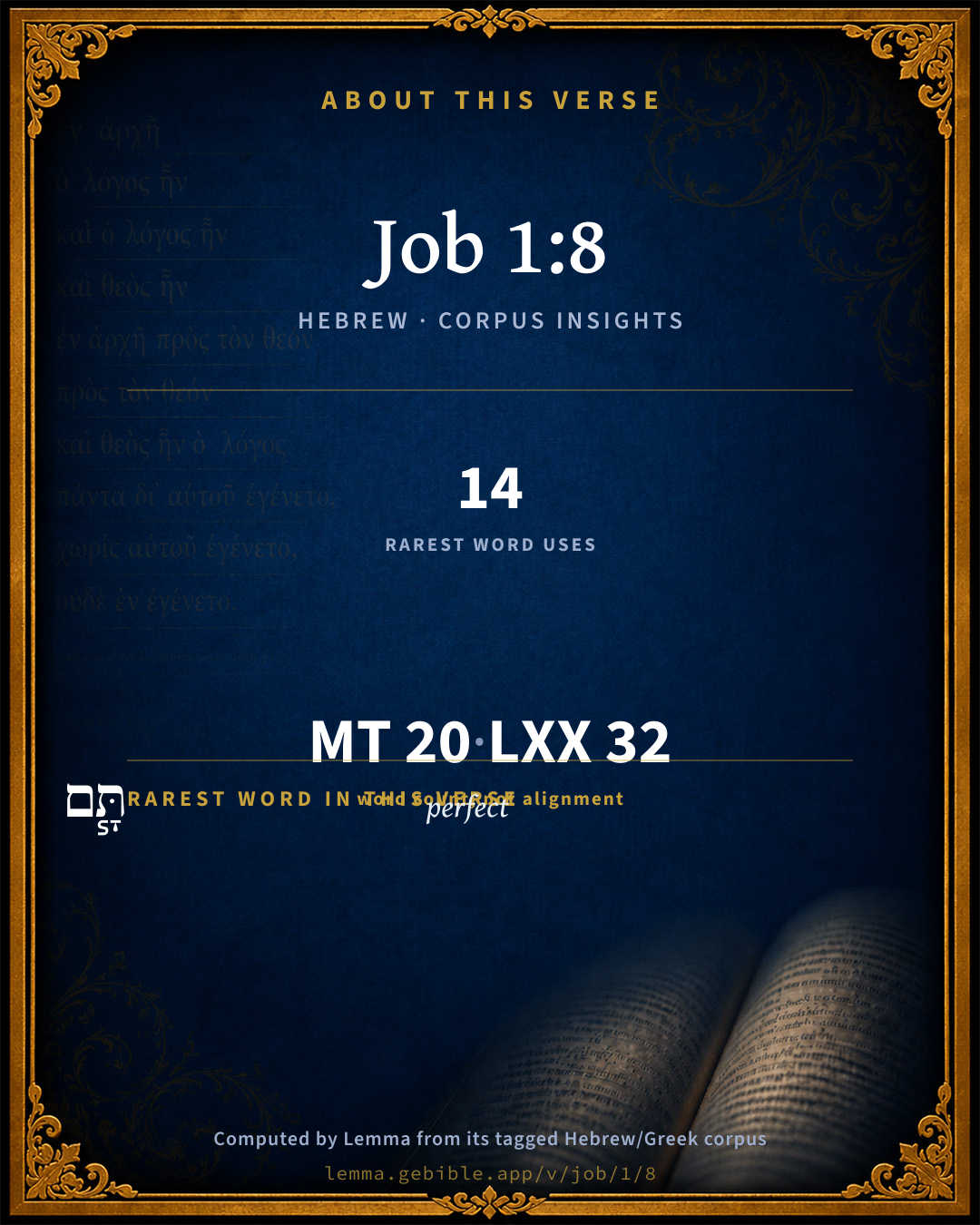
The rarest word here is תָּ֧ם perfect H8535 — appearing just 14 times in the whole Hebrew Bible.

Shared distinctive vocabulary

תָּ֧ם perfect H8535 occurs in 14 verses of the Hebrew Bible. Also found in:

Grammatical profile

  • 3 verbs
  • 8 nouns
  • 4 adjectives
  • 3 prepositions
  • 1 conjunction
  • 1 particle

Verb forms

  • וַיֹּ֤אמֶר Qal · Sequential Imperfect
  • הֲשַׂ֥מְתָּ Qal · Perfect
  • וְסָ֥ר Qal · Participle Active

Hebrew & Septuagint length

In English translation the verse runs 34 words from the Hebrew and 31 from the Septuagint (LXX English) — closely comparable.

A rough comparison of the two English renderings, which tokenize alike — not a word-level alignment.

Word counts can differ between the Hebrew and the Greek without any difference in meaning — e.g. the Hebrew direct-object marker אֵת has no separate Greek word, and Greek often adds the article ὁ.

In the original languages it is 20 Hebrew tokens and 32 Greek tokens — but the two are counted differently (Hebrew bundles its prefixes and suffixes into one token; the Greek is in lemma form), so that isn’t a like-for-like length.

Cross-references

27

Topical passages linked to Job 1:8 in the Treasury of Scripture Knowledge — connected by theme and wording, ordered by reader-vote popularity; previews shown in the World English Bible.

  • Job 2:3 Yahweh said to Satan, "Have you considered my servant Job? For there is none like him in the earth, a blameless and an upright man, one who fears God, and turns away from evil. He still maintains his integrity, although you incited me against him, to ruin him without cause."
  • Job 1:1 There was a man in the land of Uz, whose name was Job. That man was blameless and upright, and one who feared God, and turned away from evil.
  • Numbers 12:7–8 My servant Moses is not so; he is faithful in all my house:
  • 2 Kings 23:25 Like him was there no king before him, who turned to Yahweh with all his heart, and with all his soul, and with all his might, according to all the law of Moses; neither after him arose there any like him.
  • Proverbs 8:13 The fear of Yahweh is to hate evil. I hate pride, arrogance, the evil way, and the perverse mouth.
  • Job 8:20 "Behold, God will not cast away a blameless man, Neither will he uphold the evil-doers.
  • Isaiah 1:16 Wash yourselves, make yourself clean. Put away the evil of your doings from before my eyes; Cease to do evil.
  • Numbers 12:3 Now the man Moses was very humble, above all the men who were on the surface of the earth.
  • Job 23:11–12 My foot has held fast to his steps. His way have I kept, and not turned aside.
  • Psalms 84:11 For Yahweh God is a sun and a shield. Yahweh will give grace and glory. He withholds no good thing from those who walk blamelessly.
  • Job 42:7–8 It was so, that after Yahweh had spoken these words to Job, Yahweh said to Eliphaz the Temanite, "My wrath is kindled against you, and against your two friends; for you have not spoken of me the thing that is right, as my servant Job has.
  • Joshua 1:7 Only be strong and very courageous, to observe to do according to all the law, which Moses my servant commanded you: don't turn from it to the right hand or to the left, that you may have good success wherever you go.
  • 1 Kings 4:30–31 Solomon's wisdom excelled the wisdom of all the children of the east, and all the wisdom of Egypt.
  • Job 9:22–23 "It is all the same. Therefore I say, He destroys the blameless and the wicked.
  • Job 12:4 I am like one who is a joke to his neighbor, I, who called on God, and he answered. The just, the blameless man is a joke.
  • Job 17:8–9 Upright men shall be astonished at this. The innocent shall stir up himself against the godless.
  • Job 34:14 If he set his heart on himself, If he gathered to himself his spirit and his breath;
  • Psalms 18:23 I was also blameless with him. I kept myself from my iniquity.
  • Isaiah 42:1 Behold, my servant, whom I uphold; my chosen, in whom my soul delights: I have put my Spirit on him; he will bring forth justice to the Gentiles.
  • Luke 23:39–40 One of the criminals who was hanged insulted him, saying, "If you are the Christ, save yourself and us!"
  • Nehemiah 5:15 But the former governors who were before me were chargeable to the people, and took of them bread and wine, besides forty shekels of silver; yes, even their servants bore rule over the people: but I didn't do so, because of the fear of God.
  • Psalms 34:14 Depart from evil, and do good. Seek peace, and pursue it.
  • Psalms 36:1 An oracle is within my heart about the disobedience of the wicked: "There is no fear of God before his eyes."
  • Psalms 37:27 Depart from evil, and do good; Live securely forever.
  • Psalms 89:20 I have found David, my servant. I have anointed him with my holy oil,
  • Ezekiel 40:4 The man said to me, Son of man, see with your eyes, and hear with your ears, and set your heart on all that I shall show you; for, to the intent that I may show them to you, are you brought here: declare all that you see to the house of Israel.
  • John 1:47 Jesus saw Nathanael coming to him, and said about him, "Behold, an Israelite indeed, in whom is no deceit!"

Cross-references courtesy of OpenBible.info (CC BY 4.0).

Hebrew and Greek witnesses Masoretic Hebrew ↔ Greek Septuagint

The same verse in the two great witnesses to the Old Testament, shown verse-for-verse.

These are two independent witnesses, not word-aligned to each other, and the Septuagint is shown in lemma (dictionary) form.

Hebrew Job 1:8 Masoretic · Westminster Leningrad Codex

וַיֹּ֤אמֶר יְהוָה֙ אֶל הַשָּׂטָ֔ן הֲשַׂ֥מְתָּ לִבְּךָ֖ עַל עַבְדִּ֣י אִיּ֑וֹב כִּ֣י אֵ֤ין כָּמֹ֨הוּ֙ בָּאָ֔רֶץ אִ֣ישׁ תָּ֧ם וְיָשָׁ֛ר יְרֵ֥א אֱלֹהִ֖ים וְסָ֥ר מֵרָֽע

Yahweh said to Satan, "Have you considered my servant, Job? For there is none like him in the earth, a blameless and an upright man, one who fears God, and turns away from evil."

World English Bible · Public Domain

Greek LXX Job 1:8 Septuagint · lemma form

καί εἶπον αὐτός ὁ κύριος προςἔχω ὁ διάνοια σύ κατά ὁ παῖς ἐγώ ιωβ ὅτι οὐ εἰμί κατά αὐτός ὁ ἐπί ὁ γῆ ἄνθρωπος ἄμεμπτος ἀληθινός θεοσεβής ἀποἔχω ἀπό πᾶς πονηρός πρᾶγμα

And the Lord said to him, Have you diligently considered my servant Job, that there is none like him on the earth, a man blameless, true, godly, abstaining from everything evil?

LXX2012 (modern English Septuagint) · Public Domain

On this verse, Albert Barnes' Notes on the Bible discusses the Septuagint’s reading. Read the note in Commentary ↓

Hebrew: Westminster Leningrad Codex (CC BY 4.0). Greek: Septuagint (public domain); English from LXX2012 (modern English Septuagint) (Public Domain). How the Septuagint differs from the Hebrew →

Commentary

Notes on Job 1:8 from classic Christian and Jewish commentators (each source and its license shown beneath its notes). The classic Christian expositions comment on the surrounding passage and are grouped to its opening verse, so a note may address several verses; the Jewish commentaries on the Tanakh (Rashi and others) are per-verse, so they appear only where the commentator wrote on this verse.

Lemma curates 59 commentaries, every one of them public domain or Creative Commons licensed, each selected and text-cleaned for this edition rather than reprinted as found. About our sources →

Trapp's Complete Commentary

John Trapp

Job 1:8 And the LORD said unto Satan, Hast thou considered my servant Job, that [there is] none like him in the earth, a perfect and an upright man, one that feareth God, and escheweth evil?

Ver. 8. Hast thou considered my servant Job] Job then was in God’s account a considerable person, and such a one as whose praise was not of men, but of God. Such are all godly people, but especially those that are eminent tall Christians; full of goodness, filled with all knowledge, as those Romans, Job 15:14, men of choice spirits as Caleb, that walk up and down the world as so many conquerors, 1Jn 5:4, that are clothed with the sun, and tread upon the moon, Rev 12:1. These are men of mark, et undique spectabiles, worthy looking after. A man would have gone as far to have seen Luther as he in the story did to see Livy; or as the queen of Sheba did to see Solomon. A man would fetch such golden sentences as those he uttered upon his knees from Rome or Jerusalem, saith Mr Sam. Clark, that writeth his Life. "The tongue of the just is as choice silver: but the heart of the wicked is little worth," Pro 10:20. Hence Antiochus is called a vile person, Dan 11:21, though a great potentate. And the prophet tells Joram, that wicked king of Israel, that but for Jehoshaphat’s sake (a better man) he would not have looked toward him, nor have seen him, 2Ki 3:14. Job was a man of weight, and great worth, as were those precious sons of Zion, Lam 4:2. Didst thou not therefore make a stand at his door, saith God? seest thou not how he stands as a standard bearer? shines as a great light? shows forth in his whole practice such a power of godliness, as is sufficient either to draw hearts, or to daunt them? hast thou met with such a man in all thy circuit, that can quit himself so well and wisely in all estates, like as gold is purged in the fire, shineth in the water? seest thou not how all his principles, practices, and aims, are supernal and supernatural?

That there is none like him in the earth] This was a high praise indeed; and yet no hyperbole; he was a giant to other good people, who were but dwarfs and zanies to him, for growth of grace and height of holiness. He was the paragon of his time; and of unparalleled piety. As Ahab was a very nonsuch for wickedness, 1Ki 21:25, so was Job for goodness. As Hezekiah outstripped all the kings of Judah for his trusting in the Lord, 2Ki 18:5, and Josiah for his integrity, 2Ki 23:25, and the centurion for his heroic faith, Matt. viii., and Paul for his plus ultra, more in addition, Php 3:1-21, and Ambrose, that, in Theodosius’s account, he was the only bishop (Aμβροσιον οιδα μονον επισκοπον αξιως καλουμενον); so it was here, Job was above others, as Saul was above the people by the head and shoulders. As he was the greatest, so the best man of all the children of the East, not a man came near him, and yet they might be dear to God nevertheless. But it is with good people as with Jonathan’s signal arrows; two fell short, and but one beyond the mark, &c. God hath his servants of all sorts and sizes; and est aliquid prodire tenus, &c.

A perfect and an upright man, &c.] A tough piece thou findest him, I suppose, and not easily malleable. Thou hast been doing at him, I doubt not, but canst do no good on it. Thou hast set thine heart upon him, and tried thine utmost skill to overturn him, but hast met with thy match, and been sent away without thine errand; thou hast but beat upon cold iron; thou hast struck fire, but without tinder; thou hast knocked at the door, but there was none within to open to thee. Thus God speaketh, to sting Satan; and (as it were) triumphing over his and Job’s adversary.

John Trapp, A Commentary or Exposition upon All the Books of the Old and New Testament (1647–1656) — public domain. Text from a community e-Sword module.

Joseph Benson's Commentary

Job 1:8. Hast thou considered my servant Job? — Hast thou taken notice of him, and of his spirit and conduct? That there is none like him in all the earth — The Targum saith, “None like him in the land of the Gentiles;” intimating, probably, that notwithstanding he was of the Gentiles, he was yet so distinguished an example of virtue and goodness, that his equal was not to be found among them. Dr. Lightfoot speaks of Job as being, without the least doubt, a heathen, observing, “In these times, when it went thus sadly with Israel in Egypt, there shone forth the glorious piety of Job in the land of Uz,” vol. 1. p. 23; and again, p. 1026, “About (the time of) Israel’s being in Egypt, Job lives in Arabia, a heathen man, and yet so good.” And thus St. Gregory: “His country is purposely named, that the goodness of the man may be the more illustrated.”

Joseph Benson's Commentary on the Old and New Testaments (1811–1818) — public domain. Text from a community e-Sword module.

Tyndale Open Study Notes

Tyndale Open Resources

1:8 my servant: This title was used for the patriarchs (Gen 26:24; Exod 32:13), the prophets (2 Kgs 17:13; Jer 7:25; Zech 1:6), and David (e.g., 2 Sam 7:1-29; Pss 18:1; 36:1).

Tyndale Open Study Notes — © Tyndale Open Resources, licensed CC BY-SA 4.0. Text via the HelloAO Bible API.

Jamieson, Fausset & Brown

Robert Jamieson, A. R. Fausset & David Brown

considered--Margin, "set thine heart on"; that is, considered attentively. No true servant of God escapes the eye of the adversary of God.

Jamieson, Fausset & Brown — Commentary Critical and Explanatory on the Whole Bible (1871) — public domain (CC PDM 1.0). Text via the HelloAO Bible API.

Adam Clarke's Commentary

Verse 8. Hast thou considered my servant Job] Literally, Hast thou placed thy heart on my servant Job? Hast thou viewed his conduct with attention, whilst thou wert roaming about, seeking whom thou mightest devour? viz., the careless, prayerless, and profligate in general.

Adam Clarke's Commentary on the Bible (1810–1826) — public domain. Text from a community e-Sword/MySword module.

The Cambridge Bible for Schools and Colleges

gen. ed. J. J. S. Perowne

8. The integrity and godliness attributed to Job by the author of the Poem are confirmed by God Himself.

The Cambridge Bible for Schools and Colleges (gen. ed. J. J. S. Perowne; Cambridge University Press, 1878–1918) — public domain. Text from a community e-Sword module.

John Gill's Exposition

And the Lord said unto Satan, hast thou considered my servant Job,.... Or, "hast thou put thine heart on my servant" (p); not in a way of love and affection to him, to do him any good or service, there being an original and implacable enmity in this old serpent to the seed of the woman; but rather his heart was set upon him in a way of desire to have him in his hands, to do him all the mischief he could, as the desire of his heart was toward Peter, Luk 22:31 but the sense of the question is, since thou sayest thou hast been walking up and down in the earth, hast thou not taken notice of Job, and cast an eye upon him, and wished in thine heart to have him in thine hands to do him hurt? I know that thou hast; hast thou not contrived in thine heart how to attack him, tempt him, and draw him from my service, and into sins and snares, in order to reproach and accuse him? thou hast, but all in vain; and so it is a sarcasm upon Satan, as well as an expression of indignation at him for such an attempt upon him, and as anticipating his accusation of Job; for it is as if he should further say, I know he is in thine eye, and upon thine heart, now thou art come with a full intent to accuse and charge him; so Jarchi, "lest thou set thine heart", &c. so as "to have a good will to accuse him" he had, but the Lord prevents him, by giving a high character of him, in these and the following words: here he calls him "my servant"; not a servant of men, living according to the lusts and will of men, and their customs and forays of worship, superstition, and idolatry; nor a servant of sin and the lusts of the flesh; nor of Satan, who boasted of the whole earth being his; but the Lord's servant, not only by creation, but by special choice, by redemption, by efficacious grace, and the voluntary surrender of himself to the Lord under the influence of it; and by his cheerful and constant obedience he answered this character; and the Lord here claims his property in him, acknowledges him as his servant, calls him by name, and gives an high and honourable account of him:

that there is none like him in the earth; or "in the land"; in the land of Uz, so Obadiah Sephorno; whatever there were in other countries, there were none in this, being in general idolaters; or in the land of the people of the Heathen nations, as the Targum; or rather in the whole earth, where Satan had been walking: and, very probably, Abraham, Isaac, and Jacob, were now dead; Job being, as it should seem, between them and the times of Moses; and though there might be many godly persons then living, who were like to him in quality, being partakers of the same divine nature, having the same image of God upon them, and the same graces in them, and a similar experience of divine things, yet not upon an equality with him; he exceeded them all in grace and holiness; and particularly, none came up to him for his patience in suffering affliction, though this was often tried; as Moses excelled others in meekness, and Solomon in wisdom; Job was an eminent saint and servant of the Lord, a father in his family, a pillar in his house, like Saul among the people, taller in grace and the exercise of it; and this is a reason why he could not but be taken notice of by Satan, who has his eye more especially on the most eminent saints, and envies them, and strikes at them; and so the words are by some rendered, "for there is none like him" (q); or rather they may be rendered, "but there is none like him" (r): and so are opposed to the accusations and charges Satan was come with against him:

a perfect and an upright man, one that feareth God, and escheweth evil? See Gill on Job 1:1. Here the character there given is confirmed by the Lord in the express words of it.

(p) "nunquid posuisti cor tuum super servum meum", Pagninus, Montanus, Bolducius, Schmidt. (q) "nam", Piscator. (r) "Atqui", Schmidt.

John Gill's Exposition of the Whole Bible (1746–1763) — public domain (CC PDM 1.0). Text via the HelloAO Bible API.

Albert Barnes' Notes on the Bible

Hast thou considered my servant Job? - Margin, “Set thine heart on.” The margin is a literal translation of the Hebrew. Schultens remarks on this, that it means more than merely to observe or to look at - since it is abundantly manifest from the following verses that Satan “had” attentively considered Job, and had been desirous of injuring him. It means, according to him, to set himself against Job, to fix the heart on him with an intention to injure him, and yahweh means to ask whether Satan had done this. But it seems more probable that the phrase means to consider “attentively,” and that God means to ask him whether he had carefully observed him. Satan is represented as having no confidence in human virtue, and as maintaining that there was none which would resist temptation, if presented in a form sufficiently alluring. God here appeals to the case of Job as a full refutation of this opinion. The trial which follows is designed to test the question whether the piety of Job was of this order.

That there is none like him in the earth - That he is the very highest example of virtue and piety on earth. Or might not the word כי kı̂y here be rendered “for?” “For there is none like him in the earth.” Then the idea would be, not that he had considered “that” there was none like him, but God directs his attention to him “because” he was the most eminent among mortals.

A perfect and an upright man - See the Notes at Job 1:1. The Septuagint translates this verse as they do Job 1:1.

Albert Barnes' Notes on the Bible (1834–1885) — public domain. Text from a community e-Sword/MySword module.

Matthew Poole's English Annotations

Hast thou taken notice of him, and his spirit and carriage? and what hast thou to say against him?

Matthew Poole's English Annotations on the Holy Bible (1683–1685) — public domain. Text from a community e-Sword/MySword module.

Whedon's Commentary on the Bible

Daniel D. Whedon

8. Hast thou (in thy travels) considered — Remarked, noticed, לב על שׂים, literally, as in the margin. The question falls like a spark upon a mind inflammable with evil, and the evil spirit becomes unconsciously an agent for the accomplishment of the divine purpose — the trial of Job. “Not only must he receive God’s permission before he can proceed one step against Job, but the very occasion through which he attains that permission is gratuitously provided for him by God.” — Evans.

My servant — A title of honour conferred by God on but few. The term is endearing, My servant. Though but “a root out of a dry ground” of heathenism, there was none in all the East his equal.

A perfect and an upright man — The repetition not only constitutes a poetical elegance common in the classics, but shows most expressively the moral worth of the man. The estimate of Job, expressed by the author in Job_1:1, (which see,) now receives the divine approval.

Daniel D. Whedon (gen. ed.), Commentary on the Old and New Testaments (1874–1909) — public domain. Text from a community e-Sword module.

The Pulpit Commentary

And the Lord said unto Satan, Hast thou considered? literally. Hast thou set thine heart on? equivalent to "Hast thou given thine attention to?". (comp. Isa_41:22 Hag_1:5, Hag_1:7) My servant Job ; i.e. "my true servant, faithful in all that he does". (comp. Heb_3:5) It is a high honour to any man for God to acknowledge him as his servant. (see Jos_1:2 1Ki_11:13, etc.) That there is none like him in the earth; rather, for there is none like him (see the Revised Version). This is given as a reason why Satan should have paid special attention to his case, and is a sort of challenge: "Thou that art always spying out some defect or other in a righteous man, hast thou noted my servant Job, and discovered any fault in him?" A perfect and an upright man, one that feareth God, and escheweth evil (see the comment on ver. 1).

The righteous man.

Righteousness as descriptive of human character illustrated in Job. A few words only used. The Divine description. Highest testimony. Generally "my servant, the most honourable distinction. There is no higher calling in life than to serve God. But Job stands in special distinction he is unequalled amongst men. His is the typical example of righteousness till a Greater than he appears. "There is none like him in the earth." A truly honourable position to be the first man of one"s age. Job has the special honour of this Divine judgment. Needful for us to know the elements of so exalted a character. They are stated. The righteousness of Job is displayed in

I INWARD SANCTITY. Freedom from evil; "perfect wholeness, completeness of character; not to be supposed free from human frailty, but free from blemishes of character and conduct; a just man, having a well-balanced, self-controlled, law-abiding spirit.

II UPRIGHTNESS. Conformed to that which is right; holding a right relation to God and man; correct and honourable in his dealings; a man of probity, truth, and honour. "One that feareth God.

III REVERENCE TOWARDS GOD. Pious; fulfilling religious duties; devotional. "The fear of the Lord is the beginning of wisdom;" the root of the matter" in Job.

IV ABHORRENCE OF EVIL. Having fear of God, he stands aloof from everything on which the Divine disapprobation rests. A pure mind withdraws from foulness, as a charitable man from selfishness, and an upright man from baseness. Such a character is fitted to be a servant of God. On such the blessing of the Lord rests. But such are not exempt from trial. Even virtue must be tested. Into the hands of the dark agent of human probation even Job must be cast. This book reveals this truth, and illustrates and answers the difficulties suggested by it. R.G.

The Pulpit Commentary (1880–1919), ed. H.D.M. Spence-Jones & Joseph S. Exell — public domain. Text from a community e-Sword module.

Keil & Delitzsch

C. F. Keil & F. Delitzsch

8 Then said Jehovah to Satan, Hast thou considered my servant Job? for there is none like him in the earth, a perfect and an upright man, one that feareth God and escheweth evil.

By כּי Jehovah gives the reason of His inquiry. Had Satan been observant of Job, even he must have confessed that there was on the earth real genuine piety. לב שׂים, animum advertere (for לב is animus, נפשׁ anima), is construed with על, of the object on which the attention falls, and on which it fixes itself, or אל, of the object towards which it is directed (Job 2:3). The repetition of the four predicates used of Job (Job 1:1) in the mouth of Jehovah (though without the waw combining both pairs there) is a skilful touch of the poet. Further on, the narrative is also interwoven with poetic repetitions (as e.g., Job 34 and Gen 1), to give it architectural symmetry, and to strengthen the meaning and impression of what is said. Jehovah triumphantly displays His servant, the incomparable one, in opposition to Satan; but this does not disconcert him: he knows how, as on all occasions, so here also, to deny what Jehovah affirms.

Keil & Delitzsch — Biblical Commentary on the Old Testament (1861–1891) — public domain (CC PDM 1.0). Text via the HelloAO Bible API. (Old Testament only.)

Scofield Reference Notes

C. I. Scofield

feareth

(See Scofield "Psa 19:9").

The Scofield Reference Bible (1917 edition), notes by C. I. Scofield — public domain. Text from a community e-Sword module.

Rashi

Rabbi Shlomo Yitzchaki (Rashi)

Have you paid attention to My servant Job that you should desire to denounce him?

“Have you paid, etc.” An expression of a wonder.

sincere and upright Perfect in his deeds.

Rashi on the Tanakh — English translations: “The Judaica Press complete Tanach with Rashi, translated by A. J. Rosenberg” (CC BY 4.0); “Pentateuch with Rashi's commentary by M. Rosenbaum and A.M. Silbermann, 1929-1934” (public domain); “The Metsudah Tanach series, Lakewood, N.J” (CC BY 4.0); and “The Book of Joshua, Metsudah Publications, 1997” (CC BY 4.0). Text via Sefaria.

Lesson kit

Teaching starters — assembled from the data on this page, not authored interpretation. Every prompt links to the verse data it draws on. Edit before teaching.

Job, in the Wisdom, opens this verse with 20 words (20 distinct Hebrew lemmas). Its most distinctive word is tâm (“perfect”). A historical commentator’s framing appears above. Read the whole chapter for the surrounding context.

Discussion questions

  1. What does “perfect” (tâm) contribute to the verse as a whole?
  2. Genesis 25:27 shares the word «perfect» with this verse. How do the two illuminate each other?
  3. The translations on this page render this verse differently — a whole-verse word diff, not a word-by-word alignment. What might account for the different wordings?
  4. The verb «וַיֹּ֤אמֶר» is Qal Sequential Imperfect. How does its form color the action?
  5. Reading how Trapp's Complete Commentary and Joseph Benson's Commentary read this verse, where do the two commentators agree and where do they part?

Things to notice

Reading settings

Reading text

Shown beneath each verse's original-language words.

Old Testament
Old Testament edition

Read the OT as the Masoretic Hebrew (MT) or the Greek Septuagint (LXX).

English shown for the Greek Septuagint (in the Hebrew ↔ Greek comparison).

Comparing translations? Open the Compare panel on any verse page to stack up to four side by side.