1 Samuel 7:4

Hebrew (Westminster Leningrad Codex) 1 Samuel 7:4 appears in the Hebrew Old Testament. The text above is from the Westminster Leningrad Codex. Each word links to its Strong’s number, a concise gloss, and parsing drawn from the Open Scriptures Hebrew Bible morphology. Click any word for its full Brown-Driver-Briggs (BDB) entry.
Download image
Cite this verse

1 Samuel 7:4 (World English Bible). Public Domain. Lemma interlinear Bible study tool, https://lemma.gebible.app/v/1-samuel/7/4.

Show BibTeX & RIS
BibTeX
RIS
English Translation
Then the children of Israel did put away the Baals and the Ashtaroth, and served Yahweh only.
World English Bible · Public Domain
Download a study sheet

One document with this verse’s original text, its word-by-word gloss line, the meaning frame, cross-references with their text, attributed commentary, and full source and license credits — printable, and it pastes into notes with its structure intact.

This verse Autodidact and up

Study sheet (.html) Plain text (.txt)

A passage Seminary Student

Up to 50 verses in one chapter. A passage sheet keeps up to 6 commentary sources and 12 cross-references per verse, in the order this page ranks them, and says so on the sheet whenever that leaves anything out. Ask for a single verse and you get the Autodidact verse sheet above.

Everything on this page stays free to read, with no account — the sheet is a download of what is already on screen, not access to it.

Want to remove ads? Support Godless Engineer
Compare translations 3

The same verse in 3 English versions, stacked beneath the original-language interlinear above. Click any original word for its lexicon entry.

Each is an independent rendering of the whole verse — the interlinear is not word-aligned to these translations.

Highlighted words mark where these versions differ — a whole-verse word diff, not a word-by-word alignment.

  • World English Bible Public Domain
    Then the children of Israel did put away the Baals and the Ashtaroth, and served Yahweh only.
  • King James Version Public Domain
    Then the children of Israel did put away Baalim and Ashtaroth, and served the LORD only.
  • unfoldingWord Literal Text CC BY-SA 4.0
    And the sons of Israel removed the Baals and the Ashtoreths, and they served Yahweh alone.

unfoldingWord Literal Text — © unfoldingWord, licensed CC BY-SA 4.0. Word-aligned USFM3 via Door43 (git.door43.org/unfoldingWord/en_ult).

Versions to compare (up to 4)

3 of 4 selected

Show all 18 translations

Every available English version of this verse, each an independent rendering of the whole verse.

  • World English Bible Public Domain
    Then the children of Israel did put away the Baals and the Ashtaroth, and served Yahweh only.
  • Berean Standard Bible Public Domain
    So the Israelites put away the Baals and Ashtoreths and served only the LORD.
  • Majority Standard Bible Public Domain
    So the Israelites put away the Baals and Ashtoreths and served only the LORD.
  • King James Version Public Domain
    Then the children of Israel did put away Baalim and Ashtaroth, and served the LORD only.
  • American Standard Version (1901) Public Domain
    Then the children of Israel did put away the Baalim and the Ashtaroth, and served Jehovah only.
  • Revised Version (1885) Public Domain
    Then the children of Israel did put away the Baalim and the Ashtaroth, and served the LORD only.
  • Geneva Bible (1599) Public Domain
    Then the children of Israel did put away Baalim and Ashtaroth, and serued the Lord onely.
  • Douay-Rheims (1899) Public Domain
    Then the children of Israel put away Baalim and Astaroth, and served the Lord only.
  • Young's Literal Translation Public Domain
    And the sons of Israel turn aside the Baalim and Ashtaroth, and serve Jehovah alone;
  • Literal Standard Version CC BY-SA 4.0
    And the sons of Israel turn aside the Ba‘alim and Ashtaroth, and serve YHWH alone;
  • Unlocked Literal Bible CC BY-SA 4.0
    Then the people of Israel removed the Baals and the Ashtoreths, and worshiped Yahweh only.
  • unfoldingWord Literal Text CC BY-SA 4.0
    And the sons of Israel removed the Baals and the Ashtoreths, and they served Yahweh alone.
  • Darby Bible Public Domain
    And the children of Israel put away the Baals and the Ashtoreths and served Jehovah only.
  • World Messianic Bible Public Domain
    Then the children of Israel removed the Baals and the Ashtaroth, and served the LORD only.
  • Webster's Bible Public Domain
    Then the children of Israel put away Baalim, and Ashtaroth, and served the LORD only.
  • Free Bible Version CC BY-SA 4.0
    The people of Israel got rid of their Baals and Ashtoreth images and worshiped only the Lord.
  • Bible in Basic English Public Domain
    So the children of Israel gave up the worship of Baal and Astarte, and became worshippers of the Lord only.
  • JPS Tanakh (1917) Public Domain
    Then the children of Israel did put away the Baalim and the Ashtaroth, and served the LORD only.

Literal Standard Version (2020), Covenant Press — licensed CC BY-SA 4.0. Text via the HelloAO Bible API (eBible.org). Unlocked Literal Bible (unfoldingWord) — licensed CC BY-SA 4.0. Text via the HelloAO Bible API (eBible.org). unfoldingWord Literal Text — © unfoldingWord, licensed CC BY-SA 4.0. Word-aligned USFM3 via Door43 (git.door43.org/unfoldingWord/en_ult). Free Bible Version, Dr. Jonathan Gallagher — licensed CC BY-SA 4.0. Text via the HelloAO Bible API (eBible.org).

Word by word

More ways to search: Search by grammar → Find every occurrence → Compare this word →

Practice this passage: Drill this verse → Learn its vocabulary →

הָעַשְׁתָּרֹ֑ת
ʻAshtârôwth
H6252
“the · Ashtaroth”
Particle, Definite Article + Noun, Proper
Part of Speech
Particle + Noun
Type
Proper
Full BDB Definition

Origin: pl. of H6251

TWOT: 1718b

Ashtaroth or Astaroth = "star" - false goddesses in the Canaanite religion, usually related to fertility cult (noun proper feminine deity) - a city in Bashan east of the Jordan given to Manasseh (noun proper locative)
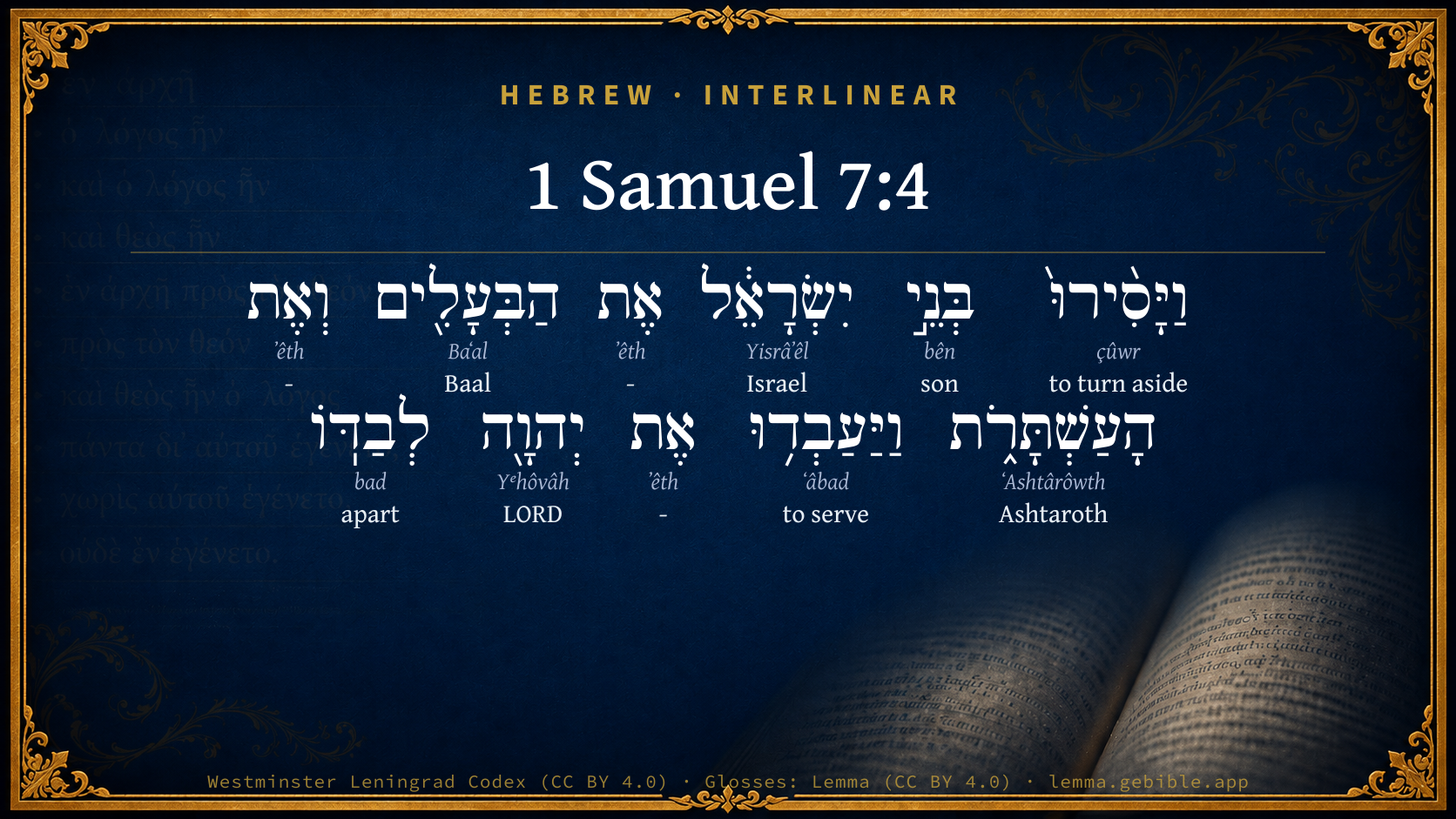
  1. וַיָּסִ֨ירוּ֙ çûwr H5493 “and · to turn aside” Conjunction + Verb, Hiphil, Sequential Imperfect, 3rd Person, Masculine, Plural
  2. בְּנֵ֣י bên H1121 “sons of” Noun, Common, Masculine, Plural, Construct
  3. יִשְׂרָאֵ֔ל Yisrâʼêl H3478 “Israel” Noun, Proper
  4. אֶת ʼêth H853 “-” Particle, Direct Object
  5. הַבְּעָלִ֖ים Baʻal H1168 “the · Baal” Particle, Definite Article + Noun, Proper
  6. וְאֶת ʼêth H853 “and · -” Conjunction + Particle, Direct Object
  7. וַיַּעַבְד֥וּ ʻâbad H5647 “and · to serve” Conjunction + Verb, Qal, Sequential Imperfect, 3rd Person, Masculine, Plural
  8. אֶת ʼêth H853 “-” Particle, Direct Object
  9. יְהוָ֖ה Yᵉhôvâh H3068 “LORD” Noun, Proper
  10. לְבַדּֽוֹ bad H905 “to/for · apart · his” Preposition + Noun, Common, Masculine, Singular, Construct + Suffix, Personal, 3rd Person, Masculine, Singular

About this verse

These counts appear in no published source. They are computed here, from the morphology-tagged text and Lemma’s own curated glosses. What Lemma adds →

11
words
9
distinct lemmas
Historical
section

Notable vocabulary

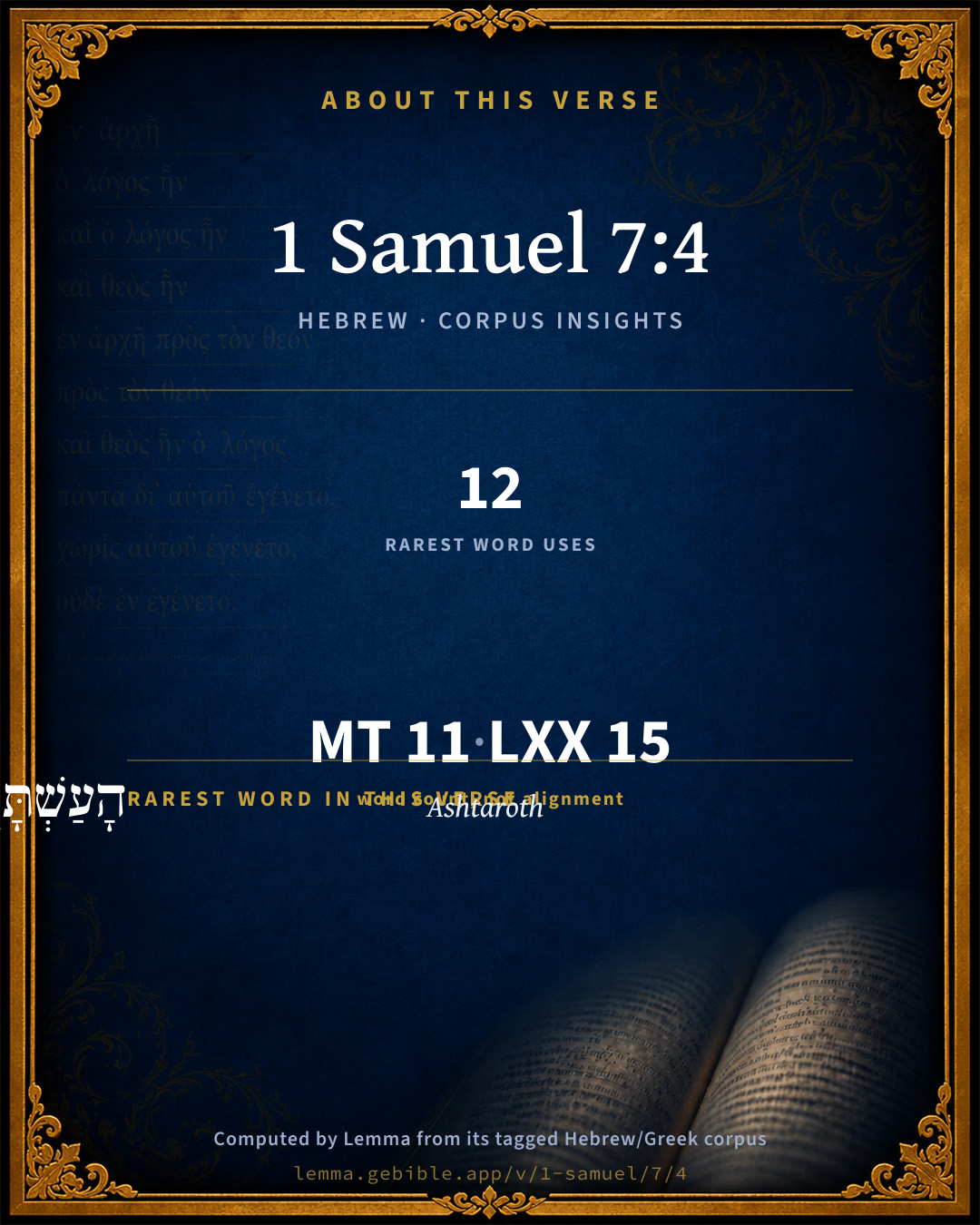
The rarest word here is הָעַשְׁתָּרֹ֑ת Ashtaroth H6252 — appearing just 12 times in the whole Hebrew Bible.

Shared distinctive vocabulary

הָעַשְׁתָּרֹ֑ת Ashtaroth H6252 occurs in 12 verses of the Hebrew Bible. Also found in:

Grammatical profile

  • 2 verbs
  • 6 nouns
  • 3 particles

Verb forms

  • וַיָּסִ֨ירוּ֙ Hiphil · Sequential Imperfect
  • וַיַּעַבְד֥וּ Qal · Sequential Imperfect

Hebrew & Septuagint length

In English translation the verse runs 17 words from the Hebrew and 18 from the Septuagint (LXX English) — closely comparable.

A rough comparison of the two English renderings, which tokenize alike — not a word-level alignment.

Word counts can differ between the Hebrew and the Greek without any difference in meaning — e.g. the Hebrew direct-object marker אֵת has no separate Greek word, and Greek often adds the article ὁ.

In the original languages it is 11 Hebrew tokens and 15 Greek tokens — but the two are counted differently (Hebrew bundles its prefixes and suffixes into one token; the Greek is in lemma form), so that isn’t a like-for-like length.

Cross-references

6

Topical passages linked to 1 Samuel 7:4 in the Treasury of Scripture Knowledge — connected by theme and wording, ordered by reader-vote popularity; previews shown in the World English Bible.

  • Hosea 14:8 Ephraim, what have I to do any more with idols? I answer, and will take care of him. I am like a green fir tree; From me your fruit is found."
  • Hosea 14:3 Assyria can't save us. We won't ride on horses; Neither will we say any more to the work of our hands, 'Our gods!' For in you the fatherless finds mercy."
  • Judges 2:11 The children of Israel did that which was evil in the sight of Yahweh, and served the Baals;
  • Judges 2:13 They forsook Yahweh, and served Baal and the Ashtaroth.
  • Judges 10:15–16 The children of Israel said to Yahweh, We have sinned: do you to us whatever seems good to you; only deliver us, we pray you, this day.
  • 1 Kings 11:33 because that they have forsaken me, and have worshiped Ashtoreth the goddess of the Sidonians, Chemosh the god of Moab, and Milcom the god of the children of Ammon; and they have not walked in my ways, to do that which is right in my eyes, and [to keep] my statutes and my ordinances, as did David his father.

Cross-references courtesy of OpenBible.info (CC BY 4.0).

Hebrew and Greek witnesses Masoretic Hebrew ↔ Greek Septuagint

The same verse in the two great witnesses to the Old Testament, shown verse-for-verse.

These are two independent witnesses, not word-aligned to each other, and the Septuagint is shown in lemma (dictionary) form.

Hebrew 1 Samuel 7:4 Masoretic · Westminster Leningrad Codex

וַיָּסִ֨ירוּ֙ בְּנֵ֣י יִשְׂרָאֵ֔ל אֶת הַבְּעָלִ֖ים וְאֶת הָעַשְׁתָּרֹ֑ת וַיַּעַבְד֥וּ אֶת יְהוָ֖ה לְבַדּֽוֹ

Then the children of Israel did put away the Baals and the Ashtaroth, and served Yahweh only.

World English Bible · Public Domain

Greek LXX 1 Samuel 7:4 Septuagint · lemma form

καί περιαἱρέω ὁ υἱός ἰσραήλ ὁ βααλιμ καί ὁ ἄλσος ασταρωθ καί δουλεύω κύριος μόνος

And the children of Israel took away Baalim and the groves of Astaroth, and served the Lord only.

LXX2012 (modern English Septuagint) · Public Domain

Hebrew: Westminster Leningrad Codex (CC BY 4.0). Greek: Septuagint (public domain); English from LXX2012 (modern English Septuagint) (Public Domain). How the Septuagint differs from the Hebrew →

Targum (Aramaic paraphrase)

1

The Targum is the ancient Jewish Aramaic paraphrase of the Hebrew Scriptures — an interpretive translation, not the Hebrew text itself. Onkelos (literal) and Pseudo-Jonathan (expansive) render the Torah, and Jonathan the Prophets. Coverage is partial: where no permissively-licensed English translation exists for a verse, only the Aramaic is shown. This is verse-level text, not a word-by-word alignment to the Hebrew.

  1. Targum Jonathan Prophets (Joshua–Malachi)
    וְאַעְדִיוּ בְּנֵי יִשְׂרָאֵל יַת בְּעָלַיָא וְיַת עַשְׁתְּרָתָא וּפְלַחוּ קֳדָם יְיָ בִּלְחוֹדוֹהִי:

    (no public-domain English translation for this verse)

    Targum Jonathan — Aramaic: “Mikraot Gedolot” (public domain). English: “Sefaria Community Translation” (CC0 1.0 (public-domain dedication)); “London "Chaldee Paraphrase," 1871” (public domain). Text via Sefaria.

Commentary

Notes on 1 Samuel 7:4 from classic Christian and Jewish commentators (each source and its license shown beneath its notes). The classic Christian expositions comment on the surrounding passage and are grouped to its opening verse, so a note may address several verses; the Jewish commentaries on the Tanakh (Rashi and others) are per-verse, so they appear only where the commentator wrote on this verse.

Lemma curates 59 commentaries, every one of them public domain or Creative Commons licensed, each selected and text-cleaned for this edition rather than reprinted as found. About our sources →

Trapp's Complete Commentary

John Trapp

1Sa 7:4 Then the children of Israel did put away Baalim and Ashtaroth, and served the LORD only.

Ver. 4. Then the children of Israel did put away, &c.] Their he-gods and their she-gods: so powerful is the word coming upon the rod, when God is pleased by his Spirit to second and set it on. Samuel might speak persuasively, as doubtless he had done for twenty years before, but God only persuadeth the heart.

John Trapp, A Commentary or Exposition upon All the Books of the Old and New Testament (1647–1656) — public domain. Text from a community e-Sword module.

Joseph Benson's Commentary

1Sa 7:4-5. Then the children of Israel did put away Baalim, &c. — Samuel’s reproofs and instructions, and the representations he made of their sin and danger, touched their hearts, and induced them to break off their sins by repentance. Gather all Israel to Mizpeh, and I will pray for you — He could have prayed for them himself alone in private, but he knew it would tend to perfect the repentance and reformation begun among them, and to establish them in God’s service, to engage them to unite with him in that duty; and it was well worth while for them to come from the most distant part of the country to join with Samuel in seeking God’s favour. Doubtless Samuel prayed both that they might, by the grace of God, be separated from their idols, and then, by the providence of God, delivered from the Philistines.

Joseph Benson's Commentary on the Old and New Testaments (1811–1818) — public domain. Text from a community e-Sword module.

Adam Clarke's Commentary

Verse 4. Put away Baalim and Ashtaroth] These were not two particular deities, but two genera of idols; the one masculine, BAALIM; the other feminine, ASHTAROTH; both the words are in the plural number, and signify all their gods and goddesses.

Adam Clarke's Commentary on the Bible (1810–1826) — public domain. Text from a community e-Sword/MySword module.

Ellicott's Commentary for English Readers

(4) Then the children of Israel did put away Baalim and Ashtaroth.—The answer of the people showed how well and thoroughly the prophet-statesman had done his Master’s work. Through the land of Israel the graven images of the Phœnician idols were thrown down, and their impious worship everywhere was boldly dishonoured, and once more, in bold defiance of the idol-worshipping Philistines, the Invisible and Eternal was throughout the land acknowledged as the one God. These acts, of course, were an open act of rebellion against that warlike people who for so long had ruled them with an iron rule.

A Bible Commentary for English Readers, edited by Charles John Ellicott (1878–1897) — public domain. Text from a community e-Sword module.

John Gill's Exposition

Then the children of Israel did put away Baalim and Ashtaroth,.... Both their male and female deities, of which see Jdg 2:13.

and served the Lord Only; Dr. Lightfoot (i) observes, that a spirit of repentance and conversion came generally upon all the people; a matter and a time as remarkable as almost any we read of in Scripture, one only parallel to it; and that is in Acts, chapters two and three, at the great conversion there.

(i) Works, vol. 1. p. 54.

John Gill's Exposition of the Whole Bible (1746–1763) — public domain (CC PDM 1.0). Text via the HelloAO Bible API.

Whedon's Commentary on the Bible

Daniel D. Whedon

4. Baalim and Ashtaroth — Male and female deities of several of the neighbouring nations, especially of the Zidonians. See on Jdg_2:11-13. Israel repeatedly fell into the worship of these idol gods.

Daniel D. Whedon (gen. ed.), Commentary on the Old and New Testaments (1874–1909) — public domain. Text from a community e-Sword module.

The Pulpit Commentary

Then the children of Israel did put away the Baalim and the Ashtaroth. This must have been done by a public act, by which at some time previously arranged the images of their Baals and Astartes were torn from their shrines, thrown down, and broken in pieces. Of course this was an overt act of rebellion, for these deities were especially Phoenician idols, and subsequently it was the Phoenician Jezebel who tried so fanatically to introduce their worship into Israel in Ahab"s time. To cast off the Philistine deities was equivalent to a rebellion generally against Philistine supremacy. Baal and Astarte, the husband and the wife, represented the reproductive powers of nature, and under various names were worshipped throughout the East, and usually with lewd and wanton orgies.

The Pulpit Commentary (1880–1919), ed. H.D.M. Spence-Jones & Joseph S. Exell — public domain. Text from a community e-Sword module.

Lesson kit

Teaching starters — assembled from the data on this page, not authored interpretation. Every prompt links to the verse data it draws on. Edit before teaching.

1 Samuel, in the Historical, opens this verse with 11 words (9 distinct Hebrew lemmas). Its most distinctive word is ʻAshtârôwth (“Ashtaroth”). A historical commentator’s framing appears above. Read the whole chapter for the surrounding context.

Discussion questions

  1. How does “Ashtaroth” (ʻAshtârôwth) shape what this verse is saying?
  2. How does Deuteronomy 1:4, which shares the word «Ashtaroth», read alongside this verse?
  3. These translations render this verse differently. What is at stake in choosing one wording over another?
  4. «וַיָּסִ֨ירוּ֙» is a Hiphil Sequential Imperfect verb. How does that grammatical form shape the action described?
  5. Compare how Trapp's Complete Commentary and Joseph Benson's Commentary read this verse. Where do they agree or differ?

Things to notice

Reading settings

Reading text

Shown beneath each verse's original-language words.

Old Testament
Old Testament edition

Read the OT as the Masoretic Hebrew (MT) or the Greek Septuagint (LXX).

English shown for the Greek Septuagint (in the Hebrew ↔ Greek comparison).

Comparing translations? Open the Compare panel on any verse page to stack up to four side by side.