Esther 8:2

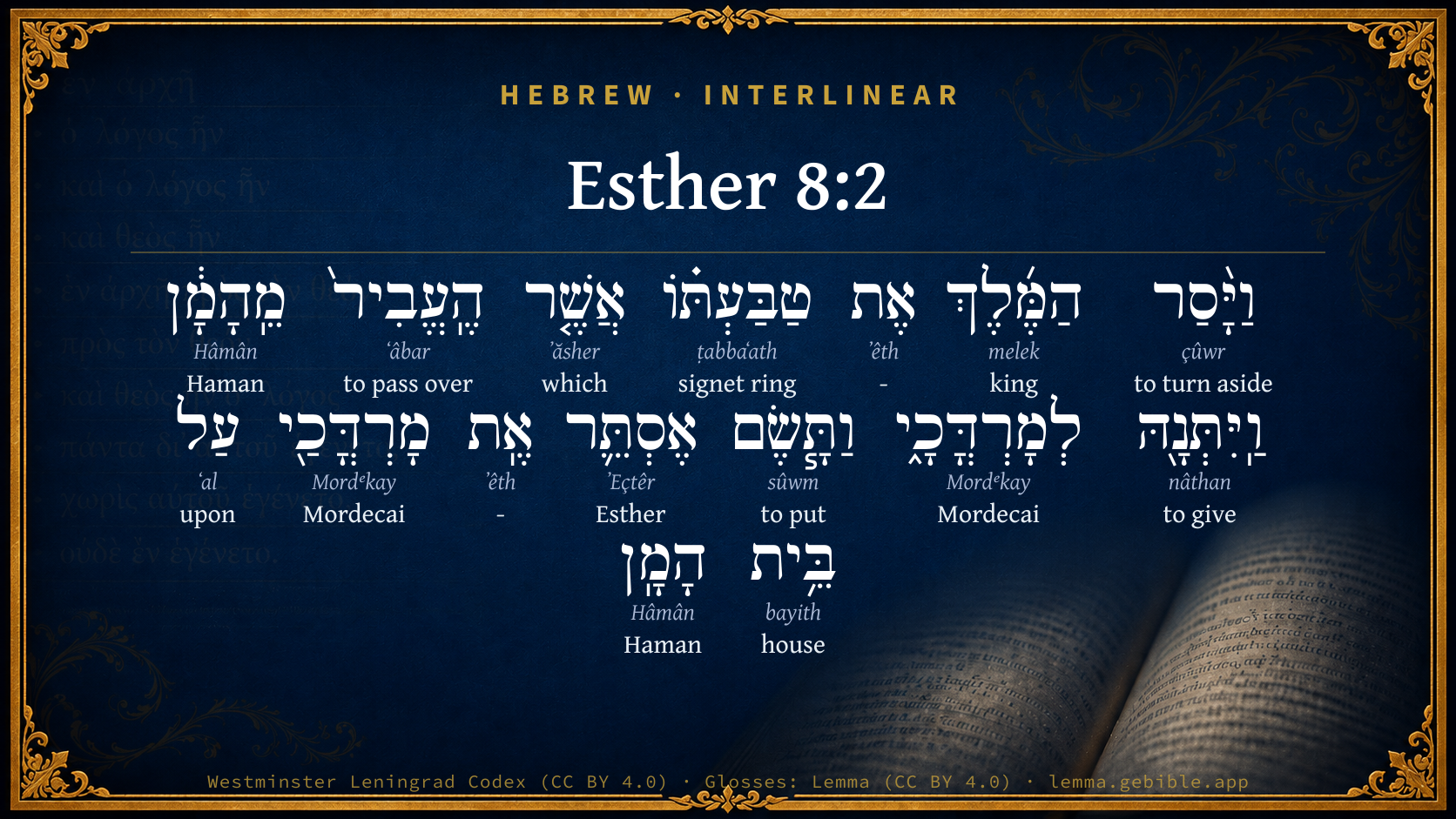
Hebrew (Westminster Leningrad Codex) Esther 8:2 appears in the Hebrew Old Testament. The text above is from the Westminster Leningrad Codex. Each word links to its Strong’s number, a concise gloss, and parsing drawn from the Open Scriptures Hebrew Bible morphology. Click any word for its full Brown-Driver-Briggs (BDB) entry.
Download image
Cite this verse

Esther 8:2 (World English Bible). Public Domain. Lemma interlinear Bible study tool, https://lemma.gebible.app/v/esther/8/2.

Show BibTeX & RIS
BibTeX
RIS
English Translation
The king took off his ring, which he had taken from Haman, and gave it to Mordecai. Esther set Mordecai over the house of Haman.
World English Bible · Public Domain
Download a study sheet

One document with this verse’s original text, its word-by-word gloss line, the meaning frame, cross-references with their text, attributed commentary, and full source and license credits — printable, and it pastes into notes with its structure intact.

This verse Autodidact and up

Study sheet (.html) Plain text (.txt)

A passage Seminary Student

Up to 50 verses in one chapter. A passage sheet keeps up to 6 commentary sources and 12 cross-references per verse, in the order this page ranks them, and says so on the sheet whenever that leaves anything out. Ask for a single verse and you get the Autodidact verse sheet above.

Everything on this page stays free to read, with no account — the sheet is a download of what is already on screen, not access to it.

Want to remove ads? Support Godless Engineer
Compare translations 3

The same verse in 3 English versions, stacked beneath the original-language interlinear above. Click any original word for its lexicon entry.

Each is an independent rendering of the whole verse — the interlinear is not word-aligned to these translations.

Highlighted words mark where these versions differ — a whole-verse word diff, not a word-by-word alignment.

  • World English Bible Public Domain
    The king took off his ring, which he had taken from Haman, and gave it to Mordecai. Esther set Mordecai over the house of Haman.
  • King James Version Public Domain
    And the king took off his ring, which he had taken from Haman, and gave it unto Mordecai. And Esther set Mordecai over the house of Haman.
  • unfoldingWord Literal Text CC BY-SA 4.0
    And the king removed his signet ring, which he had caused to pass from Haman, and he gave it to Mordecai. And Esther placed Mordecai over the house of Haman.

unfoldingWord Literal Text — © unfoldingWord, licensed CC BY-SA 4.0. Word-aligned USFM3 via Door43 (git.door43.org/unfoldingWord/en_ult).

Versions to compare (up to 4)

3 of 4 selected

Show all 18 translations

Every available English version of this verse, each an independent rendering of the whole verse.

  • World English Bible Public Domain
    The king took off his ring, which he had taken from Haman, and gave it to Mordecai. Esther set Mordecai over the house of Haman.
  • Berean Standard Bible Public Domain
    The king removed the signet ring he had recovered from Haman and presented it to Mordecai. And Esther appointed Mordecai over the estate of Haman.
  • Majority Standard Bible Public Domain
    The king removed the signet ring he had recovered from Haman and presented it to Mordecai. And Esther appointed Mordecai over the estate of Haman.
  • King James Version Public Domain
    And the king took off his ring, which he had taken from Haman, and gave it unto Mordecai. And Esther set Mordecai over the house of Haman.
  • American Standard Version (1901) Public Domain
    And the king took off his ring, which he had taken from Haman, and gave it unto Mordecai. And Esther set Mordecai over the house of Haman.
  • Revised Version (1885) Public Domain
    And the king took off his ring, which he had taken from Haman, and gave it unto Mordecai. And Esther set Mordecai over the house of Haman.
  • Geneva Bible (1599) Public Domain
    And the King tooke off his ring, which he had taken from Haman, and gaue it vnto Mordecai: and Ester set Mordecai ouer the house of Haman.
  • Douay-Rheims (1899) Public Domain
    And the king took the ring which he had commanded to be taken again from Aman, and gave it to Mardochai. And Esther set Mardochai over her house.
  • Young's Literal Translation Public Domain
    and the king turneth aside his signet, that he hath caused to pass away from Haman, and giveth it to Mordecai, and Esther setteth Mordecai over the house of Haman.
  • Literal Standard Version CC BY-SA 4.0
    and the king turns aside his signet, that he has caused to pass away from Haman, and gives it to Mordecai, and Esther sets Mordecai over the house of Haman.
  • Unlocked Literal Bible CC BY-SA 4.0
    The king took off his signet ring, which he had taken back from Haman, and gave it to Mordecai. Esther designated Mordecai to be in charge of Haman's estate.
  • unfoldingWord Literal Text CC BY-SA 4.0
    And the king removed his signet ring, which he had caused to pass from Haman, and he gave it to Mordecai. And Esther placed Mordecai over the house of Haman.
  • Darby Bible Public Domain
    And the king took off his ring, which he had taken from Haman, and gave it to Mordecai. And Esther set Mordecai over the house of Haman.
  • World Messianic Bible Public Domain
    The king took off his ring, which he had taken from Haman, and gave it to Mordecai. Esther set Mordecai over the house of Haman.
  • Webster's Bible Public Domain
    And the king took off his ring which he had taken from Haman, and gave it to Mordecai. And Esther set Mordecai over the house of Haman.
  • Free Bible Version CC BY-SA 4.0
    The king removed his signet ring which he had taken back from Haman, and gave it to Mordecai. Esther put Mordecai in charge of Haman's property.
  • Bible in Basic English Public Domain
    And the king took off his ring, which he had taken from Haman, and gave it to Mordecai. And Esther put Mordecai over the family of Haman.
  • JPS Tanakh (1917) Public Domain
    And the king took off his ring, which he had taken from Haman, and gave it unto Mordecai. And Esther set Mordecai over the house of Haman.

Literal Standard Version (2020), Covenant Press — licensed CC BY-SA 4.0. Text via the HelloAO Bible API (eBible.org). Unlocked Literal Bible (unfoldingWord) — licensed CC BY-SA 4.0. Text via the HelloAO Bible API (eBible.org). unfoldingWord Literal Text — © unfoldingWord, licensed CC BY-SA 4.0. Word-aligned USFM3 via Door43 (git.door43.org/unfoldingWord/en_ult). Free Bible Version, Dr. Jonathan Gallagher — licensed CC BY-SA 4.0. Text via the HelloAO Bible API (eBible.org).

Word by word

More ways to search: Search by grammar → Find every occurrence → Compare this word →

Practice this passage: Drill this verse → Learn its vocabulary →

טַבַּעְתּ֗וֹ
ṭabbaʻath
H2885
“signet ring · his”
Noun, Common, Feminine, Singular, Construct + Suffix, Personal, 3rd Person, Masculine, Singular
Part of Speech
Noun
Type
Common
Gender
Feminine
Number
Singular
State
Construct
Full BDB Definition

Origin: from H2883

TWOT: 789a

ring, signet, signet ring - signet ring (as symbol of authority) - ring (as ornament)
  1. וַיָּ֨סַר çûwr H5493 “and · to turn aside” Conjunction + Verb, Hiphil, Sequential Imperfect, 3rd Person, Masculine, Singular
  2. הַמֶּ֜לֶךְ melek H4428 “the · king” Particle, Definite Article + Noun, Common, Masculine, Singular, Absolute
  3. אֶת ʼêth H853 “-” Particle, Direct Object
  4. אֲשֶׁ֤ר ʼăsher H834 “which” Particle, Relative
  5. הֶֽעֱבִיר֙ ʻâbar H5674 “to pass over” Verb, Hiphil, Perfect, 3rd Person, Masculine, Singular
  6. מֵֽהָמָ֔ן Hâmân H2001 “from · Haman” Preposition + Noun, Proper
  7. וַֽיִּתְּנָ֖הּ nâthan H5414 “and · to give · her” Conjunction + Verb, Qal, Sequential Imperfect, 3rd Person, Masculine, Singular + Suffix, Personal, 3rd Person, Feminine, Singular
  8. לְמָרְדֳּכָ֑י Mordᵉkay H4782 “to/for · Mordecai” Preposition + Noun, Proper
  9. וַתָּ֧שֶׂם sûwm H7760 “and · to put” Conjunction + Verb, Qal, Sequential Imperfect, 3rd Person, Feminine, Singular
  10. אֶסְתֵּ֛ר ʼEçtêr H635 “Esther” Noun, Proper
  11. אֶֽת ʼêth H853 “-” Particle, Direct Object
  12. מָרְדֳּכַ֖י Mordᵉkay H4782 “Mordecai” Noun, Proper
  13. עַל ʻal H5921 “upon” Preposition
  14. בֵּ֥ית bayith H1004 “house of” Noun, Common, Masculine, Singular, Construct
  15. הָמָֽן Hâmân H2001 “Haman” Noun, Proper

About this verse

These counts appear in no published source. They are computed here, from the morphology-tagged text and Lemma’s own curated glosses. What Lemma adds →

16
words
13
distinct lemmas
Historical
section

Shared distinctive vocabulary

טַבַּעְתּ֗וֹ signet ring H2885 occurs in 38 verses of the Hebrew Bible. Also found in:

Grammatical profile

  • 4 verbs
  • 8 nouns
  • 1 preposition
  • 3 particles

Verb forms

  • וַיָּ֨סַר Hiphil · Sequential Imperfect
  • הֶֽעֱבִיר֙ Hiphil · Perfect
  • וַֽיִּתְּנָ֖הּ Qal · Sequential Imperfect
  • וַתָּ֧שֶׂם Qal · Sequential Imperfect

Repetition

Words recur within this verse — often emphatic in Hebrew:

  • מֵֽהָמָ֔ן Haman H2001 ×2
  • לְמָרְדֳּכָ֑י Mordecai H4782 ×2

Hebrew & Septuagint length

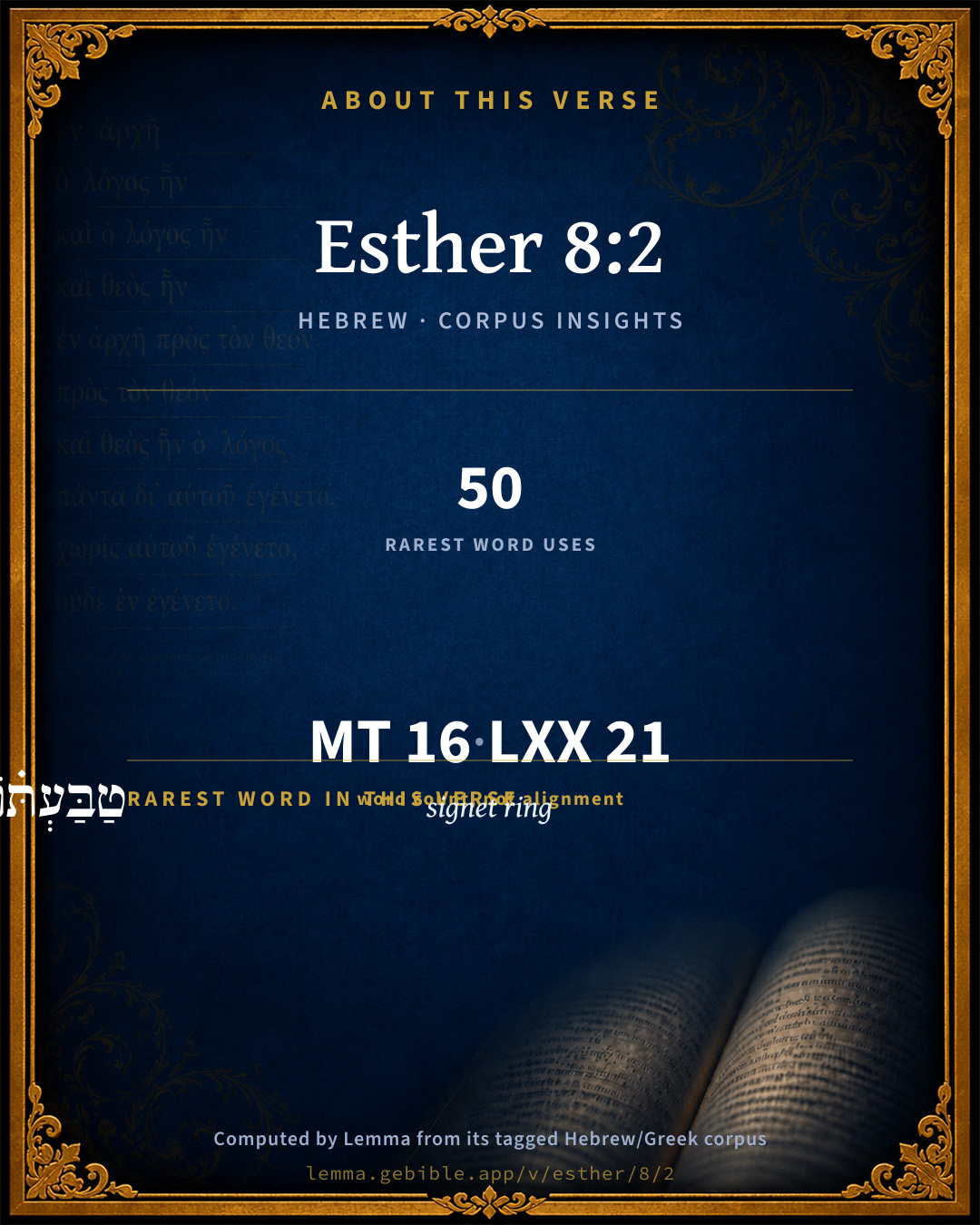
In English translation the verse runs 25 words from the Hebrew and 28 from the Septuagint (LXX English) — closely comparable.

A rough comparison of the two English renderings, which tokenize alike — not a word-level alignment.

Word counts can differ between the Hebrew and the Greek without any difference in meaning — e.g. the Hebrew direct-object marker אֵת has no separate Greek word, and Greek often adds the article ὁ.

In the original languages it is 16 Hebrew tokens and 21 Greek tokens — but the two are counted differently (Hebrew bundles its prefixes and suffixes into one token; the Greek is in lemma form), so that isn’t a like-for-like length.

Cross-references

9

Topical passages linked to Esther 8:2 in the Treasury of Scripture Knowledge — connected by theme and wording, ordered by reader-vote popularity; previews shown in the World English Bible.

  • Esther 3:10 The king took his ring from his hand, and gave it to Haman the son of Hammedatha the Agagite, the Jews' enemy.
  • Genesis 41:42 Pharaoh took off his signet ring from his hand, and put it on Joseph's hand, and arrayed him in robes of fine linen, and put a gold chain about his neck,
  • Daniel 2:48 Then the king made Daniel great, and gave him many great gifts, and made him to rule over the whole province of Babylon, and to be chief governor over all the wise men of Babylon.
  • Psalms 37:34 Wait for Yahweh, and keep his way, And he will exalt you to inherit the land. When the wicked are cut off, you shall see it.
  • Luke 15:22 "But the father said to his servants, 'Bring out the best robe, and put it on him. Put a ring on his hand, and shoes on his feet.
  • 2 Samuel 9:7–10 David said to him, "Don't be afraid of him; for I will surely show you kindness for Jonathan your father's sake, and will restore you all the land of Saul your father; and you shall eat bread at my table continually."
  • Ecclesiastes 2:18–26 I hated all my labor in which I labored under the sun, seeing that I must leave it to the man who comes after me.
  • Ecclesiastes 5:13–14 There is a grievous evil which I have seen under the sun: wealth kept by its owner to his harm.
  • Isaiah 22:19–22 I will thrust you from your office; and from your station shall you be pulled down.

Cross-references courtesy of OpenBible.info (CC BY 4.0).

Hebrew and Greek witnesses Masoretic Hebrew ↔ Greek Septuagint

The same verse in the two great witnesses to the Old Testament, shown verse-for-verse.

These are two independent witnesses, not word-aligned to each other, and the Septuagint is shown in lemma (dictionary) form.

Hebrew Esther 8:2 Masoretic · Westminster Leningrad Codex

וַיָּ֨סַר הַמֶּ֜לֶךְ אֶת טַבַּעְתּ֗וֹ אֲשֶׁ֤ר הֶֽעֱבִיר֙ מֵֽהָמָ֔ן וַֽיִּתְּנָ֖הּ לְמָרְדֳּכָ֑י וַתָּ֧שֶׂם אֶסְתֵּ֛ר אֶֽת מָרְדֳּכַ֖י עַל בֵּ֥ית הָמָֽן

The king took off his ring, which he had taken from Haman, and gave it to Mordecai. Esther set Mordecai over the house of Haman.

World English Bible · Public Domain

Greek LXX Esther 8:2 Septuagint · lemma form

λαμβάνω δέ ὁ βασιλεύς ὁ δακτύλιος ὅς ἀποαἱρέω αμαν καί δίδωμι αὐτός μαρδοχαῖος καί καταἵστημι εσθηρ μαρδοχαῖος ἐπί πᾶς ὁ αμαν

And the king took the ring which he had taken away from Aman, and gave it to Mardochaeus: and Esther appointed Mardochaeus over all that had been Aman's.

LXX2012 (modern English Septuagint) · Public Domain

Hebrew: Westminster Leningrad Codex (CC BY 4.0). Greek: Septuagint (public domain); English from LXX2012 (modern English Septuagint) (Public Domain). How the Septuagint differs from the Hebrew →

Commentary

Notes on Esther 8:2 from classic Christian and Jewish commentators (each source and its license shown beneath its notes). The classic Christian expositions comment on the surrounding passage and are grouped to its opening verse, so a note may address several verses; the Jewish commentaries on the Tanakh (Rashi and others) are per-verse, so they appear only where the commentator wrote on this verse.

Lemma curates 59 commentaries, every one of them public domain or Creative Commons licensed, each selected and text-cleaned for this edition rather than reprinted as found. About our sources →

Trapp's Complete Commentary

John Trapp

Est 8:2 And the king took off his ring, which he had taken from Haman, and gave it unto Mordecai. And Esther set Mordecai over the house of Haman.

Ver. 2. And the king took off his ring] As a sign of intimate friendship, and a bond of strictest league of love. That this was usual among the Persians, is testified by Alexander. {ab Alexandro, Lib. i. c. 26.} Of Alexander the Great it is told, that when he died he left his ring to his dearest friend Perdiccas, but his dominions, τω κρατιστω, to the worthiest. This set up competitors, and bred much trouble. Ahasuerus knew that a worthier than Mordecai he could not easily find, and therefore besides that momentary honour he had newly done him, Est 6:10, he now not only by this ring admitteth him into nearest friendship, but, as some think, advanceth him to be keeper of the seal, and lord chancellor of all the empire.

Which he had taken from Haman] And so degraded and exauthorated him before his execution: this is usual.

And gave it unto Mordecai] Acknowledging thereby his error in promoting so unworthy a man before; whom having punished for his deserts, he here pitcheth upon a better. En Imperatorem valde terribilem nec minus clementem, Behold the very emperor terrible and very little mercy, as Frederick, the elector of Saxony, said of Charles V. Let Ahasuerus be what he wishes, Almighty God is in this text set forth as bountiful to his people, and terrible to his enemies. See Psa 34:15-16.

And Esther set Mordecai over the house of Haman] As her chief steward, to see that everything went right, and were put to the best. Haman’s sons lived some months after this, but were outed of all. An inheritance may be gotten hastily at the beginning, but the end thereof shall not be blessed, Pro 20:21. He that by usury and unjust gain increaseth his substance, he shall gather it for him that will pity the poor, Pro 23:8. God will provide him both an executor and an overseer, as here he did Haman.

John Trapp, A Commentary or Exposition upon All the Books of the Old and New Testament (1647–1656) — public domain. Text from a community e-Sword module.

Joseph Benson's Commentary

Est 8:2. The king took off his ring — That ring which he had formerly given to Haman, but had resumed, he now gives to Mordecai, in token of his favour, and with it that power whereof this ring was a sign, making him, as Haman had been, the keeper of his signet. And Esther set Mordecai over the house of Haman — Not over his family, for that was destroyed, but over his lands and goods, given her by the king: of which she made Mordecai her steward, to manage that great estate for her, as he thought fit. With what little pleasure, nay, with what constant vexation, would Haman have looked upon his estate, if he could have foreseen that Mordecai, the man he hated above all men in the world, should have rule over all that wherein he had laboured, and thought he showed himself so wise! See, then, the vanity of laying up treasure on earth; he that heapeth up riches knoweth not who shall gather them, Psa 39:6; not only whether he shall be a wise man or a fool, (Ecc 2:19,) but whether he shall be a friend or an enemy. It is our interest, therefore, to make sure of those riches which will not be left behind, but will go with us to another world. Reader, attend to this, and lay not up for thy posterity, any more than for thyself treasures on earth.

Joseph Benson's Commentary on the Old and New Testaments (1811–1818) — public domain. Text from a community e-Sword module.

Tyndale Open Study Notes

Tyndale Open Resources

8:2 The signet ring that Haman had used to seal the decree to destroy the Jewish people (3:10) was now given to the Jewish person he had most wanted to destroy.

Tyndale Open Study Notes — © Tyndale Open Resources, licensed CC BY-SA 4.0. Text via the HelloAO Bible API.

Jamieson, Fausset & Brown

Robert Jamieson, A. R. Fausset & David Brown

the king took off his ring, . . . and gave it unto Mordecai--By that act transferring to him all the power and authority which the ring symbolized, and promoting him to the high dignity which Haman had formerly filled.

Esther set Mordecai over the house of Haman--as her steward or factor, to manage that large and opulent estate which had been assigned to her.

Jamieson, Fausset & Brown — Commentary Critical and Explanatory on the Whole Bible (1871) — public domain (CC PDM 1.0). Text via the HelloAO Bible API.

Adam Clarke's Commentary

Verse 2. The king took off his ring] In the ring was the seal of the king. Giving the ring to Mordecai was tantamount to giving him the seal of the kingdom, and constituting him the same as lord chancellor among us.

Adam Clarke's Commentary on the Bible (1810–1826) — public domain. Text from a community e-Sword/MySword module.

Ellicott's Commentary for English Readers

(2) Took off his ring . . . and gave it unto Mordecai.—Constituting him thereby his Vizier, who would thus authenticate a royal decree, and by having, as it were, carte blanche given him for the time, would for that time save his master all further trouble. Mordecai’s position had now become what Daniel’s had been to Darius, that nobler servant to a worthier lord (see Dan_6:2, 38). He was the queen’s cousin, and he had on one occasion been the means of saving the king’s life, and therefore starts under distinctly favourable auspices.

A Bible Commentary for English Readers, edited by Charles John Ellicott (1878–1897) — public domain. Text from a community e-Sword module.

John Gill's Exposition

And the king took off his ring, which he had taken from Haman, and gave it unto Mordecai,.... which, with the Persians, was a token of the strongest affection and strictest friendship (z); the Targum calls it his signatory ring, that with which he signed laws, edicts, letters, patents, &c. and so hereby made him keeper of the seals:

and Esther set Mordecai over the house of Haman; appointed him her steward of the estate of Haman, the king had given her.

(z) Alex. ab Alex. Genial. Dier. l. 1. c. 26. & l. 2. c. 19.

John Gill's Exposition of the Whole Bible (1746–1763) — public domain (CC PDM 1.0). Text via the HelloAO Bible API.

Albert Barnes' Notes on the Bible

His ring - i. e. the royal signet by which the decrees of the government were signed.

Over the house of Haman - Not only the building and the furniture, but the household - the vast train of attendants of all kinds that was attached to the residence of a Persian noble.

Albert Barnes' Notes on the Bible (1834–1885) — public domain. Text from a community e-Sword/MySword module.

Haydock's Catholic Bible Commentary

Aman. It seems the traitor had hitherto kept possession of it, and sealed the king’s edicts, as Mardochai was now to do, ver. 8. --- House. Hebrew, &c., "of Aman," to whom it had belonged. (Calmet)

George Leo Haydock (1774–1849), Haydock's Catholic Family Bible and Commentary, 1859 edition — public domain. Excludes Psalms (Douay-Rheims chapter numbering differs from Protestant) and Deuterocanonical books (Catholic canon only).

Matthew Poole's English Annotations

The king took off his ring; that ring which he had formerly given to Haman for that present or any further use, Est 3:10, he now gives to Mordecai, and with it that power and authority whereof this ring was a sign, making him, as Haman had been, the keeper of his signet.

Esther set Mordecai over the house of Haman; as her steward, to manage that great estate for her as he thought fittest.

Matthew Poole's English Annotations on the Holy Bible (1683–1685) — public domain. Text from a community e-Sword/MySword module.

Whedon's Commentary on the Bible

Daniel D. Whedon

2. Took off his ring — See note on Est_3:10.

Which he had taken from Haman — When Haman was led forth to execution he was, of course, stripped of all seals and emblems of his office and authority, and all such insignia returned to the king.

Gave it unto Mordecai — Thus transferring to a Jew the authority and emoluments lately enjoyed by the Agagite. It was no strange thing for eastern kings thus to honour foreigners.

And Esther set Mordecai — She felt she could make no better disposal of her present than to give it to the keeping and use of her venerated relative and friend.

Daniel D. Whedon (gen. ed.), Commentary on the Old and New Testaments (1874–1909) — public domain. Text from a community e-Sword module.

The Pulpit Commentary

And the king took off his ring. The king"s signet would, as a matter of course, be taken from Haman before his execution and restored to Ahasuerus, who now once more wore it himself. Business, however, was irksome to him, and, having resolved to make Mordecai minister in Haman"s room, he very soon took the signet off again, and made it over to the new vizier. And Esther set Mordecai over the house of Haman. It would not have been seemly for Esther to give away what she had received as a gift from the king. She was therefore unable to make Mordecai a present of the house. But she did what was equivalent she set him over it, made him practically its master. Thus he was provided with a residence suitable to his new dignity.

AT ESTHER"S REQUEST AHASUERUS ALLOWS THE ISSUE OF A SECOND EDICT, PERMITTING THE JEWS TO RESIST ANY WHO SHOULD ATTACK THEM, TO KILL THEM IN THEIR OWN DEFENCE, AND TO TAKE POSSESSION OF THEIR GOODS. (Est_8:3-14) The execution of Haman, the confiscation of his property, the advancement of Mordecai into his place, though of favourable omen, as showing the present temper and inclination of Abasuerus, left the Jews in as great danger as before. In most countries there would neither have been delay nor difficulty. The edict which went forth on the 13th of Nisan, (Est_3:12) and which could not be executed till the 13th of Adar, would have been cancelled, revoked, recalled. But in Persia this could not be done; or at any rate it could not be done without breaking one of the first principles of Persian law, the principle that "the writing which is written in the king"s name, and sealed with the king"s ring, may no man reverse" (ver. 8). It was therefore necessary to devise a mode whereby the desired escape of the Jews might practically be obtained, and yet the edict remain unrevoked, and the king"s honour be saved. At first Mordecai and Esther do not appear to have seen this, and Esther asked openly for the reversal of the decree, only representing it as the writing of Haman, and not the writing of the king (ver. 5). But Ahasuerus pointed out that this could not be done. Anything short of a reversal, any new decree, he would sanction; but he could do no more he could not revoke his own word (ver. 8). The course actually followed was then devised, probably by Mordecai. The old decree was allowed to stand; but a new decree was issued and signed in the usual way, whereby the Jews were allowed and encouraged to resist those who should attack them, to "gather themselves together, and to stand for their life; to destroy, slay, and cause to perish all the power of the people of the province that would assault them, and were further permitted to "take the spoil of them for a prey," or, in other words, to seize the property of all whom they should slay (ver. 11). The royal posts carried out this decree (ver. 14), as they had the former one; and it was publicly set forth and proclaimed in every province, that if the Jews were attacked under the terms of the one, they might defend themselves and retaliate on their foes under the terms of the other (ver. 13). As the second decree was issued on the 23rd of Sivan, the third month (ver. 9), and the day appointed for the attack was the 13th of Adar, the twelfth, there was ample time-above eight months for the Jews to make preparations, to organise themselves, to collect arms, and to arrange an effective resistance.

The Pulpit Commentary (1880–1919), ed. H.D.M. Spence-Jones & Joseph S. Exell — public domain. Text from a community e-Sword module.

John Wesley's Explanatory Notes

Ring - That ring which he had formerly given to Haman he now gives to Mordecai, and with it that power whereof this ring was a sign, making him, as Haman had been, the keeper of his signet. Set - As her steward, to manage that great estate for her as he thought fittest.

John Wesley, Explanatory Notes Upon the Whole Bible (1754–1765) — public domain. Text via the GEBible commentary corpus.

Lesson kit

Teaching starters — assembled from the data on this page, not authored interpretation. Every prompt links to the verse data it draws on. Edit before teaching.

Esther, in the Historical, opens this verse with 16 words (13 distinct Hebrew lemmas). Its most distinctive word is ṭabbaʻath (“signet ring”). A historical commentator’s framing appears above. Read the whole chapter for the surrounding context.

Discussion questions

  1. What does “signet ring” (ṭabbaʻath) contribute to the verse as a whole?
  2. How does Genesis 41:42, which shares the word «signet ring», read alongside this verse?
  3. What does the repetition of “Haman” (2× in this one verse) do in this verse?
  4. The translations on this page render this verse differently — a whole-verse word diff, not a word-by-word alignment. What might account for the different wordings?
  5. «וַיָּ֨סַר» is a Hiphil Sequential Imperfect verb. How does that grammatical form shape the action described?
  6. Compare how Trapp's Complete Commentary and Joseph Benson's Commentary read this verse. Where do they agree or differ?

Things to notice

Reading settings

Reading text

Shown beneath each verse's original-language words.

Old Testament
Old Testament edition

Read the OT as the Masoretic Hebrew (MT) or the Greek Septuagint (LXX).

English shown for the Greek Septuagint (in the Hebrew ↔ Greek comparison).

Comparing translations? Open the Compare panel on any verse page to stack up to four side by side.