
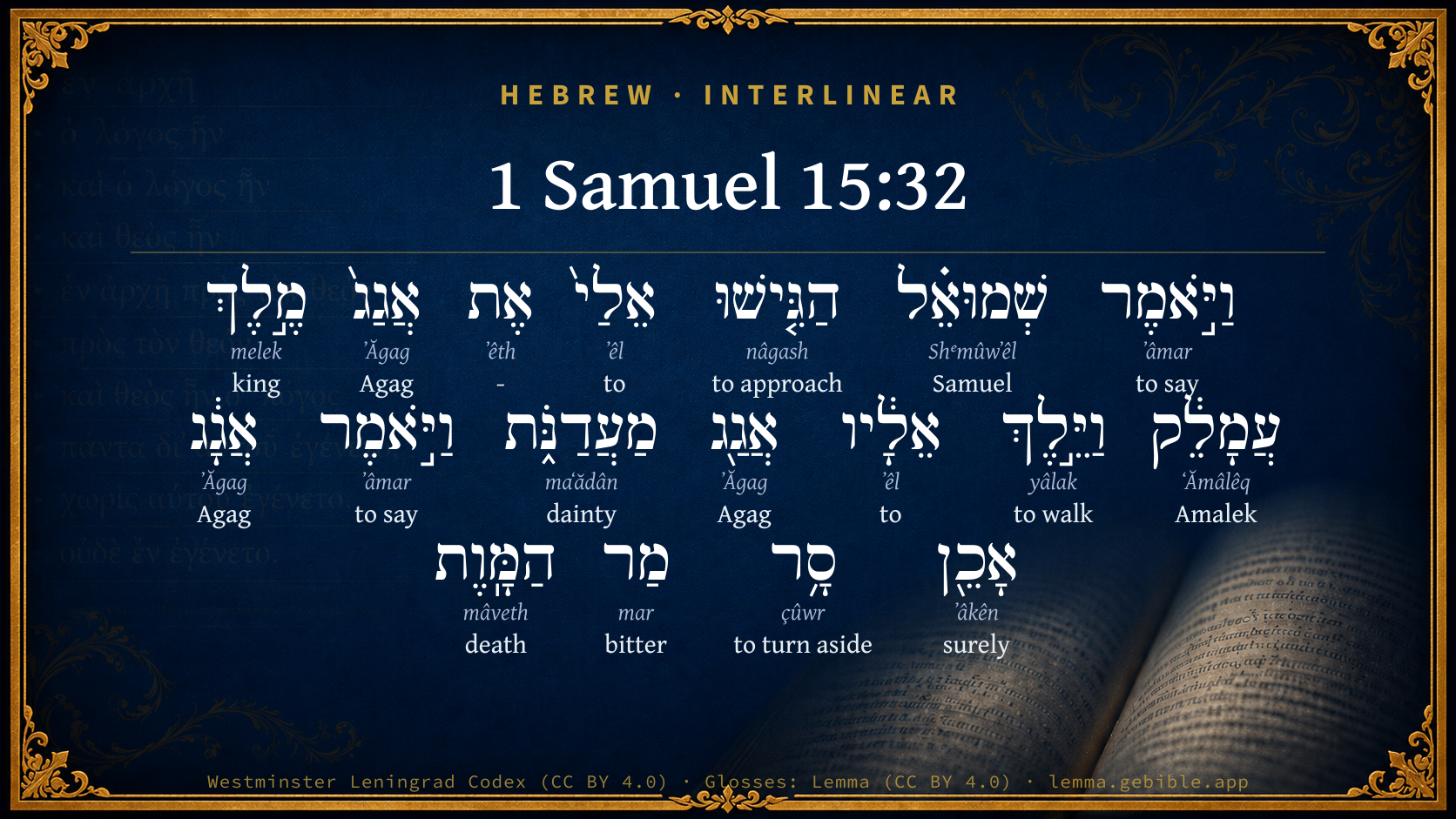
1 Samuel 15:32

Hebrew (Westminster Leningrad Codex) 1 Samuel 15:32 appears in the Hebrew Old Testament. The text above is from the Westminster Leningrad Codex. Each word links to its Strong’s number, a concise gloss, and parsing drawn from the Open Scriptures Hebrew Bible morphology. Click any word for its full Brown-Driver-Briggs (BDB) entry.
Download image
Cite this verse

1 Samuel 15:32 (World English Bible). Public Domain. Lemma interlinear Bible study tool, https://lemma.gebible.app/v/1-samuel/15/32.

Show BibTeX & RIS
BibTeX
RIS
English Translation
Then said Samuel, Bring you here to me Agag the king of the Amalekites. Agag came to him cheerfully. Agag said, Surely the bitterness of death is past.
World English Bible · Public Domain
Download a study sheet

One document with this verse’s original text, its word-by-word gloss line, the meaning frame, cross-references with their text, attributed commentary, and full source and license credits — printable, and it pastes into notes with its structure intact.

This verse Autodidact and up

Study sheet (.html) Plain text (.txt)

A passage Seminary Student

Up to 50 verses in one chapter. A passage sheet keeps up to 6 commentary sources and 12 cross-references per verse, in the order this page ranks them, and says so on the sheet whenever that leaves anything out. Ask for a single verse and you get the Autodidact verse sheet above.

Everything on this page stays free to read, with no account — the sheet is a download of what is already on screen, not access to it.

Want to remove ads? Support Godless Engineer
Compare translations 3

The same verse in 3 English versions, stacked beneath the original-language interlinear above. Click any original word for its lexicon entry.

Each is an independent rendering of the whole verse — the interlinear is not word-aligned to these translations.

Highlighted words mark where these versions differ — a whole-verse word diff, not a word-by-word alignment.

  • World English Bible Public Domain
    Then said Samuel, Bring you here to me Agag the king of the Amalekites. Agag came to him cheerfully. Agag said, Surely the bitterness of death is past.
  • King James Version Public Domain
    Then said Samuel, Bring ye hither to me Agag the king of the Amalekites. And Agag came unto him delicately. And Agag said, Surely the bitterness of death is past.
  • unfoldingWord Literal Text CC BY-SA 4.0
    And Samuel said, “Bring Agag, the king of Amalek, to me.” And Agag went to him bonds. And Agag said, “Surely the bitterness of death has turned aside.”

unfoldingWord Literal Text — © unfoldingWord, licensed CC BY-SA 4.0. Word-aligned USFM3 via Door43 (git.door43.org/unfoldingWord/en_ult).

Versions to compare (up to 4)

3 of 4 selected

Show all 18 translations

Every available English version of this verse, each an independent rendering of the whole verse.

  • World English Bible Public Domain
    Then said Samuel, Bring you here to me Agag the king of the Amalekites. Agag came to him cheerfully. Agag said, Surely the bitterness of death is past.
  • Berean Standard Bible Public Domain
    Then Samuel said, “Bring me Agag king of the Amalekites.” Agag came to him cheerfully, for he thought, “Surely the bitterness of death is past.”
  • Majority Standard Bible Public Domain
    Then Samuel said, “Bring me Agag king of the Amalekites.” Agag came to him cheerfully, for he thought, “Surely the bitterness of death is past.”
  • King James Version Public Domain
    Then said Samuel, Bring ye hither to me Agag the king of the Amalekites. And Agag came unto him delicately. And Agag said, Surely the bitterness of death is past.
  • American Standard Version (1901) Public Domain
    Then said Samuel, Bring ye hither to me Agag the king of the Amalekites. And Agag came unto him cheerfully. And Agag said, Surely the bitterness of death is past.
  • Revised Version (1885) Public Domain
    Then said Samuel, Bring ye hither to me Agag the king of the Amalekites. And Agag came unto him delicately. And Agag said, Surely the bitterness of death is past.
  • Geneva Bible (1599) Public Domain
    Then saide Samuel, Bring yee hither to me Agag ye King of the Amalekites: and Agag came vnto him pleasantly, and Agag saide, Truely the bitternesse of death is passed.
  • Douay-Rheims (1899) Public Domain
    And Samuel said: Bring hitherto me Agag the king of Amalec. And Agag was presented to him very fat, and trembling. And Agag said: Doth bitter death separate in this manner?
  • Young's Literal Translation Public Domain
    and Samuel saith, `Bring ye nigh unto me Agag king of Amalek,' and Agag cometh unto him daintily, and Agag saith, `Surely the bitterness of death hath turned aside.'
  • Literal Standard Version CC BY-SA 4.0
    and Samuel says, “Bring Agag king of Amalek to me,” and Agag comes to him daintily, and Agag says, “Surely the bitterness of death has turned aside.”
  • Unlocked Literal Bible CC BY-SA 4.0
    Then Samuel said, “Bring Agag the king of the Amalekites here to me.” Agag came to him confined with chains and said, “Surely the bitterness of death has past.”
  • unfoldingWord Literal Text CC BY-SA 4.0
    And Samuel said, “Bring Agag, the king of Amalek, to me.” And Agag went to him bonds. And Agag said, “Surely the bitterness of death has turned aside.”
  • Darby Bible Public Domain
    And Samuel said, Bring ye near to me Agag the king of Amalek. And Agag came to him gaily. And Agag said, Surely the bitterness of death is past.
  • World Messianic Bible Public Domain
    Then Samuel said, “Bring Agag the king of the Amalekites here to me!” Agag came to him cheerfully. Agag said, “Surely the bitterness of death is past.”
  • Webster's Bible Public Domain
    Then said Samuel, Bring ye hither to me Agag the king of the Amalekites. And Agag came to him delicately. And Agag said, Surely the bitterness of death is past.
  • Free Bible Version CC BY-SA 4.0
    Then Samuel said, “Bring me Agag, king of the Amalekites.” Agag came to him confidently, for he thought, “The threat of being killed must have passed.”
  • Bible in Basic English Public Domain
    Then Samuel said, Make Agag, the king of the Amalekites, come here to me. And Agag came to him shaking with fear. And Agag said, Truly the pain of death is past.
  • JPS Tanakh (1917) Public Domain
    Then said Samuel: 'Bring ye hither to me Agag the king of the Amalekites.' And Agag came unto him in chains. And Agag said: 'Surely the bitterness of death is at hand.'

Literal Standard Version (2020), Covenant Press — licensed CC BY-SA 4.0. Text via the HelloAO Bible API (eBible.org). Unlocked Literal Bible (unfoldingWord) — licensed CC BY-SA 4.0. Text via the HelloAO Bible API (eBible.org). unfoldingWord Literal Text — © unfoldingWord, licensed CC BY-SA 4.0. Word-aligned USFM3 via Door43 (git.door43.org/unfoldingWord/en_ult). Free Bible Version, Dr. Jonathan Gallagher — licensed CC BY-SA 4.0. Text via the HelloAO Bible API (eBible.org).

Word by word

More ways to search: Search by grammar → Find every occurrence → Compare this word →

Practice this passage: Drill this verse → Learn its vocabulary →

מַעֲדַנֹּ֑ת
maʻădân
H4574
“dainties”
Noun, Common, Both, Plural, Absolute
Part of Speech
Noun
Type
Common
Gender
Both
Number
Plural
State
Absolute
Full BDB Definition

Origin: from H5727

TWOT: 1567d

dainty (food), delight
  1. וַיֹּ֣אמֶר ʼâmar H559 “and · to say” Conjunction + Verb, Qal, Sequential Imperfect, 3rd Person, Masculine, Singular
  2. שְׁמוּאֵ֗ל Shᵉmûwʼêl H8050 “Samuel” Noun, Proper
  3. הַגִּ֤ישׁוּ nâgash H5066 “approach” Verb, Hiphil, Imperative, 2nd Person, Masculine, Plural
  4. אֵלַי֙ ʼêl H413 “to · me” Preposition + Suffix, Personal, 1st Person, Common, Singular
  5. אֶת ʼêth H853 “-” Particle, Direct Object
  6. אֲגַג֙ ʼĂgag H90 “Agag” Noun, Proper
  7. מֶ֣לֶךְ melek H4428 “king of” Noun, Common, Masculine, Singular, Construct
  8. עֲמָלֵ֔ק ʻĂmâlêq H6002 “Amalek” Noun, Proper
  9. וַיֵּ֣לֶךְ yâlak H3212 “and · to walk” Conjunction + Verb, Qal, Sequential Imperfect, 3rd Person, Masculine, Singular
  10. אֵלָ֔יו ʼêl H413 “to · him” Preposition + Suffix, Personal, 3rd Person, Masculine, Singular
  11. אֲגַ֖ג ʼĂgag H90 “Agag” Noun, Proper
  12. וַיֹּ֣אמֶר ʼâmar H559 “and · to say” Conjunction + Verb, Qal, Sequential Imperfect, 3rd Person, Masculine, Singular
  13. אֲגָ֔ג ʼĂgag H90 “Agag” Noun, Proper
  14. אָכֵ֖ן ʼâkên H403 “surely” Adverb
  15. סָ֥ר çûwr H5493 “to turn aside” Verb, Qal, Perfect, 3rd Person, Masculine, Singular
  16. מַר mar H4751 “bitter of” Adjective, Adjective, Masculine, Singular, Construct
  17. הַמָּֽוֶת mâveth H4194 “the · death” Particle, Definite Article + Noun, Common, Masculine, Singular, Absolute

About this verse

These counts appear in no published source. They are computed here, from the morphology-tagged text and Lemma’s own curated glosses. What Lemma adds →

18
words
14
distinct lemmas
Historical
section

Notable vocabulary

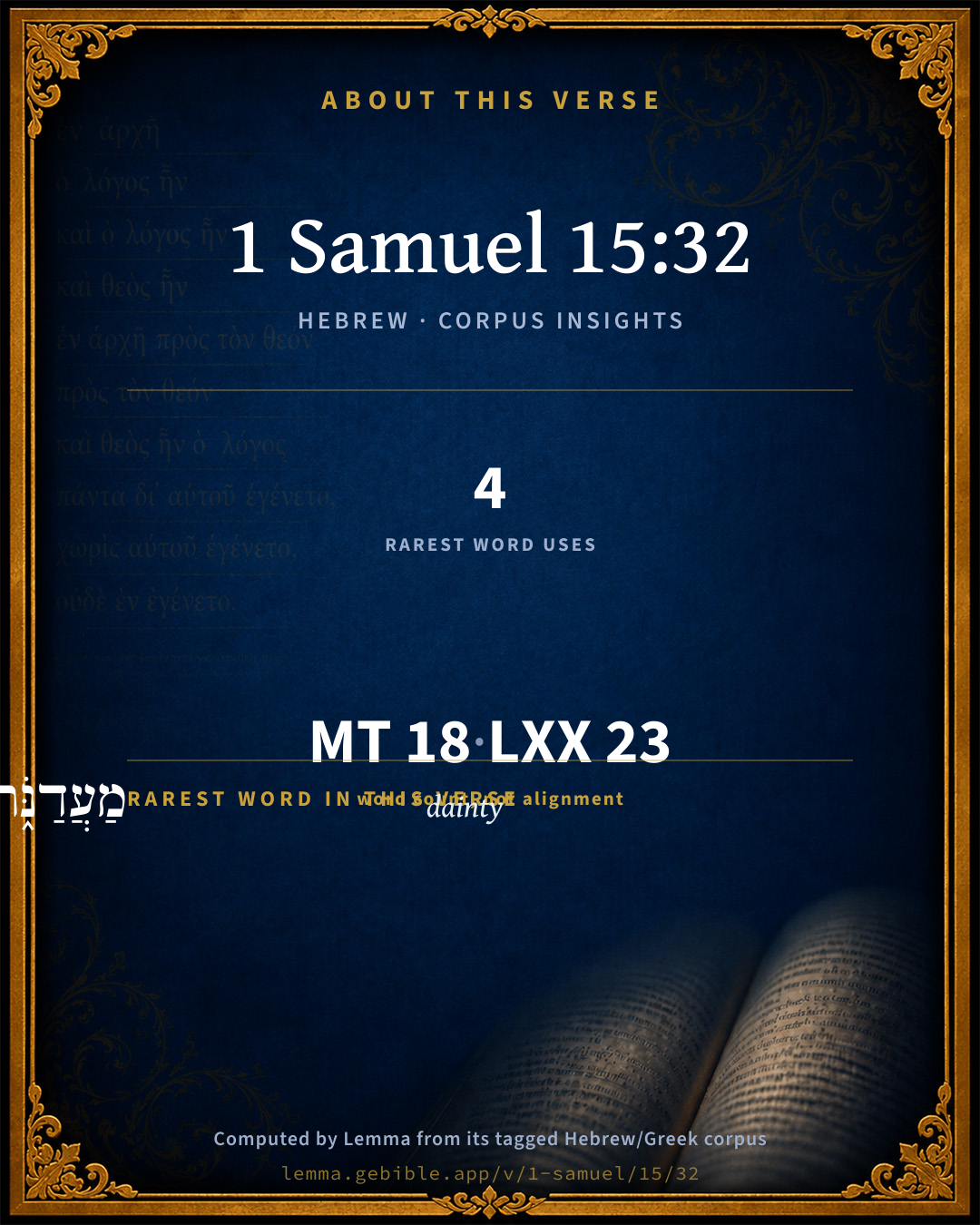
The rarest word here is מַעֲדַנֹּ֑ת dainty H4574 — appearing just 4 times in the whole Hebrew Bible.

Shared distinctive vocabulary

מַעֲדַנֹּ֑ת dainty H4574 occurs in 4 verses of the Hebrew Bible. Also found in:

Grammatical profile

  • 5 verbs
  • 8 nouns
  • 1 adjective
  • 2 prepositions
  • 1 adverb
  • 1 particle

Verb forms

  • וַיֹּ֣אמֶר Qal · Sequential Imperfect
  • הַגִּ֤ישׁוּ Hiphil · Imperative
  • וַיֵּ֣לֶךְ Qal · Sequential Imperfect
  • וַיֹּ֣אמֶר Qal · Sequential Imperfect
  • סָ֥ר Qal · Perfect

Repetition

Words recur within this verse — often emphatic in Hebrew:

  • אֲגַג֙ Agag H90 ×3
  • וַיֹּ֣אמֶר to say H559 ×2
  • אֵלַי֙ to H413 ×2

Hebrew & Septuagint length

In English translation the verse runs 28 words from the Hebrew and 23 from the Septuagint (LXX English) — closely comparable.

A rough comparison of the two English renderings, which tokenize alike — not a word-level alignment.

Word counts can differ between the Hebrew and the Greek without any difference in meaning — e.g. the Hebrew direct-object marker אֵת has no separate Greek word, and Greek often adds the article ὁ.

In the original languages it is 18 Hebrew tokens and 23 Greek tokens — but the two are counted differently (Hebrew bundles its prefixes and suffixes into one token; the Greek is in lemma form), so that isn’t a like-for-like length.

Cross-references

3

Topical passages linked to 1 Samuel 15:32 in the Treasury of Scripture Knowledge — connected by theme and wording, ordered by reader-vote popularity; previews shown in the World English Bible.

  • Jeremiah 48:44 He who flees from the fear shall fall into the pit; and he who gets up out of the pit shall be taken in the snare: for I will bring on him, even on Moab, the year of their visitation, says Yahweh.
  • 1 Thessalonians 5:3 For when they are saying, "Peace and safety," then sudden destruction will come on them, like birth pains on a pregnant woman; and they will in no way escape.
  • Revelation 18:7 However much she glorified herself, and grew wanton, so much give her of torment and mourning. For she says in her heart, 'I sit a queen, and am no widow, and will in no way see mourning.'

Cross-references courtesy of OpenBible.info (CC BY 4.0).

Hebrew and Greek witnesses Masoretic Hebrew ↔ Greek Septuagint

The same verse in the two great witnesses to the Old Testament, shown verse-for-verse.

These are two independent witnesses, not word-aligned to each other, and the Septuagint is shown in lemma (dictionary) form.

Hebrew 1 Samuel 15:32 Masoretic · Westminster Leningrad Codex

וַיֹּ֣אמֶר שְׁמוּאֵ֗ל הַגִּ֤ישׁוּ אֵלַי֙ אֶת אֲגַג֙ מֶ֣לֶךְ עֲמָלֵ֔ק וַיֵּ֣לֶךְ אֵלָ֔יו אֲגַ֖ג מַעֲדַנֹּ֑ת וַיֹּ֣אמֶר אֲגָ֔ג אָכֵ֖ן סָ֥ר מַר הַמָּֽוֶת

Then said Samuel, Bring you here to me Agag the king of the Amalekites. Agag came to him cheerfully. Agag said, Surely the bitterness of death is past.

World English Bible · Public Domain

Greek LXX 1 Samuel 15:32 Septuagint · lemma form

καί εἶπον σαμουηλ προςἄγω ἐγώ ὁ αγαγ βασιλεύς αμαληκ καί προςἔρχομαι πρός αὐτός αγαγ τρέμω καί εἶπον αγαγ εἰ οὕτως πικρός ὁ θάνατος

And Samuel said, Bring me Agag the king of Amalec: and Agag came to him trembling; and Agag said Is death thus bitter?

LXX2012 (modern English Septuagint) · Public Domain

On this verse, Matthew Henry's Commentary discusses the Septuagint’s reading. Read the note in Commentary ↓

Hebrew: Westminster Leningrad Codex (CC BY 4.0). Greek: Septuagint (public domain); English from LXX2012 (modern English Septuagint) (Public Domain). How the Septuagint differs from the Hebrew →

Targum (Aramaic paraphrase)

1

The Targum is the ancient Jewish Aramaic paraphrase of the Hebrew Scriptures — an interpretive translation, not the Hebrew text itself. Onkelos (literal) and Pseudo-Jonathan (expansive) render the Torah, and Jonathan the Prophets. Coverage is partial: where no permissively-licensed English translation exists for a verse, only the Aramaic is shown. This is verse-level text, not a word-by-word alignment to the Hebrew.

  1. Targum Jonathan Prophets (Joshua–Malachi)
    וַאֲמַר שְׁמוּאֵל קָרִיבוּ לְוָתִי יַת אֲגָג מַלְכָּא דְבֵית עֲמָלֵק וַאֲתָא לְוָתֵיהּ אֲגָג מְפַנְקָא וַאֲמַר אֲגָג בְּבָעוּ רִבּוֹנִי מְרִיר מוֹתָא:

    (no public-domain English translation for this verse)

    Targum Jonathan — Aramaic: “Mikraot Gedolot” (public domain). English: “Sefaria Community Translation” (CC0 1.0 (public-domain dedication)); “London "Chaldee Paraphrase," 1871” (public domain). Text via Sefaria.

Commentary

Notes on 1 Samuel 15:32 from classic Christian and Jewish commentators (each source and its license shown beneath its notes). The classic Christian expositions comment on the surrounding passage and are grouped to its opening verse, so a note may address several verses; the Jewish commentaries on the Tanakh (Rashi and others) are per-verse, so they appear only where the commentator wrote on this verse.

Lemma curates 59 commentaries, every one of them public domain or Creative Commons licensed, each selected and text-cleaned for this edition rather than reprinted as found. About our sources →

Matthew Henry's Commentary

Samuel, as a prophet, is here set over kings, Jer 1:10.

I. He destroys king Agag, doubtless by such special direction from heaven as none now can pretend to. He hewed Agag in pieces. Some think he only ordered it to be done; or perhaps he did it with his own hands, as a sacrifice to God's injured justice (Sa1 15:33), and sacrifices used to be cut in pieces. Now observe in this,

1. How Agag's present vain hopes were frustrated: He came delicately, in a stately manner, to show that he was a king, and therefore to be treated with respect, or in a soft effeminate manner, as one never used to hardship, that could not set the sole of his foot to the ground for tenderness and delicacy (Deu 28:56), to move compassion: and he said, "Surely, now that the heat of the battle is over, the bitterness of death is past, Sa1 15:32. Having escaped the sword of Saul," that man of war, he thought he was in no danger from Samuel, and old prophet, a man of peace. Note, (1.) There is bitterness in death, it is terrible to nature. Surely death is bitter, so divers versions read those words of Agag; as the Septuagint read the former clause, He came trembling. Death will dismay the stoutest heart. (2.) Many think the bitterness of death is past when it is not so; they put that evil day far from them which is very near. True believers may, through grace, say this, upon good grounds, though death be not past, the bitterness of it is. O death! where is thy sting?

2. How his former wicked practices were now punished. Samuel calls him to account, not only for the sins of his ancestors, but his own sins: Thy sword has made women childless, Sa1 15:33. He trod in the steps of his ancestors' cruelty, and those under him, it is likely, did the same; justly therefore is all the righteous blood shed by Amalek required of this generation, Mat 23:36. Agag, that was delicate and luxurious himself, was cruel and barbarous to others. It is commonly so: those who are indulgent in their appetites are not less indulgent of their passions. But blood will be reckoned for; even kings must account to the King of kings for the guiltless blood they shed or cause to be shed. It was that crime of king Manasseh which the Lord would not pardon, Kg2 24:4. See Rev 13:10.

II. He deserts king Saul, takes leave of him (Sa1 15:34), and never came any more to see him (Sa1 15:35), to advise or assist him in any of his affairs, because Saul did not desire his company nor would he be advised by him. He looked upon him as rejected of God, and therefore he forsook him. Though he might sometimes see him accidentally (as Sa1 19:24), yet he never came to see him out of kindness or respect. Yet he mourned for Saul, thinking it a very lamentable thing that a man who stood so fair for great things should ruin himself so foolishly. He mourned for the bad state of the country, to which Saul was likely to have been so great a blessing, but now would prove a curse and a plague. He mourned for his everlasting state, having no hopes of bringing him to repentance. When he wept for him, it is likely, he made supplication, but the Lord had repented that he had made Saul king, and resolved to undo that work of his, so that Samuel's prayers prevailed not for him. Observe, We must mourn for the rejection of sinners, 1. Though we withdraw from them, and dare not converse familiarly with them. Thus the prophet determines to leave his people and go from them, and yet to weep day and night for them, Jer 9:1, Jer 9:2. 2. Though they do not mourn for themselves. Saul seems unconcerned at the tokens of God's displeasure which he lay under, and yet Samuel mourns day and night for him. Jerusalem was secure when Christ wept over it.

Matthew Henry's Commentary on the Whole Bible (1708–1710) — public domain (CC PDM 1.0). Text via the HelloAO Bible API.

Trapp's Complete Commentary

John Trapp

1Sa 15:32 Then said Samuel, Bring ye hither to me Agag the king of the Amalekites. And Agag came unto him delicately. And Agag said, Surely the bitterness of death is past.

Ver. 32. And Agag came unto him delicately.] Gressu et incessu regio, et superbo, {a} stately and haughtily, with the garb and gait of a king; as little dreaming of death. Ultimus sanitatis gradus est morbo proximus, say physicians. The wicked when nearest misery, are oft in greatest security: as here Agag.

{a} Vatab. Pinguissimus et tremens. - Vulg., sc., prae pinguedine.

John Trapp, A Commentary or Exposition upon All the Books of the Old and New Testament (1647–1656) — public domain. Text from a community e-Sword module.

The Biblical Illustrator

Joseph S. Exell

1Sa_15:32

Surely, the bitterness of death is passed.

Death an advantage

So cried Agag, and the only objection I have go this text is that a bad man uttered it. Nevertheless, it is true, and in a higher sense than that in which it was originally uttered. We talk about the shortness of life, but if we exercised good sense we would realise that life is quite long enough. If we are the children of God, we are at a banquet, and this world is only the first course of the food, and we ought to be glad that there are other and richer courses of food to be handed on. We are here in one room of our Fathers house, but there are rooms upstairs. They are better pictured, better upholstered, better furnished. Why do we want to stay in the inte-room forever, when there are palatial apartments waiting for our occupancy? What a mercy that there is a limitation to earthly environments!

1. Death also makes room for improved physical machinery. Our bodies have wondrous powers, but they are very limited. Death removes this slower and less adroit machinery and makes room for something better. Mind you, I believe with all anatomists and all physiologists, and with all scientists and with the Psalmist that we are fearfully and wonderfully made. But I believe and I know that God can and will give us better physical equipment. Is it possible for man to make improvements in almost, anything and God not be able to make improvements in mans physical machinery? Shall canal boats give way to limited express train? Shall slow letter give place to telegraphy, that places San Francisco and New York within a minute of communication? Shall the telephone take the sound of a voice sixty miles and instantly bring back another voice, and God, who made the man who does these things, not be able to improve the man himself with infinite velocities and infinite multiplication? Beneficent Death comes in and makes the necessary removal to make way for these supernatural improvements. Well, you say, does not that destroy the idea of a resurrection of the present body? Oh no. It will be the old factory with new machinery, new driving wheel, new bands, new levers, and new powers. Dont you see? So I suppose the dullest human brain after the resurrectionary process will have more knowledge, more acuteness, more brilliancy, more breadth of swing than any Sir William Hamilton, or Herschel, or Isaac Newton, or Faraday, or Agassiz ever had in the mortal state or all their intellectual powers combined. You see God has only just begun to build you.

2. Then there are the climatological hindrances. We run against unpropitious weather of all sorts. Winter blizzard and summer scorch, and each season seems to batch a brood of its own disorders. Have you any doubt that God can make better weather than is characteristic of this planet? Blessed is Death! for it prepares the way for change of zones, yea, it clears the path to a semi-omnipresence. While death may not open opportunity to be in many places at the same time, so easy and so quick and so instantaneous will be the transference that it will amount to about the same thing. Quicker than I can speak this sentence you will be among your glorified kindred, among the martyrs, among the apostles, in the gate, on the battlements, at the temple, and now from world to world as soon as a robin hops from one tree branch to another tree branch. Distance no hindrance. Immensity easily compassed. Semi-omnipresence. Aye! to make that resurrection body will not require half as much ingenuity and power as those other bodies you have had. Is it not easier for a sculptor to make a statue out of silent clay than it would be to make a statue out of some material that is alive and moving, and running hither and thither? Will it not be easier for God to make the resurrection body out of the silent dust of the crumbled body than it was to make your body over five or six or eight times while it was in motion, walking, climbing, falling, or rising?

3. Now, if Death clears the way for all this, why paint him as a hobgoblin? Why call him the King of Terrors? Why sketch him with skeleton and arrows, and standing on a bank of dark waters? Why have children so frightened at his name that they dare not go to bed alone, and old reed have their teeth chatter lest some shortness of breath band them over to the monster? All the ages have been busy in maligning Death, hurling repulsive metaphors at Death, slandering Death. Oh, for the sweet breath of Easter to come down on the earth! I was told, at Johnstown, after the flood, that many people who had been for months and years bereft, for the first time got comfort when the awful flood came, to think that their departed ones were not present to see the catastrophe. As the people were floating down on the house tops, they said: Oh, how glad I am that father and mother are not here, or how glad I am that the children are not alive to see this horror! And ought not we who are down here amid the upturnings of this life be glad that none of the troubles which submerge us can ever afright our friends ascended? Surely, the bitterness of death is past. Further, if what I have been saying is true, we should trust the Lord and be thrilled with the fact that our own day of escape cometh. If our lives were going to end when our hearts ceased to pulsate and our lungs to breathe, I would want to take ten million years of life here for the first instalment. But we cannot afford always to stay down in the cellar of our Fathers house. We cannot always be postponing the best things. We cannot always be tuning our violins for the celestial orchestra. We must get our wings out. We must mount. We cannot afford always to stand out here in the vestibule of the house of many mansions. All these thoughts are suggested as we stand this morn amid the broken rocks of the Saviours tomb. The day that Christ rose and name forth the sepulchre was demolished forever, and no trowel of earthly masonry can ever rebuild it. Now is Christ risen from the dead and become the first fruits of them that slept. (T. De Witt Talmage.)

The bitterness of death

I. Why bitter. Because--

1. It is accompanied with physical sufferings.

2. It is the end of earthly hopes and advantages.

3. It separates from friends.

4. There is within us a fear of the unknown realities beyond the grave.

5. In each heart there is a consciousness of sin.

II. How this bitterness may be changed to sweetness. Faith in Christ.

1. Makes physical sufferings trivial.

2. Assures us of hopes and advantages infinitely more important than those which perish through death.

3. Introduces us to the friendship of all heaven, and this for all eternity.

4. Makes to know that Christ, our Brother, and God, our Father, dominate all other realities in the world to come.

5. It clothes us with the righteousness of Christ. O death, where is thy sting? O grave, where is thy victory? (Homiletic Review.)

The Biblical Illustrator, edited by Joseph S. Exell (c. 1880s–1900s) — public domain. Text from a community e-Sword module.

Joseph Benson's Commentary

1Sa 15:32-33. Agag came unto him delicately — Hebrew, מעדנת, magnadannoth, in delights, or ornaments; that is, he came not like an offender, expecting the sentence of death, but in the garb, and gesture, and majesty of a king. And Agag said — Or, For Agag said; this being mentioned as the reason why he came so. Surely the bitterness of death is past — I, who have escaped death from a warlike prince and his soldiers in the fury of battle, shall certainly not suffer it from a prophet in time of peace. As thy sword hath made women childless — By this it appears that he had been a tyrant; and guilty of many bloody actions; and was now cut off, not merely for the sins of his ancestors four hundred years ago, but also for his own merciless cruelty. Samuel hewed Agag in pieces — This he doubtless did by a divine instinct, and in pursuance of God’s express command, which had been sinfully neglected and disobeyed by Saul, but is now executed by Samuel. It is not said that Samuel cut Agag in pieces with his own hand; perhaps he only commanded him to be slain by proper officers. In those days, however, it was no unusual thing for the greatest persons to perform these executions. But no private persons are authorized to make such instances as these precedents for taking the sword of justice into their own hands. For we must be governed in our own conduct by the laws of God, and not by extraordinary examples. Before the Lord in Gilgal — That is, before the altar of the Lord, where they had been praying and offering sacrifices.

Joseph Benson's Commentary on the Old and New Testaments (1811–1818) — public domain. Text from a community e-Sword module.

Geneva Bible (1599)

Geneva Bible translators

He suspected nothing less than death, or as some write, he passed not for death.

Or, in bonds.

Geneva Bible (1599) marginal notes — public domain. Text via Bolls.life.

Jamieson, Fausset & Brown

Robert Jamieson, A. R. Fausset & David Brown

Agag came unto him delicately--or cheerfully, since he had gained the favor and protection of the king.

Jamieson, Fausset & Brown — Commentary Critical and Explanatory on the Whole Bible (1871) — public domain (CC PDM 1.0). Text via the HelloAO Bible API.

Adam Clarke's Commentary

Verse 32. Agag came unto him delicately.] The Septuagint have τρεμων, trembling; the original, מעדנת maadannoth, delicacies; probably איש ish, man, understood; a man of delights, a pleasure-taker: the Vulgate, pinguissimus et tremens, "very fat and trembling."

Surely the bitterness of death is past.] Almost all the versions render this differently from ours. Surely death is bitter, is their general sense; and this seems to be the true meaning.

Adam Clarke's Commentary on the Bible (1810–1826) — public domain. Text from a community e-Sword/MySword module.

Ellicott's Commentary for English Readers

(32) Bring ye hither to me Agag the king of the Amalekites.—But in the public service of thanksgiving there was one stern act of judgment still to be done. The King of the Amalekites had been sentenced to die. Saul had spared him for selfish reasons of his own; we need not discuss here the apparent harshness of the doom. There were, no doubt, amply sufficient reasons for the seemingly hard sentence on the people of Amalek: such as their past crimes, their evil example, the unhappy influence which they probably exercised on the surrounding nations. Weighed in the balance of the Divine justice, Amalek had been found wanting; and perhaps—we speak in all reverence—this death which was the doom of Amalek was sent in mercy rather than in punishment: mercy to those whom their evil lives might have corrupted with deep corruption—mercy to themselves, in calling them off from greater evils yet to come, had they been permitted still to live on in sin. Their king, whom Saul had, in defiance of the Divine command, spared, could not be permitted to live. From Samuel’s words in 1Sa_15:33 he seems, even among a wicked race, to have been pre-eminent. in wickedness. Ewald suggests a curious, but not wholly improbable, reason for Saul’s preserving him alive: “kings, for the honour of their craft, must spare each other.” There are other instances in the Sacred Book of prophets and priests acting as the executioners of the Divine decrees: for instance, Phinehas, when he slew Zimri and Cozbi before all Israel (Num_25:8-15); and Elijah, in the case of the slaughter of the prophets of Baal on Mount Carmel (1Ki_18:40). It has been suggested that Samuel did not perform the terrible act of Divine justice with his own hand, but simply handed over Agag to the officers of justice to put to death; but it is far more in harmony with other similar scenes in Hebrew story, and with the stern unflinching character of these devoted servants of the God of Israel, to understand the recital in its literal sense, which certainly leaves the impression on the reader that Samuel himself slew the King of Amalek.

The Hebrew word rendered “delicately” is apparently derived from the same root as “Eden,” the garden of joy; the meaning then would probably be “cheerfully, gladly;” another derivation, however, would enable us to render it “in bands or in fetters.” This would give a very good sense, but most expositors prefer the idea of “cheerfulness” or “gladness.” The LXX. must have found another word altogether in their copies, for they render it “trembling.” The Syriac Version omits it—strangely enough—altogether. Another view of the tragical incident is suggested in Excursus G at the end of this Book.

A Bible Commentary for English Readers, edited by Charles John Ellicott (1878–1897) — public domain. Text from a community e-Sword module.

The Cambridge Bible for Schools and Colleges

gen. ed. J. J. S. Perowne

32–35. The execution of Agag. Samuel’s departure

32. delicately] Rather, cheerfully: not fearing any harm from the aged prophet, as the king had spared his life. But the meaning of the word is very doubtful. The Sept. has “trembling;” the Vulg. a curious double rendering, “sleek and trembling” (pinguissimus et tremens).

Surely the bitterness of death is past] This was what Agag said to himself, expecting to be spared. But the Sept. (from a different reading) gives: “Is death so bitter?” Vulg. “Does bitter death thus sever [me from life]?” (Siccine separat amara mors?) representing Agag as afraid.

The Cambridge Bible for Schools and Colleges (gen. ed. J. J. S. Perowne; Cambridge University Press, 1878–1918) — public domain. Text from a community e-Sword module.

John Gill's Exposition

And Samuel said, as thy sword hath made women childless,.... Or, "bereaved (s)" them, not of their children only, but of their husbands also, and so made them both childless and widows; by which it appears that he was a cruel prince, and justly died for his own barbarity and wickedness, as well as for the sins of his ancestors four hundred years ago:

so shall thy mother be childless among women; which was according to the law of retaliation, and what the Jews call measure for measure:

and Samuel hewed Agag in pieces before the Lord in Gilgal; either before the ark of the Lord, the symbol of the divine Presence; or before the altar, where Saul and the people had been sacrificing; this he did either himself, though an old man, or by others to whom he gave the orders; and which he did not as being the chief magistrate, and by virtue of his office, but acting as on a special occasion, at the command of God, and to show his zeal for him, and indignation at such a breach of his command. In what manner this was done, is not easy to say; he was not torn to pieces by the hand, without an instrument, as Baebius by the Romans (t); or sawn asunder, as some by Caligula (u); and as Isaiah the prophet is said to be by Manasseh, king of Judah, to which it is thought the apostle alludes, Heb 11:37. According to Ben Gersom, the word signifies he cleaved him, as wood is cleaved; or divided him into four parts, as Jarchi; perhaps he slew him with the sword, and then quartered him; that is, ordered it to be done.

(s) "orbavit", Pagninus, Montanus, Vatablus, &c. (t) Flori Hist. l. 3. c. 21. (u) Sueton. in Vita ejus, c. 27.

John Gill's Exposition of the Whole Bible (1746–1763) — public domain (CC PDM 1.0). Text via the HelloAO Bible API.

Albert Barnes' Notes on the Bible

Delicately - This phrase is very obscure. The meaning of the word so rendered is “dainties, delights” Gen 49:20; Pro 29:17; Lam 4:5, which hardly gives a tolerable sense here. Some understand it “fawningly, flatteringly,” with a view of appeasing Samuel. (Others alter the reading, and translate “in bonds.”)

Surely the bitterness ... - Agag hopes that his life will be spared, and so expresses his confident belief that the bitterness of death is over.

Albert Barnes' Notes on the Bible (1834–1885) — public domain. Text from a community e-Sword/MySword module.

Haydock's Catholic Bible Commentary

Trembling. Hebrew, "and Agag came to him delicately." Septuagint, "trembling," (Haydock) or walking with a soft step, or "with bands or chains;" mahadannoth. See Pagnin. (Menochius) --- Some think that he presented himself boldly, like a king, fearing nothing. (Vatable) --- Manner. Hebrew, "Surely the bitterness of death is past." I have obtained pardon from Saul. But the sense of the Vulgate seems preferable, as he must have perceived, from the looks of the prophet, that death was hanging over him. Hence others translate, "is pouring upon me," instead of, is past. Septuagint, "Is death thus bitter?" Chaldean, "I pray my Lord: the bitterness of death." (Haydock) --- O death! how bitter is the remembrance of thee to a man that hath peace in his possessions, &c., Ecclesiasticus xli. 1. So Aristotle (Nicom. iii. 6.) says, "Death is most terrible, (Greek: peras gar) for it is a passage," or separation, from all the things which could attach a man to this world. (Calmet) --- This catastrophe of Agag and Saul, had been long before predicted, Numbers xxiv. 7. (Haydock)

George Leo Haydock (1774–1849), Haydock's Catholic Family Bible and Commentary, 1859 edition — public domain. Excludes Psalms (Douay-Rheims chapter numbering differs from Protestant) and Deuterocanonical books (Catholic canon only).

Matthew Poole's English Annotations

Delicately, or in delights, or in his ornaments, i.e. he came not like an offender, expecting the sentence of death, but in that garb and gesture which became his quality.

And Agag said, or, for Agag said; this being the reason why he came so.

The bitterness of death is past: I who have escaped death from the hands of a warlike prince in the fury of battle, shall certainly never suffer death from an old prophet in time of peace.

Matthew Poole's English Annotations on the Holy Bible (1683–1685) — public domain. Text from a community e-Sword/MySword module.

Whedon's Commentary on the Bible

Daniel D. Whedon

32. Delicately — We render the passage thus: Agag came unto him in fetters. And Agag said, Terrible and bitter is the death. The majority of interpreters, ancient and modern, have understood by the word delicately that Agag came to Samuel cheerfully and with delight, and supposed that he was not to be put to death. But it is difficult to conceive how or why such a part should be acted by this captive king. The only other place where this plural form, מעדנות, occurs is in Job_38:31, and it is there translated sweet influences. But this translation makes no sense, and both Gesenius and Furst render it bands, in accordance with the Septuagint and Chaldee. According to this etymology the word is to be derived from עֶנד to bind; and מעדנת is formed by transposition of the letters נand ד, and is to be regarded as an adverbial accusative — in fetters. We render then — Agag came unto him in fetters.

Surely the bitterness of death is past — Thus rendered, this passage also is difficult to explain satisfactorily. Accordingly we prefer, with Furst, to render סר is terrible, rather than is past; deriving it from סור, to be bad, corrupt. The passage then becomes literally an exclamation — Surely loathsome and bitter the death!

Daniel D. Whedon (gen. ed.), Commentary on the Old and New Testaments (1874–1909) — public domain. Text from a community e-Sword module.

The Pulpit Commentary

Delicately. The Septuagint and Vulgate translate this word trembling, and the Syriac omits, probably from inability to give its meaning. Most commentators render cheerfully, joyfully, forming it from the same root as Eden, the garden of joy. (comp. Psa_36:8, where Eden is translated pleasure) The very word, however, occurs in Job_38:31, where the A.V renders it bands, and this seems the right sense: "Agag came unto him in fetters." The idea that Agag came cheerfully is contradicted by the next clauseSurely the bitterness of death is passed. Though put affirmatively, there is underlying doubt. It is no expression of heroic contempt for death, nor of real confidence that, as Saul had spared him hitherto, his life was in no danger. He had been brought to the national sanctuary, and a great festival in honour of the success of the army was to be held. It was entirely in accordance with the customs of ancient times that his execution should be the central feature of the spectacle. Agag"s words show that this fear was present in his mind, though they are put in such a form as to be a protest against his life being taken after so long delay. Samuel"s reply treats Agag"s assertion as being thus at once a question and a protest. The bitterness of death has still to be borne, and the cruelty of Agag"s past life makes the shedding of his own blood just. The Syriac translates, "Surely death is bitter;" the Septuagint, "If death be so bitter," with which the Vulgate agrees. Thus they all understood that Agag came trembling for his life.

Vers. 32-35.

Painful duties.

The facts are

1. Samuel summons Agag into his presence and hews him in pieces.

2. Samuel departs from Saul, and though mourning for him, no longerholds any official connection with him. The effect of Saul"s disobedience on the people would have been disastrous were the original command to be in any way evaded; and, therefore, though it was no part of the prophet"s ordinary functions to act as executioner, Samuel so far deviated from his usual course, and put his feelings under restraint, as to slay the captive king. There could be no mistake of the imperativeness of the Divine command when the people saw Samuel perform on the body of the king an act symbolical of the utter destruction of the enemies of God. The act itself, as also the occasion of it, must have given pain to the prophet"s mind. The subsequent suspension of relations with Saul was the natural result and formal expression of God"s rejection of him. Any other line of conduct would be open to serious misinterpretation. Samuel naturally was grieved in thus setting his ban on one for whom he had taken such pains, and in whose successful career he himself was deeply interested. But duty is above personal feeling.

I HUMAN IMPERFECTION GIVES OCCASION FOR THE DISCHARGE OF PAINFUL DUTIES. Samuel is not the only one who has had to discharge solemn duties with a sorrowful heart.

1. There are instances recorded in Scripture.

(1) Of men. It was not without pain that Moses broke away from the associations of the home of Pharaoh"s daughter, where he had from childhood been treated with consideration and kindness. Nathan could not but put constraint on his feelings when he exposed the sin of one for whom he had cherished the profoundest respect. (2Sa_12:7-14) See the case of the apostles (Act_5:1-10 Act_9:23-29; Rom_9:1-3; Php_3:5-8)

(2) Of Christ. It was as much beside his usual course as for Samuel to slay Agag when the gentle Saviour made a scourge and drove the money changers from the temple. (Joh_2:15) There was evident sorrow of heart running through the terrible denunciations and forebodings which duty required him to utter over Capernaum, Jerusalem, and the scribes and Pharisees. His leaving Nazareth and never returning, after the cruel rejection of his word, must have been, considering his associations with the place, a duty as painful almost as the revelation to his disciples that one of their number would betray him. (Luk_4:28-30 Luk_22:21-23) And may we not say that it will not be without a tone of sadness, more marked than any that entered into Samuel"s demand for Agag, that Christ, the great Judge, will on the day of judgment say to those who once heard his call of mercy and scorned it, "Depart from me.

2. There are instances recurring, in modern life. On some is imposed the sorrowful duty of rebuking friends for disgraceful deeds, or of administering chastisements which cause more pain to the chastiser than to the chastised, or of enforcing with bleeding heart the rigorous rules of Church discipline upon persons once honoured and beloved. Samuel is but one of a host who have to assert Divine authority, moral order, and the interests of the community at the cost of much personal suffering.

II SUCH DISCHARGE OF PAINFUL DUTIES IS AN ILLUSTRATION OF THE SUPREMACY OF RIGHTEOUSNESS. The emotional element is strong in life. Personal considerations have, wisely and usefully, great weight in regulating actions. But it was profound regard for right that enabled Samuel to rule every feeling of his nature and subordinate it to the ends of justice, and therefore of benevolence. The same is seen in every kindred instance. It is indicative of a healthful moral condition where regard for right is dominant. Love, tenderness, pity are useful, powerful elements in a moral character; but they cease to be strictly moral when they operate as mere feelings apart from the guidance and control of righteousness. This looking high above personal relations to the requirements of a universal equity is the sublimest form of conduct.

Vers. 32, 33. (GILGAL.)

The execution of Agag.

Agag was put to death, perhaps, by the hand of Samuel: more probably by other hands under his order, for it is common to speak of official persons doing what they simply command to be done. (Joh_19:1) "In ancient time persons of the highest rank were employed to execute the sentence of the law (Jether, the eldest son of Gideon, Doeg, Benaiah). Sometimes the chief magistrate executed the sentence of the law with his own bands" (Paxton"s "Illustrations," 4:171). The act was one of great severity. It should, however, be remembered that

1. The Amalekite king had committed great atrocities (ver. 33), and was the chief representative of cruel and irreconcilable enemies of Israel.

2. Amalek lay under a ban of extermination which had been pronounced by Jehovah (Exo_17:14; Num_24:20) and was now required to be fully carried into effect. Samuel acted in obedience to a higher will than his own; not from personal revenge, but in his public capacity, doing what Saul (from no feelings of humanity) had failed to do, and giving honour to Jehovah before his altar. "There must indeed have been inadequate ideas of the individuality of man and of the rights of human life before a dispensation could have been received which enforced wars of extermination wars which would now be contrary to morality; for the reason that our ideas on the subject of human individuality and the rights of life are completely changed, and that we have been enlightened on these subjects, upon which the early ages of mankind were in the dark" (Mozley, "Ruling Ideas in Early Ages," p. 161).

3. The peculiar circumstances of the case necessitated some such exhibitionof the authority and justice of Jehovah for the maintenance of the theocracy, and the reproof and warning of the people who had shared in the sin of their king. "Such a sinking age could be saved from imminent dissolution only by extreme severity. He who, however kindly disposed in other respects, was most direct and inexorable in carrying out what seemed urgently needed, he alone could now become the true physician of the times, and the successful founder of a better age" (Ewald). We have here

I A NOTORIOUS OFFENDER MEETING HIS JUST DOOM.

1. Although sentence upon an evil work is not speedily executed, it is notreversed. The long suffering of God waits, "as in the days of Noah", (1Pe_3:20) when judgment was suspended for 120 years; but "he spared not the old world". (2Pe_2:5)

2. Justice requires that incorrigible sinners should be punished withsignificant severity. "As" (in the same manner as) "thy sword," etc.

3. Death is naturally bitter to men, and especially to those who have heavyguilt upon their consciences. The last words of Agag were, "Surely the bitterness of death is past.

4. When sinners deem themselves most secure, then "sudden destructioncometh upon them." Having been spared so long, he imagined that the danger was over, and little thought that the venerable prophet was the messenger of wrath. "The feet of the avenging deities are shod with wool, but they strike with iron hands.

II AN AMIABLE PROPHET CLOTHED WITH HOLY SEVERITY.

1. The more a man loves righteousness, the more intensely does he hatesin. "Ye that love the Lord, hate evil." What woes were ever so terrible as those that fell from the lips of Christ?

2. A good man may inflict punishment on the wicked without feelings ofpersonal revenge against them "Our Lord declared the inferiority of the legal position of the Old Testament not because the desire of retribution ought to be excluded from the religion of reconciliation, but because it ought not to predominate in it" (Thohlck).

3. When some fail to carry out the purposes of God, others are bound tomake up for their defect, and sometimes to do things for which they do not seem well adapted, and which do not harmonise with their general character Kings 18:40). "When kings abandoned their duty God often executed his law by the prophets" (Grotius).

4. That which is severity to one must often be done, provided it be notcontrary to justice, for the good of all.

III AN OBSTINATE PEOPLE TAUGHT A SALUTARY LESSON.

1. No excuse can justify disobedience to the commands of God. Doubtlessthe people, if called to account, would have been as ready as Saul to offer excuses for the part they took in sparing Agag and the best of the sheep, etc.

2. They who fail to obey these commands deprive themselves of invaluableblessings. The sunshine of heaven is beclouded, and the sentence of rejection on their king, although at present little known, will ere long produce disastrous effects in them.

3 . God"s work must be done, and if one refuses to do it, another is raisedup for the purpose. As with individuals, so with nations. (Numbers Rom_11:22)

4 . Those who, although the professed people of God, contend against hispurposes must share the fate of his open enemies. "If ye shall still do wickedly ye shall be consumed, both you and your king". D. (1Sa_12:25)

The Pulpit Commentary (1880–1919), ed. H.D.M. Spence-Jones & Joseph S. Exell — public domain. Text from a community e-Sword module.

Keil & Delitzsch

C. F. Keil & F. Delitzsch

After Saul had prayed, Samuel directed him to bring Agag the king of the Amalekites. Agag came מעדנּת, i.e., in a contented and joyous state of mind, and said (in his heart), "Surely the bitterness of death is vanished," not from any special pleasure at the thought of death, or from a heroic contempt of death, but because he thought that his life was to be granted him, as he had not been put to death at once, and was now about to be presented to the prophet (Clericus).

Keil & Delitzsch — Biblical Commentary on the Old Testament (1861–1891) — public domain (CC PDM 1.0). Text via the HelloAO Bible API. (Old Testament only.)

unfoldingWord translationNotes

Door43 World Missions Community

Agag came to him confined with chains and said

"They brought Agag to him bound by chains and Agag said"

Surely the bitterness of death has past

This idiom appears to mean that Agag no longer thought he would be killed. AT: "Surely I am no longer in danger or dying" (See: Idiom)

As your sword has made women childless, so shall your mother be childless among women

Both of these phrases have similar meaning and may be intended to be in poetic form. AT: "Since you have killed people, you will also be killed" (See: Parallelism)

made women childless, so shall your mother be childless

This is a polite way of referring to killing people. AT: "killed the sons of other women, so shall I kill your mother's son" (See: Euphemism)

Then Samuel chopped Agag to pieces

Samuel is the one who completed this task that Yahweh commanded Saul to do. AT: "Then Samuel cut Agag into pieces with his sword"

translationWords

die

sword

Gilgal

unfoldingWord translationNotes — © Distant Shores Media and the Door43 World Missions Community, licensed CC BY-SA 4.0. Source: git.door43.org/Door43/en_tn.

Rashi

Rabbi Shlomo Yitzchaki (Rashi)

Agag went to him bound. Targum Yonoson renders, mincingly.

Indeed, the bitterness of death approaches. Indeed, I know that it has turned and is approaching toward me—the bitterness of death.

Rashi on the Tanakh — English translations: “The Judaica Press complete Tanach with Rashi, translated by A. J. Rosenberg” (CC BY 4.0); “Pentateuch with Rashi's commentary by M. Rosenbaum and A.M. Silbermann, 1929-1934” (public domain); “The Metsudah Tanach series, Lakewood, N.J” (CC BY 4.0); and “The Book of Joshua, Metsudah Publications, 1997” (CC BY 4.0). Text via Sefaria.

Lesson kit

Teaching starters — assembled from the data on this page, not authored interpretation. Every prompt links to the verse data it draws on. Edit before teaching.

1 Samuel, in the Historical, opens this verse with 18 words (14 distinct Hebrew lemmas). Its most distinctive word is maʻădân (“dainty”). A historical commentator’s framing appears above. Read the whole chapter for the surrounding context.

Discussion questions

  1. What does “dainty” (maʻădân) contribute to the verse as a whole?
  2. How does Genesis 49:20, which shares the word «dainty», read alongside this verse?
  3. What does the repetition of “Agag” (3× in this one verse) do in this verse?
  4. These translations render this verse differently. What is at stake in choosing one wording over another?
  5. «וַיֹּ֣אמֶר» is a Qal Sequential Imperfect verb. How does that grammatical form shape the action described?
  6. Compare how Matthew Henry's Commentary and Trapp's Complete Commentary read this verse. Where do they agree or differ?

Things to notice

Reading settings

Reading text

Shown beneath each verse's original-language words.

Old Testament
Old Testament edition

Read the OT as the Masoretic Hebrew (MT) or the Greek Septuagint (LXX).

English shown for the Greek Septuagint (in the Hebrew ↔ Greek comparison).

Comparing translations? Open the Compare panel on any verse page to stack up to four side by side.