
Exodus 14:25

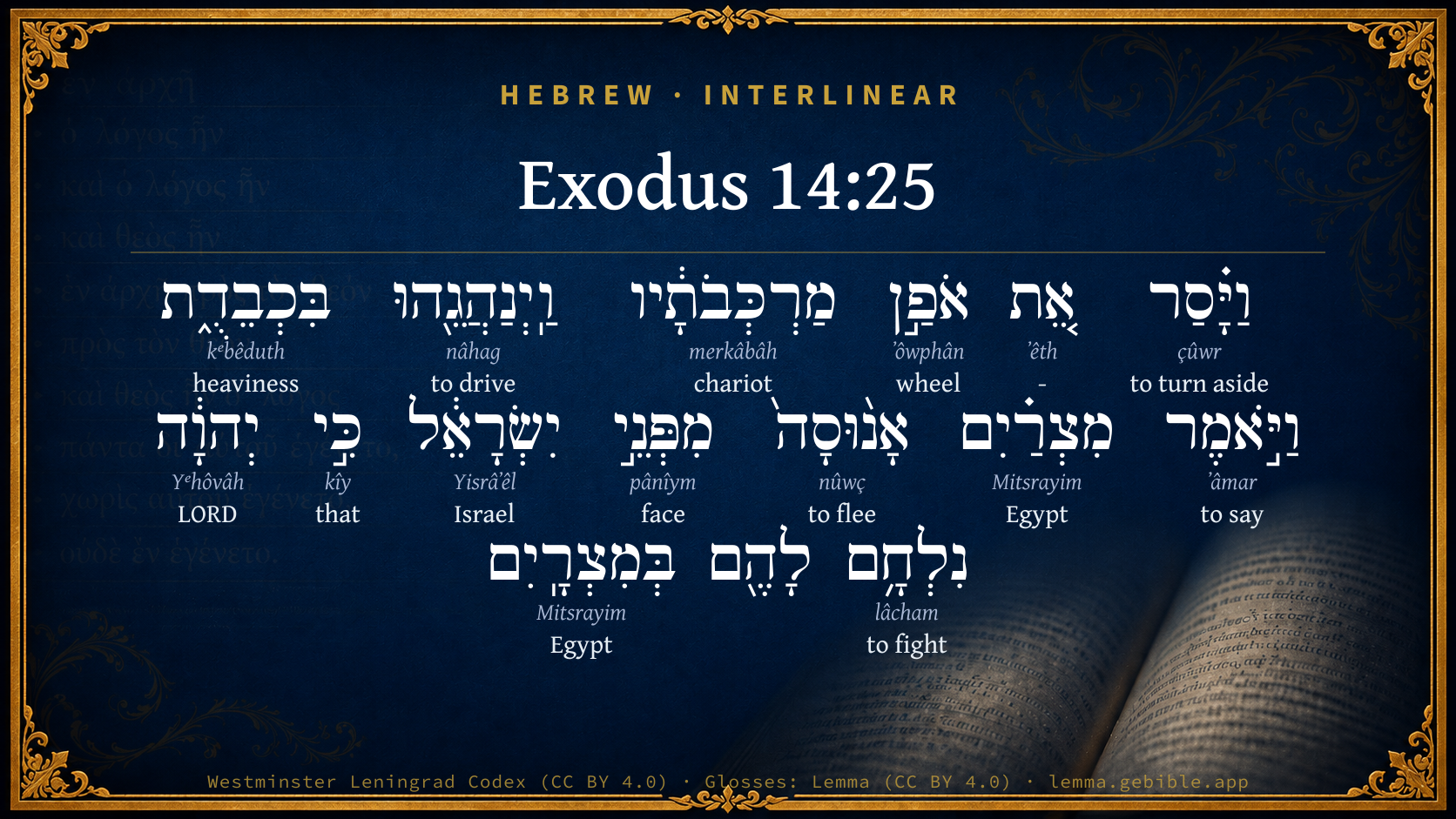
Hebrew (Westminster Leningrad Codex) Exodus 14:25 appears in the Hebrew Old Testament. The text above is from the Westminster Leningrad Codex. Each word links to its Strong’s number, a concise gloss, and parsing drawn from the Open Scriptures Hebrew Bible morphology. Click any word for its full Brown-Driver-Briggs (BDB) entry.
Download image
Cite this verse

Exodus 14:25 (World English Bible). Public Domain. Lemma interlinear Bible study tool, https://lemma.gebible.app/v/exodus/14/25.

Show BibTeX & RIS
BibTeX
RIS
English Translation
He took off their chariot wheels, and they drove them heavily; so that the Egyptians said, "Let's flee from the face of Israel, for Yahweh fights for them against the Egyptians!"
World English Bible · Public Domain
Highlights
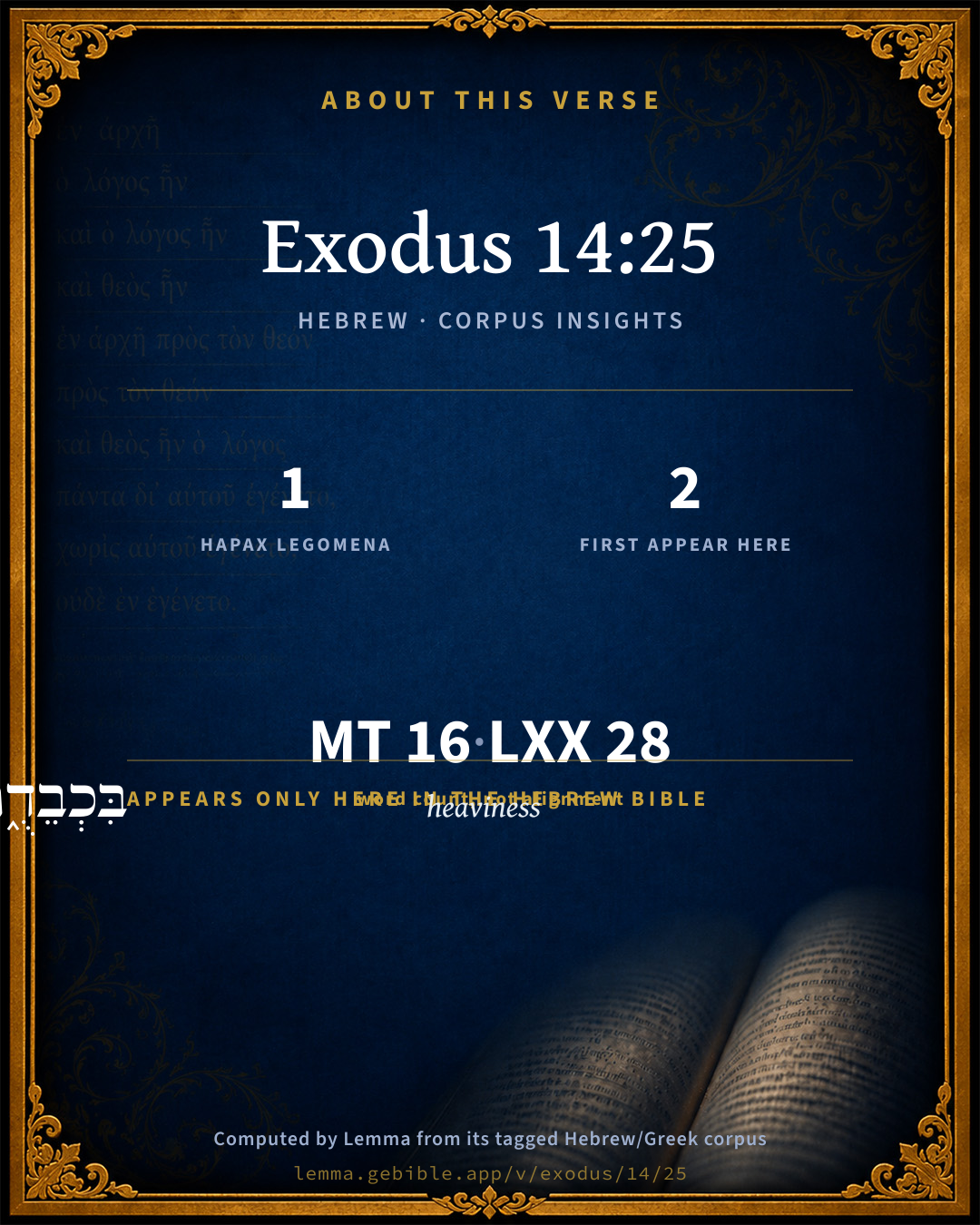
  • 1 hapax legomenon — only here in the Hebrew Bible
  • 2 first appearances in the Hebrew Bible
Full analysis ↓
Download a study sheet

One document with this verse’s original text, its word-by-word gloss line, the meaning frame, cross-references with their text, attributed commentary, and full source and license credits — printable, and it pastes into notes with its structure intact.

This verse Autodidact and up

Study sheet (.html) Plain text (.txt)

A passage Seminary Student

Up to 50 verses in one chapter. A passage sheet keeps up to 6 commentary sources and 12 cross-references per verse, in the order this page ranks them, and says so on the sheet whenever that leaves anything out. Ask for a single verse and you get the Autodidact verse sheet above.

Everything on this page stays free to read, with no account — the sheet is a download of what is already on screen, not access to it.

Want to remove ads? Support Godless Engineer
Compare translations 3

The same verse in 3 English versions, stacked beneath the original-language interlinear above. Click any original word for its lexicon entry.

Each is an independent rendering of the whole verse — the interlinear is not word-aligned to these translations.

Highlighted words mark where these versions differ — a whole-verse word diff, not a word-by-word alignment.

  • World English Bible Public Domain
    He took off their chariot wheels, and they drove them heavily; so that the Egyptians said, "Let's flee from the face of Israel, for Yahweh fights for them against the Egyptians!"
  • King James Version Public Domain
    And took off their chariot wheels, that they drave them heavily: so that the Egyptians said, Let us flee from the face of Israel; for the LORD fighteth for them against the Egyptians.
  • unfoldingWord Literal Text CC BY-SA 4.0
    And he caused the wheels of their chariots to turn aside and caused them to drive heavily. And the Egyptians said, “Let us run from the face of Israel, for Yahweh is fighting for them against Egypt.”

unfoldingWord Literal Text — © unfoldingWord, licensed CC BY-SA 4.0. Word-aligned USFM3 via Door43 (git.door43.org/unfoldingWord/en_ult).

Versions to compare (up to 4)

3 of 4 selected

Show all 18 translations

Every available English version of this verse, each an independent rendering of the whole verse.

  • World English Bible Public Domain
    He took off their chariot wheels, and they drove them heavily; so that the Egyptians said, "Let's flee from the face of Israel, for Yahweh fights for them against the Egyptians!"
  • Berean Standard Bible Public Domain
    He caused their chariot wheels to wobble, so that they had difficulty driving. “Let us flee from the Israelites,” said the Egyptians, “for the LORD is fighting for them against Egypt!”
  • Majority Standard Bible Public Domain
    He caused their chariot wheels to wobble, so that they had difficulty driving. “Let us flee from the Israelites,” said the Egyptians, “for the LORD is fighting for them against Egypt!”
  • King James Version Public Domain
    And took off their chariot wheels, that they drave them heavily: so that the Egyptians said, Let us flee from the face of Israel; for the LORD fighteth for them against the Egyptians.
  • American Standard Version (1901) Public Domain
    And he took off their chariot wheels, and they drove them heavily; so that the Egyptians said, Let us flee from the face of Israel; for Jehovah fighteth for them against the Egyptians.
  • Revised Version (1885) Public Domain
    And he took off their chariot wheels, that they drave them heavily: so that the Egyptians said, Let us flee from the face of Israel; for the LORD fighteth for them against the Egyptians.
  • Geneva Bible (1599) Public Domain
    For he tooke off their charet wheeles, and they draue them with much a doe: so that the Egyptians euery one sayd, I wil flee from the face of Israel: for the Lord fighteth for them against the Egyptians.
  • Douay-Rheims (1899) Public Domain
    And overthrew the wheels of the chariots, and they were carried into the deep. And the Egyptians said: Let us flee from Israel: for the Lord fighteth for them against us.
  • Young's Literal Translation Public Domain
    and turneth aside the wheels of their chariots, and they lead them with difficulty, and the Egyptians say, `Let us flee from the face of Israel, for Jehovah is fighting for them against the Egyptians.'
  • Literal Standard Version CC BY-SA 4.0
    and turns aside the wheels of their chariots, and they lead them with difficulty, and the Egyptians say, “Let us flee from the face of Israel, for YHWH is fighting for them against the Egyptians.”
  • Unlocked Literal Bible CC BY-SA 4.0
    Their chariot wheels were clogged, and the horsemen drove with difficulty. So the Egyptians said, “Let us flee from Israel, for Yahweh is fighting for them against us.”
  • unfoldingWord Literal Text CC BY-SA 4.0
    And he caused the wheels of their chariots to turn aside and caused them to drive heavily. And the Egyptians said, “Let us run from the face of Israel, for Yahweh is fighting for them against Egypt.”
  • Darby Bible Public Domain
    And he took off their chariot wheels, and caused them to drive with difficulty; and the Egyptians said, Let us flee before Israel, for Jehovah is fighting for them against the Egyptians!
  • World Messianic Bible Public Domain
    He took off their chariot wheels, and they drove them heavily; so that the Egyptians said, “Let’s flee from the face of Israel, for the LORD fights for them against the Egyptians!”
  • Webster's Bible Public Domain
    And took off their chariot-wheels, and made them to move heavily, so that the Egyptians said, Let us flee from the face of Israel; for the LORD fighteth for them against the Egyptians.
  • Free Bible Version CC BY-SA 4.0
    He made their chariot wheels get stuck so it was hard for them to drive. The Egyptians shouted out, “Retreat! We must run from the Israelites because the Lord is fighting for them against us!”
  • Bible in Basic English Public Domain
    And made the wheels of their war-carriages stiff, so that they had hard work driving them: so the Egyptians said, Let us go in flight from before the face of Israel, for the Lord is fighting for them against the Egyptians.
  • JPS Tanakh (1917) Public Domain
    And He took off their chariot wheels, and made them to drive heavily; so that the Egyptians said: 'Let us flee from the face of Israel; for the LORD fighteth for them against the Egyptians.'

Literal Standard Version (2020), Covenant Press — licensed CC BY-SA 4.0. Text via the HelloAO Bible API (eBible.org). Unlocked Literal Bible (unfoldingWord) — licensed CC BY-SA 4.0. Text via the HelloAO Bible API (eBible.org). unfoldingWord Literal Text — © unfoldingWord, licensed CC BY-SA 4.0. Word-aligned USFM3 via Door43 (git.door43.org/unfoldingWord/en_ult). Free Bible Version, Dr. Jonathan Gallagher — licensed CC BY-SA 4.0. Text via the HelloAO Bible API (eBible.org).

Word by word

More ways to search: Search by grammar → Find every occurrence → Compare this word →

Practice this passage: Drill this verse → Learn its vocabulary →

בִּכְבֵדֻ֑ת
kᵉbêduth
H3517
“in/at · heaviness”
Preposition + Noun, Common, Feminine, Singular, Absolute
Part of Speech
Preposition + Noun
Type
Common
Gender
Feminine
Number
Singular
State
Absolute
Full BDB Definition

Origin: from H3515

TWOT: 943g

heaviness, difficulty
  1. וַיָּ֗סַר çûwr H5493 “and · to turn aside” Conjunction + Verb, Hiphil, Sequential Imperfect, 3rd Person, Masculine, Singular
  2. אֵ֚ת ʼêth H853 “-” Particle, Direct Object
  3. אֹפַ֣ן ʼôwphân H212 “wheel of” Noun, Common, Masculine, Singular, Construct
  4. מַרְכְּבֹתָ֔יו merkâbâh H4818 “chariots · his” Noun, Common, Feminine, Plural, Construct + Suffix, Personal, 3rd Person, Masculine, Singular
  5. וַֽיְנַהֲגֵ֖הוּ nâhag H5090 “and · to drive · him” Conjunction + Verb, Piel, Sequential Imperfect, 3rd Person, Masculine, Singular + Suffix, Personal, 3rd Person, Masculine, Singular
  6. וַיֹּ֣אמֶר ʼâmar H559 “and · to say” Conjunction + Verb, Qal, Sequential Imperfect, 3rd Person, Masculine, Singular
  7. מִצְרַ֗יִם Mitsrayim H4714 “Egypt” Noun, Proper
  8. אָנ֨וּסָה֙ nûwç H5127 “to flee” Verb, Qal, Cohortative, 1st Person, Common, Singular
  9. מִפְּנֵ֣י pânîym H6440 “from · face(s) of” Preposition + Noun, Common, Both, Plural, Construct
  10. יִשְׂרָאֵ֔ל Yisrâʼêl H3478 “Israel” Noun, Proper
  11. כִּ֣י kîy H3588 “that” Conjunction
  12. יְהוָ֔ה Yᵉhôvâh H3068 “LORD” Noun, Proper
  13. נִלְחָ֥ם lâcham H3898 “fighting” Verb, Niphal, Participle Active, Masculine, Singular, Absolute
  14. בְּמִצְרָֽיִם Mitsrayim H4714 “in/at · Egypt” Preposition + Noun, Proper

About this verse

These counts appear in no published source. They are computed here, from the morphology-tagged text and Lemma’s own curated glosses. What Lemma adds →

16
words
14
distinct lemmas
Pentateuch
section

Notable vocabulary

1 hapax legomenon — a word that appears only here in the entire Hebrew Bible:

  • בִּכְבֵדֻ֑ת heaviness H3517

First appearance in Scripture

These words make their first canonical appearance in the Hebrew Bible here:

  • אֹפַ֣ן wheel H212
  • בִּכְבֵדֻ֑ת heaviness H3517

Shared distinctive vocabulary

וַֽיְנַהֲגֵ֖הוּ to drive H5090 occurs in 31 verses of the Hebrew Bible. Also found in:

Grammatical profile

  • 5 verbs
  • 8 nouns
  • 1 preposition
  • 1 conjunction
  • 1 particle

Verb forms

  • וַיָּ֗סַר Hiphil · Sequential Imperfect
  • וַֽיְנַהֲגֵ֖הוּ Piel · Sequential Imperfect
  • וַיֹּ֣אמֶר Qal · Sequential Imperfect
  • אָנ֨וּסָה֙ Qal · Cohortative
  • נִלְחָ֥ם Niphal · Participle Active

Repetition

A word recurs within this verse — often emphatic in Hebrew:

  • מִצְרַ֗יִם Egypt H4714 ×2

Hebrew & Septuagint length

In English translation the verse runs 31 words from the Hebrew and 35 from the Septuagint (LXX English) — closely comparable.

A rough comparison of the two English renderings, which tokenize alike — not a word-level alignment.

Word counts can differ between the Hebrew and the Greek without any difference in meaning — e.g. the Hebrew direct-object marker אֵת has no separate Greek word, and Greek often adds the article ὁ.

In the original languages it is 16 Hebrew tokens and 28 Greek tokens — but the two are counted differently (Hebrew bundles its prefixes and suffixes into one token; the Greek is in lemma form), so that isn’t a like-for-like length.

Cross-references

14

Topical passages linked to Exodus 14:25 in the Treasury of Scripture Knowledge — connected by theme and wording, ordered by reader-vote popularity; previews shown in the World English Bible.

  • Exodus 14:14 Yahweh will fight for you, and you shall be still."
  • Deuteronomy 3:22 You shall not fear them; for Yahweh your God, he it is who fights for you.
  • 1 Samuel 4:7–8 The Philistines were afraid, for they said, God is come into the camp. They said, Woe to us! for there has not been such a thing heretofore.
  • Job 20:24 He shall flee from the iron weapon. The bronze arrow shall strike him through.
  • Jeremiah 51:21 and with you will I break in pieces the horse and his rider;
  • Amos 5:19 As if a man fled from a lion, And a bear met him; Or he went into the house and leaned his hand on the wall, And a snake bit him.
  • Amos 9:1 I saw the Lord standing beside the altar, and he said, "Strike the tops of the pillars, that the thresholds may shake; and break them in pieces on the head of all of them; and I will kill the last of them with the sword: there shall not one of them flee away, and there shall not one of them escape.
  • Job 11:20 But the eyes of the wicked shall fail, They shall have no way to flee; Their hope shall be the giving up of the spirit."
  • Job 27:22 For it hurls at him, and does not spare, As he flees away from his hand.
  • Psalms 46:9 He makes wars cease to the end of the earth. He breaks the bow, and shatters the spear. He burns the chariots in the fire.
  • Psalms 68:12 "Kings of armies flee! They flee!" She who waits at home divides the spoil,
  • Psalms 76:6 At your rebuke, God of Jacob, Both chariot and horse are cast into a deep sleep.
  • Judges 4:15 Yahweh confused Sisera, and all his chariots, and all his host, with the edge of the sword before Barak; and Sisera alighted from his chariot, and fled away on his feet.
  • Amos 1:14 But I will kindle a fire in the wall of Rabbah, And it will devour its palaces, With shouting in the day of battle, With a tempest in the day of the whirlwind;

Cross-references courtesy of OpenBible.info (CC BY 4.0).

Hebrew and Greek witnesses Masoretic Hebrew ↔ Greek Septuagint

The same verse in the two great witnesses to the Old Testament, shown verse-for-verse.

These are two independent witnesses, not word-aligned to each other, and the Septuagint is shown in lemma (dictionary) form.

Hebrew Exodus 14:25 Masoretic · Westminster Leningrad Codex

וַיָּ֗סַר אֵ֚ת אֹפַ֣ן מַרְכְּבֹתָ֔יו וַֽיְנַהֲגֵ֖הוּ בִּכְבֵדֻ֑ת וַיֹּ֣אמֶר מִצְרַ֗יִם אָנ֨וּסָה֙ מִפְּנֵ֣י יִשְׂרָאֵ֔ל כִּ֣י יְהוָ֔ה נִלְחָ֥ם לָהֶ֖ם בְּמִצְרָֽיִם

He took off their chariot wheels, and they drove them heavily; so that the Egyptians said, "Let's flee from the face of Israel, for Yahweh fights for them against the Egyptians!"

World English Bible · Public Domain

Greek LXX Exodus 14:25 Septuagint · lemma form

καί συνδέω ὁ ἄξων ὁ ἅρμα αὐτός καί ἄγω αὐτός μετά βία καί εἶπον ὁ αἰγύπτιος φεύγω ἀπό πρόσωπον ἰσραήλ ὁ γάρ κύριος πολεμέω περί αὐτός ὁ αἰγύπτιος

and bound the axle-trees of their chariots, and caused them to go with difficulty; and the Egyptians said, Let us flee from the face of Israel, for the Lord fights for them against the Egyptians.

LXX2012 (modern English Septuagint) · Public Domain

On this verse, The Cambridge Bible for Schools and Colleges discusses the Septuagint’s reading. Read the note in Commentary ↓

Hebrew: Westminster Leningrad Codex (CC BY 4.0). Greek: Septuagint (public domain); English from LXX2012 (modern English Septuagint) (Public Domain). How the Septuagint differs from the Hebrew →

Targum (Aramaic paraphrase)

2

The Targum is the ancient Jewish Aramaic paraphrase of the Hebrew Scriptures — an interpretive translation, not the Hebrew text itself. Onkelos (literal) and Pseudo-Jonathan (expansive) render the Torah, and Jonathan the Prophets. Coverage is partial: where no permissively-licensed English translation exists for a verse, only the Aramaic is shown. This is verse-level text, not a word-by-word alignment to the Hebrew.

  1. Targum Onkelos Torah (Genesis–Deuteronomy)
    וְאַעְדִי יָת גַלְגַלֵי רְתִכּוֹהִי וּמְדַבְּרִין לְהוֹן בִּתְקוֹף וַאֲמַר מִצְרָאֵי נֵעִירוֹק מִן קֳדָם יִשְׂרָאֵל אֲרֵי דָא הִיא גְבֻרְתָּא דַיְיָ דַעֲבֵד לְהוֹן קְרָבִין בְּמִצְרָיִם:

    (no public-domain English translation for this verse)

    Targum Onkelos — Aramaic: “Onkelos Genesis” (public domain); “Onkelos Exodus” (public domain); “Onkelos Leviticus” (public domain); “Onkelos Numbers” (public domain); “Onkelos Deuteronomy” (public domain). English: “Sefaria Community Translation” (CC0 1.0 (public-domain dedication)); “J.W. Etheridge. The Targums of Onkelos and Jonathan Ben Uzziel on the Pentateuch. London: Longmans, Green, 1862” (public domain). Text via Sefaria.

  2. Targum Pseudo-Jonathan Torah (Genesis–Deuteronomy)
    וּנְסַר יַת גַּלְגַּלֵי רִידְוָותֵיהּ דְּפַרְעה וַהֲווֹ מְדַבְּרִין יַתְהוֹן בְּקַשְׁיוּ וַהֲווֹן מְהַלְכִין וְשַׁרְיָין מִן בַּתְרֵיהוֹן וַאֲמָרוּ מִצְרָאֵי אִלֵּין לְאִלֵּין נְעִירוֹק מִן עַמָּא בֵּית יִשְרָאֵל אֲרוּם מֵימְרָא דַיְיָ הוּא דִמְגִיחַ לְהוֹן קְרָבִין בְּמִצְרָאֵי

    and He brake (or, made rough) the wheels of Pharoh's carriages, so that they drave them with hardship, and that they went on and left them behind. And the Mizraee said one to another, Let us flee from the people of the house of Israel; for this is the Word of the Lord who fought for them in Mizraim.

    Targum Pseudo-Jonathan — Aramaic: “Targum Jonathan on Genesis” (public domain); “Targum Jonathan on Exodus” (public domain); “Targum Jonathan on Leviticus” (public domain); “Targum Jonathan on Numbers” (public domain); “Targum Jonathan on Deuteronomy” (public domain). English: “The Targum of Jonathan ben Uzziel, trans. J. W. Etheridge, London, 1862” (public domain). Text via Sefaria.

Commentary

Notes on Exodus 14:25 from classic Christian and Jewish commentators (each source and its license shown beneath its notes). The classic Christian expositions comment on the surrounding passage and are grouped to its opening verse, so a note may address several verses; the Jewish commentaries on the Tanakh (Rashi and others) are per-verse, so they appear only where the commentator wrote on this verse.

Lemma curates 59 commentaries, every one of them public domain or Creative Commons licensed, each selected and text-cleaned for this edition rather than reprinted as found. About our sources →

Joseph Benson's Commentary

Exo 14:25. They drave heavily — They had driven furiously, but they now found themselves embarrassed at every step; the way grew deep, their hearts grew sad, their wheels dropped off, and the axle-trees failed. They had been flying upon the back of Israel as the hawk on the dove; but now they cried, Let us flee from the face of Israel.

Joseph Benson's Commentary on the Old and New Testaments (1811–1818) — public domain. Text from a community e-Sword module.

Tyndale Open Study Notes

Tyndale Open Resources

14:25 He twisted their chariot wheels: The ancient versions differ on the translation of this phrase. Perhaps there was deep sand where the water had been, and this broke the light wheels of the chariots. At any rate, the Egyptian charge through the sea failed, and they became terrified. • The Lord is fighting for them: Certainly by this time everyone in Egypt was aware of the special relationship between the Lord and his people.

Tyndale Open Study Notes — © Tyndale Open Resources, licensed CC BY-SA 4.0. Text via the HelloAO Bible API.

Geneva Bible (1599)

Geneva Bible translators

Or, heavily.

Geneva Bible (1599) marginal notes — public domain. Text via Bolls.life.

The Cambridge Bible for Schools and Colleges

gen. ed. J. J. S. Perowne

25. removed. The marg. bound (Sam. LXX. Pesh.; ויאסר for ויסר), i.e. clogged,—presumably by their sinking in the wet sand,—is probably to be preferred (so Di. Bä.).

and made them to drive (them) heavily. The marg. is preferable, for grammatical reasons.

and Egypt said, Let me flee. The same idiomatic and forcible singular as in v. 10. So frequently, as Num_20:18-19, Deu_2:27-29, Jos_17:14 f., 17 f., besides often in the prophets (cf. LOT. p. 390).

fighteth] as v. 14.

The Cambridge Bible for Schools and Colleges (gen. ed. J. J. S. Perowne; Cambridge University Press, 1878–1918) — public domain. Text from a community e-Sword module.

John Gill's Exposition

And took off their chariot wheels,.... The Targum of Jonathan renders it "cut" or "sawed them off"; perhaps they might be broken off by the hailstones. Milton (s) seems to have a notion of Pharaoh's chariot wheels being broken, when he says, "and craze" (i.e. break) "their chariot wheels"; or, as Jarchi suggests, he burnt them, through the force of the fire or lightning:

that they drave them heavily; the wheels being off, the chariots must be dragged along by the horses by mere force, which must be heavy work; or, "and made them to go, or led them heavily", or "with heaviness" (t); and so to be ascribed to the Lord, who looked at the Egyptians, took off the wheels of their chariots, and stopped them in the fury of their career, that they could not pursue with the swiftness they had:

so that the Egyptians said, let us flee from the face of Israel; for by this battery and flashes of fire on them, they concluded that Israel, who they thought were fleeing before them, had turned and were facing them, and the Lord at the head of them; and therefore it was high time for them to flee, as follows:

for the Lord fighteth for them against the Egyptians; for they rightly took the thunder and lightning, the fire and hailstones, to be the artillery of heaven turned against them, and in favour of the Israelites. Jarchi interprets it, the Lord fights for them in Egypt, even in Egypt itself; but so he had done many a time before, of which they were not insensible.

(s) Paradise Lost, B. 12. ver. 210. (t) "et deduxit eos graviter", Vatablus; "et duxit eos cum gravitate", Drusius; so Ainsworth.

John Gill's Exposition of the Whole Bible (1746–1763) — public domain (CC PDM 1.0). Text via the HelloAO Bible API.

Haydock's Catholic Bible Commentary

Lord. thus they reluctantly confess his might, and are forced to glory Him in their destruction. Their change is only the effect of fear and temporal danger, ver. 18. (Haydock)

George Leo Haydock (1774–1849), Haydock's Catholic Family Bible and Commentary, 1859 edition — public domain. Excludes Psalms (Douay-Rheims chapter numbering differs from Protestant) and Deuterocanonical books (Catholic canon only).

Matthew Poole's English Annotations

Took off their chariot wheels; either burning them with lightning, or tearing them in pieces with thunder-bolts, or loosening them, and making them to fall off.

That they drave them heavily; Heb. and he made him, or them, the singular number for the plural, i.e. the Egyptians, or their chariots, to go heavily, hardly and slowly, either for want of wheels, or for breaches in them, or because the rain had softened the bottom of the sea, or because the lightnings and thunders affrighted and dispirited their horses.

For the Lord fighteth for them. Prodigious stupidity! They did not understand and consider this, though it was notorious, to them especially, by many great and fresh instances, till it was too late to prevent it; therein being a type of most sinners, who will not be convinced, nor repent, till they be past all benefit by it.

Matthew Poole's English Annotations on the Holy Bible (1683–1685) — public domain. Text from a community e-Sword/MySword module.

Whedon's Commentary on the Bible

Daniel D. Whedon

25. Took off their chariot wheels — Their chariots were entangled with each other, bemired, broken, and overturned in the awful confusion that ensued from the pouring rains, blinding lightnings, and appalling thunders. Yet this was but a premonition of what awaited them when the sea returned to his strength.

Daniel D. Whedon (gen. ed.), Commentary on the Old and New Testaments (1874–1909) — public domain. Text from a community e-Sword module.

The Pulpit Commentary

And took off their chariot wheels. The Sept. has clogged the axles of their chariots; " but this is from a reading not at present found in the Hebrew MSS. Most modern commentators, however, prefer the reading, which gives a good sense; whereas the existing text is unintelligible. As Kalisch observes, if the wheels of the chariots had been broken off, the chariots would not have moved at all. " That they drove them heavily. The marginal rendering, and made them go heavily," is preferable. The wheels no doubt sank into the sand up to the axles, and were with difficulty extricated, again to sink a few yards further on.

Progress was thus greatly retarded. So that the Egyptians said, Let us flee. " Literally, And Egypt said, "I will flee. The Lord fighteth for them. Compare the promise of Moses (ver. 14). The Egyptians were convinced, by the various obstacles which they encountered, that Jehovah was lending his people active aid, and miraculously obstructing their advance. If this were so, it was of no use to persevere, and accordingly they began their retreat.

The Pulpit Commentary (1880–1919), ed. H.D.M. Spence-Jones & Joseph S. Exell — public domain. Text from a community e-Sword module.

John Wesley's Explanatory Notes

They had driven furiously, but now they drove heavily, and found themselves embarrassed at every step; the way grew deep, their hearts grew sad, their wheels dropt off, and the axle-trees failed. They had been flying upon the back of Israel as the hawk upon the dove; but now they cried, Let us flee from the face of Israel.

John Wesley, Explanatory Notes Upon the Whole Bible (1754–1765) — public domain. Text via the GEBible commentary corpus.

Keil & Delitzsch

C. F. Keil & F. Delitzsch

"And (Jehovah) made the wheels of his (the Egyptian's) chariots give way, and made, that he (the Egyptian) drove in difficulty." נהג ".ytlucif to drive a chariot (Sa2 6:3, cf. Kg2 9:20).

Keil & Delitzsch — Biblical Commentary on the Old Testament (1861–1891) — public domain (CC PDM 1.0). Text via the HelloAO Bible API. (Old Testament only.)

Rashi

Rabbi Shlomo Yitzchaki (Rashi)

‎ויסר את אפן מרכבותיו AND HE REMOVED THEIR CHARIOT WHEELS — Through the power of the fire of the pillar of fire the wheels were burnt and the chariots were thus dragged along and those who were sitting in them were thrown about and their limbs were all put out of joint (cf. Mekhilta).

וינהגהו בכבדות signifies: And He treated them with a treatment that was hard and harsh to them. In the measure that they (the Egyptians) had meted out to the Israelites was it meted out to them, for (9:34) “He hardened his heart, he and his servants”, and therefore here: “He treated them (the Egyptians) in a hard manner” (cf. Mekhilta).

נלחם להם במצרים FIGHTETH FOR THEM במצריים — means against the Egyptians. Another explanation of במצרים is: in the land of Egypt, for just as these were smitten at the Sea so, too, were smitten those who remained in Egypt (cf. Mekhilta).

Rashi on the Tanakh — English translations: “The Judaica Press complete Tanach with Rashi, translated by A. J. Rosenberg” (CC BY 4.0); “Pentateuch with Rashi's commentary by M. Rosenbaum and A.M. Silbermann, 1929-1934” (public domain); “The Metsudah Tanach series, Lakewood, N.J” (CC BY 4.0); and “The Book of Joshua, Metsudah Publications, 1997” (CC BY 4.0). Text via Sefaria.

Lesson kit

Teaching starters — assembled from the data on this page, not authored interpretation. Every prompt links to the verse data it draws on. Edit before teaching.

Exodus, in the Pentateuch, opens this verse with 16 words (14 distinct Hebrew lemmas). Its most distinctive word is kᵉbêduth (“heaviness”). A historical commentator’s framing appears above. Read the whole chapter for the surrounding context.

Discussion questions

  1. How does “heaviness” (kᵉbêduth) shape what this verse is saying?
  2. This verse holds 1 word here found nowhere else in the Hebrew Bible. What might the rare word draw attention to?
  3. 2 words here appear for the first time in Scripture. What is being introduced at this debut?
  4. Genesis 31:18 shares the word «to drive» with this verse. How do the two illuminate each other?
  5. “Egypt” occurs 2× in this one verse. What is the effect of the repetition?
  6. These translations render this verse differently; the difference is in the English rendering, not the original. What questions does that raise?
  7. The verb «וַיָּ֗סַר» is Hiphil Sequential Imperfect. How does its form color the action?
  8. Reading how Joseph Benson's Commentary and Tyndale Open Study Notes read this verse, where do the two commentators agree and where do they part?

Things to notice

  • 1 word in this verse appears nowhere else in the Hebrew Bible.
  • 2 words make their first canonical appearance in Scripture here.
  • This verse counts 16 Hebrew ↔ 28 Greek words.
  • These translations choose different wording for 21 words in this verse.
  • “Egypt” occurs 2× in this single verse.

Reading settings

Reading text

Shown beneath each verse's original-language words.

Old Testament
Old Testament edition

Read the OT as the Masoretic Hebrew (MT) or the Greek Septuagint (LXX).

English shown for the Greek Septuagint (in the Hebrew ↔ Greek comparison).

Comparing translations? Open the Compare panel on any verse page to stack up to four side by side.