
1 Samuel 17:26

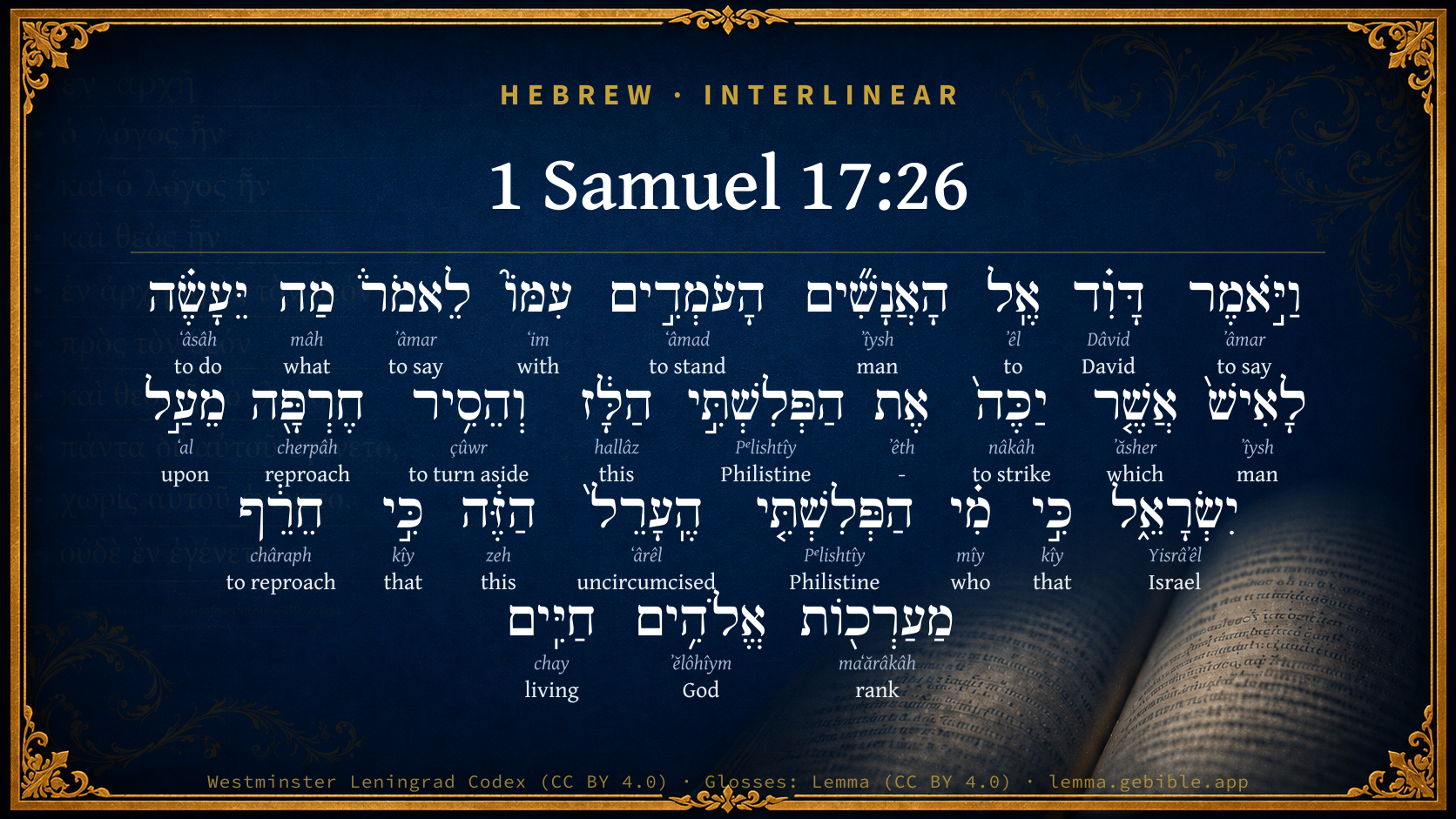
Hebrew (Westminster Leningrad Codex) 1 Samuel 17:26 appears in the Hebrew Old Testament. The text above is from the Westminster Leningrad Codex. Each word links to its Strong’s number, a concise gloss, and parsing drawn from the Open Scriptures Hebrew Bible morphology. Click any word for its full Brown-Driver-Briggs (BDB) entry.
Download image
Cite this verse

1 Samuel 17:26 (World English Bible). Public Domain. Lemma interlinear Bible study tool, https://lemma.gebible.app/v/1-samuel/17/26.

Show BibTeX & RIS
BibTeX
RIS
English Translation
David spoke to the men who stood by him, saying, What shall be done to the man who kills this Philistine, and takes away the reproach from Israel? for who is this uncircumcised Philistine, that he should defy the armies of the living God?
World English Bible · Public Domain
Download a study sheet

One document with this verse’s original text, its word-by-word gloss line, the meaning frame, cross-references with their text, attributed commentary, and full source and license credits — printable, and it pastes into notes with its structure intact.

This verse Autodidact and up

Study sheet (.html) Plain text (.txt)

A passage Seminary Student

Up to 50 verses in one chapter. A passage sheet keeps up to 6 commentary sources and 12 cross-references per verse, in the order this page ranks them, and says so on the sheet whenever that leaves anything out. Ask for a single verse and you get the Autodidact verse sheet above.

Everything on this page stays free to read, with no account — the sheet is a download of what is already on screen, not access to it.

Want to remove ads? Support Godless Engineer
Compare translations 3

The same verse in 3 English versions, stacked beneath the original-language interlinear above. Click any original word for its lexicon entry.

Each is an independent rendering of the whole verse — the interlinear is not word-aligned to these translations.

Highlighted words mark where these versions differ — a whole-verse word diff, not a word-by-word alignment.

  • World English Bible Public Domain
    David spoke to the men who stood by him, saying, What shall be done to the man who kills this Philistine, and takes away the reproach from Israel? for who is this uncircumcised Philistine, that he should defy the armies of the living God?
  • King James Version Public Domain
    And David spake to the men that stood by him, saying, What shall be done to the man that killeth this Philistine, and taketh away the reproach from Israel? for who is this uncircumcised Philistine, that he should defy the armies of the living God?
  • unfoldingWord Literal Text CC BY-SA 4.0
    And David spoke to the men standing with him, saying, “What will be done for the man who strikes this Philistine and turns away the disgrace from upon Israel? For who this uncircumcised Philistine, that he should taunt the arrays of the living God?”

unfoldingWord Literal Text — © unfoldingWord, licensed CC BY-SA 4.0. Word-aligned USFM3 via Door43 (git.door43.org/unfoldingWord/en_ult).

Versions to compare (up to 4)

3 of 4 selected

Show all 18 translations

Every available English version of this verse, each an independent rendering of the whole verse.

  • World English Bible Public Domain
    David spoke to the men who stood by him, saying, What shall be done to the man who kills this Philistine, and takes away the reproach from Israel? for who is this uncircumcised Philistine, that he should defy the armies of the living God?
  • Berean Standard Bible Public Domain
    David asked the men who were standing with him, “What will be done for the man who kills this Philistine and removes this disgrace from Israel? Just who is this uncircumcised Philistine, that he should defy the armies of the living God?”
  • Majority Standard Bible Public Domain
    David asked the men who were standing with him, “What will be done for the man who kills this Philistine and removes this disgrace from Israel? Just who is this uncircumcised Philistine, that he should defy the armies of the living God?”
  • King James Version Public Domain
    And David spake to the men that stood by him, saying, What shall be done to the man that killeth this Philistine, and taketh away the reproach from Israel? for who is this uncircumcised Philistine, that he should defy the armies of the living God?
  • American Standard Version (1901) Public Domain
    And David spake to the men that stood by him, saying, What shall be done to the man that killeth this Philistine, and taketh away the reproach from Israel? for who is this uncircumcised Philistine, that he should defy the armies of the living God?
  • Revised Version (1885) Public Domain
    And David spake to the men that stood by him, saying, What shall be done to the man that killeth this Philistine, and taketh away the reproach from Israel? for who is this uncircumcised Philistine, that he should defy the armies of the living God?
  • Geneva Bible (1599) Public Domain
    Then Dauid spake to the men that stoode with him, and sayde, What shall be done to the man that killeth this Philistim, and taketh away the shame from Israel? for who is this vncircumcised Philistim, that he shoulde reuile the hoste of the liuing God?
  • Douay-Rheims (1899) Public Domain
    And David spoke to the men that stood by him, saying: What shall be given to the man that shall kill this Philistine, and shall take away the reproach from Israel? for who is this uncircumcised Philistine, that he should defy the armies of the living God?
  • Young's Literal Translation Public Domain
    And David speaketh unto the men who are standing by him, saying, `What is done to the man who smiteth this Philistine, and hath turned aside reproach from Israel? for who `is' this uncircumcised Philistine that he hath reproached the ranks of the living God?'
  • Literal Standard Version CC BY-SA 4.0
    And David speaks to the men who are standing by him, saying, “What is done to the man who strikes this Philistine, and has turned aside reproach from Israel? For who [is] this uncircumcised Philistine that he has reproached the ranks of the living God?”
  • Unlocked Literal Bible CC BY-SA 4.0
    David said to the men who stood by him, “What will be done for the man who kills this Philistine and takes away the disgrace from Israel? Who is this uncircumcised Philistine that he should defy the armies of the living God?”
  • unfoldingWord Literal Text CC BY-SA 4.0
    And David spoke to the men standing with him, saying, “What will be done for the man who strikes this Philistine and turns away the disgrace from upon Israel? For who this uncircumcised Philistine, that he should taunt the arrays of the living God?”
  • Darby Bible Public Domain
    And David spoke to the men that stood by him, saying, What shall be done to the man that smites this Philistine, and takes away the reproach from Israel? for who is this uncircumcised Philistine, that he should defy the armies of the living God?
  • World Messianic Bible Public Domain
    David spoke to the men who stood by him, saying, “What shall be done to the man who kills this Philistine and takes away the reproach from Israel? For who is this uncircumcised Philistine, that he should defy the armies of the living God?”
  • Webster's Bible Public Domain
    And David spoke to the men that stood by him, saying, What shall be done to the man that killeth this Philistine, and taketh away the reproach from Israel? for who is this uncircumcised Philistine, that he should defy the armies of the living God?
  • Free Bible Version CC BY-SA 4.0
    David asked the men who were standing beside him, “What will the man receive who kills this Philistine and removes this shame from Israel? Who does this heathen Philistine think he is, mocking the armies of the living God?”
  • Bible in Basic English Public Domain
    And David said to the men near him, What will be done to the man who overcomes this Philistine and takes away the shame from Israel? for who is this Philistine, a man without circumcision, that he has put shame on the armies of the living God?
  • JPS Tanakh (1917) Public Domain
    And David spoke to the men that stood by him, saying: 'What shall be done to the man that killeth this Philistine, and taketh away the taunt from Israel? for who is this uncircumcised Philistine, that he should have taunted the armies of the living God?'

Literal Standard Version (2020), Covenant Press — licensed CC BY-SA 4.0. Text via the HelloAO Bible API (eBible.org). Unlocked Literal Bible (unfoldingWord) — licensed CC BY-SA 4.0. Text via the HelloAO Bible API (eBible.org). unfoldingWord Literal Text — © unfoldingWord, licensed CC BY-SA 4.0. Word-aligned USFM3 via Door43 (git.door43.org/unfoldingWord/en_ult). Free Bible Version, Dr. Jonathan Gallagher — licensed CC BY-SA 4.0. Text via the HelloAO Bible API (eBible.org).

Word by word

More ways to search: Search by grammar → Find every occurrence → Compare this word →

Practice this passage: Drill this verse → Learn its vocabulary →

הַלָּ֔ז
hallâz
H1975
“this”
Pronoun, Demonstrative, Masculine, Singular
Part of Speech
Pronoun
Type
Demonstrative
Gender
Masculine
Number
Singular
Full BDB Definition

Origin: from H1976

TWOT: 497

this, this one (without subst), yonder
  1. וַיֹּ֣אמֶר ʼâmar H559 “and · to say” Conjunction + Verb, Qal, Sequential Imperfect, 3rd Person, Masculine, Singular
  2. דָּוִ֗ד Dâvid H1732 “David” Noun, Proper
  3. אֶֽל ʼêl H413 “to” Preposition
  4. הָאֲנָשִׁ֞ים ʼîysh H376 “the · men” Particle, Definite Article + Noun, Common, Masculine, Plural, Absolute
  5. הָעֹמְדִ֣ים ʻâmad H5975 “the · standing” Particle, Definite Article + Verb, Qal, Participle Active, Masculine, Plural, Absolute
  6. עִמּוֹ֮ ʻim H5973 “with · him” Preposition + Suffix, Personal, 3rd Person, Masculine, Singular
  7. לֵאמֹר֒ ʼâmar H559 “to say” Preposition + Verb, Qal, Infinitive Construct
  8. מַה mâh H4100 “what” Particle, Interrogative
  9. יֵּעָשֶׂ֗ה ʻâsâh H6213 “to do” Verb, Niphal, Imperfect, 3rd Person, Masculine, Singular
  10. לָאִישׁ֙ ʼîysh H376 “to/for the · man” Preposition, Determined + Noun, Common, Masculine, Singular, Absolute
  11. אֲשֶׁ֤ר ʼăsher H834 “which” Particle, Relative
  12. יַכֶּה֙ nâkâh H5221 “to strike” Verb, Hiphil, Imperfect, 3rd Person, Masculine, Singular
  13. אֶת ʼêth H853 “-” Particle, Direct Object
  14. הַפְּלִשְׁתִּ֣י Pᵉlishtîy H6430 “the · Philistine” Particle, Definite Article + Noun, Gentilic, Masculine, Singular, Absolute
  15. וְהֵסִ֥יר çûwr H5493 “and · to turn aside” Conjunction + Verb, Hiphil, Sequential Perfect, 3rd Person, Masculine, Singular
  16. חֶרְפָּ֖ה cherpâh H2781 “reproach” Noun, Common, Feminine, Singular, Absolute
  17. מֵעַ֣ל ʻal H5921 “from · upon” Preposition + Preposition
  18. יִשְׂרָאֵ֑ל Yisrâʼêl H3478 “Israel” Noun, Proper
  19. כִּ֣י kîy H3588 “that” Conjunction
  20. מִ֗י mîy H4310 “who” Particle, Interrogative
  21. הַפְּלִשְׁתִּ֤י Pᵉlishtîy H6430 “the · Philistine” Particle, Definite Article + Noun, Gentilic, Masculine, Singular, Absolute
  22. הֶֽעָרֵל֙ ʻârêl H6189 “the · uncircumcised” Particle, Definite Article + Adjective, Adjective, Masculine, Singular, Absolute
  23. הַזֶּ֔ה zeh H2088 “the · this” Particle, Definite Article + Pronoun, Demonstrative, Masculine, Singular
  24. כִּ֣י kîy H3588 “that” Conjunction
  25. חֵרֵ֔ף châraph H2778 “to reproach” Verb, Piel, Perfect, 3rd Person, Masculine, Singular
  26. מַעַרְכ֖וֹת maʻărâkâh H4634 “ranks of” Noun, Common, Feminine, Plural, Construct
  27. אֱלֹהִ֥ים ʼĕlôhîym H430 “God(s)” Noun, Common, Masculine, Plural, Absolute
  28. חַיִּֽים chay H2416 “living” Adjective, Adjective, Masculine, Plural, Absolute

About this verse

These counts appear in no published source. They are computed here, from the morphology-tagged text and Lemma’s own curated glosses. What Lemma adds →

29
words
25
distinct lemmas
Historical
section

Notable vocabulary

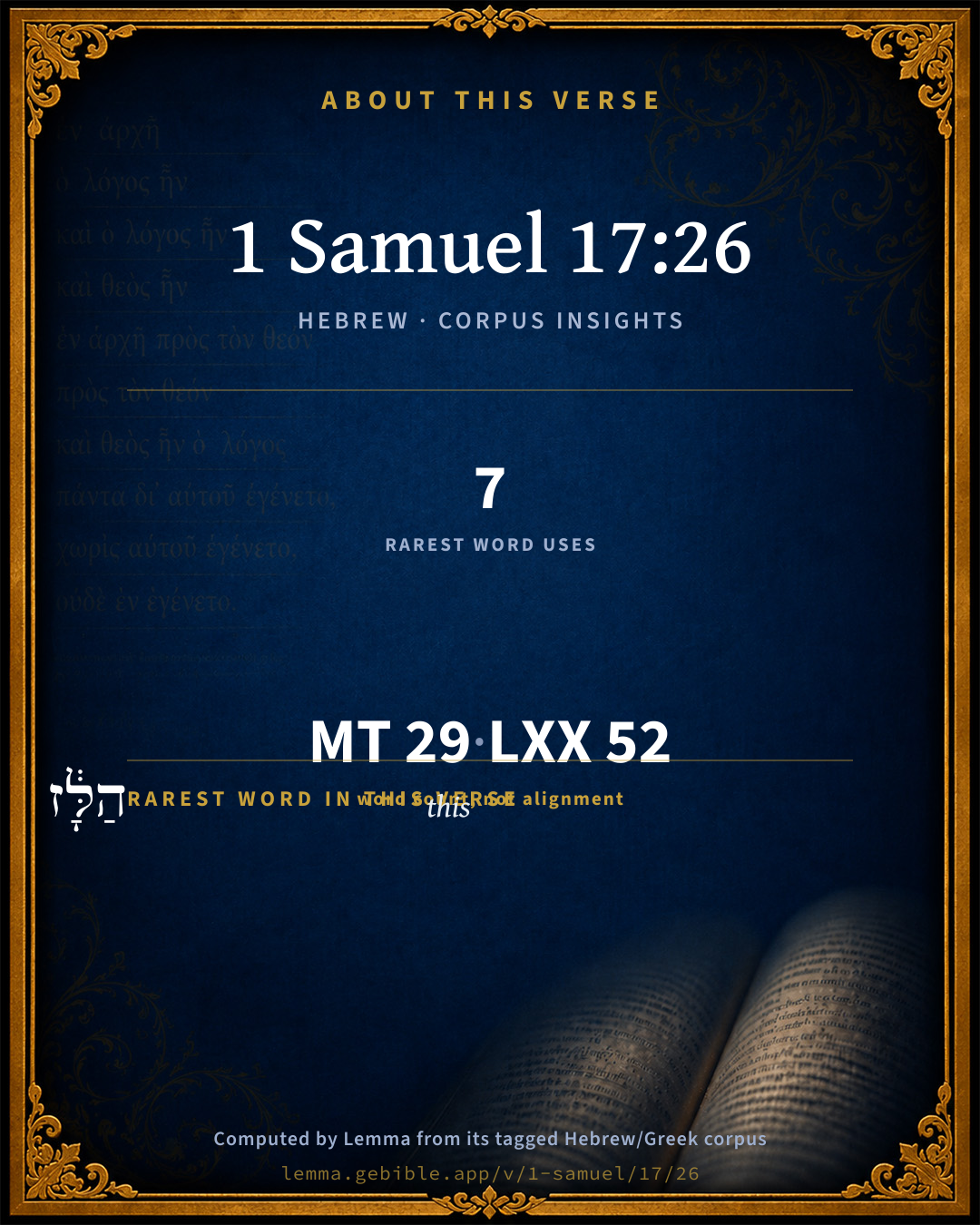
The rarest word here is הַלָּ֔ז this H1975 — appearing just 7 times in the whole Hebrew Bible.

Shared distinctive vocabulary

הַלָּ֔ז this H1975 occurs in 7 verses of the Hebrew Bible. Also found in:

Grammatical profile

  • 7 verbs
  • 9 nouns
  • 2 adjectives
  • 2 pronouns
  • 3 prepositions
  • 2 conjunctions
  • 4 particles

Verb forms

  • וַיֹּ֣אמֶר Qal · Sequential Imperfect
  • הָעֹמְדִ֣ים Qal · Participle Active
  • לֵאמֹר֒ Qal · Infinitive Construct
  • יֵּעָשֶׂ֗ה Niphal · Imperfect
  • יַכֶּה֙ Hiphil · Imperfect
  • וְהֵסִ֥יר Hiphil · Sequential Perfect
  • חֵרֵ֔ף Piel · Perfect

Repetition

Words recur within this verse — often emphatic in Hebrew:

  • וַיֹּ֣אמֶר to say H559 ×2
  • הָאֲנָשִׁ֞ים man H376 ×2
  • הַפְּלִשְׁתִּ֣י Philistine H6430 ×2
  • כִּ֣י that H3588 ×2

Hebrew & Septuagint length

In English translation the verse runs 44 words from the Hebrew and 47 from the Septuagint (LXX English) — closely comparable.

A rough comparison of the two English renderings, which tokenize alike — not a word-level alignment.

Word counts can differ between the Hebrew and the Greek without any difference in meaning — e.g. the Hebrew direct-object marker אֵת has no separate Greek word, and Greek often adds the article ὁ.

In the original languages it is 29 Hebrew tokens and 52 Greek tokens — but the two are counted differently (Hebrew bundles its prefixes and suffixes into one token; the Greek is in lemma form), so that isn’t a like-for-like length.

Cross-references

16

Topical passages linked to 1 Samuel 17:26 in the Treasury of Scripture Knowledge — connected by theme and wording, ordered by reader-vote popularity; previews shown in the World English Bible.

  • Deuteronomy 5:26 For who is there of all flesh, that has heard the voice of the living God speaking out of the midst of the fire, as we have, and lived?
  • 1 Samuel 11:2 Nahash the Ammonite said to them, On this condition will I make it with you, that all your right eyes be put out; and I will lay it for a reproach on all Israel.
  • 1 Samuel 14:6 Jonathan said to the young man who bore his armor, Come, and let us go over to the garrison of these uncircumcised: it may be that Yahweh will work for us; for there is no restraint to Yahweh to save by many or by few.
  • 1 Samuel 17:10 The Philistine said, I defy the armies of Israel this day; give me a man, that we may fight together.
  • 1 Samuel 17:36 Your servant struck both the lion and the bear: and this uncircumcised Philistine shall be as one of them, seeing he has defied the armies of the living God.
  • 2 Kings 19:4 It may be Yahweh your God will hear all the words of Rabshakeh, whom the king of Assyria his master has sent to defy the living God, and will rebuke the words which Yahweh your God has heard. Therefore lift up your prayer for the remnant that is left.
  • Joshua 7:8–9 Oh, Lord, what shall I say, after that Israel has turned their backs before their enemies!
  • Nehemiah 5:9 Also I said, The thing that you do is not good: ought you not to walk in the fear of our God, because of the reproach of the nations our enemies?
  • Psalms 44:13 You make us a reproach to our neighbors, A scoffing and a derision to those who are around us.
  • Jeremiah 10:10 But Yahweh is the true God; he is the living God, and an everlasting King: at his wrath the earth trembles, and the nations are not able to abide his indignation.
  • Daniel 9:16 Lord, according to all your righteousness, let your anger and please let your wrath be turned away from your city Jerusalem, your holy mountain; because for our sins, and for the iniquities of our fathers, Jerusalem and your people are become a reproach to all who are round about us.
  • Psalms 79:12 Pay back to our neighbors seven times into their bosom Their reproach with which they have reproached you, Lord.
  • Joel 2:19 Yahweh answered his people, "Behold, I will send you grain, new wine, and oil, And you will be satisfied with them; And I will no more make you a reproach among the nations.
  • 1 Thessalonians 1:9 For they themselves report concerning us what kind of a reception we had from you; and how you turned to God from idols, to serve a living and true God,
  • 1 John 5:20 We know that the Son of God has come, and has given us an understanding, that we know him who is true, and we are in him who is true, in his Son Jesus Christ. This is the true God, and eternal life.
  • Psalms 74:18 Remember this, that the enemy has mocked you, Yahweh. Foolish people have blasphemed your name.

Cross-references courtesy of OpenBible.info (CC BY 4.0).

Hebrew and Greek witnesses Masoretic Hebrew ↔ Greek Septuagint

The same verse in the two great witnesses to the Old Testament, shown verse-for-verse.

These are two independent witnesses, not word-aligned to each other, and the Septuagint is shown in lemma (dictionary) form.

Hebrew 1 Samuel 17:26 Masoretic · Westminster Leningrad Codex

וַיֹּ֣אמֶר דָּוִ֗ד אֶֽל הָאֲנָשִׁ֞ים הָעֹמְדִ֣ים עִמּוֹ֮ לֵאמֹר֒ מַה יֵּעָשֶׂ֗ה לָאִישׁ֙ אֲשֶׁ֤ר יַכֶּה֙ אֶת הַפְּלִשְׁתִּ֣י הַלָּ֔ז וְהֵסִ֥יר חֶרְפָּ֖ה מֵעַ֣ל יִשְׂרָאֵ֑ל כִּ֣י מִ֗י הַפְּלִשְׁתִּ֤י הֶֽעָרֵל֙ הַזֶּ֔ה כִּ֣י חֵרֵ֔ף מַעַרְכ֖וֹת אֱלֹהִ֥ים חַיִּֽים

David spoke to the men who stood by him, saying, What shall be done to the man who kills this Philistine, and takes away the reproach from Israel? for who is this uncircumcised Philistine, that he should defy the armies of the living God?

World English Bible · Public Domain

Greek LXX 1 Samuel 17:26 Septuagint · lemma form

καί ἀποκλείω σύ κύριος σήμερον εἰς ὁ χείρ ἐγώ καί ἀποκτείνω σύ καί ἀποαἱρέω ὁ κεφαλή σύ ἀπό σύ καί δίδωμι ὁ κῶλον σύ καί ὁ κῶλον παρεμβολή ἀλλόφυλος ἐν οὗτος ὁ ἡμέρα ὁ πετεινόν ὁ οὐρανός καί ὁ θηρίον ὁ γῆ καί γιγνώσκω πᾶς ὁ γῆ ὅτι εἰμί θεός ἐν ἰσραήλ

and David spoke to the men who stood with him saying, Shall it indeed be done thus to the man who shall strike that Philistine, and take away reproach from Israel? for who is this uncircumcised Philistine that he has defied the army of the living God?

LXX2012 (modern English Septuagint) · Public Domain

Hebrew: Westminster Leningrad Codex (CC BY 4.0). Greek: Septuagint (public domain); English from LXX2012 (modern English Septuagint) (Public Domain). How the Septuagint differs from the Hebrew →

Targum (Aramaic paraphrase)

1

The Targum is the ancient Jewish Aramaic paraphrase of the Hebrew Scriptures — an interpretive translation, not the Hebrew text itself. Onkelos (literal) and Pseudo-Jonathan (expansive) render the Torah, and Jonathan the Prophets. Coverage is partial: where no permissively-licensed English translation exists for a verse, only the Aramaic is shown. This is verse-level text, not a word-by-word alignment to the Hebrew.

  1. Targum Jonathan Prophets (Joshua–Malachi)
    וַאֲמַר דָוִד לְגַבְרַיָא דְקַיְמִין עִמֵיהּ לְמֵימַר מַה יִתְעֲבֵיד לְגַבְרָא דְיִקְטוֹל יַת פְלִישְׁתָּאָה דֵיכִי וְיַעְדִי חִסוּדָא מֵעַל יִשְׂרָאֵל אֲרֵי מַן פְלִשְׁתָּאָה עֲרֵלָא הָדֵין אֲרֵי חֲסַד סִדְרֵי עַבְדֵי קְרָבָא דְעַמֵיהּ דַייָ קַיָמָא:

    (no public-domain English translation for this verse)

    Targum Jonathan — Aramaic: “Mikraot Gedolot” (public domain). English: “Sefaria Community Translation” (CC0 1.0 (public-domain dedication)); “London "Chaldee Paraphrase," 1871” (public domain). Text via Sefaria.

Commentary

Notes on 1 Samuel 17:26 from classic Christian and Jewish commentators (each source and its license shown beneath its notes). The classic Christian expositions comment on the surrounding passage and are grouped to its opening verse, so a note may address several verses; the Jewish commentaries on the Tanakh (Rashi and others) are per-verse, so they appear only where the commentator wrote on this verse.

Lemma curates 59 commentaries, every one of them public domain or Creative Commons licensed, each selected and text-cleaned for this edition rather than reprinted as found. About our sources →

Trapp's Complete Commentary

John Trapp

1Sa 17:26 And David spake to the men that stood by him, saying, What shall be done to the man that killeth this Philistine, and taketh away the reproach from Israel? for who [is] this uncircumcised Philistine, that he should defy the armies of the living God?

Ver. 26. What shall be done to the man?] This he inquireth, non quia victus his pollicitationibus, as Chrysostom saith; not because he was won by these promises, - for as he hardly credited them, so he never claimed them, - but moved with "a zeal of God," and for the honour of his nation, he is willing to enter the contest, and wisheth that the king knew as much. David is not so much encouraged, as enraged against that dead dog, that thus proudly barked against the God of Israel.

John Trapp, A Commentary or Exposition upon All the Books of the Old and New Testament (1647–1656) — public domain. Text from a community e-Sword module.

Tyndale Open Study Notes

Tyndale Open Resources

17:26 What will a man get: Cp. 18:17-27. David’s interest in a reward was overshadowed by his determination to silence Goliath’s defiance of God (17:45-47). • pagan: Literally uncircumcised. See study note on 14:6.

Tyndale Open Study Notes — © Tyndale Open Resources, licensed CC BY-SA 4.0. Text via the HelloAO Bible API.

Geneva Bible (1599)

Geneva Bible translators

This dishonor that he doeth to Israel.

Geneva Bible (1599) marginal notes — public domain. Text via Bolls.life.

Ellicott's Commentary for English Readers

(26) And David spake . . .—Very vividly does the historian here depict the scene that morning in the “front:” the dismayed soldiers of King Saul watching and listening to the boastful, impious words, as the giant champion shouted them across the narrow ravine which parted the outposts of the two armies; the enthusiastic shepherd boy, glowing with religious fervour, going from group to group of the advanced guard in the front, as they stood gloomily leaning on their spears, asking questions, and gleaning all the information possible about this insulter of his God.

A Bible Commentary for English Readers, edited by Charles John Ellicott (1878–1897) — public domain. Text from a community e-Sword module.

The Cambridge Bible for Schools and Colleges

gen. ed. J. J. S. Perowne

26. the living God] Jehovah as the one “living and true God” is contrasted with the idols of the heathen “which have no breath in their mouths.” Cp. Deu_5:26, and esp. 2Ki_19:4.

The Cambridge Bible for Schools and Colleges (gen. ed. J. J. S. Perowne; Cambridge University Press, 1878–1918) — public domain. Text from a community e-Sword module.

John Gill's Exposition

And David spake to the men that stood by him,.... Who were next to him, looking upon the Philistine, and hearing what he said:

saying, what shall be done to the man that killeth this Philistine,

and taketh away the reproach from Israel? which he asked not for the sake of the reward, but to observe the necessity there was of some man's engaging with him, and killing him, or otherwise it would be a reproach to Israel, and to signify that he had an inclination to attempt it:

for who is this uncircumcised Philistine, that he should defy the armies of the living God? there were two things which provoked David, and raised indignation in him against this man; the one was, the character of the person that reproached, a Philistine, an uncircumcised person, a profane man, that had no true religion in him, an alien from the commonwealth of Israel, and a stranger to the covenants of promise; and the other was the persons whom he reproached, the armies of the living God, of the King of kings, and Lord of lords; and which in effect was reproaching the Lord himself, and which David, filled with zeal for God, and for his people, could not bear; and the consideration of these things animated him to engage with him, not doubting of success.

John Gill's Exposition of the Whole Bible (1746–1763) — public domain (CC PDM 1.0). Text via the HelloAO Bible API.

Albert Barnes' Notes on the Bible

The living God - This fine expression occurs first in Deuteronomy (marginal reference), and next in Jos 3:10, and 2Ki 19:4. We find it twice in the Psalms of David Psa 42:2; Psa 84:2, four times in the prophets, and frequently in the New Testament. It is generally in contrast to false gods (1Th 1:9, etc.).

Albert Barnes' Notes on the Bible (1834–1885) — public domain. Text from a community e-Sword/MySword module.

Matthew Poole's English Annotations

Why should you all be thus dismayed at him? he is but a man, and that of an accursed race, a stranger and enemy to God, and no way able to stand before them who have the living and almighty God for their strength and refuge.

Matthew Poole's English Annotations on the Holy Bible (1683–1685) — public domain. Text from a community e-Sword/MySword module.

unfoldingWord translationNotes

Door43 World Missions Community

takes away the disgrace from Israel

This can be expressed with the verb "disgrace." AT: "stops Israel from being disgraced" or "stops him from disgracing Israel" (See: Abstract Nouns)

Who is this uncircumcised Philistine that he should defy the armies of the living God?

David said this to show his anger that this Philistine was defying God's army. AT: "This uncircumcised Philistine certainly has no power that he should defy the armies of the living God!" (See: Rhetorical Question)

this uncircumcised Philistine

This phrase is an insult and indicates that Goliath does not belong to the living God.

translationWords

David

Philistines

Israel

circumcise

God

unfoldingWord translationNotes — © Distant Shores Media and the Door43 World Missions Community, licensed CC BY-SA 4.0. Source: git.door43.org/Door43/en_tn.

Lesson kit

Teaching starters — assembled from the data on this page, not authored interpretation. Every prompt links to the verse data it draws on. Edit before teaching.

1 Samuel, in the Historical, opens this verse with 29 words (25 distinct Hebrew lemmas). Its most distinctive word is hallâz (“this”). A historical commentator’s framing appears above. Read the whole chapter for the surrounding context.

Discussion questions

  1. What does “this” (hallâz) contribute to the verse as a whole?
  2. Judges 6:20 shares the word «this» with this verse. How do the two illuminate each other?
  3. “to say” occurs 2× in this one verse. What is the effect of the repetition?
  4. The translations on this page render this verse differently — a whole-verse word diff, not a word-by-word alignment. What might account for the different wordings?
  5. The verb «וַיֹּ֣אמֶר» is Qal Sequential Imperfect. How does its form color the action?
  6. Reading how Trapp's Complete Commentary and Tyndale Open Study Notes read this verse, where do the two commentators agree and where do they part?

Things to notice

Reading settings

Reading text

Shown beneath each verse's original-language words.

Old Testament
Old Testament edition

Read the OT as the Masoretic Hebrew (MT) or the Greek Septuagint (LXX).

English shown for the Greek Septuagint (in the Hebrew ↔ Greek comparison).

Comparing translations? Open the Compare panel on any verse page to stack up to four side by side.