2 Chronicles 17:6

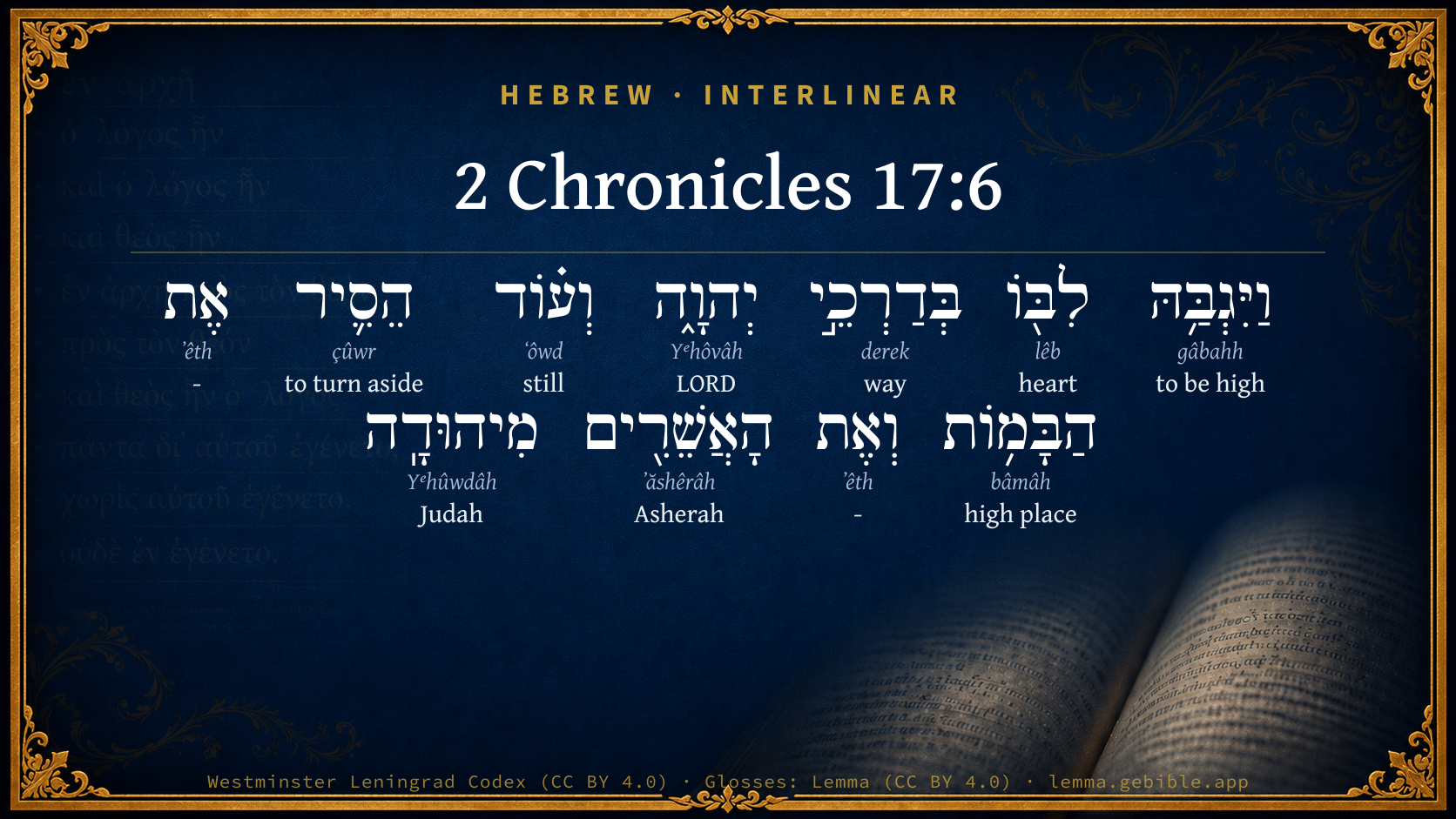
Hebrew (Westminster Leningrad Codex) 2 Chronicles 17:6 appears in the Hebrew Old Testament. The text above is from the Westminster Leningrad Codex. Each word links to its Strong’s number, a concise gloss, and parsing drawn from the Open Scriptures Hebrew Bible morphology. Click any word for its full Brown-Driver-Briggs (BDB) entry.
Download image
Cite this verse

2 Chronicles 17:6 (World English Bible). Public Domain. Lemma interlinear Bible study tool, https://lemma.gebible.app/v/2-chronicles/17/6.

Show BibTeX & RIS
BibTeX
RIS
English Translation
His heart was lifted up in the ways of Yahweh: and furthermore he took away the high places and the Asherim out of Judah.
World English Bible · Public Domain
Download a study sheet

One document with this verse’s original text, its word-by-word gloss line, the meaning frame, cross-references with their text, attributed commentary, and full source and license credits — printable, and it pastes into notes with its structure intact.

This verse Autodidact and up

Study sheet (.html) Plain text (.txt)

A passage Seminary Student

Up to 50 verses in one chapter. A passage sheet keeps up to 6 commentary sources and 12 cross-references per verse, in the order this page ranks them, and says so on the sheet whenever that leaves anything out. Ask for a single verse and you get the Autodidact verse sheet above.

Everything on this page stays free to read, with no account — the sheet is a download of what is already on screen, not access to it.

Want to remove ads? Support Godless Engineer
Compare translations 3

The same verse in 3 English versions, stacked beneath the original-language interlinear above. Click any original word for its lexicon entry.

Each is an independent rendering of the whole verse — the interlinear is not word-aligned to these translations.

Highlighted words mark where these versions differ — a whole-verse word diff, not a word-by-word alignment.

  • World English Bible Public Domain
    His heart was lifted up in the ways of Yahweh: and furthermore he took away the high places and the Asherim out of Judah.
  • King James Version Public Domain
    And his heart was lifted up in the ways of the LORD: moreover he took away the high places and groves out of Judah.
  • unfoldingWord Literal Text CC BY-SA 4.0
    And his heart was high in the ways of Yahweh. And also, he took away the high places and the Asherim from Judah.

unfoldingWord Literal Text — © unfoldingWord, licensed CC BY-SA 4.0. Word-aligned USFM3 via Door43 (git.door43.org/unfoldingWord/en_ult).

Versions to compare (up to 4)

3 of 4 selected

Show all 18 translations

Every available English version of this verse, each an independent rendering of the whole verse.

  • World English Bible Public Domain
    His heart was lifted up in the ways of Yahweh: and furthermore he took away the high places and the Asherim out of Judah.
  • Berean Standard Bible Public Domain
    And his heart took delight in the ways of the LORD; furthermore, he removed the high places and Asherah poles from Judah.
  • Majority Standard Bible Public Domain
    And his heart took delight in the ways of the LORD; furthermore, he removed the high places and Asherah poles from Judah.
  • King James Version Public Domain
    And his heart was lifted up in the ways of the LORD: moreover he took away the high places and groves out of Judah.
  • American Standard Version (1901) Public Domain
    And his heart was lifted up in the ways of Jehovah: and furthermore he took away the high places and the Asherim out of Judah.
  • Revised Version (1885) Public Domain
    And his heart was lifted up in the ways of the LORD: and furthermore he took away the high places and the Asherim out of Judah.
  • Geneva Bible (1599) Public Domain
    And he lift vp his heart vnto the wayes of the Lord, and he tooke away moreouer the hie places and the groues out of Iudah.
  • Douay-Rheims (1899) Public Domain
    And when his heart had taken courage for the ways of the Lord, he took away also the high places and the groves out of Juda.
  • Young's Literal Translation Public Domain
    and his heart is high in the ways of Jehovah, and again he hath turned aside the high places and the shrines out of Judah.
  • Literal Standard Version CC BY-SA 4.0
    and his heart is high in the ways of YHWH, and again he has turned aside the high places and the Asherim out of Judah.
  • Unlocked Literal Bible CC BY-SA 4.0
    His heart was committed to Yahweh's ways. He also removed the high places and the Asherah poles from Judah.
  • unfoldingWord Literal Text CC BY-SA 4.0
    And his heart was high in the ways of Yahweh. And also, he took away the high places and the Asherim from Judah.
  • Darby Bible Public Domain
    And he took courage in the ways of Jehovah; moreover, he removed the high places and Asherahs out of Judah.
  • World Messianic Bible Public Domain
    His heart was lifted up in the ways of the LORD. Furthermore, he took away the high places and the Asherah poles out of Judah.
  • Webster's Bible Public Domain
    And his heart was lifted up in the ways of the LORD: moreover he took away the high places and groves out of Judah.
  • Free Bible Version CC BY-SA 4.0
    He was sincerely committed to what the Lord wanted. He also removed the high places and Asherah poles from Judah.
  • Bible in Basic English Public Domain
    His heart was lifted up in the ways of the Lord; and he went so far as to take away the high places and the wood pillars out of Judah.
  • JPS Tanakh (1917) Public Domain
    And his heart was lifted up in the ways of the LORD; and furthermore he took away the high places and the Asherim out of Judah.

Literal Standard Version (2020), Covenant Press — licensed CC BY-SA 4.0. Text via the HelloAO Bible API (eBible.org). Unlocked Literal Bible (unfoldingWord) — licensed CC BY-SA 4.0. Text via the HelloAO Bible API (eBible.org). unfoldingWord Literal Text — © unfoldingWord, licensed CC BY-SA 4.0. Word-aligned USFM3 via Door43 (git.door43.org/unfoldingWord/en_ult). Free Bible Version, Dr. Jonathan Gallagher — licensed CC BY-SA 4.0. Text via the HelloAO Bible API (eBible.org).

Word by word

More ways to search: Search by grammar → Find every occurrence → Compare this word →

Practice this passage: Drill this verse → Learn its vocabulary →

וַיִּגְבַּ֥הּ
gâbahh
H1361
“and · to be high”
Conjunction + Verb, Qal, Sequential Imperfect, 3rd Person, Masculine, Singular
Part of Speech
Conjunction + Verb
Stem
Qal
Form
Sequential Imperfect
Person
3rd Person
Gender
Masculine
Number
Singular
Full BDB Definition

Origin: a primitive root

TWOT: 305

to be high, be exalted - (Qal) - to be high, lofty, tall - to be exalted - to be lofty - to be lofty (of Jehovah's ways - good sense) - to be haughty, be arrogant (bad sense) - (Hiphil) to make high, exalt
  1. לִבּ֖וֹ lêb H3820 “heart · his” Noun, Common, Masculine, Singular, Construct + Suffix, Personal, 3rd Person, Masculine, Singular
  2. בְּדַרְכֵ֣י derek H1870 “in/at · ways of” Preposition + Noun, Common, Both, Plural, Construct
  3. יְהוָ֑ה Yᵉhôvâh H3068 “LORD” Noun, Proper
  4. וְע֗וֹד ʻôwd H5750 “and · still” Conjunction + Adverb
  5. הֵסִ֛יר çûwr H5493 “to turn aside” Verb, Hiphil, Perfect, 3rd Person, Masculine, Singular
  6. אֶת ʼêth H853 “-” Particle, Direct Object
  7. הַבָּמ֥וֹת bâmâh H1116 “the · high places” Particle, Definite Article + Noun, Common, Feminine, Plural, Absolute
  8. וְאֶת ʼêth H853 “and · -” Conjunction + Particle, Direct Object
  9. הָאֲשֵׁרִ֖ים ʼăshêrâh H842 “the · Asherah” Particle, Definite Article + Noun, Proper
  10. מִיהוּדָֽה Yᵉhûwdâh H3063 “from · Judah” Preposition + Noun, Proper

About this verse

These counts appear in no published source. They are computed here, from the morphology-tagged text and Lemma’s own curated glosses. What Lemma adds →

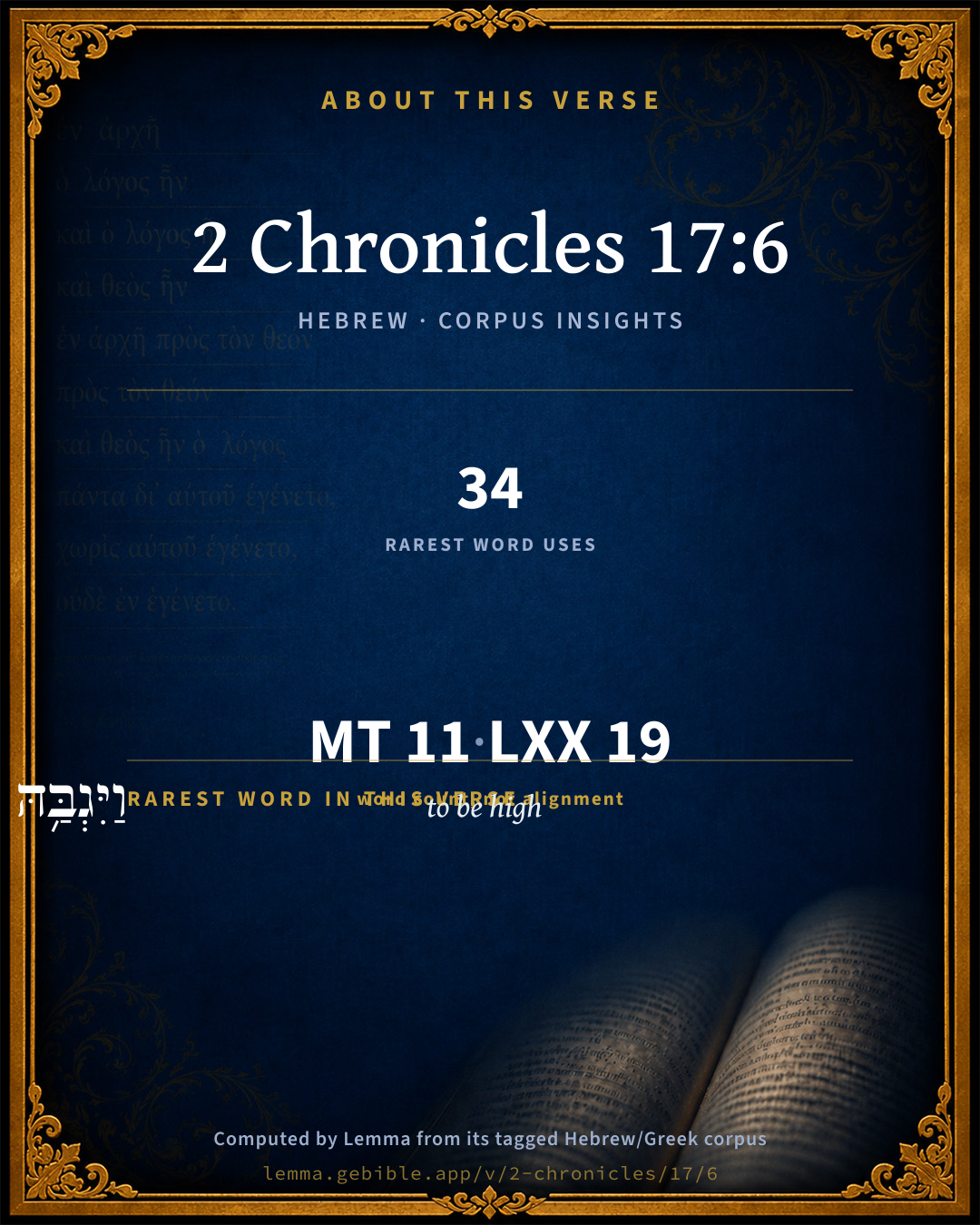
11
words
10
distinct lemmas
Historical
section

Shared distinctive vocabulary

וַיִּגְבַּ֥הּ to be high H1361 occurs in 33 verses of the Hebrew Bible. Also found in:

Grammatical profile

  • 2 verbs
  • 6 nouns
  • 1 adverb
  • 2 particles

Verb forms

  • וַיִּגְבַּ֥הּ Qal · Sequential Imperfect
  • הֵסִ֛יר Hiphil · Perfect

Hebrew & Septuagint length

In English translation the verse runs 24 words from the Hebrew and 25 from the Septuagint (LXX English) — closely comparable.

A rough comparison of the two English renderings, which tokenize alike — not a word-level alignment.

Word counts can differ between the Hebrew and the Greek without any difference in meaning — e.g. the Hebrew direct-object marker אֵת has no separate Greek word, and Greek often adds the article ὁ.

In the original languages it is 11 Hebrew tokens and 19 Greek tokens — but the two are counted differently (Hebrew bundles its prefixes and suffixes into one token; the Greek is in lemma form), so that isn’t a like-for-like length.

Cross-references

14

Topical passages linked to 2 Chronicles 17:6 in the Treasury of Scripture Knowledge — connected by theme and wording, ordered by reader-vote popularity; previews shown in the World English Bible.

  • Hosea 14:9 Who is wise, that he may understand these things? Who is prudent, that he may know them? For the ways of Yahweh are right, And the righteous walk in them; But the rebellious stumble in them.
  • 2 Chronicles 15:17 But the high places were not taken away out of Israel: nevertheless the heart of Asa was perfect all his days.
  • 2 Chronicles 20:33 However the high places were not taken away; neither as yet had the people set their hearts to the God of their fathers.
  • Psalms 119:1 Blessed are those whose ways are blameless, Who walk according to Yahweh's law.
  • 1 Kings 22:43 He walked in all the way of Asa his father; He didn't turn aside from it, doing that which was right in the eyes of Yahweh: however the high places were not taken away; the people still sacrificed and burnt incense in the high places.
  • 2 Chronicles 19:3 Nevertheless there are good things found in you, in that you have put away the Asheroth out of the land, and have set your heart to seek God.
  • 2 Chronicles 34:3–7 For in the eighth year of his reign, while he was yet young, he began to seek after the God of David his father; and in the twelfth year he began to purge Judah and Jerusalem from the high places, and the Asherim, and the engraved images, and the molten images.
  • Psalms 18:21–22 For I have kept the ways of Yahweh, And have not wickedly departed from my God.
  • Psalms 138:5 Yes, they will sing of the ways of Yahweh; For great is Yahweh's glory.
  • Deuteronomy 28:47 Because you didn't serve Yahweh your God with joyfulness, and with gladness of heart, by reason of the abundance of all things;
  • 2 Chronicles 14:3 for he took away the foreign altars, and the high places, and broke down the pillars, and hewed down the Asherim,
  • 2 Chronicles 31:1 Now when all this was finished, all Israel who were present went out to the cities of Judah, and broke in pieces the pillars, and hewed down the Asherim, and broke down the high places and the altars out of all Judah and Benjamin, in Ephraim also and Manasseh, until they had destroyed them all. Then all the children of Israel returned, every man to his possession, into their own cities.
  • Job 22:26 For then shall you delight yourself in the Almighty, And shall lift up your face to God.
  • Acts 13:10 and said, "Full of all deceit and all cunning, you son of the devil, you enemy of all righteousness, will you not cease to pervert the right ways of the Lord?

Cross-references courtesy of OpenBible.info (CC BY 4.0).

Hebrew and Greek witnesses Masoretic Hebrew ↔ Greek Septuagint

The same verse in the two great witnesses to the Old Testament, shown verse-for-verse.

These are two independent witnesses, not word-aligned to each other, and the Septuagint is shown in lemma (dictionary) form.

Hebrew 2 Chronicles 17:6 Masoretic · Westminster Leningrad Codex

וַיִּגְבַּ֥הּ לִבּ֖וֹ בְּדַרְכֵ֣י יְהוָ֑ה וְע֗וֹד הֵסִ֛יר אֶת הַבָּמ֥וֹת וְאֶת הָאֲשֵׁרִ֖ים מִיהוּדָֽה

His heart was lifted up in the ways of Yahweh: and furthermore he took away the high places and the Asherim out of Judah.

World English Bible · Public Domain

Greek LXX 2 Chronicles 17:6 Septuagint · lemma form

καί ὑψόω καρδία αὐτός ἐν ὁδός κύριος καί ἔτι ἐκαἴρω ὁ ὑψηλός καί ὁ ἄλσος ἀπό ὁ γῆ ἰουδά

And his heart was exalted in the way of the Lord; and he removed the high places and the groves from the land of Juda.

LXX2012 (modern English Septuagint) · Public Domain

Hebrew: Westminster Leningrad Codex (CC BY 4.0). Greek: Septuagint (public domain); English from LXX2012 (modern English Septuagint) (Public Domain). How the Septuagint differs from the Hebrew →

Commentary

Notes on 2 Chronicles 17:6 from classic Christian and Jewish commentators (each source and its license shown beneath its notes). The classic Christian expositions comment on the surrounding passage and are grouped to its opening verse, so a note may address several verses; the Jewish commentaries on the Tanakh (Rashi and others) are per-verse, so they appear only where the commentator wrote on this verse.

Lemma curates 59 commentaries, every one of them public domain or Creative Commons licensed, each selected and text-cleaned for this edition rather than reprinted as found. About our sources →

Trapp's Complete Commentary

John Trapp

2Ch 17:6 And his heart was lifted up in the ways of the LORD: moreover he took away the high places and groves out of Judah.

Ver. 6. And his heart was lifted up.] Not with pride, as 2Ch 32:25, but with undaunted courage and disengaged zeal, such as made him come off roundly and readily in the ensuing reformation: he was more forward and forth putting than his father Asa, "not slothful in business, but fervent in spirit, serving the Lord."

John Trapp, A Commentary or Exposition upon All the Books of the Old and New Testament (1647–1656) — public domain. Text from a community e-Sword module.

The Biblical Illustrator

Joseph S. Exell

2Ch_17:6

And his heart was lifted up in the ways of the Lord.

Encouragement in the ways of the Lord

I. The ways of the Lord are divine. Are His ways cold and unpleasant? H we descend a deep coal-pit and look up the shaft into the bright sky, we see the stars, but the pit is cold and dark. So men think that when they commune with God, it is like being in a coal-pit beholding a star; it is a beautiful sight, but makes one cold and unpleasant. Is this the truth? No; the Bible describes Gods people as having melody in their hearts, and one of His sweetest names is The happy God. Some people are afraid of becoming religious, lest they should be miserable; but they mistake the God in whose breast there is an ever-flowing heaven. The man who the most loves God is the happiest in disposition and the most cheerful as well as the most graceful in life.

II. His ways are also humane; they constrain us to love our suffering fellow-man, when he can do us no good but when we can do him good. (W. Birch.)

Jehoshaphat

I. Some men when, like jehoshaphat, they have riches and honour in abundance, have their hearts lifted up, but not in the ways of the Lord. The natural tendency of such circumstances is to create and foster a spirit of pride, of self-sufficiency, and of independence. How necessary the warning (Deu_8:11-14). Nebuchadnezzar is a striking exemplification of this.

II. Some men whose hearts are not lifted up are in the ways of the Lord. They are real Christians, but doubting, desponding Christians.

III. Some men have their hearts lifted up, like Jehoshaphat, in the ways of the Lord. They rejoice in the Lord alway. (R. Harley.)

The Biblical Illustrator, edited by Joseph S. Exell (c. 1880s–1900s) — public domain. Text from a community e-Sword module.

Geneva Bible (1599)

Geneva Bible translators

He gave himself wholly to serve the Lord.

Geneva Bible (1599) marginal notes — public domain. Text via Bolls.life.

Jamieson, Fausset & Brown

Robert Jamieson, A. R. Fausset & David Brown

his heart was lifted up in the ways of the Lord--Full of faith and piety, he possessed zeal and courage to undertake the reformation of manners, to suppress all the works and objects of idolatry (see on Ch2 20:33), and he held out public encouragement to the pure worship of God.

Jamieson, Fausset & Brown — Commentary Critical and Explanatory on the Whole Bible (1871) — public domain (CC PDM 1.0). Text via the HelloAO Bible API.

Ellicott's Commentary for English Readers

(6) And his heart was lifted up.—Gabhah lçbh, which usually, like the phrase of Authorised version, has a bad meaning, as in 2Ch_26:16. The margin is right here: “his courage rose high,” or “he grew bold” in the ways of Jehovah, i.e., in the path of religious reform. Vulg., “cum sumpsisset cor ejus audaciam propter vias Domini.”

Moreover.—And again, further. Referring to 2Ch_17:3. Not only did he not seek the Baals, but more than this, he removed the high places, &c. [This is the common explanation. But the sense may rather be: “And he again removed,” referring back to Asa’s reforms, 2Ch_14:5.]

Groves.—’Ashêrim, “Asherahs.” (2Ch_14:3.)

A Bible Commentary for English Readers, edited by Charles John Ellicott (1878–1897) — public domain. Text from a community e-Sword module.

The Cambridge Bible for Schools and Colleges

gen. ed. J. J. S. Perowne

6. moreover he took away] R.V. and furthermore he took away. In 2Ch_20:33 = 1Ki_22:43 it is said that the high places were not taken away. Cp. what is said of Asa (2Ch_14:3 and 2Ch_15:17 = 1Ki_15:14). It seems that in both cases the Chronicler incorporates mutually contradictory traditions. If the removal took place, it must have met with only partial success.

and groves] R.V. and the Asherim. See note on 2Ch_14:3.

The Cambridge Bible for Schools and Colleges (gen. ed. J. J. S. Perowne; Cambridge University Press, 1878–1918) — public domain. Text from a community e-Sword module.

John Gill's Exposition

And his heart was lifted up in the ways of the Lord,.... It was engaged in them, was bent and set upon them; he walked in them with great pleasure and cheerfulness, being inspired with zeal and courage; he was fearless and intrepid, and regarded not any opposition he might have, or expect to have, in the work of reformation in which he was concerned:

moreover, he took away the high places; such as were dedicated to idols, but not those in which the true God was worshipped, Ch2 20:33

and groves out of Judah; where idols were placed; for though these had been removed by Asa, yet had been renewed in the latter part of his days, when more negligent of religion.

John Gill's Exposition of the Whole Bible (1746–1763) — public domain (CC PDM 1.0). Text via the HelloAO Bible API.

Albert Barnes' Notes on the Bible

His heart was lifted up - This expression generally occurs in a bad sense Deu 8:14; 2Ch 26:16; Psa 131:1; Pro 18:12; but here it must be taken differently. The margin “was encouraged” expresses fairly the true meaning. He first began by setting an example of faithfulness to Yahweh. He then proceeded to use his best endeavors to extirpate idolatry.

He took away the high places - Compare 2Ch 20:33, and see the 2Ch 15:17 note.

Albert Barnes' Notes on the Bible (1834–1885) — public domain. Text from a community e-Sword/MySword module.

Haydock's Catholic Bible Commentary

When. Heb. "And his heart was elevated in the ways of the Lord." He was endued with courage to undertake the great work of banishing all abuses out of his dominions, seeing that the people were well affected, and the Lord urged him forward. H. --- He trusted no so much to his great army or riches, as to a good conscience, (T.) which made him fear no difficulties; (1 John iii. 21,) doubting not but God would grant him success, as he endeavoured to keep his laws. C. --- Groves of idols, (M.) though he tolerated the high places, which had been consecrated to God, C. xx. 33., and 3 K. xxii. 43. H. --- Good works, rewarded by God, encouraged people to proceed in virtue. W.

George Leo Haydock (1774–1849), Haydock's Catholic Family Bible and Commentary, 1859 edition — public domain. Excludes Psalms (Douay-Rheims chapter numbering differs from Protestant) and Deuterocanonical books (Catholic canon only).

Matthew Poole's English Annotations

His heart was lifted up above all discouragements, and difficulties, and fears, by which men’s hearts use to be cast down: he was valiant and resolute for God and his ways.

He took away the high places and groves, to wit, such only wherein idols were worshipped, as appears by comparing this with 2Ch 20:33. And though Asa had done this before, yet either he did not do it thoroughly, or the Jews (who were many of them mad upon their idols) had secretly made new ones, in the latter part of his reign, when he grew more infirm in body, and more remiss in God’s cause.

Matthew Poole's English Annotations on the Holy Bible (1683–1685) — public domain. Text from a community e-Sword/MySword module.

Whedon's Commentary on the Bible

Daniel D. Whedon

6. His heart was lifted up — That is, exalted with holy faith and courage.

Took away the high places — Yet, in spite of all his efforts and successes in this matter, the people had become so addicted to these practices that their destruction was not thoroughly secured. See note on 2Ch_14:3, and compare 2Ch_20:33.

Daniel D. Whedon (gen. ed.), Commentary on the Old and New Testaments (1874–1909) — public domain. Text from a community e-Sword module.

The Pulpit Commentary

And his heart was lifted up in the ways of the Lord. Although the verb Hbg; often carries a bad sense with it, it quite as often carries with it a good one in the Old Testament, and the typical instance of the former (Psa_131:1) is fully counterbalanced by Isa_52:13.The marginal "was enencouraged may be superseded with advantage by "took courage". (Isa_40:29-31) The groves. Supersede this incorrect rendering by the Asherim; and upon the seeming discrepancy, see again 2Ch_15:17, and "Introduction to Chronicles" there quoted.

The Pulpit Commentary (1880–1919), ed. H.D.M. Spence-Jones & Joseph S. Exell — public domain. Text from a community e-Sword module.

John Wesley's Explanatory Notes

Lifted up - Above all discouragements, and fears. He was valiant and resolute for God and his ways. Groves - Those wherein idols were worshipped, and though Asa had done this before, yet either he did not do it thoroughly; or the Jews (who were many of them mad upon their idols) had secretly made new ones, in the latter part of his reign, when he grew more infirm in body, and more remiss in God's cause.

John Wesley, Explanatory Notes Upon the Whole Bible (1754–1765) — public domain. Text via the GEBible commentary corpus.

Scofield Reference Notes

C. I. Scofield

high places (See Scofield "1Ki 3:2").

groves (See Scofield "Deu 16:21") See Scofield "Jdg 3:7".

The Scofield Reference Bible (1917 edition), notes by C. I. Scofield — public domain. Text from a community e-Sword module.

Rashi

Rabbi Shlomo Yitzchaki (Rashi)

And his heart was uplifted in the ways of the Lord His heart was lifted up in this matter, that he went only in the ways of the Lord. An example of this is (Exod. 35:26): “whose hearts had uplifted them in wisdom.”

Rashi on the Tanakh — English translations: “The Judaica Press complete Tanach with Rashi, translated by A. J. Rosenberg” (CC BY 4.0); “Pentateuch with Rashi's commentary by M. Rosenbaum and A.M. Silbermann, 1929-1934” (public domain); “The Metsudah Tanach series, Lakewood, N.J” (CC BY 4.0); and “The Book of Joshua, Metsudah Publications, 1997” (CC BY 4.0). Text via Sefaria.

Lesson kit

Teaching starters — assembled from the data on this page, not authored interpretation. Every prompt links to the verse data it draws on. Edit before teaching.

2 Chronicles, in the Historical, opens this verse with 11 words (10 distinct Hebrew lemmas). Its most distinctive word is gâbahh (“to be high”). A historical commentator’s framing appears above. Read the whole chapter for the surrounding context.

Discussion questions

  1. What does “to be high” (gâbahh) contribute to the verse as a whole?
  2. 1 Samuel 10:23 shares the word «to be high» with this verse. How do the two illuminate each other?
  3. These translations render this verse differently; the difference is in the English rendering, not the original. What questions does that raise?
  4. The verb «וַיִּגְבַּ֥הּ» is Qal Sequential Imperfect. How does its form color the action?
  5. Reading how Trapp's Complete Commentary and The Biblical Illustrator read this verse, where do the two commentators agree and where do they part?

Things to notice

Reading settings

Reading text

Shown beneath each verse's original-language words.

Old Testament
Old Testament edition

Read the OT as the Masoretic Hebrew (MT) or the Greek Septuagint (LXX).

English shown for the Greek Septuagint (in the Hebrew ↔ Greek comparison).

Comparing translations? Open the Compare panel on any verse page to stack up to four side by side.