Leviticus 3:15

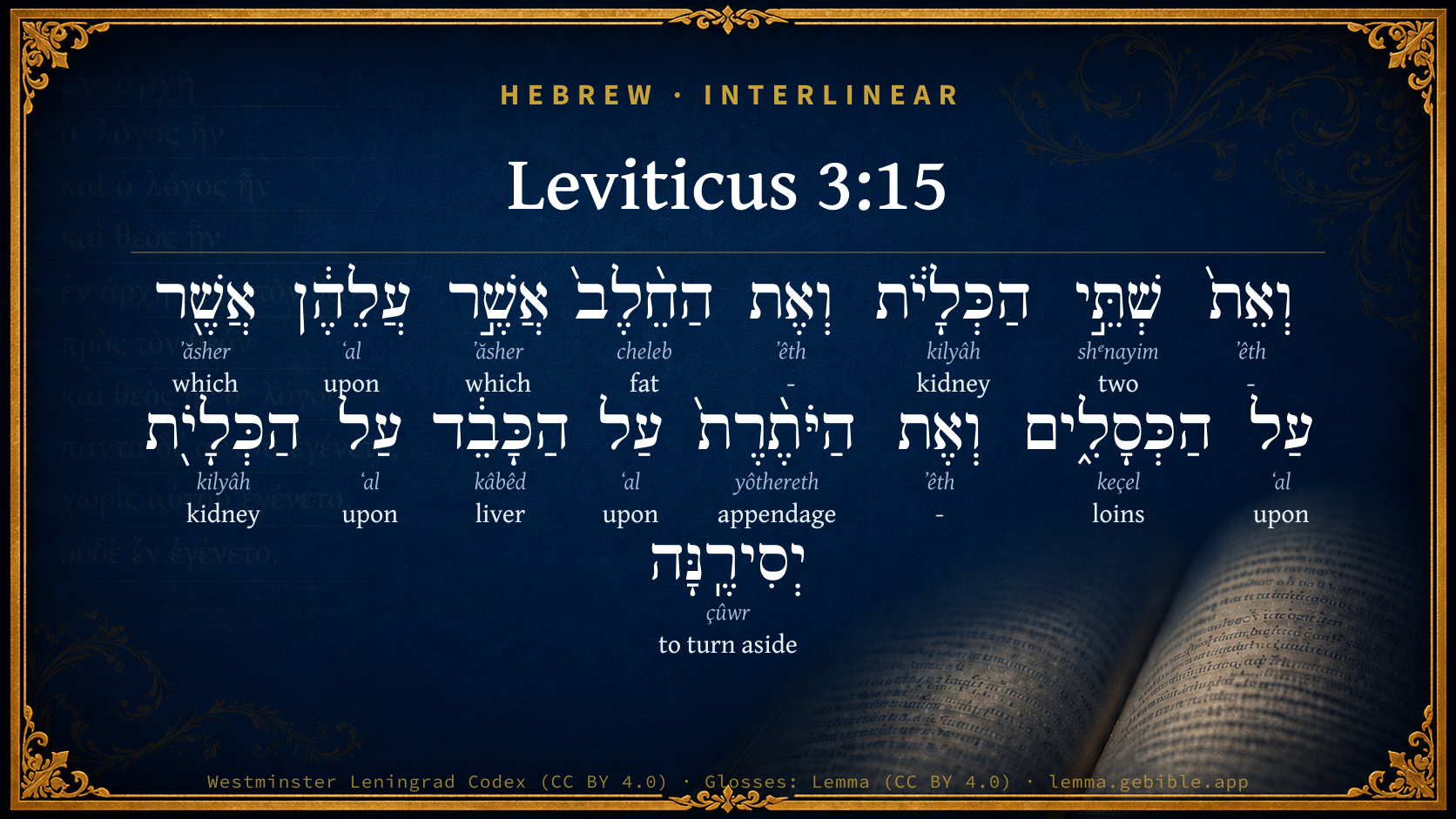
Hebrew (Westminster Leningrad Codex) Leviticus 3:15 appears in the Hebrew Old Testament. The text above is from the Westminster Leningrad Codex. Each word links to its Strong’s number, a concise gloss, and parsing drawn from the Open Scriptures Hebrew Bible morphology. Click any word for its full Brown-Driver-Briggs (BDB) entry.
Download image
Cite this verse

Leviticus 3:15 (World English Bible). Public Domain. Lemma interlinear Bible study tool, https://lemma.gebible.app/v/leviticus/3/15.

Show BibTeX & RIS
BibTeX
RIS
English Translation
and the two kidneys, and the fat that is on them, which is by the loins, and the cover on the liver, with the kidneys, he shall take away.
World English Bible · Public Domain
Download a study sheet

One document with this verse’s original text, its word-by-word gloss line, the meaning frame, cross-references with their text, attributed commentary, and full source and license credits — printable, and it pastes into notes with its structure intact.

This verse Autodidact and up

Study sheet (.html) Plain text (.txt)

A passage Seminary Student

Up to 50 verses in one chapter. A passage sheet keeps up to 6 commentary sources and 12 cross-references per verse, in the order this page ranks them, and says so on the sheet whenever that leaves anything out. Ask for a single verse and you get the Autodidact verse sheet above.

Everything on this page stays free to read, with no account — the sheet is a download of what is already on screen, not access to it.

Want to remove ads? Support Godless Engineer
Compare translations 3

The same verse in 3 English versions, stacked beneath the original-language interlinear above. Click any original word for its lexicon entry.

Each is an independent rendering of the whole verse — the interlinear is not word-aligned to these translations.

Highlighted words mark where these versions differ — a whole-verse word diff, not a word-by-word alignment.

  • World English Bible Public Domain
    and the two kidneys, and the fat that is on them, which is by the loins, and the cover on the liver, with the kidneys, he shall take away.
  • King James Version Public Domain
    And the two kidneys, and the fat that is upon them, which is by the flanks, and the caul above the liver, with the kidneys, it shall he take away.
  • unfoldingWord Literal Text CC BY-SA 4.0
    and the two kidneys and the fat that on them that by the loins and the lobe on the liver (he shall remove it with the kidneys).

unfoldingWord Literal Text — © unfoldingWord, licensed CC BY-SA 4.0. Word-aligned USFM3 via Door43 (git.door43.org/unfoldingWord/en_ult).

Versions to compare (up to 4)

3 of 4 selected

Show all 18 translations

Every available English version of this verse, each an independent rendering of the whole verse.

  • World English Bible Public Domain
    and the two kidneys, and the fat that is on them, which is by the loins, and the cover on the liver, with the kidneys, he shall take away.
  • Berean Standard Bible Public Domain
    both kidneys with the fat on them near the loins, and the lobe of the liver, which he is to remove with the kidneys.
  • Majority Standard Bible Public Domain
    both kidneys with the fat on them near the loins, and the lobe of the liver, which he is to remove with the kidneys.
  • King James Version Public Domain
    And the two kidneys, and the fat that is upon them, which is by the flanks, and the caul above the liver, with the kidneys, it shall he take away.
  • American Standard Version (1901) Public Domain
    and the two kidneys, and the fat that is upon them, which is by the loins, and the caul upon the liver, with the kidneys, shall he take away.
  • Revised Version (1885) Public Domain
    and the two kidneys, and the fat that is upon them, which is by the loins, and the caul upon the liver, with the kidneys, shall he take away.
  • Geneva Bible (1599) Public Domain
    Also hee shall take away the two kidneis, and the fat that is vpon them, and vpon ye flankes, and the kall vpon the liuer with the kidneis.
  • Douay-Rheims (1899) Public Domain
    The two little kidneys with the caul that is upon them which is by the flanks, and the fat of the liver with the little kidneys:
  • Young's Literal Translation Public Domain
    and the two kidneys, and the fat which `is' upon them, which `is' on the flanks, and the redundance above the liver, (beside the kidneys he doth turn it aside),
  • Literal Standard Version CC BY-SA 4.0
    and the two kidneys, and the fat which [is] on them, which [is] on the flanks, and the redundance on the liver above the kidneys—he turns it aside,
  • Unlocked Literal Bible CC BY-SA 4.0
    He will also remove the two kidneys and the fat that is with them, which is by the loins, and the lobe of the liver with the kidneys.
  • unfoldingWord Literal Text CC BY-SA 4.0
    and the two kidneys and the fat that on them that by the loins and the lobe on the liver (he shall remove it with the kidneys).
  • Darby Bible Public Domain
    and the two kidneys, and the fat that is on them, which is by the flanks, and the net above the liver which he shall take away as far as the kidneys;
  • World Messianic Bible Public Domain
    and the two kidneys, and the fat that is on them, which is by the loins, and the cover on the liver, with the kidneys, he shall take away.
  • Webster's Bible Public Domain
    And the two kidneys, and the fat that is upon them, which is by the flanks, and the caul above the liver, with the kidneys, that shall he take away.
  • Free Bible Version CC BY-SA 4.0
    both kidneys with the fat on them by the loins, and the best part of the liver, which you are to remove together with the kidneys.
  • Bible in Basic English Public Domain
    And the two kidneys, with the fat on them, which is by the top part of the legs, and the fat joining the liver and the kidneys, let him take away;
  • JPS Tanakh (1917) Public Domain
    and the two kidneys, and the fat that is upon them, which is by the loins, and the lobe above the liver, which he shall take away by the kidneys.

Literal Standard Version (2020), Covenant Press — licensed CC BY-SA 4.0. Text via the HelloAO Bible API (eBible.org). Unlocked Literal Bible (unfoldingWord) — licensed CC BY-SA 4.0. Text via the HelloAO Bible API (eBible.org). unfoldingWord Literal Text — © unfoldingWord, licensed CC BY-SA 4.0. Word-aligned USFM3 via Door43 (git.door43.org/unfoldingWord/en_ult). Free Bible Version, Dr. Jonathan Gallagher — licensed CC BY-SA 4.0. Text via the HelloAO Bible API (eBible.org).

Word by word

More ways to search: Search by grammar → Find every occurrence → Compare this word →

Practice this passage: Drill this verse → Learn its vocabulary →

הַיֹּתֶ֨רֶת֙
yôthereth
H3508
“the · appendage”
Particle, Definite Article + Noun, Common, Feminine, Singular, Absolute
Part of Speech
Particle + Noun
Type
Common
Gender
Feminine
Number
Singular
State
Absolute
Full BDB Definition

Origin: act. participle of H3498

TWOT: 936e

appendage, overhang, protrusion, the caudate lobe of the liver of a sacrificial animal
  1. וְאֵת֙ ʼêth H853 “and · -” Conjunction + Particle, Direct Object
  2. שְׁתֵּ֣י shᵉnayim H8147 “two” Adjective, Cardinal number, Feminine, Dual, Construct
  3. הַכְּלָיֹ֔ת kilyâh H3629 “the · kidneys” Particle, Definite Article + Noun, Common, Feminine, Plural, Absolute
  4. וְאֶת ʼêth H853 “and · -” Conjunction + Particle, Direct Object
  5. הַחֵ֨לֶב֙ cheleb H2459 “the · fat” Particle, Definite Article + Noun, Common, Masculine, Singular, Absolute
  6. אֲשֶׁ֣ר ʼăsher H834 “which” Particle, Relative
  7. עֲלֵהֶ֔ן ʻal H5921 “upon · them” Preposition + Suffix, Personal, 3rd Person, Feminine, Plural
  8. אֲשֶׁ֖ר ʼăsher H834 “which” Particle, Relative
  9. עַל ʻal H5921 “upon” Preposition
  10. הַכְּסָלִ֑ים keçel H3689 “the · loins” Particle, Definite Article + Noun, Common, Masculine, Plural, Absolute
  11. וְאֶת ʼêth H853 “and · -” Conjunction + Particle, Direct Object
  12. עַל ʻal H5921 “upon” Preposition
  13. הַכָּבֵ֔ד kâbêd H3516 “the · liver” Particle, Definite Article + Noun, Common, Feminine, Singular, Absolute
  14. עַל ʻal H5921 “upon” Preposition
  15. הַכְּלָיֹ֖ת kilyâh H3629 “the · kidneys” Particle, Definite Article + Noun, Common, Feminine, Plural, Absolute
  16. יְסִירֶֽנָּה çûwr H5493 “to turn aside · her” Verb, Hiphil, Imperfect, 3rd Person, Masculine, Singular + Suffix, Personal, 3rd Person, Feminine, Singular

About this verse

These counts appear in no published source. They are computed here, from the morphology-tagged text and Lemma’s own curated glosses. What Lemma adds →

17
words
10
distinct lemmas
Pentateuch
section

Notable vocabulary

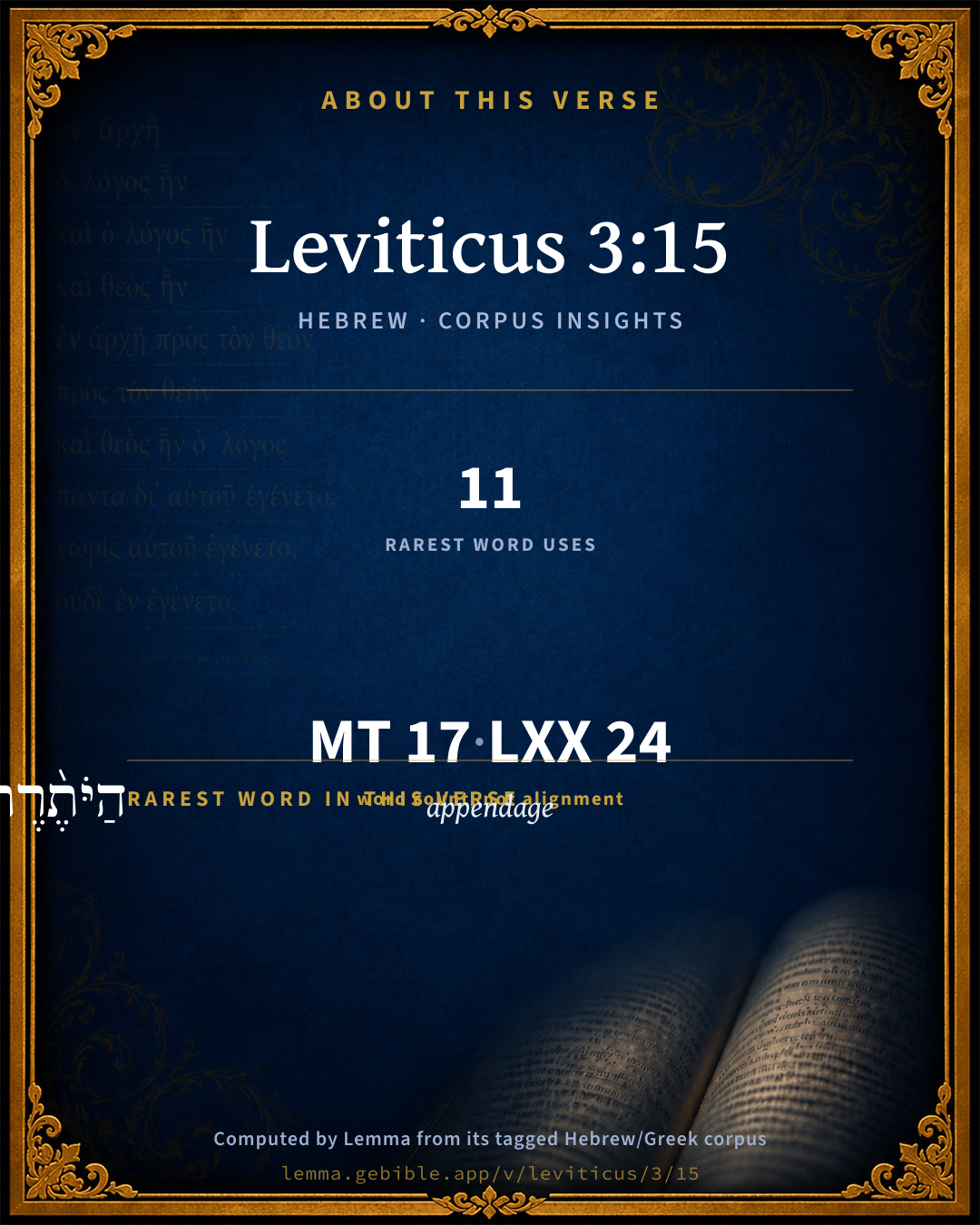
The rarest word here is הַיֹּתֶ֨רֶת֙ appendage H3508 — appearing just 11 times in the whole Hebrew Bible.

Shared distinctive vocabulary

הַיֹּתֶ֨רֶת֙ appendage H3508 occurs in 11 verses of the Hebrew Bible. Also found in:

Grammatical profile

  • 1 verb
  • 6 nouns
  • 1 adjective
  • 4 prepositions
  • 5 particles

Verb forms

  • יְסִירֶֽנָּה Hiphil · Imperfect

Repetition

Words recur within this verse — often emphatic in Hebrew:

  • עֲלֵהֶ֔ן upon H5921 ×4
  • הַכְּלָיֹ֔ת kidney H3629 ×2
  • אֲשֶׁ֣ר which H834 ×2

Hebrew & Septuagint length

In English translation the verse runs 29 words from the Hebrew and 31 from the Septuagint (LXX English) — closely comparable.

A rough comparison of the two English renderings, which tokenize alike — not a word-level alignment.

Word counts can differ between the Hebrew and the Greek without any difference in meaning — e.g. the Hebrew direct-object marker אֵת has no separate Greek word, and Greek often adds the article ὁ.

In the original languages it is 17 Hebrew tokens and 24 Greek tokens — but the two are counted differently (Hebrew bundles its prefixes and suffixes into one token; the Greek is in lemma form), so that isn’t a like-for-like length.

Hebrew and Greek witnesses Masoretic Hebrew ↔ Greek Septuagint

The same verse in the two great witnesses to the Old Testament, shown verse-for-verse.

These are two independent witnesses, not word-aligned to each other, and the Septuagint is shown in lemma (dictionary) form.

Hebrew Leviticus 3:15 Masoretic · Westminster Leningrad Codex

וְאֵת֙ שְׁתֵּ֣י הַכְּלָיֹ֔ת וְאֶת הַחֵ֨לֶב֙ אֲשֶׁ֣ר עֲלֵהֶ֔ן אֲשֶׁ֖ר עַל הַכְּסָלִ֑ים וְאֶת הַיֹּתֶ֨רֶת֙ עַל הַכָּבֵ֔ד עַל הַכְּלָיֹ֖ת יְסִירֶֽנָּה

and the two kidneys, and the fat that is on them, which is by the loins, and the cover on the liver, with the kidneys, he shall take away.

World English Bible · Public Domain

Greek LXX Leviticus 3:15 Septuagint · lemma form

καί ἀμφότεροι ὁ νεφρός καί πᾶς ὁ στέαρ ὁ ἐπί αὐτός ὁ ἐπί ὁ μηρίον καί ὁ λοβός ὁ ἧπαρ σύν ὁ νεφρός περιαἱρέω

And both the kidneys, and all the fat that is upon them, that which is upon the thighs, and the caul of the liver with the kidneys, shall he take away.

LXX2012 (modern English Septuagint) · Public Domain

Hebrew: Westminster Leningrad Codex (CC BY 4.0). Greek: Septuagint (public domain); English from LXX2012 (modern English Septuagint) (Public Domain). How the Septuagint differs from the Hebrew →

Targum (Aramaic paraphrase)

2

The Targum is the ancient Jewish Aramaic paraphrase of the Hebrew Scriptures — an interpretive translation, not the Hebrew text itself. Onkelos (literal) and Pseudo-Jonathan (expansive) render the Torah, and Jonathan the Prophets. Coverage is partial: where no permissively-licensed English translation exists for a verse, only the Aramaic is shown. This is verse-level text, not a word-by-word alignment to the Hebrew.

  1. Targum Onkelos Torah (Genesis–Deuteronomy)
    וְיָת תַּרְתֵּין כָּלְיָן וְיָת תַּרְבָּא דִי עֲלֵיהֶן דִי עַל גִסְסַיָא וְיָת חַצְרָא דִי עַל כַּבְדָא עַל כָּלְיֵתָא יֶעְדִנַהּ

    (no public-domain English translation for this verse)

    Targum Onkelos — Aramaic: “Onkelos Genesis” (public domain); “Onkelos Exodus” (public domain); “Onkelos Leviticus” (public domain); “Onkelos Numbers” (public domain); “Onkelos Deuteronomy” (public domain). English: “Sefaria Community Translation” (CC0 1.0 (public-domain dedication)); “J.W. Etheridge. The Targums of Onkelos and Jonathan Ben Uzziel on the Pentateuch. London: Longmans, Green, 1862” (public domain). Text via Sefaria.

  2. Targum Pseudo-Jonathan Torah (Genesis–Deuteronomy)
    וְיַת תַּרְתֵּין כּוּלְיַין וְיַת תַּרְבָּא דַעֲלֵיהוֹן דְעַל כַּפְלֵי וְיַת חַצְרָא דְעַל כַּבְדָא דְעַל כּוּלְיְיתָא יַעֲדִינָהּ

    And the two kidneys and the fat which is upon them (and) on the foldings, and the caul which is over the liver, along with the kidneys, he shall take away.

    Targum Pseudo-Jonathan — Aramaic: “Targum Jonathan on Genesis” (public domain); “Targum Jonathan on Exodus” (public domain); “Targum Jonathan on Leviticus” (public domain); “Targum Jonathan on Numbers” (public domain); “Targum Jonathan on Deuteronomy” (public domain). English: “The Targum of Jonathan ben Uzziel, trans. J. W. Etheridge, London, 1862” (public domain). Text via Sefaria.

Commentary

Notes on Leviticus 3:15 from classic Christian and Jewish commentators (each source and its license shown beneath its notes). The classic Christian expositions comment on the surrounding passage and are grouped to its opening verse, so a note may address several verses; the Jewish commentaries on the Tanakh (Rashi and others) are per-verse, so they appear only where the commentator wrote on this verse.

Lemma curates 59 commentaries, every one of them public domain or Creative Commons licensed, each selected and text-cleaned for this edition rather than reprinted as found. About our sources →

unfoldingWord translationNotes

Door43 World Missions Community

He will also

Here "He" refers to the person offering the sacrifice.

will burn all that on the altar as a burnt offering of food

Translate this in a way that it does not seem like Yahweh actually eats the food. AT: "will burn those things on the altar to be an offering to Yahweh. It will be as though they are food given to Yahweh"

to produce a sweet aroma

Yahweh is pleased with the aroma of burning meat when he is pleased with the worshiper's sincerity. See how you translated this in Leviticus 1:9. (See: Metaphor)

It will be a permanent statute throughout your people's generations

This means that they and their descendants must obey this command forever.

or blood

"or consume blood"

translationWords

priest

altar

sacrifice

Yahweh

statute

people group

generation

unfoldingWord translationNotes — © Distant Shores Media and the Door43 World Missions Community, licensed CC BY-SA 4.0. Source: git.door43.org/Door43/en_tn.

Lesson kit

Teaching starters — assembled from the data on this page, not authored interpretation. Every prompt links to the verse data it draws on. Edit before teaching.

Leviticus, in the Pentateuch, opens this verse with 17 words (10 distinct Hebrew lemmas). Its most distinctive word is yôthereth (“appendage”). Read the whole chapter for the surrounding context.

Discussion questions

  1. The word yôthereth carries the sense “appendage.” How does it shape the verse?
  2. How does Exodus 29:13, which shares the word «appendage», read alongside this verse?
  3. What does the repetition of “upon” (4× in this one verse) do in this verse?
  4. The translations on this page render this verse differently — a whole-verse word diff, not a word-by-word alignment. What might account for the different wordings?
  5. «יְסִירֶֽנָּה» is a Hiphil Imperfect verb. How does that grammatical form shape the action described?

Things to notice

Reading settings

Reading text

Shown beneath each verse's original-language words.

Old Testament
Old Testament edition

Read the OT as the Masoretic Hebrew (MT) or the Greek Septuagint (LXX).

English shown for the Greek Septuagint (in the Hebrew ↔ Greek comparison).

Comparing translations? Open the Compare panel on any verse page to stack up to four side by side.