Esther 3:10

Hebrew (Westminster Leningrad Codex) Esther 3:10 appears in the Hebrew Old Testament. The text above is from the Westminster Leningrad Codex. Each word links to its Strong’s number, a concise gloss, and parsing drawn from the Open Scriptures Hebrew Bible morphology. Click any word for its full Brown-Driver-Briggs (BDB) entry.
Download image
Cite this verse

Esther 3:10 (World English Bible). Public Domain. Lemma interlinear Bible study tool, https://lemma.gebible.app/v/esther/3/10.

Show BibTeX & RIS
BibTeX
RIS
English Translation
The king took his ring from his hand, and gave it to Haman the son of Hammedatha the Agagite, the Jews' enemy.
World English Bible · Public Domain
Download a study sheet

One document with this verse’s original text, its word-by-word gloss line, the meaning frame, cross-references with their text, attributed commentary, and full source and license credits — printable, and it pastes into notes with its structure intact.

This verse Autodidact and up

Study sheet (.html) Plain text (.txt)

A passage Seminary Student

Up to 50 verses in one chapter. A passage sheet keeps up to 6 commentary sources and 12 cross-references per verse, in the order this page ranks them, and says so on the sheet whenever that leaves anything out. Ask for a single verse and you get the Autodidact verse sheet above.

Everything on this page stays free to read, with no account — the sheet is a download of what is already on screen, not access to it.

Want to remove ads? Support Godless Engineer
Compare translations 3

The same verse in 3 English versions, stacked beneath the original-language interlinear above. Click any original word for its lexicon entry.

Each is an independent rendering of the whole verse — the interlinear is not word-aligned to these translations.

Highlighted words mark where these versions differ — a whole-verse word diff, not a word-by-word alignment.

  • World English Bible Public Domain
    The king took his ring from his hand, and gave it to Haman the son of Hammedatha the Agagite, the Jews' enemy.
  • King James Version Public Domain
    And the king took his ring from his hand, and gave it unto Haman the son of Hammedatha the Agagite, the Jews' enemy.
  • unfoldingWord Literal Text CC BY-SA 4.0
    And the king removed his signet ring from on his hand, and he gave it to Haman, the son of Hammedatha, the Agagite, the adversary of the Jews.

unfoldingWord Literal Text — © unfoldingWord, licensed CC BY-SA 4.0. Word-aligned USFM3 via Door43 (git.door43.org/unfoldingWord/en_ult).

Versions to compare (up to 4)

3 of 4 selected

Show all 18 translations

Every available English version of this verse, each an independent rendering of the whole verse.

  • World English Bible Public Domain
    The king took his ring from his hand, and gave it to Haman the son of Hammedatha the Agagite, the Jews' enemy.
  • Berean Standard Bible Public Domain
    So the king removed the signet ring from his finger and gave it to Haman son of Hammedatha, the Agagite, the enemy of the Jews.
  • Majority Standard Bible Public Domain
    So the king removed the signet ring from his finger and gave it to Haman son of Hammedatha, the Agagite, the enemy of the Jews.
  • King James Version Public Domain
    And the king took his ring from his hand, and gave it unto Haman the son of Hammedatha the Agagite, the Jews' enemy.
  • American Standard Version (1901) Public Domain
    And the king took his ring from his hand, and gave it unto Haman the son of Hammedatha the Agagite, the Jews' enemy.
  • Revised Version (1885) Public Domain
    And the king took his ring from his hand, and gave it unto Haman the son of Hammedatha the Agagite, the Jews’ enemy.
  • Geneva Bible (1599) Public Domain
    Then the King tooke his ring from his hand and gaue it vnto Haman the sonne of Hammedatha the Agagite the Iewes aduersarie.
  • Douay-Rheims (1899) Public Domain
    And the king took the ring that he used, from his own hand, and gave it to Aman, the son of Amadathi of the race of Agag, the enemy of the Jews,
  • Young's Literal Translation Public Domain
    And the king turneth aside his signet from off his hand, and giveth it to Haman son of Hammedatha the Agagite, adversary of the Jews;
  • Literal Standard Version CC BY-SA 4.0
    And the king turns aside his signet from off his hand, and gives it to Haman son of Hammedatha the Agagite, adversary of the Jews;
  • Unlocked Literal Bible CC BY-SA 4.0
    Then the king took the signet ring from his hand and gave it to Haman son of Hammedatha the Agagite, the enemy of the Jews.
  • unfoldingWord Literal Text CC BY-SA 4.0
    And the king removed his signet ring from on his hand, and he gave it to Haman, the son of Hammedatha, the Agagite, the adversary of the Jews.
  • Darby Bible Public Domain
    And the king took his ring from his hand, and gave it to Haman the son of Hammedatha the Agagite, the Jews' enemy.
  • World Messianic Bible Public Domain
    The king took his ring from his hand, and gave it to Haman the son of Hammedatha the Agagite, the Jews’ enemy.
  • Webster's Bible Public Domain
    And the king took his ring from his hand, and gave it to Haman the son of Hammedatha the Agagite, the Jews enemy.
  • Free Bible Version CC BY-SA 4.0
    The king took off his signet ring and handed it to Haman, son of Hammedatha, the Agagite, the enemy of the Jews.
  • Bible in Basic English Public Domain
    And the king took his ring from his hand and gave it to Haman, the son of Hammedatha the Agagite, the hater of the Jews.
  • JPS Tanakh (1917) Public Domain
    And the king took his ring from his hand, and gave it unto Haman the son of Hammedatha the Agagite, the Jews' enemy.

Literal Standard Version (2020), Covenant Press — licensed CC BY-SA 4.0. Text via the HelloAO Bible API (eBible.org). Unlocked Literal Bible (unfoldingWord) — licensed CC BY-SA 4.0. Text via the HelloAO Bible API (eBible.org). unfoldingWord Literal Text — © unfoldingWord, licensed CC BY-SA 4.0. Word-aligned USFM3 via Door43 (git.door43.org/unfoldingWord/en_ult). Free Bible Version, Dr. Jonathan Gallagher — licensed CC BY-SA 4.0. Text via the HelloAO Bible API (eBible.org).

Word by word

More ways to search: Search by grammar → Find every occurrence → Compare this word →

Practice this passage: Drill this verse → Learn its vocabulary →

הַמְּדָ֛תָא
Mᵉdâthâʼ
H4099
“Hammedatha”
Noun, Proper
Part of Speech
Noun
Type
Proper
Full BDB Definition

Origin: of Persian origin

TWOT: None

Hammedatha = "double" - father of Haman
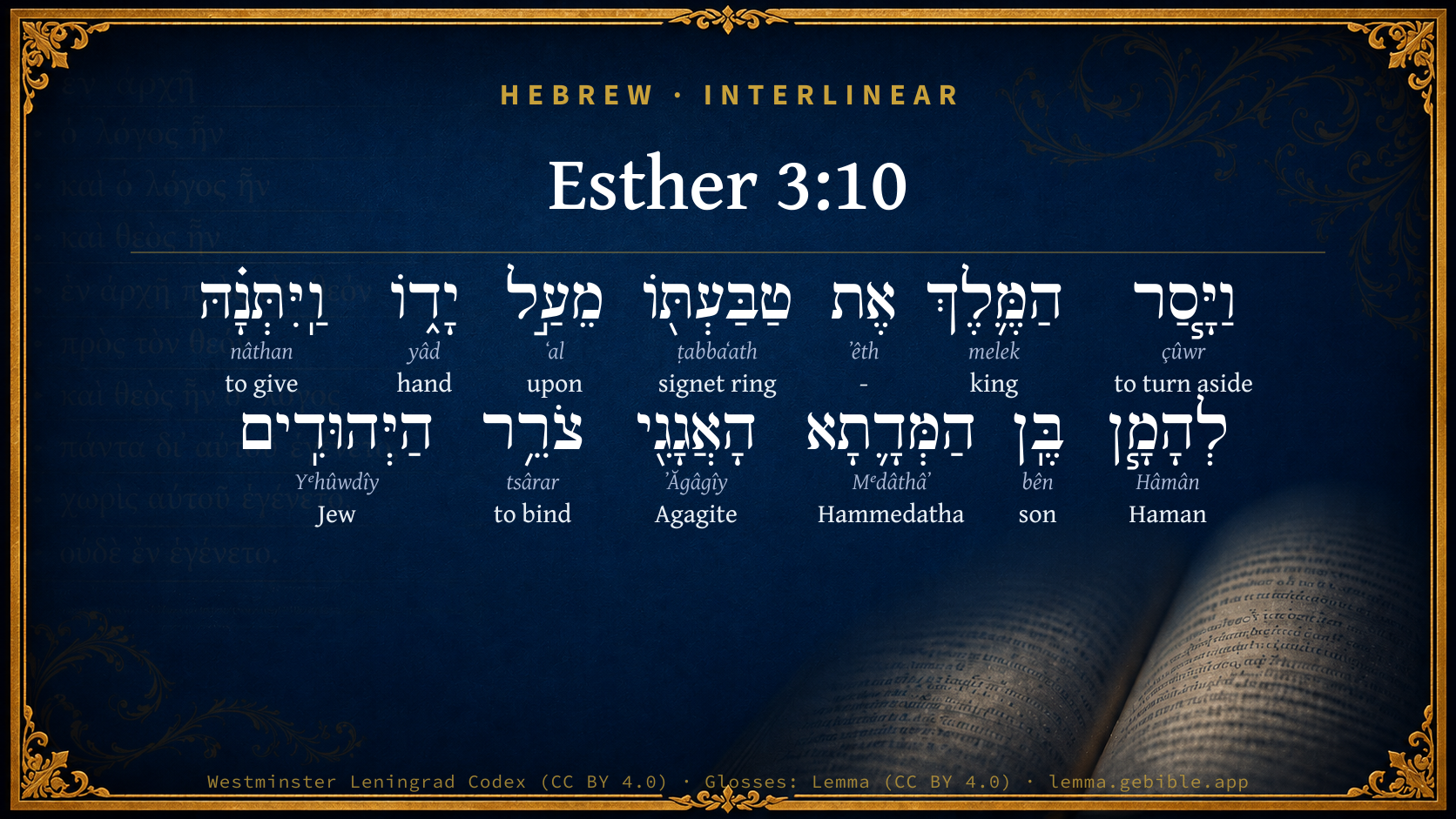
  1. וַיָּ֧סַר çûwr H5493 “and · to turn aside” Conjunction + Verb, Hiphil, Sequential Imperfect, 3rd Person, Masculine, Singular
  2. הַמֶּ֛לֶךְ melek H4428 “the · king” Particle, Definite Article + Noun, Common, Masculine, Singular, Absolute
  3. אֶת ʼêth H853 “-” Particle, Direct Object
  4. טַבַּעְתּ֖וֹ ṭabbaʻath H2885 “signet ring · his” Noun, Common, Feminine, Singular, Construct + Suffix, Personal, 3rd Person, Masculine, Singular
  5. מֵעַ֣ל ʻal H5921 “from · upon” Preposition + Preposition
  6. יָד֑וֹ yâd H3027 “hand · his” Noun, Common, Both, Singular, Construct + Suffix, Personal, 3rd Person, Masculine, Singular
  7. וַֽיִּתְּנָ֗הּ nâthan H5414 “and · to give · her” Conjunction + Verb, Qal, Sequential Imperfect, 3rd Person, Masculine, Singular + Suffix, Personal, 3rd Person, Feminine, Singular
  8. לְהָמָ֧ן Hâmân H2001 “to/for · Haman” Preposition + Noun, Proper
  9. בֶּֽן bên H1121 “son of” Noun, Common, Masculine, Singular, Construct
  10. הָאֲגָגִ֖י ʼĂgâgîy H91 “the · Agagite” Particle, Definite Article + Noun, Gentilic, Masculine, Singular, Absolute
  11. צֹרֵ֥ר tsârar H6887 “binding” Verb, Qal, Participle Active, Masculine, Singular, Construct
  12. הַיְּהוּדִֽים Yᵉhûwdîy H3064 “the · Jews” Particle, Definite Article + Noun, Gentilic, Masculine, Plural, Absolute

About this verse

These counts appear in no published source. They are computed here, from the morphology-tagged text and Lemma’s own curated glosses. What Lemma adds →

13
words
13
distinct lemmas
Historical
section

Notable vocabulary

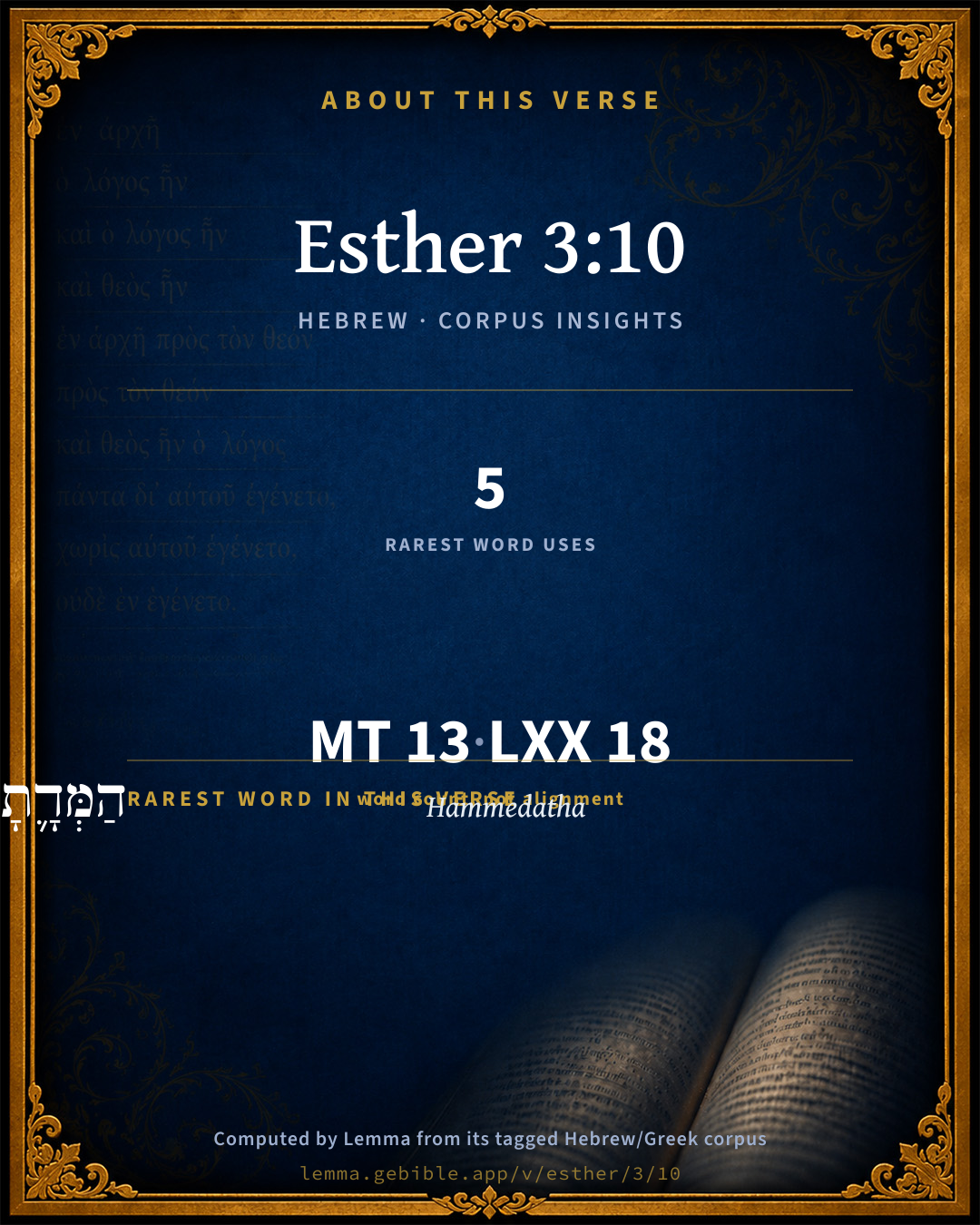
The rarest word here is הַמְּדָ֛תָא Hammedatha H4099 — appearing just 5 times in the whole Hebrew Bible.

Shared distinctive vocabulary

הַמְּדָ֛תָא Hammedatha H4099 occurs in 5 verses of the Hebrew Bible. Also found in:

Grammatical profile

  • 3 verbs
  • 8 nouns
  • 1 preposition
  • 1 particle

Verb forms

  • וַיָּ֧סַר Hiphil · Sequential Imperfect
  • וַֽיִּתְּנָ֗הּ Qal · Sequential Imperfect
  • צֹרֵ֥ר Qal · Participle Active

Hebrew & Septuagint length

In English translation the verse runs 22 words from the Hebrew and 22 from the Septuagint (LXX English) — the same length.

A rough comparison of the two English renderings, which tokenize alike — not a word-level alignment.

Word counts can differ between the Hebrew and the Greek without any difference in meaning — e.g. the Hebrew direct-object marker אֵת has no separate Greek word, and Greek often adds the article ὁ.

In the original languages it is 13 Hebrew tokens and 18 Greek tokens — but the two are counted differently (Hebrew bundles its prefixes and suffixes into one token; the Greek is in lemma form), so that isn’t a like-for-like length.

Cross-references

5

Topical passages linked to Esther 3:10 in the Treasury of Scripture Knowledge — connected by theme and wording, ordered by reader-vote popularity; previews shown in the World English Bible.

  • Genesis 41:42 Pharaoh took off his signet ring from his hand, and put it on Joseph's hand, and arrayed him in robes of fine linen, and put a gold chain about his neck,
  • Esther 8:2 The king took off his ring, which he had taken from Haman, and gave it to Mordecai. Esther set Mordecai over the house of Haman.
  • Esther 7:6 Esther said, An adversary and an enemy, even this wicked Haman. Then Haman was afraid before the king and the queen.
  • Esther 3:1 After these things did king Ahasuerus promote Haman the son of Hammedatha the Agagite, and advanced him, and set his seat above all the princes who were with him.
  • Esther 8:8 Write you also to the Jews, as it pleases you, in the king's name, and seal it with the king's ring; for the writing which is written in the king's name, and sealed with the king's ring, may no man reverse.

Cross-references courtesy of OpenBible.info (CC BY 4.0).

Hebrew and Greek witnesses Masoretic Hebrew ↔ Greek Septuagint

The same verse in the two great witnesses to the Old Testament, shown verse-for-verse.

These are two independent witnesses, not word-aligned to each other, and the Septuagint is shown in lemma (dictionary) form.

Hebrew Esther 3:10 Masoretic · Westminster Leningrad Codex

וַיָּ֧סַר הַמֶּ֛לֶךְ אֶת טַבַּעְתּ֖וֹ מֵעַ֣ל יָד֑וֹ וַֽיִּתְּנָ֗הּ לְהָמָ֧ן בֶּֽן הַמְּדָ֛תָא הָאֲגָגִ֖י צֹרֵ֥ר הַיְּהוּדִֽים

The king took his ring from his hand, and gave it to Haman the son of Hammedatha the Agagite, the Jews' enemy.

World English Bible · Public Domain

Greek LXX Esther 3:10 Septuagint · lemma form

καί περιαἱρέω ὁ βασιλεύς ὁ δακτύλιος δίδωμι εἰς χείρ ὁ αμαν σφραγίζω κατά ὁ γράφω κατά ὁ ἰουδαῖος

And the king took off his ring, and gave it into the hands of Aman, to seal the decrees against the Jews.

LXX2012 (modern English Septuagint) · Public Domain

Hebrew: Westminster Leningrad Codex (CC BY 4.0). Greek: Septuagint (public domain); English from LXX2012 (modern English Septuagint) (Public Domain). How the Septuagint differs from the Hebrew →

Commentary

Notes on Esther 3:10 from classic Christian and Jewish commentators (each source and its license shown beneath its notes). The classic Christian expositions comment on the surrounding passage and are grouped to its opening verse, so a note may address several verses; the Jewish commentaries on the Tanakh (Rashi and others) are per-verse, so they appear only where the commentator wrote on this verse.

Lemma curates 59 commentaries, every one of them public domain or Creative Commons licensed, each selected and text-cleaned for this edition rather than reprinted as found. About our sources →

Trapp's Complete Commentary

John Trapp

Est 3:10 And the king took his ring from his hand, and gave it unto Haman the son of Hammedatha the Agagite, the Jews’ enemy.

Ver. 10. And the king took his ring from his hand] And thereby gave him power to do what he pleased, Gen 41:42 1Ki 21:8, En regis huius inertiam et impcritiam. How weak (weak as water, Gen 49:4) was the heart of this brutish barbarian, skilful to destroy! Eze 21:31, seeing he did all these things, the work of an imperious whorish woman, Eze 16:30, rather than of an able man, such as every magistrate should be, Exo 18:21, just, and ruling in the fear of God, 2Sa 23:3. In the case of Vashti he could refer the matter to the consideration of a council. In the case of the two eunuchs that had conspired against his life he made inquisition of the matter, and did all things deliberately. In the case of Haman after this, though deeply displeased, yet he did nothing rashly, till he had gone into the palace garden, and considered with himself what was best to be done. But here upon the very first motion (without hearing them speak for themselves, or admonishing them to do their duty better, &c.) he gives order for the slaying of so many thousand innocents, never considering that every drop of their blood had a voice in it to cry for vengeance against him and his, Gen 4:10 Mat 22:7. And when the king heard it; for blood cries aloud to God; 2Ki 9:26, "Surely I have seen yesterday the blood of Naboth." Murder ever bleeds fresh in the eye of Almighty God. To him many years, yea, that eternity that is past, is but yesterday. He will give such blood again to drink, for they are worthy, Rev 16:6. Dealt he not so by Herod, Julian, Attilas, Felix of Wurtemburg, Farnesius, Minerius, Charles IX, king of France, who died by exceeding bleeding at sundry parts of his body, soon after the Parisian Massacre, whereof he was the author, giving as large and as bloody a commission to the duke of Guise to destroy, to kill, and to cause to perish all the French Protestants, as Ahasuerus did here to Haman? Neither was he slack to execute it with greatest inhumanity, crying out to those of his party (after that he had slain the admiral), Courage, my fellows, fall on, the king commands it, it is his express pleasure, he commands it (The Hist. of French Mass., by Mr Clark). But what followed shortly after?

Quem sitiit vivens scelerata mente cruorem,

Perfidus hunc moriens Carolus ore vomit.

Ergo Dei tandem verbo subscribite, Reges;

Ne rapiant Stygiae vos Acherontis aquae.

And gave it unto Haman] Who now being his favourite, might have anything of him, like as it is said of Sejanus, that in all his designs he found in Tiberius the emperor so great facility and affection to his desire, that he needed only to ask and give thanks. He never denied him anything, and ofttimes anticipated his request, and avowed that he deserved much more. It was not, therefore, without cause that the primitive Christians prayed so hard for the emperor, that God would send him good counsellors, and deliver him from flatterers and slanderers, those pests of the court (Tertull. Apol.).

The Jews’ enemy] That was his style, or rather his brand and mark of ignominy, worse than that of Cain, Gen 4:15, that of Dathan, Num 26:9, of Ahaz, 2Ch 28:22. It may be he affected this title, and gloried in it; as we read of John Oneal, father to the earl of Tyrone, that rebel 1598, that he inscribed himself in all places, I, great John Oneal, cousin to Christ, friend to the queen of England, and foe to all the world besides (Camden).

John Trapp, A Commentary or Exposition upon All the Books of the Old and New Testament (1647–1656) — public domain. Text from a community e-Sword module.

Joseph Benson's Commentary

Est 3:10. And the king took his ring from his hand, &c. — Without any examination into the condition of the people, he consented to their destruction. So loath are men that love their pleasure to take any pains to distinguish between truth and falsehood. And gave it unto Haman — That he might keep it as a badge of his supreme authority under the king, and that he might use it for the sealing of this decree which was now made, or of any other that might be made hereafter. The Agagite, the Jews’ enemy — Such he was, both by inclination, as he was an Amalekite, and especially by this destructive design and resolution.

Joseph Benson's Commentary on the Old and New Testaments (1811–1818) — public domain. Text from a community e-Sword module.

Tyndale Open Study Notes

Tyndale Open Resources

3:10-11 The king agreed with no inquiry. The king is presented as someone very irresponsible and easily manipulated. By removing his signet ring, the king gave up his control over official policies; by giving it to Haman, he signified that Haman had complete authority to seal the decree. • the enemy of the Jews: The narrator’s new title for Haman is an ominous note regarding his power to persecute the Jews (see also 8:1; 9:10, 24). • The money and the people are both yours: It may appear that the king did not want the bribe, but 4:7 suggests that Haman did give the money. The king was following a customary protocol to make the bribe and his greed less obvious (cp. Gen 23:10-16). For the sake of public appearance the king pretended not to be interested in the money, but in reality he was.

Tyndale Open Study Notes — © Tyndale Open Resources, licensed CC BY-SA 4.0. Text via the HelloAO Bible API.

Jamieson, Fausset & Brown

Robert Jamieson, A. R. Fausset & David Brown

the king took his ring from his hand, and gave it unto Haman--There was a seal or signet in the ring. The bestowment of the ring, with the king's name and that of his kingdom engraven on it, was given with much ceremony, and it was equivalent to putting the sign manual to a royal edict.

Jamieson, Fausset & Brown — Commentary Critical and Explanatory on the Whole Bible (1871) — public domain (CC PDM 1.0). Text via the HelloAO Bible API.

Adam Clarke's Commentary

Verse 10. The king took his ring] In this ring was no doubt included his privy seal, and he gave this to Haman, that when he had formed such a decree as he thought fit, he might seal it with this ring, which would give it its due force and influence among the rulers of the provinces. The privy seal of many of our sovereigns appears to have been inserted in their rings; and the seals of Eastern potentates were worn in rings upon their fingers. One such seal, once the property of the late Tippoo Sultan, lies before me; the inscription is deeply cut in silver, which is set in a massy carriage of gold. This, as fitted to the finger, he probably kept always on his hand, to be ready to seal despatches, &c., or it might be carried by a confidential officer for the same purpose, as it seems to refer to one of the chief cutcheries, or military officers.

Adam Clarke's Commentary on the Bible (1810–1826) — public domain. Text from a community e-Sword/MySword module.

The Cambridge Bible for Schools and Colleges

gen. ed. J. J. S. Perowne

10. his ring] The possession of the king’s signet ring gave the holder full power to issue edicts in his name, since the sealing of them with his signet gave them validity. Alexander the Great is said to have intimated in this way that he desired his general Perdiccas to succeed him. Cp. for the use of a signet ring in this connexion Est_8:2; Gen_41:42; 1Ma_6:15; see also Josephus, Ant. xx. 2. 2.

Haman the son of Hammedatha the Agagite, the Jews’ enemy] This full description lays stress upon the terrible plight in which the Jews were placed by the delegation of unlimited powers for their destruction into the hands of their hereditary foe.

The Cambridge Bible for Schools and Colleges (gen. ed. J. J. S. Perowne; Cambridge University Press, 1878–1918) — public domain. Text from a community e-Sword module.

John Gill's Exposition

And the king took his ring from his hand, and gave it unto Haman, the son of Hammedatha the Agagite, the Jews' enemy. As a token of his affection for him, and a mark of honour to him; with the Persians (w) for a king to give a ring to anyone was a token and bond of the greatest love and friendship imaginable; and it may be this was given to Haman, to seal with it the letters that were or should be written, giving order for the destruction of the Jews. It seems as if as yet Esther had not acquainted the king who her kindred and people were; or it can hardly be thought he would have so easily come into such a scheme, or so highly favoured an enemy of her people.

(w) Alex. ab. Alex. Genial. Dier. l. 1. c. 26. & l. 2. c. 19.

John Gill's Exposition of the Whole Bible (1746–1763) — public domain (CC PDM 1.0). Text via the HelloAO Bible API.

Haydock's Catholic Bible Commentary

Ring, to transfer his power to him, for the time, Genesis xli. 42. Alexander gave his ring to Periccas, and was generally supposed thus to designate him for his successor. (Justin. xii.) See 1 Machabees vi. 14, 15.

George Leo Haydock (1774–1849), Haydock's Catholic Family Bible and Commentary, 1859 edition — public domain. Excludes Psalms (Douay-Rheims chapter numbering differs from Protestant) and Deuterocanonical books (Catholic canon only).

Matthew Poole's English Annotations

Gave it unto Haman; that he might keep it as a badge of his supreme authority under the king, and that he might use it for the sealing of this decree which now he desired, or of any other, as hereafter he should see fit. Compare Est 8:2,8; Ge 41:42.

The Jews’ enemy; so he was, both by inclination, as he was an Amalekite, and especially by this malicious and destructive design and resolution.

Matthew Poole's English Annotations on the Holy Bible (1683–1685) — public domain. Text from a community e-Sword/MySword module.

Whedon's Commentary on the Bible

Daniel D. Whedon

10. Took his ring… and gave it unto Haman — This was done for the purpose of sealing with irrevocable authority the letters which Haman designed (see Est_3:12) to send to all the rulers of the provinces; “for the writing which is written in the king’s name, and sealed with the king’s ring may no man reverse.” Est_8:8. Many ancient signet rings have been discovered, some made of gold, others of various kinds of stone. Those made of stone are usually cylindrical. The signet cylinder of Darius Hystaspes bears a trilingual inscription which reads, “Darius the Great King,” and also a picture of the king hunting lions in a palm grove.

Daniel D. Whedon (gen. ed.), Commentary on the Old and New Testaments (1874–1909) — public domain. Text from a community e-Sword module.

The Pulpit Commentary

The king took his ring from his hand. Rather, "took his signet from his hand." This may have been a ring, for signet-rings were known to the Persians, but is perhaps more likely to have been a cylinder, like that of Darius, his father, which is now in the British Museum ("Ancient Monarchies," vol. 4. p. 182). And gave it unto Haman. Thus giving him the power of making whatsoever edicts he pleased, since nothing was requisite to give authority to an edict but the impression of the royal seal (see Herod., 3:128). For similar acts of confidence see Gen_41:42; Est_8:2. The Jews" enemy. Rather, "persecutor.

Vers. 10, 11.

Power in bad hands.

How all the links in the chain of evil counsel were fastened together! The tyrannical king was willing enough, in order to please a favourite, to decree the slaughter of a whole people scattered through his dominions. The cruel minister of state was willing enough to take the king s signet, and to issue the decree of extermination. The scribes were willing enough to write the missives of destruction. The lieutenants, governors, and rulers were willing enough to receive and to issue orders for the slaughter of the exiles. And, when the time came, the soldiers and other officers of injustice would be willing enough to "destroy, to kill, and to cause to perish, all Jews" upon whom they could lay their hands.

I THE COUNSELLOR OF STATE ABUSES HIS INFLUENCE. It is a responsible thing to be the adviser of a throne; for such counsel, as may in such circumstances be given, may mould a nation"s character and determine its destinies. It is prostitution of such power to use it for selfish, far more for malicious, ends.

II THE SOVEREIGN DELEGATES HIS POWER WITH INDIFFERENCE. It does not follow that because bad counsel is given, it must be followed. But this is likely enough to be the case when a monarch is careless, voluptuous, capricious, and arbitrary. Such was the character of Xerxes. How natural from his lips the language, "The silver is given to thee, the people also, to do with them as it seemeth good to thee." Scarcely less culpable was the king than his counsellor.

III ALL MEN"S EVIL DESIGNS MAY BE FRUSTRATED BY THE PROVIDENCE OF GOD. If the prime minister and the despotic king of Persia could not, with all their power, destroy the Jews, who what could do so?

Practical lessons:

1. Rejoice in the blessings of constitutional government. In our country,happily, such a proceeding as this is impossible.

2. Sympathise with the cause of liberty, as opposed to tyranny, throughout the world. What vast populations are at the present day subject to the unjust authority, exactions, and oppressions of tyrannical governors. May the Lord deliver them from the yoke!

3. Pray for the frustration of cruel and tyrannical counsels, in many placesChristians have been, and are, persecuted for righteousness" sake. Let our prayer be, God deliver them from the hands of those that hate and oppress them.

The Pulpit Commentary (1880–1919), ed. H.D.M. Spence-Jones & Joseph S. Exell — public domain. Text from a community e-Sword module.

unfoldingWord translationNotes

Door43 World Missions Community

signet ring

a special ring that could be used to imprint the king's official seal on a proclamation

I will see that the money is given back to you

The meaning of this phrase is not clear. Possible meanings are 1) "I will return the money to you" or 2) "Take the money and give it to the men just as you have said." (See: Active or Passive)

translationWords

Jew

unfoldingWord translationNotes — © Distant Shores Media and the Door43 World Missions Community, licensed CC BY-SA 4.0. Source: git.door43.org/Door43/en_tn.

Rashi

Rabbi Shlomo Yitzchaki (Rashi)

And the king took his ring off This represents the granting of any great matter that is requested of the king; the one who has the ring on his hand is the ruler over all the king’s affairs.

Rashi on the Tanakh — English translations: “The Judaica Press complete Tanach with Rashi, translated by A. J. Rosenberg” (CC BY 4.0); “Pentateuch with Rashi's commentary by M. Rosenbaum and A.M. Silbermann, 1929-1934” (public domain); “The Metsudah Tanach series, Lakewood, N.J” (CC BY 4.0); and “The Book of Joshua, Metsudah Publications, 1997” (CC BY 4.0). Text via Sefaria.

Lesson kit

Teaching starters — assembled from the data on this page, not authored interpretation. Every prompt links to the verse data it draws on. Edit before teaching.

Esther, in the Historical, opens this verse with 13 words (13 distinct Hebrew lemmas). Its most distinctive word is Mᵉdâthâʼ (“Hammedatha”). A historical commentator’s framing appears above. Read the whole chapter for the surrounding context.

Discussion questions

  1. The word Mᵉdâthâʼ carries the sense “Hammedatha.” How does it shape the verse?
  2. How does Esther 3:1, which shares the word «Hammedatha», read alongside this verse?
  3. These translations render this verse differently. What is at stake in choosing one wording over another?
  4. «וַיָּ֧סַר» is a Hiphil Sequential Imperfect verb. How does that grammatical form shape the action described?
  5. Compare how Trapp's Complete Commentary and Joseph Benson's Commentary read this verse. Where do they agree or differ?

Things to notice

Reading settings

Reading text

Shown beneath each verse's original-language words.

Old Testament
Old Testament edition

Read the OT as the Masoretic Hebrew (MT) or the Greek Septuagint (LXX).

English shown for the Greek Septuagint (in the Hebrew ↔ Greek comparison).

Comparing translations? Open the Compare panel on any verse page to stack up to four side by side.