
Job 2:3

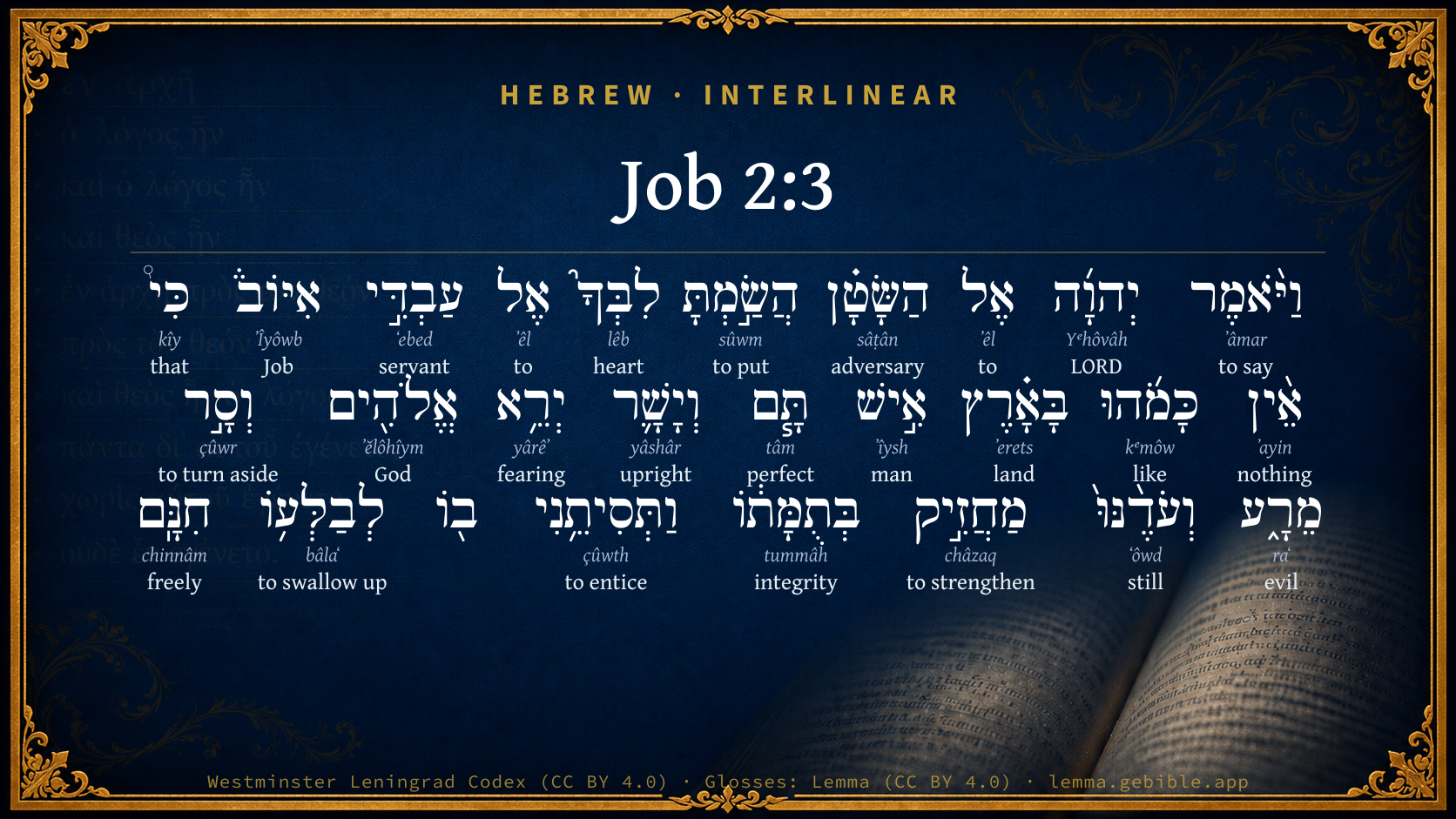
Hebrew (Westminster Leningrad Codex) Job 2:3 appears in the Hebrew Old Testament. The text above is from the Westminster Leningrad Codex. Each word links to its Strong’s number, a concise gloss, and parsing drawn from the Open Scriptures Hebrew Bible morphology. Click any word for its full Brown-Driver-Briggs (BDB) entry.
Download image
Cite this verse

Job 2:3 (World English Bible). Public Domain. Lemma interlinear Bible study tool, https://lemma.gebible.app/v/job/2/3.

Show BibTeX & RIS
BibTeX
RIS
English Translation
Yahweh said to Satan, "Have you considered my servant Job? For there is none like him in the earth, a blameless and an upright man, one who fears God, and turns away from evil. He still maintains his integrity, although you incited me against him, to ruin him without cause."
World English Bible · Public Domain
Highlights
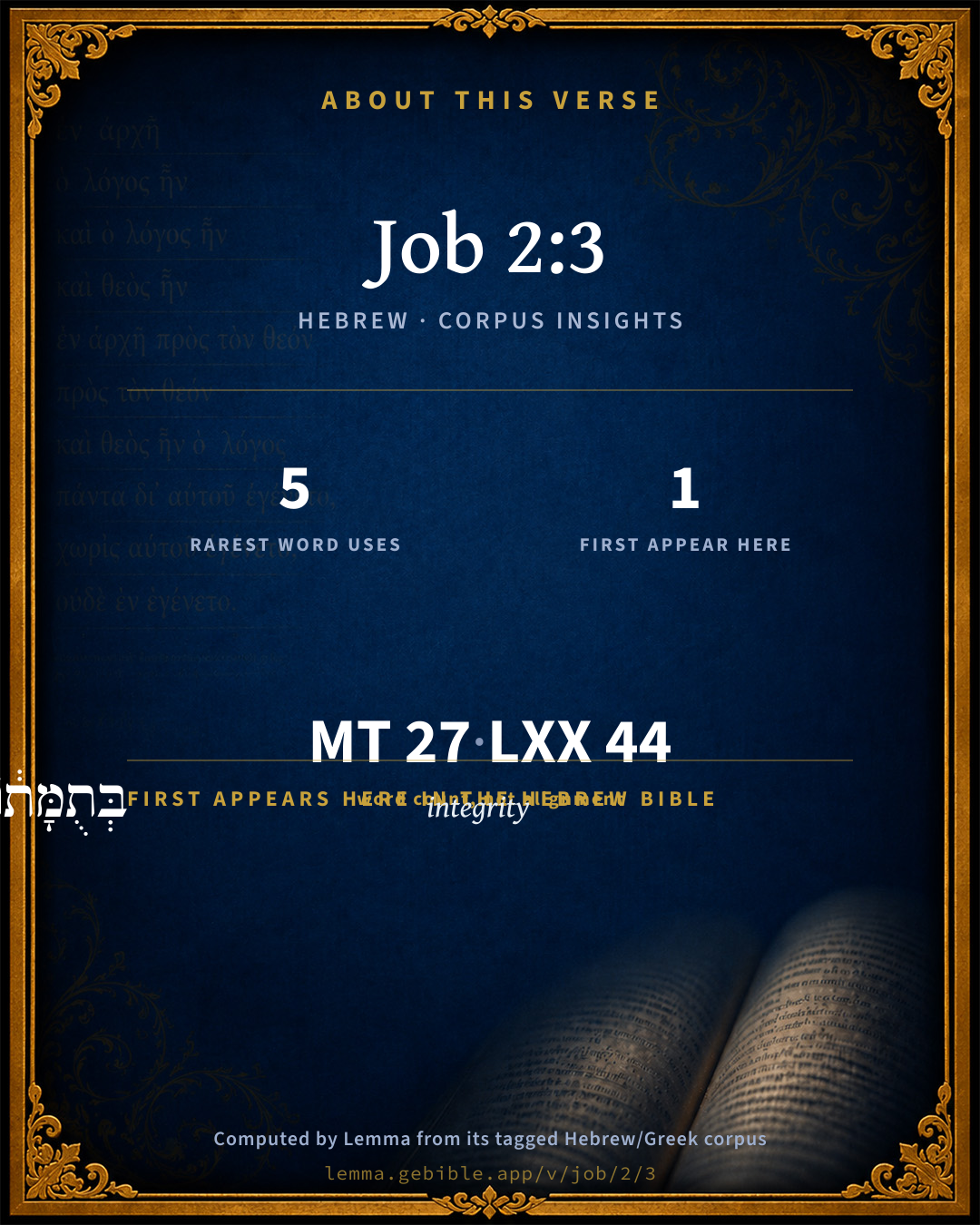
  • 1 first appearance in the Hebrew Bible
Full analysis ↓
Download a study sheet

One document with this verse’s original text, its word-by-word gloss line, the meaning frame, cross-references with their text, attributed commentary, and full source and license credits — printable, and it pastes into notes with its structure intact.

This verse Autodidact and up

Study sheet (.html) Plain text (.txt)

A passage Seminary Student

Up to 50 verses in one chapter. A passage sheet keeps up to 6 commentary sources and 12 cross-references per verse, in the order this page ranks them, and says so on the sheet whenever that leaves anything out. Ask for a single verse and you get the Autodidact verse sheet above.

Everything on this page stays free to read, with no account — the sheet is a download of what is already on screen, not access to it.

Want to remove ads? Support Godless Engineer
Compare translations 3

The same verse in 3 English versions, stacked beneath the original-language interlinear above. Click any original word for its lexicon entry.

Each is an independent rendering of the whole verse — the interlinear is not word-aligned to these translations.

Highlighted words mark where these versions differ — a whole-verse word diff, not a word-by-word alignment.

  • World English Bible Public Domain
    Yahweh said to Satan, "Have you considered my servant Job? For there is none like him in the earth, a blameless and an upright man, one who fears God, and turns away from evil. He still maintains his integrity, although you incited me against him, to ruin him without cause."
  • King James Version Public Domain
    And the LORD said unto Satan, Hast thou considered my servant Job, that there is none like him in the earth, a perfect and an upright man, one that feareth God, and escheweth evil? and still he holdeth fast his integrity, although thou movedst me against him, to destroy him without cause.
  • unfoldingWord Literal Text CC BY-SA 4.0
    And Yahweh said to the adversary, “Have you set your heart on my servant Job? For there is not like him on the earth, a blameless and righteous man, fearful of God and turning from evil. And still he is holding firmly to his integrity, although you incited me against him, to devour him for nothing.”

unfoldingWord Literal Text — © unfoldingWord, licensed CC BY-SA 4.0. Word-aligned USFM3 via Door43 (git.door43.org/unfoldingWord/en_ult).

Versions to compare (up to 4)

3 of 4 selected

Show all 18 translations

Every available English version of this verse, each an independent rendering of the whole verse.

  • World English Bible Public Domain
    Yahweh said to Satan, "Have you considered my servant Job? For there is none like him in the earth, a blameless and an upright man, one who fears God, and turns away from evil. He still maintains his integrity, although you incited me against him, to ruin him without cause."
  • Berean Standard Bible Public Domain
    Then the LORD said to Satan, “Have you considered My servant Job? For there is no one on earth like him, a man who is blameless and upright, who fears God and shuns evil. He still retains his integrity, even though you incited Me against him to ruin him without cause.”
  • Majority Standard Bible Public Domain
    Then the LORD said to Satan, “Have you considered My servant Job? For there is no one on earth like him, a man who is blameless and upright, who fears God and shuns evil. He still retains his integrity, even though you incited Me against him to ruin him without cause.”
  • King James Version Public Domain
    And the LORD said unto Satan, Hast thou considered my servant Job, that there is none like him in the earth, a perfect and an upright man, one that feareth God, and escheweth evil? and still he holdeth fast his integrity, although thou movedst me against him, to destroy him without cause.
  • American Standard Version (1901) Public Domain
    And Jehovah said unto Satan, Hast thou considered my servant Job? for there is none like him in the earth, a perfect and an upright man, one that feareth God, and turneth away from evil: and he still holdeth fast his integrity, although thou movedst me against him, to destroy him without cause.
  • Revised Version (1885) Public Domain
    And the LORD said unto Satan, Hast thou considered my servant Job? for there is none like him in the earth, a perfect and an upright man, one that feareth God, and escheweth evil: and he still holdeth fast his integrity, although thou movedst me against him, to destroy him without cause.
  • Geneva Bible (1599) Public Domain
    And the Lord sayd vnto Satan, Hast thou not considered my seruant Iob, how none is like him in the earth? an vpright and iust man, one that feareth God, and escheweth euill? for yet he continueth in his vprightnesse, although thou mouedst me against him, to destroy him without cause.
  • Douay-Rheims (1899) Public Domain
    And the Lord said to Satan: Hast thou considered my servant Job, that there is none like him in the earth, a man simple, and upright, and fearing Cod, and avoiding evil, and still keeping his innocence? But thou hast moved me against him, that I sho uld afflict him without cause.
  • Young's Literal Translation Public Domain
    And Jehovah saith unto the Adversary, `Hast thou set thy heart unto My servant Job because there is none like him in the land, a man perfect and upright, fearing God and turning aside from evil? and still he is keeping hold on his integrity, and thou dost move Me against him to swallow him up for nought!'
  • Literal Standard Version CC BY-SA 4.0
    And YHWH says to Satan, “Have you set your heart to My servant Job because there is none like him in the land, a man perfect and upright, fearing God and turning aside from evil? And still he is keeping hold on his integrity, and you move Me against him to swallow him up for nothing!”
  • Unlocked Literal Bible CC BY-SA 4.0
    Yahweh said to Satan, “Have you considered my servant Job? For there is no one like him on the earth, a blameless and upright man, one who fears God and turns away from evil. He still holds fast to his integrity, although you misled me against him, to destroy him without cause.”
  • unfoldingWord Literal Text CC BY-SA 4.0
    And Yahweh said to the adversary, “Have you set your heart on my servant Job? For there is not like him on the earth, a blameless and righteous man, fearful of God and turning from evil. And still he is holding firmly to his integrity, although you incited me against him, to devour him for nothing.”
  • Darby Bible Public Domain
    And Jehovah said to Satan, Hast thou considered my servant Job, that there is none like him on the earth, a perfect and an upright man, one that feareth God and abstaineth from evil? and still he remaineth firm in his integrity, though thou movedst me against him, to swallow him up without cause.
  • World Messianic Bible Public Domain
    The LORD said to Satan, “Have you considered my servant Job? For there is no one like him in the earth, a blameless and an upright man, one who fears God, and turns away from evil. He still maintains his integrity, although you incited me against him, to ruin him without cause.”
  • Webster's Bible Public Domain
    And the LORD said to Satan, Hast thou considered my servant Job, that there is none like him on the earth, a perfect and an upright man, one that feareth God, and shunneth evil? and still he holdeth fast his integrity, although thou movedst me against him, to destroy him without cause.
  • Free Bible Version CC BY-SA 4.0
    “Have you noticed my servant Job?” asked the Lord. “There's no one like him on earth, a man of integrity who does what is right, who respects God and avoids evil. And he has kept his integrity, even though you wanted me to harm him for no reason.”
  • Bible in Basic English Public Domain
    And the Lord said to the Satan, Have you taken note of my servant Job, for there is no one like him on the earth, a man without sin and upright, fearing God and keeping himself far from evil? and he still keeps his righteousness, though you have been moving me to send destruction on him without cause.
  • JPS Tanakh (1917) Public Domain
    And the LORD said unto Satan: 'Hast thou considered my servant Job, that there is none like him in the earth, a whole-hearted and an upright man, one that feareth God, and shunneth evil? and he still holdeth fast his integrity, although thou didst move Me against him, to destroy him without cause.'

Literal Standard Version (2020), Covenant Press — licensed CC BY-SA 4.0. Text via the HelloAO Bible API (eBible.org). Unlocked Literal Bible (unfoldingWord) — licensed CC BY-SA 4.0. Text via the HelloAO Bible API (eBible.org). unfoldingWord Literal Text — © unfoldingWord, licensed CC BY-SA 4.0. Word-aligned USFM3 via Door43 (git.door43.org/unfoldingWord/en_ult). Free Bible Version, Dr. Jonathan Gallagher — licensed CC BY-SA 4.0. Text via the HelloAO Bible API (eBible.org).

Word by word

More ways to search: Search by grammar → Find every occurrence → Compare this word →

Practice this passage: Drill this verse → Learn its vocabulary →

בְּתֻמָּת֔וֹ
tummâh
H8538
“in/at · integrity · his”
Preposition + Noun, Common, Feminine, Singular, Construct + Suffix, Personal, 3rd Person, Masculine, Singular
Part of Speech
Preposition + Noun
Type
Common
Gender
Feminine
Number
Singular
State
Construct
Full BDB Definition

Origin: from H8537

TWOT: 2522b

integrity
  1. וַיֹּ֨אמֶר ʼâmar H559 “and · to say” Conjunction + Verb, Qal, Sequential Imperfect, 3rd Person, Masculine, Singular
  2. יְהוָ֜ה Yᵉhôvâh H3068 “LORD” Noun, Proper
  3. אֶל ʼêl H413 “to” Preposition
  4. הַשָּׂטָ֗ן sâṭân H7854 “the · adversary” Particle, Definite Article + Noun, Common, Masculine, Singular, Absolute
  5. הֲשַׂ֣מְתָּ sûwm H7760 “to put” Particle, Interrogative + Verb, Qal, Perfect, 2nd Person, Masculine, Singular
  6. לִבְּךָ֮ lêb H3820 “heart · your” Noun, Common, Masculine, Singular, Construct + Suffix, Personal, 2nd Person, Masculine, Singular
  7. אֶל ʼêl H413 “to” Preposition
  8. עַבְדִּ֣י ʻebed H5650 “servant · my” Noun, Common, Masculine, Singular, Construct + Suffix, Personal, 1st Person, Common, Singular
  9. אִיּוֹב֒ ʼÎyôwb H347 “Job” Noun, Proper
  10. כִּי֩ kîy H3588 “that” Conjunction
  11. אֵ֨ין ʼayin H369 “nothing” Particle, Negative
  12. כָּמֹ֜הוּ kᵉmôw H3644 “like · him” Preposition + Suffix, Personal, 3rd Person, Masculine, Singular
  13. בָּאָ֗רֶץ ʼerets H776 “in/at the · land” Preposition, Determined + Noun, Common, Both, Singular, Absolute
  14. אִ֣ישׁ ʼîysh H376 “man” Noun, Common, Masculine, Singular, Absolute
  15. תָּ֧ם tâm H8535 “perfect” Adjective, Adjective, Masculine, Singular, Absolute
  16. וְיָשָׁ֛ר yâshâr H3477 “and · upright” Conjunction + Adjective, Adjective, Masculine, Singular, Absolute
  17. יְרֵ֥א yârêʼ H3373 “fearing of” Adjective, Adjective, Masculine, Singular, Construct
  18. אֱלֹהִ֖ים ʼĕlôhîym H430 “God(s)” Noun, Common, Masculine, Plural, Absolute
  19. וְסָ֣ר çûwr H5493 “and · turning aside” Conjunction + Verb, Qal, Participle Active, Masculine, Singular, Absolute
  20. מֵרָ֑ע raʻ H7451 “from · evil” Preposition + Adjective, Adjective, Masculine, Singular, Absolute
  21. וְעֹדֶ֨נּוּ֙ ʻôwd H5750 “and · still · his” Conjunction + Adverb + Suffix, Personal, 3rd Person, Masculine, Singular
  22. מַחֲזִ֣יק châzaq H2388 “strengthening” Verb, Hiphil, Participle Active, Masculine, Singular, Absolute
  23. וַתְּסִיתֵ֥נִי çûwth H5496 “and · to entice · me” Conjunction + Verb, Hiphil, Sequential Imperfect, 2nd Person, Masculine, Singular + Suffix, Personal, 1st Person, Common, Singular
  24. לְבַלְּע֥וֹ bâlaʻ H1104 “to swallow up · him” Preposition + Verb, Piel, Infinitive Construct + Suffix, Personal, 3rd Person, Masculine, Singular
  25. חִנָּֽם chinnâm H2600 “freely” Adverb

About this verse

These counts appear in no published source. They are computed here, from the morphology-tagged text and Lemma’s own curated glosses. What Lemma adds →

27
words
25
distinct lemmas
Wisdom
section

Notable vocabulary

The rarest word here is בְּתֻמָּת֔וֹ integrity H8538 — appearing just 5 times in the whole Hebrew Bible.

First appearance in Scripture

This word makes its first canonical appearance in the Hebrew Bible here:

  • בְּתֻמָּת֔וֹ integrity H8538

Shared distinctive vocabulary

בְּתֻמָּת֔וֹ integrity H8538 occurs in 5 verses of the Hebrew Bible. Also found in:

Grammatical profile

  • 6 verbs
  • 9 nouns
  • 4 adjectives
  • 4 prepositions
  • 1 conjunction
  • 2 adverbs
  • 1 particle

Verb forms

  • וַיֹּ֨אמֶר Qal · Sequential Imperfect
  • הֲשַׂ֣מְתָּ Qal · Perfect
  • וְסָ֣ר Qal · Participle Active
  • מַחֲזִ֣יק Hiphil · Participle Active
  • וַתְּסִיתֵ֥נִי Hiphil · Sequential Imperfect
  • לְבַלְּע֥וֹ Piel · Infinitive Construct

Repetition

A word recurs within this verse — often emphatic in Hebrew:

  • אֶל to H413 ×2

Hebrew & Septuagint length

In English translation the verse runs 50 words from the Hebrew and 52 from the Septuagint (LXX English) — closely comparable.

A rough comparison of the two English renderings, which tokenize alike — not a word-level alignment.

Word counts can differ between the Hebrew and the Greek without any difference in meaning — e.g. the Hebrew direct-object marker אֵת has no separate Greek word, and Greek often adds the article ὁ.

In the original languages it is 27 Hebrew tokens and 44 Greek tokens — but the two are counted differently (Hebrew bundles its prefixes and suffixes into one token; the Greek is in lemma form), so that isn’t a like-for-like length.

Cross-references

23

Topical passages linked to Job 2:3 in the Treasury of Scripture Knowledge — connected by theme and wording, ordered by reader-vote popularity; previews shown in the World English Bible.

  • Job 1:8 Yahweh said to Satan, "Have you considered my servant, Job? For there is none like him in the earth, a blameless and an upright man, one who fears God, and turns away from evil."
  • Job 9:17 For he breaks me with a tempest, Multiplies my wounds without cause.
  • Job 27:5–6 Far be it from me that I should justify you. Until I die I will not put away my integrity from me.
  • James 1:12 Blessed is the man who endures temptation, for when he has been approved, he will receive the crown of life, which the Lord promised to those who love him.
  • Proverbs 16:17 The highway of the upright is to depart from evil. He who keeps his way preserves his soul.
  • 1 Peter 1:7 that the proof of your faith, which is more precious than gold that perishes even though it is tested by fire, may be found to result in praise, glory, and honor at the revelation of Jesus Christ--
  • John 9:3 Jesus answered, "Neither did this man sin, nor his parents; but, that the works of God might be revealed in him.
  • Philippians 3:12 Not that I have already obtained, or am already made perfect; but I press on, if it is so that I may take hold of that for which also I was taken hold of by Christ Jesus.
  • Job 1:1 There was a man in the land of Uz, whose name was Job. That man was blameless and upright, and one who feared God, and turned away from evil.
  • Proverbs 15:8 The sacrifice made by the wicked is an abomination to Yahweh, But the prayer of the upright is his delight.
  • 1 Peter 5:10 But may the God of all grace, who called you to his eternal glory by Christ Jesus, after you have suffered a little while, perfect, establish, strengthen, and settle you.
  • Genesis 6:9 This is the history of the generations of Noah. Noah was a righteous man, blameless among the people of his time. Noah walked with God.
  • 2 Samuel 20:20 Joab answered, Far be it, far be it from me, that I should swallow up or destroy.
  • Job 1:11 But put forth your hand now, and touch all that he has, and he will renounce you to your face."
  • Job 1:21–22 He said, "Naked I came out of my mother's womb, and naked shall I return there. Yahweh gave, and Yahweh has taken away. Blessed be the name of Yahweh."
  • Job 9:20 Though I am righteous, my own mouth shall condemn me. Though I am blameless, it shall prove me perverse.
  • Job 13:15 Behold, he will kill me; I have no hope. Nevertheless, I will maintain my ways before him.
  • Psalms 37:37 Mark the perfect man, and see the upright, For there is a future for the man of peace.
  • Psalms 41:12 As for me, you uphold me in my integrity, And set me in your presence forever.
  • Proverbs 11:8 A righteous person is delivered out of trouble, And the wicked takes his place.
  • Proverbs 13:6 Righteousness guards the way of integrity, But wickedness overthrows the sinner.
  • Proverbs 14:2 He who walks in his uprightness fears Yahweh, But he who is perverse in his ways despises him.
  • Psalms 26:1 Judge me, Yahweh, for I have walked in my integrity. I have trusted also in Yahweh without wavering.

Cross-references courtesy of OpenBible.info (CC BY 4.0).

Hebrew and Greek witnesses Masoretic Hebrew ↔ Greek Septuagint

The same verse in the two great witnesses to the Old Testament, shown verse-for-verse.

These are two independent witnesses, not word-aligned to each other, and the Septuagint is shown in lemma (dictionary) form.

Hebrew Job 2:3 Masoretic · Westminster Leningrad Codex

וַיֹּ֨אמֶר יְהוָ֜ה אֶל הַשָּׂטָ֗ן הֲשַׂ֣מְתָּ לִבְּךָ֮ אֶל עַבְדִּ֣י אִיּוֹב֒ כִּי֩ אֵ֨ין כָּמֹ֜הוּ בָּאָ֗רֶץ אִ֣ישׁ תָּ֧ם וְיָשָׁ֛ר יְרֵ֥א אֱלֹהִ֖ים וְסָ֣ר מֵרָ֑ע וְעֹדֶ֨נּוּ֙ מַחֲזִ֣יק בְּתֻמָּת֔וֹ וַתְּסִיתֵ֥נִי ב֖וֹ לְבַלְּע֥וֹ חִנָּֽם

Yahweh said to Satan, "Have you considered my servant Job? For there is none like him in the earth, a blameless and an upright man, one who fears God, and turns away from evil. He still maintains his integrity, although you incited me against him, to ruin him without cause."

World English Bible · Public Domain

Greek LXX Job 2:3 Septuagint · lemma form

εἶπον δέ ὁ κύριος πρός ὁ διάβολος προςἔχω οὖν ὁ θεράπων ἐγώ ιωβ ὅτι οὐ εἰμί κατά αὐτός ὁ ἐπί ὁ γῆ ἄνθρωπος ἄκακος ἀληθινός ἄμεμπτος θεοσεβής ἀποἔχω ἀπό πᾶς κακός ἔτι δέ ἔχω ἀκακία σύ δέ εἶπον ὁ ὑποἄρχω αὐτός διά κενός ἀποὀλλύω

And the Lord said to the devil, Have you then observed my servant Job, that there is none of men upon the earth like him, a harmless, true, blameless, godly man, abstaining from all evil? and he yet cleaves to innocence, whereas you have told me to destroy his substance without cause?

LXX2012 (modern English Septuagint) · Public Domain

On this verse, Albert Barnes' Notes on the Bible discusses the Septuagint’s reading. Read the note in Commentary ↓

Hebrew: Westminster Leningrad Codex (CC BY 4.0). Greek: Septuagint (public domain); English from LXX2012 (modern English Septuagint) (Public Domain). How the Septuagint differs from the Hebrew →

Commentary

Notes on Job 2:3 from classic Christian and Jewish commentators (each source and its license shown beneath its notes). The classic Christian expositions comment on the surrounding passage and are grouped to its opening verse, so a note may address several verses; the Jewish commentaries on the Tanakh (Rashi and others) are per-verse, so they appear only where the commentator wrote on this verse.

Lemma curates 59 commentaries, every one of them public domain or Creative Commons licensed, each selected and text-cleaned for this edition rather than reprinted as found. About our sources →

Trapp's Complete Commentary

John Trapp

Job 2:3 And the LORD said unto Satan, Hast thou considered my servant Job, that [there is] none like him in the earth, a perfect and an upright man, one that feareth God, and escheweth evil? and still he holdeth fast his integrity, although thou movedst me against him, to destroy him without cause.

Ver. 3. And the Lord said unto Satan] Before he would condemn him he thus interrogateth him (which he would not vouchsafe to do when he had deceived our first parents, Gen 3:14), but with a very bitter taunt and sharp reprehension; as if God should have said, Art thou not ashamed, Satan, thus to answer me, as if I had forgotten what I granted thee in our last assembly, and thus in my presence to dissemble? &c. (Beza).

Hast thou considered my servant Job] See Job 1:8.

One that feareth God, &c.] This he did not without God (according to that clause in the new covenant, I will put my fear into their hearts, Jer 31:40. I, is emphatical and exclusive, q.d. I, and I alone), yet God giveth him the honour of it; as if he himself had been the sole doer. Certum est, nos facere quod facimus; sed ille tacit ut faciamus, saith Austin. Sure it is that we do what good we do; but as sure it is that God doth all our works in us and for us, Isa 26:12.

And still he holdeth fast his integrity] Which thou hast driven quasi ficedula extorquere, as to tear a small bird, by wrench and wile to get from him; but he hath hitherto held it fast, as with tooth and nail. This was a singular commendation, and that is a rare faith, which, being long tried, doth not flag and hang the wing. By reason of the overflow of iniquity the love of many shall wax cold (saith our Saviour), but he that endureth to the end shall be saved, Mat 24:12-13. Lo, it is but a he, a single man, that retaineth his integrity; when many lose their first love, and fall from their former stedfastness, as fast as leaves fall in autumn. Job would not part with his integrity to die for it; when all was taken away he laid fast hold on that, and resolved to let go his life sooner. Christ he saw standing over him (as once Stephen did), and saying, Hold fast that thou hast, that no one take thy crown from thee, Rev 3:11. Omnia perdidit qui fidem amisit, he destroys everthing who loses faith. saith Seneca. In a common combustion a mail will be sure to secure his jewels, whatever become of his lumber.

Although thou movedst me against him] That is, against his personal estate, and his children, which are called himself; against these Satan is said to have moved the Lord, to have incited and instigated him, stirring him up with reasons and arguments; as he is an excellent orator if he may but have audience. But that the Lord was hereby moved to do aught against Job must be wisely and rightly understood; for God is immutable and unmovable; neither can he be drawn to do anything but what he hath decreed to do from before all beginnings; but here he speaketh after the manner of men, as if he were prevailed with by Satan’s solicitations.

To destroy him] So Satan would have had it, when God meant to try him only. See the like Rev 2:10.

Without cause] Or for nothing (as the word signifieth, Job 1:10, "Doth Job fear God for nought?") without any provocation or cause on his part procuring it. Not but that there is cause enough in the best why God should afflict them: but as there was no peccatum flagrans burning sin in Jacob, Num 23:21, no foul sin of that people, flaming at that time in the eyes of God, or stinking in his nostrils, and therefore Balaam (the devil’s spellman) could do nought against them by his enchantments, Num 23:23; so there was not in Job that gross hypocrisy, wherewith Satan had falsely charged him ( Iob non erat flagitiosus, Job was no disgraceful, Lavat.), he was not that mercenary that Satan would have made of him. In vain did that arch slanderer and accuser of the saints move the Lord against Job, Gratis, id est, Frustra, without payment it is, in vain, saith Lyra; in vain did he assault this stout champion, &c.

John Trapp, A Commentary or Exposition upon All the Books of the Old and New Testament (1647–1656) — public domain. Text from a community e-Sword module.

The Biblical Illustrator

Joseph S. Exell

Job_2:3

Still he holdeth fast his integrity.

A commendation of Jobs integrity

1. Constancy in piety, notwithstanding the sharp temptations of an afflicted condition, is a singular commendation in Gods esteem; for hereby Job so acquits himself that the old characters of his piety are not sufficient without this new addition to his commendation (1Pe_1:7). And the reason of this is insinuated in the word holding fast, which in the original imports a retaining and holding of a thing firmly and with our whole strength, because of difficulties and opposition; as the traveller keeps his garment on a windy day.

2. Whatever it be in religion wherewith men please themselves, yet nothing pleaseth God better than sincerity and uprightness when it is persevered in under affliction, and in a trying condition.

3. As God is specially pleased with mens sincerity, so it is against this that Satan plants his chief engines and battery. Satan did not assault Jobs outward prosperity, but to better his integrity thereby. Nor is it mens formality or outward profession that he doth so much malign, if he can keep them from being sincere in what they do.

4. Albeit it be no small difficulty to stand fast, and to continue straight and upright in sharp trials, yet the truly sincere are, by the grace of God, able to do it, and to abide never so many and sharp assaults. Even weak grace, supported by God, is a party too hard for all opposition.

5. It is an act of Divine wisdom, when things of the world are going to ruin, not to cast away piety also, and a good conscience; or, because God strips us of outward contentments, therefore to turn our back upon that which ought to be a cordial under all pressures: for this is commended as an act of great wisdom in Job, when other things were pulled from him, still he held fast his integrity. To take another course will nothing benefit men, or ease their griefs, but doth indeed double their losses. (George Hutcheson.)

Graces held fast in trial

1. That Satan in all his temptations plants his chiefest battery against sincerity. Satan did not care at all to pull Jobs oxen from him, or his sheep from him, or his children from him, but to pull his grace from him; therefore it is said, Job held that fast.

2. That whatsoever a godly man loseth, he will be sure to lay hold of his graces, he will hold spirituals, whatever becomes of temporals. As it is with a man at sea in a shipwreck, when all is cast overboard, the corn that feeds him, and the clothes that cover him, yet he swims to the shore if he can, with his life in his hand. Or as it is with a valiant standard bearer, that carries the banner in war, if he sees all lost he will wrap the banner about his body, and choose rather to die in that as his winding sheet than let any man take it from him.

3. That grace doth not only oppose, but conquers Satan and all his temptations. He doth prevail in his integrity (so the Hebrew may be rendered in the letter).

4. That true grace gains by opposition. True grace is increased the more it is assaulted. (J. Caryl.)

God unchangeable toward the afflicted servant

He is still His servant, and one prominent among His children, and a word is now added showing that Jehovah notes the fidelity of His own: Holdeth fast his integrity. How beautiful is this! Poor and stricken, bereft of all, Job is still My servant. The living God loses not interest in His tried and suffering ones. Drink deep from this sweet well. Though change of circumstance oft brings change in those we once called friends, and those from whom we look for comfort give only blame, God is not a man that He should change, and it is still My servant Job. (H. E. Stone.)

The moral law and its observance

The lowest step of the religious life is obedience to the moral law, and our time can never be lost when we are gazing at those simple, infinite, eternal sanctions. This is to all Christian life as the primitive granite on which the world is built. The man who strives to be faithful to the moral law, be he even a heathen or a publican, may be nearer to the kingdom of God than they who, in theologic hatreds, systematically violate its most essential precept: Obedience is better than sacrifice. The sum and substance of the moral law, as Christ set it forth, is truth and love. Only a few men are, in the highest sense, men of principle. A man of principle is one of the noblest works of God. He has learned the sacredness of eternity, the awful axiomatic certainty of law. Two most necessary cautions.

1. None of you may suppose for a moment that it needs no more than an appeal to reason and to conscience to secure obedience to this moral law. This, as all history proves, is a vital error.

2. You cannot see the face of God unless you keep your bodies in temperance, soberness, and chastity. It is not the grandeur of the moral law alone which can help you in this. You have to hear the voice of Christ. (Dean Farrar, D. D.)

Although thou movedst Me against him.

Satanic importunity

1. That Satan is an earnest and importunate solicitor against the people and Church of God.

2. That pure, or rather impure, malice stirreth Satan against the people of God.

3. That God doth afflict His people sometimes without respect unto their sins. Thou didst move Me against him without cause.

4. That God will at the last give testimony for the clearing of the innocency of His servants against all Satans malicious accusations. (J. Caryl.)

Satans malicious incitements

The expression although thou movedst Me against him is startling. Is it an admission, after all, that the Almighty can be moved by any consideration less than pure right, or to act in any way to the disadvantage or hurt of His servant? Such an interpretation would exclude the idea of supreme power, wisdom, and righteousness which unquestionably governs the book from first to last. The words really imply a charge against the adversary of malicious untruth. The saying of the Almighty is ironical, as Schultens points out: Although thou, forsooth, didst incite Me against him. He who flings sharp javelins of detraction is pierced with a sharper javelin of judgment. Yet he goes on with his attempt to ruin Job, and prove his own penetration the keenest in the universe. (R. A. Watson.)

The Biblical Illustrator, edited by Joseph S. Exell (c. 1880s–1900s) — public domain. Text from a community e-Sword module.

Joseph Benson's Commentary

Job 2:3. Hast thou considered, &c. — Hebrew, השׁמת לבךְ, hashamta libbecha, Hast thou set thy heart on my servant? &c. And still he holdeth fast his integrity — Notwithstanding all his trials and tribulations, and thy malicious suggestion to the contrary, he continues to be the same perfect and upright man he was before; and all thy efforts to wrest from him his integrity, and draw him into sin, have been fruitless. Although thou movedst me, &c. — It is justly observed by a late writer, that the translation of this verse will be more agreeable to the Hebrew, if, with the vulgar Latin, we place the interrogation after the word integrity; namely, Timens Deum, et recedens a malo, et adhuc retinens innocentiam? Fearing God, departing from evil, and still holding fast his integrity? For thus do the three participles in Hebrew follow one another. Instead then of rendering the next word, although thou movedst me; he proposes reading, And yet thou movest me; or, to continue the interrogation, namely, And dost thou, or, wilt thou, move me against him to destroy him without cause? This, and the rest of this representation, respecting Satan’s moving, that is, persuading and prevailing with God, to bring, or to suffer this his enemy to bring, these grievous calamities upon Job, is not to be understood literally; as if God could be moved by any of his creatures, especially by Satan, to alter or depart from his own wise and holy purposes, which are all eternal and unchangeable, to gratify that evil spirit by granting his desires: but the design is simply to signify the devil’s restless malice, in promoting man’s misery, and God’s permission of it, for his own glory. To destroy him without cause — Without any signal guilt or special provocation, whereby he, more than others, deserved to be chastised by such heavy calamities; not but that there might be other very weighty causes for them: for the divine wisdom, we may be sure, neither does nor suffers any thing without cause; that is, without a sufficient reason. That good men are sometimes extremely afflicted, and that not only in their outward estate, but in their persons, as Job was, is too plain to be denied; (see Joh 9:3;) and, whether God permits wicked spirits, or wicked men, or any thing else, to be the immediate instrument of a good man’s sufferings, makes no alteration as to the nature or degree of his sufferings. But the word חנםchinnam, here rendered, without cause, may, with equal propriety, be translated, as it is Pro 1:17; Eze 6:10, and elsewhere, in vain; and be referred, not to God’s destroying him, but to Satan’s moving God so to do. And then the reading will be, Thou hast in vain moved, or dost, or wilt, in vain move me to destroy him; that is, without effect, or to no purpose; for thou art not able to take away his integrity, which, in spite of all thy art and malice, he still holds fast. Thus Junius and Tremellius translate the words: Hast thou considered my servant Job — that he still retains his integrity? and, in vain hast thou excited me to destroy him: and Houbigant, He still retains his integrity, after thou hast excited me against him, that I might trouble him, in vain.

Joseph Benson's Commentary on the Old and New Testaments (1811–1818) — public domain. Text from a community e-Sword module.

Tyndale Open Study Notes

Tyndale Open Resources

2:3 The phrase without cause (Hebrew khinnam) is a wordplay on Satan’s question in 1:9.

Tyndale Open Study Notes — © Tyndale Open Resources, licensed CC BY-SA 4.0. Text via the HelloAO Bible API.

Geneva Bible (1599)

Geneva Bible translators

That is, when thou hadst nought against him, or when thou wast not able to bring thy purpose to pass.

He proveth Job’s integrity by this that he ceased not to fear God when his plagues were grievously upon him.

Geneva Bible (1599) marginal notes — public domain. Text via Bolls.life.

Jamieson, Fausset & Brown

Robert Jamieson, A. R. Fausset & David Brown

integrity--literally, "completeness"; so "perfect," another form of the same Hebrew word, Job 11:7.

movedst . . . against--So Sa1 26:19; compare Ch1 21:1 with Sa2 24:1.

Jamieson, Fausset & Brown — Commentary Critical and Explanatory on the Whole Bible (1871) — public domain (CC PDM 1.0). Text via the HelloAO Bible API.

Adam Clarke's Commentary

Verse 3. To destroy him without cause.] Thou wishedst me to permit thee to destroy a man whose sins have not called for so heavy a judgment. This seems to be the meaning of this saying. The original word, לבלעו leballeo, signifies to swallow down or devour; and this word St. Peter had no doubt in view in the place quoted on verse 7 of the preceding chapter: Job 1:7 "Your adversary the devil goeth about as a roaring lion, seeking whom he may DEVOUR; ζητων, τινα καταπιῃ, seeking whom he may SWALLOW or GULP DOWN. 1Pe 5:8.

Adam Clarke's Commentary on the Bible (1810–1826) — public domain. Text from a community e-Sword/MySword module.

The Cambridge Bible for Schools and Colleges

gen. ed. J. J. S. Perowne

3. still he holdeth fast his integrity] Or, his perfectness, see on Job_1:1. Satan had insinuated that Job’s religiousness was interested, he served God for the benefits He conferred. That he maintained his godly fear when the benefits were taken away refuted the suspicion, and shewed that his trials were without cause.

The Cambridge Bible for Schools and Colleges (gen. ed. J. J. S. Perowne; Cambridge University Press, 1878–1918) — public domain. Text from a community e-Sword module.

John Gill's Exposition

And Satan answered the Lord, and said,.... Satan would not as yet own that Job was the man the Lord had described; but still would suggest, that he was a selfish and mercenary man, and that what had been done to him was not a sufficient trial of his integrity; the thing had not been pushed far and close enough to discover him; he had lost indeed his substance, and most of his servants, and all his children, but still he had not only his own life, but his health and ease; and so long as he enjoyed these he would serve God, though only for the sake of them: and therefore, says he, as it is usually and proverbially said:

skin for skin, yea, all that a man hath will he give for his life; the Targum is,"member for member;''which the Jewish commentators, many of them, explain thus, that if a man's head or his eyes are in danger, he will lift up his hand or his arm, and expose that in order to save the other; but the word is generally used of the skin, and so it may in this sense; and mean the skin of his hand, as a shield for the skin of his head or eye, as Gussetius observes (r): some understand it of the skins of others for his own skin, which he will part with, that he may keep that; nay, he will give all that he is possessed of for the preservation of his life, so dear is that unto him; meaning either the skins of beasts, in whom the principal substance of men consisted in those times and countries, and whose skins slain for food, and in sacrifice, might be of worth and value, and used in traffic; or, as others think, money cut out of leather made of skins is meant, which a man would part with, even all such money he had in the world, and even his "suppellex", or all the goods of his house, for to save his life: or the sense is, that Job would not only give the skins of his beasts, even of all that he had, for his own skin, but the skins of his servants, nay, of his own children, provided he could but keep his own skin; and hereby Satan suggests, that Job did not regard the loss his cattle, nor of his servants, nor even of his children, so long as he had his own life and health; and thus represents him as a lover of himself, and as cruel and hardhearted, and without natural affections to his children; the contrary to which is very manifest from Job 1:5; or rather this designs his own skin, and may be rendered, "skin upon skin", or "skin even unto skin", or "skin within skin" (s); for man has two skins, an inward and an outward one, called the "cutis" and "cuticula", "derma" and "epidermis"; the latter is of a whitish colour, and is properly the covering of the skin, is very thin, and void of sensation (t), which may be raised up by a blister, and taken off without pain; but the other is reddish, and very sensible of pain, and cannot be taken off without putting a man to the most exquisite misery; and yet a man will part with both skins, and if he had ever so many, or he willing to be put to the greatest torment, rather than part with his life: and to this one point all the above senses, and others given by interpreters, tend, namely, to observe how precious the life of man is to him; and if this was all that Satan meant, it is very trite; but he seems to insinuate something more, and that is, that any man, and so Job though reckoned a good man, would not only part with all the skins he had, and the substance he was possessed of, to save his life, but he would part with his God, and his religion, and the profession of it, for the sake of it, which is false; for there is something more valuable than life to good men; they reckon the loving kindness of God better than life, and would sooner lose their lives than risk the danger of losing their interest in it; and are willing to part with their lives for the sake of God and true religion, for the sake of Christ and his Gospel, and for his cause and interest, as many have done.

(r) Ebr. Comment. p. 582. (s) "cutim super cute", Schultens. (t) Vid Bartholin. Anatomia Reform. l. 1. c. 1. & 9.

John Gill's Exposition of the Whole Bible (1746–1763) — public domain (CC PDM 1.0). Text via the HelloAO Bible API.

Albert Barnes' Notes on the Bible

Hast thou considered - Notes, Job 1:8.

That there is none like him in the earth - The same addition is made here by the Septuagint which occurs in Job 1:1; see the notes at that verse.

And still he holdeth fast his integrity - Notwithstanding all the efforts made to show that his piety was the result of mere selfishness. The word “integrity” here תמה tûmmâh means “perfection;” another form of the word which is rendered “perfect” in Job 1:1; see the notes at that verse.

Although thou movedst me - The word rendered “movedst” סוּת sûth means to incite, to impel, to urge, to irritate against anyone; Jos 15:18; Jdg 1:14; 2Ch 18:2; 1Sa 26:19; Jer 43:3. The Septuagint renders this in a special manner, “And thou hast ordered (εἶπας eipas) his property to be destroyed in vain” (διακενῆς diakenēs), that is, without accomplishing the purpose intended.

To destroy him - The word used here (from בלע bela‛) means properly to swallow, to devour, with the idea of eagerness or greediness. It is then used in the sense of to consume, or destroy; compare Job 20:18; Pro 1:12; Num 16:30; Psa 69:15. In the margin it is rendered “swallow him up.”

Without cause - Without any sufficient reason. The cause assigned by Satan Job 1:9-11 was, that the piety of Job was selfish, and that if God should remove his possessions, he would show that he had no true religion. God says now that it was demonstrated that there was no reason for having made the trial. The result had shown that the charge was unfounded, and that his piety still remained, though he was stripped of all that he had. This passage may remind us of the speech of Neptune in favor of Aeneas, Iliad v. 297:

And can ye see this righteous chief atone

With guiltless blood for vices not his own?

To all the gods his constant vows were paid;

Sure though he wars for Troy he claims our aid.

Fate wills not this - Pope

Albert Barnes' Notes on the Bible (1834–1885) — public domain. Text from a community e-Sword/MySword module.

Haydock's Catholic Bible Commentary

Simple. Plain-dealing, mild, and without guile. (St. Gregory) (Worthington) --- Without cause. This may form a new sentence. (Haydock) --- Thy proposal and attempts are vain. (Calmet) --- Job has not deserved this treatment. (St. Chrysostom, &c.)

George Leo Haydock (1774–1849), Haydock's Catholic Family Bible and Commentary, 1859 edition — public domain. Excludes Psalms (Douay-Rheims chapter numbering differs from Protestant) and Deuterocanonical books (Catholic canon only).

Matthew Poole's English Annotations

Still, notwithstanding all his trials and tribulations, and thy malicious suggestion to the contrary, he holdeth fast his integrity, i.e. he continues to be the same perfect and upright man which he was before. All thy endeavours to pull away his integrity have made him only to hold it the faster.

Thou movedst me, i.e. didst persuade me, and prevailed with me to do it. But this, as the rest of this representation, is not to be understood properly, as if God could be moved by any of his creatures to alter his purposes, which are all eternal and unchangeable, and especially by Satan, as if God would gratify him by granting his desires; but the design of these words is to signify, both the devil’s restless malice in promoting man’s misery, and God’s permission of it for his own wise and holy ends.

Without cause, i.e. without any special provocation, whereby he, more than others, deserved such heavy punishments; which also Job himself oft allegeth for his justification, although he doth not deny himself to be a sinner, as is apparent from Job 7:20,21; 9:2; 13:23,26; nor that sin deserves judgments. Or, without any such cause as thou didst allege, which was his hypocrisy. Or, in vain, as this word is used, Pro 1:17; Eze 6:10, and elsewhere. So it is not referred to God’s destroying him, but to Satan’s moving God so to do. And so this place may be thus rendered exactly according to the Hebrew, and thou hast moved me to destroy him in vain, or without effect, or to no purpose, i.e. thou hast lost thy design and expectation therein, which was to take away his integrity, which in spite of all thy art and malice he still holdeth fast.

Matthew Poole's English Annotations on the Holy Bible (1683–1685) — public domain. Text from a community e-Sword/MySword module.

Whedon's Commentary on the Bible

Daniel D. Whedon

3. Holdeth fast his integrity — As a soldier his shield, because his life is wrapped up in it.

Movedst me — For the test and maturing of the godly character of men, the devices of Satan are tolerated in the divine scheme.

To destroy him without cause — “This points to a very important rule in the divine administration, according to which the cause of a destructive temptation is something in a man’s self — a sin, for example, leading on to a larger and larger. There was no such cause in Job why he should be tempted to destruction.” — Chalmers. The bias of the heart to any peculiar sin invites trial or temptation; while the cherishing of secret sin subsequently lands us in a larger temptation. The metallic rock hidden in the each attracts not one, but many lightning strokes. The strokes of trial, in the mercy of God, are meant not to scathe, but to burn out the subtle springs of sin’s disease. That the malicious aspersions of Satan may be confounded, and Job become an exemplar to the Church in all ages, God is moved, of his own free will, to permit the trial of Job, though without cause.

Daniel D. Whedon (gen. ed.), Commentary on the Old and New Testaments (1874–1909) — public domain. Text from a community e-Sword module.

The Pulpit Commentary

And the Lord said unto Satan, Hast thou conquered my servant Job, that there is none like him in the earth, a perfect and an upright man, one that feareth God, and escheweth evil? Thus far is identical with Job_1:1 (quod vide). The rest of the verse is additional, having reference to the conduct of Job under his earlier trials. (Job_1:20-22) And still he holdeth fast his integrity. This has been justly called "the key-note of the whole book" (Cook). Satan had declared that Job"s integrity rested on no solid basis, and would easily be overthrown and disappear. God, confident in his servant"s faithfulness and truth, had allowed him to assail it. What was the result? God declares it with his own mouth. Job"s "integrity" had not been wrested from him; he still maintained, (Job_1:21, Job_1:22) as he was about to do till the end.Compare (Job_42:1-6) the ideal "just man" of HoraceJustum et tenacem propositi virum Non civium ardor prava jubentium, Non vultus instantis tyranny Menta quatit solida, neque Anster, Dux inquieti turbidus Hadriae .... Si fractus illabatur orbis, Impavidum ferient ruinae. ("Od.," 3:3.) Although thou movedst me against him, (see Job_1:9-11) to destroy him; literally, to swallow him up; i.e. to ruin him, overwhelm him with calamities. Without cause; i.e. "when he had done nothing to deserve such treatment."

The Pulpit Commentary (1880–1919), ed. H.D.M. Spence-Jones & Joseph S. Exell — public domain. Text from a community e-Sword module.

John Wesley's Explanatory Notes

Still - Notwithstanding all his afflictions, and thy suggestion to the contrary. Movedst - This, as the rest of this representation, is not to be understood literally: But the design is to signify both the devil's restless malice in promoting man's misery and God's permission of it for wise and holy ends.

John Wesley, Explanatory Notes Upon the Whole Bible (1754–1765) — public domain. Text via the GEBible commentary corpus.

Keil & Delitzsch

C. F. Keil & F. Delitzsch

3 Then Jehovah said to Satan, Hast thou considered my servant Job? for there is none like him in the earth, a perfect and an upright man, fearing God and eschewing evil; and still he holdeth fast his integrity, although thou hast moved me against him, to injure him without cause.

From the foregoing fact, that amidst all his sufferings hitherto Job has preserved and proved his תּמּה (except in the book of Job, only Pro 11:3), the fut. consec. draws the conclusion: there was no previous reason for the injury which Satan had urged God to decree for Job. הסית does not signify, as Umbreit thinks, to lead astray, in which case it were an almost blasphemous anthropomorphism: it signifies instigare, and indeed generally, to evil, as e.g., Ch1 21:1; but not always, e.g., Jos 15:18 : here it is certainly in a strongly anthropopathical sense of the impulse given by Satan to Jehovah to prove Job in so hurtful a manner. The writer purposely chooses these strong expressions, הסית and בּלּע. Satan's aim, since he suspected Job still, went beyond the limited power which was given him over Job. Satan even now again denies what Jehovah affirms.

Keil & Delitzsch — Biblical Commentary on the Old Testament (1861–1891) — public domain (CC PDM 1.0). Text via the HelloAO Bible API. (Old Testament only.)

Scofield Reference Notes

C. I. Scofield

feareth

(See Scofield "Psa 19:9").

The Scofield Reference Bible (1917 edition), notes by C. I. Scofield — public domain. Text from a community e-Sword module.

unfoldingWord translationNotes

Door43 World Missions Community

General Information:

This verse is the same as Job 1:8, except for the addition of "He still holds fast to his integrity, although you misled me against him, to destroy him without cause."

Have you considered my servant Job?

This rhetorical question actually makes a statement.See how you translated this in Job 1:8. AT: "Consider my servant Job." (See: Rhetorical Question)

a blameless and upright man

The words "blameless" and "upright" share similar meanings and emphasize that Job was a righteous man. See how you translated a similar phrase in Job 1:1. AT: "one who did what was right before God" (See: Doublet)

one who fears God and turns away from evil

See how you translated this in Job 1:1.

still holds fast to his integrity

"remains completely dedicated to doing what is good and right"

misled me against him

"persuaded me without cause to attack him"

to destroy him

Here "destroy" represents "make poor." AT: "to make him a poor man"

translationWords

Yahweh

Satan

servant

earth

fear

God

turn

evil

integrity

unfoldingWord translationNotes — © Distant Shores Media and the Door43 World Missions Community, licensed CC BY-SA 4.0. Source: git.door43.org/Door43/en_tn.

Rashi

Rabbi Shlomo Yitzchaki (Rashi)

maintains Heb. מחזיק, holds, as in (Exod. 4:4) “and he held (ויחזק) onto it”; (Prov. 26:17), “One who holds (מחזיק) onto a dog’s ears.”

Yet you enticed Me against him You enticed Me to destroy him. Every expression of הֲסָתָה is only an expression of attracting a person to his counsel.

Rashi on the Tanakh — English translations: “The Judaica Press complete Tanach with Rashi, translated by A. J. Rosenberg” (CC BY 4.0); “Pentateuch with Rashi's commentary by M. Rosenbaum and A.M. Silbermann, 1929-1934” (public domain); “The Metsudah Tanach series, Lakewood, N.J” (CC BY 4.0); and “The Book of Joshua, Metsudah Publications, 1997” (CC BY 4.0). Text via Sefaria.

Lesson kit

Teaching starters — assembled from the data on this page, not authored interpretation. Every prompt links to the verse data it draws on. Edit before teaching.

Job, in the Wisdom, opens this verse with 27 words (25 distinct Hebrew lemmas). Its most distinctive word is tummâh (“integrity”). A historical commentator’s framing appears above. Read the whole chapter for the surrounding context.

Discussion questions

  1. How does “integrity” (tummâh) shape what this verse is saying?
  2. The word “integrity” first appears here in Scripture. What is being introduced at this debut?
  3. Job 2:9 shares the word «integrity» with this verse. How do the two illuminate each other?
  4. “to” occurs 2× in this one verse. What is the effect of the repetition?
  5. These translations render this verse differently. What is at stake in choosing one wording over another?
  6. The verb «וַיֹּ֨אמֶר» is Qal Sequential Imperfect. How does its form color the action?
  7. Reading how Trapp's Complete Commentary and The Biblical Illustrator read this verse, where do the two commentators agree and where do they part?

Things to notice

Reading settings

Reading text

Shown beneath each verse's original-language words.

Old Testament
Old Testament edition

Read the OT as the Masoretic Hebrew (MT) or the Greek Septuagint (LXX).

English shown for the Greek Septuagint (in the Hebrew ↔ Greek comparison).

Comparing translations? Open the Compare panel on any verse page to stack up to four side by side.