
1 Kings 22:43

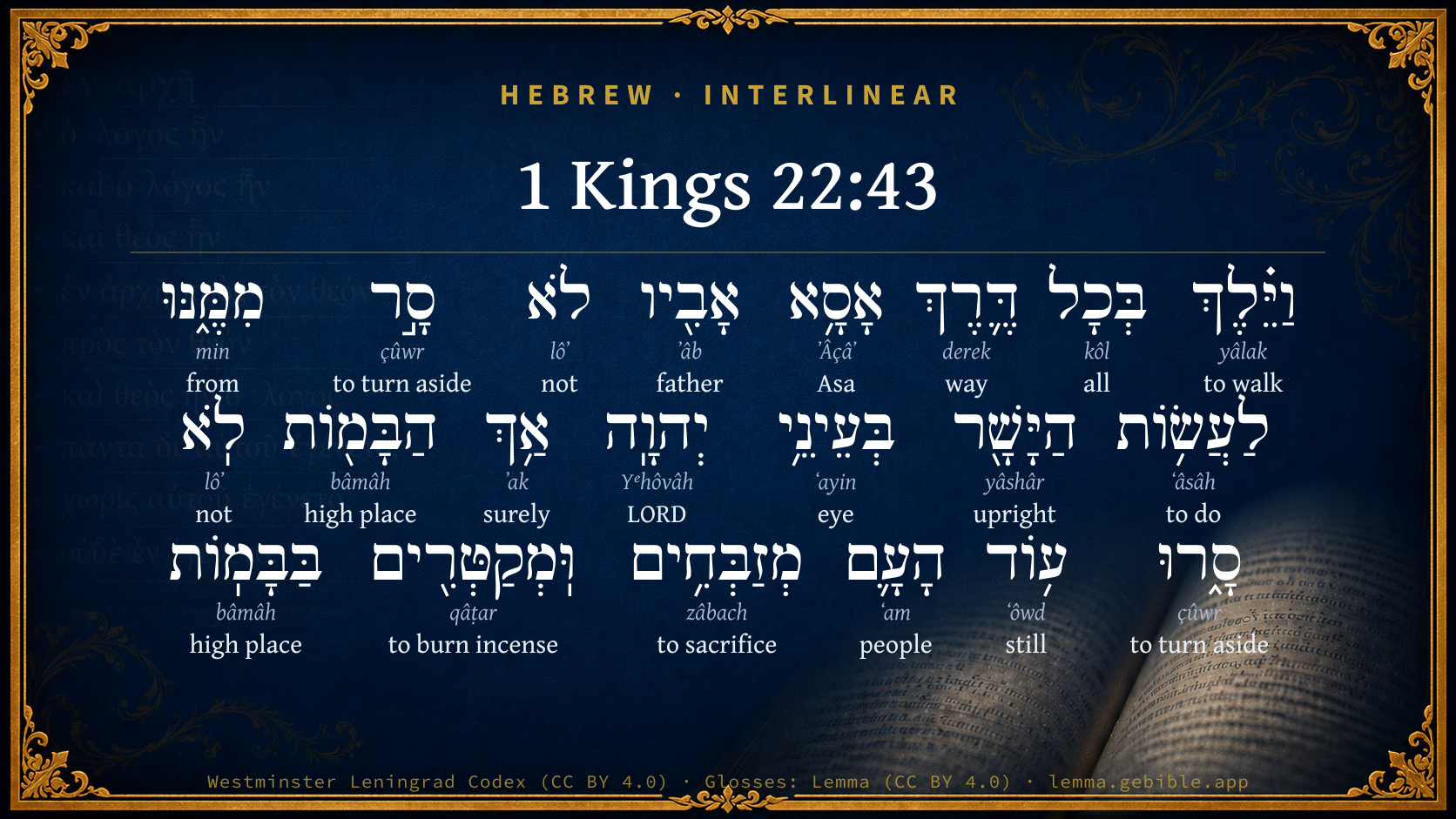
Hebrew (Westminster Leningrad Codex) 1 Kings 22:43 appears in the Hebrew Old Testament. The text above is from the Westminster Leningrad Codex. Each word links to its Strong’s number, a concise gloss, and parsing drawn from the Open Scriptures Hebrew Bible morphology. Click any word for its full Brown-Driver-Briggs (BDB) entry.
Download image
Cite this verse

1 Kings 22:43 (World English Bible). Public Domain. Lemma interlinear Bible study tool, https://lemma.gebible.app/v/1-kings/22/43.

Show BibTeX & RIS
BibTeX
RIS
English Translation
He walked in all the way of Asa his father; He didn't turn aside from it, doing that which was right in the eyes of Yahweh: however the high places were not taken away; the people still sacrificed and burnt incense in the high places.
World English Bible · Public Domain
Download a study sheet

One document with this verse’s original text, its word-by-word gloss line, the meaning frame, cross-references with their text, attributed commentary, and full source and license credits — printable, and it pastes into notes with its structure intact.

This verse Autodidact and up

Study sheet (.html) Plain text (.txt)

A passage Seminary Student

Up to 50 verses in one chapter. A passage sheet keeps up to 6 commentary sources and 12 cross-references per verse, in the order this page ranks them, and says so on the sheet whenever that leaves anything out. Ask for a single verse and you get the Autodidact verse sheet above.

Everything on this page stays free to read, with no account — the sheet is a download of what is already on screen, not access to it.

Want to remove ads? Support Godless Engineer
Compare translations 3

The same verse in 3 English versions, stacked beneath the original-language interlinear above. Click any original word for its lexicon entry.

Each is an independent rendering of the whole verse — the interlinear is not word-aligned to these translations.

Highlighted words mark where these versions differ — a whole-verse word diff, not a word-by-word alignment.

  • World English Bible Public Domain
    He walked in all the way of Asa his father; He didn't turn aside from it, doing that which was right in the eyes of Yahweh: however the high places were not taken away; the people still sacrificed and burnt incense in the high places.
  • King James Version Public Domain
    And he walked in all the ways of Asa his father; he turned not aside from it, doing that which was right in the eyes of the LORD: nevertheless the high places were not taken away; for the people offered and burnt incense yet in the high places.
  • unfoldingWord Literal Text CC BY-SA 4.0
    And he walked in every way of Asa his father, he did not turn from it, doing right in the eyes of Yahweh. However, they did not remove the high places. The people were still sacrificing and burning incense at the high places.

unfoldingWord Literal Text — © unfoldingWord, licensed CC BY-SA 4.0. Word-aligned USFM3 via Door43 (git.door43.org/unfoldingWord/en_ult).

Versions to compare (up to 4)

3 of 4 selected

Show all 18 translations

Every available English version of this verse, each an independent rendering of the whole verse.

  • World English Bible Public Domain
    He walked in all the way of Asa his father; He didn't turn aside from it, doing that which was right in the eyes of Yahweh: however the high places were not taken away; the people still sacrificed and burnt incense in the high places.
  • Berean Standard Bible Public Domain
    And Jehoshaphat walked in all the ways of his father Asa; he did not turn away from them, but did what was right in the eyes of the LORD. The high places, however, were not removed; the people still sacrificed and burned incense on the high places.
  • Majority Standard Bible Public Domain
    And Jehoshaphat walked in all the ways of his father Asa; he did not turn away from them, but did what was right in the eyes of the LORD. The high places, however, were not removed; the people still sacrificed and burned incense on the high places.
  • King James Version Public Domain
    And he walked in all the ways of Asa his father; he turned not aside from it, doing that which was right in the eyes of the LORD: nevertheless the high places were not taken away; for the people offered and burnt incense yet in the high places.
  • American Standard Version (1901) Public Domain
    And he walked in all the way of Asa his father; He turned not aside from it, doing that which was right in the eyes of Jehovah: howbeit the high places were not taken away; the people still sacrificed and burnt incense in the high places.
  • Revised Version (1885) Public Domain
    And he walked in all the way of Asa his father; he turned not aside from it, doing that which was right in the eyes of the LORD: howbeit the high places were not taken away; the people still sacrificed and burnt incense in the high places.
  • Geneva Bible (1599) Public Domain
    And he walked in all the wayes of Asa his father, and declined not therefrom, but did that which was right in the eyes of the Lord. Neuerthelesse the hie places were not taken away: for the people offred still and burnt incense in the hie places.
  • Douay-Rheims (1899) Public Domain
    And he walked in all the way of Asa his father, and he declined not from it: and he did that which was right in the sight of the Lord.
  • Young's Literal Translation Public Domain
    And he walketh in all the way of Asa his father, he hath not turned aside from it, to do that which `is' right in the eyes of Jehovah; only the high places have not turned aside, yet are the people sacrificing and making perfume in high places.
  • Literal Standard Version CC BY-SA 4.0
    And he walks in all the way of his father Asa, he has not turned aside from it, to do that which [is] right in the eyes of YHWH; only, the high places have not been removed—the people are still sacrificing and making incense in high places.
  • Unlocked Literal Bible CC BY-SA 4.0
    He walked in the ways of Asa, his father; he did not turn away from them; he did what was right in the eyes of Yahweh. Yet the high places were not taken away. The people were still sacrificing and burning incense on the high places.
  • unfoldingWord Literal Text CC BY-SA 4.0
    And he walked in every way of Asa his father, he did not turn from it, doing right in the eyes of Yahweh. However, they did not remove the high places. The people were still sacrificing and burning incense at the high places.
  • Darby Bible Public Domain
    And he walked in all the way of Asa his father; he turned not aside from it, doing what was right in the sight of Jehovah. Only, the high places were not removed: the people offered and burned incense still on the high places.
  • World Messianic Bible Public Domain
    He walked in all the way of Asa his father. He didn’t turn away from it, doing that which was right in the LORD’s eyes. However, the high places were not taken away. The people still sacrificed and burned incense on the high places.
  • Webster's Bible Public Domain
    And he walked in all the way of Asa his father; he turned not aside from it, doing that which was right in the eyes of the LORD:\\
  • Free Bible Version CC BY-SA 4.0
    He followed all the ways of his father; he did not depart from them, and he did what was right in the Lord's sight. However, the high places were not removed and the people still sacrificed and presented offerings there.
  • Bible in Basic English Public Domain
    He did as Asa his father had done, not turning away from it, but doing what was right in the eyes of the Lord; but the high places were not taken away: the people went on making offerings and burning them in the high places.
  • JPS Tanakh (1917) Public Domain
    And he walked in all the way of Asa his father; he turned not aside from it, doing that which was right in the eyes of the LORD; (22-44) howbeit the high places were not taken away; the people still sacrificed and offered in the high places.

Literal Standard Version (2020), Covenant Press — licensed CC BY-SA 4.0. Text via the HelloAO Bible API (eBible.org). Unlocked Literal Bible (unfoldingWord) — licensed CC BY-SA 4.0. Text via the HelloAO Bible API (eBible.org). unfoldingWord Literal Text — © unfoldingWord, licensed CC BY-SA 4.0. Word-aligned USFM3 via Door43 (git.door43.org/unfoldingWord/en_ult). Free Bible Version, Dr. Jonathan Gallagher — licensed CC BY-SA 4.0. Text via the HelloAO Bible API (eBible.org).

Word by word

More ways to search: Search by grammar → Find every occurrence → Compare this word →

Practice this passage: Drill this verse → Learn its vocabulary →

אָסָ֥א
ʼÂçâʼ
H609
“Asa”
Noun, Proper
Part of Speech
Noun
Type
Proper
Full BDB Definition

Origin: of uncertain derivation

TWOT: None

Asa = "healer: injurious (?)" - king of Judah, son of Abijam, father of Jehoshaphat - a Levite
  1. וַיֵּ֗לֶךְ yâlak H3212 “and · to walk” Conjunction + Verb, Qal, Sequential Imperfect, 3rd Person, Masculine, Singular
  2. בְּכָל kôl H3605 “in/at · all of” Preposition + Noun, Common, Masculine, Singular, Construct
  3. דֶּ֛רֶךְ derek H1870 “way of” Noun, Common, Both, Singular, Construct
  4. אָבִ֖יו ʼâb H1 “father · his” Noun, Common, Masculine, Singular, Construct + Suffix, Personal, 3rd Person, Masculine, Singular
  5. לֹא lôʼ H3808 “not” Particle, Negative
  6. סָ֣ר çûwr H5493 “to turn aside” Verb, Qal, Perfect, 3rd Person, Masculine, Singular
  7. מִמֶּ֑נּוּ min H4480 “from · us” Preposition + Suffix, Personal, 1st Person, Common, Plural
  8. לַעֲשׂ֥וֹת ʻâsâh H6213 “to do” Preposition + Verb, Qal, Infinitive Construct
  9. הַיָּשָׁ֖ר yâshâr H3477 “the · upright” Particle, Definite Article + Adjective, Adjective, Masculine, Singular, Absolute
  10. בְּעֵינֵ֥י ʻayin H5869 “in/at · eyes of” Preposition + Noun, Common, Both, Dual, Construct
  11. יְהוָֽה Yᵉhôvâh H3068 “LORD” Noun, Proper
  12. אַ֥ךְ ʼak H389 “surely” Particle, Accusative
  13. הַבָּמ֖וֹת bâmâh H1116 “the · high places” Particle, Definite Article + Noun, Common, Feminine, Plural, Absolute
  14. לֹֽא lôʼ H3808 “not” Particle, Negative
  15. סָ֑רוּ çûwr H5493 “to turn aside” Verb, Qal, Perfect, 3rd Person, Common, Plural
  16. ע֥וֹד ʻôwd H5750 “still” Adverb
  17. הָעָ֛ם ʻam H5971 “the · people” Particle, Definite Article + Noun, Common, Masculine, Singular, Absolute
  18. מְזַבְּחִ֥ים zâbach H2076 “sacrificing” Verb, Piel, Participle Active, Masculine, Plural, Absolute
  19. וּֽמְקַטְּרִ֖ים qâṭar H6999 “and · burning incense” Conjunction + Verb, Piel, Participle Active, Masculine, Plural, Absolute
  20. בַּבָּמֽוֹת bâmâh H1116 “in/at the · high places” Preposition, Determined + Noun, Common, Feminine, Plural, Absolute

About this verse

These counts appear in no published source. They are computed here, from the morphology-tagged text and Lemma’s own curated glosses. What Lemma adds →

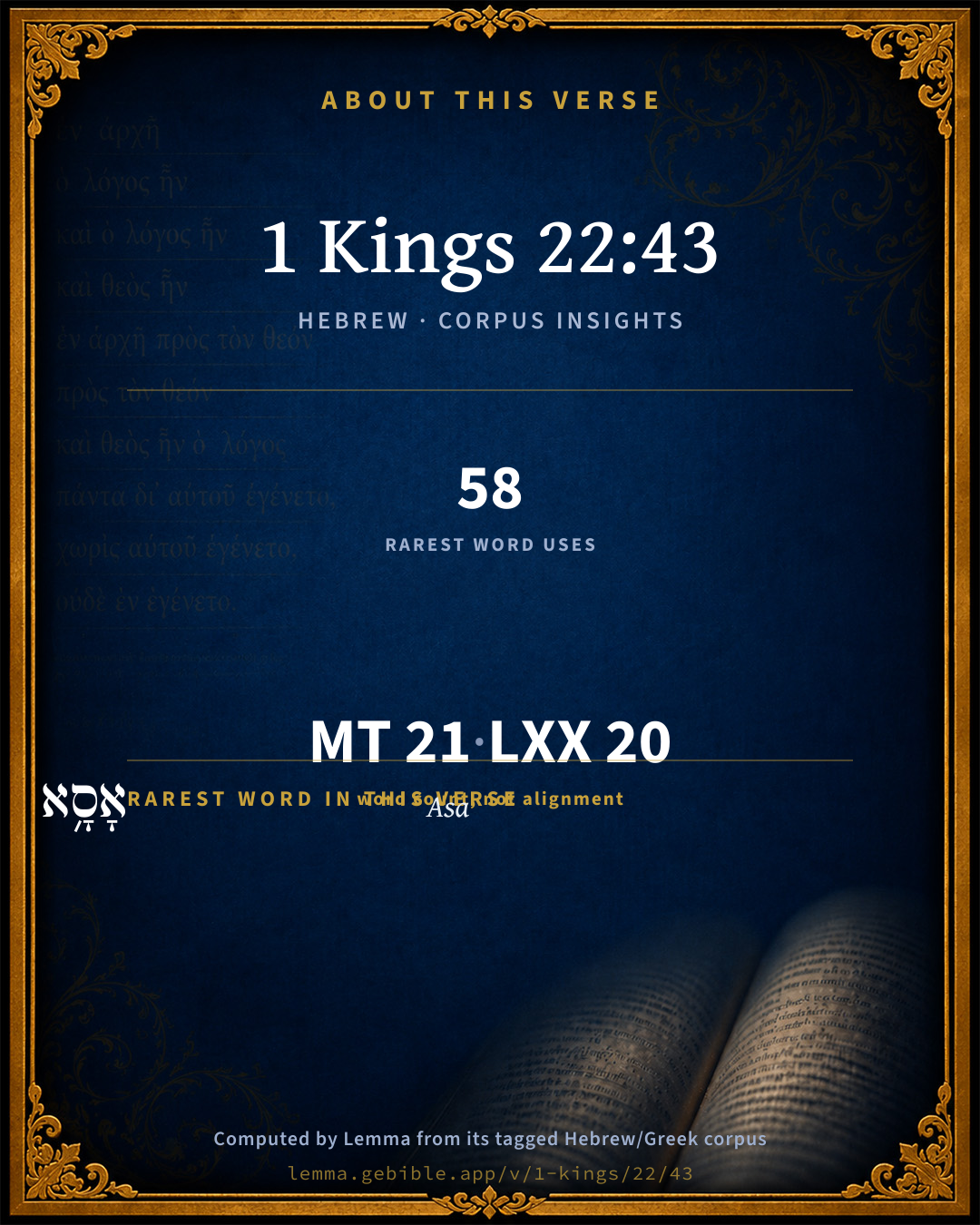
21
words
18
distinct lemmas
Historical
section

Shared distinctive vocabulary

אָסָ֥א Asa H609 occurs in 52 verses of the Hebrew Bible. Also found in:

Grammatical profile

  • 6 verbs
  • 9 nouns
  • 1 adjective
  • 1 preposition
  • 1 adverb
  • 3 particles

Verb forms

  • וַיֵּ֗לֶךְ Qal · Sequential Imperfect
  • סָ֣ר Qal · Perfect
  • לַעֲשׂ֥וֹת Qal · Infinitive Construct
  • סָ֑רוּ Qal · Perfect
  • מְזַבְּחִ֥ים Piel · Participle Active
  • וּֽמְקַטְּרִ֖ים Piel · Participle Active

Repetition

Words recur within this verse — often emphatic in Hebrew:

  • סָ֣ר to turn aside H5493 ×2
  • הַבָּמ֖וֹת high place H1116 ×2
  • לֹא not H3808 ×2

Hebrew & Septuagint length

In English translation the verse runs 45 words from the Hebrew and 29 from the Septuagint (LXX English) — the Septuagint runs noticeably shorter here. See the side-by-side →

A rough comparison of the two English renderings, which tokenize alike — not a word-level alignment.

Word counts can differ between the Hebrew and the Greek without any difference in meaning — e.g. the Hebrew direct-object marker אֵת has no separate Greek word, and Greek often adds the article ὁ.

In the original languages it is 21 Hebrew tokens and 20 Greek tokens — but the two are counted differently (Hebrew bundles its prefixes and suffixes into one token; the Greek is in lemma form), so that isn’t a like-for-like length.

Cross-references

22

Topical passages linked to 1 Kings 22:43 in the Treasury of Scripture Knowledge — connected by theme and wording, ordered by reader-vote popularity; previews shown in the World English Bible.

  • 1 Kings 15:14 But the high places were not taken away: nevertheless the heart of Asa was perfect with Yahweh all his days.
  • 2 Kings 12:3 However the high places were not taken away; the people still sacrificed and burnt incense in the high places.
  • Proverbs 4:27 Don't turn to the right hand nor to the left. Remove your foot from evil.
  • Exodus 32:8 They have turned aside quickly out of the way which I commanded them. They have made themselves a molten calf, and have worshiped it, and have sacrificed to it, and said, 'These are your gods, Israel, which brought you up out of the land of Egypt.'"
  • 1 Samuel 12:20–21 Samuel said to the people, "Don't be afraid; you have indeed done all this evil; yet don't turn aside from following Yahweh, but serve Yahweh with all your heart:
  • 1 Kings 14:23 For they also built them high places, and pillars, and Asherim, on every high hill, and under every green tree;
  • 1 Kings 15:5 because David did that which was right in the eyes of Yahweh, and didn't turn aside from anything that he commanded him all the days of his life, except only in the matter of Uriah the Hittite.
  • 1 Kings 15:11 Asa did that which was right in the eyes of Yahweh, as did David his father.
  • 2 Kings 14:3–4 He did that which was right in the eyes of Yahweh, yet not like David his father: he did according to all that Joash his father had done.
  • 2 Kings 15:3–4 He did that which was right in the eyes of Yahweh, according to all that his father Amaziah had done.
  • 2 Kings 18:22 But if you tell me, We trust in Yahweh our God; isn't that he whose high places and whose altars Hezekiah has taken away, and has said to Judah and to Jerusalem, You shall worship before this altar in Jerusalem?
  • 2 Chronicles 14:2–5 Asa did that which was good and right in the eyes of Yahweh his God:
  • 2 Chronicles 14:11 Asa cried to Yahweh his God, and said, Yahweh, there is none besides you to help, between the mighty and him who has no strength: help us, Yahweh our God; for we rely on you, and in your name are we come against this multitude. Yahweh, you are our God; don't let man prevail against you.
  • 2 Chronicles 15:8 When Asa heard these words, and the prophecy of Oded the prophet, he took courage, and put away the abominations out of all the land of Judah and Benjamin, and out of the cities which he had taken from the hill-country of Ephraim; and he renewed the altar of Yahweh, that was before the porch of Yahweh.
  • 2 Chronicles 15:17 But the high places were not taken away out of Israel: nevertheless the heart of Asa was perfect all his days.
  • 2 Chronicles 16:7–12 At that time Hanani the seer came to Asa king of Judah, and said to him, Because you have relied on the king of Syria, and have not relied on Yahweh your God, therefore is the host of the king of Syria escaped out of your hand.
  • 2 Chronicles 17:3–6 Yahweh was with Jehoshaphat, because he walked in the first ways of his father David, and didn't seek the Baals,
  • 2 Chronicles 19:3–4 Nevertheless there are good things found in you, in that you have put away the Asheroth out of the land, and have set your heart to seek God.
  • 2 Chronicles 20:3–30 Jehoshaphat feared, and set himself to seek to Yahweh; and he proclaimed a fast throughout all Judah.
  • Psalms 40:4 Blessed is the man who makes Yahweh his trust, And doesn't respect the proud, nor such as turn aside to lies.
  • Psalms 101:3 I will set no vile thing before my eyes. I hate the deeds of faithless men. They will not cling to me.
  • Psalms 125:5 But as for those who turn aside to their crooked ways, Yahweh will lead them away with the workers of iniquity. Peace be on Israel.

Cross-references courtesy of OpenBible.info (CC BY 4.0).

Hebrew and Greek witnesses Masoretic Hebrew ↔ Greek Septuagint

The same verse in the two great witnesses to the Old Testament, shown verse-for-verse.

Here the Septuagint runs noticeably shorter than the Hebrew — LXX2012 (modern English Septuagint) 29 words vs World English Bible 45. A rough length comparison of the two English translations, not a word-level alignment — read both below.

These are two independent witnesses, not word-aligned to each other, and the Septuagint is shown in lemma (dictionary) form.

Hebrew 1 Kings 22:43 Masoretic · Westminster Leningrad Codex

וַיֵּ֗לֶךְ בְּכָל דֶּ֛רֶךְ אָסָ֥א אָבִ֖יו לֹא סָ֣ר מִמֶּ֑נּוּ לַעֲשׂ֥וֹת הַיָּשָׁ֖ר בְּעֵינֵ֥י יְהוָֽה אַ֥ךְ הַבָּמ֖וֹת לֹֽא סָ֑רוּ ע֥וֹד הָעָ֛ם מְזַבְּחִ֥ים וּֽמְקַטְּרִ֖ים בַּבָּמֽוֹת

He walked in all the way of Asa his father; He didn't turn aside from it, doing that which was right in the eyes of Yahweh: however the high places were not taken away; the people still sacrificed and burnt incense in the high places.

World English Bible · Public Domain

Greek LXX 1 Kings 22:43 Septuagint · lemma form

καί πορεύομαι ἐν πᾶς ὁδός ασα ὁ πατήρ αὐτός οὐ ἐκκλίνω ἀπό αὐτός ὁ ποιέω ὁ εὐθής ἐν ὀφθαλμός κύριος

And he walked in all the way of Asa his father: he turned not from it, even from doing that which was right in the eyes of the Lord.

LXX2012 (modern English Septuagint) · Public Domain

Hebrew: Westminster Leningrad Codex (CC BY 4.0). Greek: Septuagint (public domain); English from LXX2012 (modern English Septuagint) (Public Domain). How the Septuagint differs from the Hebrew →

Targum (Aramaic paraphrase)

1

The Targum is the ancient Jewish Aramaic paraphrase of the Hebrew Scriptures — an interpretive translation, not the Hebrew text itself. Onkelos (literal) and Pseudo-Jonathan (expansive) render the Torah, and Jonathan the Prophets. Coverage is partial: where no permissively-licensed English translation exists for a verse, only the Aramaic is shown. This is verse-level text, not a word-by-word alignment to the Hebrew.

  1. Targum Jonathan Prophets (Joshua–Malachi)
    וַאֲזַל בְּכָל אוֹרְחָא אָסָא אֲבוֹהִי לָא סְטָא מִנֵיהּ לְמֶעְבַּד דְכָשַׁר קֳדָם יְיָ:

    (no public-domain English translation for this verse)

    Targum Jonathan — Aramaic: “Mikraot Gedolot” (public domain). English: “Sefaria Community Translation” (CC0 1.0 (public-domain dedication)); “London "Chaldee Paraphrase," 1871” (public domain). Text via Sefaria.

Commentary

Notes on 1 Kings 22:43 from classic Christian and Jewish commentators (each source and its license shown beneath its notes). The classic Christian expositions comment on the surrounding passage and are grouped to its opening verse, so a note may address several verses; the Jewish commentaries on the Tanakh (Rashi and others) are per-verse, so they appear only where the commentator wrote on this verse.

Lemma curates 59 commentaries, every one of them public domain or Creative Commons licensed, each selected and text-cleaned for this edition rather than reprinted as found. About our sources →

Trapp's Complete Commentary

John Trapp

1Ki 22:43 And he walked in all the ways of Asa his father; he turned not aside from it, doing [that which was] right in the eyes of the LORD: nevertheless the high places were not taken away; [for] the people offered and burnt incense yet in the high places.

Ver. 43. Nevertheless the high places were not taken away,] viz., Those wherein the people served and worshipped the God of Israel. The people were much set upon them; and the king perhaps thought there was no great harm in them; hence they still stood, when there was otherwise a great reformation.

John Trapp, A Commentary or Exposition upon All the Books of the Old and New Testament (1647–1656) — public domain. Text from a community e-Sword module.

Joseph Benson's Commentary

1Ki 22:43. He walked in all the ways of Asa — He took the same care for the government of his kingdom, and especially for the reformation of religion, which Asa did. Nevertheless, the high places were not taken away — Not fully, or not in the beginning of his reign. For that he did take them away, at least in part, and probably all those which were erected for the worship of idols, appears from 2Ch 17:9. The people offered — incense yet in the high places — Old corruptions are not eradicated without difficulty, especially when they have formerly had the patronage of those that were good, as the high places had of Samuel, Solomon, and some others. Indeed this error was so deeply rooted, that the best of their kings, till Hezekiah’s time, connived at it.

Joseph Benson's Commentary on the Old and New Testaments (1811–1818) — public domain. Text from a community e-Sword module.

Tyndale Open Study Notes

Tyndale Open Resources

22:43-44 Although Jehoshaphat is remembered as a king who did what was pleasing in the Lord’s sight, his record is blemished by his failure to remove all the pagan shrines (see 15:14) and by his involvement with Ahab (22:4, 29-32; 2 Chr 19:1-3) and, later, Joram (2 Kgs 3:4-27).

Tyndale Open Study Notes — © Tyndale Open Resources, licensed CC BY-SA 4.0. Text via the HelloAO Bible API.

Geneva Bible (1599)

Geneva Bible translators

Meaning, that he was led with an error, thinking that they might still sacrifice to the Lord in those places, as well as they did before the Temple was built.

Geneva Bible (1599) marginal notes — public domain. Text via Bolls.life.

Adam Clarke's Commentary

Verse 43. The high places were not taken away] In 2Ch 17:6, it is expressly said, that he did take away the high places. Allowing that the text is right in 2 Chron., the two places may be easily reconciled. There were two kinds of high places in the land:

1. Those used for idolatrous purposes.

2. Those that were consecrated to God, and were used before the temple was built. The former he did take away; the latter he did not.

But some think the parallel place in 2Ch 17:6 is corrupted, and that, instead of ועוד הסיר veod hesir, "and moreover he took away," we should read, ולא הסיר velo hesir, "and he did NOT take away."

Adam Clarke's Commentary on the Bible (1810–1826) — public domain. Text from a community e-Sword/MySword module.

Ellicott's Commentary for English Readers

(43) The high places were not taken away.—This agrees with 2Ch_20:33, and stands in apparent contradiction with 2Ch_17:6 : “He took away the high places and groves out of Judah.” Probably the key to the apparent discrepancy lies in the words “and groves” (Asherah). The high places taken away were those connected with the base Asherah worship; those which were simply unauthorised sanctuaries remained, at any rate in part.

A Bible Commentary for English Readers, edited by Charles John Ellicott (1878–1897) — public domain. Text from a community e-Sword module.

The Cambridge Bible for Schools and Colleges

gen. ed. J. J. S. Perowne

43. nevertheless [R.V. howbeit] the high places were not taken away] for [om. for R.V.] the people offered [R.V. still sacrificed] and burnt incense yet [om. yet R.V.] in the high places. The changes get rid of the italic for, and put still instead of yet in its proper place in the verse. ‘To sacrifice’ is the constant translation of the verb changed in R.V.

The statement here made is no contradiction, as might at first sight appear, to 2Ch_17:6, ‘he took away the high places and groves [R.V. the Ashêrim] out of Judah.’ The addition of ‘the Ashêrim’ in the latter passage shews that the writer is speaking of the high places which were devoted to the worship of Baal and Astoreth. This worship had spread from Israel into Judah, and it was this which Jehoshaphat swept away, an act which Jehu the prophet specially commends (2Ch_19:3). But the high places which had been from early times set apart for the worship of Jehovah, and which were meant to be put down when the Temple was built, he had not power to abolish. From long custom people clung to them, and having at first been places of acceptable worship, there was great difficulty in proceeding to extremities against those who still chose to worship there.

The Cambridge Bible for Schools and Colleges (gen. ed. J. J. S. Perowne; Cambridge University Press, 1878–1918) — public domain. Text from a community e-Sword module.

Albert Barnes' Notes on the Bible

On the general piety of Asa, see above, 1Ki 15:11-15 and references. Jehoshaphat seems to have been a still better king, for he did not, like Asa, fall away in his old age 2Ch 16:2-12.

The high places were not taken away - This seems to contradict 2Ch 17:6. Probably the writer of Chronicles refers to the desire and intention of the monarch, while the author of Kings records the practical failure of his efforts.

Albert Barnes' Notes on the Bible (1834–1885) — public domain. Text from a community e-Sword/MySword module.

Matthew Poole's English Annotations

He walked in all the ways of Asa his father; he took the same care for the government of his kingdom, and especially for the reformation of religion, that Asa did; of whom see 1Ki 15:11.

The high places were not taken away.

Object. It is said he did take them away, 2Ch 17:6.

Answ. He took away those which were erected to idols; of which he seems to speak there, because the high places are there joined with groves, which were generally erected to idols, and not to the true God, as will appear to any one that shall compare all the scriptures where groves are mentioned; but he could not take away those which were erected to the true God, of which this; place manifestly speaks; as also that parallel place 1Ki 15:14, where See Poole "1Ki 15:14". Or he took them away, but not fully; or not in the very beginning of his reign.

Matthew Poole's English Annotations on the Holy Bible (1683–1685) — public domain. Text from a community e-Sword/MySword module.

The Pulpit Commentary

And he walked in the ways of Asa his father Apart from his alliance with the house of Ahab, and the troubles in which it involved him, his reign was alike pious and prosperous. Like Asa"s, it was distinguished by internal reforms, and By signal deliverances from foreign enemies; he turned not aside from it as Asa was tempted to do in his old age, doing Heb. to do that which was right in the eyes of the Lord: nevertheless the high places were not taken away Heb. de parted not, as in 1Ki_15:14; 2Ch_15:17; 2Ki_12:4 2Ki_14:4, Hebrews But see 2Ch_18:6. The discrepancy is the exact parallel of that between 1Ki_15:14 and 2Ch_14:3; or between this latter passage and; 2Ch_15:17. And the explanation is the same, viz., that an effort was made to remove the high places, which was partially, and only partially, successful for the people offered and burnt incense yet in the high places. (cf. 1Ki_3:2)

The Pulpit Commentary (1880–1919), ed. H.D.M. Spence-Jones & Joseph S. Exell — public domain. Text from a community e-Sword module.

John Wesley's Explanatory Notes

High places - He took them away, but not fully; or not in the beginning of of his reign.

John Wesley, Explanatory Notes Upon the Whole Bible (1754–1765) — public domain. Text via the GEBible commentary corpus.

unfoldingWord translationNotes

Door43 World Missions Community

He walked in the ways of Asa, his father

A person's behavior is spoken of as if that person walked along a path. AT: "He did the same things that Asa, his father, had done" (See: Metaphor)

what was right in the eyes of Yahweh

Here "eyes" represents seeing and Yahweh's opinion is spoken of as if he were able to see something. AT: "what Yahweh considered to be right" (See: Metaphor)

the high places were not taken away

This can be stated in active form. AT: "he did not take away the high places" (See: Active or Passive)

translationWords

walk

turn

Yahweh

high place

sacrifice

incense

peace

king

unfoldingWord translationNotes — © Distant Shores Media and the Door43 World Missions Community, licensed CC BY-SA 4.0. Source: git.door43.org/Door43/en_tn.

Lesson kit

Teaching starters — assembled from the data on this page, not authored interpretation. Every prompt links to the verse data it draws on. Edit before teaching.

1 Kings, in the Historical, opens this verse with 21 words (18 distinct Hebrew lemmas). Its most distinctive word is ʼÂçâʼ (“Asa”). The Greek Septuagint runs shorter here. A historical commentator’s framing appears above. Read the whole chapter for the surrounding context.

Discussion questions

  1. How does “Asa” (ʼÂçâʼ) shape what this verse is saying?
  2. 1 Kings 15:8 shares the word «Asa» with this verse. How do the two illuminate each other?
  3. “to turn aside” occurs 2× in this one verse. What is the effect of the repetition?
  4. Compared with the Hebrew, the Septuagint runs shorter here. What questions does that raise?
  5. These translations render this verse differently. What is at stake in choosing one wording over another?
  6. The verb «וַיֵּ֗לֶךְ» is Qal Sequential Imperfect. How does its form color the action?
  7. Reading how Trapp's Complete Commentary and Joseph Benson's Commentary read this verse, where do the two commentators agree and where do they part?

Things to notice

Reading settings

Reading text

Shown beneath each verse's original-language words.

Old Testament
Old Testament edition

Read the OT as the Masoretic Hebrew (MT) or the Greek Septuagint (LXX).

English shown for the Greek Septuagint (in the Hebrew ↔ Greek comparison).

Comparing translations? Open the Compare panel on any verse page to stack up to four side by side.