
2 Kings 23:27

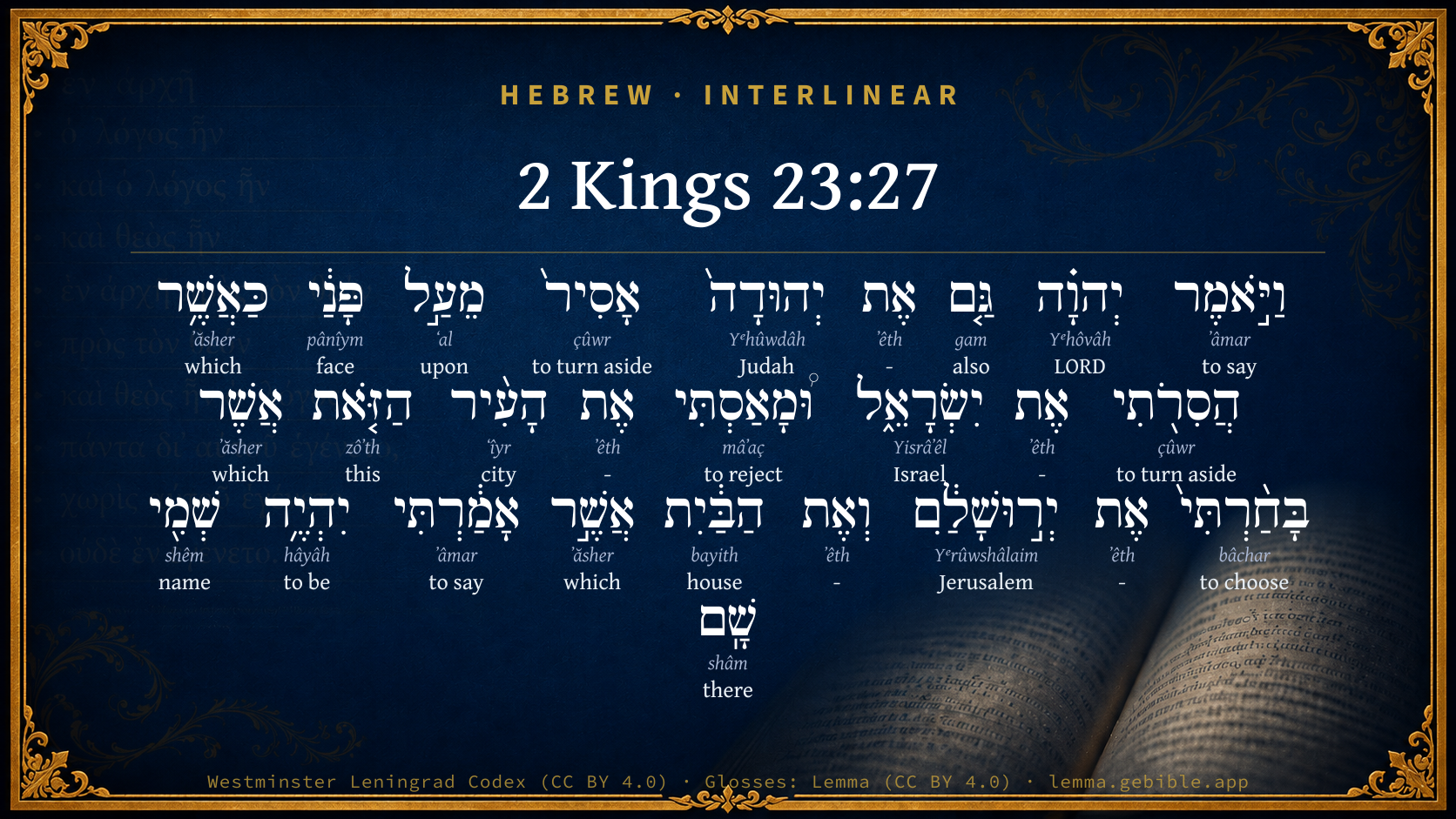
Hebrew (Westminster Leningrad Codex) 2 Kings 23:27 appears in the Hebrew Old Testament. The text above is from the Westminster Leningrad Codex. Each word links to its Strong’s number, a concise gloss, and parsing drawn from the Open Scriptures Hebrew Bible morphology. Click any word for its full Brown-Driver-Briggs (BDB) entry.
Download image
Cite this verse

2 Kings 23:27 (World English Bible). Public Domain. Lemma interlinear Bible study tool, https://lemma.gebible.app/v/2-kings/23/27.

Show BibTeX & RIS
BibTeX
RIS
English Translation
Yahweh said, I will remove Judah also out of my sight, as I have removed Israel, and I will cast off this city which I have chosen, even Jerusalem, and the house of which I said, My name shall be there.
World English Bible · Public Domain
Download a study sheet

One document with this verse’s original text, its word-by-word gloss line, the meaning frame, cross-references with their text, attributed commentary, and full source and license credits — printable, and it pastes into notes with its structure intact.

This verse Autodidact and up

Study sheet (.html) Plain text (.txt)

A passage Seminary Student

Up to 50 verses in one chapter. A passage sheet keeps up to 6 commentary sources and 12 cross-references per verse, in the order this page ranks them, and says so on the sheet whenever that leaves anything out. Ask for a single verse and you get the Autodidact verse sheet above.

Everything on this page stays free to read, with no account — the sheet is a download of what is already on screen, not access to it.

Want to remove ads? Support Godless Engineer
Compare translations 3

The same verse in 3 English versions, stacked beneath the original-language interlinear above. Click any original word for its lexicon entry.

Each is an independent rendering of the whole verse — the interlinear is not word-aligned to these translations.

Highlighted words mark where these versions differ — a whole-verse word diff, not a word-by-word alignment.

  • World English Bible Public Domain
    Yahweh said, I will remove Judah also out of my sight, as I have removed Israel, and I will cast off this city which I have chosen, even Jerusalem, and the house of which I said, My name shall be there.
  • King James Version Public Domain
    And the LORD said, I will remove Judah also out of my sight, as I have removed Israel, and will cast off this city Jerusalem which I have chosen, and the house of which I said, My name shall be there.
  • unfoldingWord Literal Text CC BY-SA 4.0
    And Yahweh had said, “I will also remove Judah away from my face, just as I removed Israel. And I will reject this city that I chose, Jerusalem, and the house which I said, ‘My name will be there.’”

unfoldingWord Literal Text — © unfoldingWord, licensed CC BY-SA 4.0. Word-aligned USFM3 via Door43 (git.door43.org/unfoldingWord/en_ult).

Versions to compare (up to 4)

3 of 4 selected

Show all 18 translations

Every available English version of this verse, each an independent rendering of the whole verse.

  • World English Bible Public Domain
    Yahweh said, I will remove Judah also out of my sight, as I have removed Israel, and I will cast off this city which I have chosen, even Jerusalem, and the house of which I said, My name shall be there.
  • Berean Standard Bible Public Domain
    For the LORD had said, “I will remove Judah from My sight, just as I removed Israel. I will reject this city Jerusalem, which I chose, and the temple of which I said, ‘My Name shall be there.’”
  • Majority Standard Bible Public Domain
    For the LORD had said, “I will remove Judah from My sight, just as I removed Israel. I will reject this city Jerusalem, which I chose, and the temple of which I said, ‘My Name shall be there.’”
  • King James Version Public Domain
    And the LORD said, I will remove Judah also out of my sight, as I have removed Israel, and will cast off this city Jerusalem which I have chosen, and the house of which I said, My name shall be there.
  • American Standard Version (1901) Public Domain
    And Jehovah said, I will remove Judah also out of my sight, as I have removed Israel, and I will cast off this city which I have chosen, even Jerusalem, and the house of which I said, My name shall be there.
  • Revised Version (1885) Public Domain
    And the LORD said, I will remove Judah also out of my sight, as I have removed Israel, and I will cast off this city which I have chosen, even Jerusalem, and the house of which I said, My name shall be there.
  • Geneva Bible (1599) Public Domain
    Therefore the Lord saide, I will put Iudah also out of my sight, as I haue put away Israel, and will cast off this citie Ierusalem, which I haue chosen, and the house whereof I said, My name shalbe there.
  • Douay-Rheims (1899) Public Domain
    And the Lord said: I will remove Juda also from before my face, as I have removed Israel: and I will cast off this city Jerusalem, which I chose, and the house, of which I said: My name shall be there.
  • Young's Literal Translation Public Domain
    and Jehovah saith, `Also Judah I turn aside from my presence, as I turned Israel aside, and I have rejected this city that I have chosen -- Jerusalem, and the house of which I said, My name is there.'
  • Literal Standard Version CC BY-SA 4.0
    and YHWH says, “I also turn Judah aside from my presence, as I turned Israel aside, and I have rejected this city that I have chosen—Jerusalem, and the house of which I said, My Name is there.”
  • Unlocked Literal Bible CC BY-SA 4.0
    So Yahweh said, “I will also remove Judah out of my sight, as I have removed Israel, and I will throw away this city that I have chosen, Jerusalem, and the house of which I said, 'My name will be there.'”
  • unfoldingWord Literal Text CC BY-SA 4.0
    And Yahweh had said, “I will also remove Judah away from my face, just as I removed Israel. And I will reject this city that I chose, Jerusalem, and the house which I said, ‘My name will be there.’”
  • Darby Bible Public Domain
    And Jehovah said, I will remove Judah also out of my sight, as I have removed Israel, and will reject this city Jerusalem which I have chosen, and the house of which I said, My name shall be there.
  • World Messianic Bible Public Domain
    The LORD said, “I will also remove Judah out of my sight, as I have removed Israel; and I will cast off this city which I have chosen, even Jerusalem, and the house of which I said, ‘My name shall be there.’”
  • Webster's Bible Public Domain
    And the LORD said, I will remove Judah also out of my sight, as I have removed Israel, and will reject this city Jerusalem which I have chosen, and the house of which I said, My name shall be there.
  • Free Bible Version CC BY-SA 4.0
    So the Lord announced, “I'm also going to banish Judah from my presence, just as I banished Israel. I will abandon this city that I have chosen, Jerusalem, and the Temple regarding which I said, My name will be there.”
  • Bible in Basic English Public Domain
    And the Lord said, I will send Judah away from before my face, as I have sent Israel; I will have nothing more to do with this town, which I had made mine, even Jerusalem, and the holy house of which I said, My name will be there.
  • JPS Tanakh (1917) Public Domain
    And the LORD said: 'I will remove Judah also out of My sight, as I have removed Israel, and I will cast off this city which I have chosen, even Jerusalem, and the house of which I said: My name shall be there.'

Literal Standard Version (2020), Covenant Press — licensed CC BY-SA 4.0. Text via the HelloAO Bible API (eBible.org). Unlocked Literal Bible (unfoldingWord) — licensed CC BY-SA 4.0. Text via the HelloAO Bible API (eBible.org). unfoldingWord Literal Text — © unfoldingWord, licensed CC BY-SA 4.0. Word-aligned USFM3 via Door43 (git.door43.org/unfoldingWord/en_ult). Free Bible Version, Dr. Jonathan Gallagher — licensed CC BY-SA 4.0. Text via the HelloAO Bible API (eBible.org).

Word by word

More ways to search: Search by grammar → Find every occurrence → Compare this word →

Practice this passage: Drill this verse → Learn its vocabulary →

וּ֠מָאַסְתִּי
mâʼaç
H3988
“and · to reject”
Conjunction + Verb, Qal, Sequential Perfect, 1st Person, Common, Singular
Part of Speech
Conjunction + Verb
Stem
Qal
Form
Sequential Perfect
Person
1st Person
Gender
Common
Number
Singular
Full BDB Definition

Origin: a primitive root

TWOT: 1139 , 1140

to reject, despise, refuse - (Qal) - to reject, refuse - to despise - (Niphal) to be rejected - (Niphal) to flow, run
  1. וַיֹּ֣אמֶר ʼâmar H559 “and · to say” Conjunction + Verb, Qal, Sequential Imperfect, 3rd Person, Masculine, Singular
  2. יְהוָ֗ה Yᵉhôvâh H3068 “LORD” Noun, Proper
  3. גַּ֤ם gam H1571 “also” Particle, Accusative
  4. אֶת ʼêth H853 “-” Particle, Direct Object
  5. יְהוּדָה֙ Yᵉhûwdâh H3063 “Judah” Noun, Proper
  6. אָסִיר֙ çûwr H5493 “to turn aside” Verb, Hiphil, Imperfect, 1st Person, Common, Singular
  7. מֵעַ֣ל ʻal H5921 “from · upon” Preposition + Preposition
  8. פָּנַ֔י pânîym H6440 “face(s) · my” Noun, Common, Both, Plural, Construct + Suffix, Personal, 1st Person, Common, Singular
  9. כַּאֲשֶׁ֥ר ʼăsher H834 “like/as · which” Preposition + Particle, Relative
  10. הֲסִרֹ֖תִי çûwr H5493 “to turn aside” Verb, Hiphil, Perfect, 1st Person, Common, Singular
  11. אֶת ʼêth H853 “-” Particle, Direct Object
  12. יִשְׂרָאֵ֑ל Yisrâʼêl H3478 “Israel” Noun, Proper
  13. אֶת ʼêth H853 “-” Particle, Direct Object
  14. הָעִ֨יר ʻîyr H5892 “the · city” Particle, Definite Article + Noun, Common, Feminine, Singular, Absolute
  15. הַזֹּ֤את zôʼth H2063 “the · this” Particle, Definite Article + Pronoun, Demonstrative, Feminine, Singular
  16. אֲשֶׁר ʼăsher H834 “which” Particle, Relative
  17. בָּחַ֨רְתִּי֙ bâchar H977 “to choose” Verb, Qal, Perfect, 1st Person, Common, Singular
  18. אֶת ʼêth H853 “-” Particle, Direct Object
  19. יְר֣וּשָׁלִַ֔ם Yᵉrûwshâlaim H3389 “Jerusalem” Noun, Proper
  20. וְאֶת ʼêth H853 “and · -” Conjunction + Particle, Direct Object
  21. הַבַּ֔יִת bayith H1004 “the · house” Particle, Definite Article + Noun, Common, Masculine, Singular, Absolute
  22. אֲשֶׁ֣ר ʼăsher H834 “which” Particle, Relative
  23. אָמַ֔רְתִּי ʼâmar H559 “to say” Verb, Qal, Perfect, 1st Person, Common, Singular
  24. יִהְיֶ֥ה hâyâh H1961 “to be” Verb, Qal, Imperfect, 3rd Person, Masculine, Singular
  25. שְׁמִ֖י shêm H8034 “name · my” Noun, Common, Masculine, Singular, Construct + Suffix, Personal, 1st Person, Common, Singular
  26. שָֽׁם shâm H8033 “there” Adverb

About this verse

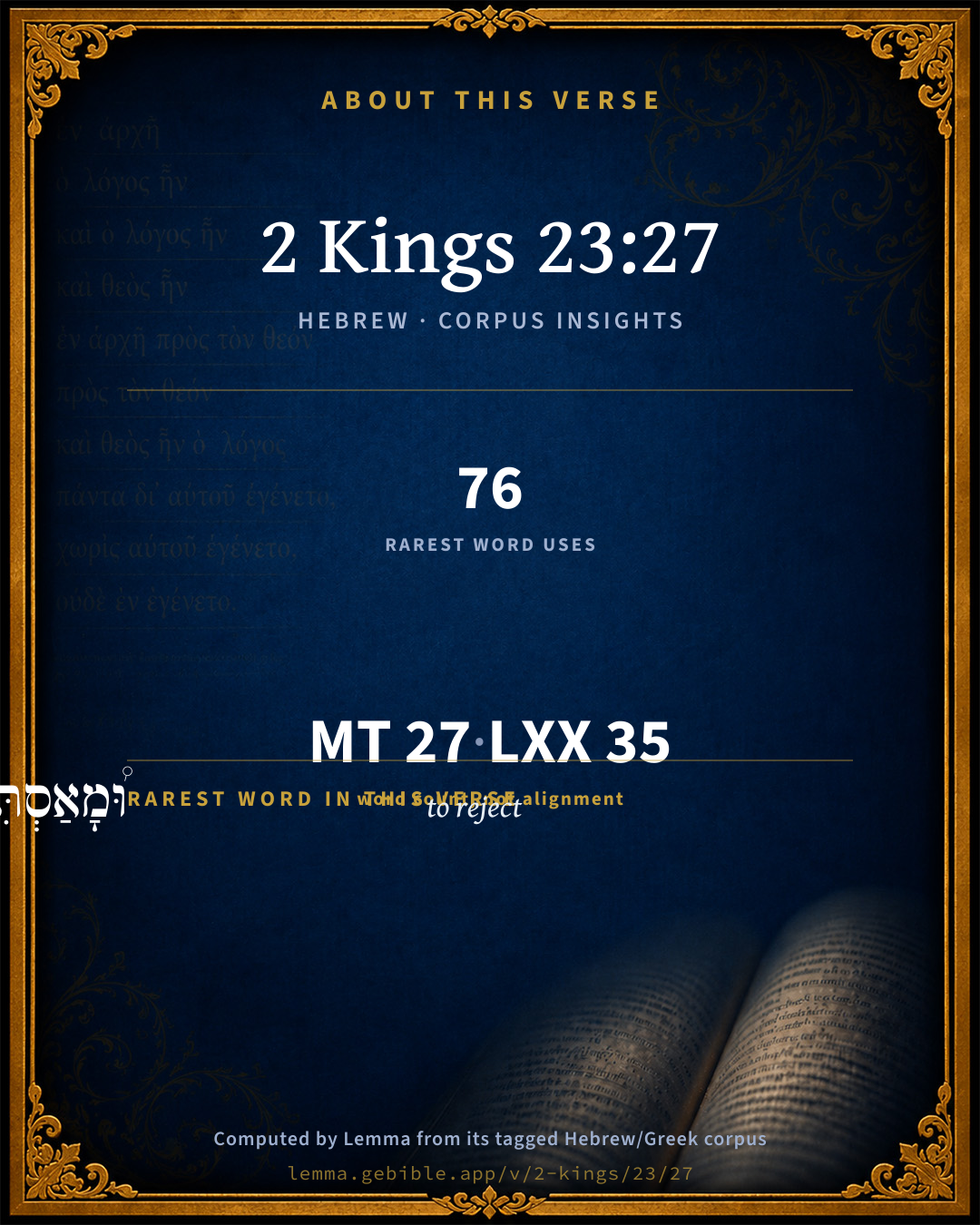
These counts appear in no published source. They are computed here, from the morphology-tagged text and Lemma’s own curated glosses. What Lemma adds →

27
words
19
distinct lemmas
Historical
section

Grammatical profile

  • 7 verbs
  • 8 nouns
  • 1 pronoun
  • 1 preposition
  • 1 adverb
  • 9 particles

Verb forms

  • וַיֹּ֣אמֶר Qal · Sequential Imperfect
  • אָסִיר֙ Hiphil · Imperfect
  • הֲסִרֹ֖תִי Hiphil · Perfect
  • וּ֠מָאַסְתִּי Qal · Sequential Perfect
  • בָּחַ֨רְתִּי֙ Qal · Perfect
  • אָמַ֔רְתִּי Qal · Perfect
  • יִהְיֶ֥ה Qal · Imperfect

Repetition

Words recur within this verse — often emphatic in Hebrew:

  • וַיֹּ֣אמֶר to say H559 ×2
  • אָסִיר֙ to turn aside H5493 ×2
  • כַּאֲשֶׁ֥ר which H834 ×3

Hebrew & Septuagint length

In English translation the verse runs 41 words from the Hebrew and 39 from the Septuagint (LXX English) — closely comparable.

A rough comparison of the two English renderings, which tokenize alike — not a word-level alignment.

Word counts can differ between the Hebrew and the Greek without any difference in meaning — e.g. the Hebrew direct-object marker אֵת has no separate Greek word, and Greek often adds the article ὁ.

In the original languages it is 27 Hebrew tokens and 35 Greek tokens — but the two are counted differently (Hebrew bundles its prefixes and suffixes into one token; the Greek is in lemma form), so that isn’t a like-for-like length.

Cross-references

16

Topical passages linked to 2 Kings 23:27 in the Treasury of Scripture Knowledge — connected by theme and wording, ordered by reader-vote popularity; previews shown in the World English Bible.

  • 2 Kings 18:11 The king of Assyria carried Israel away to Assyria, and put them in Halah, and on the Habor, the river of Gozan, and in the cities of the Medes,
  • 2 Kings 21:13 I will stretch over Jerusalem the line of Samaria, and the plummet of the house of Ahab; and I will wipe Jerusalem as a man wipes a dish, wiping it and turning it upside down.
  • 2 Kings 17:18 Therefore Yahweh was very angry with Israel, and removed them out of his sight: there was none left but the tribe of Judah only.
  • 2 Kings 17:20 Yahweh rejected all the seed of Israel, and afflicted them, and delivered them into the hand of spoilers, until he had cast them out of his sight.
  • 2 Kings 21:4 He built altars in the house of Yahweh, of which Yahweh said, In Jerusalem will I put my name.
  • Jeremiah 33:24 Don't you consider what this people has spoken, saying, The two families which Yahweh did choose, he has cast them off? thus do they despise my people, that they should be no more a nation before them.
  • Deuteronomy 29:27–28 therefore the anger of Yahweh was kindled against this land, to bring on it all the curse that is written in this book;
  • 1 Kings 8:29 that your eyes may be open toward this house night and day, even toward the place of which you have said, My name shall be there; to listen to the prayer which your servant shall pray toward this place.
  • 1 Kings 9:3 Yahweh said to him, I have heard your prayer and your supplication, that you have made before me: I have made this house holy, which you have built, to put my name there forever; and my eyes and my heart shall be there perpetually.
  • 2 Kings 21:7 He set the engraved image of Asherah, that he had made, in the house of which Yahweh said to David and to Solomon his son, In this house, and in Jerusalem, which I have chosen out of all the tribes of Israel, will I put my name forever;
  • 2 Kings 24:3 Surely at the commandment of Yahweh came this on Judah, to remove them out of his sight, for the sins of Manasseh, according to all that he did,
  • 2 Kings 25:11 The residue of the people who were left in the city, and those who fell away, who fell to the king of Babylon, and the residue of the multitude, did Nebuzaradan the captain of the guard carry away captive.
  • Psalms 51:11 Don't throw me from your presence, And don't take your holy Spirit from me.
  • Jeremiah 31:37 Thus says Yahweh: If heaven above can be measured, and the foundations of the earth searched out beneath, then will I also cast off all the seed of Israel for all that they have done, says Yahweh.
  • Lamentations 2:7 The Lord has cast off his altar, he has abhorred his sanctuary; He has given up into the hand of the enemy the walls of her palaces: They have made a noise in the house of Yahweh, as in the day of a solemn assembly.
  • Ezekiel 23:32–35 Thus says the Lord Yahweh: You shall drink of your sister's cup, which is deep and large; you shall ridiculed and had in derision; it contains much.

Cross-references courtesy of OpenBible.info (CC BY 4.0).

Hebrew and Greek witnesses Masoretic Hebrew ↔ Greek Septuagint

The same verse in the two great witnesses to the Old Testament, shown verse-for-verse.

These are two independent witnesses, not word-aligned to each other, and the Septuagint is shown in lemma (dictionary) form.

Hebrew 2 Kings 23:27 Masoretic · Westminster Leningrad Codex

וַיֹּ֣אמֶר יְהוָ֗ה גַּ֤ם אֶת יְהוּדָה֙ אָסִיר֙ מֵעַ֣ל פָּנַ֔י כַּאֲשֶׁ֥ר הֲסִרֹ֖תִי אֶת יִשְׂרָאֵ֑ל וּ֠מָאַסְתִּי אֶת הָעִ֨יר הַזֹּ֤את אֲשֶׁר בָּחַ֨רְתִּי֙ אֶת יְר֣וּשָׁלִַ֔ם וְאֶת הַבַּ֔יִת אֲשֶׁ֣ר אָמַ֔רְתִּי יִהְיֶ֥ה שְׁמִ֖י שָֽׁם

Yahweh said, I will remove Judah also out of my sight, as I have removed Israel, and I will cast off this city which I have chosen, even Jerusalem, and the house of which I said, My name shall be there.

World English Bible · Public Domain

Greek LXX 2 Kings 23:27 Septuagint · lemma form

καί εἶπον κύριος καί γέ ὁ ἰούδας ἀποἵστημι ἀπό ὁ πρόσωπον ἐγώ καθώς ἀποἵστημι ὁ ἰσραήλ καί ἀποὠθέω ὁ πόλις οὗτος ὅς ἐκλέγω ὁ ἰερουσαλήμ καί ὁ οἶκος ὅς εἶπον εἰμί ὁ ὄνομα ἐγώ ἐκεῖ

And the Lord said, I will also remove Juda from my presence, as I removed Israel, and will reject this city which I have chosen even Jerusalem, and the house of which I said, My name shall be there.

LXX2012 (modern English Septuagint) · Public Domain

Hebrew: Westminster Leningrad Codex (CC BY 4.0). Greek: Septuagint (public domain); English from LXX2012 (modern English Septuagint) (Public Domain). How the Septuagint differs from the Hebrew →

Targum (Aramaic paraphrase)

1

The Targum is the ancient Jewish Aramaic paraphrase of the Hebrew Scriptures — an interpretive translation, not the Hebrew text itself. Onkelos (literal) and Pseudo-Jonathan (expansive) render the Torah, and Jonathan the Prophets. Coverage is partial: where no permissively-licensed English translation exists for a verse, only the Aramaic is shown. This is verse-level text, not a word-by-word alignment to the Hebrew.

  1. Targum Jonathan Prophets (Joshua–Malachi)
    וַאֲמַר יְיָ אַף יַת דְבֵית יְהוּדָה אַגְלֵי מֵאַרְעָא בֵּית שְׁכִנְתִּי כְּמָא דְאַגְלֵיתִי יַת יִשְׂרָאֵל וְאַרְחִיק יַת קַרְתָּא הָדָא דְאִתְרְעֵיתִי בִּירוּשְׁלֵם וּבְבֵיתָא דַאֲמָרֵית יְהִי שְׁמִי תַּמָן:

    (no public-domain English translation for this verse)

    Targum Jonathan — Aramaic: “Mikraot Gedolot” (public domain). English: “Sefaria Community Translation” (CC0 1.0 (public-domain dedication)); “London "Chaldee Paraphrase," 1871” (public domain). Text via Sefaria.

Commentary

Notes on 2 Kings 23:27 from classic Christian and Jewish commentators (each source and its license shown beneath its notes). The classic Christian expositions comment on the surrounding passage and are grouped to its opening verse, so a note may address several verses; the Jewish commentaries on the Tanakh (Rashi and others) are per-verse, so they appear only where the commentator wrote on this verse.

Lemma curates 59 commentaries, every one of them public domain or Creative Commons licensed, each selected and text-cleaned for this edition rather than reprinted as found. About our sources →

Trapp's Complete Commentary

John Trapp

2Ki 23:27 And the LORD said, I will remove Judah also out of my sight, as I have removed Israel, and will cast off this city Jerusalem which I have chosen, and the house of which I said, My name shall be there.

Ver. 27. I will remove Judah also out of my sight.] Who was now grown worse than Israel, {Jer 3:11} and was therefore worse, because she should have been better warned by the others’ harms.

John Trapp, A Commentary or Exposition upon All the Books of the Old and New Testament (1647–1656) — public domain. Text from a community e-Sword module.

Joseph Benson's Commentary

2Ki 23:27. I will cast off this city, and the house of which I said, My name shall be there — God promised upon conditions, in sundry places expressed, that his name should be there. These conditions they broke, and therefore God justly made them to know his breach of promise.

Joseph Benson's Commentary on the Old and New Testaments (1811–1818) — public domain. Text from a community e-Sword module.

The Cambridge Bible for Schools and Colleges

gen. ed. J. J. S. Perowne

27. and will cast off this city Jerusalem which I have chosen] R.V. this city which I have chosen, even Jerusalem. This rendering preserves the order of the Hebrew. More than this cannot be said in its favour.

The Cambridge Bible for Schools and Colleges (gen. ed. J. J. S. Perowne; Cambridge University Press, 1878–1918) — public domain. Text from a community e-Sword module.

John Gill's Exposition

In his days Pharaohnechoh king of Egypt,.... Who is called in the Targum Pharaoh the lame, because he was lame in his feet, perhaps gouty; Herodotus (x) also calls him Necos the son of Psammiticus; now it was in the last days of Josiah this king reigned in Egypt, or however that the following event was:

that he went up against the king of Assyria to the river Euphrates; to Carchemish, a city situated upon it; see Ch2 35:26, the king he went against was the king of Babylon, who had conquered the Assyrian monarchy, and therefore called king of it; some take him to be Nabopolassar; according to Marsham (y), he was Chyniladanus:

and King Josiah went against him; to stop him, that he might not pass through his country, and attack the king of Babylon, whose ally, perhaps, Josiah was; or, however, thought himself obliged to him by the privileges, power, and authority he allowed him to exercise in the land of Israel:

and he slew him at Megiddo, when he had seen him; as soon as they came face to face, and engaged in battle, see Kg2 14:8 that is Pharaoh slew Josiah at the first onset. Megiddo was a city in the tribe of Manasseh, Jos 17:11. Herodotus (z) calls it Magdolus, which seems to be a city on the borders of Egypt, the same with Migdol, Jer 44:1 where he says Pharoahnechoh conquered the Syrians; in Josephus (a) it is called Mendes very wrongly. Josiah seems to have engaged in this action without consulting the Lord and his prophets.

(x) Euterpe, sive, l. 2. c. 158. (y) Chronic. Secul. 18. p. 568. (z) Ibid. c. 159. (a) Antiqu. l. 10. c. 5. sect. 1.

John Gill's Exposition of the Whole Bible (1746–1763) — public domain (CC PDM 1.0). Text via the HelloAO Bible API.

Albert Barnes' Notes on the Bible

It added to the guilt of Judah that she had had the warning of her sister Israel’s example, and had failed to profit by it.

Albert Barnes' Notes on the Bible (1834–1885) — public domain. Text from a community e-Sword/MySword module.

Matthew Poole's English Annotations

To wit, upon the conditions in sundry places expressed, which they broke, and therefore God justly made them to know his breach of promise, as he threatens, Num 14:34.

Matthew Poole's English Annotations on the Holy Bible (1683–1685) — public domain. Text from a community e-Sword/MySword module.

Whedon's Commentary on the Bible

Daniel D. Whedon

27. The Lord said — By the prophets.

Out of my sight — Not out of his knowledge and remembrance. But hitherto Judah had stood as the specially favoured of Jehovah — as in the Divine presence — and the light and smile of his countenance had shone upon them; but now this nearness must end.

Daniel D. Whedon (gen. ed.), Commentary on the Old and New Testaments (1874–1909) — public domain. Text from a community e-Sword module.

The Pulpit Commentary

And the Lord said God said in his secret counsels, came to the determination, and pronounced the sentence in his thoughtsI will remove Judah also out of my sight, as I have removed Israel. (comp. 2Ki_17:18, "Therefore the Lord was very angry with Israel, and removed them out of his sight The sins of Judah were now as great as those of Israel had been; therefore her punishment must be the same, as God is no respecter of persons. And I will east off this city Jerusalem which I have chosen. (comp. 1Ki_8:44, 48 11:13, 32, 36, etc.) God "chose" Jerusalem when he put it into the heart of David to bring up the ark thither. (2Sa_6:1-17) And the house of which I said, My Name shall he there (see Deu_12:11; 1Ki_8:29, etc.) A visible confirmation was given to all that David and Solomon had done in establishing the temple at Jerusalem as the head-quarters of the national religion, when "fire came down from heaven, and consumed the burnt offering and the sacrifices" made there, and "the glory of the Lord filled the house" (2Ch_7:1; comp. 2Ch_5:13, 2Ch_5:14)

The Pulpit Commentary (1880–1919), ed. H.D.M. Spence-Jones & Joseph S. Exell — public domain. Text from a community e-Sword module.

John Wesley's Explanatory Notes

I said - Upon the conditions in sundry places expressed, which they broke, and therefore God justly made them to know his breach of promise.

John Wesley, Explanatory Notes Upon the Whole Bible (1754–1765) — public domain. Text via the GEBible commentary corpus.

Lesson kit

Teaching starters — assembled from the data on this page, not authored interpretation. Every prompt links to the verse data it draws on. Edit before teaching.

2 Kings, in the Historical, opens this verse with 27 words (19 distinct Hebrew lemmas). Its most distinctive word is mâʼaç (“to reject”). A historical commentator’s framing appears above. Read the whole chapter for the surrounding context.

Discussion questions

  1. How does “to reject” (mâʼaç) shape what this verse is saying?
  2. 2 Kings 18:11 shares this passage’s theme. How do the two illuminate each other?
  3. “to say” occurs 2× in this one verse. What is the effect of the repetition?
  4. These translations render this verse differently; the difference is in the English rendering, not the original. What questions does that raise?
  5. The verb «וַיֹּ֣אמֶר» is Qal Sequential Imperfect. How does its form color the action?
  6. Reading how Trapp's Complete Commentary and Joseph Benson's Commentary read this verse, where do the two commentators agree and where do they part?

Things to notice

Reading settings

Reading text

Shown beneath each verse's original-language words.

Old Testament
Old Testament edition

Read the OT as the Masoretic Hebrew (MT) or the Greek Septuagint (LXX).

English shown for the Greek Septuagint (in the Hebrew ↔ Greek comparison).

Comparing translations? Open the Compare panel on any verse page to stack up to four side by side.