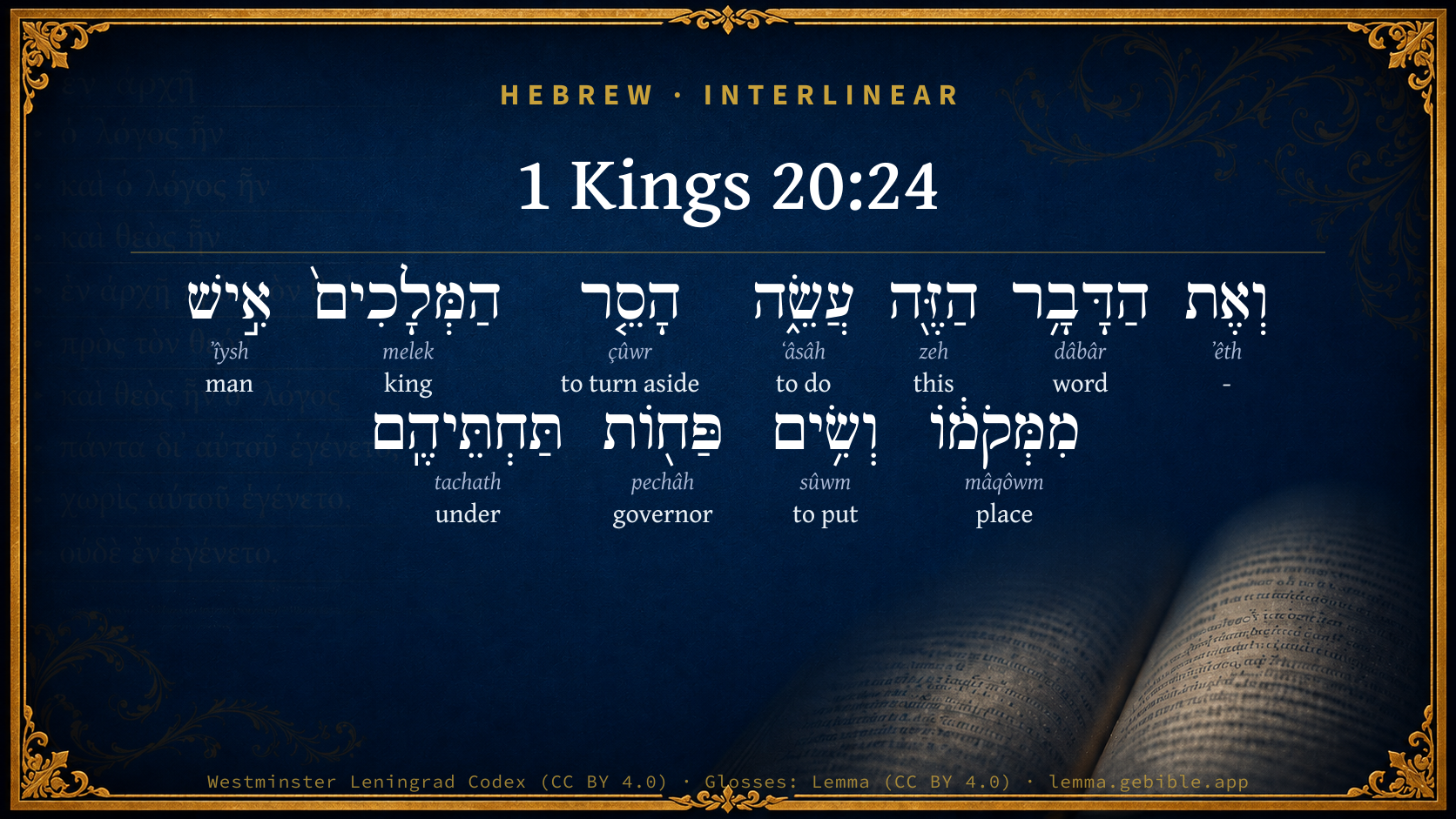
1 Kings 20:24

Hebrew (Westminster Leningrad Codex) 1 Kings 20:24 appears in the Hebrew Old Testament. The text above is from the Westminster Leningrad Codex. Each word links to its Strong’s number, a concise gloss, and parsing drawn from the Open Scriptures Hebrew Bible morphology. Click any word for its full Brown-Driver-Briggs (BDB) entry.
Download image
Cite this verse

1 Kings 20:24 (World English Bible). Public Domain. Lemma interlinear Bible study tool, https://lemma.gebible.app/v/1-kings/20/24.

Show BibTeX & RIS
BibTeX
RIS
English Translation
Do this thing: take the kings away, every man out of his place, and put captains in their room;
World English Bible · Public Domain
Download a study sheet

One document with this verse’s original text, its word-by-word gloss line, the meaning frame, cross-references with their text, attributed commentary, and full source and license credits — printable, and it pastes into notes with its structure intact.

This verse Autodidact and up

Study sheet (.html) Plain text (.txt)

A passage Seminary Student

Up to 50 verses in one chapter. A passage sheet keeps up to 6 commentary sources and 12 cross-references per verse, in the order this page ranks them, and says so on the sheet whenever that leaves anything out. Ask for a single verse and you get the Autodidact verse sheet above.

Everything on this page stays free to read, with no account — the sheet is a download of what is already on screen, not access to it.

Want to remove ads? Support Godless Engineer
Compare translations 3

The same verse in 3 English versions, stacked beneath the original-language interlinear above. Click any original word for its lexicon entry.

Each is an independent rendering of the whole verse — the interlinear is not word-aligned to these translations.

Highlighted words mark where these versions differ — a whole-verse word diff, not a word-by-word alignment.

  • World English Bible Public Domain
    Do this thing: take the kings away, every man out of his place, and put captains in their room;
  • King James Version Public Domain
    And do this thing, Take the kings away, every man out of his place, and put captains in their rooms:
  • unfoldingWord Literal Text CC BY-SA 4.0
    And do this thing: remove the kings, a man from his place, and appoint captains instead of them.

unfoldingWord Literal Text — © unfoldingWord, licensed CC BY-SA 4.0. Word-aligned USFM3 via Door43 (git.door43.org/unfoldingWord/en_ult).

Versions to compare (up to 4)

3 of 4 selected

Show all 18 translations

Every available English version of this verse, each an independent rendering of the whole verse.

  • World English Bible Public Domain
    Do this thing: take the kings away, every man out of his place, and put captains in their room;
  • Berean Standard Bible Public Domain
    So do this: Dismiss all the kings from their positions and replace them with other officers.
  • Majority Standard Bible Public Domain
    So do this: Dismiss all the kings from their positions and replace them with other officers.
  • King James Version Public Domain
    And do this thing, Take the kings away, every man out of his place, and put captains in their rooms:
  • American Standard Version (1901) Public Domain
    And do this thing: take the kings away, every man out of his place, and put captains in their room;
  • Revised Version (1885) Public Domain
    And do this thing; take the kings away, every man out of his place, and put captains in their room:
  • Geneva Bible (1599) Public Domain
    And this doe, Take the Kings away, euery one out of his place, and place captaines for them.
  • Douay-Rheims (1899) Public Domain
    Do thou therefore this thing: Remove all the kings from thy army, and put captains in their stead:
  • Young's Literal Translation Public Domain
    `And this thing do thou: turn aside the kings each out of his place, and set captains in their stead;
  • Literal Standard Version CC BY-SA 4.0
    And this thing you do: turn aside each of the kings out of his place, and set captains in their stead;
  • Unlocked Literal Bible CC BY-SA 4.0
    So you must do this: Remove all the kings from their positions of authority and replace them with military commanders.
  • unfoldingWord Literal Text CC BY-SA 4.0
    And do this thing: remove the kings, a man from his place, and appoint captains instead of them.
  • Darby Bible Public Domain
    And do this: take the kings away, every man out of his place, and put governors in their stead;
  • World Messianic Bible Public Domain
    Do this thing: take the kings away, every man out of his place, and put captains in their place.
  • Webster's Bible Public Domain
    And do this thing, Take the kings away, every man out of his place, and put captains in their rooms:
  • Free Bible Version CC BY-SA 4.0
    You should do this: remove each of the kings from their positions and replace them with commanders.
  • Bible in Basic English Public Domain
    This is what you have to do: take away the kings from their positions, and put captains in their places;
  • JPS Tanakh (1917) Public Domain
    And do this thing: take the kings away, every man out of his place, and put governors in their room:

Literal Standard Version (2020), Covenant Press — licensed CC BY-SA 4.0. Text via the HelloAO Bible API (eBible.org). Unlocked Literal Bible (unfoldingWord) — licensed CC BY-SA 4.0. Text via the HelloAO Bible API (eBible.org). unfoldingWord Literal Text — © unfoldingWord, licensed CC BY-SA 4.0. Word-aligned USFM3 via Door43 (git.door43.org/unfoldingWord/en_ult). Free Bible Version, Dr. Jonathan Gallagher — licensed CC BY-SA 4.0. Text via the HelloAO Bible API (eBible.org).

Word by word

More ways to search: Search by grammar → Find every occurrence → Compare this word →

Practice this passage: Drill this verse → Learn its vocabulary →

פַּח֖וֹת
pechâh
H6346
“governors”
Noun, Common, Masculine, Plural, Absolute
Part of Speech
Noun
Type
Common
Gender
Masculine
Number
Plural
State
Absolute
Full BDB Definition

Origin: of foreign origin

TWOT: 1757

governor
  1. וְאֶת ʼêth H853 “and · -” Conjunction + Particle, Direct Object
  2. הַדָּבָ֥ר dâbâr H1697 “the · word” Particle, Definite Article + Noun, Common, Masculine, Singular, Absolute
  3. הַזֶּ֖ה zeh H2088 “the · this” Particle, Definite Article + Pronoun, Demonstrative, Masculine, Singular
  4. עֲשֵׂ֑ה ʻâsâh H6213 “do” Verb, Qal, Imperative, 2nd Person, Masculine, Singular
  5. הָסֵ֤ר çûwr H5493 “turn aside” Verb, Hiphil, Imperative, 2nd Person, Masculine, Singular
  6. הַמְּלָכִים֙ melek H4428 “the · kings” Particle, Definite Article + Noun, Common, Masculine, Plural, Absolute
  7. אִ֣ישׁ ʼîysh H376 “man” Noun, Common, Masculine, Singular, Absolute
  8. מִמְּקֹמ֔וֹ mâqôwm H4725 “from · place · his” Preposition + Noun, Common, Masculine, Singular, Construct + Suffix, Personal, 3rd Person, Masculine, Singular
  9. וְשִׂ֥ים sûwm H7760 “and · put” Conjunction + Verb, Qal, Imperative, 2nd Person, Masculine, Singular
  10. תַּחְתֵּיהֶֽם tachath H8478 “under · them” Preposition + Suffix, Personal, 3rd Person, Masculine, Plural

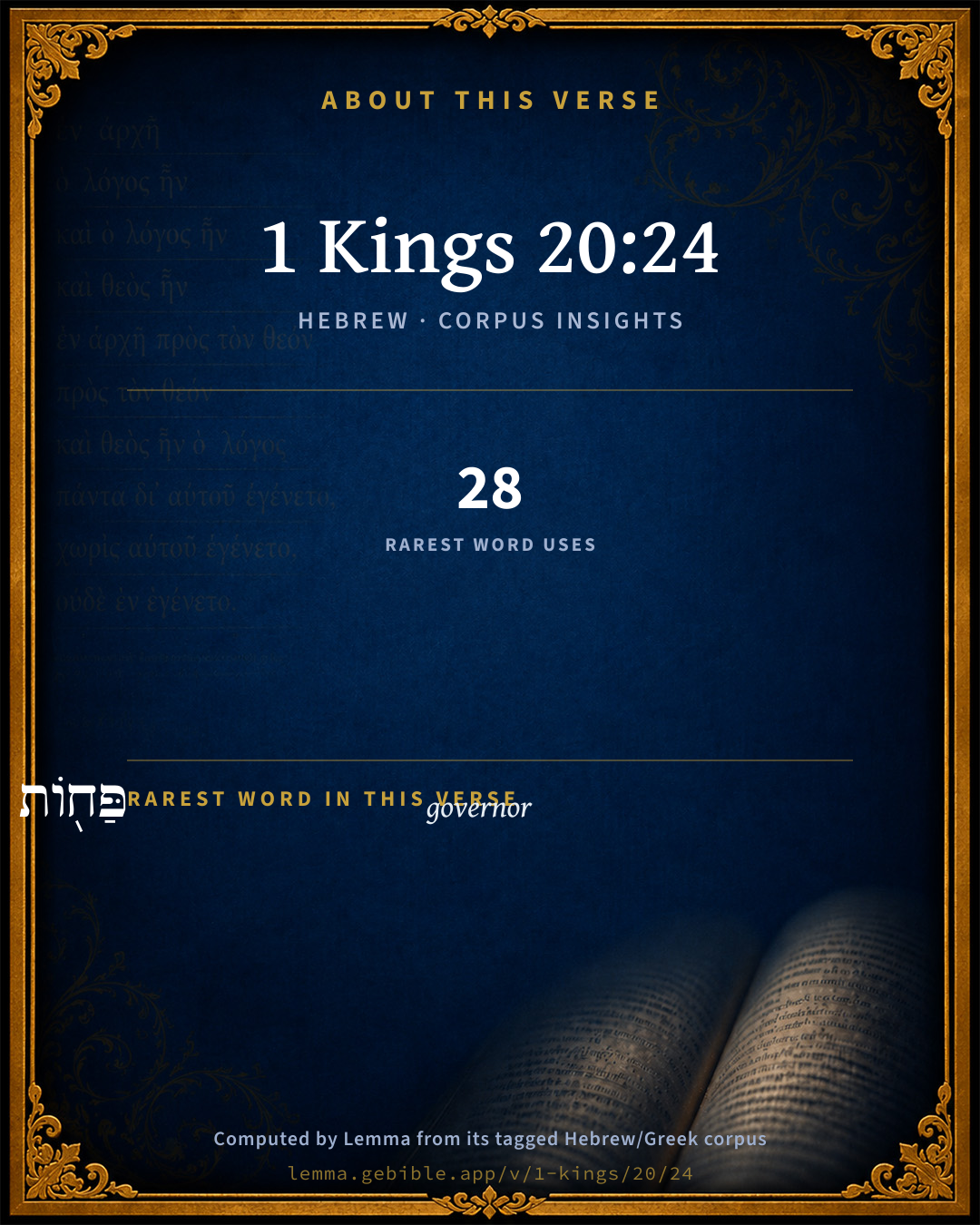
About this verse

These counts appear in no published source. They are computed here, from the morphology-tagged text and Lemma’s own curated glosses. What Lemma adds →

11
words
11
distinct lemmas
Historical
section

Shared distinctive vocabulary

פַּח֖וֹת governor H6346 occurs in 27 verses of the Hebrew Bible. Also found in:

Grammatical profile

  • 3 verbs
  • 5 nouns
  • 1 pronoun
  • 1 preposition
  • 1 particle

Verb forms

  • עֲשֵׂ֑ה Qal · Imperative
  • הָסֵ֤ר Hiphil · Imperative
  • וְשִׂ֥ים Qal · Imperative

Hebrew & Septuagint length

In English translation the verse runs 19 words from the Hebrew and 30 from the Septuagint (LXX English) — the Septuagint runs noticeably longer here. See the side-by-side →

A rough comparison of the two English renderings, which tokenize alike — not a word-level alignment.

Word counts can differ between the Hebrew and the Greek without any difference in meaning — e.g. the Hebrew direct-object marker אֵת has no separate Greek word, and Greek often adds the article ὁ.

Cross-references

4

Topical passages linked to 1 Kings 20:24 in the Treasury of Scripture Knowledge — connected by theme and wording, ordered by reader-vote popularity; previews shown in the World English Bible.

  • 1 Kings 22:31 Now the king of Syria had commanded the thirty-two captains of his chariots, saying, Fight neither with small nor great, save only with the king of Israel.
  • Proverbs 21:30 There is no wisdom nor understanding Nor counsel against Yahweh.
  • 1 Kings 20:1 Ben Hadad the king of Syria gathered all his host together; and there were thirty-two kings with him, and horses and chariots: and he went up and besieged Samaria, and fought against it.
  • 1 Kings 20:16 They went out at noon. But Ben Hadad was drinking himself drunk in the pavilions, he and the kings, the thirty-two kings who helped him.

Cross-references courtesy of OpenBible.info (CC BY 4.0).

Hebrew and Greek witnesses Masoretic Hebrew ↔ Greek Septuagint

The same verse in the two great witnesses to the Old Testament, shown verse-for-verse.

Here the Septuagint runs noticeably longer than the Hebrew — LXX2012 (modern English Septuagint) 30 words vs World English Bible 19. A rough length comparison of the two English translations, not a word-level alignment — read both below.

These are two independent witnesses, not word-aligned to each other, and the Septuagint is shown in lemma (dictionary) form.

Hebrew 1 Kings 20:24 Masoretic · Westminster Leningrad Codex

וְאֶת הַדָּבָ֥ר הַזֶּ֖ה עֲשֵׂ֑ה הָסֵ֤ר הַמְּלָכִים֙ אִ֣ישׁ מִמְּקֹמ֔וֹ וְשִׂ֥ים פַּח֖וֹת תַּחְתֵּיהֶֽם

Do this thing: take the kings away, every man out of his place, and put captains in their room;

World English Bible · Public Domain

Greek LXX 1 Kings 20:24 Septuagint · lemma form

ὁ θνήσκω ὁ αχααβ ἐν ὁ πόλις ἐσθίω ὁ κύων καί ὁ θνήσκω αὐτός ἐν ὁ πεδίον ἐσθίω ὁ πετεινόν ὁ οὐρανός

Him that is dead of Achaab in the city shall the dogs eat, and him that is dead of him in the field shall the birds of the sky eat.

LXX2012 (modern English Septuagint) · Public Domain

Hebrew: Westminster Leningrad Codex (CC BY 4.0). Greek: Septuagint (public domain); English from LXX2012 (modern English Septuagint) (Public Domain). How the Septuagint differs from the Hebrew →

Targum (Aramaic paraphrase)

1

The Targum is the ancient Jewish Aramaic paraphrase of the Hebrew Scriptures — an interpretive translation, not the Hebrew text itself. Onkelos (literal) and Pseudo-Jonathan (expansive) render the Torah, and Jonathan the Prophets. Coverage is partial: where no permissively-licensed English translation exists for a verse, only the Aramaic is shown. This is verse-level text, not a word-by-word alignment to the Hebrew.

  1. Targum Jonathan Prophets (Joshua–Malachi)
    וְיַת פִּתְגָמָא הָדֵין עֲבֵיד אַעְדֵי מַלְכַיָא גְבַר מֵאַתְרֵיהּ וּמַנֵי שִׁלְטוֹנַיָא חִלוּפֵיהוֹן:

    (no public-domain English translation for this verse)

    Targum Jonathan — Aramaic: “Mikraot Gedolot” (public domain). English: “Sefaria Community Translation” (CC0 1.0 (public-domain dedication)); “London "Chaldee Paraphrase," 1871” (public domain). Text via Sefaria.

Commentary

Notes on 1 Kings 20:24 from classic Christian and Jewish commentators (each source and its license shown beneath its notes). The classic Christian expositions comment on the surrounding passage and are grouped to its opening verse, so a note may address several verses; the Jewish commentaries on the Tanakh (Rashi and others) are per-verse, so they appear only where the commentator wrote on this verse.

Lemma curates 59 commentaries, every one of them public domain or Creative Commons licensed, each selected and text-cleaned for this edition rather than reprinted as found. About our sources →

Trapp's Complete Commentary

John Trapp

1Ki 20:24 And do this thing, Take the kings away, every man out of his place, and put captains in their rooms:

Ver. 24. Take the kings away.] As being rather the knights of Venus, than of Bellona; and are better at tossing a pot than a pike.

John Trapp, A Commentary or Exposition upon All the Books of the Old and New Testament (1647–1656) — public domain. Text from a community e-Sword module.

Joseph Benson's Commentary

1Ki 20:24. Do this — take the kings away, &c. — He had made the thirty- two kings, who were his tributaries, chief commanders in his former army; which his counsellors represent to him as a great error, and therefore advise him to displace them, and put his own captains in their stead, who would fight better. The kings, they thought, had had a softer education; and, being less inured to hardships, and less experienced in military matters, were less fit for service: besides, being many of them mercenaries, and therefore less concerned in his good success, they judged they would be more cautious in venturing themselves, and risking their lives in his cause, and not so obedient to discipline, as captains from his own subjects would be. These latter, they supposed, would faithfully obey the commands of their general, to whom the kings would not readily yield, and would use their utmost skill and valour for their own interest and advancement.

Joseph Benson's Commentary on the Old and New Testaments (1811–1818) — public domain. Text from a community e-Sword module.

Tyndale Open Study Notes

Tyndale Open Resources

20:24-25 Ben-hadad’s field commanders reasoned that with trained military leadership and superiority in manpower and equipment, they would easily defeat Israel on the plains in the next encounter.

Tyndale Open Study Notes — © Tyndale Open Resources, licensed CC BY-SA 4.0. Text via the HelloAO Bible API.

Adam Clarke's Commentary

Verse 24. Take the kings away] These were not acquainted with military affairs, or they had not competent skill. Put experienced captains in their place, and fight not but on the plains, and you will be sure of victory.

Adam Clarke's Commentary on the Bible (1810–1826) — public domain. Text from a community e-Sword/MySword module.

The Cambridge Bible for Schools and Colleges

gen. ed. J. J. S. Perowne

24. Take the kings away] That is, the thirty and two, whose attendance on the court, and the wassail consequent on their presence, had done much harm to the expedition. We need not suppose that these kings were to be deprived of their power and deposed, though the text would bear that interpretation, but only that they were no longer to take part in the war. Their places were to be supplied by those who had made war their trade, and who would give their attention to the battle and not to revelry.

The Cambridge Bible for Schools and Colleges (gen. ed. J. J. S. Perowne; Cambridge University Press, 1878–1918) — public domain. Text from a community e-Sword module.

John Gill's Exposition

And do this thing,.... Also take this further piece of advice:

take the kings away, every man out of his place: for being brought up delicately, they were not inured to war, nor expert in the art of it; and being addicted to pleasure, gave themselves to that, and drew the king into it, which they observed was the case before, though they did not care to mention it; and if they were tributaries or allies, they would not fight as men do for their own country:

and put captains in their rooms; of his own people, men of skill and courage, and who would fight both for their own honour, and for the good of their country.

John Gill's Exposition of the Whole Bible (1746–1763) — public domain (CC PDM 1.0). Text via the HelloAO Bible API.

Albert Barnes' Notes on the Bible

The Syrian chiefs evidently thought that want of unity had weakened their army. They therefore proposed the deposition of the kings, and the substitution, in their place, of Syrian governors: not “captains.” The term used always denotes a civil office.

Albert Barnes' Notes on the Bible (1834–1885) — public domain. Text from a community e-Sword/MySword module.

Haydock's Catholic Bible Commentary

Stead, who may obey thy orders more implicitly. Rex unius esto. (Calmet) --- Captains, who have been inured to warfare, would not so easily run away. (Menochius) --- Thus, in the late French republic, commanders were chosen from the common ranks, while the nobles were neglected. (Haydock)

George Leo Haydock (1774–1849), Haydock's Catholic Family Bible and Commentary, 1859 edition — public domain. Excludes Psalms (Douay-Rheims chapter numbering differs from Protestant) and Deuterocanonical books (Catholic canon only).

Matthew Poole's English Annotations

The kings being of softer education, and less experienced in military matters, were less fit for his service; and being many of them but mercenaries, and therefore less concerned in his good success, would be more negligent and cautious in venturing themselves for his good.

Captains, i.e. experienced soldiers of his own subjects, who will faithfully obey the commands of the general, (to which the kings would not so readily yield,) and use their utmost skill and valour for their own interest and advancement.

Matthew Poole's English Annotations on the Holy Bible (1683–1685) — public domain. Text from a community e-Sword/MySword module.

Whedon's Commentary on the Bible

Daniel D. Whedon

24. Put captains in their rooms — Officers more skilled in warfare than these kings have shown themselves to be. The vassal kings were probably the first to become panic stricken, and to fly before the youths of Israel.

Daniel D. Whedon (gen. ed.), Commentary on the Old and New Testaments (1874–1909) — public domain. Text from a community e-Sword module.

The Pulpit Commentary

And do this thing. Take the kings away, every man out of his place, and put captains Same word as in 1Ki_10:15, where see note in their rooms. Not so much because (Bahr) the kings only fought through compulsion, for they appear to have been in complete accord with Ben-hadad (vers. 1, 12, 16), as because of their incapacity and divided interests and plans. The captains would presumably be selected because of their valour, military skill, etc.; the kings would owe their command to the accident of birth, etc. Moreover an army with thirty-three leaders could not have the necessary solidarity. Bahr assumes that the removal of the kings would involve the withdrawal of the auxiliaries which they contributed. But this does not appear to have occurred to Ben-ha( lad"s advisers when they said, "put captains in their rooms." If the auxiliaries were withdrawn, what were the thirty-two captains to command?

The Pulpit Commentary (1880–1919), ed. H.D.M. Spence-Jones & Joseph S. Exell — public domain. Text from a community e-Sword module.

John Wesley's Explanatory Notes

Take the kings away - Who being of softer education, and less experienced in military matters, were less fit for service; and being many of them but mercenaries, and therefore less concerned in his good success, would be more cautions in venturing themselves. Captains - That is, experienced soldiers of his own subjects, who would faithfully obey the commands of the general (to which the kings would not so readily yield) and use their utmost skill and valour for their own interest and advancement.

John Wesley, Explanatory Notes Upon the Whole Bible (1754–1765) — public domain. Text via the GEBible commentary corpus.

unfoldingWord translationNotes

Door43 World Missions Community

Remove all the kings from their positions of authority

"You must remove the thirty-two kings who are leading your troops"

translationWords

command

advice

unfoldingWord translationNotes — © Distant Shores Media and the Door43 World Missions Community, licensed CC BY-SA 4.0. Source: git.door43.org/Door43/en_tn.

Rashi

Rabbi Shlomo Yitzchaki (Rashi)

And replace them with generals. Because they are not of a high [society] family, they will put in an extra effort in order to find favor [in your eyes].

Rashi on the Tanakh — English translations: “The Judaica Press complete Tanach with Rashi, translated by A. J. Rosenberg” (CC BY 4.0); “Pentateuch with Rashi's commentary by M. Rosenbaum and A.M. Silbermann, 1929-1934” (public domain); “The Metsudah Tanach series, Lakewood, N.J” (CC BY 4.0); and “The Book of Joshua, Metsudah Publications, 1997” (CC BY 4.0). Text via Sefaria.

Lesson kit

Teaching starters — assembled from the data on this page, not authored interpretation. Every prompt links to the verse data it draws on. Edit before teaching.

1 Kings, in the Historical, opens this verse with 11 words (11 distinct Hebrew lemmas). Its most distinctive word is pechâh (“governor”). The Greek Septuagint runs longer here. A historical commentator’s framing appears above. Read the whole chapter for the surrounding context.

Discussion questions

  1. What does “governor” (pechâh) contribute to the verse as a whole?
  2. How does 1 Kings 10:15, which shares the word «governor», read alongside this verse?
  3. The Septuagint runs longer here than the Hebrew. What might account for the difference?
  4. The translations on this page render this verse differently — a whole-verse word diff, not a word-by-word alignment. What might account for the different wordings?
  5. «עֲשֵׂ֑ה» is a Qal Imperative verb. How does that grammatical form shape the action described?
  6. Compare how Trapp's Complete Commentary and Joseph Benson's Commentary read this verse. Where do they agree or differ?

Things to notice

Reading settings

Reading text

Shown beneath each verse's original-language words.

Old Testament
Old Testament edition

Read the OT as the Masoretic Hebrew (MT) or the Greek Septuagint (LXX).

English shown for the Greek Septuagint (in the Hebrew ↔ Greek comparison).

Comparing translations? Open the Compare panel on any verse page to stack up to four side by side.