2 Kings 17:18

Hebrew (Westminster Leningrad Codex) 2 Kings 17:18 appears in the Hebrew Old Testament. The text above is from the Westminster Leningrad Codex. Each word links to its Strong’s number, a concise gloss, and parsing drawn from the Open Scriptures Hebrew Bible morphology. Click any word for its full Brown-Driver-Briggs (BDB) entry.
Download image
Cite this verse

2 Kings 17:18 (World English Bible). Public Domain. Lemma interlinear Bible study tool, https://lemma.gebible.app/v/2-kings/17/18.

Show BibTeX & RIS
BibTeX
RIS
English Translation
Therefore Yahweh was very angry with Israel, and removed them out of his sight: there was none left but the tribe of Judah only.
World English Bible · Public Domain
Download a study sheet

One document with this verse’s original text, its word-by-word gloss line, the meaning frame, cross-references with their text, attributed commentary, and full source and license credits — printable, and it pastes into notes with its structure intact.

This verse Autodidact and up

Study sheet (.html) Plain text (.txt)

A passage Seminary Student

Up to 50 verses in one chapter. A passage sheet keeps up to 6 commentary sources and 12 cross-references per verse, in the order this page ranks them, and says so on the sheet whenever that leaves anything out. Ask for a single verse and you get the Autodidact verse sheet above.

Everything on this page stays free to read, with no account — the sheet is a download of what is already on screen, not access to it.

Want to remove ads? Support Godless Engineer
Compare translations 3

The same verse in 3 English versions, stacked beneath the original-language interlinear above. Click any original word for its lexicon entry.

Each is an independent rendering of the whole verse — the interlinear is not word-aligned to these translations.

Highlighted words mark where these versions differ — a whole-verse word diff, not a word-by-word alignment.

  • World English Bible Public Domain
    Therefore Yahweh was very angry with Israel, and removed them out of his sight: there was none left but the tribe of Judah only.
  • King James Version Public Domain
    Therefore the LORD was very angry with Israel, and removed them out of his sight: there was none left but the tribe of Judah only.
  • unfoldingWord Literal Text CC BY-SA 4.0
    And Yahweh was exceedingly enraged at Israel, and he removed them away from his face. None was left, only the tribe of Judah alone.

unfoldingWord Literal Text — © unfoldingWord, licensed CC BY-SA 4.0. Word-aligned USFM3 via Door43 (git.door43.org/unfoldingWord/en_ult).

Versions to compare (up to 4)

3 of 4 selected

Show all 18 translations

Every available English version of this verse, each an independent rendering of the whole verse.

  • World English Bible Public Domain
    Therefore Yahweh was very angry with Israel, and removed them out of his sight: there was none left but the tribe of Judah only.
  • Berean Standard Bible Public Domain
    So the LORD was very angry with Israel, and He removed them from His presence. Only the tribe of Judah remained,
  • Majority Standard Bible Public Domain
    So the LORD was very angry with Israel, and He removed them from His presence. Only the tribe of Judah remained,
  • King James Version Public Domain
    Therefore the LORD was very angry with Israel, and removed them out of his sight: there was none left but the tribe of Judah only.
  • American Standard Version (1901) Public Domain
    Therefore Jehovah was very angry with Israel, and removed them out of his sight: there was none left but the tribe of Judah only.
  • Revised Version (1885) Public Domain
    Therefore the LORD was very angry with Israel, and removed them out of his sight: there was none left but the tribe of Judah only.
  • Geneva Bible (1599) Public Domain
    Therefore the Lord was exceeding wroth with Israel, and put them out of his sight, and none was left but the tribe of Iudah onely.
  • Douay-Rheims (1899) Public Domain
    And the Lord was very angry with Israel, and removed them from his sight, and there remained only the tribe of Juda.
  • Young's Literal Translation Public Domain
    That Jehovah sheweth himself very angry against Israel, and turneth them aside from His presence; none hath been left, only the tribe of Judah by itself.
  • Literal Standard Version CC BY-SA 4.0
    And YHWH shows Himself very angry against Israel, and turns them aside from His presence; none has been left, only the tribe of Judah by itself.
  • Unlocked Literal Bible CC BY-SA 4.0
    Therefore Yahweh was very angry with Israel and removed them out of his sight. There was no one left but the tribe of Judah alone.
  • unfoldingWord Literal Text CC BY-SA 4.0
    And Yahweh was exceedingly enraged at Israel, and he removed them away from his face. None was left, only the tribe of Judah alone.
  • Darby Bible Public Domain
    Therefore Jehovah was very angry with Israel, and removed them out of his sight: there remained but the tribe of Judah only.
  • World Messianic Bible Public Domain
    Therefore the LORD was very angry with Israel, and removed them out of his sight. There was none left but the tribe of Judah only.
  • Webster's Bible Public Domain
    Therefore the LORD was very angry with Israel, and removed them out of his sight: there was none left but the tribe of Judah only.
  • Free Bible Version CC BY-SA 4.0
    So the Lord was extremely angry with Israel, and he banished them from his presence. Only the tribe of Judah was left,
  • Bible in Basic English Public Domain
    So the Lord was very angry with Israel, and his face was turned away from them: only the tribe of Judah kept its place.
  • JPS Tanakh (1917) Public Domain
    that the LORD was very angry with Israel, and removed them out of His sight; there was none left but the tribe of Judah only.

Literal Standard Version (2020), Covenant Press — licensed CC BY-SA 4.0. Text via the HelloAO Bible API (eBible.org). Unlocked Literal Bible (unfoldingWord) — licensed CC BY-SA 4.0. Text via the HelloAO Bible API (eBible.org). unfoldingWord Literal Text — © unfoldingWord, licensed CC BY-SA 4.0. Word-aligned USFM3 via Door43 (git.door43.org/unfoldingWord/en_ult). Free Bible Version, Dr. Jonathan Gallagher — licensed CC BY-SA 4.0. Text via the HelloAO Bible API (eBible.org).

Word by word

More ways to search: Search by grammar → Find every occurrence → Compare this word →

Practice this passage: Drill this verse → Learn its vocabulary →

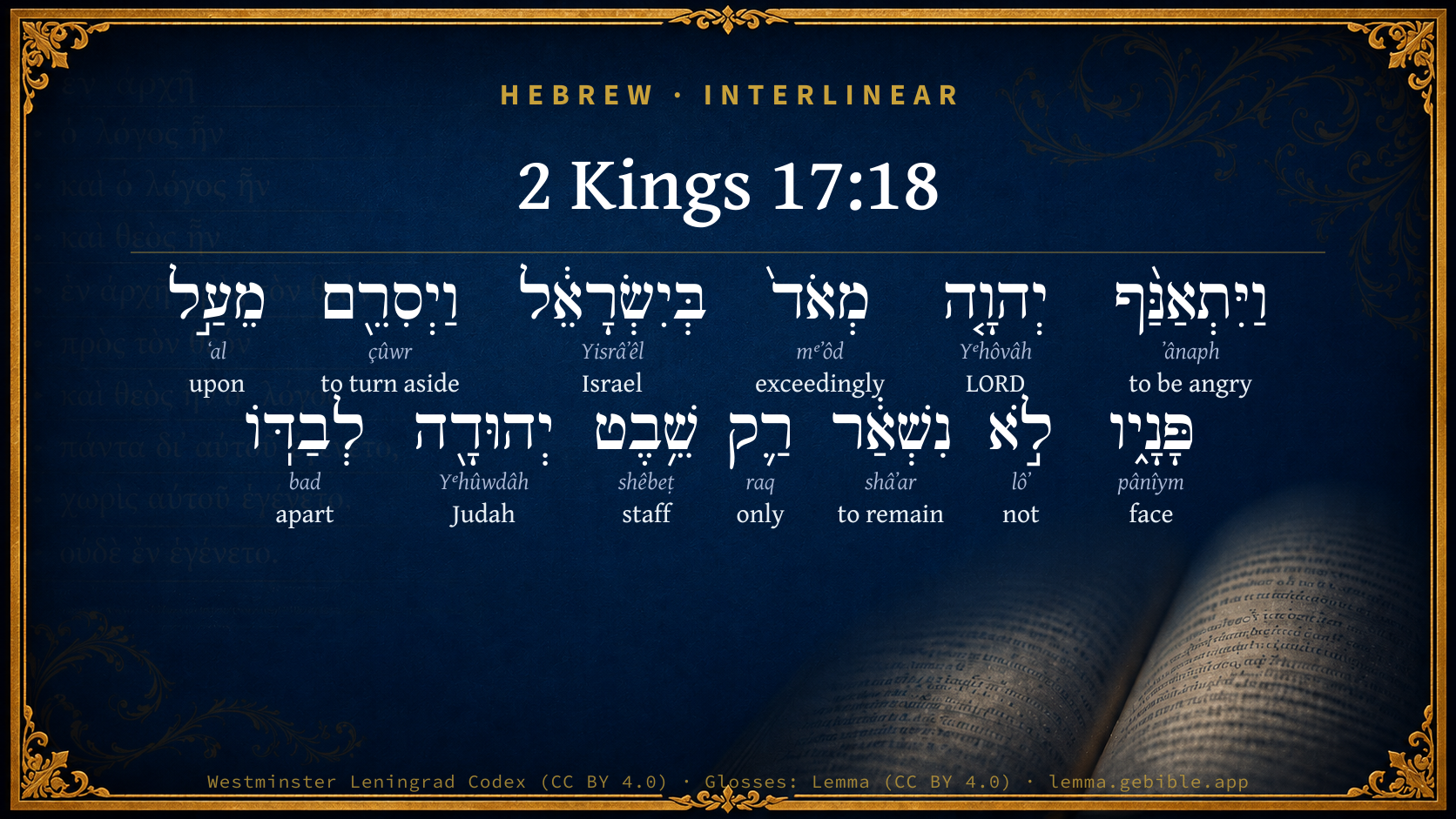
וַיִּתְאַנַּ֨ף
ʼânaph
H599
“and · to be angry”
Conjunction + Verb, Hithpael, Sequential Imperfect, 3rd Person, Masculine, Singular
Part of Speech
Conjunction + Verb
Stem
Hithpael
Form
Sequential Imperfect
Person
3rd Person
Gender
Masculine
Number
Singular
Full BDB Definition

Origin: a primitive root

TWOT: 133

to be angry, to be displeased, to breathe hard - (Qal) to be angry (of God) - (Hithpael) to be angry (always of God)
  1. יְהוָ֤ה Yᵉhôvâh H3068 “LORD” Noun, Proper
  2. מְאֹד֙ mᵉʼôd H3966 “exceedingly” Adverb
  3. בְּיִשְׂרָאֵ֔ל Yisrâʼêl H3478 “in/at · Israel” Preposition + Noun, Proper
  4. וַיְסִרֵ֖ם çûwr H5493 “and · to turn aside · them” Conjunction + Verb, Hiphil, Sequential Imperfect, 3rd Person, Masculine, Singular + Suffix, Personal, 3rd Person, Masculine, Plural
  5. מֵעַ֣ל ʻal H5921 “from · upon” Preposition + Preposition
  6. פָּנָ֑יו pânîym H6440 “face(s) · his” Noun, Common, Both, Plural, Construct + Suffix, Personal, 3rd Person, Masculine, Singular
  7. לֹ֣א lôʼ H3808 “not” Particle, Negative
  8. נִשְׁאַ֔ר shâʼar H7604 “to remain” Verb, Niphal, Perfect, 3rd Person, Masculine, Singular
  9. רַ֛ק raq H7535 “only” Particle, Accusative
  10. שֵׁ֥בֶט shêbeṭ H7626 “staff of” Noun, Common, Masculine, Singular, Construct
  11. יְהוּדָ֖ה Yᵉhûwdâh H3063 “Judah” Noun, Proper
  12. לְבַדּֽוֹ bad H905 “to/for · apart · his” Preposition + Noun, Common, Masculine, Singular, Construct + Suffix, Personal, 3rd Person, Masculine, Singular

About this verse

These counts appear in no published source. They are computed here, from the morphology-tagged text and Lemma’s own curated glosses. What Lemma adds →

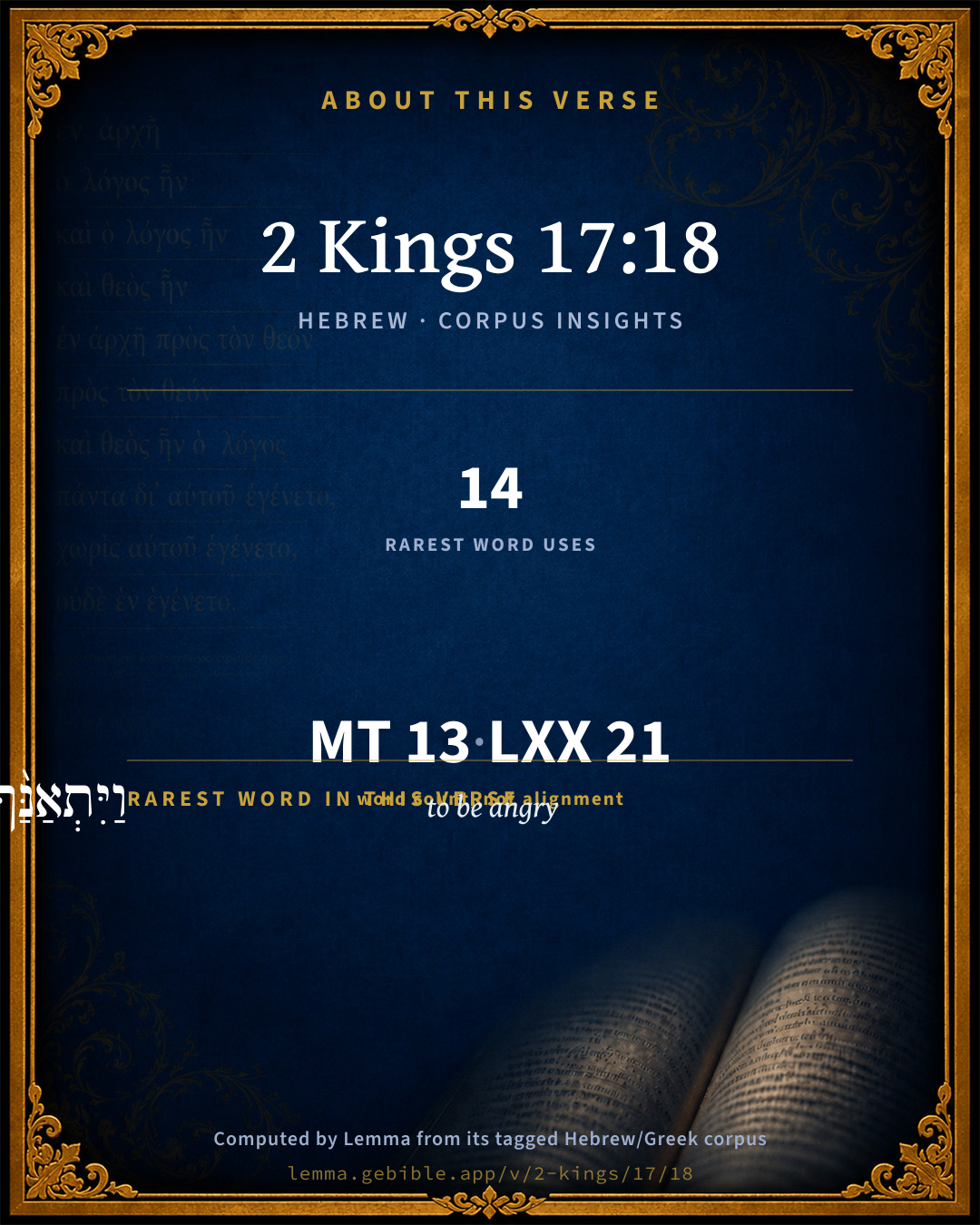
13
words
13
distinct lemmas
Historical
section

Notable vocabulary

The rarest word here is וַיִּתְאַנַּ֨ף to be angry H599 — appearing just 14 times in the whole Hebrew Bible.

Shared distinctive vocabulary

וַיִּתְאַנַּ֨ף to be angry H599 occurs in 14 verses of the Hebrew Bible. Also found in:

Grammatical profile

  • 3 verbs
  • 6 nouns
  • 1 preposition
  • 1 adverb
  • 2 particles

Verb forms

  • וַיִּתְאַנַּ֨ף Hithpael · Sequential Imperfect
  • וַיְסִרֵ֖ם Hiphil · Sequential Imperfect
  • נִשְׁאַ֔ר Niphal · Perfect

Hebrew & Septuagint length

In English translation the verse runs 24 words from the Hebrew and 26 from the Septuagint (LXX English) — closely comparable.

A rough comparison of the two English renderings, which tokenize alike — not a word-level alignment.

Word counts can differ between the Hebrew and the Greek without any difference in meaning — e.g. the Hebrew direct-object marker אֵת has no separate Greek word, and Greek often adds the article ὁ.

In the original languages it is 13 Hebrew tokens and 21 Greek tokens — but the two are counted differently (Hebrew bundles its prefixes and suffixes into one token; the Greek is in lemma form), so that isn’t a like-for-like length.

Cross-references

13

Topical passages linked to 2 Kings 17:18 in the Treasury of Scripture Knowledge — connected by theme and wording, ordered by reader-vote popularity; previews shown in the World English Bible.

  • 1 Kings 11:13 However I will not tear away all the kingdom; but I will give one tribe to your son, for David my servant's sake, and for Jerusalem's sake which I have chosen.
  • 1 Kings 12:20 It happened, when all Israel heard that Jeroboam was returned, that they sent and called him to the congregation, and made him king over all Israel: there was none who followed the house of David, but the tribe of Judah only.
  • Deuteronomy 32:21–26 They have moved me to jealousy with that which is not God; They have provoked me to anger with their vanities: I will move them to jealousy with those who are not a people; I will provoke them to anger with a foolish nation.
  • 1 Kings 11:32 (but he shall have one tribe, for my servant David's sake and for Jerusalem's sake, the city which I have chosen out of all the tribes of Israel);
  • 1 Kings 11:36 To his son will I give one tribe, that David my servant may have a lamp always before me in Jerusalem, the city which I have chosen me to put my name there.
  • Hosea 11:12 Ephraim surrounds me with falsehood, And the house of Israel with deceit; And Judah still us unruly with God, And is unfaithful to the Holy One.
  • 2 Kings 23:27 Yahweh said, I will remove Judah also out of my sight, as I have removed Israel, and I will cast off this city which I have chosen, even Jerusalem, and the house of which I said, My name shall be there.
  • Hosea 9:3 They won't dwell in Yahweh's land; But Ephraim will return to Egypt, And they will eat unclean food in Assyria.
  • Deuteronomy 29:20–28 Yahweh will not pardon him, but then the anger of Yahweh and his jealousy will smoke against that man, and all the curse that is written in this book shall lie on him, and Yahweh will blot out his name from under the sky.
  • Joshua 23:13 know for a certainty that Yahweh your God will no more drive these nations from out of your sight; but they shall be a snare and a trap to you, and a scourge in your sides, and thorns in your eyes, until you perish from off this good land which Yahweh your God has given you.
  • Joshua 23:15 It shall happen, that as all the good things are come on you of which Yahweh your God spoke to you, so will Yahweh bring on you all the evil things, until he have destroyed you from off this good land which Yahweh your God has given you.
  • 2 Kings 13:23 But Yahweh was gracious to them, and had compassion on them, and had respect to them, because of his covenant with Abraham, Isaac, and Jacob, and would not destroy them, neither cast he them from his presence as yet.
  • Jeremiah 15:1 Then said Yahweh to me, Though Moses and Samuel stood before me, yet my mind would not be toward this people: cast them out of my sight, and let them go forth.

Cross-references courtesy of OpenBible.info (CC BY 4.0).

Hebrew and Greek witnesses Masoretic Hebrew ↔ Greek Septuagint

The same verse in the two great witnesses to the Old Testament, shown verse-for-verse.

These are two independent witnesses, not word-aligned to each other, and the Septuagint is shown in lemma (dictionary) form.

Hebrew 2 Kings 17:18 Masoretic · Westminster Leningrad Codex

וַיִּתְאַנַּ֨ף יְהוָ֤ה מְאֹד֙ בְּיִשְׂרָאֵ֔ל וַיְסִרֵ֖ם מֵעַ֣ל פָּנָ֑יו לֹ֣א נִשְׁאַ֔ר רַ֛ק שֵׁ֥בֶט יְהוּדָ֖ה לְבַדּֽוֹ

Therefore Yahweh was very angry with Israel, and removed them out of his sight: there was none left but the tribe of Judah only.

World English Bible · Public Domain

Greek LXX 2 Kings 17:18 Septuagint · lemma form

καί θυμόω κύριος σφόδρα ἐν ὁ ἰσραήλ καί ἀποἵστημι αὐτός ἀπό ὁ πρόσωπον αὐτός καί οὐ ὑπολείπω πλήν φυλή ιουδα μόνος

And the Lord was very angry with Israel, and removed them out of his sight; and there was only left the tribe of Juda quite alone.

LXX2012 (modern English Septuagint) · Public Domain

Hebrew: Westminster Leningrad Codex (CC BY 4.0). Greek: Septuagint (public domain); English from LXX2012 (modern English Septuagint) (Public Domain). How the Septuagint differs from the Hebrew →

Targum (Aramaic paraphrase)

1

The Targum is the ancient Jewish Aramaic paraphrase of the Hebrew Scriptures — an interpretive translation, not the Hebrew text itself. Onkelos (literal) and Pseudo-Jonathan (expansive) render the Torah, and Jonathan the Prophets. Coverage is partial: where no permissively-licensed English translation exists for a verse, only the Aramaic is shown. This is verse-level text, not a word-by-word alignment to the Hebrew.

  1. Targum Jonathan Prophets (Joshua–Malachi)
    וַהֲוָה רְגַז מִן קֳדָם יְיָ לַחֲדָא בְיִשְׂרָאֵל וְאַגְלִינוּן מֵאַרְעָא בֵית שְׁכִינְתֵּיהּ לָא אִשְׁתָּאַר לְחוֹד שִׁבְטָא דְבֵית יְהוּדָה בִּלְחוֹדוֹהִי:

    (no public-domain English translation for this verse)

    Targum Jonathan — Aramaic: “Mikraot Gedolot” (public domain). English: “Sefaria Community Translation” (CC0 1.0 (public-domain dedication)); “London "Chaldee Paraphrase," 1871” (public domain). Text via Sefaria.

Commentary

Notes on 2 Kings 17:18 from classic Christian and Jewish commentators (each source and its license shown beneath its notes). The classic Christian expositions comment on the surrounding passage and are grouped to its opening verse, so a note may address several verses; the Jewish commentaries on the Tanakh (Rashi and others) are per-verse, so they appear only where the commentator wrote on this verse.

Lemma curates 59 commentaries, every one of them public domain or Creative Commons licensed, each selected and text-cleaned for this edition rather than reprinted as found. About our sources →

Trapp's Complete Commentary

John Trapp

2Ki 17:18 Therefore the LORD was very angry with Israel, and removed them out of his sight: there was none left but the tribe of Judah only.

Ver. 18. Removed them out of his sight.] That since they would not live by his laws, they should not live in his land, quippe qui moribus suis quam legibus uti mallent. {a}

{a} Val. Max.

John Trapp, A Commentary or Exposition upon All the Books of the Old and New Testament (1647–1656) — public domain. Text from a community e-Sword module.

Joseph Benson's Commentary

2Ki 17:18. Therefore the Lord was very angry with Israel — For he is a jealous God, and highly resents the giving that honour to any created or imaginary being, which is due to himself only. And removed them out of his sight — A very strong expression, to signify, not only his casting them out of Canaan, then the only place of his solemn worship, and gracious presence, or out of his church, but his utter rejection and total removal of this apostate people from his care and providence. There was none left but Judah only — And the greatest part of the tribe of Benjamin, with those of the tribes of Simeon and Levi, who adhered to them, and were incorporated with them, and therefore are fitly denominated from them.

Joseph Benson's Commentary on the Old and New Testaments (1811–1818) — public domain. Text from a community e-Sword module.

Tyndale Open Study Notes

Tyndale Open Resources

17:18-20 the Lord was very angry: God’s wrath is his righteous response to evil that demands his justice. • even the people of Judah refused to obey the commands of the Lord: This remark foreshadows the eventual fall of the southern kingdom as well (25:1-21).

Tyndale Open Study Notes — © Tyndale Open Resources, licensed CC BY-SA 4.0. Text via the HelloAO Bible API.

Geneva Bible (1599)

Geneva Bible translators

No whole tribe was left but Judah, and they of Benjamin and Levi, which remained, were counted with Judah.

Geneva Bible (1599) marginal notes — public domain. Text via Bolls.life.

Adam Clarke's Commentary

Verse 18. Removed them out of his sight] Banished them from the promised land, from the temple, and from every ordinance of righteousness, as wholly unworthy of any kind of good.

None left but the tribe of Judah only.] Under this name all those of Benjamin and Levi, and the Israelites, who abandoned their idolatries and joined with Judah, are comprised. It was the ten tribes that were carried away by the Assyrians.

Adam Clarke's Commentary on the Bible (1810–1826) — public domain. Text from a community e-Sword/MySword module.

Ellicott's Commentary for English Readers

(18) Removed them out of his sight.—By banishing them from his land (2Ki_17:23)—an expression founded upon the old local conceptions of deity.

The tribe—i.e., the kingdom. (Comp. 1Ki_11:36.)

A Bible Commentary for English Readers, edited by Charles John Ellicott (1878–1897) — public domain. Text from a community e-Sword module.

The Cambridge Bible for Schools and Colleges

gen. ed. J. J. S. Perowne

18. removed them out of his sight] The language is accommodated to human ideas. God’s eye was regarded as specially directed to the land of Canaan, where He had chosen to place His Name. So to be taken away from that land is a removal from His special oversight. By the ‘tribe of Judah’ is meant the kingdom. Cf. 1Ki_11:36.

The Cambridge Bible for Schools and Colleges (gen. ed. J. J. S. Perowne; Cambridge University Press, 1878–1918) — public domain. Text from a community e-Sword module.

John Gill's Exposition

Therefore the Lord was very angry with Israel,.... Nothing being more provoking to him than idolatry:

and removed them out of his sight; not out of the reach of his all seeing eye, but from all tokens of his favour, from the good land he had given them, and all the benefits and privileges of it:

there was none left but the tribe of Judah only; and part of Benjamin, which was annexed to it, and incorporated in it, and made one kingdom, and maintained the same worship; and there was the lot of Simeon, which was within the tribe of Judah; and the priests and the Levites, and various individuals of the several tribes, that came and settled among them for the sake of worship; but no perfect, distinct, tribe besides.

John Gill's Exposition of the Whole Bible (1746–1763) — public domain (CC PDM 1.0). Text via the HelloAO Bible API.

Haydock's Catholic Bible Commentary

Sight, as objects of horror, cast away from the temple, and from the promised land. --- Tribe, or kingdom. See 3 Kings xii. 20. Israel began to be rejected by God, when the schism took place. (Haydock) --- It was entirely lost, when Salmanasar took the people into captivity. Some few were left; and these formed a part of the kingdom of Josias, on their returning to the service of the true God, (2 Paralipomenon xxiv. 6.) while others fled into Egypt, Osee viii. 13., and ix. 3. (Calmet)

George Leo Haydock (1774–1849), Haydock's Catholic Family Bible and Commentary, 1859 edition — public domain. Excludes Psalms (Douay-Rheims chapter numbering differs from Protestant) and Deuterocanonical books (Catholic canon only).

Matthew Poole's English Annotations

Out of his sight, i.e. out of Canaan, the only place of God’s solemn worship and gracious presence; or, out of his church.

The tribe of Judah only; and the greatest part of the tribe of Benjamin, and those of the tribes of Simeon and Levi, who adhered to them, and were incorporated with them; and therefore very fitly denominated from them: See Poole "1Ki 11:13".

Matthew Poole's English Annotations on the Holy Bible (1683–1685) — public domain. Text from a community e-Sword/MySword module.

Whedon's Commentary on the Bible

Daniel D. Whedon

18. Therefore — In view of all the sins mentioned in 2Ki_17:7-17. See note on 2Ki_17:7.

Removed them out of his sight — “That is, out of the Holy Land where Jehovah had his dwelling; out of the land of the covenant and out of the land of revelation.” — Bahr.

The tribe of Judah only — Compare marginal references.

Daniel D. Whedon (gen. ed.), Commentary on the Old and New Testaments (1874–1909) — public domain. Text from a community e-Sword module.

The Pulpit Commentary

Therefore the Lord was very angry with Israel; rather, that then the Lord was very angry, etc. We have here the apodosis of the long sentence beginning with ver. 7 and continuing to the end of ver. 17. When all that is enumerated in these verses had taken place, then the Lord was moved to anger against Israel, then matters had reached a crisis, the cup of their iniquity was full, and God"s wrath, long restrained, descended on them. And removed them out of his sight. Removal out of God"s sight is loss of his favor and of his care. "The eyes of the Lord are over the righteous" (Psa_34:15) he "knoweth their way," "watcheth ever, (Jer_31:28) "careth for them"; (Psa_146:8) but "the countenance of the Lord is against them averted from them who do evil". (Psa_34:16) He will not look upon them nor hear them. There was none left but the tribe of Judah only. The "tribe of Judah" stands for the kingdom of the two tribes of Judah and Benjamin (see 1Ki_11:31-36 1Ki_12:23; 2Ch_17:14-18) into which the greater part of Dan and Simeon had also been absorbed. This became now, exclusively, God"s "peculiar people," the object of his love and of his care. The writer, it must be remembered, belongs to the period of the Captivity, and is not speaking of the restored Israel.

The Pulpit Commentary (1880–1919), ed. H.D.M. Spence-Jones & Joseph S. Exell — public domain. Text from a community e-Sword module.

John Wesley's Explanatory Notes

Judah only - And the greatest part of the tribe of Benjamin, with those of the tribes of Simeon and Levi who were incorporated with them.

John Wesley, Explanatory Notes Upon the Whole Bible (1754–1765) — public domain. Text via the GEBible commentary corpus.

Rashi

Rabbi Shlomo Yitzchaki (Rashi)

And He banished them from His Presence. For they were exiled with Hoshei'a son of Eiloh.

Rashi on the Tanakh — English translations: “The Judaica Press complete Tanach with Rashi, translated by A. J. Rosenberg” (CC BY 4.0); “Pentateuch with Rashi's commentary by M. Rosenbaum and A.M. Silbermann, 1929-1934” (public domain); “The Metsudah Tanach series, Lakewood, N.J” (CC BY 4.0); and “The Book of Joshua, Metsudah Publications, 1997” (CC BY 4.0). Text via Sefaria.

Lesson kit

Teaching starters — assembled from the data on this page, not authored interpretation. Every prompt links to the verse data it draws on. Edit before teaching.

2 Kings, in the Historical, opens this verse with 13 words (13 distinct Hebrew lemmas). Its most distinctive word is ʼânaph (“to be angry”). A historical commentator’s framing appears above. Read the whole chapter for the surrounding context.

Discussion questions

  1. What does “to be angry” (ʼânaph) contribute to the verse as a whole?
  2. How does Deuteronomy 1:37, which shares the word «to be angry», read alongside this verse?
  3. These translations render this verse differently. What is at stake in choosing one wording over another?
  4. «וַיִּתְאַנַּ֨ף» is a Hithpael Sequential Imperfect verb. How does that grammatical form shape the action described?
  5. Compare how Trapp's Complete Commentary and Joseph Benson's Commentary read this verse. Where do they agree or differ?

Things to notice

Reading settings

Reading text

Shown beneath each verse's original-language words.

Old Testament
Old Testament edition

Read the OT as the Masoretic Hebrew (MT) or the Greek Septuagint (LXX).

English shown for the Greek Septuagint (in the Hebrew ↔ Greek comparison).

Comparing translations? Open the Compare panel on any verse page to stack up to four side by side.