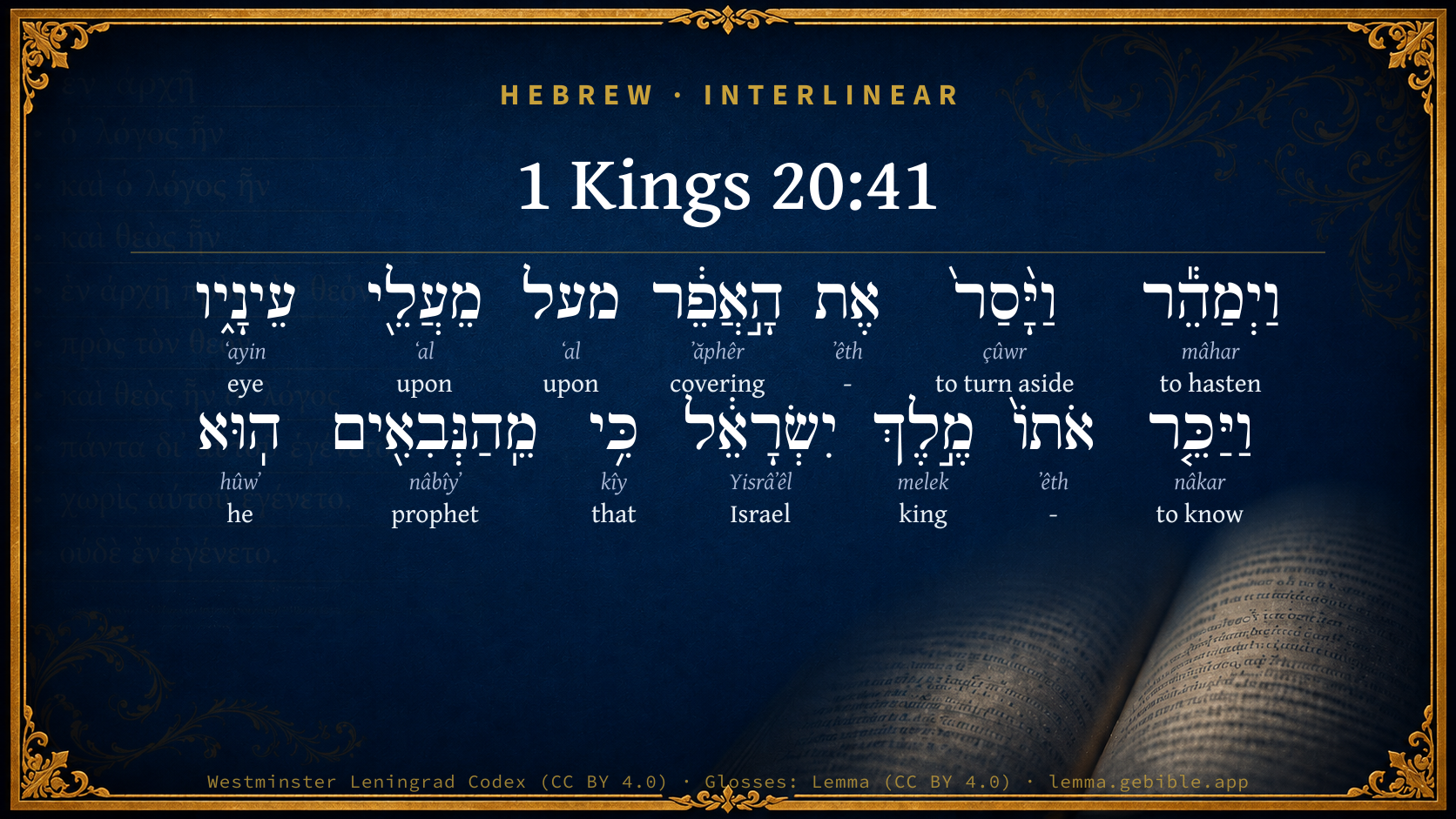
1 Kings 20:41

Hebrew (Westminster Leningrad Codex) 1 Kings 20:41 appears in the Hebrew Old Testament. The text above is from the Westminster Leningrad Codex. Each word links to its Strong’s number, a concise gloss, and parsing drawn from the Open Scriptures Hebrew Bible morphology. Click any word for its full Brown-Driver-Briggs (BDB) entry.
Download image
Cite this verse

1 Kings 20:41 (World English Bible). Public Domain. Lemma interlinear Bible study tool, https://lemma.gebible.app/v/1-kings/20/41.

Show BibTeX & RIS
BibTeX
RIS
English Translation
He hurried, and took the headband away from his eyes; and the king of Israel discerned him that he was of the prophets.
World English Bible · Public Domain
Download a study sheet

One document with this verse’s original text, its word-by-word gloss line, the meaning frame, cross-references with their text, attributed commentary, and full source and license credits — printable, and it pastes into notes with its structure intact.

This verse Autodidact and up

Study sheet (.html) Plain text (.txt)

A passage Seminary Student

Up to 50 verses in one chapter. A passage sheet keeps up to 6 commentary sources and 12 cross-references per verse, in the order this page ranks them, and says so on the sheet whenever that leaves anything out. Ask for a single verse and you get the Autodidact verse sheet above.

Everything on this page stays free to read, with no account — the sheet is a download of what is already on screen, not access to it.

Want to remove ads? Support Godless Engineer
Compare translations 3

The same verse in 3 English versions, stacked beneath the original-language interlinear above. Click any original word for its lexicon entry.

Each is an independent rendering of the whole verse — the interlinear is not word-aligned to these translations.

Highlighted words mark where these versions differ — a whole-verse word diff, not a word-by-word alignment.

  • World English Bible Public Domain
    He hurried, and took the headband away from his eyes; and the king of Israel discerned him that he was of the prophets.
  • King James Version Public Domain
    And he hasted, and took the ashes away from his face; and the king of Israel discerned him that he was of the prophets.
  • unfoldingWord Literal Text CC BY-SA 4.0
    And he hurried and removed the covering from upon his eyes, and the king of Israel recognized him, that he from the prophets.

unfoldingWord Literal Text — © unfoldingWord, licensed CC BY-SA 4.0. Word-aligned USFM3 via Door43 (git.door43.org/unfoldingWord/en_ult).

Versions to compare (up to 4)

3 of 4 selected

Show all 18 translations

Every available English version of this verse, each an independent rendering of the whole verse.

  • World English Bible Public Domain
    He hurried, and took the headband away from his eyes; and the king of Israel discerned him that he was of the prophets.
  • Berean Standard Bible Public Domain
    Then the prophet quickly removed the bandage from his eyes, and the king of Israel recognized him as one of the prophets.
  • Majority Standard Bible Public Domain
    Then the prophet quickly removed the bandage from his eyes, and the king of Israel recognized him as one of the prophets.
  • King James Version Public Domain
    And he hasted, and took the ashes away from his face; and the king of Israel discerned him that he was of the prophets.
  • American Standard Version (1901) Public Domain
    And he hasted, and took the headband away from his eyes; and the king of israel discerned him that he was of the prophets.
  • Revised Version (1885) Public Domain
    And he hasted, and took the headband away from his eyes; and the king of Israel discerned him that he was of the prophets.
  • Geneva Bible (1599) Public Domain
    And hee hasted, and tooke the ashes away from his face: and the King of Israel knewe him that he was of the Prophets:
  • Douay-Rheims (1899) Public Domain
    But he forthwith wiped off the dust from his face, and the king of Israel knew him, that he was one of the prophets.
  • Young's Literal Translation Public Domain
    And he hasteth and turneth aside the ashes from off his eyes, and the king of Israel discerneth him, that he `is' of the prophets,
  • Literal Standard Version CC BY-SA 4.0
    And he hurries and turns aside the ashes from off his eyes, and the king of Israel discerns him, that he [is] of the prophets,
  • Unlocked Literal Bible CC BY-SA 4.0
    Then the prophet quickly removed the bandage from his eyes, and the king of Israel recognized that he was one of the prophets.
  • unfoldingWord Literal Text CC BY-SA 4.0
    And he hurried and removed the covering from upon his eyes, and the king of Israel recognized him, that he from the prophets.
  • Darby Bible Public Domain
    Then he hastily took the sash away from his face; and the king of Israel discerned him, that he was of the prophets.
  • World Messianic Bible Public Domain
    He hurried, and took the headband away from his eyes; and the king of Israel recognized that he was one of the prophets.
  • Webster's Bible Public Domain
    And he hasted, and took the ashes away from his face; and the king of Israel discerned him that he was of the prophets.
  • Free Bible Version CC BY-SA 4.0
    Then the prophet quickly took off the bandage from his eyes, and the king of Israel recognized he was one of the prophets.
  • Bible in Basic English Public Domain
    Then he quickly took the head-band from his eyes; and the king of Israel saw that he was one of the prophets.
  • JPS Tanakh (1917) Public Domain
    And he hastened, and took the headband away from his eyes; and the king of Israel discerned him that he was of the prophets.

Literal Standard Version (2020), Covenant Press — licensed CC BY-SA 4.0. Text via the HelloAO Bible API (eBible.org). Unlocked Literal Bible (unfoldingWord) — licensed CC BY-SA 4.0. Text via the HelloAO Bible API (eBible.org). unfoldingWord Literal Text — © unfoldingWord, licensed CC BY-SA 4.0. Word-aligned USFM3 via Door43 (git.door43.org/unfoldingWord/en_ult). Free Bible Version, Dr. Jonathan Gallagher — licensed CC BY-SA 4.0. Text via the HelloAO Bible API (eBible.org).

Word by word

More ways to search: Search by grammar → Find every occurrence → Compare this word →

Practice this passage: Drill this verse → Learn its vocabulary →

הָ֣אֲפֵ֔ר
ʼăphêr
H666
“the · covering”
Particle, Definite Article + Noun, Common, Masculine, Singular, Absolute
Part of Speech
Particle + Noun
Type
Common
Gender
Masculine
Number
Singular
State
Absolute
Full BDB Definition

Origin: from the same as H665 (in the sense of covering)

TWOT: 151a

covering, bandage
  1. וַיְמַהֵ֕ר mâhar H4116 “and · to hasten” Conjunction + Verb, Piel, Sequential Imperfect, 3rd Person, Masculine, Singular
  2. וַיָּ֨סַר֙ çûwr H5493 “and · to turn aside” Conjunction + Verb, Hiphil, Sequential Imperfect, 3rd Person, Masculine, Singular
  3. אֶת ʼêth H853 “-” Particle, Direct Object
  4. מעל ʻal H5921 “from · upon” Preposition + Preposition
  5. מֵעֲלֵ֖י ʻal H5921 “from · upon” Preposition + Preposition
  6. עֵינָ֑יו ʻayin H5869 “eyes · his” Noun, Common, Both, Dual, Construct + Suffix, Personal, 3rd Person, Masculine, Singular
  7. וַיַּכֵּ֤ר nâkar H5234 “and · to know” Conjunction + Verb, Hiphil, Sequential Imperfect, 3rd Person, Masculine, Singular
  8. אֹתוֹ֙ ʼêth H853 “- · him” Particle, Direct Object + Suffix, Personal, 3rd Person, Masculine, Singular
  9. מֶ֣לֶךְ melek H4428 “king of” Noun, Common, Masculine, Singular, Construct
  10. יִשְׂרָאֵ֔ל Yisrâʼêl H3478 “Israel” Noun, Proper
  11. כִּ֥י kîy H3588 “that” Conjunction
  12. מֵֽהַנְּבִאִ֖ים nâbîyʼ H5030 “from · the · prophets” Preposition + Particle, Definite Article + Noun, Common, Masculine, Plural, Absolute
  13. הֽוּא hûwʼ H1931 “he” Pronoun, Personal, 3rd Person, Masculine, Singular

About this verse

These counts appear in no published source. They are computed here, from the morphology-tagged text and Lemma’s own curated glosses. What Lemma adds →

14
words
12
distinct lemmas
Historical
section

Notable vocabulary

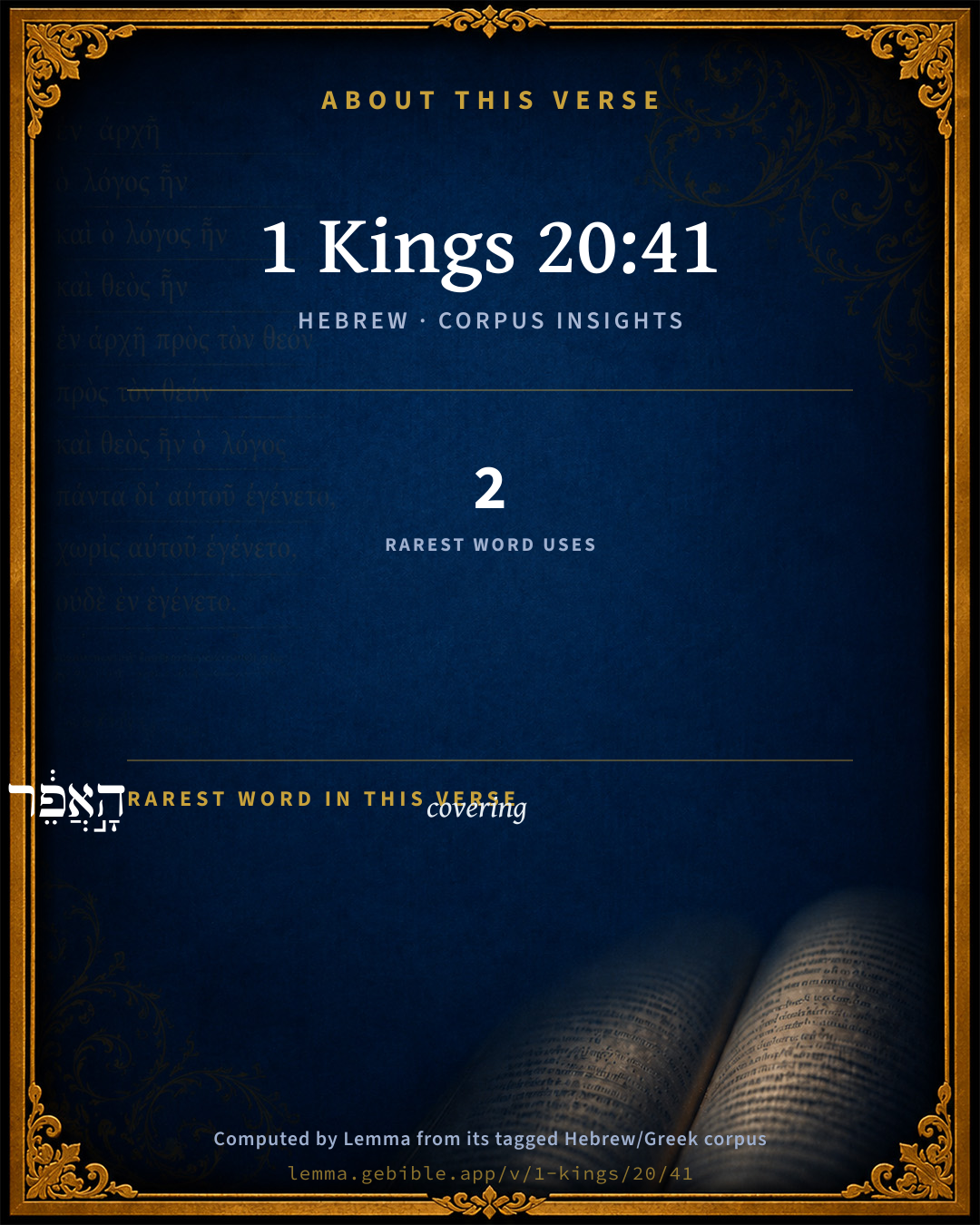
The rarest word here is הָ֣אֲפֵ֔ר covering H666 — appearing just 2 times in the whole Hebrew Bible.

Shared distinctive vocabulary

הָ֣אֲפֵ֔ר covering H666 occurs in 2 verses of the Hebrew Bible. Also found in:

Grammatical profile

  • 3 verbs
  • 5 nouns
  • 1 pronoun
  • 2 prepositions
  • 1 conjunction
  • 2 particles

Verb forms

  • וַיְמַהֵ֕ר Piel · Sequential Imperfect
  • וַיָּ֨סַר֙ Hiphil · Sequential Imperfect
  • וַיַּכֵּ֤ר Hiphil · Sequential Imperfect

Repetition

A word recurs within this verse — often emphatic in Hebrew:

Cross-references

4

Topical passages linked to 1 Kings 20:41 in the Treasury of Scripture Knowledge — connected by theme and wording, ordered by reader-vote popularity; previews shown in the World English Bible.

  • 2 Samuel 13:19 Tamar put ashes on her head, and tore her garment of various colors that was on her; and she laid her hand on her head, and went her way, crying aloud as she went.
  • 1 Kings 20:38 So the prophet departed, and waited for the king by the way, and disguised himself with his headband over his eyes.
  • Job 2:8 He took for himself a potsherd to scrape himself with, and he sat among the ashes.
  • Jeremiah 6:26 Daughter of my people, gird you with sackcloth, and wallow yourself in ashes: make you mourning, as for an only son, most bitter lamentation; for the destroyer shall suddenly come on us.

Cross-references courtesy of OpenBible.info (CC BY 4.0).

Hebrew and Greek witnesses Masoretic Hebrew ↔ Greek Septuagint

The same verse in the two great witnesses to the Old Testament, shown verse-for-verse.

These are two independent witnesses, not word-aligned to each other, and the Septuagint is shown in lemma (dictionary) form.

Hebrew 1 Kings 20:41 Masoretic · Westminster Leningrad Codex

וַיְמַהֵ֕ר וַיָּ֨סַר֙ אֶת הָ֣אֲפֵ֔ר מעל מֵעֲלֵ֖י עֵינָ֑יו וַיַּכֵּ֤ר אֹתוֹ֙ מֶ֣לֶךְ יִשְׂרָאֵ֔ל כִּ֥י מֵֽהַנְּבִאִ֖ים הֽוּא

He hurried, and took the headband away from his eyes; and the king of Israel discerned him that he was of the prophets.

World English Bible · Public Domain

On this verse, The Cambridge Bible for Schools and Colleges discusses the Septuagint’s reading. Read the note in Commentary ↓

Hebrew: Westminster Leningrad Codex (CC BY 4.0). Greek: Septuagint (public domain); English from a public-domain English Septuagint. How the Septuagint differs from the Hebrew →

Targum (Aramaic paraphrase)

1

The Targum is the ancient Jewish Aramaic paraphrase of the Hebrew Scriptures — an interpretive translation, not the Hebrew text itself. Onkelos (literal) and Pseudo-Jonathan (expansive) render the Torah, and Jonathan the Prophets. Coverage is partial: where no permissively-licensed English translation exists for a verse, only the Aramaic is shown. This is verse-level text, not a word-by-word alignment to the Hebrew.

  1. Targum Jonathan Prophets (Joshua–Malachi)
    וְאוֹחִי וְאַעְדִי יַת מֵעֲפָרָא מֵעִלַוֵי עֵינוֹהִי וְאִשְׁתְּמוֹדַע יָתֵיהּ מַלְכָּא דְיִשְׂרָאֵל אֲרֵי מִתַּלְמִידֵי נְבִיַיָא הוּא:

    (no public-domain English translation for this verse)

    Targum Jonathan — Aramaic: “Mikraot Gedolot” (public domain). English: “Sefaria Community Translation” (CC0 1.0 (public-domain dedication)); “London "Chaldee Paraphrase," 1871” (public domain). Text via Sefaria.

Commentary

Notes on 1 Kings 20:41 from classic Christian and Jewish commentators (each source and its license shown beneath its notes). The classic Christian expositions comment on the surrounding passage and are grouped to its opening verse, so a note may address several verses; the Jewish commentaries on the Tanakh (Rashi and others) are per-verse, so they appear only where the commentator wrote on this verse.

Lemma curates 59 commentaries, every one of them public domain or Creative Commons licensed, each selected and text-cleaned for this edition rather than reprinted as found. About our sources →

Trapp's Complete Commentary

John Trapp

1Ki 20:41 And he hasted, and took the ashes away from his face; and the king of Israel discerned him that he [was] of the prophets.

Ver. 41. And the king of Israel discerned him.] He had known him before for a prophet, and was ill-affected unto him for his plain dealing. {1Ki 22:8}

John Trapp, A Commentary or Exposition upon All the Books of the Old and New Testament (1647–1656) — public domain. Text from a community e-Sword module.

Joseph Benson's Commentary

1Ki 20:41. And he hasted, and took the ashes away from his face — Threw off his disguise immediately, by pulling off the cloth or bandage wherewith his face, or a part of it, had been concealed. And the king of Israel discerned him — Either by his face, which was known to the king, or to some of the courtiers there present: or, by the manner of his address to him, which, being changed, was now such as the prophets generally used.

Joseph Benson's Commentary on the Old and New Testaments (1811–1818) — public domain. Text from a community e-Sword module.

Adam Clarke's Commentary

Verse 41. Took the ashes away] He took the bandage from off his eyes: see on 1Kg 20:38. It was no doubt of thin cloth, through which he could see, while it served for a sufficient disguise.

Adam Clarke's Commentary on the Bible (1810–1826) — public domain. Text from a community e-Sword/MySword module.

The Cambridge Bible for Schools and Colleges

gen. ed. J. J. S. Perowne

41. the ashes away from his face] Here R.V. (as in 38) the head band from his eyes.

that he was of the prophets] It is clear that the prophets were distinguished by dress, or in some evident manner, so that they were easy of recognition. Perhaps the hairy prophetic mantle was the usual garb, and that on the present occasion the prophet had some wrapping thrown over that, which he laid aside along with the head band, and then the king recognised his character.

out of thy hand] The LXX. represents the pronoun, which is omitted in the Hebrew text, perhaps only by a slip of the scribe.

The Cambridge Bible for Schools and Colleges (gen. ed. J. J. S. Perowne; Cambridge University Press, 1878–1918) — public domain. Text from a community e-Sword module.

John Gill's Exposition

And he hasted, and took away the ashes from his face,.... Took off the linen cloth from his eyes, unveiled or unmasked himself:

and the king of Israel discerned him, that he was of the prophets; he knew him again, having seen him once or twice before; otherwise there could be nothing in his face that could discover him to be a prophet, rather he was to be known by his habit.

John Gill's Exposition of the Whole Bible (1746–1763) — public domain (CC PDM 1.0). Text via the HelloAO Bible API.

Albert Barnes' Notes on the Bible

He was of the prophets - Josephus and others conjecture that this prophet was Micaiah, the son of Imlah (but compare 1Ki 20:13 note).

Albert Barnes' Notes on the Bible (1834–1885) — public domain. Text from a community e-Sword/MySword module.

Matthew Poole's English Annotations

Either,

1. By his face, which was known either to the king, or to some of his courtiers there present. Or,

2. By the change of the manner of his address to him, which now was such as the prophets used.

Matthew Poole's English Annotations on the Holy Bible (1683–1685) — public domain. Text from a community e-Sword/MySword module.

The Pulpit Commentary

And he hasted, and took the ashes away from his face Heb. removed the covering from upon his eyes; and the king of Israel discerned him that he was of the prophets. That is, he was one of the prophets who were known to him The face alone would hardly have proclaimed him a prophet. And the prophet"s dress would of course have been laid aside when the disguise was assumed.

The Pulpit Commentary (1880–1919), ed. H.D.M. Spence-Jones & Joseph S. Exell — public domain. Text from a community e-Sword module.

Keil & Delitzsch

C. F. Keil & F. Delitzsch

Then the disciple of the prophets drew the bandage quickly from his eyes, so that the king recognised him as a prophet, and announced to him the word of the Lord: "Because thou hast let go out of thy hand the man of my ban (i.e., Benhadad, who has fallen under my ban), thy life shall stand for his life, and thy people for his people," i.e., the destruction to which Benhadad was devoted will fall upon thee and thy people. The expression אישׁ־חרמי (man of my ban) showed Ahab clearly enough what ought to have been done with Benhadad. A person on whom the ban was pronounced was to be put to death (Lev 27:29).

Keil & Delitzsch — Biblical Commentary on the Old Testament (1861–1891) — public domain (CC PDM 1.0). Text via the HelloAO Bible API. (Old Testament only.)

unfoldingWord translationNotes

Door43 World Missions Community

let go from your hand

Here the word "hand" is metonymy for power. AT: "released" or "spared the life of" (See: Metonymy)

your life will take the place of his life, and your people for his people

"you will die in his place, and your people will die in the place of his people"

translationWords

prophet

Yahweh

hand

die

people group

anger

Samaria

unfoldingWord translationNotes — © Distant Shores Media and the Door43 World Missions Community, licensed CC BY-SA 4.0. Source: git.door43.org/Door43/en_tn.

Lesson kit

Teaching starters — assembled from the data on this page, not authored interpretation. Every prompt links to the verse data it draws on. Edit before teaching.

1 Kings, in the Historical, opens this verse with 14 words (12 distinct Hebrew lemmas). Its most distinctive word is ʼăphêr (“covering”). A historical commentator’s framing appears above. Read the whole chapter for the surrounding context.

Discussion questions

  1. How does “covering” (ʼăphêr) shape what this verse is saying?
  2. 1 Kings 20:38 shares the word «covering» with this verse. How do the two illuminate each other?
  3. “upon” occurs 2× in this one verse. What is the effect of the repetition?
  4. These translations render this verse differently; the difference is in the English rendering, not the original. What questions does that raise?
  5. The verb «וַיְמַהֵ֕ר» is Piel Sequential Imperfect. How does its form color the action?
  6. Reading how Trapp's Complete Commentary and Joseph Benson's Commentary read this verse, where do the two commentators agree and where do they part?

Things to notice

Reading settings

Reading text

Shown beneath each verse's original-language words.

Old Testament
Old Testament edition

Read the OT as the Masoretic Hebrew (MT) or the Greek Septuagint (LXX).

English shown for the Greek Septuagint (in the Hebrew ↔ Greek comparison).

Comparing translations? Open the Compare panel on any verse page to stack up to four side by side.