
Psalms 60:10

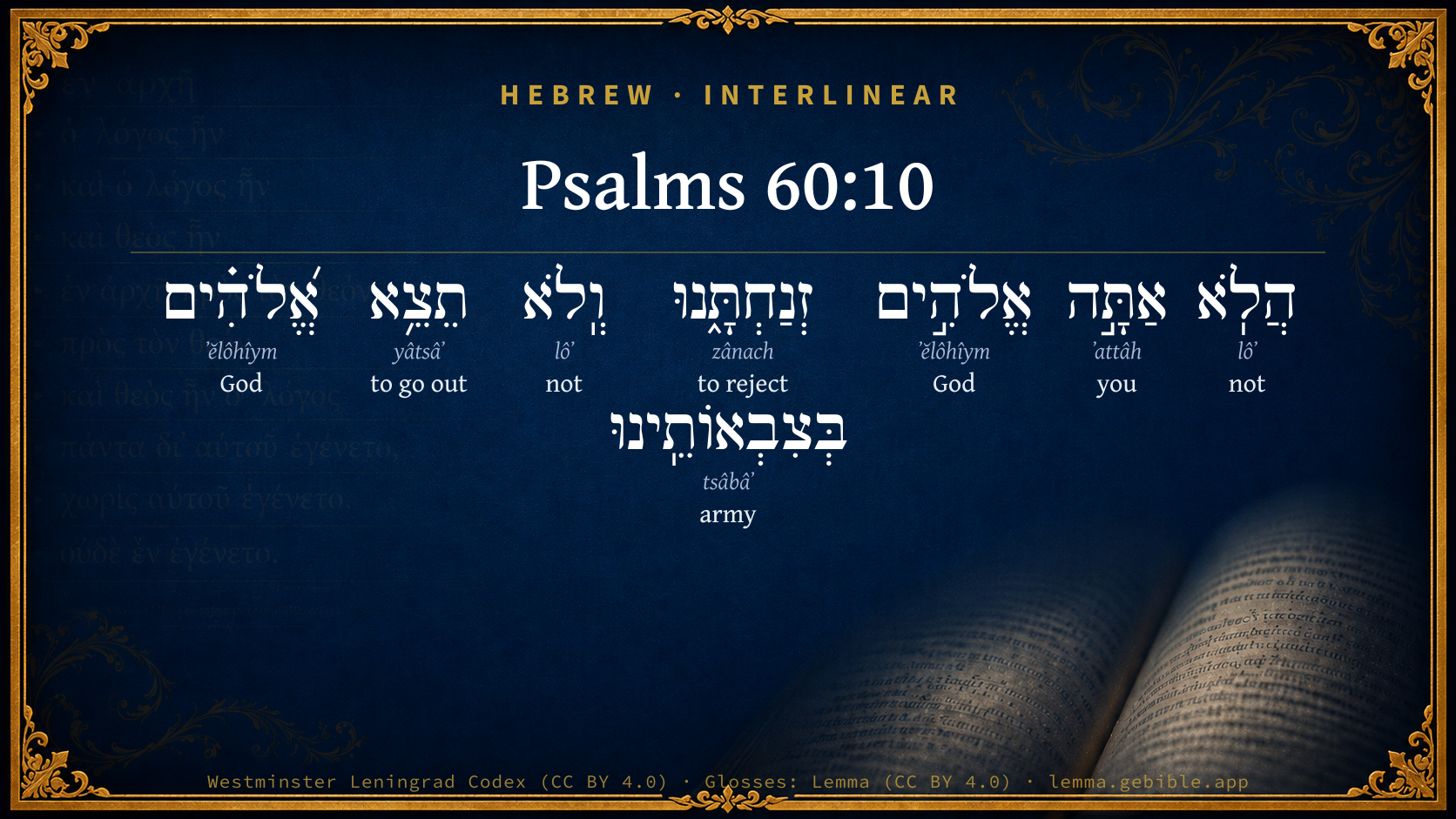
Hebrew (Westminster Leningrad Codex) Psalms 60:10 appears in the Hebrew Old Testament. The text above is from the Westminster Leningrad Codex. Each word links to its Strong’s number, a concise gloss, and parsing drawn from the Open Scriptures Hebrew Bible morphology. Click any word for its full Brown-Driver-Briggs (BDB) entry.
Download image
Cite this verse

Psalms 60:10 (World English Bible). Public Domain. Lemma interlinear Bible study tool, https://lemma.gebible.app/v/psalms/60/10.

Show BibTeX & RIS
BibTeX
RIS
English Translation
Haven't you, God, rejected us? You don't go out with our armies, God.
World English Bible · Public Domain
Download a study sheet

One document with this verse’s original text, its word-by-word gloss line, the meaning frame, cross-references with their text, attributed commentary, and full source and license credits — printable, and it pastes into notes with its structure intact.

This verse Autodidact and up

Study sheet (.html) Plain text (.txt)

A passage Seminary Student

Up to 50 verses in one chapter. A passage sheet keeps up to 6 commentary sources and 12 cross-references per verse, in the order this page ranks them, and says so on the sheet whenever that leaves anything out. Ask for a single verse and you get the Autodidact verse sheet above.

Everything on this page stays free to read, with no account — the sheet is a download of what is already on screen, not access to it.

Want to remove ads? Support Godless Engineer
Compare translations 3

The same verse in 3 English versions, stacked beneath the original-language interlinear above. Click any original word for its lexicon entry.

Each is an independent rendering of the whole verse — the interlinear is not word-aligned to these translations.

Highlighted words mark where these versions differ — a whole-verse word diff, not a word-by-word alignment.

  • World English Bible Public Domain
    Haven't you, God, rejected us? You don't go out with our armies, God.
  • King James Version Public Domain
    Wilt not thou, O God, which hadst cast us off? and thou, O God, which didst not go out with our armies?
  • unfoldingWord Literal Text CC BY-SA 4.0
    You, God, have you not rejected us? And you do not go out with our armies, God.

unfoldingWord Literal Text — © unfoldingWord, licensed CC BY-SA 4.0. Word-aligned USFM3 via Door43 (git.door43.org/unfoldingWord/en_ult).

Versions to compare (up to 4)

3 of 4 selected

Show all 18 translations

Every available English version of this verse, each an independent rendering of the whole verse.

  • World English Bible Public Domain
    Haven't you, God, rejected us? You don't go out with our armies, God.
  • Berean Standard Bible Public Domain
    Have You not rejected us, O God? Will You no longer march out, O God, with our armies?
  • Majority Standard Bible Public Domain
    Have You not rejected us, O God? Will You no longer march out, O God, with our armies?
  • King James Version Public Domain
    Wilt not thou, O God, which hadst cast us off? and thou, O God, which didst not go out with our armies?
  • American Standard Version (1901) Public Domain
    Hast not thou, O God, cast us off? And thou goest not forth, O God, with our hosts.
  • Revised Version (1885) Public Domain
    Hast not thou, O God, cast us off? and thou goest not forth, O God, with our hosts.
  • Geneva Bible (1599) Public Domain
    Wilt not thou, O God, which hadest cast vs off, and didest not go forth, O God, with our armies?
  • Douay-Rheims (1899) Public Domain
    Moab is the pot of my hope. Into Edom will I stretch out my shoe: to me the foreigners are made subject.
  • Young's Literal Translation Public Domain
    Is it not Thou, O God? hast Thou cast us off? And dost Thou not go forth, O God, with our hosts!
  • Literal Standard Version CC BY-SA 4.0
    Is it not You, O God? Have You cast us off? And do You not go forth, O God, with our hosts?
  • Unlocked Literal Bible CC BY-SA 4.0
    But you, God, have you not rejected us? You do not go into battle with our army.
  • unfoldingWord Literal Text CC BY-SA 4.0
    You, God, have you not rejected us? And you do not go out with our armies, God.
  • Darby Bible Public Domain
    [Wilt] not thou, O God, who didst cast us off? and didst not go forth, O God, with our armies?
  • World Messianic Bible Public Domain
    Haven’t you, God, rejected us? You don’t go out with our armies, God.
  • Webster's Bible Public Domain
    \\60:8\\Moab is my washpot; over Edom will I cast out my shoe: Philistia, triumph thou because of me.
  • Free Bible Version CC BY-SA 4.0
    Have you rejected us, God? Won't you lead our armies?
  • Bible in Basic English Public Domain
    Have not you put us away, O God? and you have not gone out with our armies.
  • JPS Tanakh (1917) Public Domain
    (60-12) Hast not Thou, O God, cast us off? And Thou goest not forth, O God, with our hosts.

Literal Standard Version (2020), Covenant Press — licensed CC BY-SA 4.0. Text via the HelloAO Bible API (eBible.org). Unlocked Literal Bible (unfoldingWord) — licensed CC BY-SA 4.0. Text via the HelloAO Bible API (eBible.org). unfoldingWord Literal Text — © unfoldingWord, licensed CC BY-SA 4.0. Word-aligned USFM3 via Door43 (git.door43.org/unfoldingWord/en_ult). Free Bible Version, Dr. Jonathan Gallagher — licensed CC BY-SA 4.0. Text via the HelloAO Bible API (eBible.org).

Word by word

More ways to search: Search by grammar → Find every occurrence → Compare this word →

Practice this passage: Drill this verse → Learn its vocabulary →

זְנַחְתָּ֑נוּ
zânach
H2186
“to reject · us”
Verb, Qal, Perfect, 2nd Person, Masculine, Singular + Suffix, Personal, 1st Person, Common, Plural
Part of Speech
Verb
Stem
Qal
Form
Perfect
Person
2nd Person
Gender
Masculine
Number
Singular
Full BDB Definition

Origin: a primitive root meaning to push aside

TWOT: 564

to cast off, reject, spurn - (Qal) to reject - (Hiphil) to forcefully reject someone - to stink, emit stench, become odious - (Hiphil) stink (perfect)
  1. הֲלֹֽא lôʼ H3808 “not” Particle, Interrogative + Particle, Negative
  2. אַתָּ֣ה ʼattâh H859 “you” Pronoun, Personal, 2nd Person, Masculine, Singular
  3. אֱלֹהִ֣ים ʼĕlôhîym H430 “God(s)” Noun, Common, Masculine, Plural, Absolute
  4. וְֽלֹא lôʼ H3808 “and · not” Conjunction + Particle, Negative
  5. תֵצֵ֥א yâtsâʼ H3318 “to go out” Verb, Qal, Imperfect, 2nd Person, Masculine, Singular
  6. אֱ֝לֹהִ֗ים ʼĕlôhîym H430 “God(s)” Noun, Common, Masculine, Plural, Absolute
  7. בְּצִבְאוֹתֵֽינוּ tsâbâʼ H6635 “in/at · armies · our” Preposition + Noun, Common, Both, Plural, Construct + Suffix, Personal, 1st Person, Common, Plural

About this verse

These counts appear in no published source. They are computed here, from the morphology-tagged text and Lemma’s own curated glosses. What Lemma adds →

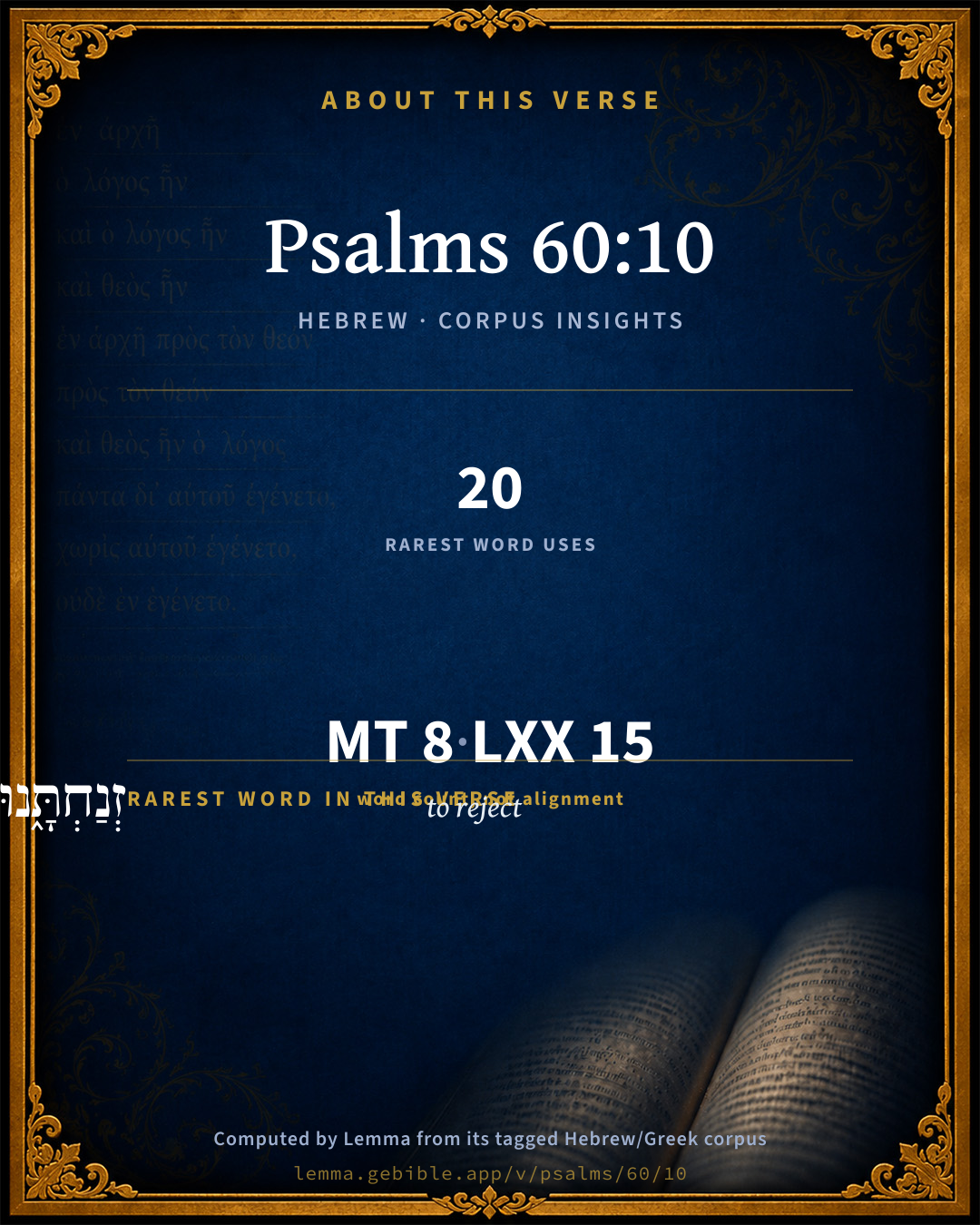
8
words
6
distinct lemmas
Wisdom
section

Notable vocabulary

The rarest word here is זְנַחְתָּ֑נוּ to reject H2186 — appearing just 20 times in the whole Hebrew Bible.

Shared distinctive vocabulary

זְנַחְתָּ֑נוּ to reject H2186 occurs in 20 verses of the Hebrew Bible. Also found in:

Grammatical profile

  • 2 verbs
  • 3 nouns
  • 1 pronoun
  • 2 particles

Verb forms

  • זְנַחְתָּ֑נוּ Qal · Perfect
  • תֵצֵ֥א Qal · Imperfect

Repetition

Words recur within this verse — often emphatic in Hebrew:

  • אֱלֹהִ֣ים God H430 ×2
  • הֲלֹֽא not H3808 ×2

Hebrew & Septuagint length

In English translation the verse runs 13 words from the Hebrew and 21 from the Septuagint (LXX English) — closely comparable.

A rough comparison of the two English renderings, which tokenize alike — not a word-level alignment.

Word counts can differ between the Hebrew and the Greek without any difference in meaning — e.g. the Hebrew direct-object marker אֵת has no separate Greek word, and Greek often adds the article ὁ.

In the original languages it is 8 Hebrew tokens and 15 Greek tokens — but the two are counted differently (Hebrew bundles its prefixes and suffixes into one token; the Greek is in lemma form), so that isn’t a like-for-like length.

Cross-references

15

Topical passages linked to Psalms 60:10 in the Treasury of Scripture Knowledge — connected by theme and wording, ordered by reader-vote popularity; previews shown in the World English Bible.

  • Joshua 7:12 Therefore the children of Israel can't stand before their enemies; they turn their backs before their enemies, because they are become accursed: I will not be with you any more, except you destroy the devoted thing from among you.
  • Psalms 108:11 Haven't you rejected us, God? You don't go forth, God, with our armies.
  • Deuteronomy 1:42 Yahweh said to me, Tell them, Don't go up, neither fight; for I am not among you; lest you be struck before your enemies.
  • Psalms 60:1 God, you have rejected us. You have broken us down. You have been angry. Restore us, again.
  • Deuteronomy 20:4 for Yahweh your God is he who goes with you, to fight for you against your enemies, to save you.
  • Joshua 10:42 All these kings and their land did Joshua take at one time, because Yahweh, the God of Israel, fought for Israel.
  • 1 Samuel 4:6–7 When the Philistines heard the noise of the shout, they said, What means the noise of this great shout in the camp of the Hebrews? They understood that the ark of Yahweh was come into the camp.
  • 1 Samuel 4:10–11 The Philistines fought, and Israel was struck, and they fled every man to his tent: and there was a very great slaughter; for there fell of Israel thirty thousand footmen.
  • 1 Chronicles 10:1–14 Now the Philistines fought against Israel: and the men of Israel fled from before the Philistines, and fell down slain on Mount Gilboa.
  • Psalms 20:7 Some trust in chariots, and some in horses, But we trust the name of Yahweh our God.
  • Psalms 44:5–9 Through you, will we push down our adversaries. Through your name, will we tread them under who rise up against us.
  • Psalms 118:9–10 It is better to take refuge in Yahweh, Than to put confidence in princes.
  • Isaiah 8:17 I will wait for Yahweh, who hides his face from the house of Jacob, and I will look for him.
  • Isaiah 12:1–2 In that day you will say, "I will give thanks to you, Yahweh; for though you were angry with me, your anger has turned away and you comfort me.
  • Jeremiah 33:24–26 Don't you consider what this people has spoken, saying, The two families which Yahweh did choose, he has cast them off? thus do they despise my people, that they should be no more a nation before them.

Cross-references courtesy of OpenBible.info (CC BY 4.0).

Hebrew and Greek witnesses Masoretic Hebrew ↔ Greek Septuagint

The same verse in the two great witnesses to the Old Testament, shown verse-for-verse.

You’re reading Greek Psalm 59 (Hebrew Psalm 60). The Septuagint counts the superscription, so verse numbers can differ from the Hebrew — chapter-level alignment, not verse-by-verse. Numbering follows Rahlfs.

These are two independent witnesses, not word-aligned to each other, and the Septuagint is shown in lemma (dictionary) form.

Hebrew Psalms 60:10 Masoretic · Westminster Leningrad Codex

הֲלֹֽא אַתָּ֣ה אֱלֹהִ֣ים זְנַחְתָּ֑נוּ וְֽלֹא תֵצֵ֥א אֱ֝לֹהִ֗ים בְּצִבְאוֹתֵֽינוּ

Haven't you, God, rejected us? You don't go out with our armies, God.

World English Bible · Public Domain

Greek LXX Greek Psalm 59:10 Septuagint · lemma form

μωαβ λέβης ὁ ἐλπίς ἐγώ ἐπί ὁ ιδουμαία ἐκτείνω ὁ ὑπόδημα ἐγώ ἐγώ ἀλλόφυλος ὑποτάσσω

Will not you, O God, who have cast us off? and will not you, O God, go forth with our forces?

LXX2012 (modern English Septuagint) · Public Domain

On this verse, The Cambridge Bible for Schools and Colleges discusses the Septuagint’s reading. Read the note in Commentary ↓

Hebrew: Westminster Leningrad Codex (CC BY 4.0). Greek: Septuagint (public domain); English from LXX2012 (modern English Septuagint) (Public Domain). How the Septuagint differs from the Hebrew →

Commentary

Notes on Psalms 60:10 from classic Christian and Jewish commentators (each source and its license shown beneath its notes). The classic Christian expositions comment on the surrounding passage and are grouped to its opening verse, so a note may address several verses; the Jewish commentaries on the Tanakh (Rashi and others) are per-verse, so they appear only where the commentator wrote on this verse.

Lemma curates 59 commentaries, every one of them public domain or Creative Commons licensed, each selected and text-cleaned for this edition rather than reprinted as found. About our sources →

Trapp's Complete Commentary

John Trapp

Psa 60:10 [Wilt] not thou, O God, [which] hadst cast us off? and [thou], O God, [which] didst not go out with our armies?

Ver. 10. Wilt not thou, O God?] Or, hast not thou, &c. The glory of all victories is to be given to God in solidum. Strong cities are nothing, when he will have them subdued, and sacked.

Which hadst cast us off] See Psa 44:9. The Church’s prosperity, like checker work, is intermingled with adversity.

John Trapp, A Commentary or Exposition upon All the Books of the Old and New Testament (1647–1656) — public domain. Text from a community e-Sword module.

J. A. Alexander on Psalms

Joseph Addison Alexander

12. (Psa 60:10). (Is it) not thou, O God, (who) hast cast us off and will not go orth with our hosts? A simpler construction of the first clause would be, hast thou not cast us off? But it seems better to explain the verse as an indirect answer to the question in the one preceding. Who has brought us into Edom, if not he who had rejected us? The terms are borrowed from Psa 44:9, which seems to have been written in the midst of the distress here spoken of as past. "Wilt not thou, of whom we lately were compelled to say, thou hast forsaken us and wilt not go forth with our hosts?" Compare 2Sa 5:24.

Joseph Addison Alexander, The Psalms Translated and Explained (1850) — public domain. Text from a community e-Sword module.

Jamieson, Fausset & Brown

Robert Jamieson, A. R. Fausset & David Brown

Wilt not thou?--or, "Is it not Thou?"

Jamieson, Fausset & Brown — Commentary Critical and Explanatory on the Whole Bible (1871) — public domain (CC PDM 1.0). Text via the HelloAO Bible API.

Adam Clarke's Commentary

Verse 10. Wilt not thou, O God] It is God alone from whom we can expect our enlargement. He who has cast us off, and has abandoned us in battle; it is that very God alone from whom we expect complete enlargement, the repossession of our own land, and the subduction of the surrounding nations; and we expect this, because he has graciously promised these mercies.

Adam Clarke's Commentary on the Bible (1810–1826) — public domain. Text from a community e-Sword/MySword module.

The Cambridge Bible for Schools and Colleges

gen. ed. J. J. S. Perowne

10. Wilt not thou, O God &c.] This rendering, which is that of the LXX, Vulg., Symm., and Jer., is grammatically legitimate, though less obvious than that of R.V.;

Hast not thou, O God, cast us off?

And thou goest not forth, O God, with our hosts.

It suits the context better as the answer to Psa_60:9 in a tone of confidence which corresponds to that of Psa_60:12. Though God has for the moment deserted us, and has not led our armies to victory, He will surely now give us help, for we trust in Him alone. The rendering of R.V. introduces a note of despair, which harmonises ill with the confidence of Psa_60:12. With it the connexion of thought would be, Who can lead us into the enemy’s stronghold? None but God, and God has deserted us. Yet even now perhaps He will hear our prayer (Psa_60:11). With the second line cp. Psa_44:9.

The Cambridge Bible for Schools and Colleges (gen. ed. J. J. S. Perowne; Cambridge University Press, 1878–1918) — public domain. Text from a community e-Sword module.

John Gill's Exposition

Wilt not thou, O God?.... This is an answer to the question, and is made by putting another, which tacitly contains in it an affirmation that God would do it. He has foretold the destruction of the Romish antichrist; he has said it shall be: he is faithful to his purposes, predictions, and promises; he is able to effect it; strong is the Lord that judgeth Babylon, Rev 18:10; He will put it into the hearts of the kings of the earth to hate her; he will encourage them to reward her double; he will give her blood to drink, because she is worthy; her destruction will be according to his righteous judgment, and will be irretrievable; he will call upon all his people to rejoice at it, whose shoutings on this occasion will be like those of persons that enter into a conquered city in triumph;

which hadst cast us off; who seemed in former times to have cast off his people, when they were killed all the day long; accounted as sheep for the slaughter; were slain in great numbers in the Low Countries; burnt here in England; massacred in France and Ireland: especially God seemed to have cast off his people, and to have had no regard to his interest, when antichrist so prevailed, that all the world wondered after the beast;

and thou, O God, which didst not go forth with our armies: but suffered the antichristian beast to make war with the saints, and to overcome and kill them; and which was the case in many pitched battles with the Waldenses and Albigenses before the Reformation, and with the Protestants in Germany since. But this will not be always the case; he whose name is the Word of God, the King of kings, and Lord of lords, will fight with the antichristian powers, and overcome them, and make his people more than conquerors over them; and his having formerly seemed to have cast them off, and not going forth with their armies, will serve as a foil to set off the glorious and complete victory that will at last be obtained.

John Gill's Exposition of the Whole Bible (1746–1763) — public domain (CC PDM 1.0). Text via the HelloAO Bible API.

Albert Barnes' Notes on the Bible

Wilt not thou, O God, which hadst east us off? - See the notes at Psa 60:1. The meaning is, that although God had seemed to reject and forsake them, they had no other resource, and the appeal might be still made to him. The psalmist hoped that he would again be favorable to his people, and would not forsake them altogether. It is still true that although God may seem to forsake us, that although he may leave us for a time to discouragement and darkness, yet we have no other resource but himself; it is still true that we may hope in his mercy, and plead for his return.

And thou, O God, which didst not go out with our armies? - Who didst suffer us to be defeated. See the notes at Psa 60:2-3.

Albert Barnes' Notes on the Bible (1834–1885) — public domain. Text from a community e-Sword/MySword module.

Matthew Poole's English Annotations

To wit, in former times, but now hast graciously returned to us. He brings to his own and people’s minds their former calamities, that they may be more thankful for present mercies and deliverance.

Matthew Poole's English Annotations on the Holy Bible (1683–1685) — public domain. Text from a community e-Sword/MySword module.

The Treasury of David

Charles H. Spurgeon

Ver. 10. Wilt not thou, O God, which hadst cast us off? Yes, the chastising God is our only hope. He loves us still. For a small moment doth he forsake, but with great mercy does he gather his people. Strong to smite, he is also strong to save. He who proved to us our need of him by showing us what poor creatures we are without him, will now reveal the glory of his help by conducting great enterprises to a noble issue.

And thou, O God, which didst not go out with our armies? The self same God art thou, and to thee faith cleaves. Though thou slay us, we will trust in thee, and look for thy merciful help.

Charles H. Spurgeon's The Treasury of David (1869–1885) — public domain. Psalms only. Text from a community e-Sword/MySword module.

Whedon's Commentary on the Bible

Daniel D. Whedon

10. Hadst cast us off—See Psa_60:1

Daniel D. Whedon (gen. ed.), Commentary on the Old and New Testaments (1874–1909) — public domain. Text from a community e-Sword module.

The Pulpit Commentary

Wilt not thou, O God, which hadst cast us off? rather, Hast not thou, O God, cast us off? Can we expect thee to lead us, when thou hast so lately cast us off, and, as we hear it said on all sides, dost not go out with our armies? A reference, perhaps, to Psa_44:9.

The Pulpit Commentary (1880–1919), ed. H.D.M. Spence-Jones & Joseph S. Exell — public domain. Text from a community e-Sword module.

John Wesley's Explanatory Notes

Hadst cut off - But now hast graciously returned to us.

John Wesley, Explanatory Notes Upon the Whole Bible (1754–1765) — public domain. Text via the GEBible commentary corpus.

unfoldingWord translationNotes

Door43 World Missions Community

But you, God, have you not rejected us?

The psalmist uses this question to express his sadness that it seems that God has rejected them. AT: "But God, it seems like you have rejected us." or "God, you seem to have abandoned us." (See: Rhetorical Question)

You do not go into battle with our army

The psalmist speaks of God helping their army as if God were to go and fight with them. AT: "you do not help our army when we go into battle" (See: Metaphor)

is futile

"is worthless"

will triumph

"will defeat our enemies"

he will trample down our enemies

The psalmist speaks of God helping their army defeat their enemies as if God were to trample down the enemies. AT: "he will enable us to trample down our enemies" or "he will make us able to defeat our enemies" (See: Metaphor)

translationWords

reject

adversary

unfoldingWord translationNotes — © Distant Shores Media and the Door43 World Missions Community, licensed CC BY-SA 4.0. Source: git.door43.org/Door43/en_tn.

Rashi

Rabbi Shlomo Yitzchaki (Rashi)

Moab is my washbasin I will use them as a copper pot prepared for washing therein.

my lock Heb. נעלי, my imprisonment.

join me Join my kingdom to be subordinate to me, for Gath, and also Gaza, which David vanquished, are of the land of the Philistines.

Rashi on the Tanakh — English translations: “The Judaica Press complete Tanach with Rashi, translated by A. J. Rosenberg” (CC BY 4.0); “Pentateuch with Rashi's commentary by M. Rosenbaum and A.M. Silbermann, 1929-1934” (public domain); “The Metsudah Tanach series, Lakewood, N.J” (CC BY 4.0); and “The Book of Joshua, Metsudah Publications, 1997” (CC BY 4.0). Text via Sefaria.

Lesson kit

Teaching starters — assembled from the data on this page, not authored interpretation. Every prompt links to the verse data it draws on. Edit before teaching.

Psalms, in the Wisdom, opens this verse with 8 words (6 distinct Hebrew lemmas). Its most distinctive word is zânach (“to reject”). A historical commentator’s framing appears above. Read the whole chapter for the surrounding context.

Discussion questions

  1. The word zânach carries the sense “to reject.” How does it shape the verse?
  2. How does 1 Chronicles 28:9, which shares the word «to reject», read alongside this verse?
  3. What does the repetition of “God” (2× in this one verse) do in this verse?
  4. These translations render this verse differently; the difference is in the English rendering, not the original. What questions does that raise?
  5. «זְנַחְתָּ֑נוּ» is a Qal Perfect verb. How does that grammatical form shape the action described?
  6. Compare how Trapp's Complete Commentary and J. A. Alexander on Psalms read this verse. Where do they agree or differ?

Things to notice

Reading settings

Reading text

Shown beneath each verse's original-language words.

Old Testament
Old Testament edition

Read the OT as the Masoretic Hebrew (MT) or the Greek Septuagint (LXX).

English shown for the Greek Septuagint (in the Hebrew ↔ Greek comparison).

Comparing translations? Open the Compare panel on any verse page to stack up to four side by side.