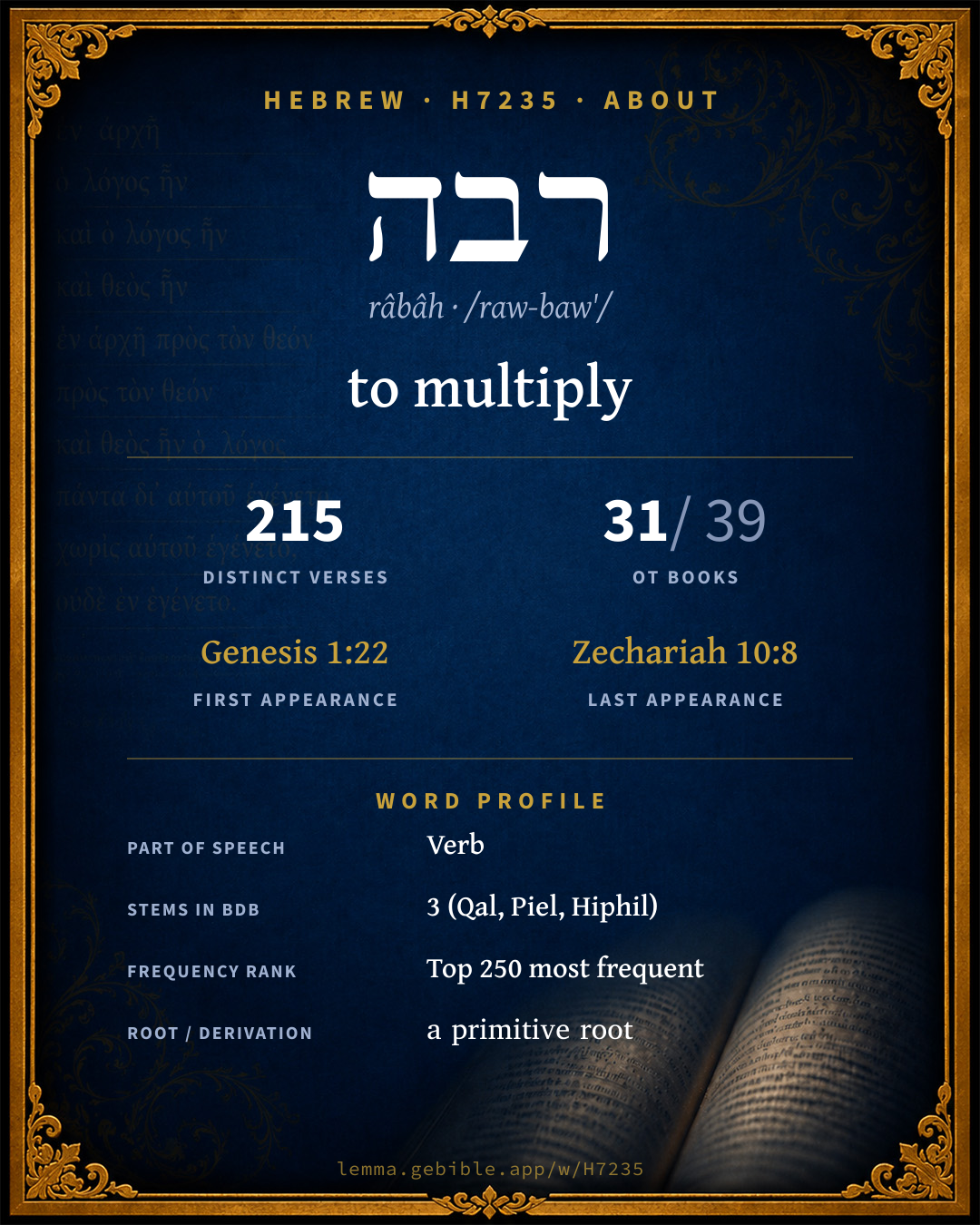
רָבָה
to multiply
‘to multiply’ is one of 2 main senses fuller range ↓
Full lexicon entry — Brown-Driver-Briggs (BDB)
From Brown-Driver-Briggs (BDB)
Where this word appears
See every Hiphil verb in the Hebrew Bible →
Grammar key — what these labels mean
Part of speech
- Verb
- An action or state-of-being word.
Stem
- Hiphil
- The causative active stem (“he caused / brought about”). Here: ‘make much or many’
- Qal
- The basic, simple active stem — the plain form of the verb (“he wrote”). Here: ‘become many’
- Piel
- An intensive or resultative active stem.
Form
- Infinitive Absolute
- An unbound verbal noun, often intensifying or standing in for a finite verb.
- Sequential Perfect
- A perfect with prefixed waw continuing a preceding imperfect or command (waw-consecutive perfect).
- Imperfect
- An incomplete, ongoing, or future action (“he will / would write”).
- Perfect
- A completed action or state — Hebrew marks aspect (completeness) more than strict tense (“he wrote”).
- Sequential Imperfect
- An imperfect with prefixed waw — the standard past-narrative form (waw-consecutive imperfect).
- Imperative
- A direct command (“write!”).
- Infinitive Construct
- A bound verbal noun, frequently with prepositions (“to write / in writing”).
- Participle Active
- A verbal adjective expressing ongoing or characteristic action (“writing / one who writes”).
- Cohortative
- A first-person volitional form expressing wish or resolve (“let me / let us write”).
- Jussive
- A third- or second-person volitional form expressing wish or command (“let him write”).
State
- Absolute
- The independent form of a noun, not bound to a following word.
- Construct
- A noun bound to a following noun in a possessive / “of” relationship (the construct chain).
Person
- 1st Person
- The speaker (“I / we”).
- 3rd Person
- The one spoken about (“he / she / it / they”).
- 2nd Person
- The one addressed (“you”).
Gender
- Common
- Either gender — not distinguished for this form.
- Masculine
- Grammatically masculine.
- Feminine
- Grammatically feminine.
Number
- Singular
- One.
- Plural
- More than one (in Hebrew, generally three or more).
Grammatical forms 57 distinct
- Verb, Hiphil, Infinitive Absolute 54 times (23%)
- Verb, Hiphil, Sequential Perfect, 1st Person, Common, Singular 12 times (5%)
- Verb, Hiphil, Imperfect, 3rd Person, Masculine, Singular 12 times (5%)
- Verb, Qal, Imperfect, 3rd Person, Masculine, Singular 10 times (4%)
- Verb, Qal, Perfect, 3rd Person, Common, Plural 10 times (4%)
- Verb, Hiphil, Perfect, 3rd Person, Masculine, Singular 9 times (4%)
- Verb, Qal, Imperfect, 3rd Person, Masculine, Plural 9 times (4%)
- Verb, Hiphil, Imperfect, 1st Person, Common, Singular 8 times (3%)
+49 more forms (111 occurrences)
Parsed forms decoded from the imported morphology (morphhb / Westminster Leningrad Codex — WLC text public domain, morphhb tagging CC BY 4.0), counted across 235 parsed occurrences — not distinct verses.
Page 1 of 2 — showing verses 1–200 of 215 distinct verses where H7235 appears, across 31 books. Click any verse to open its interlinear word-by-word view. Verse text shown in the World English Bible for context — . Each verse’s Hebrew form is shown with its reference; the English is not keyword-highlighted, since the data carries no word-level English alignment. Use “Compare translations” on any verse to read it across multiple English versions. This concordance covers the Hebrew Bible; Septuagint (Greek Old Testament) occurrences are not indexed here.
Genesis 24 verses
- Genesis 1:22 וּ/רְב֗וּ יִ֥רֶב conj + Qal impv 2mp Qal juss 3ms God blessed them, saying, "Be fruitful, and multiply, and fill the waters in the seas, and let birds multiply on the earth."
- Genesis 1:28 וּ/רְב֛וּ conj + Qal impv 2mp God blessed them. God said to them, "Be fruitful, multiply, fill the earth, and subdue it. Have dominion over the fish of the sea, over the birds of the sky, and over every living thing that moves on the earth."
- Genesis 3:16 הַרְבָּ֤ה אַרְבֶּה֙ Hiphil inf.abs Hiphil impf 1cs To the woman he said, "I will greatly multiply your pain in childbirth. In pain you will bring forth children. Your desire will be for your husband, and he will rule over you."
- Genesis 7:17 וַ/יִּרְבּ֣וּ conj + Qal wimpf 3mp The flood was forty days on the earth. The waters increased, and lifted up the ark, and it was lifted up above the earth.
- Genesis 7:18 וַ/יִּרְבּ֥וּ conj + Qal wimpf 3mp The waters prevailed, and increased greatly on the earth; and the ark floated on the surface of the waters.
- Genesis 8:17 וְ/רָב֖וּ conj + Qal wpf 3cp Bring forth with you every living thing that is with you of all flesh, including birds, cattle, and every creeping thing that creeps on the earth; that they may breed abundantly in the earth, and be fruitful, and multiply on the earth."
- Genesis 9:1 וּ/רְב֖וּ conj + Qal impv 2mp God blessed Noah and his sons, and said to them, "Be fruitful, and multiply, and replenish the earth.
- Genesis 9:7 וּ/רְב֑וּ וּ/רְבוּ conj + Qal impv 2mp conj + Qal impv 2mp Be fruitful, and multiply. Bring forth abundantly in the earth, and multiply in it."
- Genesis 15:1 הַרְבֵּ֥ה Hiphil inf.abs After these things the word of Yahweh came to Abram in a vision, saying, "Don't be afraid, Abram. I am your shield, your exceedingly great reward."
- Genesis 16:10 הַרְבָּ֥ה אַרְבֶּ֖ה Hiphil inf.abs Hiphil impf 1cs The angel of Yahweh said to her, "I will greatly multiply your seed, that they will not be numbered for multitude."
- Genesis 17:2 וְ/אַרְבֶּ֥ה conj + Hiphil coh 1cs I will make my covenant between me and you, and will multiply you exceedingly."
- Genesis 17:20 וְ/הִרְבֵּיתִ֥י conj + Hiphil wpf 1cs As for Ishmael, I have heard you. Behold, I have blessed him, and will make him fruitful, and will multiply him exceedingly. He will become the father of twelve princes, and I will make him a great nation.
- Genesis 21:20 רֹבֶ֥ה Qal ptcp.act ms cs God was with the boy, and he grew. He lived in the wilderness, and became, as he grew up, an archer.
- Genesis 22:17 וְ/הַרְבָּ֨ה אַרְבֶּ֤ה conj + Hiphil inf.abs Hiphil impf 1cs that in blessing I will bless you, and in multiplying I will multiply your seed as the stars of the heavens, and as the sand which is on the seashore. Your seed will possess the gate of his enemies.
- Genesis 26:4 וְ/הִרְבֵּיתִ֤י conj + Hiphil wpf 1cs I will multiply your seed as the stars of the sky, and will give to your seed all these lands. In your seed will all the nations of the earth be blessed,
- Genesis 26:24 וְ/הִרְבֵּיתִ֣י conj + Hiphil wpf 1cs Yahweh appeared to him the same night, and said, "I am the God of Abraham your father. Don't be afraid, for I am with you, and will bless you, and multiply your seed for my servant Abraham's sake."
- Genesis 28:3 וְ/יַרְבֶּ֑/ךָ conj + Hiphil juss 3ms + sfx pers 2ms May God Almighty bless you, and make you fruitful, and multiply you, that you may be a company of peoples,
- Genesis 34:12 הַרְבּ֨וּ Hiphil impv 2mp Ask me a great amount for a dowry, and I will give whatever you ask of me, but give me the young lady as a wife."
- Genesis 35:11 וּ/רְבֵ֔ה conj + Qal impv 2ms God said to him, "I am God Almighty. Be fruitful and multiply. A nation and a company of nations will be from you, and kings will come out of your loins.
- Genesis 38:12 וַ/יִּרְבּוּ֙ conj + Qal wimpf 3mp After many days, Shua's daughter, the wife of Judah, died. Judah was comforted, and went up to his sheep-shearers to Timnah, he and his friend Hirah, the Adullamite.
- Genesis 41:49 הַרְבֵּ֣ה Hiphil inf.abs Joseph laid up grain as the sand of the sea, very much, until he stopped counting, for it was without number.
- Genesis 43:34 וַ/תֵּ֜רֶב conj + Qal wimpf 3fs He sent portions to them from before him, but Benjamin's portion was five times as much as any of theirs. They drank, and were merry with him.
- Genesis 47:27 וַ/יִּרְבּ֖וּ conj + Qal wimpf 3mp Israel lived in the land of Egypt, in the land of Goshen; and they got themselves possessions therein, and were fruitful, and multiplied exceedingly.
- Genesis 48:4 וְ/הִרְבִּיתִ֔/ךָ conj + Hiphil wpf 1cs + sfx pers 2ms and said to me, 'Behold, I will make you fruitful, and multiply you, and I will make of you a company of peoples, and will give this land to your seed after you for an everlasting possession.'
Exodus 11 verses
- Exodus 1:7 וַ/יִּרְבּ֥וּ conj + Qal wimpf 3mp The children of Israel were fruitful, and increased abundantly, and multiplied, and grew exceedingly mighty; and the land was filled with them.
- Exodus 1:10 יִרְבֶּ֗ה Qal impf 3ms Come, let us deal wisely with them, lest they multiply, and it happen that when any war breaks out, they also join themselves to our enemies, and fight against us, and escape out of the land."
- Exodus 1:12 יִרְבֶּ֖ה Qal impf 3ms But the more they afflicted them, the more they multiplied and the more they spread out. They were grieved because of the children of Israel.
- Exodus 1:20 וַ/יִּ֧רֶב conj + Qal wimpf 3ms God dealt well with the midwives, and the people multiplied, and grew very mighty.
- Exodus 7:3 וְ/הִרְבֵּיתִ֧י conj + Hiphil wpf 1cs I will harden Pharaoh's heart, and multiply my signs and my wonders in the land of Egypt.
- Exodus 11:9 רְב֥וֹת Qal inf.cs Yahweh said to Moses, "Pharaoh won't listen to you, that my wonders may be multiplied in the land of Egypt."
- Exodus 16:17 הַ/מַּרְבֶּ֖ה ptcl def.art + Hiphil ptcp.act ms The children of Israel did so, and gathered some more, some less.
- Exodus 16:18 הַ/מַּרְבֶּ֔ה ptcl def.art + Hiphil ptcp.act ms When they measured it with an omer, he who gathered much had nothing over, and he who gathered little had no lack. They gathered every man according to his eating.
- Exodus 30:15 יַרְבֶּ֗ה Hiphil impf 3ms The rich shall not give more, and the poor shall not give less, than the half shekel, when they give the offering of Yahweh, to make atonement for your souls.
- Exodus 32:13 אַרְבֶּה֙ Hiphil impf 1cs Remember Abraham, Isaac, and Israel, your servants, to whom you swore by your own self, and said to them, 'I will multiply your seed as the stars of the sky, and all this land that I have spoken of I will give to your seed, and they shall inherit it forever.'"
- Exodus 36:5 מַרְבִּ֥ים Hiphil ptcp.act mp They spoke to Moses, saying, "The people bring much more than enough for the service of the work which Yahweh commanded to make."
Leviticus 3 verses
- Leviticus 11:42 מַרְבֵּ֣ה Hiphil ptcp.act ms cs Whatever goes on its belly, and whatever goes on all fours, or whatever has many feet, even all creeping things that creep on the earth, them you shall not eat; for they are an abomination.
- Leviticus 25:16 תַּרְבֶּה֙ Hiphil impf 2ms According to the length of the years you shall increase the price of it, and according to the shortness of the years you shall diminish the price of it; for he is selling the number of the crops to you.
- Leviticus 26:9 וְ/הִרְבֵּיתִ֖י conj + Hiphil wpf 1cs "'I will have respect for you, and make you fruitful, and multiply you, and will establish my covenant with you.
Numbers 3 verses
- Numbers 26:54 תַּרְבֶּה֙ Hiphil impf 2ms To the more you shall give the more inheritance, and to the fewer you shall give the less inheritance: to everyone according to those who were numbered of him shall his inheritance be given.
- Numbers 33:54 תַּרְבּ֤וּ Hiphil impf 2mp You shall inherit the land by lot according to your families; to the more you shall give the more inheritance, and to the fewer you shall give the less inheritance: wherever the lot falls to any man, that shall be his; according to the tribes of your fathers shall you inherit.
- Numbers 35:8 תַּרְבּ֔וּ Hiphil impf 2mp Concerning the cities which you shall give of the possession of the children of Israel, from the many you shall take many; and from the few you shall take few: everyone according to his inheritance which he inherits shall give of his cities to the Levites.
Deuteronomy 16 verses
- Deuteronomy 1:10 הִרְבָּ֣ה Hiphil pf 3ms Yahweh your God has multiplied you, and, behold, you are this day as the stars of the sky for multitude.
- Deuteronomy 3:5 הַרְבֵּ֥ה Hiphil inf.abs All these were cities fortified with high walls, gates, and bars; besides the unwalled towns a great many.
- Deuteronomy 6:3 תִּרְבּ֖וּ/ן Qal impf 2mp + sfx n Hear therefore, Israel, and observe to do it; that it may be well with you, and that you may increase mightily, as Yahweh, the God of your fathers, has promised to you, in a land flowing with milk and honey.
- Deuteronomy 7:13 וְ/הִרְבֶּ֑/ךָ conj + Hiphil wpf 3ms + sfx pers 2ms and he will love you, and bless you, and multiply you; he will also bless the fruit of your body and the fruit of your ground, your grain and your new wine and your oil, the increase of your cattle and the young of your flock, in the land which he swore to your fathers to give you.
- Deuteronomy 7:22 תִּרְבֶּ֥ה Qal impf 3fs Yahweh your God will cast out those nations before you by little and little: you may not consume them at once, lest the animals of the field increase on you.
- Deuteronomy 8:1 וּ/רְבִיתֶ֗ם conj + Qal wpf 2mp All the commandment which I command you this day shall you observe to do, that you may live, and multiply, and go in and possess the land which Yahweh swore to your fathers.
- Deuteronomy 8:13 יִרְבְּיֻ֔/ן יִרְבֶּה יִרְבֶּֽה Qal impf 3mp + sfx n Qal impf 3ms Qal impf 3ms and when your herds and your flocks multiply, and your silver and your gold is multiplied, and all that you have is multiplied;
- Deuteronomy 11:21 יִרְבּ֤וּ Qal impf 3mp that your days may be multiplied, and the days of your children, in the land which Yahweh swore to your fathers to give them, as the days of the heavens above the earth.
- Deuteronomy 13:17 וְ/הִרְבֶּ֔/ךָ conj + Hiphil wpf 3ms + sfx pers 2ms There shall cleave nothing of the devoted thing to your hand; that Yahweh may turn from the fierceness of his anger, and show you mercy, and have compassion on you, and multiply you, as he has sworn to your fathers;
- Deuteronomy 14:24 יִרְבֶּ֨ה Qal impf 3ms If the way be too long for you, so that you are not able to carry it, because the place is too far from you, which Yahweh your God shall choose, to set his name there, when Yahweh your God shall bless you;
- Deuteronomy 17:16 יַרְבֶּה הַרְבּ֣וֹת Hiphil impf 3ms Hiphil inf.cs Only he shall not multiply horses to himself, nor cause the people to return to Egypt, to the end that he may multiply horses; because Yahweh has said to you, You shall henceforth return no more that way.
- Deuteronomy 17:17 יַרְבֶּה יַרְבֶּה Hiphil impf 3ms Hiphil impf 3ms Neither shall he multiply wives to himself, that his heart not turn away: neither shall he greatly multiply to himself silver and gold.
- Deuteronomy 19:6 יִרְבֶּ֥ה Qal impf 3ms lest the avenger of blood pursue the manslayer, while his heart is hot, and overtake him, because the way is long, and strike him mortally; whereas he was not worthy of death, inasmuch as he didn't hate him in time past.
- Deuteronomy 28:63 וּ/לְ/הַרְבּ֣וֹת conj + prep + Hiphil inf.cs It shall happen that as Yahweh rejoiced over you to do you good, and to multiply you, so Yahweh will rejoice over you to cause you to perish, and to destroy you; and you shall be plucked from off the land where you go in to possess it.
- Deuteronomy 30:5 וְ/הִרְבְּ/ךָ֖ conj + Hiphil wpf 3ms + sfx pers 2ms and Yahweh your God will bring you into the land which your fathers possessed, and you shall possess it; and he will do you good, and multiply you above your fathers.
- Deuteronomy 30:16 וְ/רָבִ֔יתָ conj + Qal wpf 2ms in that I command you this day to love Yahweh your God, to walk in his ways, and to keep his commandments and his statutes and his ordinances, that you may live and multiply, and that Yahweh your God may bless you in the land where you go in to possess it.
Joshua 3 verses
- Joshua 13:1 הַרְבֵּֽה Hiphil inf.abs Now Joshua was old and well stricken in years; and Yahweh said to him, You are old and well stricken in years, and there remains yet very much land to be possessed.
- Joshua 22:8 הַרְבֵּ֣ה Hiphil inf.abs and spoke to them, saying, Return with much wealth to your tents, and with very much cattle, with silver, and with gold, and with brass, and with iron, and with very much clothing: divide the spoil of your enemies with your brothers.
- Joshua 24:3 ו/ארב וָ/אַרְבֶּה֙ conj + Hiphil wimpf 1cs conj + Hiphil wimpf 1cs I took your father Abraham from beyond the River, and led him throughout all the land of Canaan, and multiplied his seed, and gave him Isaac.
Judges 3 verses
- Judges 9:29 רַבֶּ֥ה Piel impv 2ms Would that this people were under my hand! then would I remove Abimelech. He said to Abimelech, Increase your army, and come out.
- Judges 16:24 הִרְבָּ֖ה Hiphil pf 3ms When the people saw him, they praised their god; for they said, Our god has delivered into our hand our enemy, and the destroyer of our country, who has slain many of us.
- Judges 20:38 הֶ֕רֶב Hiphil impv 2ms Now the appointed sign between the men of Israel and the liers-in-wait was that they should make a great cloud of smoke rise up out of the city.
1 Samuel 6 verses
- 1 Samuel 1:12 הִרְבְּתָ֔ה Hiphil pf 3fs It happened, as she continued praying before Yahweh, that Eli marked her mouth.
- 1 Samuel 2:3 תַּרְבּ֤וּ Hiphil juss 2mp Talk no more so exceeding proudly; Don't let arrogance come out of your mouth; For Yahweh is a God of knowledge, By him actions are weighed.
- 1 Samuel 7:2 וַ/יִּרְבּוּ֙ conj + Qal wimpf 3mp It happened, from the day that the ark abode in Kiriath Jearim, that the time was long; for it was twenty years: and all the house of Israel lamented after Yahweh.
- 1 Samuel 14:30 רָבְתָ֥ה Qal pf 3fs How much more, if haply the people had eaten freely today of the spoil of their enemies which they found? for now has there been no great slaughter among the Philistines.
- 1 Samuel 25:10 רַבּ֣וּ Qal pf 3cp Nabal answered David's servants, and said, Who is David? and who is the son of Jesse? there are many servants now-a-days who break away every man from his master.
- 1 Samuel 26:21 הַרְבֵּ֥ה Hiphil inf.abs Then said Saul, I have sinned: return, my son David; for I will no more do you harm, because my life was precious in your eyes this day: behold, I have played the fool, and have erred exceedingly.
2 Samuel 7 verses
- 2 Samuel 1:4 הַרְבֵּ֞ה Hiphil inf.abs David said to him, How went the matter? Please tell me. He answered, The people are fled from the battle, and many of the people also are fallen and dead; and Saul and Jonathan his son are dead also.
- 2 Samuel 8:8 הַרְבֵּ֥ה Hiphil inf.abs From Betah and from Berothai, cities of Hadadezer, king David took exceeding much brass.
- 2 Samuel 12:2 הַרְבֵּ֥ה Hiphil inf.abs The rich man had very many flocks and herds,
- 2 Samuel 12:30 הַרְבֵּ֥ה Hiphil inf.abs He took the crown of their king from off his head; and the weight of it was a talent of gold, and [in it were] precious stones; and it was set on David's head. He brought forth the spoil of the city, exceeding much.
- 2 Samuel 14:11 מ/הרבית מֵ/הַרְבַּ֞ת prep + Hiphil inf.cs prep + Hiphil inf.cs Then said she, Please let the king remember Yahweh your God, that the avenger of blood destroy not any more, lest they destroy my son. He said, As Yahweh lives, there shall not one hair of your son fall to the earth.
- 2 Samuel 18:8 וַ/יֶּ֤רֶב conj + Hiphil wimpf 3ms For the battle was there spread over the surface of all the country; and the forest devoured more people that day than the sword devoured.
- 2 Samuel 22:36 תַּרְבֵּֽ/נִי Hiphil impf 2ms + sfx pers 1cs You have also given me the shield of your salvation; Your gentleness has made me great.
1 Kings 4 verses
- 1 Kings 4:29 הַרְבֵּ֣ה Hiphil inf.abs God gave Solomon wisdom and understanding exceeding much, and very great understanding, even as the sand that is on the sea-shore.
- 1 Kings 4:30 וַ/תֵּ֨רֶב֙ conj + Qal wimpf 3fs Solomon's wisdom excelled the wisdom of all the children of the east, and all the wisdom of Egypt.
- 1 Kings 10:10 הַרְבֵּ֥ה Hiphil inf.abs She gave the king one hundred twenty talents of gold, and of spices very great store, and precious stones: there came no more such abundance of spices as these which the queen of Sheba gave to king Solomon.
- 1 Kings 10:11 הַרְבֵּ֥ה Hiphil inf.abs The navy also of Hiram, that brought gold from Ophir, brought in from Ophir great plenty of almug trees and precious stones.
2 Kings 3 verses
- 2 Kings 10:18 הַרְבֵּֽה Hiphil inf.abs Jehu gathered all the people together, and said to them, Ahab served Baal a little; but Jehu will serve him much.
- 2 Kings 21:6 הִרְבָּ֗ה Hiphil pf 3ms He made his son to pass through the fire, and practiced sorcery, and used enchantments, and dealt with those who had familiar spirits, and with wizards: he worked much evil in the sight of Yahweh, to provoke him to anger.
- 2 Kings 21:16 הַרְבֵּ֣ה Hiphil inf.abs Moreover Manasseh shed innocent blood very much, until he had filled Jerusalem from one end to another; besides his sin with which he made Judah to sin, in doing that which was evil in the sight of Yahweh.
1 Chronicles 10 verses
- 1 Chronicles 4:10 וְ/הִרְבִּ֤יתָ conj + Hiphil wpf 2ms Jabez called on the God of Israel, saying, Oh that you would bless me indeed, and enlarge my border, and that your hand might be with me, and that you would keep me from evil, that it not be to my sorrow! God granted him that which he requested.
- 1 Chronicles 4:27 הִרְבּ֖וּ Hiphil pf 3cp Shimei had sixteen sons and six daughters; but his brothers didn't have many children, neither did all their family multiply like the children of Judah.
- 1 Chronicles 5:9 רָב֖וּ Qal pf 3cp and eastward he lived even to the entrance of the wilderness from the river Euphrates, because their cattle were multiplied in the land of Gilead.
- 1 Chronicles 5:23 רָבֽוּ Qal pf 3cp The children of the half-tribe of Manasseh lived in the land: they increased from Bashan to Baal Hermon and Senir and Mount Hermon.
- 1 Chronicles 7:4 הִרְבּ֥וּ Hiphil pf 3cp With them, by their generations, after their fathers' houses, were bands of the host for war, thirty-six thousand; for they had many wives and sons.
- 1 Chronicles 8:40 וּ/מַרְבִּ֤ים conj + Hiphil ptcp.act mp The sons of Ulam were mighty men of valor, archers, and had many sons, and sons' sons, one hundred fifty. All these were of the sons of Benjamin.
- 1 Chronicles 20:2 הַרְבֵּ֥ה Hiphil inf.abs David took the crown of their king from off his head, and found it to weigh a talent of gold, and there were precious stones in it; and it was set on David's head: and he brought forth the spoil of the city, exceeding much.
- 1 Chronicles 23:11 הִרְבּ֣וּ Hiphil pf 3cp Jahath was the chief, and Zizah the second: but Jeush and Beriah didn't have many sons; therefore they became a fathers' house in one reckoning.
- 1 Chronicles 23:17 רָב֥וּ Qal pf 3cp The sons of Eliezer were: Rehabiah the chief; and Eliezer had no other sons; but the sons of Rehabiah were very many.
- 1 Chronicles 27:23 לְ/הַרְבּ֥וֹת prep + Hiphil inf.cs But David didn't take the number of them from twenty years old and under, because Yahweh had said he would increase Israel like the stars of the sky.
2 Chronicles 10 verses
- 2 Chronicles 11:12 לְ/הַרְבֵּ֣ה prep + Hiphil inf.abs In every city [he put] shields and spears, and made them exceeding strong. Judah and Benjamin belonged to him.
- 2 Chronicles 14:13 הַרְבֵּ֥ה Hiphil inf.abs Asa and the people who were with him pursued them to Gerar: and there fell of the Ethiopians so many that they could not recover themselves; for they were destroyed before Yahweh, and before his host; and they carried away very much booty.
- 2 Chronicles 16:8 לְ/הַרְבֵּ֣ה prep + Hiphil inf.abs Weren't the Ethiopians and the Lubim a huge host, with chariots and horsemen exceeding many? yet, because you did rely on Yahweh, he delivered them into your hand.
- 2 Chronicles 24:27 יִ֧רֶ֞ב Qal impf 3ms Now concerning his sons, and the greatness of the burdens [laid] on him, and the rebuilding of the house of God, behold, they are written in the commentary of the book of the kings. Amaziah his son reigned in his place.
- 2 Chronicles 25:9 הַרְבֵּ֥ה Hiphil inf.abs Amaziah said to the man of God, But what shall we do for the hundred talents which I have given to the army of Israel? The man of God answered, Yahweh is able to give you much more than this.
- 2 Chronicles 31:5 הִרְבּ֤וּ Hiphil pf 3cp As soon as the commandment came abroad, the children of Israel gave in abundance the first fruits of grain, new wine, and oil, and honey, and of all the increase of the field; and the tithe of all things brought they in abundantly.
- 2 Chronicles 32:27 הַרְבֵּ֣ה Hiphil inf.abs Hezekiah had exceeding much riches and honor: and he provided him treasuries for silver, and for gold, and for precious stones, and for spices, and for shields, and for all manner of goodly vessels;
- 2 Chronicles 33:6 הִרְבָּ֗ה Hiphil pf 3ms He also made his children to pass through the fire in the valley of the son of Hinnom; and he practiced sorcery, and used enchantments, and practiced sorcery, and dealt with those who had familiar spirits, and with wizards: he worked much evil in the sight of Yahweh, to provoke him to anger.
- 2 Chronicles 33:23 הִרְבָּ֥ה Hiphil pf 3ms He didn't humble himself before Yahweh, as Manasseh his father had humbled himself; but this same Amon trespassed more and more.
- 2 Chronicles 36:14 הִרְבּ֣וּ Hiphil pf 3cp Moreover all the chiefs of the priests, and the people, trespassed very greatly after all the abominations of the nations; and they polluted the house of Yahweh which he had made holy in Jerusalem.
Ezra 3 verses
- Ezra 9:6 רָבוּ֙ Qal pf 3cp and I said, my God, I am ashamed and blush to lift up my face to you, my God; for our iniquities are increased over our head, and our guiltiness is grown up to the heavens.
- Ezra 10:1 הַרְבֵּה Hiphil inf.abs Now while Ezra prayed and made confession, weeping and casting himself down before the house of God, there was gathered together to him out of Israel a very great assembly of men and women and children; for the people wept very sore.
- Ezra 10:13 הִרְבִּ֥ינוּ Hiphil pf 1cp But the people are many, and it is a time of much rain, and we are not able to stand outside: neither is this a work of one day or two; for we have greatly transgressed in this matter.
Nehemiah 8 verses
- Nehemiah 2:2 הַרְבֵּ֥ה Hiphil inf.abs The king said to me, Why is your face sad, seeing you are not sick? this is nothing else but sorrow of heart. Then I was very sore afraid.
- Nehemiah 4:1 הַרְבֵּ֑ה Hiphil inf.abs But it happened that when Sanballat heard that we were building the wall, he was angry, and took great indignation, and mocked the Jews.
- Nehemiah 4:10 הַרְבֵּ֑ה Hiphil inf.abs Judah said, The strength of the bearers of burdens is decayed, and there is much rubbish; so that we are not able to build the wall.
- Nehemiah 4:19 הַרְבֵּ֖ה Hiphil inf.abs I said to the nobles, and to the rulers and to the rest of the people, The work is great and large, and we are separated on the wall, one far from another:
- Nehemiah 5:18 לְ/הַרְבֵּ֑ה prep + Hiphil inf.abs Now that which was prepared for one day was one ox and six choice sheep; also fowls were prepared for me, and once in ten days store of all sorts of wine: yet for all this I didn't demand the bread of the governor, because the bondage was heavy on this people.
- Nehemiah 6:17 מַרְבִּ֞ים Hiphil ptcp.act mp Moreover in those days the nobles of Judah sent many letters to Tobiah, and [the letters] of Tobiah came to them.
- Nehemiah 9:23 הִרְבִּ֔יתָ Hiphil pf 2ms Their children also multiplied you as the stars of the sky, and brought them into the land concerning which you did say to their fathers, that they should go in to possess it.
- Nehemiah 9:37 מַרְבָּ֗ה Hiphil ptcp.act fs It yields much increase to the kings whom you have set over us because of our sins: also they have power over our bodies, and over our cattle, at their pleasure, and we are in great distress.
Job 8 verses
- Job 9:17 וְ/הִרְבָּ֖ה conj + Hiphil wpf 3ms For he breaks me with a tempest, Multiplies my wounds without cause.
- Job 10:17 וְ/תֶ֣רֶב conj + Hiphil juss 2ms You renew your witnesses against me, And increase your indignation on me. Changes and warfare are with me.
- Job 27:14 יִרְבּ֣וּ Qal impf 3mp If his children are multiplied, it is for the sword. His offspring shall not be satisfied with bread.
- Job 29:18 אַרְבֶּ֥ה Hiphil impf 1cs Then I said, 'I shall die in my own house, I shall number my days as the sand.
- Job 33:12 יִרְבֶּ֥ה Qal impf 3ms "Behold, I will answer you. In this you are not just; For God is greater than man.
- Job 34:37 וְ/יֶ֖רֶב conj + Hiphil impf 3ms For he adds rebellion to his sin. He claps his hands among us, And multiplies his words against God."
- Job 39:4 יִרְבּ֣וּ Qal impf 3mp Their young ones become strong. They grow up in the open field. They go forth, and don't return again.
- Job 41:3 הֲ/יַרְבֶּ֣ה ptcl inter + Hiphil impf 3ms Will he make many petitions to you? Or will he speak soft words to you?
Psalms 10 verses
- Psalms 16:4 יִרְבּ֥וּ Qal impf 3mp Their sorrows shall be multiplied who give gifts to another god. Their drink-offerings of blood I will not offer, Nor take their names on my lips.
- Psalms 18:35 תַרְבֵּֽ/נִי Hiphil impf 3fs + sfx pers 1cs You have also given me the shield of your salvation. Your right hand sustains me. Your gentleness has made me great.
- Psalms 44:12 רִ֝בִּ֗יתָ Piel pf 2ms You sell your people for nothing, And have gained nothing from their sale.
- Psalms 49:16 יִ֝רְבֶּה Qal impf 3ms Don't be afraid when a man is made rich, When the glory of his house is increased.
- Psalms 51:2 הרבה הֶ֭רֶב Hiphil inf.abs Hiphil impv 2ms Wash me thoroughly from my iniquity. Cleanse me from my sin.
- Psalms 71:21 תֶּ֤רֶב Hiphil impf 2ms Increase my honor, And comfort me again.
- Psalms 78:38 וְ֭/הִרְבָּה conj + Hiphil wpf 3ms But he, being merciful, forgave iniquity, and didn't destroy them. Yes, many times he turned his anger away, And didn't stir up all his wrath.
- Psalms 107:38 וַ/יִּרְבּ֣וּ conj + Qal wimpf 3mp He blesses them also, so that they are multiplied greatly. He doesn't allow their cattle to decrease.
- Psalms 130:7 וְ/הַרְבֵּ֖ה conj + Hiphil inf.abs Israel, hope in Yahweh, For with Yahweh there is loving kindness. With him is abundant redemption.
- Psalms 139:18 יִרְבּ֑וּ/ן Qal impf 3mp + sfx n If I would count them, they are more in number than the sand. When I wake up, I am still with you.
Proverbs 10 verses
- Proverbs 4:10 וְ/יִרְבּ֥וּ conj + Qal impf 3mp Listen, my son, and receive my sayings. The years of your life will be many.
- Proverbs 6:35 תַרְבֶּה Hiphil impf 2ms He won't regard any ransom, Neither will he rest content, though you give many gifts.
- Proverbs 9:11 יִרְבּ֣וּ Qal impf 3mp For by me your days will be multiplied. The years of your life will be increased.
- Proverbs 13:11 יַרְבֶּֽה Hiphil impf 3ms Wealth gained dishonestly dwindles away, But he who gathers by hand makes it grow.
- Proverbs 22:16 לְ/הַרְבּ֣וֹת prep + Hiphil inf.cs Whoever oppresses the poor for his own increase and whoever gives to the rich, Both come to poverty.
- Proverbs 25:27 הַרְבּ֣וֹת Hiphil inf.cs It is not good to eat much honey; Nor is it honorable to seek one's own honor.
- Proverbs 28:8 מַרְבֶּ֣ה Hiphil ptcp.act ms He who increases his wealth by excessive interest Gathers it for one who has pity on the poor.
- Proverbs 28:28 יִרְבּ֥וּ Qal impf 3mp When the wicked rise, men hide themselves; But when they perish, the righteous thrive.
- Proverbs 29:2 בִּ/רְב֣וֹת prep + Qal inf.cs When the righteous thrive, the people rejoice; But when the wicked rule, the people groan.
- Proverbs 29:16 בִּ/רְב֣וֹת יִרְבֶּה prep + Qal inf.cs Qal impf 3ms When the wicked increase, sin increases; But the righteous will see their downfall.
Ecclesiastes 15 verses
- Ecclesiastes 1:16 הַרְבֵּ֖ה Hiphil inf.abs I said to myself, "Behold, I have obtained for myself great wisdom above all who were before me in Jerusalem. Yes, my heart has had great experience of wisdom and knowledge."
- Ecclesiastes 2:7 הַרְבֵּה֙ Hiphil inf.abs I bought men-servants and maid-servants, and had servants born in my house. I also had great possessions of herds and flocks, above all who were before me in Jerusalem;
- Ecclesiastes 5:7 הַרְבֵּ֑ה Hiphil inf.abs For in the multitude of dreams there are vanities, as well as in many words: but you must fear God.
- Ecclesiastes 5:11 בִּ/רְבוֹת֙ רַבּ֖וּ prep + Qal inf.cs Qal pf 3cp When goods increase, those who eat them are increased; and what advantage is there to its owner, except to feast on them with his eyes?
- Ecclesiastes 5:12 הַרְבֵּ֖ה Hiphil inf.abs The sleep of a laboring man is sweet, whether he eats little or much; but the abundance of the rich will not allow him to sleep.
- Ecclesiastes 5:17 הַרְבֵּ֖ה Hiphil inf.abs All his days he also eats in darkness, he is frustrated, and has sickness and wrath.
- Ecclesiastes 5:20 הַרְבֵּ֔ה Hiphil inf.abs For he shall not often reflect on the days of his life; because God occupies him with the joy of his heart.
- Ecclesiastes 6:11 הַרְבֵּ֖ה מַרְבִּ֣ים Hiphil inf.abs Hiphil ptcp.act mp For there are many words that create vanity. What does that profit man?
- Ecclesiastes 7:16 הַרְבֵּ֔ה Hiphil inf.abs Don't be overly righteous, neither make yourself overly wise. Why should you destroy yourself?
- Ecclesiastes 7:17 הַרְבֵּ֖ה Hiphil inf.abs Don't be too wicked, neither be foolish. Why should you die before your time?
- Ecclesiastes 9:18 הַרְבֵּֽה Hiphil inf.abs Wisdom is better than weapons of war; but one sinner destroys much good.
- Ecclesiastes 10:14 יַרְבֶּ֣ה Hiphil impf 3ms A fool also multiplies words. Man doesn't know what will be; and that which will be after him, who can tell him?
- Ecclesiastes 11:8 הַרְבֵּ֛ה הַרְבֵּ֥ה Hiphil inf.abs Hiphil inf.abs Yes, if a man lives many years, let him rejoice in them all; But let him remember the days of darkness, for they shall be many. All that comes is vanity.
- Ecclesiastes 12:9 הַרְבֵּֽה Hiphil inf.abs Further, because the Preacher was wise, he still taught the people knowledge. Yes, he pondered, sought out, and set in order many proverbs.
- Ecclesiastes 12:12 הַרְבֵּה֙ הַרְבֵּ֖ה Hiphil inf.abs Hiphil inf.abs Furthermore, my son, be admonished: of making many books there is no end; and much study is a weariness of the flesh.
Isaiah 10 verses
- Isaiah 1:15 תַרְבּ֥וּ Hiphil impf 2mp When you spread forth your hands, I will hide my eyes from you; Yes, when you make many prayers, I will not hear. Your hands are full of blood.
- Isaiah 9:3 הִרְבִּ֣יתָ Hiphil pf 2ms You have multiplied the nation, you have increased their joy: they joy before you according to the joy in harvest, as men rejoice when they divide the spoil.
- Isaiah 22:9 רָ֑בּוּ Qal pf 3cp You saw the breaches of the city of David, that they were many; and you gathered together the waters of the lower pool;
- Isaiah 23:16 הַרְבִּי Hiphil impv 2fs Take a harp, go about the city, you prostitute that has been forgotten; make sweet melody, sing many songs, that you may be remembered.
- Isaiah 30:33 הַרְבֵּ֔ה Hiphil inf.abs For a Topheth is prepared of old; yes, for the king it is made ready; he has made it deep and large; the pile of it is fire and much wood; the breath of Yahweh, like a stream of sulfur, does kindle it.
- Isaiah 40:29 יַרְבֶּֽה Hiphil impf 3ms He gives power to the faint; and to him who has no might he increases strength.
- Isaiah 51:2 וְ/אַרְבֵּֽ/הוּ conj + Hiphil impf 1cs + sfx pers 3ms Look to Abraham your father, and to Sarah who bore you; for when he was but one I called him, and I blessed him, and made him many.
- Isaiah 55:7 יַרְבֶּ֥ה Hiphil impf 3ms let the wicked forsake his way, and the unrighteous man his thoughts; and let him return to Yahweh, and he will have mercy on him; and to our God, for he will abundantly pardon.
- Isaiah 57:9 וַ/תַּרְבִּ֖י conj + Hiphil wimpf 2fs You went to the king with oil, and did increase your perfumes, and did send your ambassadors far off, and did debase yourself even to Sheol.
- Isaiah 59:12 רַבּ֤וּ Qal pf 3cp For our transgressions are multiplied before you, and our sins testify against us; for our transgressions are with us, and as for our iniquities, we know them:
Jeremiah 10 verses
- Jeremiah 2:22 וְ/תַרְבִּי conj + Hiphil impf 2fs For though you wash yourself with lye, and use much soap, yet your iniquity is marked before me, says the Lord Yahweh.
- Jeremiah 3:16 תִרְבּוּ֩ Qal impf 2mp It shall come to pass, when you are multiplied and increased in the land, in those days, says Yahweh, they shall say no more, The ark of the covenant of Yahweh; neither shall it come to mind; neither shall they remember it; neither shall they miss it; neither shall it be made any more.
- Jeremiah 23:3 וְ/רָבֽוּ conj + Qal wpf 3cp I will gather the remnant of my flock out of all the countries where I have driven them, and will bring them again to their folds; and they shall be fruitful and multiply.
- Jeremiah 29:6 וּ/רְבוּ conj + Qal impv 2mp Take wives, and father sons and daughters; and take wives for your sons, and give your daughters to husbands, that they may bear sons and daughters; and multiply you there, and don't be diminished.
- Jeremiah 30:19 וְ/הִרְבִּתִי/ם֙ conj + Hiphil wpf 1cs + sfx pers 3mp Out of them shall proceed thanksgiving and the voice of those who make merry: and I will multiply them, and they shall not be few; I will also glorify them, and they shall not be small.
- Jeremiah 33:22 אַרְבֶּ֗ה Hiphil impf 1cs As the host of the sky can't be numbered, neither the sand of the sea measured; so will I multiply the seed of David my servant, and the Levites who minister to me.
- Jeremiah 40:12 הַרְבֵּ֥ה Hiphil inf.abs then all the Jews returned out of all places where they were driven, and came to the land of Judah, to Gedaliah, to Mizpah, and gathered wine and summer fruits very much.
- Jeremiah 42:2 מֵֽ/הַרְבֵּ֔ה prep + Hiphil inf.abs and said to Jeremiah the prophet, Let, we pray you, our supplication be presented before you, and pray for us to Yahweh your God, even for all this remnant; for we are left but a few of many, as your eyes do see us:
- Jeremiah 46:11 הרביתי הִרְבֵּ֣ית Hiphil pf 1cs Hiphil pf 2fs Go up into Gilead, and take balm, virgin daughter of Egypt: in vain do you use many medicines; there is no healing for you.
- Jeremiah 46:16 הִרְבָּ֖ה Hiphil pf 3ms He made many to stumble, yes, they fell one on another: and they said, Arise, and let us go again to our own people, and to the land of our birth, from the oppressing sword.
Lamentations 2 verses
- Lamentations 2:5 וַ/יֶּ֨רֶב֙ conj + Hiphil wimpf 3ms The Lord is become as an enemy, he has swallowed up Israel; He has swallowed up all her palaces, he has destroyed his strongholds; He has multiplied in the daughter of Judah mourning and lamentation.
- Lamentations 2:22 וְ/רִבִּ֖יתִי conj + Piel pf 1cs You have called, as in the day of a solemn assembly, my terrors on every side; There was none that escaped or remained in the day of Yahweh's anger: Those that I have dandled and brought up has my enemy consumed.
Ezekiel 19 verses
- Ezekiel 11:6 הִרְבֵּיתֶ֥ם Hiphil pf 2mp You have multiplied your slain in this city, and you have filled the streets of it with the slain.
- Ezekiel 16:7 וַ/תִּרְבִּי֙ conj + Qal wimpf 2fs I caused you to multiply as that which grows in the field, and you increased and grew great, and you attained to excellent ornament; your breasts were fashioned, and your hair was grown; yet you were naked and bare.
- Ezekiel 16:25 וַ/תַּרְבִּ֖י conj + Hiphil wimpf 2fs You have built your lofty place at the head of every way, and have made your beauty an abomination, and have opened your feet to everyone who passed by, and multiplied your prostitution.
- Ezekiel 16:26 וַ/תַּרְבִּ֥י conj + Hiphil wimpf 2fs You have also committed sexual immorality with the Egyptians, your neighbors, great of flesh; and have multiplied your prostitution, to provoke me to anger.
- Ezekiel 16:29 וַ/תַּרְבִּ֧י conj + Hiphil wimpf 2fs You have moreover multiplied your prostitution to the land of merchants, to Chaldea; and yet you weren't satisfied with this.
- Ezekiel 16:51 וַ/תַּרְבִּ֤י conj + Hiphil wimpf 2fs Neither has Samaria committed half of your sins; but you have multiplied your abominations more than they, and have justified your sisters by all your abominations which you have done.
- Ezekiel 19:2 רִבְּתָ֥ה Piel pf 3fs and say, What was your mother? A lioness: she couched among lions, in the midst of the young lions she nourished her cubs.
- Ezekiel 21:15 וְ/הַרְבֵּה֙ conj + Hiphil inf.abs I have set the threatening sword against all their gates, that their heart may melt, and their stumblings be multiplied: ah! it is made as lightning, it is pointed for slaughter.
- Ezekiel 22:25 הִרְבּ֥וּ Hiphil pf 3cp There is a conspiracy of her prophets in the midst of it, like a roaring lion ravening the prey: they have devoured souls; they take treasure and precious things; they have made her widows many in the midst of it.
- Ezekiel 23:19 וַ/תַּרְבֶּ֖ה conj + Hiphil wimpf 3fs Yet she multiplied her prostitution, remembering the days of her youth, in which she had played the prostitute in the land of Egypt.
- Ezekiel 24:10 הַרְבֵּ֤ה Hiphil impv 2ms Heap on the wood, make the fire hot, boil well the flesh, and make thick the broth, and let the bones be burned.
- Ezekiel 28:5 הִרְבִּ֣יתָ Hiphil pf 2ms by your great wisdom [and] by your traffic have you increased your riches, and your heart is lifted up because of your riches;-
- Ezekiel 31:5 וַ/תִּרְבֶּ֨ינָה conj + Qal wimpf 3fp Therefore its stature was exalted above all the trees of the field; and its boughs were multiplied, and its branches became long by reason of many waters, when it shot [them] forth.
- Ezekiel 36:10 וְ/הִרְבֵּיתִ֤י conj + Hiphil wpf 1cs and I will multiply men on you, all the house of Israel, even all of it; and the cities shall be inhabited, and the waste places shall be built;
- Ezekiel 36:11 וְ/הִרְבֵּיתִ֧י וְ/רָב֣וּ conj + Hiphil wpf 1cs conj + Qal wpf 3cp and I will multiply on you man and animal; and they shall increase and be fruitful; and I will cause you to be inhabited after your former estate, and will do better [to you] than at your beginnings: and you shall know that I am Yahweh.
- Ezekiel 36:29 וְ/הִרְבֵּיתִ֣י conj + Hiphil wpf 1cs I will save you from all your uncleanness: and I will call for the grain, and will multiply it, and lay no famine on you.
- Ezekiel 36:30 וְ/הִרְבֵּיתִי֙ conj + Hiphil wpf 1cs I will multiply the fruit of the tree, and the increase of the field, that you may receive no more the reproach of famine among the nations.
- Ezekiel 36:37 אַרְבֶּ֥ה Hiphil impf 1cs Thus says the Lord Yahweh: For this, moreover, will I be inquired of by the house of Israel, to do it for them: I will increase them with men like a flock.
- Ezekiel 37:26 וְ/הִרְבֵּיתִ֣י conj + Hiphil wpf 1cs Moreover I will make a covenant of peace with them; it shall be an everlasting covenant with them; and I will place them, and multiply them, and will set my sanctuary in the midst of them forevermore.
Daniel 2 verses
- Daniel 11:39 יַרְבֶּ֣ה Hiphil impf 3ms He shall deal with the strongest fortresses by the help of a foreign god: whoever acknowledges [him] he will increase with glory; and he shall cause them to rule over many, and shall divide the land for a price.
- Daniel 12:4 וְ/תִרְבֶּ֥ה conj + Qal impf 3fs But you, Daniel, shut up the words, and seal the book, even to the time of the end: many shall run back and forth, and knowledge shall be increased."
About this entry
At a glance — auto-summarized from this page’s data, not written by a person. Every figure links to its source below. This summary describes the numbers; it doesn’t interpret them.
The Hebrew verb רבה centers on the idea of “to multiply.” Its earliest occurrence is Genesis 1:22. It appears 215 verses across 31 books of the Hebrew Bible, among its common vocabulary. Read the stem: it spans 3 stems, including Qal and Piel. It clusters with ארבה, מרבה and מרבה under a shared root. Dig into 215-verse concordance and the renderings breakdown below.
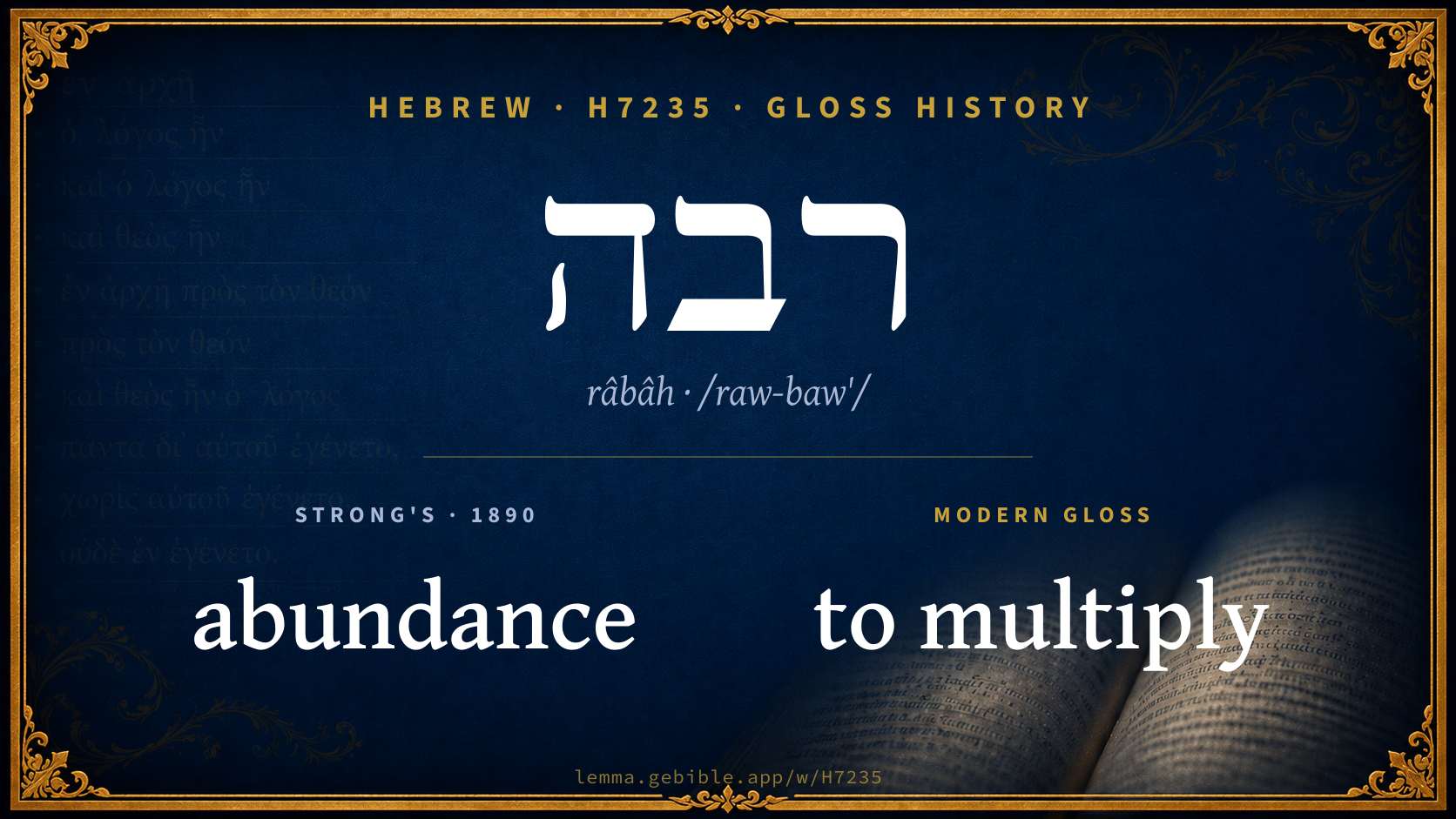
Gloss history
Strong's 1890 vs modern scholarship
About this word
Strong's H7235 catalogs a Hebrew word from the Hebrew Old Testament.
These counts are not copied from any lexicon or concordance. They are computed here, from the morphology-tagged Hebrew Old Testament. What Lemma adds →
- 215
- distinct verses
- The word appears in 215 distinct verses.
- 31 / 39
- OT books
- The word appears in 31 of 39 Old Testament books.
- #200
- by frequency
- Top 250 most frequent Hebrew words (rank 200 of 8,640 Hebrew words by occurrence).
View all 215 occurrences in the concordance →
Most concentrated in
- Genesis 24 verses 11%
- Ezekiel 19 verses 9%
- Deuteronomy 16 verses 7%
By section of the Old Testament
By traditional corpus
Conventional, traditional groupings — biblical authorship is debated, so this is a traditional corpus grouping, not an authorship claim. Each share is this word’s portion of its verses in that division of the Hebrew canon. Each figure is a share of the word’s 215 distinct verses.
- Prophets (Nevi'im) 80 verses · 37%
- Writings (Ketuvim) 78 verses · 36%
- Torah (Pentateuch) 57 verses · 27%
How translations render this word
Counts come from each version’s own published word-to-Strong’s tagging or interlinear alignment — an approximate guide to how each version renders this word, not a word-level alignment the data otherwise carries. Because each total is that version’s own tagged count, the per-version totals vary from one another and need not match the appearance or distinct-verse counts above. These counts may also differ from a printed concordance because Lemma counts each distinctly tagged rendering and does not collapse phrase taggings into a single head-word total. This is a fixed set of word-tagged versions (KJV, ASV, BSB, ULT) and does not change with the reading translation you choose elsewhere. Each version’s license is shown beside its name below (and on Sources).
BDB lists this Strong’s number as 2 distinct words (homographs). Each count above pools all of them and is not split by sense — see the Senses section below. A low-frequency rendering may belong to a different one of those words, not the primary meaning.
- King James Version†: Multiply 23×, Much 20×, Many 13×
- American Standard Version†: Much 20×, Multiply 14×, Many 13×
- Berean Standard Bible†: Multiply 21×, Many 8×, More 8×
- unfoldingWord Literal Text†: Multiply 32×, Much 23×, Many 15×
King James Version Public Domain
Renders H7235 across 227† tagged occurrences — most commonly:
Plus other, less common renderings. Plus 114 renderings that appear only once — usually multi-word phrases or single function words the recovered tagging swept in, not distinct renderings.
American Standard Version Public Domain
Renders H7235 across 224† tagged occurrences — most commonly:
Plus other, less common renderings. Plus 124 renderings that appear only once — usually multi-word phrases or single function words the recovered tagging swept in, not distinct renderings.
Berean Standard Bible Public Domain
Renders H7235 across 219† tagged occurrences — most commonly:
Plus other, less common renderings. Plus 107 renderings that appear only once — usually multi-word phrases or single function words the recovered tagging swept in, not distinct renderings. Not rendered by a distinct English word in 7 further occurrences.
unfoldingWord Literal Text CC BY-SA 4.0
Renders H7235 across 256† tagged occurrences — most commonly:
Plus other, less common renderings. Plus 70 renderings that appear only once — usually multi-word phrases or single function words the recovered tagging swept in, not distinct renderings.
6 senses and sub-senses in the full BDB
Hebrew verbs can shift meaning by stem (binyan): Qal is the basic action, Niphal is often passive or reflexive, Piel often intensifies or makes it factitive, and Hiphil is typically causative. The senses below are grouped under the stem BDB assigns to each.
What do BDB’s symbols mean?
BDB uses these scholarly abbreviations:
| Symbol | Meaning |
|---|---|
| 𝔊 | the Septuagint (the ancient Greek translation, LXX) |
| 𝔙 | the Vulgate (the Latin translation) |
| 𝔖 | the Syriac version (the Peshitta) |
| 𝔗 | the Targum (the Aramaic translation) |
| ψ | the Psalms |
| √ | root (the underlying root or stem) |
| ‖ | parallel passage (a synonymous or contrasted parallel) |
| † | the dagger: every passage where the word occurs is cited |
The 6 senses and sub-senses the full Brown-Driver-Briggs lexicon distinguishes for this word, in lexicon order (not ranked by frequency), with BDB’s own verbatim wording and sub-sense lettering. Shown in Hebrew script with BDB’s own scholarly abbreviations. The condensed entry is in the Lexicon Entry tab. See also the Forms in the corpus table below.
רבה I be, become, much, many, great
Qal
- 1. become many, numerous
- 2.
- a. be great
- b. grow great (Aramaism)
Piel
- . 4 make large, increase
Hiphil
- 1. make much or many
- 2. make great, obj. pers.
רבה II shoot
Senses from the full Brown-Driver-Briggs lexicon (Brown, Driver, Briggs; Oxford 1906 — public domain), digitized via Sefaria, supplemented by the OpenScriptures HebrewLexicon (CC BY 4.0). Full attribution on Sources.
Word origin
I. [ רָבָה ] 225 vb. be, or become, much, many, great
II. [ רָבָה ] vb. shoot;—only Qal Gn 21:20
— Brown-Driver-Briggs (Oxford 1906, public domain), digitized via Sefaria, supplemented by the OpenScriptures HebrewLexicon (CC BY 4.0). See Sources.
Origin: a primitive root
Jastrow Dictionary
A second Hebrew/Aramaic lexicon for comparison, covering Aramaic and post-biblical (Talmudic, Targumic, Midrashic) usage that the biblical-Hebrew BDB does not. Matched by lemma rather than by Strong’s number, so a lemma may carry more than one Jastrow headword (shown separately below), and the entries cover usage well beyond the Bible.
רַבָּה II
- (= רַב אַבָּה) Rabbah, name of several Amoraim, esp. a) R. bar Naḥmani, chief of the college of Pumb’ditha (v. Grætz, Gesch. d. Jud.1 IV, p. 400 sq.) Gitt. 3ᵃ. Hor. 14ᵃ ר׳ עוקר הרים R. uproots mountains (is ingenious, v. הַר). B. Mets. 86ᵃ; a. v. fr.—b) R. Zuṭi (Junior). B. Bath. 120ᵃ. Men. 31ᵇ; a. e.—c) R. bar Ḥanah. Snh. 5ᵃ.—d) R. bar bar Ḥanah, known for his fables. B. Bath. 73ᵇ; a. fr. [Y. Ber. II, 4ᵇ אבא בר בר ח׳.]—e) R. bar Abbuha (Abbahu, v. Fr. M’bo, p. 60ᵃ). Bekh. 34ᵃ. B. Kam. 46ᵇ; a. e.—f) R. bar Matt’nah. Hor. l. c.; a. e.; a. others.
רָבָה
- , v. רבי
רָבֶה
- 1. (= רָוָה) moist, saturated with liquid, opp. עבה thick and pulpy. Y. Pes. X, 37ᵈ top צריכה שתהא ר׳ וכ׳ (not צבריה) it (the חֲרוֹסֶת) must be saturated (with wine), which means that it is to remind of blood.—V. רוֹבֶה II.
- 2. pers. of רָבָה, v. רבי
רַבָּה I
- = רַבָּא
- 1. large, great; senior. בִּדְרַ׳ מיניה, v. קִים.—אַדְּרַ׳, v. אַדְּרַבָּא.—Y. Shebi. VII, end. 37ᶜ ודמיא היא כל ר׳ is this case altogether the same?; Y. Orl. I, 61ᵇ bot. ורמיה היא לכל רביה (corr. acc.).—דְּרַבָּה, v. רוּבָּה II.—Midr. Till. to Ps. XVII (ref. to רב, II Sam. XXIV, 16) ר׳ הוא משכונא גבך ed. Bub. (oth. ed. ר׳ היא משכונתך, corr. acc.) the pledge thou hast taken (with the death of Abishai) is large enough. Ber. 19ᵇ גברא ר׳ אמר וכ׳ a great man (scholar) has said something, laugh not at it; Gitt. 55ᵇ; Nidd. 50ᵇ. Sabb. 59ᵇ גברא ר׳ וכ׳ (some ed. רבא), v. אָרֵיכָא; Keth. 103ᵇ. Yeb. 21ᵇ הא … מגברא ר׳ וכ׳ I have heard this from a great scholar. Ib. אבא ר׳ grandfather. Gen. R. s. 1, beg. ר׳ הושעיה ר׳ R. Ḥ. senior (contrad. to זעירא). Y. Yeb. IV, 6ᵃ ר׳ חייא ר׳ R. Ḥ. senior; a. v. fr.—מדרש ר׳ (pl. רַבּוֹת), v. מִדְרָשׁ. e.g. 2 Samuel 24:16
- 2. teacher. Y. l. c. 6ᵇ top הידינו ר׳ ר׳ דמתניתא ר׳ דאולפנא what teacher do you mean? a teacher of the Mishnah (a Tannai), or a teacher of tradition? Lev. R. s. 22 ואיפשר כן ר׳ שאל וכ׳ can that be? did the teacher ask his pupil? B. Mets. 101ᵃ כגון דא צריכה ר׳ a thing like this requires a teacher (to say it)!; a. fr.—Pl. רַבְוָותָא. Snh. 102ᵇ נפתח בר׳ (Ms. F. ברברבתא) let us open our meeting with (speaking of our) teachers (opp. to חברין).—Fem. רַבְּתָא, q. v.; רַבָּתִי. Yeb. 21ᵇ אימא ר׳ grandmother.—אבל ר׳ (מסכת), v. אֵבֶל.
רַבָּה III
- f., v. רַב I, II.
רבי
- (b. h.) to be much, many; to grow, increase. Yoma 87ᵇ עונותינו רָבוּ וכ׳ our sins are too many to be counted. Gen. R. s. 34 אצא ואהי פרה ורָבֶה וכ׳ I may go out (of the ark) and be multiplying and increasing for curse. Bekh. 44ᵇ דם ר׳ שחין ר׳ if the blood is allowed to increase (if bleeding is neglected), skin disease will develop; מי רגלים רָּבִין וכ׳ if one allows the urine to increase (through neglect) &c. Sabb. 33ᵇ בעון … צרות רָבוֹת וכ׳ for the sin of obscene talk troubles increase, and new evil decrees come &c. Num. R. s. 11, v. פָּרָה II. Gen. R. s. 48 הכתב ר׳ וכ׳, v. כְּתָב. Sot. 47ᵇ משרבו … בדין ר׳ וכ׳ when the whisperers in court (secret influences) increased, the anger (of God) against Israel increased. Snh. 97ᵃ העזות תִּרְבֶּה impudence shall be large. Y. Yeb. IV, 6ᵃ bot., v. אל"ף; a. fr.—Gen. R. s. 98 (play on בן פרת, Gen. XLIX, 22) בן פירות רָבִיתָה ‘a child of fruits’ (through interpreting Pharaoh’s dream about the ears of corn) thou didst grow (to high office); בן פרות רביתה יוסף ‘a child of cows’ (through interpreting the dream about cows) thou didst grow; בן פורת (יוסף) רָבִיתָ יוסף ‘a child of growth’, thou didst grow tall (so as to protect Rachel from Esau’s sight; v. Gen. R. s. 78); Yalk. ib. 133 [read:] בן פורת יוסף פָּרִיתָ רבית יוסף. e.g. Genesis 49:22
- 1. to increase, do much, do more. Gen. R. s. 34 ר׳ בטהורים יותר וכ׳ ordered a larger number of the clean animals to be taken into the ark than of the unclean. Tosef. Dem. IV, 12 ר׳ בעיר ולא ר׳ במדינה if one offers a large quantity for sale, while none is offered in the country. Ib. 13 כל שר׳ לו מותר wherever one has a large quantity for sale, it is permitted (to buy of him); a. fr.—Men. 89ᵃ ר׳ שמן וכ׳, v. רְבִיכָה.
- 2. (hermeneutics) to use an additional word for the purpose of intimating something not otherwise included; to argue from an additional word or from a generalization in the Biblical text; to widen the scope of a law; to include. Ib. אם אתה מְרַבֶּה וכ׳ if thou wert to argue an entire day on the intimation of an increase lying in the words bashshemen (Lev. VI, 14; VII, 12), I should not listen to thee; Zeb. 82ᵃ; Nidd. 72ᵇ. Shebu. 26ᵃ, v. מָעַט. Ib. 27ᵃ מדאצטריך או לְרַבּוֹת וכ׳ as the word אוֹ (Lev. V, 4) is needed for the inclusion of vows for the benefit of others. Pes. 22ᵇ, v. אֵת. Snh. 60ᵇ יכול שאני מְרַבֶּה וכ׳ you might think that I must include &c.; a. v. fr.—[Yalk. Ex. 348 ר׳ כל וכ׳, v. רִיקֵן.]—Gen. R. s. 85 (ref. to Gen. XXXVIII, 29) זה רִבָּה על כל הפריצים ממך יעמודו (not יעמוד) this event implies (the prophecy) that all conquerors shall rise from thee (Perez); Yalk. ib. 145. e.g. Leviticus 6:14
- 3. to lend or borrow on usury (רִבִּית); to make a profit. Sifra B’har, ch. VI, Par. 5; B. Mets. V, 1 (expl. תַּרְבִּית) המְרַבֶּה בפירות he who makes a profit on lending provisions. Tosef. ib. IV, 2 מְרַבִּין על השכר ואין מרבין וכ׳ you may make a profit on renting (lending money to the money-changer merely for exhibition), but you dare not make a profit on a sale (of land as security for a loan). B. Mets. V, 2 מרבין … ואין מרבין וכ׳ you may make a profit by a reduction of rent on account of payment in advance, but you dare not make a profit by increasing the price of an object sold on account of postponed payment; a. e.
- to cause increase; to strengthen; to do much. Ber. 17ᵃ, v. מָעַט. Ab. I, 17 וכל המַרְבֶּה דברים וכ׳ he that talks much brings about sin. Ib. II, 7 מרבה בשר וכ׳ making much flesh (indulging in eating) makes much food for worms; מרבה צדקה וכ׳ he that does much charity, does much for peace. Ber. 40ᵃ מפרין ומרבין, v. פָּרָה II. Ib. 64ᵃ ת"ח מַרְבִּים וכ׳ scholars advance peace in the world; a. fr.—B. Bath. 11ᵇ בני מבוי … שמרבה עליהן את הדרך the neighbors may prevent him, because he increases the use of the way too much for them (causes many people to step upon their ground); Tosef. ib. I, 4; Y. ib. II, 13ᵇ bot. דו יכיל מימר … והן מרבין עלינו וכ׳ he may say to him, they go and come, ask for thee and cannot find thee, and thus they use the way too frequently for us.
- to be increased; with בגדים, to be clothed with the larger number of garments designated for the high priest, v. מְרוּבֶּה. Yoma 5ᵃ נ׳ שבעה if he wore the high priestly garments during the entire week of inauguration; נ׳ יום אחד if he wore them only one day.
A Dictionary of the Targumim, the Talmud Babli and Yerushalmi, and the Midrashic Literature (Marcus Jastrow; London, Luzac, 1903) — Public Domain. Digitized via Sefaria. Digitized via Sefaria. Full attribution on Sources.
Forms in the corpus
The 169 distinct written forms H7235 takes in the Hebrew Bible, most frequent first — each parse links to that stem’s occurrences in the concordance. Hebrew forms include their vowel points and cantillation, so a single lemma takes many written forms.
The 60 most common forms are shown; 109 rarer forms follow in the full concordance.
Same root — word family
Other BDB entries built from the same root as H7235, grouped by Strong’s listed origin. These share a root / origin per the lexicon — not necessarily a shared meaning. Each links to that word’s own entry.
Derived from this word
- ארבה ʼarbeh H697 locust
- מרבה marbeh H4766 abundance
- מרבה mirbâh H4767 much
- מרבית marbîyth H4768 multitude
- רבה rᵉbâh H7236 to grow great
- רבו rᵉbûw H7238 greatness
- תרבות tarbûwth H8635 offspring
- תרבית tarbîyth H8636 interest
Compare all same-root words → Showing 4 of 9 — not the complete family. They share a root, not necessarily a meaning.
Septuagint verse parallels
This word appears in 196 verses that also exist in the Greek Old Testament (Septuagint), out of the 215 Hebrew verses it occurs in. You can read those verses in Greek by switching the Old Testament edition to the Septuagint.
Read these verses in the Septuagint
- Genesis 1:22
- Exodus 1:7
- Leviticus 11:42
- Numbers 26:54
- Deuteronomy 1:10
- Joshua 13:1
- Judges 9:29
- 1 Samuel 1:12
- 2 Samuel 1:4
- 1 Kings 10:10
- 2 Kings 10:18
- 1 Chronicles 4:10
This is a verse-level parallel only — the same verses exist in both the Hebrew and Greek Old Testaments. No word-level Hebrew↔Greek correspondence is claimed: the data carries no such alignment, so no Greek word is shown as this Hebrew word’s translation. Coverage is not total — the Septuagint omits the deuterocanon and renumbers the Psalms, so some Hebrew verses have no direct Greek parallel.