
Exodus 30:15

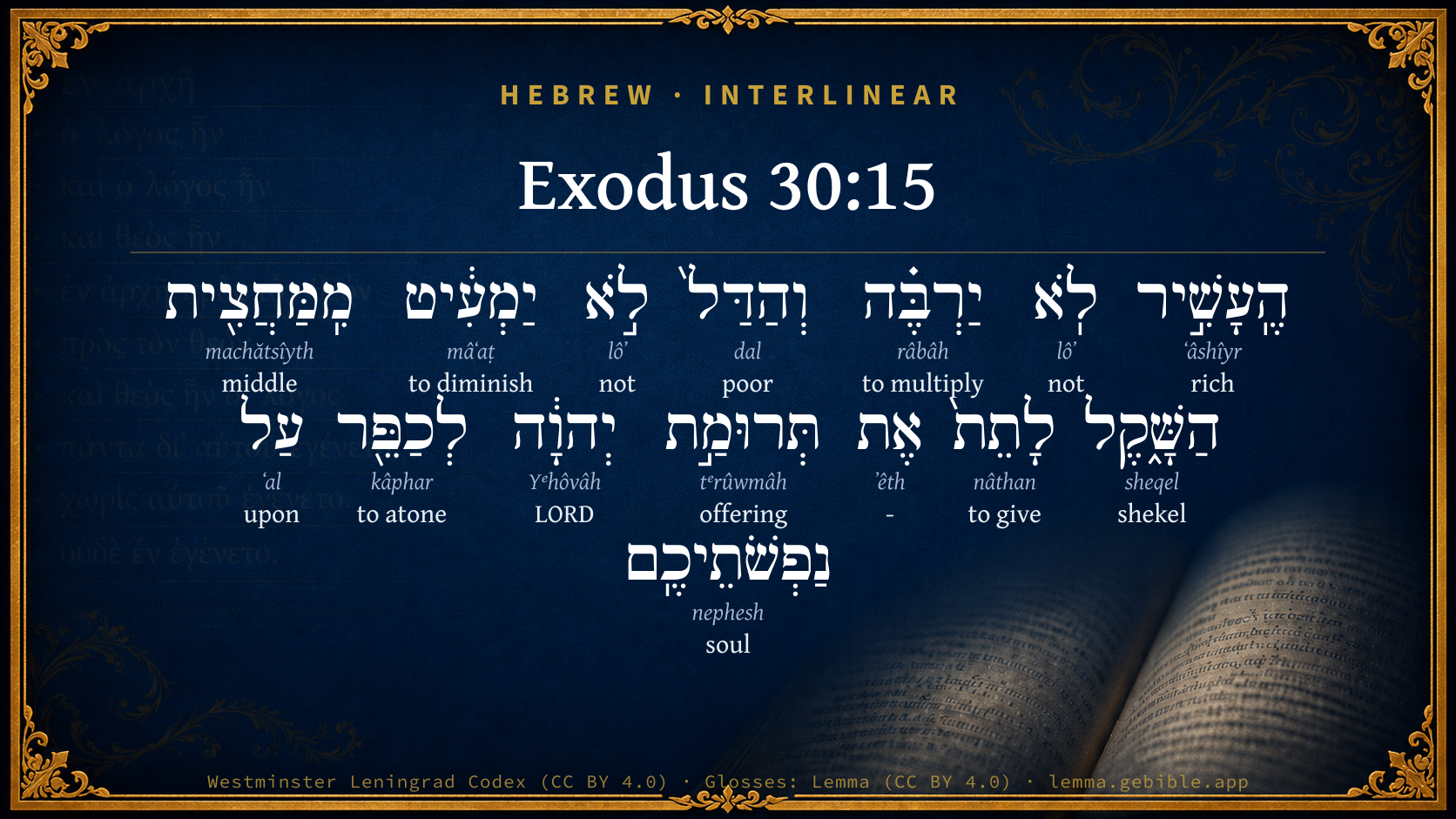
Hebrew (Westminster Leningrad Codex) Exodus 30:15 appears in the Hebrew Old Testament. The text above is from the Westminster Leningrad Codex. Each word links to its Strong’s number, a concise gloss, and parsing drawn from the Open Scriptures Hebrew Bible morphology. Click any word for its full Brown-Driver-Briggs (BDB) entry.
Download image
Cite this verse

Exodus 30:15 (World English Bible). Public Domain. Lemma interlinear Bible study tool, https://lemma.gebible.app/v/exodus/30/15.

Show BibTeX & RIS
BibTeX
RIS
English Translation
The rich shall not give more, and the poor shall not give less, than the half shekel, when they give the offering of Yahweh, to make atonement for your souls.
World English Bible · Public Domain
Highlights
  • 1 first appearance in the Hebrew Bible
Full analysis ↓
Download a study sheet

One document with this verse’s original text, its word-by-word gloss line, the meaning frame, cross-references with their text, attributed commentary, and full source and license credits — printable, and it pastes into notes with its structure intact.

This verse Autodidact and up

Study sheet (.html) Plain text (.txt)

A passage Seminary Student

Up to 50 verses in one chapter. A passage sheet keeps up to 6 commentary sources and 12 cross-references per verse, in the order this page ranks them, and says so on the sheet whenever that leaves anything out. Ask for a single verse and you get the Autodidact verse sheet above.

Everything on this page stays free to read, with no account — the sheet is a download of what is already on screen, not access to it.

Want to remove ads? Support Godless Engineer
Compare translations 3

The same verse in 3 English versions, stacked beneath the original-language interlinear above. Click any original word for its lexicon entry.

Each is an independent rendering of the whole verse — the interlinear is not word-aligned to these translations.

Highlighted words mark where these versions differ — a whole-verse word diff, not a word-by-word alignment.

  • World English Bible Public Domain
    The rich shall not give more, and the poor shall not give less, than the half shekel, when they give the offering of Yahweh, to make atonement for your souls.
  • King James Version Public Domain
    The rich shall not give more, and the poor shall not give less than half a shekel, when they give an offering unto the LORD, to make an atonement for your souls.
  • unfoldingWord Literal Text CC BY-SA 4.0
    The rich shall not increase, and the poor shall not decrease from the half-shekel for giving the contribution of Yahweh to cover over your lives.

unfoldingWord Literal Text — © unfoldingWord, licensed CC BY-SA 4.0. Word-aligned USFM3 via Door43 (git.door43.org/unfoldingWord/en_ult).

Versions to compare (up to 4)

3 of 4 selected

Show all 18 translations

Every available English version of this verse, each an independent rendering of the whole verse.

  • World English Bible Public Domain
    The rich shall not give more, and the poor shall not give less, than the half shekel, when they give the offering of Yahweh, to make atonement for your souls.
  • Berean Standard Bible Public Domain
    In making the offering to the LORD to atone for your lives, the rich shall not give more than a half shekel, nor shall the poor give less.
  • Majority Standard Bible Public Domain
    In making the offering to the LORD to atone for your lives, the rich shall not give more than a half shekel, nor shall the poor give less.
  • King James Version Public Domain
    The rich shall not give more, and the poor shall not give less than half a shekel, when they give an offering unto the LORD, to make an atonement for your souls.
  • American Standard Version (1901) Public Domain
    The rich shall not give more, and the poor shall not give less, than the half shekel, when they give the offering of Jehovah, to make atonement for your souls.
  • Revised Version (1885) Public Domain
    The rich shall not give more, and the poor shall not give less, than the half shekel, when they give the offering of the LORD, to make atonement for your souls.
  • Geneva Bible (1599) Public Domain
    The rich shall not passe, and the poore shall not diminish from halfe a shekel, when ye shall giue an offring vnto the Lord, for the redemption of your liues.
  • Douay-Rheims (1899) Public Domain
    The rich man shall not add to half a sicle, and the poor man shall diminish nothing.
  • Young's Literal Translation Public Domain
    the rich doth not multiply, and the poor doth not diminish from the half-shekel, to give the heave-offering of Jehovah, to make atonement for your souls.
  • Literal Standard Version CC BY-SA 4.0
    the rich do not multiply, and the poor do not diminish from the half-shekel, to give the raised-offering of YHWH, to make atonement for your souls.
  • Unlocked Literal Bible CC BY-SA 4.0
    When the people give this offering to me to make atonement for their lives, the rich must not give more than the half shekel, and the poor must not give less.
  • unfoldingWord Literal Text CC BY-SA 4.0
    The rich shall not increase, and the poor shall not decrease from the half-shekel for giving the contribution of Yahweh to cover over your lives.
  • Darby Bible Public Domain
    The rich shall not give more, and the poor shall not give less than half a shekel, when ye give the heave-offering of Jehovah, to make atonement for your souls.
  • World Messianic Bible Public Domain
    The rich shall not give more, and the poor shall not give less, than the half shekel, when they give the offering of the LORD, to make atonement for your souls.
  • Webster's Bible Public Domain
    The rich shall not give more, and the poor shall not give less than half a shekel, when they give an offering to the LORD to make an atonement for your souls.
  • Free Bible Version CC BY-SA 4.0
    When you give this offering to buy back your lives the rich are not to give more than a half shekel and the poor are not to give less.
  • Bible in Basic English Public Domain
    The man of wealth is to give no more and the poor man no less than the half-shekel of silver, when the offering is made to the Lord as the price for your lives.
  • JPS Tanakh (1917) Public Domain
    The rich shall not give more, and the poor shall not give less, than the half shekel, when they give the offering of the LORD, to make atonement for your souls.

Literal Standard Version (2020), Covenant Press — licensed CC BY-SA 4.0. Text via the HelloAO Bible API (eBible.org). Unlocked Literal Bible (unfoldingWord) — licensed CC BY-SA 4.0. Text via the HelloAO Bible API (eBible.org). unfoldingWord Literal Text — © unfoldingWord, licensed CC BY-SA 4.0. Word-aligned USFM3 via Door43 (git.door43.org/unfoldingWord/en_ult). Free Bible Version, Dr. Jonathan Gallagher — licensed CC BY-SA 4.0. Text via the HelloAO Bible API (eBible.org).

Word by word

More ways to search: Search by grammar → Find every occurrence → Compare this word →

Practice this passage: Drill this verse → Learn its vocabulary →

מִֽמַּחֲצִ֖ית
machătsîyth
H4276
“from · middle of”
Preposition + Noun, Common, Feminine, Singular, Construct
Part of Speech
Preposition + Noun
Type
Common
Gender
Feminine
Number
Singular
State
Construct
Full BDB Definition

Origin: from H2673

TWOT: 719e

half, middle - half - middle, midday, noon
  1. הֶֽעָשִׁ֣יר ʻâshîyr H6223 “the · rich” Particle, Definite Article + Adjective, Adjective, Masculine, Singular, Absolute
  2. לֹֽא lôʼ H3808 “not” Particle, Negative
  3. יַרְבֶּ֗ה râbâh H7235 “to multiply” Verb, Hiphil, Imperfect, 3rd Person, Masculine, Singular
  4. וְהַדַּל֙ dal H1800 “and · the · poor” Conjunction + Particle, Definite Article + Adjective, Adjective, Masculine, Singular, Absolute
  5. לֹ֣א lôʼ H3808 “not” Particle, Negative
  6. יַמְעִ֔יט mâʻaṭ H4591 “to diminish” Verb, Hiphil, Imperfect, 3rd Person, Masculine, Singular
  7. הַשָּׁ֑קֶל sheqel H8255 “the · shekel” Particle, Definite Article + Noun, Common, Masculine, Singular, Absolute
  8. לָתֵת֙ nâthan H5414 “to give” Preposition + Verb, Qal, Infinitive Construct
  9. אֶת ʼêth H853 “-” Particle, Direct Object
  10. תְּרוּמַ֣ת tᵉrûwmâh H8641 “offering of” Noun, Common, Feminine, Singular, Construct
  11. יְהוָ֔ה Yᵉhôvâh H3068 “LORD” Noun, Proper
  12. לְכַפֵּ֖ר kâphar H3722 “to atone” Preposition + Verb, Piel, Infinitive Construct
  13. עַל ʻal H5921 “upon” Preposition
  14. נַפְשֹׁתֵיכֶֽם nephesh H5315 “souls · your” Noun, Common, Both, Plural, Construct + Suffix, Personal, 2nd Person, Masculine, Plural

About this verse

These counts appear in no published source. They are computed here, from the morphology-tagged text and Lemma’s own curated glosses. What Lemma adds →

15
words
14
distinct lemmas
Pentateuch
section

Notable vocabulary

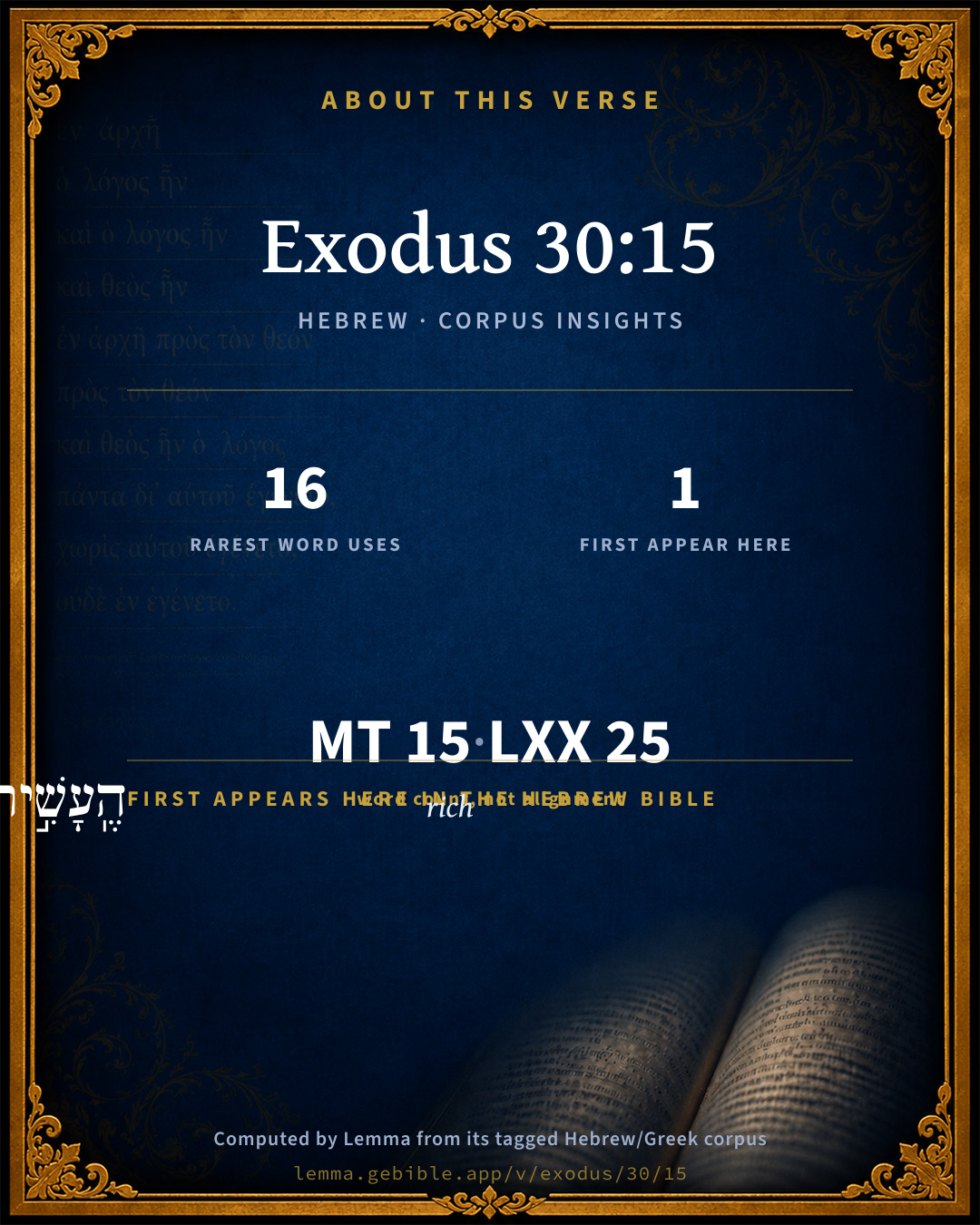
The rarest word here is מִֽמַּחֲצִ֖ית middle H4276 — appearing just 16 times in the whole Hebrew Bible.

First appearance in Scripture

This word makes its first canonical appearance in the Hebrew Bible here:

  • הֶֽעָשִׁ֣יר rich H6223

Shared distinctive vocabulary

מִֽמַּחֲצִ֖ית middle H4276 occurs in 14 verses of the Hebrew Bible. Also found in:

Grammatical profile

  • 4 verbs
  • 5 nouns
  • 2 adjectives
  • 1 preposition
  • 3 particles

Verb forms

  • יַרְבֶּ֗ה Hiphil · Imperfect
  • יַמְעִ֔יט Hiphil · Imperfect
  • לָתֵת֙ Qal · Infinitive Construct
  • לְכַפֵּ֖ר Piel · Infinitive Construct

Repetition

A word recurs within this verse — often emphatic in Hebrew:

Hebrew & Septuagint length

In English translation the verse runs 30 words from the Hebrew and 30 from the Septuagint (LXX English) — the same length.

A rough comparison of the two English renderings, which tokenize alike — not a word-level alignment.

Word counts can differ between the Hebrew and the Greek without any difference in meaning — e.g. the Hebrew direct-object marker אֵת has no separate Greek word, and Greek often adds the article ὁ.

In the original languages it is 15 Hebrew tokens and 25 Greek tokens — but the two are counted differently (Hebrew bundles its prefixes and suffixes into one token; the Greek is in lemma form), so that isn’t a like-for-like length.

Cross-references

8

Topical passages linked to Exodus 30:15 in the Treasury of Scripture Knowledge — connected by theme and wording, ordered by reader-vote popularity; previews shown in the World English Bible.

  • Numbers 31:50 We have brought Yahweh's offering, what every man has gotten, of jewels of gold, ankle-chains, and bracelets, signet-rings, ear-rings, and armlets, to make atonement for our souls before Yahweh.
  • Exodus 30:12 "When you take a census of the children of Israel, according to those who are numbered among them, then each man shall give a ransom for his soul to Yahweh, when you number them; that there be no plague among them when you number them.
  • Leviticus 17:11 For the life of the flesh is in the blood; and I have given it to you on the altar to make atonement for your souls: for it is the blood that makes atonement by reason of the life.
  • Job 34:19 Who doesn't respect the persons of princes, Nor regards the rich more than the poor; For they all are the work of his hands.
  • Ephesians 6:9 You masters, do the same things to them, and give up threatening, knowing that he who is both their Master and yours is in heaven, and there is no partiality with him.
  • 2 Samuel 21:3 and David said to the Gibeonites, What shall I do for you? And with what shall I make atonement, that you may bless the inheritance of Yahweh?
  • Proverbs 22:2 The rich and the poor have this in common: Yahweh is the maker of them all.
  • Colossians 3:25 But he who does wrong will receive again for the wrong that he has done, and there is no partiality.

Cross-references courtesy of OpenBible.info (CC BY 4.0).

Hebrew and Greek witnesses Masoretic Hebrew ↔ Greek Septuagint

The same verse in the two great witnesses to the Old Testament, shown verse-for-verse.

These are two independent witnesses, not word-aligned to each other, and the Septuagint is shown in lemma (dictionary) form.

Hebrew Exodus 30:15 Masoretic · Westminster Leningrad Codex

הֶֽעָשִׁ֣יר לֹֽא יַרְבֶּ֗ה וְהַדַּל֙ לֹ֣א יַמְעִ֔יט מִֽמַּחֲצִ֖ית הַשָּׁ֑קֶל לָתֵת֙ אֶת תְּרוּמַ֣ת יְהוָ֔ה לְכַפֵּ֖ר עַל נַפְשֹׁתֵיכֶֽם

The rich shall not give more, and the poor shall not give less, than the half shekel, when they give the offering of Yahweh, to make atonement for your souls.

World English Bible · Public Domain

Greek LXX Exodus 30:15 Septuagint · lemma form

ὁ πλουτέω οὐ προςτίθημι καί ὁ πένομαι οὐ ἐλαττονέω ἀπό ὁ ἥμισυς ὁ δίδραγμον ἐν ὁ δίδωμι ὁ εἰσφορά κύριος ἐκἱλάσκομαι περί ὁ ψυχή σύ

The rich shall not give more, and the poor shall not give less than the half didrachm in giving the offering to the Lord, to make atonement for your souls.

LXX2012 (modern English Septuagint) · Public Domain

Hebrew: Westminster Leningrad Codex (CC BY 4.0). Greek: Septuagint (public domain); English from LXX2012 (modern English Septuagint) (Public Domain). How the Septuagint differs from the Hebrew →

Targum (Aramaic paraphrase)

2

The Targum is the ancient Jewish Aramaic paraphrase of the Hebrew Scriptures — an interpretive translation, not the Hebrew text itself. Onkelos (literal) and Pseudo-Jonathan (expansive) render the Torah, and Jonathan the Prophets. Coverage is partial: where no permissively-licensed English translation exists for a verse, only the Aramaic is shown. This is verse-level text, not a word-by-word alignment to the Hebrew.

  1. Targum Onkelos Torah (Genesis–Deuteronomy)
    דְעַתִּיר לָא יַסְגֵי וּדְמִסְכֵּן לָא יַזְעֵר מִפַּלְגוּת סִלְעָא לְמִתַּן יָת אַפְרָשׁוּתָא קֳדָם יְיָ לְכַפָּרָא עַל נַפְשָׁתֵיכוֹן:

    (no public-domain English translation for this verse)

    Targum Onkelos — Aramaic: “Onkelos Genesis” (public domain); “Onkelos Exodus” (public domain); “Onkelos Leviticus” (public domain); “Onkelos Numbers” (public domain); “Onkelos Deuteronomy” (public domain). English: “Sefaria Community Translation” (CC0 1.0 (public-domain dedication)); “J.W. Etheridge. The Targums of Onkelos and Jonathan Ben Uzziel on the Pentateuch. London: Longmans, Green, 1862” (public domain). Text via Sefaria.

  2. Targum Pseudo-Jonathan Torah (Genesis–Deuteronomy)
    דְּעַתִּיר לָא יִסְגֵי וּדְמִסְכֵּן לָא יַזְעַר מִפַּלְגוּת סִלְעָא לְמִתַּן יַת אַפְרָשׁוּתָא קֳדָם יְיָ לְכַפָּרָא עַל נַפְשָׁתֵיכוֹן

    He who is rich shall not add to, and he who is poor shall not diminish from, the half shekel in giving the seperation before the Lord, to atone for your souls.

    Targum Pseudo-Jonathan — Aramaic: “Targum Jonathan on Genesis” (public domain); “Targum Jonathan on Exodus” (public domain); “Targum Jonathan on Leviticus” (public domain); “Targum Jonathan on Numbers” (public domain); “Targum Jonathan on Deuteronomy” (public domain). English: “The Targum of Jonathan ben Uzziel, trans. J. W. Etheridge, London, 1862” (public domain). Text via Sefaria.

Commentary

Notes on Exodus 30:15 from classic Christian and Jewish commentators (each source and its license shown beneath its notes). The classic Christian expositions comment on the surrounding passage and are grouped to its opening verse, so a note may address several verses; the Jewish commentaries on the Tanakh (Rashi and others) are per-verse, so they appear only where the commentator wrote on this verse.

Lemma curates 59 commentaries, every one of them public domain or Creative Commons licensed, each selected and text-cleaned for this edition rather than reprinted as found. About our sources →

Trapp's Complete Commentary

John Trapp

Exo 30:15 The rich shall not give more, and the poor shall not give less than half a shekel, when [they] give an offering unto the LORD, to make an atonement for your souls.

Ver. 15. The rich shall not give more.] They are both of a price, because in spirituals they are equal. {2Pe 1:1}

John Trapp, A Commentary or Exposition upon All the Books of the Old and New Testament (1647–1656) — public domain. Text from a community e-Sword module.

MacLaren's Expositions of Holy Scripture

Alexander MacLaren

Exodus

RANSOM FOR SOULS-II.

Exo 30:15.

This tax was exacted on numbering the people. It was a very small amount, about fifteen pence, so it was clearly symbolical in its significance. Notice-

I. The broad principle of equality of all souls in the sight of God. Contrast the reign of caste and class in heathendom with the democracy of Judaism and of Christianity.

II. The universal sinfulness. Payment of the tax was a confession that all were alike in this: not that all were equally sinful, but all were sinful, whatever variations of degree might exist.

‘There is no difference, for all have sinned and come short of the glory of God.’

III. The one ransom. It was a prophecy of which we know the meaning. Recall the incident of the ‘stater’ in the fish’s mouth.

Christ declares His exemption from the tax. Yet He voluntarily comes under it, and He provides the payment of it for Himself and for Peter.

He does so by a miracle.

The Apostle has to ‘take and give it’; so faith is called into exercise.

Thus there is but one Sacrifice for all; and the poorest can exercise faith and the richest can do no more. ‘None other name.’

Alexander MacLaren, Expositions of Holy Scripture (1904–1910) — public domain. Text from a community e-Sword module.

Geneva Bible (1599)

Geneva Bible translators

That God should be merciful unto you.

Geneva Bible (1599) marginal notes — public domain. Text via Bolls.life.

Ellicott's Commentary for English Readers

(15) The rich shall not give more, and the poor shall not give less.—See Note 2 on Exo_30:12.

A Bible Commentary for English Readers, edited by Charles John Ellicott (1878–1897) — public domain. Text from a community e-Sword module.

The Cambridge Bible for Schools and Colleges

gen. ed. J. J. S. Perowne

15. Rich and poor are to contribute alike, for both stand in the same relation towards Jehovah.

The Cambridge Bible for Schools and Colleges (gen. ed. J. J. S. Perowne; Cambridge University Press, 1878–1918) — public domain. Text from a community e-Sword module.

John Gill's Exposition

The rich shall not give more, and the poor shall not give less than half a shekel,.... Which shows that the Israelites were alike in the esteem of God, their worldly circumstances making no difference; their souls being alike, the same ransom price was given for them; and that they were all to have an equal share in the service and sanctuary of God, and the price was set so low, that the poorest man might be able to pay it: and even Maimonides (y) says, if he lived on alms, he was to beg it of others, or sell his clothes from off his back to pay it. This shows the equality of the redeemed and ransomed of the Lord; for though some sins and sinners are greater than others, and some are redeemed from more sins than others, yet all sins being infinite, as committed against an infinite God, but one price is paid for all, and that is the precious blood of Christ, the Son of God, an infinite and divine Person; hence all the ransomed ones have the same faith, righteousness, salvation, and eternal life:

when they give an offering unto the Lord, to make atonement for your souls; which have sinned, are liable to death for it, are the more excellent part of men, and require a great price for the redemption and ransom of them; and hence it is so great a blessing to be ransomed, because it is the ransom of the soul: and such is the efficacy of Christ's ransom, that it is a full atonement for the souls of men, and their sins, and completely delivers from sin, Satan, the law, death, and hell.

(y) Hilchot Shekalim, c. 1. sect. 1.

John Gill's Exposition of the Whole Bible (1746–1763) — public domain (CC PDM 1.0). Text via the HelloAO Bible API.

Haydock's Catholic Bible Commentary

Rich. The life of every man is equal in the sight of God, and He will not give the rich occasion to despise his poor neighbour. Thus also the number of people would be ascertained. (Menochius)

George Leo Haydock (1774–1849), Haydock's Catholic Family Bible and Commentary, 1859 edition — public domain. Excludes Psalms (Douay-Rheims chapter numbering differs from Protestant) and Deuterocanonical books (Catholic canon only).

Matthew Poole's English Annotations

This was partly to teach them that all souls are of equal worth in themselves and price with God; that there is no respect of persons with God, and in God’s worship and service, but gospel graces, ordinances, and privileges are common and equal to all, Exo 12; 16:18; Gal 3:28; Col 3:11; that all persons are alike obnoxious to Divine justice, and are redeemed by one and the same price: partly to check the arrogance and vanity of the rich, who are very apt to despise the poor; and partly that by this means the number of the people might be exactly known when occasion required it.

Matthew Poole's English Annotations on the Holy Bible (1683–1685) — public domain. Text from a community e-Sword/MySword module.

Whedon's Commentary on the Bible

Daniel D. Whedon

15. The rich shall not give more — This apportioning the same amount to rich and poor showed that in the meeting of Jehovah at the sanctuary all stood upon the same level. It is well to have some forms of offering which will impress this lesson. In making an atonement for souls the rich have no advantage over the poor.

Daniel D. Whedon (gen. ed.), Commentary on the Old and New Testaments (1874–1909) — public domain. Text from a community e-Sword module.

The Pulpit Commentary

The rich shall not give more, and the poor shall not give less. This is very emphatic testimony to the equal value of souls in God"s sight. The payment was "the ransom of a soul" (ver. 12) an acknowledgment of God"s mercy in sparing those whose life was justly forfeit. As each soul that he has created is equally precious in his sight, and as he designs equally the salvation of all it was fitting that the same exact sum should be paid in every case.

The Pulpit Commentary (1880–1919), ed. H.D.M. Spence-Jones & Joseph S. Exell — public domain. Text from a community e-Sword module.

unfoldingWord translationNotes

Door43 World Missions Community

General Information:

Yahweh continues to tell Moses what the people must do.

the people

Only the men made this offering.

the half shekel

Translators may use a unit of measure that people understand and a round number: "the 5.5 grams of silver" or "the 6 grams of silver." See how you translated this in Exodus 3:13. (See: Biblical Money and Biblical Weight and Fractions)

It must be a reminder to the Israelites before me, to make atonement for your lives

Possible meanings are 1) "It will remind the Israelites to make atonement for their lives" or 2) "It will remind the Israelites that they have made atonement for their lives."

translationWords

sacrifice

atonement

receive

Israel

tent of meeting

sign

unfoldingWord translationNotes — © Distant Shores Media and the Door43 World Missions Community, licensed CC BY-SA 4.0. Source: git.door43.org/Door43/en_tn.

Rashi

Rabbi Shlomo Yitzchaki (Rashi)

לכפר על נפשתיכם TO MAKE AN EXPIATION FOR YOUR SOULS — in order that you may not be liable to the plague in consequence of the census. Another explanation of לכפר על נפשתיכם is that it was really an atonement for their sins: because Scripture alludes here to three different heave offerings since it uses the expression תרומת ה׳ three times (twice in vv. 14 and 15, ‘תרומת ה, and once in vers 13, ‘תרומה לה). One mention is an allusion to the heave offering that was to be used for the making of the sockets, for he (Moses) counted them when they began to contribute towards the building of the Tabernacle, when each gave half a shekel, the total amounting to a hundred talents, as it is said, (Exodus 38:25) “and the silver of them that were numbered of the congregation was an hundred talents”, and of these the sockets were made, as it is stated, (Exodus 38:27) “And of the hundred talents of silver [were cast the sockets of the Sanctuary etc.]”. The second heave offering was also levied by way of census, for he numbered them again after the Tabernacle was erected; that is the census referred to in the beginning of the Book of Numbers: (Numbers 1:1) “[And the Lord spake unto Moses] … on the first day of the second month in the second year … [Take ye the sum of all the congregation of the children of Israel]”, and on that occasion, too, each of them gave half a shekel. These were employed in purchasing the communal sacrifices for each year. Rich and poor were made alike in regard to these half shekels; and it is with reference to this heave offering that Scripture uses here the expression לכפר על נפשתיכם, “to make expiation for your souls”, for sacrifices were brought in order to make atonement. The third heave offering was that offered for the building of the Tabernacle, as it is said, (Exodus 35:24) “Every one that did offer an offering of silver and brass…”. In this heave offering, however, they did not all participate alike, but each one brought whatever his heart prompted him to give (Talmud Yerushalmi Shekalim 1:1; cf. Rashi on Exodus 25:1).

Rashi on the Tanakh — English translations: “The Judaica Press complete Tanach with Rashi, translated by A. J. Rosenberg” (CC BY 4.0); “Pentateuch with Rashi's commentary by M. Rosenbaum and A.M. Silbermann, 1929-1934” (public domain); “The Metsudah Tanach series, Lakewood, N.J” (CC BY 4.0); and “The Book of Joshua, Metsudah Publications, 1997” (CC BY 4.0). Text via Sefaria.

Ramban (Nachmanides)

Rabbi Moshe ben Nachman (Ramban / Nachmanides)

THE RICH SHALL NOT GIVE MORE, AND THE POOR SHALL NOT GIVE LESS. The meaning of this is that they should all bring the specified amount of money in equality. It would appear from this verse that if the poor man gave as his shekel-dues less than the half-shekel [prescribed by the Torah], he transgresses this negative commandment, since this verse constitutes a prohibition. For even if we were to say that the phrase the rich shall not give more constitutes a mere negation, Note 71. meaning that it is enough for him to give the half-shekel, we could not so interpret and the poor shall not give less. If so, they must both be prohibitions: thus if the individual rich man gave more, or the poor man gave less, he transgressed this negative commandment. Perhaps the reason why the Temple — officers used to take up the shekel-dues in baskets [out of the shekel-chamber], with the intention also to cover the shekels lost and those still to be collected, was to rectify this matter, for if the poor gave less, the balance was destined to be collected from him, but as for the rich who gave more, the Temple-officers would not “take up” his surplus, for they would not take possession of these surpluses [on anyone’s behalf]. However, I have noticed that neither the author of the Hilchoth Gedoloth nor all other scholars who counted the commandments [including the Rambam in his Sefer Hamitzvoth], have mentioned this as one of the negative commandments.

Ramban (Nachmanides) on the Tanakh — English translation: “Commentary on the Torah by Ramban (Nachmanides). Translated and annotated by Charles B. Chavel. New York, Shilo Pub. House, 1971-1976” (CC BY 4.0). Text via Sefaria.

Lesson kit

Teaching starters — assembled from the data on this page, not authored interpretation. Every prompt links to the verse data it draws on. Edit before teaching.

Exodus, in the Pentateuch, opens this verse with 15 words (14 distinct Hebrew lemmas). Its most distinctive word is machătsîyth (“middle”). A historical commentator’s framing appears above. Read the whole chapter for the surrounding context.

Discussion questions

  1. How does “middle” (machătsîyth) shape what this verse is saying?
  2. This is the first place “rich” appears in Scripture (first appears here). What does its debut here establish?
  3. How does Exodus 30:13, which shares the word «middle», read alongside this verse?
  4. What does the repetition of “not” (2× in this one verse) do in this verse?
  5. These translations render this verse differently; the difference is in the English rendering, not the original. What questions does that raise?
  6. «יַרְבֶּ֗ה» is a Hiphil Imperfect verb. How does that grammatical form shape the action described?
  7. Compare how Trapp's Complete Commentary and MacLaren's Expositions of Holy Scripture read this verse. Where do they agree or differ?

Things to notice

Reading settings

Reading text

Shown beneath each verse's original-language words.

Old Testament
Old Testament edition

Read the OT as the Masoretic Hebrew (MT) or the Greek Septuagint (LXX).

English shown for the Greek Septuagint (in the Hebrew ↔ Greek comparison).

Comparing translations? Open the Compare panel on any verse page to stack up to four side by side.