
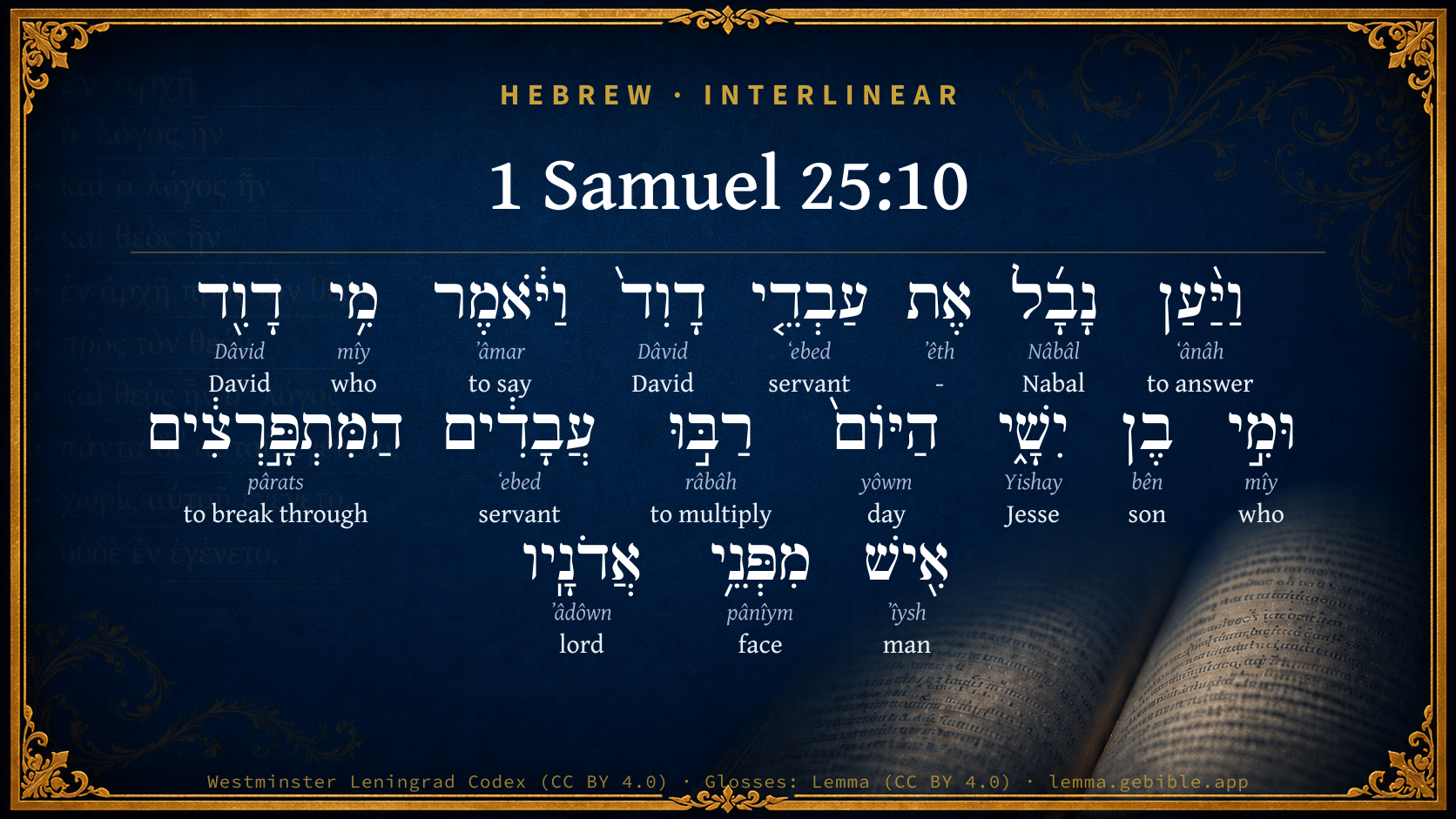
1 Samuel 25:10

Hebrew (Westminster Leningrad Codex) 1 Samuel 25:10 appears in the Hebrew Old Testament. The text above is from the Westminster Leningrad Codex. Each word links to its Strong’s number, a concise gloss, and parsing drawn from the Open Scriptures Hebrew Bible morphology. Click any word for its full Brown-Driver-Briggs (BDB) entry.
Download image
Cite this verse

1 Samuel 25:10 (World English Bible). Public Domain. Lemma interlinear Bible study tool, https://lemma.gebible.app/v/1-samuel/25/10.

Show BibTeX & RIS
BibTeX
RIS
English Translation
Nabal answered David's servants, and said, Who is David? and who is the son of Jesse? there are many servants now-a-days who break away every man from his master.
World English Bible · Public Domain
Download a study sheet

One document with this verse’s original text, its word-by-word gloss line, the meaning frame, cross-references with their text, attributed commentary, and full source and license credits — printable, and it pastes into notes with its structure intact.

This verse Autodidact and up

Study sheet (.html) Plain text (.txt)

A passage Seminary Student

Up to 50 verses in one chapter. A passage sheet keeps up to 6 commentary sources and 12 cross-references per verse, in the order this page ranks them, and says so on the sheet whenever that leaves anything out. Ask for a single verse and you get the Autodidact verse sheet above.

Everything on this page stays free to read, with no account — the sheet is a download of what is already on screen, not access to it.

Want to remove ads? Support Godless Engineer
Compare translations 3

The same verse in 3 English versions, stacked beneath the original-language interlinear above. Click any original word for its lexicon entry.

Each is an independent rendering of the whole verse — the interlinear is not word-aligned to these translations.

Highlighted words mark where these versions differ — a whole-verse word diff, not a word-by-word alignment.

  • World English Bible Public Domain
    Nabal answered David's servants, and said, Who is David? and who is the son of Jesse? there are many servants now-a-days who break away every man from his master.
  • King James Version Public Domain
    And Nabal answered David's servants, and said, Who is David? and who is the son of Jesse? there be many servants now a days that break away every man from his master.
  • unfoldingWord Literal Text CC BY-SA 4.0
    And Nabal answered the servants of David and said, “Who David? And who the son of Jesse? Today servants are many are breaking themselves away, a man from the face of his master.

unfoldingWord Literal Text — © unfoldingWord, licensed CC BY-SA 4.0. Word-aligned USFM3 via Door43 (git.door43.org/unfoldingWord/en_ult).

Versions to compare (up to 4)

3 of 4 selected

Show all 18 translations

Every available English version of this verse, each an independent rendering of the whole verse.

  • World English Bible Public Domain
    Nabal answered David's servants, and said, Who is David? and who is the son of Jesse? there are many servants now-a-days who break away every man from his master.
  • Berean Standard Bible Public Domain
    But Nabal asked them, “Who is David? Who is this son of Jesse? Many servants these days are breaking away from their masters.
  • Majority Standard Bible Public Domain
    But Nabal asked them, “Who is David? Who is this son of Jesse? Many servants these days are breaking away from their masters.
  • King James Version Public Domain
    And Nabal answered David's servants, and said, Who is David? and who is the son of Jesse? there be many servants now a days that break away every man from his master.
  • American Standard Version (1901) Public Domain
    And Nabal answered David's servants, and said, Who is David? and who is the son of Jesse? there are many servants now-a-days that break away every man from his master.
  • Revised Version (1885) Public Domain
    And Nabal answered David’s servants, and said, Who is David? and who is the son of Jesse? there be many servants now a days that break away every man from his master.
  • Geneva Bible (1599) Public Domain
    Then Nabal answered Dauids seruantes, and sayd, Who is Dauid? and who is the sonne of Ishai? there be many seruantes nowe a dayes, that breake away euery man from his master.
  • Douay-Rheims (1899) Public Domain
    But Nabal answering the servants of David, said: Who is David? and what is the son of Isai? servants are multiplied now a days who flee from their masters.
  • Young's Literal Translation Public Domain
    And Nabal answereth the servants of David and saith, `Who `is' David, and who the son of Jesse? to-day have servants been multiplied who are breaking away each from his master;
  • Literal Standard Version CC BY-SA 4.0
    And Nabal answers the servants of David and says, “Who [is] David, and who [is] the son of Jesse? Have servants been multiplied today who are each breaking away from his master?
  • Unlocked Literal Bible CC BY-SA 4.0
    Nabal answered David's servants, “Who is David, and who is the son of Jesse? There are many servants these days who are breaking away from their masters.
  • unfoldingWord Literal Text CC BY-SA 4.0
    And Nabal answered the servants of David and said, “Who David? And who the son of Jesse? Today servants are many are breaking themselves away, a man from the face of his master.
  • Darby Bible Public Domain
    And Nabal answered David's servants and said, Who is David? and who is the son of Jesse? there are many servants now-a-days that break away every man from his master.
  • World Messianic Bible Public Domain
    Nabal answered David’s servants and said, “Who is David? Who is the son of Jesse? There are many servants who break away from their masters these days.
  • Webster's Bible Public Domain
    And Nabal answered David's servants, and said, Who is David? and who is the son of Jesse? there are many servants in these days that break away every man from his master.
  • Free Bible Version CC BY-SA 4.0
    “Who does this ‘David, son of Jesse’ think he is?” Nabal replied. “Nowadays there are many servants on the run from their masters!
  • Bible in Basic English Public Domain
    And Nabal gave them his answer and said, Who is David? who is the son of Jesse? there are a number of servants in these days running away from their masters.
  • JPS Tanakh (1917) Public Domain
    And Nabal answered David's servants, and said: 'Who is David? and who is the son of Jesse? there are many servants now-a-days that break away every man from his master;

Literal Standard Version (2020), Covenant Press — licensed CC BY-SA 4.0. Text via the HelloAO Bible API (eBible.org). Unlocked Literal Bible (unfoldingWord) — licensed CC BY-SA 4.0. Text via the HelloAO Bible API (eBible.org). unfoldingWord Literal Text — © unfoldingWord, licensed CC BY-SA 4.0. Word-aligned USFM3 via Door43 (git.door43.org/unfoldingWord/en_ult). Free Bible Version, Dr. Jonathan Gallagher — licensed CC BY-SA 4.0. Text via the HelloAO Bible API (eBible.org).

Word by word

More ways to search: Search by grammar → Find every occurrence → Compare this word →

Practice this passage: Drill this verse → Learn its vocabulary →

נָבָ֜ל
Nâbâl
H5037
“Nabal”
Noun, Proper
Part of Speech
Noun
Type
Proper
Full BDB Definition

Origin: the same as H5036

TWOT: None

Nabhal or Nabal = "fool" - a man of Carmel who spurned David's messengers, then died of shock when he realised it might cause his death; his case was pleaded by his wife Abigail who became David's wife after his death
  1. וַיַּ֨עַן ʻânâh H6030 “and · to answer” Conjunction + Verb, Qal, Sequential Imperfect, 3rd Person, Masculine, Singular
  2. אֶת ʼêth H853 “-” Particle, Direct Object
  3. עַבְדֵ֤י ʻebed H5650 “servants of” Noun, Common, Masculine, Plural, Construct
  4. דָוִד֙ Dâvid H1732 “David” Noun, Proper
  5. וַיֹּ֔אמֶר ʼâmar H559 “and · to say” Conjunction + Verb, Qal, Sequential Imperfect, 3rd Person, Masculine, Singular
  6. מִ֥י mîy H4310 “who” Particle, Interrogative
  7. דָוִ֖ד Dâvid H1732 “David” Noun, Proper
  8. וּמִ֣י mîy H4310 “and · who” Conjunction + Particle, Interrogative
  9. בֶן bên H1121 “son of” Noun, Common, Masculine, Singular, Construct
  10. יִשָׁ֑י Yishay H3448 “Jesse” Noun, Proper
  11. הַיּוֹם֙ yôwm H3117 “the · day” Particle, Definite Article + Noun, Common, Masculine, Singular, Absolute
  12. רַבּ֣וּ râbâh H7235 “to multiply” Verb, Qal, Perfect, 3rd Person, Common, Plural
  13. עֲבָדִ֔ים ʻebed H5650 “servants” Noun, Common, Masculine, Plural, Absolute
  14. הַמִּתְפָּ֣רְצִ֔ים pârats H6555 “the · breaking through” Particle, Definite Article + Verb, Hithpael, Participle Active, Masculine, Plural, Absolute
  15. אִ֖ישׁ ʼîysh H376 “man” Noun, Common, Masculine, Singular, Absolute
  16. מִפְּנֵ֥י pânîym H6440 “from · face(s) of” Preposition + Noun, Common, Both, Plural, Construct
  17. אֲדֹנָֽיו ʼâdôwn H113 “lords · his” Noun, Common, Masculine, Plural, Construct + Suffix, Personal, 3rd Person, Masculine, Singular

About this verse

These counts appear in no published source. They are computed here, from the morphology-tagged text and Lemma’s own curated glosses. What Lemma adds →

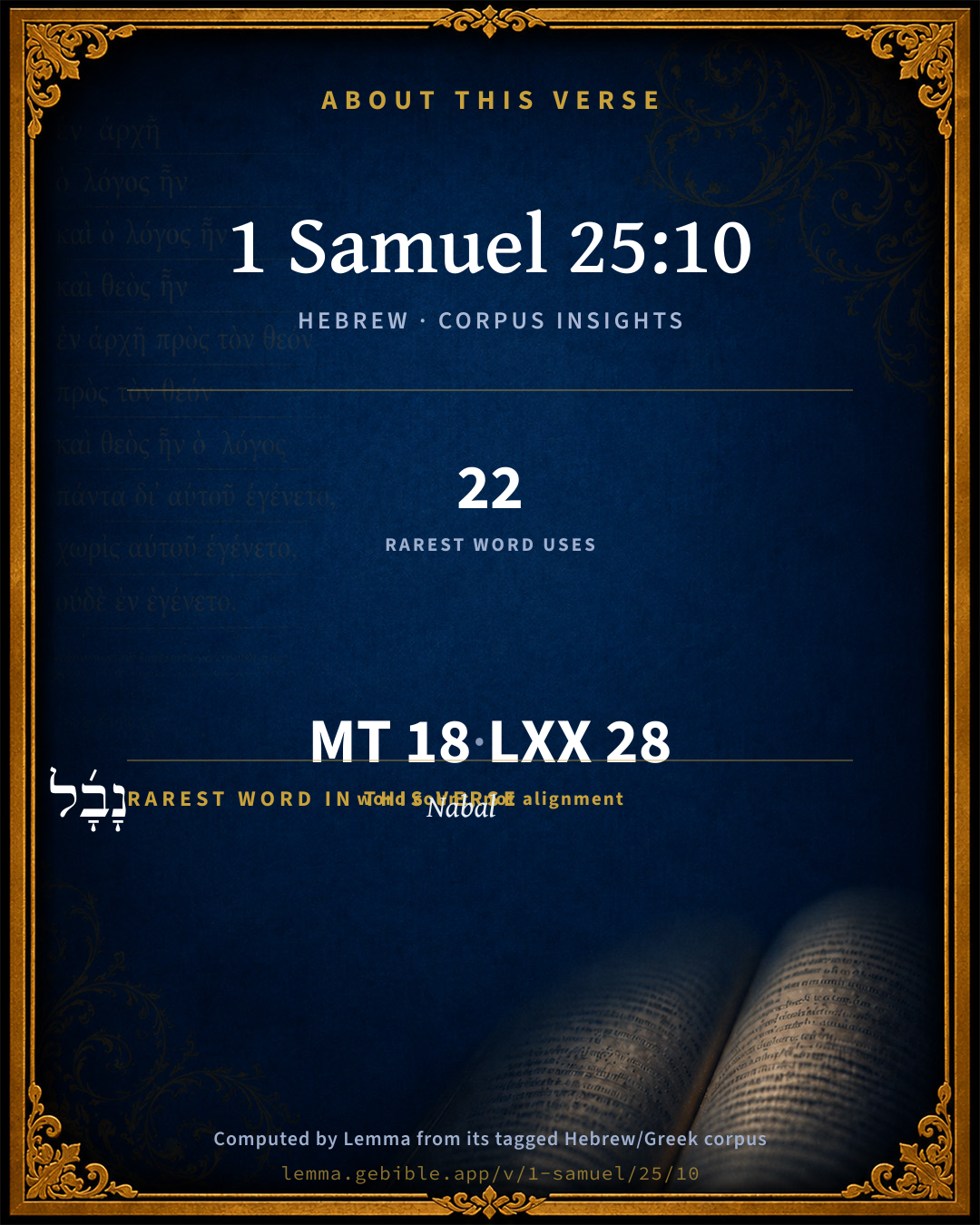
18
words
15
distinct lemmas
Historical
section

Notable vocabulary

The rarest word here is נָבָ֜ל Nabal H5037 — appearing just 22 times in the whole Hebrew Bible.

Shared distinctive vocabulary

נָבָ֜ל Nabal H5037 occurs in 18 verses of the Hebrew Bible. Also found in:

Grammatical profile

  • 4 verbs
  • 11 nouns
  • 3 particles

Verb forms

  • וַיַּ֨עַן Qal · Sequential Imperfect
  • וַיֹּ֔אמֶר Qal · Sequential Imperfect
  • רַבּ֣וּ Qal · Perfect
  • הַמִּתְפָּ֣רְצִ֔ים Hithpael · Participle Active

Repetition

Words recur within this verse — often emphatic in Hebrew:

  • עַבְדֵ֤י servant H5650 ×2
  • דָוִד֙ David H1732 ×2
  • מִ֥י who H4310 ×2

Hebrew & Septuagint length

In English translation the verse runs 29 words from the Hebrew and 35 from the Septuagint (LXX English) — closely comparable.

A rough comparison of the two English renderings, which tokenize alike — not a word-level alignment.

Word counts can differ between the Hebrew and the Greek without any difference in meaning — e.g. the Hebrew direct-object marker אֵת has no separate Greek word, and Greek often adds the article ὁ.

In the original languages it is 18 Hebrew tokens and 28 Greek tokens — but the two are counted differently (Hebrew bundles its prefixes and suffixes into one token; the Greek is in lemma form), so that isn’t a like-for-like length.

Cross-references

12

Topical passages linked to 1 Samuel 25:10 in the Treasury of Scripture Knowledge — connected by theme and wording, ordered by reader-vote popularity; previews shown in the World English Bible.

  • Judges 9:28 Gaal the son of Ebed said, Who is Abimelech, and who is Shechem, that we should serve him? Isn't he the son of Jerubbaal? and Zebul his officer? serve you the men of Hamor the father of Shechem: but why should we serve him?
  • Exodus 5:2 Pharaoh said, "Who is Yahweh, that I should listen to his voice to let Israel go? I don't know Yahweh, and moreover I will not let Israel go."
  • 1 Samuel 20:30 Then Saul's anger was kindled against Jonathan, and he said to him, You son of a perverse rebellious woman, don't I know that you have chosen the son of Jesse to your own shame, and to the shame of your mother's nakedness?
  • 1 Samuel 22:2 Everyone who was in distress, and everyone who was in debt, and everyone who was discontented, gathered themselves to him; and he became captain over them: and there were with him about four hundred men.
  • 1 Samuel 22:7–8 Saul said to his servants who stood about him, Hear now, you Benjamites; will the son of Jesse give everyone of you fields and vineyards, will he make you all captains of thousands and captains of hundreds,
  • 2 Samuel 20:1 There happened to be there a base fellow, whose name was Sheba, the son of Bichri, a Benjamite: and he blew the trumpet, and said, We have no portion in David, neither have we inheritance in the son of Jesse: every man to his tents, Israel.
  • 1 Kings 12:16 When all Israel saw that the king didn't listen to them, the people answered the king, saying, What portion have we in David? neither have we inheritance in the son of Jesse: to your tents, Israel: now see to your own house, David. So Israel departed to their tents.
  • Psalms 73:7–8 Their eyes bulge with fat. Their minds pass the limits of conceit.
  • Psalms 123:3–4 Have mercy on us, Yahweh, have mercy on us, For we have endured much contempt.
  • Ecclesiastes 7:10 Don't say, "Why were the former days better than these?" For you do not ask wisely about this.
  • Isaiah 32:5 The fool shall be no more called noble, nor the scoundrel be highly respected.
  • Isaiah 32:7 The instruments of the churl are evil: he devises wicked devices to destroy the humble with lying words, even when the needy speaks right.

Cross-references courtesy of OpenBible.info (CC BY 4.0).

Hebrew and Greek witnesses Masoretic Hebrew ↔ Greek Septuagint

The same verse in the two great witnesses to the Old Testament, shown verse-for-verse.

These are two independent witnesses, not word-aligned to each other, and the Septuagint is shown in lemma (dictionary) form.

Hebrew 1 Samuel 25:10 Masoretic · Westminster Leningrad Codex

וַיַּ֨עַן נָבָ֜ל אֶת עַבְדֵ֤י דָוִד֙ וַיֹּ֔אמֶר מִ֥י דָוִ֖ד וּמִ֣י בֶן יִשָׁ֑י הַיּוֹם֙ רַבּ֣וּ עֲבָדִ֔ים הַמִּתְפָּ֣רְצִ֔ים אִ֖ישׁ מִפְּנֵ֥י אֲדֹנָֽיו

Nabal answered David's servants, and said, Who is David? and who is the son of Jesse? there are many servants now-a-days who break away every man from his master.

World English Bible · Public Domain

Greek LXX 1 Samuel 25:10 Septuagint · lemma form

καί ἀποκρίνω ναβαλ ὁ παῖς δαυίδ καί εἶπον τίς ὁ δαυίδ καί τίς ὁ υἱός ιεσσαι σήμερον πληθύνω εἰμί ὁ δοῦλος ἀναχωρέω ἕκαστος ἐκ πρόσωπον ὁ κύριος αὐτός

And Nabal sprang up, and answered the servants of David, and said, Who is David? and who is the son of Jessae? Now-a-days there is abundance of servants who depart every one from his master.

LXX2012 (modern English Septuagint) · Public Domain

Hebrew: Westminster Leningrad Codex (CC BY 4.0). Greek: Septuagint (public domain); English from LXX2012 (modern English Septuagint) (Public Domain). How the Septuagint differs from the Hebrew →

Targum (Aramaic paraphrase)

1

The Targum is the ancient Jewish Aramaic paraphrase of the Hebrew Scriptures — an interpretive translation, not the Hebrew text itself. Onkelos (literal) and Pseudo-Jonathan (expansive) render the Torah, and Jonathan the Prophets. Coverage is partial: where no permissively-licensed English translation exists for a verse, only the Aramaic is shown. This is verse-level text, not a word-by-word alignment to the Hebrew.

  1. Targum Jonathan Prophets (Joshua–Malachi)
    וַאֲתֵיב נָבָל יַת עַבְדֵי דָוִד וַאֲמַר מַן דָוִד וּמַן בַּר יִשַׁי יוֹמָא דֵין דְסַגִיאִין עַבְדַיָא דְעָרְקִין וּדְמִטַמְרִין גְבַר מִן קֳדָם רִבּוֹנֵיהּ:

    (no public-domain English translation for this verse)

    Targum Jonathan — Aramaic: “Mikraot Gedolot” (public domain). English: “Sefaria Community Translation” (CC0 1.0 (public-domain dedication)); “London "Chaldee Paraphrase," 1871” (public domain). Text via Sefaria.

Commentary

Notes on 1 Samuel 25:10 from classic Christian and Jewish commentators (each source and its license shown beneath its notes). The classic Christian expositions comment on the surrounding passage and are grouped to its opening verse, so a note may address several verses; the Jewish commentaries on the Tanakh (Rashi and others) are per-verse, so they appear only where the commentator wrote on this verse.

Lemma curates 59 commentaries, every one of them public domain or Creative Commons licensed, each selected and text-cleaned for this edition rather than reprinted as found. About our sources →

Jamieson, Fausset & Brown

Robert Jamieson, A. R. Fausset & David Brown

THE CHURLISH ANSWER PROVOKES HIM. (Sa1 25:10-13)

Nabal answered David's servants, . . . Who is David? &c.--Nabal's answer seems to indicate that the country was at the time in a loose and disorderly state. David's own good conduct, however, as well as the important services rendered by him and his men, were readily attested by Nabal's servants. The preparations of David to chastise his insolent language and ungrateful requital are exactly what would be done in the present day by Arab chiefs, who protect the cattle of the large and wealthy sheep masters from the attacks of the marauding border tribes or wild beasts. Their protection creates a claim for some kind of tribute, in the shape of supplies of food and necessaries, which is usually given with great good will and gratitude; but when withheld, is enforced as a right. Nabal's refusal, therefore, was a violation of the established usages of the place.

Jamieson, Fausset & Brown — Commentary Critical and Explanatory on the Whole Bible (1871) — public domain (CC PDM 1.0). Text via the HelloAO Bible API.

Trapp's Complete Commentary

John Trapp

1Sa 25:10 And Nabal answered David’s servants, and said, Who [is] David? and who [is] the son of Jesse? there be many servants now a days that break away every man from his master.

Ver. 10. Who is David?] q.d., I know him not: and yet all Israel knew and honoured David as their deliverer. But this unworthy Pamphagus, to save his victuals, will either make him a man of no merits, or ill; either an obscure man, or a fugitive: and yet he was of his own tribe: but one had as good deal with a cannibal, as with a truly covetous captive.

That break away every man from his master.] As dammed rivers break the banks; or as refractory cattle break their bands, and run away from their owners. Here he maketh no better of David and his men than rogues and runaways. But David was now poor, and himself rich, therefore he thought he might say or do anything. David asked him bread; he gave him a stone.

“ Stultitiam patiuntur opes. ”

John Trapp, A Commentary or Exposition upon All the Books of the Old and New Testament (1647–1656) — public domain. Text from a community e-Sword module.

Joseph Benson's Commentary

1Sa 25:10. Who is David? — There be many servants, &c. — He reproaches them all as a company of fugitives and vagabonds; and, in effect, taxes David with infidelity to his master Saul; a most rude and brutish answer to such a civil message and humble request.

Joseph Benson's Commentary on the Old and New Testaments (1811–1818) — public domain. Text from a community e-Sword module.

Tyndale Open Study Notes

Tyndale Open Resources

25:10 son of Jesse: Like Saul (20:27, 31; 22:7), Nabal used this designation disrespectfully.

Tyndale Open Study Notes — © Tyndale Open Resources, licensed CC BY-SA 4.0. Text via the HelloAO Bible API.

Geneva Bible (1599)

Geneva Bible translators

Thus the covetous wretches instead of relieving the necessity of God’s children, used to revile their persons and condemn their cause.

Geneva Bible (1599) marginal notes — public domain. Text via Bolls.life.

Adam Clarke's Commentary

Verse 10. Who is David?] Nabal's answer shows the surliness of his disposition. It was unjust to refuse so reasonable a request; and the manner of the refusal was highly insulting. It is true what his own servants said of him, He is such a son of Belial that one cannot speak to him, 1Sa 25:17.

Adam Clarke's Commentary on the Bible (1810–1826) — public domain. Text from a community e-Sword/MySword module.

Ellicott's Commentary for English Readers

(10) There be many servants now a days that break away.—This evident insult indicates that Nabal was of the faction of Saul at this time—was reckoned among those who hated David. It was the report of these words, doubtless, which so furiously excited David. In Nabal, the rich sheep-master, the churlish refuser of the fairly earned gift, he saw a deadly political adversary—one who, with men like Doeg and Cush, would hunt him down like a wild beast. Without this explanation, David’s wrath and determination to take such speedy and bloody vengeance on a mere selfish churl is inexplicable. With the light, however, which such an open declaration of deadly hostility on the part of Nabal throws on the transaction, the subsequent passionate conduct of David, although deeply blameable, is not difficult to understand.

A Bible Commentary for English Readers, edited by Charles John Ellicott (1878–1897) — public domain. Text from a community e-Sword module.

The Cambridge Bible for Schools and Colleges

gen. ed. J. J. S. Perowne

10. Who is David, &c.] Cp. Jdg_9:38.

The Cambridge Bible for Schools and Colleges (gen. ed. J. J. S. Perowne; Cambridge University Press, 1878–1918) — public domain. Text from a community e-Sword module.

John Gill's Exposition

And Nabal answered David's servants, and said,.... In a very haughty manner, in great wrath, just as churlish covetous persons do, when they do not care to give what is asked of them:

who is David? and who is the son of Jesse; his two questions, which relate to the same person, do not well agree together, since by both he would suggest as if he knew not the person they came from, and whose name they made use of: had he stopped at the first question, it might have gone so, but his second question betrays him, and plainly shows he did know him, though he speaks with contempt of him, calling him "the son of Jesse", as Saul often did, Sa1 20:27. Abarbinel, of all interpreters, is of opinion only, that Nabal did not say this disrespectfully of David, and to his dishonour; he knew he was the Lord's anointed, and the king's son-in-law; but the sense, according to him, is, "who is David? and who is the son of Jesse?" are they not one man? but though he is the son of Jesse, and prides himself saying, I shall be king, I should not regard that, but would send him corn, and bread, and food, as much as is needful for his own use; but what can I do when there are so many servants? for they are six hundred of them, and they are too many to relieve:

there be many servants nowadays that break away every man from his master; which words also the same writer thinks have no reference to David, only to his men; but they seem plainly to strike at David himself, and suggest that he had revolted from and rebelled against Saul his master, as well as received and protected fugitives and renegades, such as fled from their masters and from their creditors; see Sa1 22:2.

John Gill's Exposition of the Whole Bible (1746–1763) — public domain (CC PDM 1.0). Text via the HelloAO Bible API.

Haydock's Catholic Bible Commentary

Masters. As if he had said, you and David are but fugitive slaves. (Calmet) --- He might also insinuate, that David encouraged such practices, chap. xxii. 2. (Haydock)

George Leo Haydock (1774–1849), Haydock's Catholic Family Bible and Commentary, 1859 edition — public domain. Excludes Psalms (Douay-Rheims chapter numbering differs from Protestant) and Deuterocanonical books (Catholic canon only).

Matthew Poole's English Annotations

Who is David? what relation or obligation have I to David?

There be many servants now a days that break away; hereby he taxeth both David, as one revolted from and risen up against Saul his lord and master; and his soldiers as runagates from their masters and creditors, &c. See 1Sa 22:2.

Matthew Poole's English Annotations on the Holy Bible (1683–1685) — public domain. Text from a community e-Sword/MySword module.

The Pulpit Commentary

Vers. 10, 11. There be many servants, etc. Nabal would scarcely have ventured to speak in so insulting a manner if David had been at Maon, but as he had moved with his men a long distance towards the south, he. gave free vent to his rude feelings without restraint. David was to him a mere slave who had run away from his master, Saul. My bread, my water. These are the necessaries of life, while the flesh was the special luxury provided for the festival. David"s ten young men would not literally carry water to him at so great a distance, nor did Nabal mean more than our phrase "meat and drink." The use, nevertheless, of water as equivalent to drink marks the value of water in the hill country, and also the abstemious habits of the people.

Ver. 10. (CARMEL.)

Masters and, servants.

are many servants nowadays that break away every man from his master." What Nabal said was probably the fact. Many servants did in that unsettled time break away from their masters, preferring independence with its risk and privation to servitude with its protection and provision. But the imputation which he intended to cast upon them was either wholly unjust, as in the case of David, or partially so, as in the case of many others. He omitted to state that their conduct toward their masters was due to the conduct of their masters toward them. People are never so ready to see and condemn the faults of the class to which they belong as those of the opposite class. Concerning masters and servants, consider

I THE NATURE OF THE RELATION. It has been aptly illustrated in the following language: party of friends, setting out together upon a journey, soon find it to be the best for all sides that while they are upon the road one of the company should wait upon the rest, another ride forward to seek out lodging and entertainment, a third to carry the portmanteau, a fourth take charge of the horses, a fifth bear the purse, conduct, and direct the route; not forgetting, however, that as they were equal and independent when they set out, so they are all to return to a level again at the journey"s end" (Paley, "Mor. Philippians," book 3.). The relation is confined to life"s journey alone.

1. It is, in some form or other, necessary and mutually beneficial. The benefit received is really greater on the part of masters than servants.

2. It must of necessity vary with the circumstances of those among whom it exists. Hence the Mosaic law tolerated and regulated a species of slavery (though no Hebrew could become other than a "hired servant" for a specified lime); but "no other ancient religion was ever so emphatically opposed to it, or at least to all inhumanity connected with it, or made such sure preparations for its abolition" (Ewald, "Antiquities").

3. It always involves mutual obligations. These "nowadays" are often neglected. The tie between master and servant (mistress and maid, employer and employed) is not what it once was. There is less dependence on the one hand, and less authority on the other. Each complains of the other: "servants are careless and too independent;" "masters are too exacting and selfish." And the relation can only be what it ought to be by their common submission to "the law of Christ". (Gal_6:2)

II THE DUTY OF SERVANTS (Eph_6:5-8; Col_3:22-25; 1Ti_6:1, 2Ti_2:9, 2Ti_2:10; 1Pe_2:18)

1. Obedience lowly, respectful, cheerful; always in subordination to the supreme will of God. This is the first duty of a servant.

2. Diligence in performing the work given them to do, with attention and earnestness, and in the best possible manner, "And be content with your wages". (Luk_3:14)

3. Faithfulness to the trust committed to them, seeking their masters" interests as their own; honesty, thorough sincerity, "as the servants of Christ, doing the will of God from the heart.

III THE DUTY OF MASTERS (Eph_6:9; Col_4:1)

1. Equity; giving to them "that which is just and equal," and imposing upon them no unnecessary burdens (Mal_3:5; Jam_5:4)

2. Consideration, respect, courtesy, kindness, seeking their physical, moral, and. spiritual welfare. "Thou shalt not rule over thy servant with rigour". (Lev_25:43) And a mere money payment is not all that a fellow creature is entitled to expect, or an adequate compensation for his services.

3. Consistency; acting in accordance with their position, reproving wrong doing, setting a good example, exercising their authority and influence as a trust committed to them by God and in obedience to his will. Those who expect to receive honour must seek to make themselves worthy of it.

Let both learn

1. To be less observant of the faults of others than of their own.

2. To be more concerned about fulfilling their duties than insisting on theirrights.

3. To look for their chief reward in the approbation of God. D.

The Pulpit Commentary (1880–1919), ed. H.D.M. Spence-Jones & Joseph S. Exell — public domain. Text from a community e-Sword module.

Rashi

Rabbi Shlomo Yitzchaki (Rashi)

Who is Dovid. Of what importance is he that I should give him mine? Is he not descended from Rus the Moavite?

Rashi on the Tanakh — English translations: “The Judaica Press complete Tanach with Rashi, translated by A. J. Rosenberg” (CC BY 4.0); “Pentateuch with Rashi's commentary by M. Rosenbaum and A.M. Silbermann, 1929-1934” (public domain); “The Metsudah Tanach series, Lakewood, N.J” (CC BY 4.0); and “The Book of Joshua, Metsudah Publications, 1997” (CC BY 4.0). Text via Sefaria.

Lesson kit

Teaching starters — assembled from the data on this page, not authored interpretation. Every prompt links to the verse data it draws on. Edit before teaching.

1 Samuel, in the Historical, opens this verse with 18 words (15 distinct Hebrew lemmas). Its most distinctive word is Nâbâl (“Nabal”). A historical commentator’s framing appears above. Read the whole chapter for the surrounding context.

Discussion questions

  1. The word Nâbâl carries the sense “Nabal.” How does it shape the verse?
  2. 1 Samuel 25:3 shares the word «Nabal» with this verse. How do the two illuminate each other?
  3. “servant” occurs 2× in this one verse. What is the effect of the repetition?
  4. The translations on this page render this verse differently — a whole-verse word diff, not a word-by-word alignment. What might account for the different wordings?
  5. The verb «וַיַּ֨עַן» is Qal Sequential Imperfect. How does its form color the action?
  6. Reading how Jamieson, Fausset & Brown and Trapp's Complete Commentary read this verse, where do the two commentators agree and where do they part?

Things to notice

Reading settings

Reading text

Shown beneath each verse's original-language words.

Old Testament
Old Testament edition

Read the OT as the Masoretic Hebrew (MT) or the Greek Septuagint (LXX).

English shown for the Greek Septuagint (in the Hebrew ↔ Greek comparison).

Comparing translations? Open the Compare panel on any verse page to stack up to four side by side.