Leviticus 26:9

Hebrew (Westminster Leningrad Codex) Leviticus 26:9 appears in the Hebrew Old Testament. The text above is from the Westminster Leningrad Codex. Each word links to its Strong’s number, a concise gloss, and parsing drawn from the Open Scriptures Hebrew Bible morphology. Click any word for its full Brown-Driver-Briggs (BDB) entry.
Download image
Cite this verse

Leviticus 26:9 (World English Bible). Public Domain. Lemma interlinear Bible study tool, https://lemma.gebible.app/v/leviticus/26/9.

Show BibTeX & RIS
BibTeX
RIS
English Translation
"'I will have respect for you, and make you fruitful, and multiply you, and will establish my covenant with you.
World English Bible · Public Domain
Download a study sheet

One document with this verse’s original text, its word-by-word gloss line, the meaning frame, cross-references with their text, attributed commentary, and full source and license credits — printable, and it pastes into notes with its structure intact.

This verse Autodidact and up

Study sheet (.html) Plain text (.txt)

A passage Seminary Student

Up to 50 verses in one chapter. A passage sheet keeps up to 6 commentary sources and 12 cross-references per verse, in the order this page ranks them, and says so on the sheet whenever that leaves anything out. Ask for a single verse and you get the Autodidact verse sheet above.

Everything on this page stays free to read, with no account — the sheet is a download of what is already on screen, not access to it.

Want to remove ads? Support Godless Engineer
Compare translations 3

The same verse in 3 English versions, stacked beneath the original-language interlinear above. Click any original word for its lexicon entry.

Each is an independent rendering of the whole verse — the interlinear is not word-aligned to these translations.

Highlighted words mark where these versions differ — a whole-verse word diff, not a word-by-word alignment.

  • World English Bible Public Domain
    "'I will have respect for you, and make you fruitful, and multiply you, and will establish my covenant with you.
  • King James Version Public Domain
    For I will have respect unto you, and make you fruitful, and multiply you, and establish my covenant with you.
  • unfoldingWord Literal Text CC BY-SA 4.0
    And I will turn to you and make you fruitful and multiply you, and I will establish my covenant with you.

unfoldingWord Literal Text — © unfoldingWord, licensed CC BY-SA 4.0. Word-aligned USFM3 via Door43 (git.door43.org/unfoldingWord/en_ult).

Versions to compare (up to 4)

3 of 4 selected

Show all 18 translations

Every available English version of this verse, each an independent rendering of the whole verse.

  • World English Bible Public Domain
    "'I will have respect for you, and make you fruitful, and multiply you, and will establish my covenant with you.
  • Berean Standard Bible Public Domain
    I will turn toward you and make you fruitful and multiply you, and I will establish My covenant with you.
  • Majority Standard Bible Public Domain
    I will turn toward you and make you fruitful and multiply you, and I will establish My covenant with you.
  • King James Version Public Domain
    For I will have respect unto you, and make you fruitful, and multiply you, and establish my covenant with you.
  • American Standard Version (1901) Public Domain
    And I will have respect unto you, and make you fruitful, and multiply you, and will establish my covenant with you.
  • Revised Version (1885) Public Domain
    And I will have respect unto you, and make you fruitful, and multiply you; and will establish my covenant with you.
  • Geneva Bible (1599) Public Domain
    For I will haue respect vnto you, and make you encrease, and multiplie you, and establish my couenant with you.
  • Douay-Rheims (1899) Public Domain
    I will look on you, and make you increase: you shell be multiplied, and I will establish my covenant with you.
  • Young's Literal Translation Public Domain
    `And I have turned unto you, and have made you fruitful, and have multiplied you, and have established My covenant with you;
  • Literal Standard Version CC BY-SA 4.0
    And I have turned to you, and have made you fruitful, and have multiplied you, and have established My covenant with you;
  • Unlocked Literal Bible CC BY-SA 4.0
    I will look at you with favor and make you fruitful and multiply you; I will establish my covenant with you.
  • unfoldingWord Literal Text CC BY-SA 4.0
    And I will turn to you and make you fruitful and multiply you, and I will establish my covenant with you.
  • Darby Bible Public Domain
    And I will turn my face towards you and make you fruitful, and multiply you, and establish my covenant with you.
  • World Messianic Bible Public Domain
    “‘I will have respect for you, make you fruitful, multiply you, and will establish my covenant with you.
  • Webster's Bible Public Domain
    For I will have respect to you, and make you fruitful, and multiply you, and establish my covenant with you.
  • Free Bible Version CC BY-SA 4.0
    I will come to help you, so you will reproduce and increase in numbers, and I will confirm my agreement with you.
  • Bible in Basic English Public Domain
    And I will have pleasure in you and make you fertile and greater in number; and I will keep my agreement with you.
  • JPS Tanakh (1917) Public Domain
    And I will have respect unto you, and make you fruitful, and multiply you; and will establish My covenant with you.

Literal Standard Version (2020), Covenant Press — licensed CC BY-SA 4.0. Text via the HelloAO Bible API (eBible.org). Unlocked Literal Bible (unfoldingWord) — licensed CC BY-SA 4.0. Text via the HelloAO Bible API (eBible.org). unfoldingWord Literal Text — © unfoldingWord, licensed CC BY-SA 4.0. Word-aligned USFM3 via Door43 (git.door43.org/unfoldingWord/en_ult). Free Bible Version, Dr. Jonathan Gallagher — licensed CC BY-SA 4.0. Text via the HelloAO Bible API (eBible.org).

Word by word

More ways to search: Search by grammar → Find every occurrence → Compare this word →

Practice this passage: Drill this verse → Learn its vocabulary →

וְהִפְרֵיתִ֣י
pârâh
H6509
“and · to bear fruit”
Conjunction + Verb, Hiphil, Sequential Perfect, 1st Person, Common, Singular
Part of Speech
Conjunction + Verb
Stem
Hiphil
Form
Sequential Perfect
Person
1st Person
Gender
Common
Number
Singular
Full BDB Definition

Origin: a primitive root

TWOT: 1809

to bear fruit, be fruitful, branch off - (Qal) to bear fruit, be fruitful - (Hiphil) - to cause to bear fruit - to make fruitful - to show fruitfulness, bear fruit
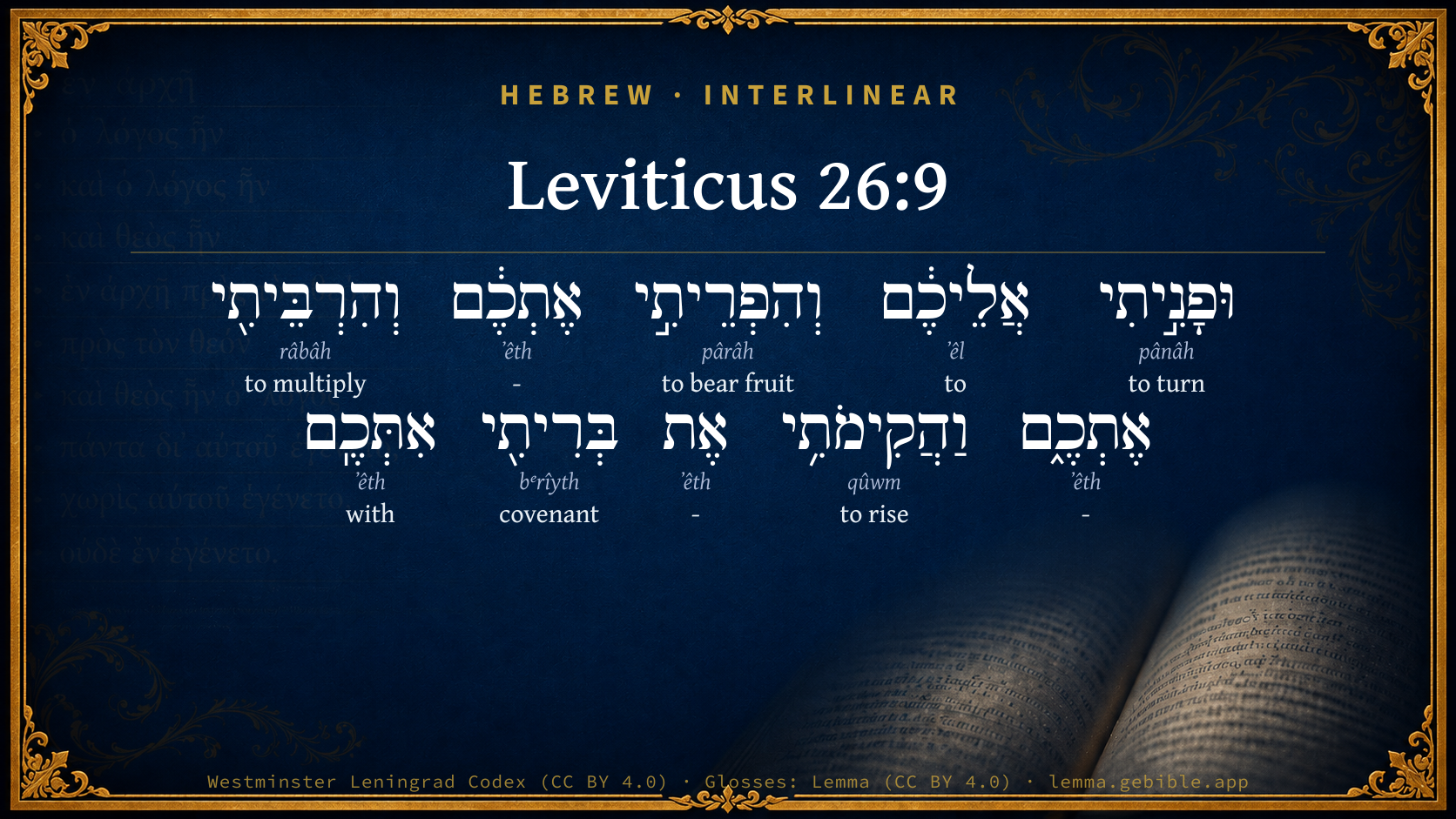
  1. וּפָנִ֣יתִי pânâh H6437 “and · to turn” Conjunction + Verb, Qal, Sequential Perfect, 1st Person, Common, Singular
  2. אֲלֵיכֶ֔ם ʼêl H413 “to · you” Preposition + Suffix, Personal, 2nd Person, Masculine, Plural
  3. אֶתְכֶ֔ם ʼêth H853 “- · you” Particle, Direct Object + Suffix, Personal, 2nd Person, Masculine, Plural
  4. וְהִרְבֵּיתִ֖י râbâh H7235 “and · to multiply” Conjunction + Verb, Hiphil, Sequential Perfect, 1st Person, Common, Singular
  5. אֶתְכֶ֑ם ʼêth H853 “- · you” Particle, Direct Object + Suffix, Personal, 2nd Person, Masculine, Plural
  6. וַהֲקִימֹתִ֥י qûwm H6965 “and · to rise” Conjunction + Verb, Hiphil, Sequential Perfect, 1st Person, Common, Singular
  7. אֶת ʼêth H853 “-” Particle, Direct Object
  8. בְּרִיתִ֖י bᵉrîyth H1285 “covenant · my” Noun, Common, Feminine, Singular, Construct + Suffix, Personal, 1st Person, Common, Singular
  9. אִתְּכֶֽם ʼêth H854 “with · you” Preposition + Suffix, Personal, 2nd Person, Masculine, Plural

About this verse

These counts appear in no published source. They are computed here, from the morphology-tagged text and Lemma’s own curated glosses. What Lemma adds →

10
words
8
distinct lemmas
Pentateuch
section

Shared distinctive vocabulary

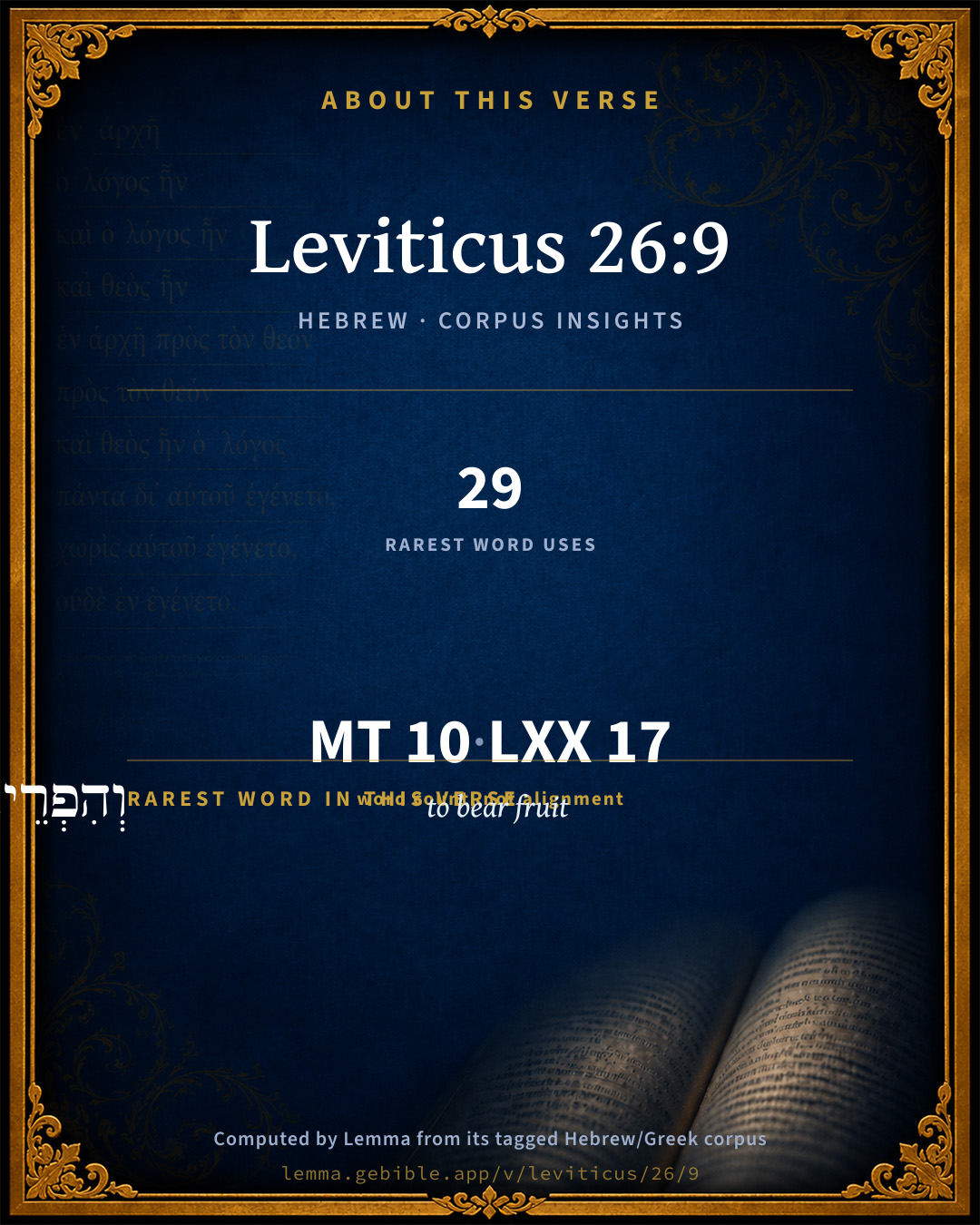
וְהִפְרֵיתִ֣י to bear fruit H6509 occurs in 28 verses of the Hebrew Bible. Also found in:

Grammatical profile

  • 4 verbs
  • 1 noun
  • 2 prepositions
  • 3 particles

Verb forms

  • וּפָנִ֣יתִי Qal · Sequential Perfect
  • וְהִפְרֵיתִ֣י Hiphil · Sequential Perfect
  • וְהִרְבֵּיתִ֖י Hiphil · Sequential Perfect
  • וַהֲקִימֹתִ֥י Hiphil · Sequential Perfect

Hebrew & Septuagint length

In English translation the verse runs 20 words from the Hebrew and 18 from the Septuagint (LXX English) — closely comparable.

A rough comparison of the two English renderings, which tokenize alike — not a word-level alignment.

Word counts can differ between the Hebrew and the Greek without any difference in meaning — e.g. the Hebrew direct-object marker אֵת has no separate Greek word, and Greek often adds the article ὁ.

In the original languages it is 10 Hebrew tokens and 17 Greek tokens — but the two are counted differently (Hebrew bundles its prefixes and suffixes into one token; the Greek is in lemma form), so that isn’t a like-for-like length.

Cross-references

22

Topical passages linked to Leviticus 26:9 in the Treasury of Scripture Knowledge — connected by theme and wording, ordered by reader-vote popularity; previews shown in the World English Bible.

  • Genesis 17:6–7 I will make you exceeding fruitful, and I will make nations of you. Kings will come out of you.
  • Nehemiah 9:23 Their children also multiplied you as the stars of the sky, and brought them into the land concerning which you did say to their fathers, that they should go in to possess it.
  • Psalms 107:38 He blesses them also, so that they are multiplied greatly. He doesn't allow their cattle to decrease.
  • Ezekiel 16:62 I will establish my covenant with you; and you shall know that I am Yahweh;
  • Isaiah 55:3 Turn your ear, and come to me; hear, and your soul shall live: and I will make an everlasting covenant with you, even the sure mercies of David.
  • Genesis 28:3 May God Almighty bless you, and make you fruitful, and multiply you, that you may be a company of peoples,
  • Psalms 138:6–7 For though Yahweh is high, yet he looks after the lowly; But the proud, he knows from afar.
  • Deuteronomy 28:11 Yahweh will make you plenteous for good, in the fruit of your body, and in the fruit of your cattle, and in the fruit of your ground, in the land which Yahweh swore to your fathers to give you.
  • Jeremiah 33:3 Call to me, and I will answer you, and will show you great things, and difficult, which you don't know.
  • Genesis 6:18 But I will establish my covenant with you. You shall come into the ark, you, your sons, your wife, and your sons' wives with you.
  • Genesis 17:20 As for Ishmael, I have heard you. Behold, I have blessed him, and will make him fruitful, and will multiply him exceedingly. He will become the father of twelve princes, and I will make him a great nation.
  • Genesis 26:4 I will multiply your seed as the stars of the sky, and will give to your seed all these lands. In your seed will all the nations of the earth be blessed,
  • Genesis 28:14 Your seed will be as the dust of the earth, and you will spread abroad to the west, and to the east, and to the north, and to the south. In you and in your seed will all the families of the earth be blessed.
  • Exodus 1:7 The children of Israel were fruitful, and increased abundantly, and multiplied, and grew exceedingly mighty; and the land was filled with them.
  • Exodus 2:25 God saw the children of Israel, and God was concerned about them.
  • Exodus 6:4 I have also established my covenant with them, to give them the land of Canaan, the land of their travels, in which they lived as aliens.
  • Deuteronomy 28:4 Blessed shall be the fruit of your body, and the fruit of your ground, and the fruit of your animals, the increase of your cattle, and the young of your flock.
  • Psalms 89:3 "I have made a covenant with my chosen one, I have sworn to David, my servant,
  • Luke 1:72 To show mercy towards our fathers, To remember his holy covenant,
  • 2 Kings 13:23 But Yahweh was gracious to them, and had compassion on them, and had respect to them, because of his covenant with Abraham, Isaac, and Jacob, and would not destroy them, neither cast he them from his presence as yet.
  • Nehemiah 2:20 Then answered I them, and said to them, The God of heaven, he will prosper us; therefore we his servants will arise and build: but you have no portion, nor right, nor memorial, in Jerusalem.
  • Hebrews 8:9 Not according to the covenant that I made with their fathers, In the day that I took them by the hand to lead them out of the land of Egypt; For they didn't continue in my covenant, And I disregarded them," says the Lord.

Cross-references courtesy of OpenBible.info (CC BY 4.0).

Hebrew and Greek witnesses Masoretic Hebrew ↔ Greek Septuagint

The same verse in the two great witnesses to the Old Testament, shown verse-for-verse.

These are two independent witnesses, not word-aligned to each other, and the Septuagint is shown in lemma (dictionary) form.

Hebrew Leviticus 26:9 Masoretic · Westminster Leningrad Codex

וּפָנִ֣יתִי אֲלֵיכֶ֔ם וְהִפְרֵיתִ֣י אֶתְכֶ֔ם וְהִרְבֵּיתִ֖י אֶתְכֶ֑ם וַהֲקִימֹתִ֥י אֶת בְּרִיתִ֖י אִתְּכֶֽם

"'I will have respect for you, and make you fruitful, and multiply you, and will establish my covenant with you.

World English Bible · Public Domain

Greek LXX Leviticus 26:9 Septuagint · lemma form

καί ἐπιβλέπω ἐπί σύ καί αὐξάνω σύ καί πληθύνω σύ καί ἵστημι ὁ διαθήκη ἐγώ μετά σύ

And I will look upon you, and increase you, and multiply you, and establish my covenant with you.

LXX2012 (modern English Septuagint) · Public Domain

Hebrew: Westminster Leningrad Codex (CC BY 4.0). Greek: Septuagint (public domain); English from LXX2012 (modern English Septuagint) (Public Domain). How the Septuagint differs from the Hebrew →

Targum (Aramaic paraphrase)

2

The Targum is the ancient Jewish Aramaic paraphrase of the Hebrew Scriptures — an interpretive translation, not the Hebrew text itself. Onkelos (literal) and Pseudo-Jonathan (expansive) render the Torah, and Jonathan the Prophets. Coverage is partial: where no permissively-licensed English translation exists for a verse, only the Aramaic is shown. This is verse-level text, not a word-by-word alignment to the Hebrew.

  1. Targum Onkelos Torah (Genesis–Deuteronomy)
    וְאֶתְפְּנֵי בְּמֵימְרִי לְאוֹטָבָא לְכוֹן וְאַפֵּשׁ יָתְכוֹן וְאַסְגֵי יָתְכוֹן וַאֲקֵם יָת קְיָמִי עִמְכוֹן

    (no public-domain English translation for this verse)

    Targum Onkelos — Aramaic: “Onkelos Genesis” (public domain); “Onkelos Exodus” (public domain); “Onkelos Leviticus” (public domain); “Onkelos Numbers” (public domain); “Onkelos Deuteronomy” (public domain). English: “Sefaria Community Translation” (CC0 1.0 (public-domain dedication)); “J.W. Etheridge. The Targums of Onkelos and Jonathan Ben Uzziel on the Pentateuch. London: Longmans, Green, 1862” (public domain). Text via Sefaria.

  2. Targum Pseudo-Jonathan Torah (Genesis–Deuteronomy)
    וְאִתְפְּנֵי מִן אֲגַר עַמְמַיָא לִמְשַׁלְמָא לְכוֹן אֲגַר עוֹבָדֵיכוֹן טַבְיָא וְאִיתְקוֹף יַתְכוֹן וְאַסְגֵי יַתְכוֹן וְאָקִים יַת קָיָימַי עִמְכוֹן

    For I will turn from the wages of the Gentiles, to fulfil to you the recompense of your good works, and I will strengthen you, and multiply you, and establish My covenant with you.

    Targum Pseudo-Jonathan — Aramaic: “Targum Jonathan on Genesis” (public domain); “Targum Jonathan on Exodus” (public domain); “Targum Jonathan on Leviticus” (public domain); “Targum Jonathan on Numbers” (public domain); “Targum Jonathan on Deuteronomy” (public domain). English: “The Targum of Jonathan ben Uzziel, trans. J. W. Etheridge, London, 1862” (public domain). Text via Sefaria.

Commentary

Notes on Leviticus 26:9 from classic Christian and Jewish commentators (each source and its license shown beneath its notes). The classic Christian expositions comment on the surrounding passage and are grouped to its opening verse, so a note may address several verses; the Jewish commentaries on the Tanakh (Rashi and others) are per-verse, so they appear only where the commentator wrote on this verse.

Lemma curates 59 commentaries, every one of them public domain or Creative Commons licensed, each selected and text-cleaned for this edition rather than reprinted as found. About our sources →

Trapp's Complete Commentary

John Trapp

Lev 26:9 For I will have respect unto you, and make you fruitful, and multiply you, and establish my covenant with you.

Ver. 9. And establish my covenant with you.] This is more than all the rest. So Gen 17:20-21, "I have blessed Ishmael; twelve princes shall he beget, but my covenant will I establish with Isaac."

John Trapp, A Commentary or Exposition upon All the Books of the Old and New Testament (1647–1656) — public domain. Text from a community e-Sword module.

Tyndale Open Study Notes

Tyndale Open Resources

26:9 fulfill my covenant: The fulfillment is seen in the “rest” spoken of in Hebrews (Heb 3:11–4:11). The Promised Land should have brought a state of security and prosperity, a state of “rest” to the Israelites (Exod 33:14; Deut 12:10; 25:19; Josh 1:13, 15). Israel succeeded in entering the Promised Land, but their rebellion kept them from seeing the covenant fulfilled.

Tyndale Open Study Notes — © Tyndale Open Resources, licensed CC BY-SA 4.0. Text via the HelloAO Bible API.

Geneva Bible (1599)

Geneva Bible translators

Perform that which I have promised.

Hebrew, I will turn unto you.

Geneva Bible (1599) marginal notes — public domain. Text via Bolls.life.

Ellicott's Commentary for English Readers

(9) For I will have respect unto you.—Better, And I will turn unto you, as it is rendered in the Authorised Version in Eze_46:9, the only other passage where this phrase occurs; that is, be merciful to them and bless them. (Comp. 2Ki_13:23; Psa_25:16; Psa_69:17, &c.)

And multiply you, and establish my covenant with you.—That is, by multiplying them as the stars of heaven and the sand of the sea, God fulfil the covenant which He made with their fathers (Gen_12:2; Gen_13:16; Gen_15:5; Gen_22:17; Exo_23:26).

A Bible Commentary for English Readers, edited by Charles John Ellicott (1878–1897) — public domain. Text from a community e-Sword module.

The Cambridge Bible for Schools and Colleges

gen. ed. J. J. S. Perowne

9. will establish] rather, will carry out. The Heb. expression means, to fulfil the promises of an older covenant. Cp. Gen_26:3, ‘I will establish [to Isaac] the oath which I sware unto Abraham’; Deu_9:5, to ‘establish the word which the Lord sware unto thy fathers.’ So Jer_34:18 of the inhabitants of Jerusalem who did not carry out the words of the covenant which they had made.

The Cambridge Bible for Schools and Colleges (gen. ed. J. J. S. Perowne; Cambridge University Press, 1878–1918) — public domain. Text from a community e-Sword module.

John Gill's Exposition

And ye shall eat old store,.... What is very old, corn of three years old, as Jarchi and Kimchi (m) interpret it; such plenty should they have that it would be so long consuming:

and bring forth the old because of the new; out of their barns and granaries, to make room for the new, which they should have great quantities of, and scarce know where to bestow them; and therefore should empty their treasures and garners of the old, and fill them with new; or they should bring them forth out of their barns into their houses, to make use of themselves, or into their markets to expose to sale, being under no temptation to withhold against a time of scarcity in order to make more of it, see Pro 11:26; now all these temporal blessings promised may be emblems of spiritual things, and might be so understood by such who were spiritually enlightened; as of the rain of divine grace, and the blessings of it, and of the doctrines of the Gospel, sometimes compared thereunto, Deu 32:2; and of great fruitfulness in grace and good works, and of internal peace in the minds of good men, and of their safety and security from spiritual enemies; of fulness of spiritual provisions, even of things new and old, and which are laid up for them, Sol 7:13; thus promises of a spiritual nature more manifestly follow.

(m) Sepher Shorash. rad.

John Gill's Exposition of the Whole Bible (1746–1763) — public domain (CC PDM 1.0). Text via the HelloAO Bible API.

Matthew Poole's English Annotations

i.e. Actually perform all that I have promised you in my covenant made with you,

Matthew Poole's English Annotations on the Holy Bible (1683–1685) — public domain. Text from a community e-Sword/MySword module.

Whedon's Commentary on the Bible

Daniel D. Whedon

9. I will have respect — I will favourably regard you.

Multiply — Rapid increase in population, especially with Oriental nations, is a manifest proof of the divine favour. Virtue promotes health and wealth. These conduce to a multiplication of the people, so long as luxury and its attendant vices are avoided. It is a sign of national decay when marriages and births relatively diminish.

Establish my covenant — Confirm the covenant already made with Abraham.

Daniel D. Whedon (gen. ed.), Commentary on the Old and New Testaments (1874–1909) — public domain. Text from a community e-Sword module.

John Wesley's Explanatory Notes

Establish my covenant - That is, actually perform all that I have promised in my covenant made with you.

John Wesley, Explanatory Notes Upon the Whole Bible (1754–1765) — public domain. Text via the GEBible commentary corpus.

Keil & Delitzsch

C. F. Keil & F. Delitzsch

Moreover the Lord would bestow His covenant blessing upon them without intermission. אל פּנה signifies a sympathizing and gracious regard (Psa 25:16; Psa 69:17). The multiplication and fruitfulness of the nation were a constant fulfilment of the covenant promise (Gen 17:4-6) and an establishment of the covenant (Gen 17:7); not merely the preservation of it, but the continual realization of the covenant grace, by which the covenant itself was carried on further and further towards its completion. This was the real purpose of the blessing, to which all earthly good, as the pledge of the constant abode of God in the midst of His people, simply served as the foundation.

Keil & Delitzsch — Biblical Commentary on the Old Testament (1861–1891) — public domain (CC PDM 1.0). Text via the HelloAO Bible API. (Old Testament only.)

unfoldingWord translationNotes

Door43 World Missions Community

I will look at you with favor

"I will show you favor" or "I will bless you"

make you fruitful and multiply you

These two phrases refer to God causing them to have many descendants so they become a large group. (See: Doublet)

make you fruitful

God speaks of them having many children as if they were trees that bear a lot of fruit. AT: "cause you to have many children" (See: Metaphor)

You will eat food stored a long time

"You will have enough food stored to eat for a long time" or "you will have enough food to store and eat it for a long time"

translationWords

favor

fruit

covenant

unfoldingWord translationNotes — © Distant Shores Media and the Door43 World Missions Community, licensed CC BY-SA 4.0. Source: git.door43.org/Door43/en_tn.

Rashi

Rabbi Shlomo Yitzchaki (Rashi)

ופניתי אליכם AND I WILL TURN UNTO YOU — This means, I will turn away from all My business in order to pay you your reward. A parable! To what may this be compared? To a king who hired labourers etc., just as is explained in Torath Cohanim (Sifra, Bechukotai, Chapter 2 5).

והפריתי אתכם AND I SHALL MAKE YOU FRUITFUL — This, of course, means:in פריה ורביה in reproductive power (i. e. in numbers), but —

והרביתי אתכם (which may denote: “I will make you large”) means in height (lit., erect stature) (Sifra, Bechukotai, Chapter 2 5).

והקמתי את בריתי אתכם AND I WILL ESTABLISH MY COVENANT WITH YOU — a new covenant; not like that covenant which you broke by worshipping the golden calf), as it said, (Jeremiah 31:31-32): “[Behold, the days come, saith the Lord that] I will make a new covenant with the house of Israel, and with the house of Judah. Not according to the covenant [that I made with their fathers,… which My covenant they broke, but… I will put My law in their inward parts, and write it in their hearts]” (Sifra, Bechukotai, Chapter 2 5).

Rashi on the Tanakh — English translations: “The Judaica Press complete Tanach with Rashi, translated by A. J. Rosenberg” (CC BY 4.0); “Pentateuch with Rashi's commentary by M. Rosenbaum and A.M. Silbermann, 1929-1934” (public domain); “The Metsudah Tanach series, Lakewood, N.J” (CC BY 4.0); and “The Book of Joshua, Metsudah Publications, 1997” (CC BY 4.0). Text via Sefaria.

Ramban (Nachmanides)

Rabbi Moshe ben Nachman (Ramban / Nachmanides)

AND I WILL MAKE YOU FRUITFUL. This means that they will all have children, fruit of the womb, and there will be no barren man or woman among them. And then He stated again, and I will multiply you, meaning that they will have many children, and will not be bereaved of them, because they will live out their days, and therefore they will be a large people.

Ramban (Nachmanides) on the Tanakh — English translation: “Commentary on the Torah by Ramban (Nachmanides). Translated and annotated by Charles B. Chavel. New York, Shilo Pub. House, 1971-1976” (CC BY 4.0). Text via Sefaria.

Sforno

Rabbi Ovadia Sforno

And establish My covenant with you — that covenant in which I said (Bereishis 17:7), “To be to you for a God and to your seed after you”.

Sforno on the Tanakh — English translation: “Yalkut, Sifsei Chachomim Chumash, Metsudah Publications, 2009” (CC BY 4.0). Text via Sefaria.

Lesson kit

Teaching starters — assembled from the data on this page, not authored interpretation. Every prompt links to the verse data it draws on. Edit before teaching.

Leviticus, in the Pentateuch, opens this verse with 10 words (8 distinct Hebrew lemmas). Its most distinctive word is pârâh (“to bear fruit”). A historical commentator’s framing appears above. Read the whole chapter for the surrounding context.

Discussion questions

  1. How does “to bear fruit” (pârâh) shape what this verse is saying?
  2. How does Genesis 1:22, which shares the word «to bear fruit», read alongside this verse?
  3. These translations render this verse differently; the difference is in the English rendering, not the original. What questions does that raise?
  4. «וּפָנִ֣יתִי» is a Qal Sequential Perfect verb. How does that grammatical form shape the action described?
  5. Compare how Trapp's Complete Commentary and Tyndale Open Study Notes read this verse. Where do they agree or differ?

Things to notice

Reading settings

Reading text

Shown beneath each verse's original-language words.

Old Testament
Old Testament edition

Read the OT as the Masoretic Hebrew (MT) or the Greek Septuagint (LXX).

English shown for the Greek Septuagint (in the Hebrew ↔ Greek comparison).

Comparing translations? Open the Compare panel on any verse page to stack up to four side by side.