Psalms 78:38

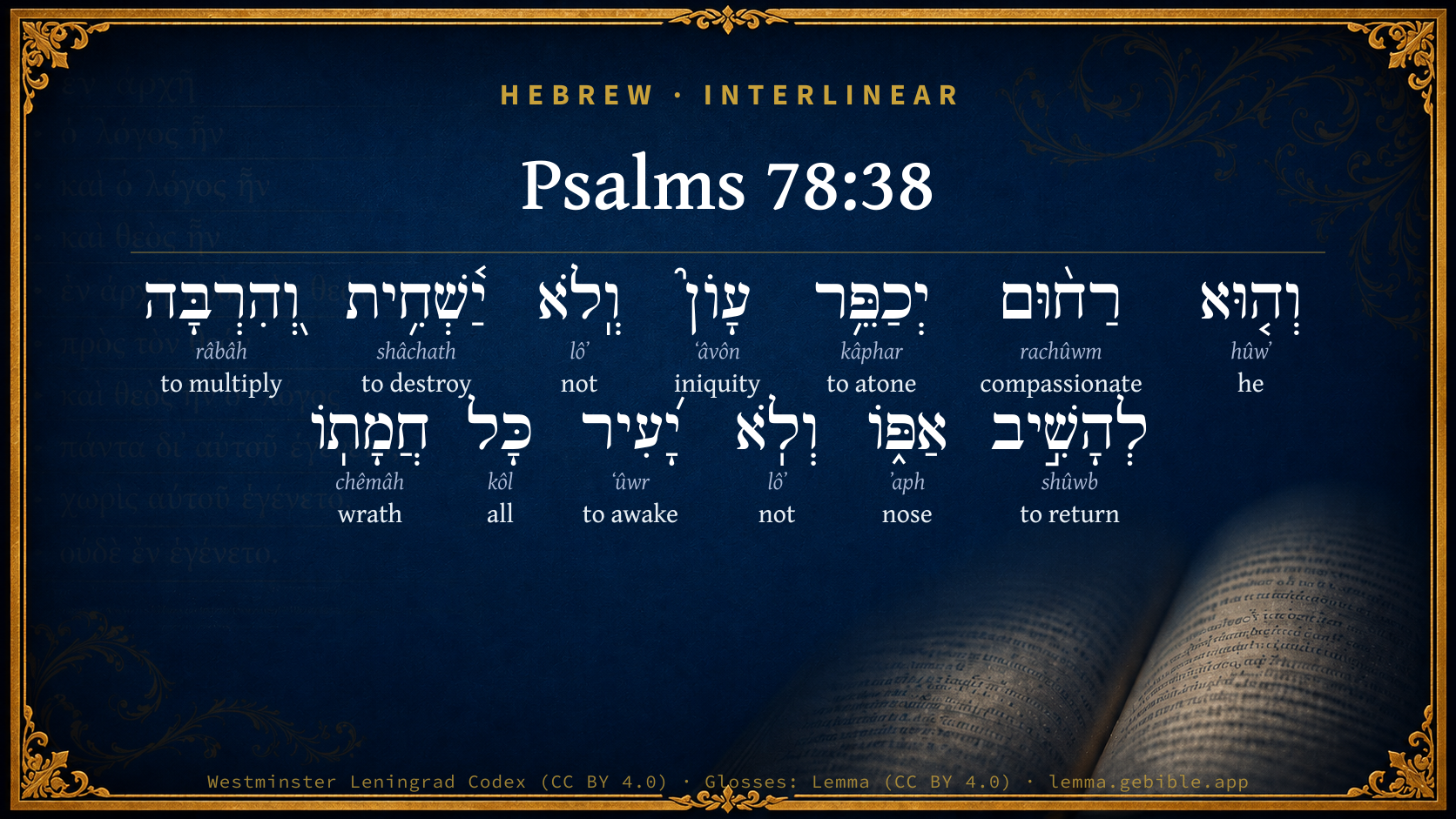
Hebrew (Westminster Leningrad Codex) Psalms 78:38 appears in the Hebrew Old Testament. The text above is from the Westminster Leningrad Codex. Each word links to its Strong’s number, a concise gloss, and parsing drawn from the Open Scriptures Hebrew Bible morphology. Click any word for its full Brown-Driver-Briggs (BDB) entry.
Download image
Cite this verse

Psalms 78:38 (World English Bible). Public Domain. Lemma interlinear Bible study tool, https://lemma.gebible.app/v/psalms/78/38.

Show BibTeX & RIS
BibTeX
RIS
English Translation
But he, being merciful, forgave iniquity, and didn't destroy them. Yes, many times he turned his anger away, And didn't stir up all his wrath.
World English Bible · Public Domain
Download a study sheet

One document with this verse’s original text, its word-by-word gloss line, the meaning frame, cross-references with their text, attributed commentary, and full source and license credits — printable, and it pastes into notes with its structure intact.

This verse Autodidact and up

Study sheet (.html) Plain text (.txt)

A passage Seminary Student

Up to 50 verses in one chapter. A passage sheet keeps up to 6 commentary sources and 12 cross-references per verse, in the order this page ranks them, and says so on the sheet whenever that leaves anything out. Ask for a single verse and you get the Autodidact verse sheet above.

Everything on this page stays free to read, with no account — the sheet is a download of what is already on screen, not access to it.

Want to remove ads? Support Godless Engineer
Compare translations 3

The same verse in 3 English versions, stacked beneath the original-language interlinear above. Click any original word for its lexicon entry.

Each is an independent rendering of the whole verse — the interlinear is not word-aligned to these translations.

Highlighted words mark where these versions differ — a whole-verse word diff, not a word-by-word alignment.

  • World English Bible Public Domain
    But he, being merciful, forgave iniquity, and didn't destroy them. Yes, many times he turned his anger away, And didn't stir up all his wrath.
  • King James Version Public Domain
    But he, being full of compassion, forgave their iniquity, and destroyed them not: yea, many a time turned he his anger away, and did not stir up all his wrath.
  • unfoldingWord Literal Text CC BY-SA 4.0
    Yet he, merciful, atoned for their iniquity and did not destroy them. And many times he held back his nose and did not stir up all his wrath.

unfoldingWord Literal Text — © unfoldingWord, licensed CC BY-SA 4.0. Word-aligned USFM3 via Door43 (git.door43.org/unfoldingWord/en_ult).

Versions to compare (up to 4)

3 of 4 selected

Show all 18 translations

Every available English version of this verse, each an independent rendering of the whole verse.

  • World English Bible Public Domain
    But he, being merciful, forgave iniquity, and didn't destroy them. Yes, many times he turned his anger away, And didn't stir up all his wrath.
  • Berean Standard Bible Public Domain
    And yet He was compassionate; He forgave their iniquity and did not destroy them. He often restrained His anger and did not unleash His full wrath.
  • Majority Standard Bible Public Domain
    And yet He was compassionate; He forgave their iniquity and did not destroy them. He often restrained His anger and did not unleash His full wrath.
  • King James Version Public Domain
    But he, being full of compassion, forgave their iniquity, and destroyed them not: yea, many a time turned he his anger away, and did not stir up all his wrath.
  • American Standard Version (1901) Public Domain
    But he, being merciful, forgave `their' iniquity, and destroyed `them' not: Yea, many a time turned he his anger away, And did not stir up all his wrath.
  • Revised Version (1885) Public Domain
    But he, being full of compassion, forgave their iniquity, and destroyed them not: yea, many a time turned he his anger away, and did not stir up all his wrath.
  • Geneva Bible (1599) Public Domain
    Yet he being merciful forgaue their iniquitie, and destroied them not, but oft times called backe his anger, and did not stirre vp all his wrath.
  • Douay-Rheims (1899) Public Domain
    But he is merciful, and will forgive their sins: and will not destroy them. And many a time did he turn away his anger: and did not kindle all his wrath.
  • Young's Literal Translation Public Domain
    And He -- the Merciful One, Pardoneth iniquity, and destroyeth not, And hath often turned back His anger, And waketh not up all His fury.
  • Literal Standard Version CC BY-SA 4.0
    And He, the Merciful One, pardons iniquity, and does not destroy, || And has often turned back His anger, || And does not awaken all His fury.
  • Unlocked Literal Bible CC BY-SA 4.0
    Yet he, being merciful, forgave their iniquity and did not destroy them. Yes, many times he held back his anger and did not stir up all his wrath.
  • unfoldingWord Literal Text CC BY-SA 4.0
    Yet he, merciful, atoned for their iniquity and did not destroy them. And many times he held back his nose and did not stir up all his wrath.
  • Darby Bible Public Domain
    But he was merciful: he forgave the iniquity, and destroyed [them] not; but many a time turned he his anger away, and did not stir up all his fury:
  • World Messianic Bible Public Domain
    But he, being merciful, forgave iniquity, and didn’t destroy them. Yes, many times he turned his anger away, and didn’t stir up all his wrath.
  • Webster's Bible Public Domain
    But he, being full of compassion, forgave their iniquity, and destroyed them not: yes, many a time he turned his anger away, and did not stir up all his wrath.
  • Free Bible Version CC BY-SA 4.0
    But being compassionate he pardoned their guilt and did not destroy all of them. He often held back his anger—he did not pour out all his fury.
  • Bible in Basic English Public Domain
    But he, being full of pity, has forgiveness for sin, and does not put an end to man: frequently turning back his wrath, and not being violently angry.
  • JPS Tanakh (1917) Public Domain
    But He, being full of compassion, forgiveth iniquity, and destroyeth not; yea, many a time doth He turn His anger away, and doth not stir up all His wrath.

Literal Standard Version (2020), Covenant Press — licensed CC BY-SA 4.0. Text via the HelloAO Bible API (eBible.org). Unlocked Literal Bible (unfoldingWord) — licensed CC BY-SA 4.0. Text via the HelloAO Bible API (eBible.org). unfoldingWord Literal Text — © unfoldingWord, licensed CC BY-SA 4.0. Word-aligned USFM3 via Door43 (git.door43.org/unfoldingWord/en_ult). Free Bible Version, Dr. Jonathan Gallagher — licensed CC BY-SA 4.0. Text via the HelloAO Bible API (eBible.org).

Word by word

More ways to search: Search by grammar → Find every occurrence → Compare this word →

Practice this passage: Drill this verse → Learn its vocabulary →

רַח֨וּם
rachûwm
H7349
“compassionate”
Adjective, Adjective, Masculine, Singular, Absolute
Part of Speech
Adjective
Type
Adjective
Gender
Masculine
Number
Singular
State
Absolute
Full BDB Definition

Origin: from H7355

TWOT: 2146c

compassionate - always of God with one possible exception
  1. וְה֤וּא hûwʼ H1931 “and · he” Conjunction + Pronoun, Personal, 3rd Person, Masculine, Singular
  2. יְכַפֵּ֥ר kâphar H3722 “to atone” Verb, Piel, Imperfect, 3rd Person, Masculine, Singular
  3. עָוֺן֮ ʻâvôn H5771 “iniquity” Noun, Common, Both, Singular, Absolute
  4. וְֽלֹא lôʼ H3808 “and · not” Conjunction + Particle, Negative
  5. יַ֫שְׁחִ֥ית shâchath H7843 “to destroy” Verb, Hiphil, Imperfect, 3rd Person, Masculine, Singular
  6. וְ֭הִרְבָּה râbâh H7235 “and · to multiply” Conjunction + Verb, Hiphil, Sequential Perfect, 3rd Person, Masculine, Singular
  7. לְהָשִׁ֣יב shûwb H7725 “to return” Preposition + Verb, Hiphil, Infinitive Construct
  8. אַפּ֑וֹ ʼaph H639 “nose · his” Noun, Common, Masculine, Singular, Construct + Suffix, Personal, 3rd Person, Masculine, Singular
  9. וְלֹֽא lôʼ H3808 “and · not” Conjunction + Particle, Negative
  10. יָ֝עִיר ʻûwr H5782 “to awake” Verb, Hiphil, Imperfect, 3rd Person, Masculine, Singular
  11. כָּל kôl H3605 “all of” Noun, Common, Masculine, Singular, Construct
  12. חֲמָתֽוֹ chêmâh H2534 “wrath · his” Noun, Common, Feminine, Singular, Construct + Suffix, Personal, 3rd Person, Masculine, Singular

About this verse

These counts appear in no published source. They are computed here, from the morphology-tagged text and Lemma’s own curated glosses. What Lemma adds →

13
words
12
distinct lemmas
Wisdom
section

Notable vocabulary

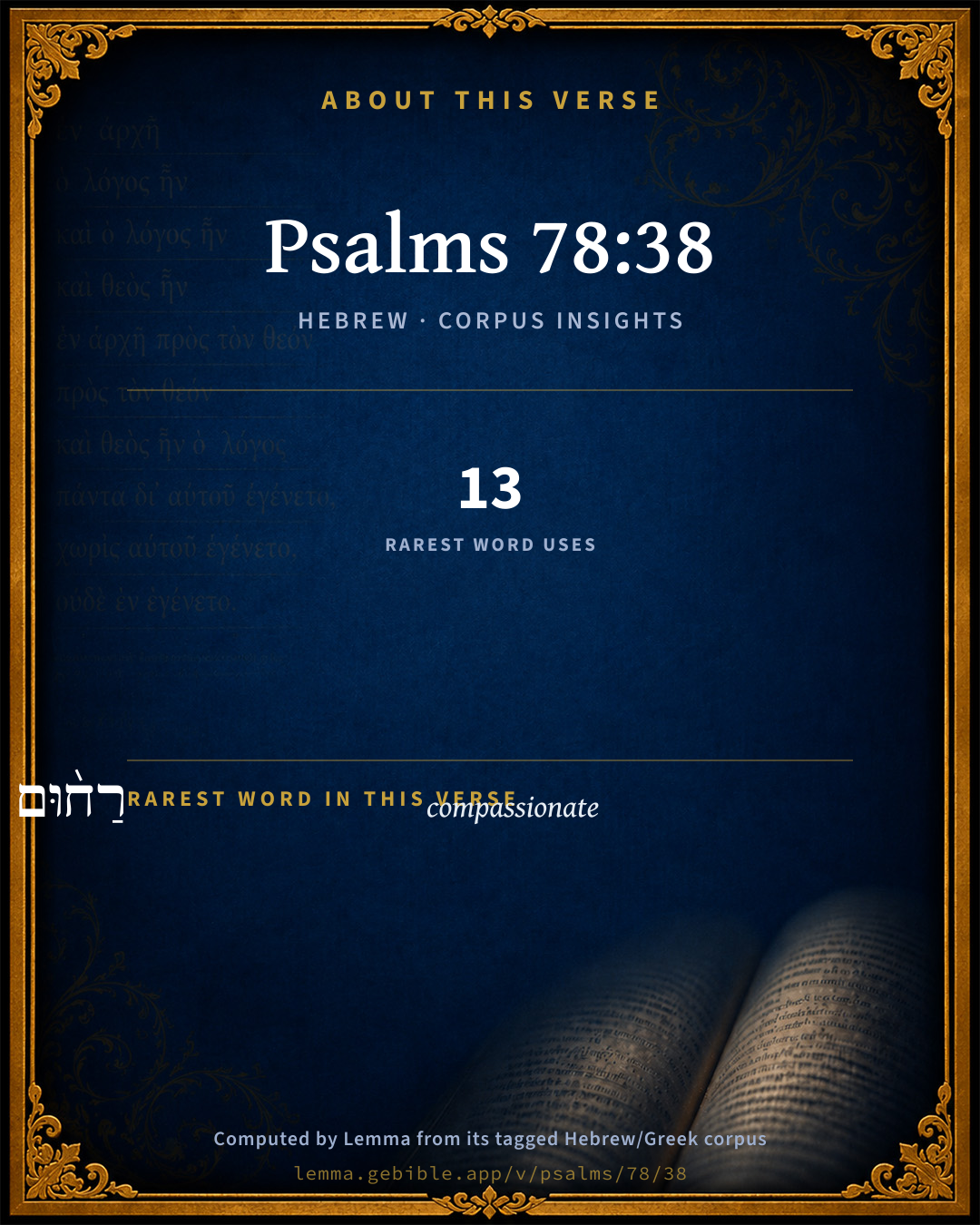
The rarest word here is רַח֨וּם compassionate H7349 — appearing just 13 times in the whole Hebrew Bible.

Shared distinctive vocabulary

רַח֨וּם compassionate H7349 occurs in 13 verses of the Hebrew Bible. Also found in:

Grammatical profile

  • 5 verbs
  • 4 nouns
  • 1 adjective
  • 1 pronoun
  • 2 particles

Verb forms

  • יְכַפֵּ֥ר Piel · Imperfect
  • יַ֫שְׁחִ֥ית Hiphil · Imperfect
  • וְ֭הִרְבָּה Hiphil · Sequential Perfect
  • לְהָשִׁ֣יב Hiphil · Infinitive Construct
  • יָ֝עִיר Hiphil · Imperfect

Repetition

A word recurs within this verse — often emphatic in Hebrew:

  • וְֽלֹא not H3808 ×2

Hebrew & Septuagint length

In English translation the verse runs 25 words from the Hebrew and 29 from the Septuagint (LXX English) — closely comparable.

A rough comparison of the two English renderings, which tokenize alike — not a word-level alignment.

Word counts can differ between the Hebrew and the Greek without any difference in meaning — e.g. the Hebrew direct-object marker אֵת has no separate Greek word, and Greek often adds the article ὁ.

Cross-references

11

Topical passages linked to Psalms 78:38 in the Treasury of Scripture Knowledge — connected by theme and wording, ordered by reader-vote popularity; previews shown in the World English Bible.

  • Isaiah 48:9 For my name's sake will I defer my anger, and for my praise will I refrain for you, that I not cut you off.
  • Numbers 14:18–20 Yahweh is slow to anger, and abundant in loving kindness, forgiving iniquity and disobedience; and that will by no means clear [the guilty], visiting the iniquity of the fathers on the children, on the third and on the fourth generation.
  • Ezekiel 20:17 Nevertheless my eye spared them, and I didn't destroy them, neither did I make a full end of them in the wilderness.
  • Exodus 34:6–9 Yahweh passed by before him, and proclaimed, "Yahweh! Yahweh, a merciful and gracious God, slow to anger, and abundant in loving kindness and truth,
  • 2 Kings 21:20 He did that which was evil in the sight of Yahweh, as did Manasseh his father.
  • Isaiah 44:21–22 Remember these things, Jacob, and Israel; for you are my servant: I have formed you; you are my servant: Israel, you shall not be forgotten by me.
  • Ezekiel 20:13–14 But the house of Israel rebelled against me in the wilderness: they didn't walk in my statutes, and they rejected my ordinances, which if a man keep, he shall live in them; and my Sabbaths they greatly profaned. Then I said I would pour out my wrath on them in the wilderness, to consume them.
  • Ezekiel 20:21–22 But the children rebelled against me; they didn't walk in my statutes, neither kept my ordinances to do them, which if a man do, he shall live in them; they profaned my Sabbaths. Then I said I would pour out my wrath on them, to accomplish my anger against them in the wilderness.
  • Numbers 16:44–48 Yahweh spoke to Moses, saying,
  • Psalms 106:43–45 Many times he delivered them, But they were rebellious in their counsel, And were brought low in their iniquity.
  • Ezekiel 20:8–9 But they rebelled against me, and would not listen to me; they did not every man cast away the abominations of their eyes, neither did they forsake the idols of Egypt. Then I said I would pour out my wrath on them, to accomplish my anger against them in the midst of the land of Egypt.

Cross-references courtesy of OpenBible.info (CC BY 4.0).

Hebrew and Greek witnesses Masoretic Hebrew ↔ Greek Septuagint

The same verse in the two great witnesses to the Old Testament, shown verse-for-verse.

You’re reading Greek Psalm 77 (Hebrew Psalm 78). The Septuagint counts the superscription, so verse numbers can differ from the Hebrew — chapter-level alignment, not verse-by-verse. Numbering follows Rahlfs.

These are two independent witnesses, not word-aligned to each other, and the Septuagint is shown in lemma (dictionary) form.

Hebrew Psalms 78:38 Masoretic · Westminster Leningrad Codex

וְה֤וּא רַח֨וּם יְכַפֵּ֥ר עָוֺן֮ וְֽלֹא יַ֫שְׁחִ֥ית וְ֭הִרְבָּה לְהָשִׁ֣יב אַפּ֑וֹ וְלֹֽא יָ֝עִיר כָּל חֲמָתֽוֹ

But he, being merciful, forgave iniquity, and didn't destroy them. Yes, many times he turned his anger away, And didn't stir up all his wrath.

World English Bible · Public Domain

Greek LXX Greek Psalm 77:38 Septuagint · lemma form

αὐτός δέ εἰμί οἰκτίρμων καί ἱλάσκομαι ὁ ἁμαρτία αὐτός καί οὐ διαφθείρω καί πληθύνω ὁ ἀποστρέφω ὁ θυμός αὐτός καί οὐ ἐκκαίω πᾶς ὁ ὀργή αὐτός

But he is compassionate, and will forgive their sins, and will not destroy them: yes, he will frequently turn away his wrath, and will not kindle all his anger.

LXX2012 (modern English Septuagint) · Public Domain

On this verse, Keil & Delitzsch discusses the Septuagint’s reading. Read the note in Commentary ↓

Hebrew: Westminster Leningrad Codex (CC BY 4.0). Greek: Septuagint (public domain); English from LXX2012 (modern English Septuagint) (Public Domain). How the Septuagint differs from the Hebrew →

Commentary

Notes on Psalms 78:38 from classic Christian and Jewish commentators (each source and its license shown beneath its notes). The classic Christian expositions comment on the surrounding passage and are grouped to its opening verse, so a note may address several verses; the Jewish commentaries on the Tanakh (Rashi and others) are per-verse, so they appear only where the commentator wrote on this verse.

Lemma curates 59 commentaries, every one of them public domain or Creative Commons licensed, each selected and text-cleaned for this edition rather than reprinted as found. About our sources →

The Cambridge Bible for Schools and Colleges

gen. ed. J. J. S. Perowne

38. This verse describes the general attributes of God, in virtue of which (Psa_78:39) He spared Israel in spite of their guilt. Render:

But he, being full of compassion, forgiveth iniquity and destroyeth not,

And offtimes turneth his anger away,

And stirreth not up all his wrath.

Cp. Exo_34:6-7; Exo_32:10; Exo_32:12; Num_14:18 ff.; Deu_4:31.

“V. 38 is, according to Kiddushin 30a, the middle of the 5896 lines (στίχοι) of the Psalter. According to Maccoth 22b, Psa_78:38 and Deu_28:58-59; Deu_29:8 were recited, when the forty stripes save one, which Paul five times suffered (2Co_11:24), were inflicted on the offender.” (Delitzsch).

The Cambridge Bible for Schools and Colleges (gen. ed. J. J. S. Perowne; Cambridge University Press, 1878–1918) — public domain. Text from a community e-Sword module.

Trapp's Complete Commentary

John Trapp

Psa 78:38 But he, [being] full of compassion, forgave [their] iniquity, and destroyed [them] not: yea, many a time turned he his anger away, and did not stir up all his wrath.

Ver. 38. But he, being full of compassion] Not standing upon terms nor taking advantages; a sin pardoning God, whose mercy rejoiceth against (or glorieth over) judgment, Jas 2:13; it is of his mercy that we are not consumed, Lam 3:22, if he should deal with us in strict justice, Et delicta nostra ad calculos vocare, there were no abiding by it, Psal. cxxx. 1; clxiii 1.

Yea, many a time turned he his anger away] With patience and piety, he overcame their provocations, although they tempted him ten times, that is, very often, Num 14:22.

And did not stir up all his wrath] Heb. He multiplied to turn away his wrath, Strenue curavit ut cohiberet iram suam, he let fall some drops of his wrath, but would not shed the whole shower of it.

John Trapp, A Commentary or Exposition upon All the Books of the Old and New Testament (1647–1656) — public domain. Text from a community e-Sword module.

The Biblical Illustrator

Joseph S. Exell

Psa_78:38

But He, being full of compassion, forgave their iniquity, and destroyed them not.

All good rewarded

The whole Book of Judges may be said to be a commentary on these words, for it is a record of successive instances of idolatry and wickedness into which the people fell, of Divine judgments which in consequence overtook them, of partial and temporary repentance produced by those judgments, and of relapses into sin when the judgments were withdrawn. The people are said, in our text, to have flattered God with their mouth, and lied unto Him with their tongues. There was no sincerity in their repentance, for their heart was not right with Him. And nevertheless, the repentance, hollow and transient as it was, had its effect. Moved by their distress and their cry, God many a time turned His anger away, and did not stir up all His wrath. Now, so far as the Israelites themselves were concerned, there is nothing in this dealing of God which is inconsistent with His character and government. If not spiritually excellent, and therefore not likely to have been recompensed with spiritual blessings, the humiliation of the Israelites had a natural or moral excellence; and, though it could do nothing towards securing a reward hereafter, it might do something like the humiliation of the Ninevites towards procuring a respite from a threatened visitation. We have no right to suppose that the Ninevites when preached to by Jonah, any more than the Israelites referred to in the text, repented in such a sense that they finally separated themselves from idols and joined themselves to the worship of the one true God. But they recognized in a very striking manner the supremacy of that Being who had rescued Jonah front the deep, and sent him among them with a prediction of woe; and, though their cry may have been wrung from them by the fear of punishment, yet was that cry as fine a witness as ever went up from this sinful creation to the awfulness and resistlessness of its Maker. And, seeing that we live beneath a retributive economy, we might almost affirm it a maxim in the Divine dealings with men, that they leave nothing of good without reward and recompense from God. You will remember that our Lord, when denouncing the hypocrisy of those who prayed and gave alms that they might be seen of men, says, Verily, they have their reward. There seems in this something more than a declaration that what they were in search of was the praise of men; it is rather a declaration that it was this praise on which they had fixed their desires, and that God permitted them to gain it, because outwardly, at least, they did Him reverence. It is the fixed end and decree of Gods government to reward every man according to his works, and therefore may He award temporary advantages to those who yield Him some temporary obedience. The greatest share of public approbation, and the most desirable portion in this world, certainly appear to be reserved for those who are signal in the duties and warm in the charities of life. And if this be true, how are we to explain it but by declaring that God is not unmindful of the least thing which may seem to be done in obedience to His will; and that, since the men who are merely earnest in curbing their passions and zealous in benefiting others are to have no future recompense, He resolves to reward them with a large measure of temporal good, and thus to allow nothing to be overlooked by His retributive government? Just as there are actions which God punishes, so are there also actions which God rewards in this life; and the reward will be more conspicuous, because the man who receives it is not one who will be accepted at the judgment. Tremble ye who are men of virtue but not of piety, whom the world is applauding, and upon whom fortune, as it is called, is continually smiling. We put no slight upon your virtues; we do not refuse to admit your integrity, your honour, your warm-heartedness, your liberality; nay, we will net even say that these virtues are without worth in Gods sight, and will not receive a recompense at Gods hands; rather we say unto you, Verily ye have your reward. You read in the Book of Psalms of men who have their portion in this life. Oh! think with yourselves whether this may not be your case. Is it not too possible, that whilst what is naturally excellent obtains for you a measure of happiness here, the want of what is spiritually excellent may cause you to be consigned to misery hereafter? You live beneath a retributive government; you shall not have to say you do well for nothing; but the retributions of good may last only for a few years, and then the retributions of evil will crowd upon you in eternity. But, on the other hand, though it may be indirectly that there is encouragement in the text for the contrite in heart, the true disciple of Christ may draw comfort from the ease of the Israelites. If God would not leave the show and semblance of contrition without a recompense, will He be unmindful of real penitences If many a time turned He His anger away from those who did but flatter Him with their mouths, and fled unto Him with their tongues, has He nothing in store for those who are humble in spirit and who come to Him with the sacrifice of a broken heart? (H. Melvill, B. D.)

The wondrous compassion and forbearance of God

The Israelites sinned in the face of abounding mercy. Their providences were special and peculiar. For them God clave the sea and rent the heavens. Angels food dropped daily round their tents, and the rocks ran with living streams. God rebuked kings for their sakes. The ancients said that Venus never looked so fair as when she sat beside Pluto. I suppose that Pluto never seemed so swarthy as when contrasted with the white-armed goddess. Sin looks its blackest when set against the lovingkindness and tender mercy of a long-suffering God. Yet even such enormities as black ingratitude and rank rebellion were forgiven hitherto. Here is the record--is it not wonderful? He being full of compassion, forgave their iniquity and destroyed them not: yea, many a time turned He His anger away and did not stir up all His wrath. (Thomas Spurgeon.)

The Biblical Illustrator, edited by Joseph S. Exell (c. 1880s–1900s) — public domain. Text from a community e-Sword module.

The Treasury of David

Charles H. Spurgeon

Ver. 38. But he, being full of compassion, forgave their iniquity, and destroyed them not. Though they were full of flattery, he was full of mercy, and for this cause he had pity on them. Not because of their pitiful and hypocritical pretensions to penitence, but because of his own real compassion for them he overlooked their provocations.

Yea, many a time turned he his anger away. When he had grown angry with them he withdrew his displeasure. Even unto seventy times seven did he forgive their offences. He was slow, very slow, to anger. The sword was uplifted and flashed in midair, but it was sheathed again, and the nation yet lived. Though not mentioned in the text, we know from the history that a mediator interposed, the man Moses stood in the gap; even so at this hour the Lord Jesus pleads for sinners, and averts the divine wrath. Many a barren tree is left standing because the dresser of the vineyard cries, "let it alone this year also."

And did not stir up all his wrath. Had he done so they must have perished in a moment. When his wrath is kindled but a little men are burned up as chaff; but were he to let loose his indignation, the solid earth itself would melt, and hell would engulf every rebel. Who knoweth the power of thine anger, O Lord? We see the fulness of God's compassion, but we never see all his wrath.

Ver. 38. According to B. Kiddushin 30a, this verse is the middle one of the 5896 Nyqymk, sticoi, of the Psalter. According to B. Maccoth 22b, Ps 78:38, and previously De 28:58-59 29:9, were recited when the forty strokes of the lash save one, which, according to 2Co 11:24, Paul received five times, were being counted out to the culprit. Franz Delitzsch.

Ver. 38. He, being full of compassion, etc. When his hand was up, and he giving the blow, he called it back again, as one that could not find it in his heart to do it; and when he did it, he did not stir up all his wrath; he let fall some drops of it, but would not shed the whole shower of it; and he giveth the reason of both, for they are but flesh; and, indeed, his primary scope is to show mercy; and that he afflicts is but upon occasions; and therefore he is provoked, and provoked much before he doth it. As it is natural for the bee to give honey, but it stings; but it stings but by occasion when it is provoked; and this we see to be true in God by experience, who suffers men, and suffers them long; they continue in their sins, and yet he continues in his mercies, and withholds his judgments. John Preston (1587-1628), in "The Golden Sceptre held forth to the Humble."

Ver. 38. Forgave is a very inadequate translation of the Hebrew word, which necessarily suggests the idea of expiation as the ground of pardon. Joseph Addison Alexander.

Ver. 38. Many a time turned he his anger away. God is provoked every day, yet is he slow to anger. Yea, sometimes when he has determined to bring evil upon a people, and has put himself into a posture of judgment, drawn out the sword, and smitten them; though they cease not to provoke him, he ceaseth to punish them; as a tender father in correcting a rebellious and graceless child, holds his hand sometimes, before the child begs for mercy, and of mere grace forbears: so God did with Israel. Notwithstanding their dissembling with their flattering tongues, and covenant breaking hearts, He forgave their iniquity, and destroyed them not: yea, many a time turned he his anger away, and did not stir up his wrath. The words are, He multiplied to turn away his anger: as they multiplied to provoke it, he multiplied to turn it away; and so at length outnumbered their sins with his mercies, that they were not destroyed. John Strickland, in "A Sermon preached before the House of Commons, " entitled "Mercy rejoicing against Judgment." 1645.

Ver. 38. He did not stir up all his wrath. His patience is manifest in moderating his judgments when he sends them. Doth he empty his quiver of his arrows, or exhaust his magazine of thunder? No; he could roll one thunderbolt successively upon all mankind; it is as easy with him to create a perpetual motion of lightning and thunder, as of the sun and stars, and make the world as terrible by the one as it is delightful by the other. He opens not all his store; he sends out a light party to skirmish with men, and puts not in array his whole army. He stirs not up all his wrath; he doth but pinch, where he might have torn asunder; when he takes away much, he leaves enough to support us. If he had stirred up all his anger, he had taken away all, and our lives to boot. He rakes up but a few sparks, takes but one firebrand to fling upon men, when he might discharge the whole furnace upon them; he sends but a few drops out of the cloud, which he might make to break in the gross, and fall down upon our heads to overwhelm us; he abates much of what he might do. Stephen Charnock.

Ver. 38. (last clause) and Ps 78:50 (first clause). God's anger as exercised against his people and against his foes. C. D.

Psalms 78:39*

Charles H. Spurgeon's The Treasury of David (1869–1885) — public domain. Psalms only. Text from a community e-Sword/MySword module.

Joseph Benson's Commentary

Psa 78:38. But he, being full of compassion — Of pity for them amidst their sins and miseries; forgave their iniquity — Not simply and absolutely, for in that sense it is undeniably certain from the Holy Scriptures, God pardons none but true penitents, such as these were not; but respectively, and so far as not to destroy them at that time, (which he had threatened to do,) as the next words limit and explain the expression. He remitted their punishment, for iniquity is often put for the punishment of iniquity. Hebrew, יכפר עון, jechapper gnavon, he expiated their iniquity. He accepted their atonement, or their professed repentance, so far as to compensate it with a removal of this outward and present affliction, as he did also to wicked Ahab upon his humiliation. And this God does for the encouragement of true penitents, who may hence learn how much greater and better recompenses they may expect and shall receive from God. And did not stir up all his wrath — But set bounds to it; and though he chastened them, yet he would not utterly destroy them, as they deserved.

Joseph Benson's Commentary on the Old and New Testaments (1811–1818) — public domain. Text from a community e-Sword module.

Keil & Delitzsch

C. F. Keil & F. Delitzsch

The second part of the Psalm now begins. God, notwithstanding, in His compassion restrains His anger; but Israel's God-tempting conduct was continued, even after the journey through the desert, in Canaan, and the miracles of judgment amidst which the deliverance out of Egypt had been effected were forgotten. With והוּא in Psa 78:38

(Note: According to B. Kiddushin 30a, this Psa 78:38 is the middle one of the 5896 פסוקין, στίχοι, of the Psalter. According to B. Maccoth 22b, Psa 78:38, and previously Deu 28:58-59; Deu 29:8 [9], were recited when the forty strokes of the lash save one, which according to Co2 11:24 Paul received five times, were being counted out to the culprit.)

begins an adversative clause, which is of universal import as far as ישׁהית, and then becomes historical. Psa 78:38 expands what lies in רחוּם: He expiates iniquity and, by letting mercy instead of right take its course, arrests the destruction of the sinner. With והרבּה (Ges. ֗֗142, 2) this universal truth is supported out of the history of Israel. As this history shows, He has many a time called back His anger, i.e., checked it in its course, and not stirred up all His blowing anger (cf. Isa 42:13), i.e., His anger in all its fulness and intensity. We see that Psa 78:38 refers to His conduct towards Israel, then Psa 78:39 follows with the ground of the determination, and that in the form of an inference drawn from such conduct towards Israel. He moderated His anger against Israel, and consequently took human frailty and perishableness into consideration. The fact that man is flesh (which not merely affirms his physical fragility, but also his moral weakness, Gen 6:3, cf. Gen 8:21), and that, after a short life, he falls a prey to death, determines God to be long-suffering and kind; it was in fact sensuous desire and loathing by which Israel was beguiled time after time. The exclamation "how oft!" Psa 78:40, calls attention to the praiseworthiness of this undeserved forbearance.

But with Psa 78:41 the record of sins begins anew. There is nothing by which any reference of this Psa 78:41 to the last example of insubordination recorded in the Pentateuch, Num 35:1-9 (Hitzig), is indicated. The poet comes back one more to the provocations of God by the Israel of the wilderness in order to expose the impious ingratitude which revealed itself in this conduct. התוה is the causative of תּוה = Syriac tewā', תּהא, to repent, to be grieved, lxx παρώξυναν. The miracles of the tie of redemption are now brought before the mind in detail, ad exaggerandum crimen tentationis Deu cum summa ingratitudine conjunctum (Venema). The time of redemption is called יום, as in Gen 2:4 the hexahemeron. שׂים אות (synon. עשׂה, נתן) is used as in Exo 10:2. We have already met with מנּי־צר in Psa 44:11. The first of the plagues of Egypt (Exo 7:14-25), the turning of the waters into blood, forms the beginning in Psa 78:44. From this the poet takes a leap over to the fourth plague, the ערב (lxx κυνόμυια), a grievous and destructive species of fly (Exo 8:20-32), and combines with it the frogs, the second plague (Exo 8:1-15). צפרדּע is the lesser Egyptian frog, Rana Mosaica, which is even now called Arab. ḍfd‛, ḍofda. Next in Psa 78:46 he comes to the eighth plague, the locusts, חסיל (a more select name of the migratory locusts than ארבּה), Ex 10:1-20; the third plague, the gnats and midges, כּנּים, is left unmentioned in addition to the fourth, which is of a similar kind. For the chastisement by means of destructive living things is now closed, and in Psa 78:47 follows the smiting with hail, the seventh plague, Ex 9:13-35. חנמל (with pausal , not ā, cf. in Eze 8:2 the similarly formed החשׁמלה) in the signification hoar-frost (πάχνη, lxx, Vulgate, Saadia, and Abulwald), or locusts (Targum כּזוּבא = חגב), or ants (J. D. Michaelis), does not harmonize with the history; also the hoar-frost is called כּפוּר, the ant נּמלה (collective in Arabic neml). Although only conjecturing from the context, we understand it, with Parchon and Kimchi, of hailstones or hail. With thick lumpy pieces of ice He smote down vines and sycamore-trees (Fayum was called in ancient Egyptian "the district of the sycamore"). הרג proceeds from the Biblical conception that the plant has a life of its own. The description of this plague is continued in Psa 78:48. Two MSS present לדּבר instead of לבּרד; but even supposing that רשׁפים might signify the fever-burnings of the pestilence (vid., on Hab 3:5), the mention of the pestilence follows in Psa 78:50, and the devastation which, according to Exo 9:19-22, the hail caused among the cattle of the Egyptians is in its right place here. Moreover it is expressly said in Exo 9:24 that there was conglomerate fire among the hail; רשׁפים are therefore flaming, blazing lightnings.

Keil & Delitzsch — Biblical Commentary on the Old Testament (1861–1891) — public domain (CC PDM 1.0). Text via the HelloAO Bible API. (Old Testament only.)

J. A. Alexander on Psalms

Joseph Addison Alexander

38. (Psa 78:38) And he, the Merciful, forgives iniquity, and does not (utterly) destroy; and he often withdrew his anger, and would not arouse all his wrath. The first clause relates rather to God's attributes, or to his method of proceeding in the general, than to his proceeding in this particular case, which is not brought forward till the last clause. There is obvious allusion to the description of God's mercy in Exo 34:6-7. Forgives is a very inadequate translation of the Hebrew word, which necessarily suggests the idea of expiation as the ground of pardon. Often withdrew, literally multiplied to withdraw his wrath, or cause it to return without accomplishing its object.

Joseph Addison Alexander, The Psalms Translated and Explained (1850) — public domain. Text from a community e-Sword module.

Geneva Bible (1599)

Geneva Bible translators

Because he would ever have some remnant of a Church to praise his Name in earth, he suffered not their sins to overcome his mercy.

Geneva Bible (1599) marginal notes — public domain. Text via Bolls.life.

Adam Clarke's Commentary

Verse 38. But he, being full of compassion] Feeling for them as a father for his children.

Forgave their iniquity] יחפר yechapper, made an atonement for their iniquity.

And did not stir up all his wrath.] Though they often grieved his Spirit, and rebelled against him, yet he seldom punished them; and when he did chastise them, it was as a tender and merciful Father. He did not stir up all his wrath - the punishment was much less than the iniquity deserved.

Adam Clarke's Commentary on the Bible (1810–1826) — public domain. Text from a community e-Sword/MySword module.

John Calvin's Commentaries

38. Yet he, being merciful, expiated their iniquity. To show the more fully that no means had succeeded in bending the Israelites, and causing them to return to a sound state of mind, we are now informed that, although God bare with their multiplied transgressions, and exercised his mercy in forgiving them, they had no less manifested their wickedness in abusing his benignity in every instance in which it was displayed, than they had shown themselves refractory and obstinate when he treated them with severity. At the same time, the reason is assigned why they did not utterly perish. They no doubt deserved to be involved in one common destruction; but it is declared that God mitigated his anger, that some seed of them might remain. That none might infer, from these examples of vengeance which have been mentioned, that God had proceeded to punish them with undue severity, we are told that the punishments inflicted upon them were moderate — yea, mild, when compared with the aggravated nature of their wickedness. God kept back his hand, not looking so much to what they had deserved, as desiring to give place to his mercy. We are not, however, to imagine that he is changeable, when at one time he chastises us with a degree of severity, and at another time gently draws and allures us to himself; for in the exercise of his matchless wisdom, he has recourse to different means by which to try whether there is really any hope of our recovery. But the guilt of men becomes more aggravated, when neither his severity can reform them nor his mercy melt them. It is to be observed, that the mercy of God, which is an essential attribute of his nature, is here assigned as the reason why he spared his people, to teach us that he was not induced by any other cause but this, to show himself so much inclined and ready to pardon. Moreover, as he pardoned them not only in one instance, nor in one respect, it is affirmed that he expiated their iniquity, that he might not destroy them; and again, that although he had been oftentimes provoked, he yet ceased not to turn away his anger; and, finally, that he mitigated his chastisements, lest the people should be overwhelmed with the weight of them.

John Calvin's Commentaries (1540-1563) — public domain. Text from the Calvin Translation Society English edition (1840s-50s) via the Christian Classics Ethereal Library (ccel.org). Calvin's coverage is partial (roughly two-thirds of the Bible); uncommented books and verses are honest gaps, never fabricated. The 19th-century editor's footnotes and remarks are omitted so the notes are faithfully Calvin's own voice.

Ellicott's Commentary for English Readers

(38) The verbs in the first clause should be in the present, But he, the compassionate, forgives iniquity, and doth not destroy, and many a time he turned away, &c.

A Bible Commentary for English Readers, edited by Charles John Ellicott (1878–1897) — public domain. Text from a community e-Sword module.

John Gill's Exposition

For he remembered that they were but flesh,.... Or "children of flesh", as the Targum; poor, frail, weak, mortal creatures, unable to bear the weight of his displeasure, the stroke of his hand, and the lighting down of his arm, with the indignation of his wrath; that they must be crushed before him, and would sink, and fail, and die; see Psa 103:14, or that they were naturally sinful and corrupt, prone to evil, easily drawn into sin; it was what their depraved natures inclined unto; they were impotent to that which is good, and unable to withstand temptations to evil; all which was taken notice of and considered by the Lord in his condescending goodness, and therefore he dealt gently with them; see Gen 6:3,

a wind that passeth away, and cometh not again; such is the life of man; it may be fitly compared to the wind, which moves swiftly, and, passing on, loses its strength and subsides; so the life of man is quickly gone, his days move swiftly on, he dies, and returns not again to his former state, to a mortal life; and though the spirit returns to the body again, yet not till the resurrection; and then not of itself, but by the power of God; see Job 7:7.

John Gill's Exposition of the Whole Bible (1746–1763) — public domain (CC PDM 1.0). Text via the HelloAO Bible API.

Albert Barnes' Notes on the Bible

But he, being full of compassion - literally, “But he, merciful,” That is, he was ready to forgive them.

Forgave their iniquity - literally, Atoned for, expiated, covered over their iniquity. There is connected with the word the idea of expiation or atonement, as the ground of pardon.

And destroyed them not - Did not cut them off in their repeated acts of rebellion. He bore with them, and spared them.

Yea, many a time turned he his anger away - literally, He multiplied to turn his anger away. That is, he did it repeatedly. There were frequent occasions on their journey for doing this, and he did it.

And did not stir up all his wrath - literally, Did not excite, or arouse all his anger. His anger was stayed or mitigated, and they were suffered still to live.

Albert Barnes' Notes on the Bible (1834–1885) — public domain. Text from a community e-Sword/MySword module.

Matthew Poole's English Annotations

Forgave their iniquity; not simply and absolutely, for so it is undeniably certain from the Holy Scriptures that God pardons none but true penitents, such as these were not; but respectively, and so far as not to destroy them at that time, which he threatened, and was about to do, as the next words limit and explain it. He remitted their punishment, for

iniquity is oft put for the punishment of it. Heb. he expiated their iniquity. He accepted of their atonement, or of their professed repentance, so far as to compensate it with a removal of this outward and present affliction; as he did also to wicked Ahab upon his hypocritical humiliation, 1Ki 21:29. And this God doth for the encouragement of all true penitents, who may hence learn how much greater and better recompences they may expect and shall receive from God.

Did not stir up all his wrath; but set bounds to it; and though he chastened them, yet he would not utterly destroy them, as they deserved.

Matthew Poole's English Annotations on the Holy Bible (1683–1685) — public domain. Text from a community e-Sword/MySword module.

The Pulpit Commentary

But he, being full of compassion, forgave their iniquity. (On God"s compassion, see Exo_34:6, 7 Num_14:18 Psa_103:8 Psa_145:8) And destroyed them not. The allusion is to such occasions as are noted in Exo_32:10-14 Num_14:12-20 Num_16:21, Num_16:45-50, when God was on the point of destroying the whole people, but relented at the intercession of Moses. Yea, many a time turned he his anger away, and did not stir up all his wrath. (comp. Jud 2:11-16 3:8, 9 4:2, 15 6:1-8, etc.)

The Pulpit Commentary (1880–1919), ed. H.D.M. Spence-Jones & Joseph S. Exell — public domain. Text from a community e-Sword module.

unfoldingWord translationNotes

Door43 World Missions Community

forgave their iniquity

"forgave them even though they had done evil deeds"

held back his anger

Asaph speaks of God's anger as if it were an angry person whom God held onto to keep him from attacking the one who had made him angry. AT: "did not punish them even though he was angry with them" (See: Metaphor)

did not stir up all his wrath

Asaph speaks of God's wrath as if it were a sleeping person whom God allowed to sleep and did not awaken. AT: "did not allow himself to become fully angry with them" (See: Metaphor)

translationWords

mercy

forgive

iniquity

wrath

unfoldingWord translationNotes — © Distant Shores Media and the Door43 World Missions Community, licensed CC BY-SA 4.0. Source: git.door43.org/Door43/en_tn.

Rashi

Rabbi Shlomo Yitzchaki (Rashi)

But He is merciful to them and constantly expiates their iniquity, and He did not destroy them.

many times Many times He withdraws His wrath from them, and even if He punishes them, He does not arouse all His anger but little by little, because He remembers that they are flesh and that the evil inclination is hidden in their heart. That is a spirit that goes away when they die, and that spirit does not return to them in the world to come. When they are resurrected, the evil inclination will have no control over them. “A spirit that goes away and does not return” cannot be explained to mean their spirit of life, because if you say so, you have denied the resurrection of the dead. In this manner, it is explained in Aggadath Tehillim (Mid Ps. 78:8).

Rashi on the Tanakh — English translations: “The Judaica Press complete Tanach with Rashi, translated by A. J. Rosenberg” (CC BY 4.0); “Pentateuch with Rashi's commentary by M. Rosenbaum and A.M. Silbermann, 1929-1934” (public domain); “The Metsudah Tanach series, Lakewood, N.J” (CC BY 4.0); and “The Book of Joshua, Metsudah Publications, 1997” (CC BY 4.0). Text via Sefaria.

Lesson kit

Teaching starters — assembled from the data on this page, not authored interpretation. Every prompt links to the verse data it draws on. Edit before teaching.

Psalms, in the Wisdom, opens this verse with 13 words (12 distinct Hebrew lemmas). Its most distinctive word is rachûwm (“compassionate”). A historical commentator’s framing appears above. Read the whole chapter for the surrounding context.

Discussion questions

  1. How does “compassionate” (rachûwm) shape what this verse is saying?
  2. Exodus 34:6 shares the word «compassionate» with this verse. How do the two illuminate each other?
  3. “not” occurs 2× in this one verse. What is the effect of the repetition?
  4. The translations on this page render this verse differently — a whole-verse word diff, not a word-by-word alignment. What might account for the different wordings?
  5. The verb «יְכַפֵּ֥ר» is Piel Imperfect. How does its form color the action?
  6. Reading how The Cambridge Bible for Schools and Colleges and Trapp's Complete Commentary read this verse, where do the two commentators agree and where do they part?

Things to notice

Reading settings

Reading text

Shown beneath each verse's original-language words.

Old Testament
Old Testament edition

Read the OT as the Masoretic Hebrew (MT) or the Greek Septuagint (LXX).

English shown for the Greek Septuagint (in the Hebrew ↔ Greek comparison).

Comparing translations? Open the Compare panel on any verse page to stack up to four side by side.