
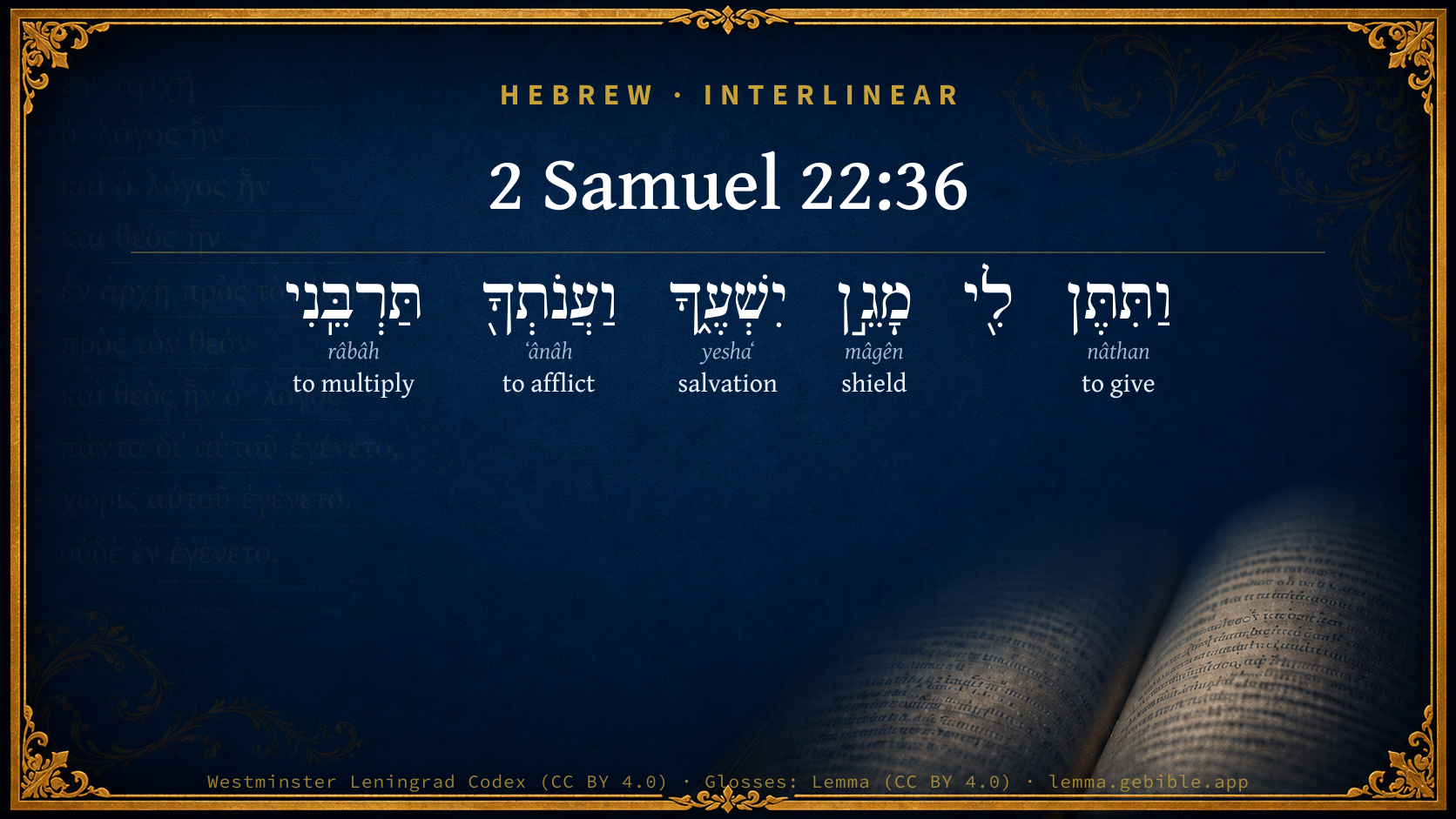
2 Samuel 22:36

Hebrew (Westminster Leningrad Codex) 2 Samuel 22:36 appears in the Hebrew Old Testament. The text above is from the Westminster Leningrad Codex. Each word links to its Strong’s number, a concise gloss, and parsing drawn from the Open Scriptures Hebrew Bible morphology. Click any word for its full Brown-Driver-Briggs (BDB) entry.
Download image
Cite this verse

2 Samuel 22:36 (World English Bible). Public Domain. Lemma interlinear Bible study tool, https://lemma.gebible.app/v/2-samuel/22/36.

Show BibTeX & RIS
BibTeX
RIS
English Translation
You have also given me the shield of your salvation; Your gentleness has made me great.
World English Bible · Public Domain
Download a study sheet

One document with this verse’s original text, its word-by-word gloss line, the meaning frame, cross-references with their text, attributed commentary, and full source and license credits — printable, and it pastes into notes with its structure intact.

This verse Autodidact and up

Study sheet (.html) Plain text (.txt)

A passage Seminary Student

Up to 50 verses in one chapter. A passage sheet keeps up to 6 commentary sources and 12 cross-references per verse, in the order this page ranks them, and says so on the sheet whenever that leaves anything out. Ask for a single verse and you get the Autodidact verse sheet above.

Everything on this page stays free to read, with no account — the sheet is a download of what is already on screen, not access to it.

Want to remove ads? Support Godless Engineer
Compare translations 3

The same verse in 3 English versions, stacked beneath the original-language interlinear above. Click any original word for its lexicon entry.

Each is an independent rendering of the whole verse — the interlinear is not word-aligned to these translations.

Highlighted words mark where these versions differ — a whole-verse word diff, not a word-by-word alignment.

  • World English Bible Public Domain
    You have also given me the shield of your salvation; Your gentleness has made me great.
  • King James Version Public Domain
    Thou hast also given me the shield of thy salvation: and thy gentleness hath made me great.
  • unfoldingWord Literal Text CC BY-SA 4.0
    And you give to me the shield of your salvation, and your answer makes me great.

unfoldingWord Literal Text — © unfoldingWord, licensed CC BY-SA 4.0. Word-aligned USFM3 via Door43 (git.door43.org/unfoldingWord/en_ult).

Versions to compare (up to 4)

3 of 4 selected

Show all 18 translations

Every available English version of this verse, each an independent rendering of the whole verse.

  • World English Bible Public Domain
    You have also given me the shield of your salvation; Your gentleness has made me great.
  • Berean Standard Bible Public Domain
    You have given me Your shield of salvation, and Your gentleness exalts me.
  • Majority Standard Bible Public Domain
    You have given me Your shield of salvation, and Your gentleness exalts me.
  • King James Version Public Domain
    Thou hast also given me the shield of thy salvation: and thy gentleness hath made me great.
  • American Standard Version (1901) Public Domain
    Thou hast also given me the shield of thy salvation; And thy gentleness hath made me great.
  • Revised Version (1885) Public Domain
    Thou hast also given me the shield of thy salvation: and thy gentleness hath made me great.
  • Geneva Bible (1599) Public Domain
    Thou hast also giuen me the shield of thy saluation, and thy louing kindnesse hath caused me to increase.
  • Douay-Rheims (1899) Public Domain
    Thou hast given me the shield of my salvation: and thy mildness hath multiplied me.
  • Young's Literal Translation Public Domain
    And Thou givest to me the shield of Thy salvation, And Thy lowliness maketh me great.
  • Literal Standard Version CC BY-SA 4.0
    And You give the shield of Your salvation to me, || And Your lowliness makes me great.
  • Unlocked Literal Bible CC BY-SA 4.0
    You have given me the shield of your salvation, and your favor has made me great.
  • unfoldingWord Literal Text CC BY-SA 4.0
    And you give to me the shield of your salvation, and your answer makes me great.
  • Darby Bible Public Domain
    And thou didst give me the shield of thy salvation, And thy condescending gentleness hath made me great.
  • World Messianic Bible Public Domain
    You have also given me the shield of your salvation. Your gentleness has made me great.
  • Webster's Bible Public Domain
    Thou hast also given me the shield of thy salvation: and thy gentleness hath made me great.
  • Free Bible Version CC BY-SA 4.0
    You protect me with the shield of your salvation; your help has made me great.
  • Bible in Basic English Public Domain
    You have given me the breastplate of your salvation, and your mercy has made me great.
  • JPS Tanakh (1917) Public Domain
    Thou hast also given me Thy shield of salvation; and Thy condescension hath made me great.

Literal Standard Version (2020), Covenant Press — licensed CC BY-SA 4.0. Text via the HelloAO Bible API (eBible.org). Unlocked Literal Bible (unfoldingWord) — licensed CC BY-SA 4.0. Text via the HelloAO Bible API (eBible.org). unfoldingWord Literal Text — © unfoldingWord, licensed CC BY-SA 4.0. Word-aligned USFM3 via Door43 (git.door43.org/unfoldingWord/en_ult). Free Bible Version, Dr. Jonathan Gallagher — licensed CC BY-SA 4.0. Text via the HelloAO Bible API (eBible.org).

Word by word

More ways to search: Search by grammar → Find every occurrence → Compare this word →

Practice this passage: Drill this verse → Learn its vocabulary →

About this verse

These counts appear in no published source. They are computed here, from the morphology-tagged text and Lemma’s own curated glosses. What Lemma adds →

6
words
5
distinct lemmas
Historical
section

Shared distinctive vocabulary

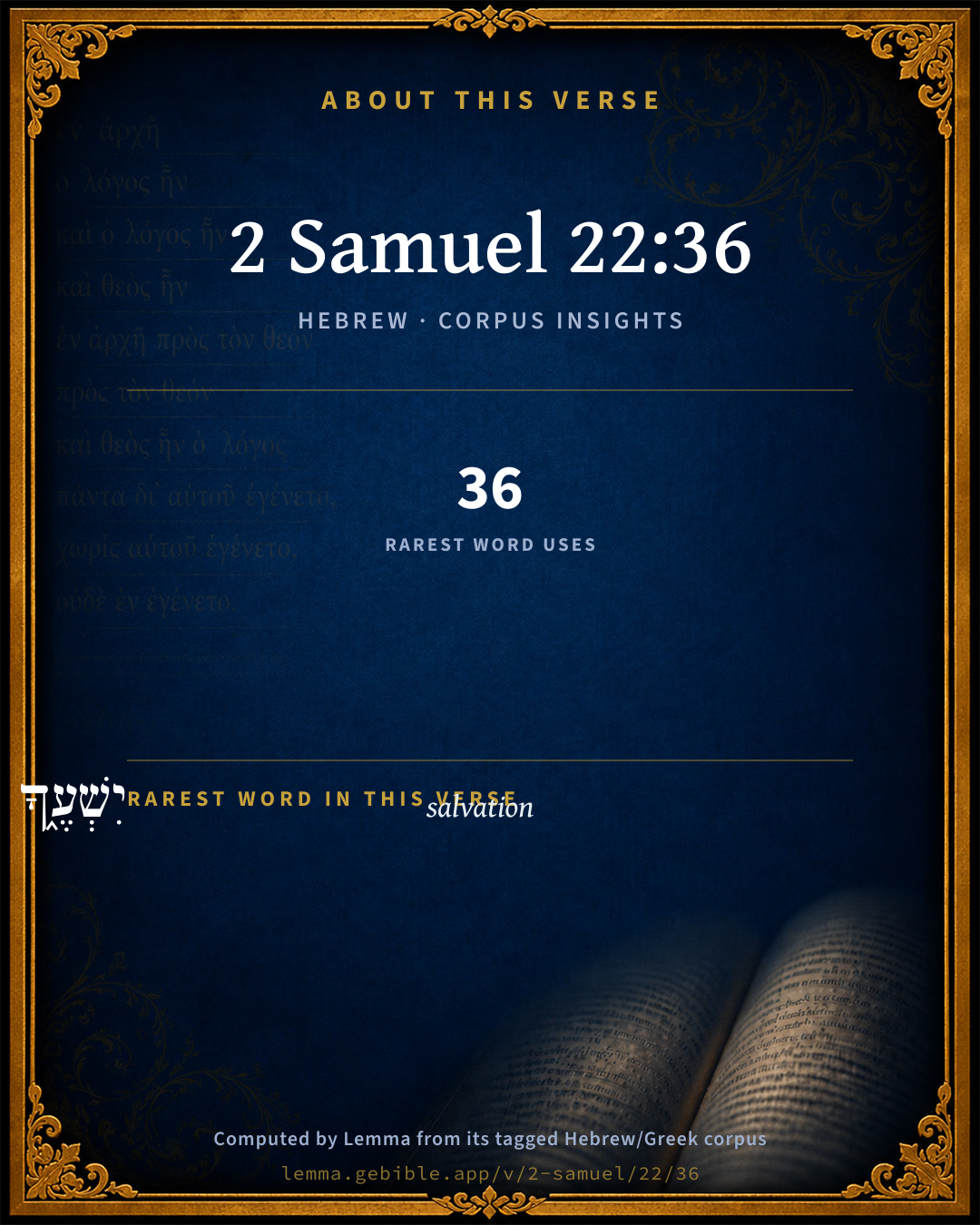
יִשְׁעֶ֑ךָ salvation H3468 occurs in 35 verses of the Hebrew Bible. Also found in:

Grammatical profile

  • 3 verbs
  • 2 nouns
  • 1 preposition

Verb forms

  • וַתִּתֶּן Qal · Sequential Imperfect
  • וַעֲנֹתְךָ֖ Qal · Infinitive Construct
  • תַּרְבֵּֽנִי Hiphil · Imperfect

Hebrew & Septuagint length

In English translation the verse runs 16 words from the Hebrew and 17 from the Septuagint (LXX English) — closely comparable.

A rough comparison of the two English renderings, which tokenize alike — not a word-level alignment.

Word counts can differ between the Hebrew and the Greek without any difference in meaning — e.g. the Hebrew direct-object marker אֵת has no separate Greek word, and Greek often adds the article ὁ.

Cross-references

7

Topical passages linked to 2 Samuel 22:36 in the Treasury of Scripture Knowledge — connected by theme and wording, ordered by reader-vote popularity; previews shown in the World English Bible.

  • Ephesians 6:16 above all, taking up the shield of faith, with which you will be able to quench all the fiery darts of the evil one.
  • Psalms 84:11 For Yahweh God is a sun and a shield. Yahweh will give grace and glory. He withholds no good thing from those who walk blamelessly.
  • Psalms 115:14 May Yahweh increase you more and more, You and your children.
  • Psalms 18:35 You have also given me the shield of your salvation. Your right hand sustains me. Your gentleness has made me great.
  • Genesis 12:2 I will make of you a great nation. I will bless you, and make your name great. You will be a blessing.
  • Genesis 15:1 After these things the word of Yahweh came to Abram in a vision, saying, "Don't be afraid, Abram. I am your shield, your exceedingly great reward."
  • Genesis 22:17 that in blessing I will bless you, and in multiplying I will multiply your seed as the stars of the heavens, and as the sand which is on the seashore. Your seed will possess the gate of his enemies.

Cross-references courtesy of OpenBible.info (CC BY 4.0).

Hebrew and Greek witnesses Masoretic Hebrew ↔ Greek Septuagint

The same verse in the two great witnesses to the Old Testament, shown verse-for-verse.

These are two independent witnesses, not word-aligned to each other, and the Septuagint is shown in lemma (dictionary) form.

Hebrew 2 Samuel 22:36 Masoretic · Westminster Leningrad Codex

וַתִּתֶּן לִ֖י מָגֵ֣ן יִשְׁעֶ֑ךָ וַעֲנֹתְךָ֖ תַּרְבֵּֽנִי

You have also given me the shield of your salvation; Your gentleness has made me great.

World English Bible · Public Domain

Greek LXX 2 Samuel 22:36 Septuagint · lemma form

καί δίδωμι ἐγώ ὑπερασπισμός σωτηρία ἐγώ καί ὁ ὑπακοή σύ πληθύνω ἐγώ

And you have given me the shield of my salvation, and your propitious dealing has increased me,

LXX2012 (modern English Septuagint) · Public Domain

Hebrew: Westminster Leningrad Codex (CC BY 4.0). Greek: Septuagint (public domain); English from LXX2012 (modern English Septuagint) (Public Domain). How the Septuagint differs from the Hebrew →

Targum (Aramaic paraphrase)

1

The Targum is the ancient Jewish Aramaic paraphrase of the Hebrew Scriptures — an interpretive translation, not the Hebrew text itself. Onkelos (literal) and Pseudo-Jonathan (expansive) render the Torah, and Jonathan the Prophets. Coverage is partial: where no permissively-licensed English translation exists for a verse, only the Aramaic is shown. This is verse-level text, not a word-by-word alignment to the Hebrew.

  1. Targum Jonathan Prophets (Joshua–Malachi)
    וִיהַבְתְּ לִי תְּקוֹף וּבְפוּרְקָנָךְ וּבְמֵימְרָךְ אַסְגִיתַנִי:

    (no public-domain English translation for this verse)

    Targum Jonathan — Aramaic: “Mikraot Gedolot” (public domain). English: “Sefaria Community Translation” (CC0 1.0 (public-domain dedication)); “London "Chaldee Paraphrase," 1871” (public domain). Text via Sefaria.

Commentary

Notes on 2 Samuel 22:36 from classic Christian and Jewish commentators (each source and its license shown beneath its notes). The classic Christian expositions comment on the surrounding passage and are grouped to its opening verse, so a note may address several verses; the Jewish commentaries on the Tanakh (Rashi and others) are per-verse, so they appear only where the commentator wrote on this verse.

Lemma curates 59 commentaries, every one of them public domain or Creative Commons licensed, each selected and text-cleaned for this edition rather than reprinted as found. About our sources →

The Biblical Illustrator

Joseph S. Exell

2Sa_22:36

Thy gentleness has made me great.

The real greatness of man

David spake unto the Lord the words of this song on the day when he had emerged victorious from all his struggles. It is the story of a life written and set to music by the man who lived it. It is not a piping song of peace, green pastures, and still waters, like some of those tender lyrics which came from the same pen. It deals with rougher and fiercer scenes, and resounds with the clash of arms and noise of battle. It is such a song as St. Paul might have sung, and did sing, when, on the eve of martyrdom, he looked back on his ministry; such a song as every Christian would wish to raise when lifes little day is near its close, and he is waiting in the shadows for another and fairer morning. Now these are the words of every man who takes a truthful reading of the facts of life, who views his lifes doings and gains in vile searching light of God. The great mind always clothes itself in humility, because it takes a true estimate of self, and disdains to walk in a vain show. In spite of his sins, awful blunders, and moral falls, David stands out in huge bulk as one of the worlds master minds; a far-seeing statesman, a gifted thinker and poet, a brilliant soldier, a man of charming personality and winsome attractiveness, a man of infinite patience and unwearying energy, and every inch a king. If he had been a vain man, what a loud story he would have told of his own mighty doings and conquest of difficulties; how loftily he would have carried himself among his throngs of courtiers and flatterers. If there is genius it is heaven-born, not self-wrought. If there is the weighty brain and the keen, far-reaching vision and the indomitable will, they are talents bestowed upon us unasked for, and not digged and coined by our own hands. If your stature is six feet are you to look down with supercilious disdain upon that other piece of humanity which is six inches lower, as if you yourself had manufactured the extra six inches? Ii you have had a brilliant career and succeeded in everything to which you have set your hands, are you to strut about as a little god, forgetting whence came all the powers and gifts of fortune which carried you to victory? A man of Davids build knows better than this, because his eyes are opened. The Bible has the greatest contempt for self-important people. Think how it lashes them with the whip of scorn. Its Pharaohs in their Egyptian palaces; its Rabshakehs, with their insolent bravado, boasting as if all the world belonged to them, and as if they could defy omnipotence; its Nebuchadnezzars walking about Babylon and calling upon all men to behold the grandeur of their doings and the majesty of their wisdom; its Herods arrayed in gorgeous robes and flaunting themselves in unholy pride as if they sat on the throne of God. How the Bible scouts and scorns these marionettes that dance for a moment on the worlds tawdry stage and mouth-inflated speeches as if they were hardly less than the Almighty. The saints of God were always like David in this one thing. There is not a man in the Bible story worth reading of who was not stamped with this characteristic feature. They had a hundred faults, but the sin of over-estimating their importance was never one of them. They had measured themselves, not with human tape-lines, but with Gods larger rule. And this was the language in which they all wrote the story of their lives--I am not, worthy of the least of all the mercies which the Lord my God has bestowed upon me. Thou hast given me the shield of Thy salvation, and Thy gentleness hath made me great. The gentleness of God: what is it? It is almost indefinable, but something which the heart can feel and understand. The gentleness of man is the most winsome of human attributes. It is strength forgetting its strength and becoming tender as a kiss and soft as a sunbeam. You see it in the old oft-told story of Hector, the Greek warrior, doffing the helmet which frightens the child, and stooping down with smiling face and velvet touch to caress and bless the child. You see it in the soldier with iron arm and mighty heart kneeling over the feeblest wounded thing and soothing it with touches soft and tearful as a childs. You see it in the mothers face as she bends over her sick and helpless infant. You see it more than all in the picture of Christs healing ministry when He lays His mighty hand, soothing and calming, upon the diseases and sicknesses of men. There is always something of unconscious stooping and condescension in it; something very high, and perhaps mighty, that puts off it, s mightiness to help and bless. That is human gentleness, and that is the gentleness of God, which makes us great. Infinitely more than all this to you is the fact that God is lowly enough to think of you, to care for you, to follow you with watchful eyes, to take any trouble with you at all. If we possessed the whole world, if we had each the genius of a Shakespeare or Milton or David, it would not give us as much right to exalt ourselves as the simple fact that we can pray to God, that it is not a waste of words, a flinging out of something into the dark, a piece of self-deceiving, but that prayer is a reality, the real talk of a real man with a real Almighty God. Think of it! It almost transcends thought. The wonder of it is unspeakable. And our greatness, if we have any, is in the fact that, He thinks us worth caring for, worth teaching and training and leading on to all goodness that we may dwell with Him and enjoy Him for ever. (J. G. Greenhough, M. A.)

Lifes most honourable distinction

The writer is reviewing the experiences of an eventful career, and uttering his thankfulness in song as he traces the work of Gods hand in all the tumultuous and trying scenes that went before the day of kingly rest. He teaches us what should be:

I. The peaceful reflection rewarding every earnest life. Thy gentleness hath multiplied me. The words are not spoken in the midst of strife, yet with the vivid recollection of many toils and sorrows attending on the career of one who spared not himself in seeking to gain an object which he considered to be of God. He had been in earnest, not afraid to sacrifice considerations of momentary ease for future and wider good; not erecting the boundary wall of personal advantage so high as to darken the heaven-born interests of the people. In commending sacrifice he had known how to be a sacrifice. The man after Gods own heart and given himself for the attainment of what he knew to be dear to Gods heart, and the reward came to him, as all real and spiritual rewards do come to faithful man, in the form of his own reflections upon what he had been or had tried to be. Happy are they who, on looking down the avenue of an eventful life, can trace all strength to resist and to achieve, all wisdom to choose and to avoid, all victory and honour, all wealth and distinction and blessing, to their proper source, and say, Thy gentleness hath made me great.

II. A correct explanation of lifes best success. When common battles are won, and ordinary mountain paths climbed, and men are seen standing high above their fellows who are still contending with difficulty and toiling hard to carry burdens, the question is asked, What made them great? And to such a question the world about us is generally ready with its answer. Fortune made this man great. It was a mere accident, a stroke of chance over which he had no control. Or, It was natural perseverance. He had no temporal advantage or native brilliance, but he was natures tortoise, who kept right on and won the race. The secret of anothers distinction is given as Self-reliance. With almost unlimited belief in himself, he contrived by force of will to make others accept him at his own valuation. He made himself great. Another was born to greatness. Inherited wealth and courtly favour caused his earliest footprints to be made on flowers, and all the world seems to have conspired to lift him upward into radiance and honour. He is great because he could not possibly be otherwise. Either one of these sayings may account for something which is seen in the lives of men, but the further question arises, Is it greatness that is here explained? Do these by virtue of any position thus achieved or held, really possess greatness? It is very possible for those who live in the eastern counties to think they reside amongst hills, until they go to Cumberland or Wales, and for these to boast of mountains until they have seen Switzerland or Northern India. Is there not an ennobling of the whole idea of greatness in human life which is possible to us after the manner of such experience? May not the popular conception be dwarfed by admitting a Divine thought just as sandhills become insignificant and poor to him who looks on Alps and Himalayahs? The Christians hope for the world is in the adoption of a corrected estimate. He sees that fortune, perseverance, self-reliance, wealth, and favour, good and right, as each one in its place must be, give, when they are alone, only sandhills, and that towering far above them all there is a snow-capped mountain life; spiritually more noble, and eternally beautiful, in love to God, and reliance on his gentle favour.

III. The loftiest principle on which to build our life. When Davids throne was established in the hearts of a united and loyal people, he began to seek a worthy place for Gods tabernacle. His heart was set on the noble height of Zion, and he obtained it. How much of lifes sorrow and humiliation might remain untasted, if we were as careful in choosing a foundation on which to build our character and life! Of all the claims asserted in our hearts, one stands supreme. It is the need of our nature to lay the beginnings of its strength on the rock of Divine security. Human life needs that God should give it a resting-place.

IV. The old Gospel of the Church. It is old. It is older than Israels march through the wilderness, or Abrahams declaration of faith, or Noahs gentle preaching of a righteous life; it dates from before the mission of the angel who guarded the tree of life. The old, old story is the compassion of Jebovah, the gentleness of the Eternal. It is the old Gospel. And yet how delightfully, sadly, strangely new! How vast the field of human life where there is no speech or language setting it forth convincingly! God apparently speaking an unknown tongue, and man untouched by the sweetest music that ever tried to charm and elevate his life! (W. H. Jackson.)

The work of gentleness

These words look back to the pasture lands of Bethlehem; to the fights with the bear and the lion; to the valley of Elah, where he met Goliath; to the palace of Saul, where his friendship with Jonathan grew, and to the caves and fastnesses where he hid from Saul, and to Ziglag and Hebron. They look back over all his troubles, and upon all the deliverances which the Lord wrought out for him, and over all the way by which the Lord had brought him. They gather up into their brief utterance all the song of the great King David, when he recounted his greatness, and reveal at once the secret of his greatness and the heart of his song. The gentleness of God: that was the secret of his greatness. Thy gentleness hath made me great: that was the heart of his song. David was well acquainted with God. He knew Him as few human souls have done. He knew Him out to the length and breadth of what the human soul can grasp of God. He knew Him as the Judge who doeth terrible things in righteousness. He knew Him as the Creator, by whose might the heavens were built, and the everlasting mountains rooted to the earth. In this very psalm he refers to powers and manifestations of God which make man tremble: There went up a smoke out of his nostrils and fire out of his mouth devoured. He thundered. He sent out arrows and lightnings. The channels of the sea appeared. The foundations of the world were discovered at the rebuke of the Lord. David knew all that. He had seen all that. But when he comes to consider his own life, and all the way he had been led, it is to the gentleness of God he turns. His gentleness, not his strength; his gentleness, not his terrors, had made him what he was.

I. The gentleness of god! It is the secret spring of all the worth to which the great ones of Gods kingdom have ever reached. It nourished the life of Abraham in all his wanderings, and was in his thoughts when he told how the God of heaven took him from his fathers house, and promised tile land in which he was a stranger, to his seed. It sustained Moses in his, mighty enterprise, and was in his teaching when be told the Israelites that God was the Rock of their salvation, and when he recited in their hearing the beneficent wonders which had been wrought for their deliverance. And, long centuries after, it is to the same rich spring the peerless life of the Apostle Paul is traced: I am what I am by the grace of God. Great Paul! Great David! Great lawgiver of Israel! Great father of the faithful! Great as men, great as ministers of God; great in thought and word and deed! But, lo! they cast their crowns at the feet of God. The summing up of the life of each is this: Thy gentleness hath made me great. In our studies of saintly life we are apt to think that we have come on the secrets of spiritual greatness when we find faith, or prayer, or zeal for God, or deep acquaintance with His Word, or lips eloquent in His Gospel, or self-denial, or love. But these very qualities are results. Above them and underneath them all are the clews and fountain springs of the gentleness of God. Consider also the greatness of the men whose names are associated with the mighty developments of thought and life in the Church--men like Augustine, Bernard, Huss, and Luther; in our own country, like Anselm, Wiclift Knox, and Wesley--and the thousand thousands, whose names were never named on earth for greatness, who yet were as great in Gods sight as these. What faith in God, what love for souls, what perseverance in tasks for which there was no praise on earth, what unquailing courage, what hoping against hope, as fellow-workers sank exhausted at their side; and, greater than all, what lowliness and meekness of heart! What was the secret of such manifold greatness? Not one would say: My genius, or my learning, or my eloquence, or my creed. But one and all, with an irrepressible throb of gratitude, would exclaim, Worthy is the Lamb! And for souls truly great, whether as workers on earth, or worshippers in heaven, this is and must be the everlasting song. For it is this gentleness of God, this mercy He shows to men, this generosity, pity, forbearance, and love of the Divine heart, which is the source of all the excellence, worth calling great, to which human beings have ever reached. It is, indeed, the very beginning and possibility of spiritual life itself. Not one of all that multitude could have risen into the Divine presence, or attained the position of a worshipper, if God had marked iniquity against him. He had to bear with them, pardon them, again pardon them, thousands of times pardon each one of them. He had to fence them in by ordinances, laws, and spiritual helps. But do I require to appeal to the histories of the redeemed in heaven, or to the lives of saintly thinkers and workers in former centuries, to illustrate this fact?

II. I shall appeal to the experience and testimony of Christs people. To be what you arc Christian men and women--is the greatest attainment of human life. Except Christs own, there is no greatness to be named by its side. And in a sense it is Christs greatness. Can you reveal the mystery of your possession of it? What force separated you from the world and the life of the world, and drew you to the side of Christ, and filled you with that life in Him in which you are rejoicing now? The very instincts of Christian life within you make you impatient to say: Not unto us, O Lord: to Thee be all the glory: in Thee are the springs of our life: it is Thy gentleness which has made us great. Can you ever forget, that hour when the fact first flashed in upon your spirit that you were a lost soul? You recollect the horror of great darkness which fell upon you then. But you also remember the vision of gentleness in tile cross, and how, little by little, it was borne in upon your spirit that there was forgiveness with God, forgiveness even for you. Speak next, you who have been smitten by great affliction. What is your testimony respecting the mystery of Christian life? No one knows better than you how near despair the human heart can be driven by sorrow; nor how unbelief, black and terrible, can come on the wings of a great despair. You have felt the cold touch of that despair. Who shall describe the black thoughts, or the rebellious impulses of despair like that? Shadows of spiritual death, ghastly fancies from the pit, rising, swelling, spreading over the whole life and darkening and eating it up, as clouds of locusts darken and eat up the joy of harvest! You felt all that: you gave way to all that. And vet--here is the gentleness of God to you--you are still on Gods side; you are still believers in his love. The evil thoughts were not permitted to triumph over you: the black despair was not allowed to suck out your life. A healing hand was laid on your wounds. Your very sorrows have made you cleave more closely to his love. By the very things you have suffered you have climbed higher into his kingdom, and from the height to which his mercy has raised you, your daily song is, O Thou Helper of the helpless: Thy gentleness hath made us great.

III. Of this gentleness which maketh great, Christ is the manifestation to us. He is that very gentleness itself. God so loved the world that He gave His only begotten Son. He is a God so gentle that He would not leave the sin-filled world to perish. Out of His gentleness He gave us Christ. What men first saw in Him was the Lamb of God, Who taketh away the sin of the world. The very symbol by which He was revealed is one which at once expresses His gentleness, and the depths into which that gentleness led Him for our sakes. The work Christ came to accomplish was the bestowal of gentleness on a world, which had lost the very elements of it. He came to put away a life of pride and unbelief and hatred from the human heart, and put his own life of humility, faith, and love in its place. Christs coming into the world, therefore, was the advent of gentleness. It was heaven stooping to the earth to heal the wounds which sin had made. It was the great God taking up His home among the creatures who had rebelled against Him, that He might raise them and bring them back to His love. It is this quality of gentleness which makes Christs earthly life so beautiful. The death of Christ is the most touching exhibition of gentleness the world has ever known. The light, which shines from the cross is the gentleness of God. One of the gentlest deeds recorded in the Old Testament is Davids dirge over the dead Saul. He folded in beautiful words the memory of the man who sought his death, and taught the people to remember him as the beauty of Israel. But the gentleness of Jesus sounded a profounder deep. In the yearning pity of His heart He wrapped His living enemies in His prayers, and carried them up and laid them on the breast of mercy: Father, forgive them, for they know not what they do. A poor prodigal once went out into the glooms of evil and made himself base with the base, and vile with the vile, and hateful, and irreverent, and cruel. And all the world turned from him, and put his name, away from their lips. All but one. She still clung to his name, she still interested herself in his life. She followed him into the darkness. She went in and down into the deepest, thickest, foulest darkness, and owned him there, and laid her hands on him, and her lips to his lips, and her heart to his heart, that she might lead him back. Oh, the gentleness of a mother! But the gentleness of Jesus transcends even that of a mother. The prodigal He came to save would have none of His love. His sins were an insult to Him: his merciless speeches stabbed Him: he filled the air with the cruel demand to Crucify Him. It lay in the work Christ came to fulfil, that it could only be finished in the shadow of death. Into that shadow, therefore, He passed. Through the insults, through the hatred, through the shame and the agony, through the very jaws of hell, into the fires of a most painful death. He passed;--and there, with the gentleness of a Divine mother, laid His hand on the hand, His heart on the heart, of the very race which crucified Him, that He might overcome their enmity and bring them back to God.

IV. And this is still the greatness of Christ as a Saviour, and His power over the hearts of men. He is strong to save because he is long-suffering and merciful and generous. We are surprised when we read, While we were yet sinners Christ died for us; but it is the same wonder of mercy, the same manifestation of gentleness, that lie still lives to save His enemies. Christ is still the same in His gentleness. On the throne as on the cross, He is the gentleness of God towards men. His reign is the reign of gentleness. His intercession within the veil is the appeal of gentleness. It is because He is the gentle Jesus that He intercedes with God for man and with man for God. Exalted though Christ now is, His works as a Saviour are still the same in their gentleness as when He ministered on earth. Still, by the ministries of His Word and Spirit, and by the hands and lives of His people, He works those works of healing and mercy which made his life on earth sublime. I saw a picture once which went to my very heart. It was the interior of a humble cottage on a lonely wild. A poor old man, a travelling pedlar, worn with exhaustion, ghastly pale and cold, is seated in the centre. You can see that he has had the very narrowest escape from death. The father of the house, casting anxious glances towards the stranger, is pouring out some cordial to revive him; the mother is bringing warm wraps, and doing it with the prompt energy of one who knows that life may depend on the haste she makes. It is only a moment since the poor man entered. The door is not yet closed. The children are peering out awe-struck into the night. The snow-flakes, falling through the light, reveal and measure back the terrible gloom outside. A wild night is upon the earth; a night of blackness and blinding snow! And this old man had been caught in the storm, and had to fight, with death in the darkness, and, at the very eleventh hour of the conflict, exhausted and utterly worn, had sunk against the door of this hospitable home. He was a stranger, and they took hint in. It was the picture of a gentle deed. But the gentleness of Jesus, in saving the souls of men, no human picture could portray. He goes out into the darkness, out into the snows and wastes and storms of sin, to seek the wanderers and the lost, to lift them, in his arms and bring them in. It is this gentleness which has been laid on the heart of the Church in the command. Go ye into all the world, and preach the Gospel to every creature. What are all the ministries of mercy in Christian life, but the outflow of this gentleness? The gentle Saviour still lives, and in His gentleness is the very life and mercy of God to men. He is near to each of us. O hearts of men and women, Christ is the Saviour for you! Open wide your doors, and let the King of Glory in. He is the gentlest, lovingest, helpfulest Friend we can have. He will not break the bruised reed; He will not quench the smoking flax! (A. Macleod, D. D.)

The gentleness of God

Life holds no motive for stimulating gentleness in man like the thought of the gentleness of God. Unfortunately, it seems difficult for man to associate delicacy and gentleness with vastness and strength. It was the misfortune of Greek philosophers, and is, indeed, that of nearly all the modern theologians, to suppose that a perfect being cannot suffer. Both schools of thought conceive of God as sitting upon a marble throne, eternally young, eternally beautiful, beholding with quiet, indifference from afar how man, with infinite blunderings, sufferings, and tears, makes his way forward. Yet He who holds the sun in the hollow of His hand, who takes up the isles, as a very little thing, who counts the nations but as the dust in the balance, is also the gentle One. Like the wide, deep ocean, that pulsates into every bay and creek, and blesses the distant isles with its dew and rain, so Gods heart, throbs and pulsates into the uttermost parts of the universe, having a parents sympathy for His children who suffer. Indeed, the seer ranges through all nature, searching out images for interpreting His all-comprehending gentleness. Even the bruised reed He will not break. Lifting itself high in the air, a mere lead-pencil for size, weighted with a heavy top, a very little injury shatters a reed. Some rude beast, in wild pursuit of prey, plunges through the swamp, shatters the reed, leaves it lying upon the ground, all bruised and bleeding, and ready to die. Such is Gods gentleness that, though man make himself as worthless as a bruised reed, though by his ignorance, frailty, and sin he expel all the manhood from his heart and life, and make himself of no more value than one of the myriad reeds in the worlds swamps, still doth God say, My gentleness is such that I will direct upon this wounded life thoughts that shall recuperate and heal, until at last the bruised reed shall rise up in strength, and judgment shall issue in victory. (N. D. Hillis.)

The need for gentleness

When a candle is newly lighted and needs to be moved, it must be carried at a slow pace or it will be extinguished. A fire which is almost expiring may be revived by a gentle breath, but it will be blown out if the bellows are plied at their full force. You can drown a little plant by watering it too much, and destroy a lovely flower by exposing it to too much sun.

Gods gentleness restraining

A lady visiting Germany was surprised to find in the midst of a city a lovely little garden of flowers, quite unprotected, at the base of a huge equestrian statue. Remarking that here in England such an experiment would be very tempting to the children, the startling answer was given, Why, the reason the flowers were planted was to save the statue from the childrens destructive attentions. They were constantly mounting the back of the horse, and occasionally falling off from it; but since the flowers have been here there has been no more trouble. Such is the German childs love for flowers, and fear to hurt anything living, that they form a perfectly sure protection to anything round which they are planted. When our hearts are right with God, it is His very gentleness and love that saves us from sin and folly; the thought that He might be grieved is an effectual barrier against offences. Thus His gentleness makes us jealously careful, as well as great. (H. O. Mackay.)

The Biblical Illustrator, edited by Joseph S. Exell (c. 1880s–1900s) — public domain. Text from a community e-Sword module.

Ellicott's Commentary for English Readers

(36) Thy gentleness.—This is the translation of the word in Psa_18:35. The word here, which differs very slightly, and is otherwise unknown, is undoubtedly meant for it; if taken as it stands it would, by its etymology, mean thy answering, viz., to the prayers offered. The psalm inserts between the two clauses of the verse, “and thy right hand hath holden me up.”

A Bible Commentary for English Readers, edited by Charles John Ellicott (1878–1897) — public domain. Text from a community e-Sword module.

The Cambridge Bible for Schools and Colleges

gen. ed. J. J. S. Perowne

36. the shield of thy salvation] Cp. Eph_6:17. Psa_18:35 adds, “and thy right hand sustained me.”

thy gentleness] This is a rendering of the word used in Psa_18:35, which means gentleness or condescension: but the reading here is different, and probably means thy answering, i.e. thy answers to my prayers for help.

The Cambridge Bible for Schools and Colleges (gen. ed. J. J. S. Perowne; Cambridge University Press, 1878–1918) — public domain. Text from a community e-Sword module.

Whedon's Commentary on the Bible

Daniel D. Whedon

36. Shield of thy salvation — The protection and defence which salvation from God affords.

Thy condescension — Thy clemency and self-humiliation in deigning to notice me so much. Such favour openly bestowed makes me great in the sight of all men.

Daniel D. Whedon (gen. ed.), Commentary on the Old and New Testaments (1874–1909) — public domain. Text from a community e-Sword module.

The Pulpit Commentary

True greatness.

answering hath made me great." Isa_18:3-5, "Thy gentleness" (humility, meekness, condescending grace). True greatness consists not in external prosperity, nor in splendid achievements, but in moral and spiritual excellence. "The good alone are great." Notice

I ITS CONDITIONS, on the part of man.

1. Conscious weakness, the sense of utter helplessness in himself (1Sa_30:1-10; Joh_15:5; 2Co_12:10; Heb_11:34)

2. Believing prayer (ver. 7). "By showing us our own nothingness, humilityforces us to depend upon God; and the expression of that dependence is prayerfulness.

3. Ardent aspiration. "When sea water rises into the clouds it loses itssaltness and becomes fresh; so the soul when lifted up to God" (Tamil proverb).

II ITS BESTOWMENT; by "that practical hearkening on the part of God when called upon for help, which was manifested in the fact that God made his steps broad" (Keil).

1. In wonderful condescension. (Psa_138:6)

2. By manifold methods; preserving, instructing, strengthening, exaltingthose who trust in him.

3. With considerate adaptation to their nature and capacities. "The greatGod and Father, intent on making his children great, follows them and plies them with the gracious indirections of a faithful and patient love" (Bushnell, "Christ and his Salvation"). "Like as father" etc.. (Psa_103:13)

III ITS MANIFESTATION. As the effect of sunshine and rain, received and appropriated by a plant, appears in its abounding strength, beauty, and fruitfulness, so the effect of Divine grace appears in enlargement and elevation of mind, sincere and fervent love to God, a set purpose to do his will, eminence in "love, joy, peace, gentleness," etc., (Gal_5:22) maturity of character, (Hos_14:5-7) holy and beneficent activity, growing conformity to the perfect Pattern of true greatness. (Mat_20:25-27) "Have the mind in you which was also in Christ Jesus". D. (Php_2:5)

Greatness from God"s condescension.

gentleness hath made me great." David had been raised from a humble position to one of greatness. He had become great in arms, in royal dignity, in the extent of his dominion. In these words he ascribes all his greatness to the condescending goodness of God. The word translated "gentleness" is elsewhere used only of men, and signifies "humility". (Pro_15:33 Pro_18:12 Pro_22:4) But in speaking of God, we use the word "condescension" rather than "humility." Yet it is said of him (Psa_113:6) that "he humbleth himself to behold the things that are in heaven and in the earth;" i.e. he stoops to regard them; it is condescension in him to notice them. The words of the text may be used by all Christians; especially by some of them.

I THE GREATNESS TO WHICH CHRISTIANS ARE EXALTED.

1. All of them are made great. For they are made:

(1) Sons and daughters of the great God, brothers and sisters of Jesus the Son of God, having a nature corresponding with the names. They are "partakers of the Divine nature", (2Pe_1:4) and therefore God like, in holiness, righteousness, and love.

(2) Wise with heavenly wisdom. A nobler wisdom than that of philosophers. "Taught of God", (Joh_6:45) who reveals to them what he hides from the worldly wise. (Mat_11:25)

(3) Powerful with the noblest power, that which is moral and spiritual, by which they "overcome the world", (1Jn_5:4) rule their own spirits, (Pro_16:32) and subdue others to the obedience of faith.

(4) Friends and associates of the best of God"s creatures holy angels and redeemed men; with whom they form one family. (Eph_3:15)

(5) Heirs, and at length possessors, of a grand and enduring estate. (1Pe_1:4) These things are not mere names or fancies; they are solid and enduring realities, to have the lowest place and the humblest share in which is, in the nature of things, to be greater than the greatest of earthly dignitaries who have no part in them.

2. Some of them are made specially great. They realize, in a larger measure than others, the various elements of greatness mentioned above. They have more of God in them; and hence are richer in spiritual wisdom and goodness, exercise a wider and stronger influence, do a greater work, attain to greater honour and renown in this world and the next. Apostles, martyrs; eminent teachers, evangelists, missionaries, and reformers; monarchs, too, and statesmen, poets, etc., who are also devoted Christians. Such special greatness arises sometimes and in part from:

(1) Greater natural endowments. More of physical energy, or intellectual power, or emotional force, to begin with.

(2) Or greater opportunities, which may be such as rank and fortune give, or the state of things around them, or such as poverty, affliction, and persecution afford.

(3) Special earnestness, faithfulness, and diligence in the cultivation and employment of powers and opportunities. (Luk_19:16-26)

(4) Special prayerfulness. Hence abundant impartation of the Holy Spirit, the Source and Sustainer of all spiritual excellence.

(5) Deeper humility. Without this all seeming greatness is not greatness at all "in the kingdom of heaven," and will shrivel into nothingness (Mat_18:1-4; Luk_9:48 Luk_14:11)

II TO WHAT SUCH GREATNESS IS TO BE ASCRIBED, AND IS ASCRIBED BY THOSE WHO ATTAIN TO IT. To the condescension of God. David recognized that all his greatness was owing to the goodness and power of God, and in their exercise on his behalf he discerned unspeakable condescension. Similar should and will be the feeling of all who are raised to spiritual greatness.

1. The work of God in their exaltation is a work of condescension. This appears as we consider:

(1) His greatness and holiness, and their littleness and sinfulness (Ps 8; Isa_57:15) God must stoop to reach and raise such creatures.

(2) His various operations upon and for them. When we consider what is involved in the Divine processes by which they are exalted, they resolve themselves into attention (so to speak) to, and animating or controlling influence over, a countless multitude of small matters. Yet we shall not be astonished at this when we remember that not a sparrow is forgotten by God, and that his children "are of more value than many sparrows". (Luk_12:6, Luk_12:7) Also that great results depend on small things; and that, in fact, to the Infinite Mind there is nothing great, nothing small.

(3) And pre-eminently, the incarnation and work of the Son of God. The self-humiliation of the eternal Word in becoming man, (Joh_1:1-3, Joh_1:14) and of the God Man in lowly service to lowly people, patiently enduring the greatest indignities and most painful and ignominious sufferings, "obedient unto death, even the death of the cross" (Mat_20:28; Luk_22:27; Joh_13:2-5; Php_2:6-8)

(4) The work of the Holy Spirit. Stooping to dwell in the hearts of the mean and sinful, bearing with neglect, waywardness, resistance, and disobedience.

2. The condescension thus displayed promotes spiritual greatness. Not only as it is exercised in the ways before mentioned, but:

(1) As it is apprehended and realized. The majesty, holiness, and justice of God tend to humiliate and repress the human spirit, and discourage aspiration and effort. At best it produces only a "spirit of bondage". (Rom_8:15) But under the influence of condescending love, love is enkindled, confidence is awakened, the heart expands and enlarges, is inspired with the freedom and courage which prepare for noble service of God and man, rises heavenward and yet looks on earth with kindlier eye, and more resolute purpose to labour and suffer for its good.

(2) As it incites to imitation. Contemplating the grandeur and beauty of the Divine condescension, we become transformed into its image. We learn to stoop to the lowly and even the degraded. We are content to serve in lowly offices, if thereby we can benefit our fellow men. It no longer seems strange that we should be required "to wash one another"s feet". (Joh_13:14) And this is the way to become great. (Mar_10:43, 44) Yet we must not indulge the thought or assume the air of condescension, or we shall fail both to benefit others and to secure honour for ourselves. Rather let us accustom ourselves to think in how many and important respects we are on a level with those whose good we seek. This will produce in us genuine humility, and enable us to feel towards our brethren a brotherly sympathy which will banish the sense of superiority. G.W.

The Pulpit Commentary (1880–1919), ed. H.D.M. Spence-Jones & Joseph S. Exell — public domain. Text from a community e-Sword module.

Keil & Delitzsch

C. F. Keil & F. Delitzsch

36 And Thou reachest me the shield of my salvation,

And Thy hearing makes me great.

37 Thou makest my steps broad under me,

And my ankles have not trembled.

The Lord bestows the true strength for victory in His salvation. The shield of salvation is the shield which consists of salvation, of the helping grace of the Lord. ענתך, for which we find in the psalm ענותך, thy humility, i.e., God's condescending grace, does not mean "thy humiliation," but "thy hearkening," i.e., that practical hearkening on the part of God, when called upon for help, which was manifested in the fact that God made his steps broad, i.e., provided the walker with a broad space for free motion, removing obstructions and stumbling-blocks out of the way. God had done this for David, so that his ankles had not trembled, i.e., he had not been wanting in the power to take firm and safe steps. In this strength of his God he could destroy all his foes.

Keil & Delitzsch — Biblical Commentary on the Old Testament (1861–1891) — public domain (CC PDM 1.0). Text via the HelloAO Bible API. (Old Testament only.)

unfoldingWord translationNotes

Door43 World Missions Community

General Information:

David continues his song to Yahweh.

the shield of your salvation

David compares Yahweh's power to save him to a shield that protects a soldier from his enemy. (See: Metaphor)

your favor

God answered David's prayers and granted him blessings and success over his enemies.

You have made a wide place for my feet beneath me

Yahweh has put David in a safe place where his enemies cannot trap him. Here he refers to himself by his "feet" to emphasize his ability to stand securely. (See: Synecdoche)

translationWords

shield

save

favor

unfoldingWord translationNotes — © Distant Shores Media and the Door43 World Missions Community, licensed CC BY-SA 4.0. Source: git.door43.org/Door43/en_tn.

Rashi

Rabbi Shlomo Yitzchaki (Rashi)

You have been abundant for my sake with Your humility. You have been abundant for my sake, with Your humility.

Rashi on the Tanakh — English translations: “The Judaica Press complete Tanach with Rashi, translated by A. J. Rosenberg” (CC BY 4.0); “Pentateuch with Rashi's commentary by M. Rosenbaum and A.M. Silbermann, 1929-1934” (public domain); “The Metsudah Tanach series, Lakewood, N.J” (CC BY 4.0); and “The Book of Joshua, Metsudah Publications, 1997” (CC BY 4.0). Text via Sefaria.

Lesson kit

Teaching starters — assembled from the data on this page, not authored interpretation. Every prompt links to the verse data it draws on. Edit before teaching.

2 Samuel, in the Historical, opens this verse with 6 words (5 distinct Hebrew lemmas). Its most distinctive word is yeshaʻ (“salvation”). A historical commentator’s framing appears above. Read the whole chapter for the surrounding context.

Discussion questions

  1. The word yeshaʻ carries the sense “salvation.” How does it shape the verse?
  2. 2 Samuel 22:3 shares the word «salvation» with this verse. How do the two illuminate each other?
  3. These translations render this verse differently; the difference is in the English rendering, not the original. What questions does that raise?
  4. The verb «וַתִּתֶּן» is Qal Sequential Imperfect. How does its form color the action?
  5. Reading how The Biblical Illustrator and Ellicott's Commentary for English Readers read this verse, where do the two commentators agree and where do they part?

Things to notice

Reading settings

Reading text

Shown beneath each verse's original-language words.

Old Testament
Old Testament edition

Read the OT as the Masoretic Hebrew (MT) or the Greek Septuagint (LXX).

English shown for the Greek Septuagint (in the Hebrew ↔ Greek comparison).

Comparing translations? Open the Compare panel on any verse page to stack up to four side by side.