
Jeremiah 40:12

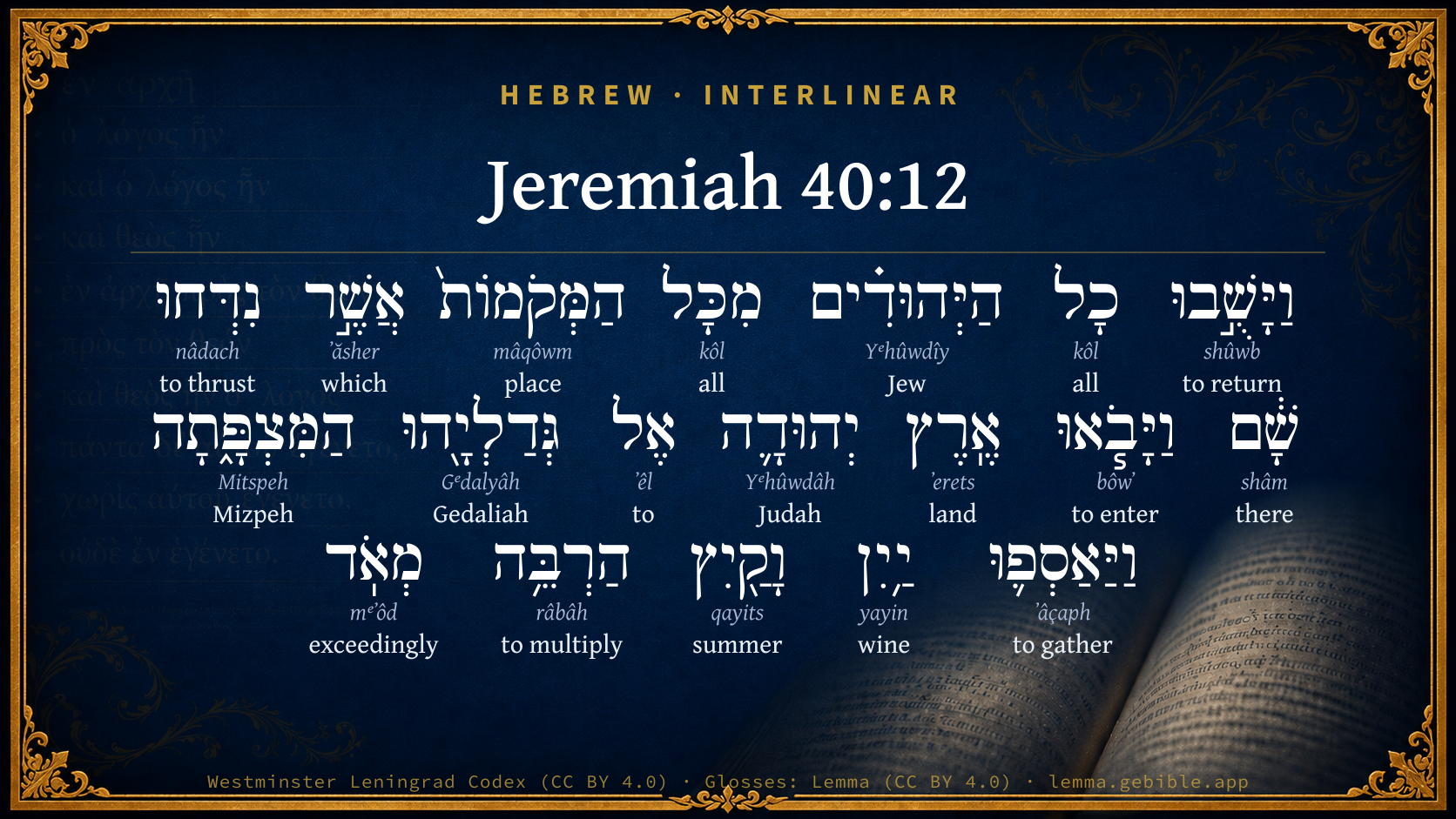
Hebrew (Westminster Leningrad Codex) Jeremiah 40:12 appears in the Hebrew Old Testament. The text above is from the Westminster Leningrad Codex. Each word links to its Strong’s number, a concise gloss, and parsing drawn from the Open Scriptures Hebrew Bible morphology. Click any word for its full Brown-Driver-Briggs (BDB) entry.
Download image
Cite this verse

Jeremiah 40:12 (World English Bible). Public Domain. Lemma interlinear Bible study tool, https://lemma.gebible.app/v/jeremiah/40/12.

Show BibTeX & RIS
BibTeX
RIS
English Translation
then all the Jews returned out of all places where they were driven, and came to the land of Judah, to Gedaliah, to Mizpah, and gathered wine and summer fruits very much.
World English Bible · Public Domain
Download a study sheet

One document with this verse’s original text, its word-by-word gloss line, the meaning frame, cross-references with their text, attributed commentary, and full source and license credits — printable, and it pastes into notes with its structure intact.

This verse Autodidact and up

Study sheet (.html) Plain text (.txt)

A passage Seminary Student

Up to 50 verses in one chapter. A passage sheet keeps up to 6 commentary sources and 12 cross-references per verse, in the order this page ranks them, and says so on the sheet whenever that leaves anything out. Ask for a single verse and you get the Autodidact verse sheet above.

Everything on this page stays free to read, with no account — the sheet is a download of what is already on screen, not access to it.

Want to remove ads? Support Godless Engineer
Compare translations 3

The same verse in 3 English versions, stacked beneath the original-language interlinear above. Click any original word for its lexicon entry.

Each is an independent rendering of the whole verse — the interlinear is not word-aligned to these translations.

Highlighted words mark where these versions differ — a whole-verse word diff, not a word-by-word alignment.

  • World English Bible Public Domain
    then all the Jews returned out of all places where they were driven, and came to the land of Judah, to Gedaliah, to Mizpah, and gathered wine and summer fruits very much.
  • King James Version Public Domain
    Even all the Jews returned out of all places whither they were driven, and came to the land of Judah, to Gedaliah, unto Mizpah, and gathered wine and summer fruits very much.
  • unfoldingWord Literal Text CC BY-SA 4.0
    So all the Judeans returned from every place where they had been scattered. They came back to the land of Judah, to Gedaliah at Mizpah. They harvested wine and summer fruit in great abundance.

unfoldingWord Literal Text — © unfoldingWord, licensed CC BY-SA 4.0. Word-aligned USFM3 via Door43 (git.door43.org/unfoldingWord/en_ult).

Versions to compare (up to 4)

3 of 4 selected

Show all 18 translations

Every available English version of this verse, each an independent rendering of the whole verse.

  • World English Bible Public Domain
    then all the Jews returned out of all places where they were driven, and came to the land of Judah, to Gedaliah, to Mizpah, and gathered wine and summer fruits very much.
  • Berean Standard Bible Public Domain
    they all returned from all the places to which they had been banished and came to the land of Judah, to Gedaliah at Mizpah. And they gathered an abundance of wine grapes and summer fruit.
  • Majority Standard Bible Public Domain
    they all returned from all the places to which they had been banished and came to the land of Judah, to Gedaliah at Mizpah. And they gathered an abundance of wine grapes and summer fruit.
  • King James Version Public Domain
    Even all the Jews returned out of all places whither they were driven, and came to the land of Judah, to Gedaliah, unto Mizpah, and gathered wine and summer fruits very much.
  • American Standard Version (1901) Public Domain
    then all the Jews returned out of all places whither they were driven, and came to the land of Judah, to Gedaliah, unto Mizpah, and gathered wine and summer fruits very much.
  • Revised Version (1885) Public Domain
    then all the Jews returned out of all places whither they were driven, and came to the land of Judah, to Gedaliah, unto Mizpah, and gathered wine and summer fruits very much.
  • Geneva Bible (1599) Public Domain
    Euen all the Iewes returned out of all places where they were driuen, and came to the land of Iudah to Gedaliah vnto Mizpah, and gathered wine and sommer fruites, very much.
  • Douay-Rheims (1899) Public Domain
    All the Jews, I say, returned out of all the places to which they had fled, and they came into the land of Juda to Godolias to Masphath: and they gathered wine, and a very great harvest.
  • Young's Literal Translation Public Domain
    and all the Jews from all the places whither they have been driven, turn back and enter the land of Judah, unto Gedaliah, to Mizpah, and they gather wine and summer fruit -- very much.
  • Literal Standard Version CC BY-SA 4.0
    and all the Jews from all the places to where they have been driven, return and enter the land of Judah, to Gedaliah, to Mizpah, and they gather wine and summer fruit—to multiply abundantly.
  • Unlocked Literal Bible CC BY-SA 4.0
    So all the Judeans returned from every place where they had been scattered. They came back to the land of Judah, to Gedaliah at Mizpah. They harvested wine and summer fruit in great abundance.
  • unfoldingWord Literal Text CC BY-SA 4.0
    So all the Judeans returned from every place where they had been scattered. They came back to the land of Judah, to Gedaliah at Mizpah. They harvested wine and summer fruit in great abundance.
  • Darby Bible Public Domain
    and all the Jews returned out of all the places whither they had been driven, and came to the land of Judah to Gedaliah, unto Mizpah, and gathered wine and summer fruits in great abundance.
  • World Messianic Bible Public Domain
    then all the Jews returned out of all places where they were driven, and came to the land of Judah, to Gedaliah, to Mizpah, and gathered very much wine and summer fruits.
  • Webster's Bible Public Domain
    Even all the Jews returned out of all places whither they were driven, and came to the land of Judah, to Gedaliah, to Mizpah, and gathered wine and summer fruits in abundance.
  • Free Bible Version CC BY-SA 4.0
    So they all came back from the different places where they'd been scattered and went to Gedaliah at Mizpah in Judah. They were able to harvest a large quantity of grapes and summer fruit.
  • Bible in Basic English Public Domain
    Then all the Jews came back from all the places to which they had gone in flight, and came to the land of Judah, to Gedaliah, to Mizpah, and got in a great store of wine and summer fruit.
  • JPS Tanakh (1917) Public Domain
    then all the Jews returned out of all places whither they were driven, and came to the land of Judah, to Gedaliah, unto Mizpah, and gathered wine and summer fruits in great abundance.

Literal Standard Version (2020), Covenant Press — licensed CC BY-SA 4.0. Text via the HelloAO Bible API (eBible.org). Unlocked Literal Bible (unfoldingWord) — licensed CC BY-SA 4.0. Text via the HelloAO Bible API (eBible.org). unfoldingWord Literal Text — © unfoldingWord, licensed CC BY-SA 4.0. Word-aligned USFM3 via Door43 (git.door43.org/unfoldingWord/en_ult). Free Bible Version, Dr. Jonathan Gallagher — licensed CC BY-SA 4.0. Text via the HelloAO Bible API (eBible.org).

Word by word

More ways to search: Search by grammar → Find every occurrence → Compare this word →

Practice this passage: Drill this verse → Learn its vocabulary →

הַמִּצְפָּ֑תָה
Mitspeh
H4708
“the · Mizpeh · toward”
Particle, Definite Article + Noun, Proper + Suffix, Demonstrative
Part of Speech
Particle + Noun
Type
Proper
Full BDB Definition

Origin: the same as H4707

TWOT: None

Mizpeh = "watchtower" - a city in the district of the Shephelah or lowlands of Judah - a place in Moab on the east of the Jordan - a place in Gilead - a place near Mount Hermon - a place in Benjamin; also 'Mizpah'
  1. וַיָּשֻׁ֣בוּ shûwb H7725 “and · to return” Conjunction + Verb, Qal, Sequential Imperfect, 3rd Person, Masculine, Plural
  2. כָל kôl H3605 “all of” Noun, Common, Masculine, Singular, Construct
  3. הַיְּהוּדִ֗ים Yᵉhûwdîy H3064 “the · Jews” Particle, Definite Article + Noun, Gentilic, Masculine, Plural, Absolute
  4. מִכָּל kôl H3605 “from · all of” Preposition + Noun, Common, Masculine, Singular, Construct
  5. הַמְּקֹמוֹת֙ mâqôwm H4725 “the · places” Particle, Definite Article + Noun, Common, Masculine, Plural, Absolute
  6. אֲשֶׁ֣ר ʼăsher H834 “which” Particle, Relative
  7. נִדְּחוּ nâdach H5080 “to thrust” Verb, Niphal, Perfect, 3rd Person, Common, Plural
  8. שָׁ֔ם shâm H8033 “there” Adverb
  9. וַיָּבֹ֧אוּ bôwʼ H935 “and · to enter” Conjunction + Verb, Qal, Sequential Imperfect, 3rd Person, Masculine, Plural
  10. אֶֽרֶץ ʼerets H776 “land of” Noun, Common, Both, Singular, Construct
  11. יְהוּדָ֛ה Yᵉhûwdâh H3063 “Judah” Noun, Proper
  12. אֶל ʼêl H413 “to” Preposition
  13. גְּדַלְיָ֖הוּ Gᵉdalyâh H1436 “Gedaliah” Noun, Proper
  14. וַיַּאַסְפ֛וּ ʼâçaph H622 “and · to gather” Conjunction + Verb, Qal, Sequential Imperfect, 3rd Person, Masculine, Plural
  15. יַ֥יִן yayin H3196 “wine” Noun, Common, Masculine, Singular, Absolute
  16. וָקַ֖יִץ qayits H7019 “and · summer” Conjunction + Noun, Common, Masculine, Singular, Absolute
  17. הַרְבֵּ֥ה râbâh H7235 “to multiply” Verb, Hiphil, Infinitive Absolute
  18. מְאֹֽד mᵉʼôd H3966 “exceedingly” Adverb

About this verse

These counts appear in no published source. They are computed here, from the morphology-tagged text and Lemma’s own curated glosses. What Lemma adds →

19
words
18
distinct lemmas
Prophets
section

Notable vocabulary

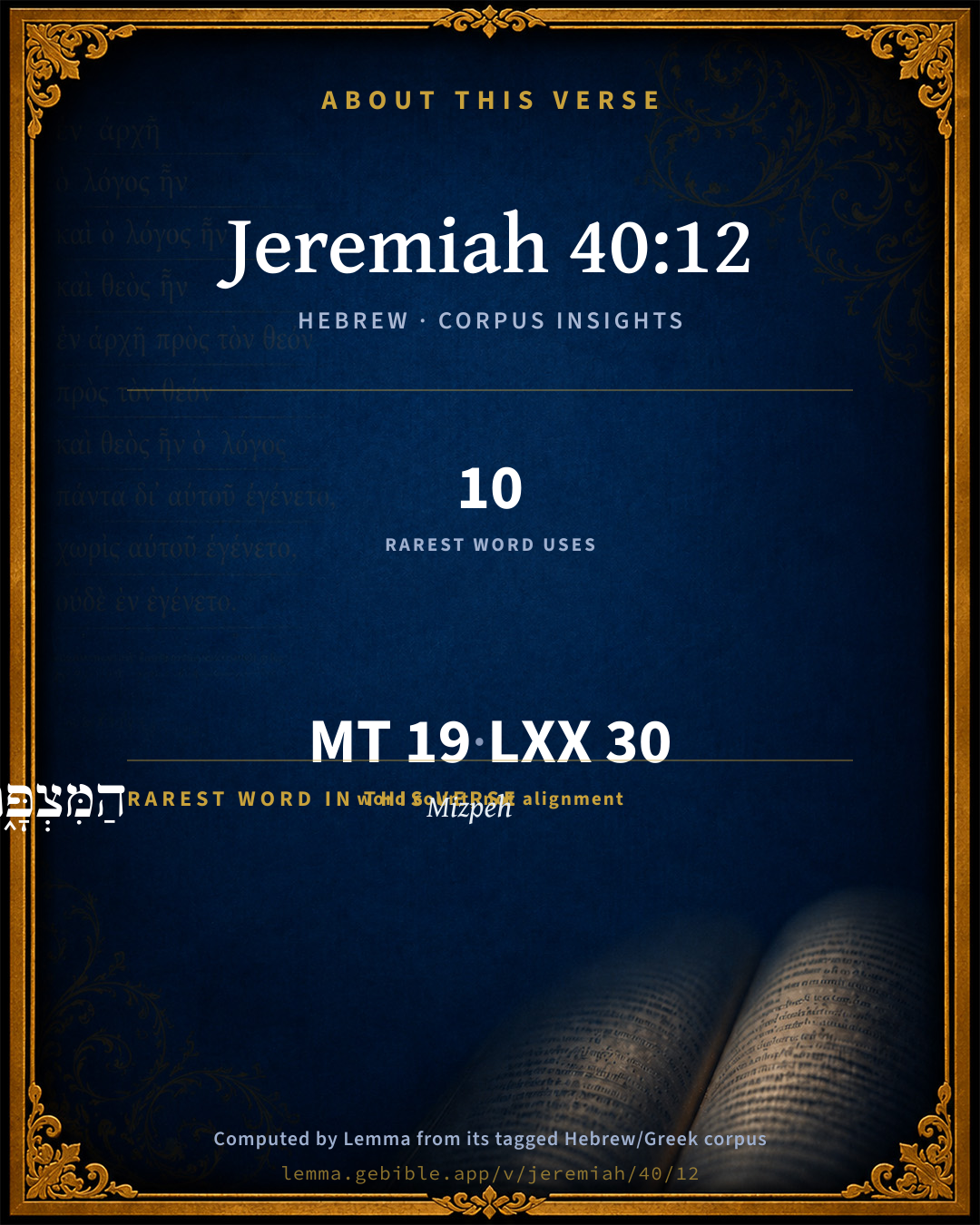
The rarest word here is הַמִּצְפָּ֑תָה Mizpeh H4708 — appearing just 10 times in the whole Hebrew Bible.

Shared distinctive vocabulary

הַמִּצְפָּ֑תָה Mizpeh H4708 occurs in 9 verses of the Hebrew Bible. Also found in:

Grammatical profile

  • 5 verbs
  • 10 nouns
  • 1 preposition
  • 2 adverbs
  • 1 particle

Verb forms

  • וַיָּשֻׁ֣בוּ Qal · Sequential Imperfect
  • נִדְּחוּ Niphal · Perfect
  • וַיָּבֹ֧אוּ Qal · Sequential Imperfect
  • וַיַּאַסְפ֛וּ Qal · Sequential Imperfect
  • הַרְבֵּ֥ה Hiphil · Infinitive Absolute

Repetition

A word recurs within this verse — often emphatic in Hebrew:

Hebrew & Septuagint length

In the original languages it is 19 Hebrew tokens and 30 Greek tokens — but the two are counted differently (Hebrew bundles its prefixes and suffixes into one token; the Greek is in lemma form), so that isn’t a like-for-like length.

Cross-references

1

Topical passages linked to Jeremiah 40:12 in the Treasury of Scripture Knowledge — connected by theme and wording, ordered by reader-vote popularity; previews shown in the World English Bible.

  • Jeremiah 43:5 But Johanan the son of Kareah, and all the captains of the forces, took all the remnant of Judah, who were returned from all the nations where they had been driven, to sojourn in the land of Judah;

Cross-references courtesy of OpenBible.info (CC BY 4.0).

Hebrew and Greek witnesses Masoretic Hebrew ↔ Greek Septuagint

The same verse in the two great witnesses to the Old Testament, shown verse-for-verse.

These are two independent witnesses, not word-aligned to each other, and the Septuagint is shown in lemma (dictionary) form.

Hebrew Jeremiah 40:12 Masoretic · Westminster Leningrad Codex

וַיָּשֻׁ֣בוּ כָל הַיְּהוּדִ֗ים מִכָּל הַמְּקֹמוֹת֙ אֲשֶׁ֣ר נִדְּחוּ שָׁ֔ם וַיָּבֹ֧אוּ אֶֽרֶץ יְהוּדָ֛ה אֶל גְּדַלְיָ֖הוּ הַמִּצְפָּ֑תָה וַיַּאַסְפ֛וּ יַ֥יִן וָקַ֖יִץ הַרְבֵּ֥ה מְאֹֽד

then all the Jews returned out of all places where they were driven, and came to the land of Judah, to Gedaliah, to Mizpah, and gathered wine and summer fruits very much.

World English Bible · Public Domain

Greek LXX Structure differs

In the Septuagint, Jeremiah is about an eighth shorter than the Hebrew and arranges its material differently — the Oracles Against the Nations (Hebrew chapters 46–51) appear in the middle of the Greek book, after 25:13. Because the chapter and verse boundaries do not line up, a verse-for-verse comparison with the Hebrew is not shown.

A verse-for-verse comparison isn’t shown here because the chapters and verses don’t line up. Switch to the LXX edition with the MT / LXX toggle above to read the Greek directly.

Hebrew: Westminster Leningrad Codex (CC BY 4.0). Greek: Septuagint (public domain); English from a public-domain English Septuagint. How the Septuagint differs from the Hebrew →

Targum (Aramaic paraphrase)

1

The Targum is the ancient Jewish Aramaic paraphrase of the Hebrew Scriptures — an interpretive translation, not the Hebrew text itself. Onkelos (literal) and Pseudo-Jonathan (expansive) render the Torah, and Jonathan the Prophets. Coverage is partial: where no permissively-licensed English translation exists for a verse, only the Aramaic is shown. This is verse-level text, not a word-by-word alignment to the Hebrew.

  1. Targum Jonathan Prophets (Joshua–Malachi)
    וְתָבוּ כָל יְהוּדָאֵי מִכָּל אַתְרַיָא דְאִתְבְּדָרוּ לְתַמָן וַאֲתוֹ לְאַרְעָא דְבֵית יְהוּדָה לְוַת גְדַלְיָהוּ לְמִצְפְּיָא וּכְנָשׁוּ חַמְרָא וּדְבֵילְתָּא סַגִי לַחֲדָא:

    (no public-domain English translation for this verse)

    Targum Jonathan — Aramaic: “Mikraot Gedolot” (public domain). English: “Sefaria Community Translation” (CC0 1.0 (public-domain dedication)); “London "Chaldee Paraphrase," 1871” (public domain). Text via Sefaria.

Commentary

Notes on Jeremiah 40:12 from classic Christian and Jewish commentators (each source and its license shown beneath its notes). The classic Christian expositions comment on the surrounding passage and are grouped to its opening verse, so a note may address several verses; the Jewish commentaries on the Tanakh (Rashi and others) are per-verse, so they appear only where the commentator wrote on this verse.

Lemma curates 59 commentaries, every one of them public domain or Creative Commons licensed, each selected and text-cleaned for this edition rather than reprinted as found. About our sources →

Trapp's Complete Commentary

John Trapp

Jer 40:12 Even all the Jews returned out of all places whither they were driven, and came to the land of Judah, to Gedaliah, unto Mizpah, and gathered wine and summer fruits very much.

Ver. 12. And gathered wine and summer fruits very much.] So is God wont to reward those that love their country.

John Trapp, A Commentary or Exposition upon All the Books of the Old and New Testament (1647–1656) — public domain. Text from a community e-Sword module.

John Calvin's Commentaries

He says that all the Jews; he puts in the particle גם, gam, for the sake of emphasis, and even all the Jews, who had fled either to the Moabites or to the children of Ammon, or to the Idumeans, or to other parts in other countries. There is no doubt but they made up a considerable number. Then the whole land must have had many inhabitants; and though it was not populous, yet the desolation that might have been feared, was not extreme. We hence conclude, that there was no over-statement made, when Gedaliah promised security to the leaders of the forces and their companions. As he then made an oath that they would all be safe, he did not deceive them, for he really proved his faithfulness, because these miserable exiles, who returned into Judea, dwelt in safety, and God also gave them a rich abundance of fruits, so that they lived comfortably in their own country. Before the city was taken these were wanderers, and no doubt they must have suffered great poverty and want. But now the Lord gave them relief, and supplied them with plenty.

But we hence know more fully how great must have been the impiety and wickedness of Ishmael and his companions, who not only had the liberty to dwell comfortably in their own country under the care and protection of Gedaliah, but who also enjoyed abundance of blessings. For as the most miserable of them gathered great abundance of fruits, they might have had a large portion of all good things. Hence then the more and the more detestable appeared their ingratitude. And it further appears how extreme and incurable was their perverseness, that they were not moved and affected, when they saw Jerusalem destroyed, the temple burnt, and the horrible slaughter which had taken place; and especially when they knew what Nebuzaradan had preached respecting God’s vengeance, and had performed the office of a prophet in reproving them. That they thus so obstinately rejected the blessings of God and resisted what he did for them, was an evident proof that they were monstrously stupid; and this is what the Prophet intended to shew, as we shall hereafter see. But I must make an end here.

John Calvin's Commentaries (1540-1563) — public domain. Text from the Calvin Translation Society English edition (1840s-50s) via the Christian Classics Ethereal Library (ccel.org). Calvin's coverage is partial (roughly two-thirds of the Bible); uncommented books and verses are honest gaps, never fabricated. The 19th-century editor's footnotes and remarks are omitted so the notes are faithfully Calvin's own voice.

The Cambridge Bible for Schools and Colleges

gen. ed. J. J. S. Perowne

12. gathered wine … very much] This was done in the 6th month (Aug.–Sept.), only two months (cp. Jer_39:2) after the capture of the city. It is clear that the Babylonians had not devastated the country, but “had risen above the methods of barbarism which characterized ancient and have characterized so much modern warfare.” Peake.

The Cambridge Bible for Schools and Colleges (gen. ed. J. J. S. Perowne; Cambridge University Press, 1878–1918) — public domain. Text from a community e-Sword module.

John Gill's Exposition

Even all the Jews returned from all places whither they were driven,.... Through fear of the Chaldean army; they came all of them from the several countries before mentioned; so that here was like to be a happy settlement and a flourishing commonwealth again; here being princes and generals, soldiers and common people, in large numbers, that were returned and coalesced under the government of Gedaliah:

and came to the land of Judah, to Gedaliah, unto Mizpah; they came out of the several countries where they had been for some time, and entered the land of Judah; but did not take up their abode anywhere, till they had presented themselves to the governor, and put themselves under his protection; promising, no doubt, to regard him as such, and to be tributary to the Chaldeans; being assured by him, as the generals and their forces before, that all would be well with them, giving them free liberty to settle in the cities and villages to which they belonged; and accordingly they set out from Mizpah, and went to their respective habitations they had abandoned:

and gathered wine and summer fruits very much; See Gill on Jer 40:10; the people of the land being carried captive; and the Chaldean army not having ravaged these parts, or however had left an abundance of fruits, which these people, at their return, found and gathered.

John Gill's Exposition of the Whole Bible (1746–1763) — public domain (CC PDM 1.0). Text via the HelloAO Bible API.

Matthew Poole's English Annotations

Probably upon the king of Babylon’s first invading Judah many fled, and more as he went on in his conquests, overrunning the country, and it is likely at the taking of the city many escaped, and fled into several countries as they had opportunity, or judged this or that country would be safest; some fled to Moab, some to Ammon, some to Edom, some one way, some another. But when they heard that the king of Babylon had set a governor of their own religion and country over them, they came back to him; and there being few people left in the land, which was of itself wonderfully fruitful, they gathered a great plenty of grapes and other summer fruits which the country produced.

Matthew Poole's English Annotations on the Holy Bible (1683–1685) — public domain. Text from a community e-Sword/MySword module.

John Wesley's Explanatory Notes

Returned - Probably upon the king of Babylon's first invading Judah, many fled, and more as he went on his conquests, over- running the country; and it is likely at the taking of the city, many escaped, and fled into several countries, as they had opportunity, or judged this or that country would be safest; some fled to Moab, some to Ammon some to Edom, some one way, and some another: but when they heard that the king of Babylon had set a governor of their own religion and country over them, they came back to him; and there being few people left in the land, which was wonderfully fruitful, they gathered plenty of grapes, and other summer fruits.

John Wesley, Explanatory Notes Upon the Whole Bible (1754–1765) — public domain. Text via the GEBible commentary corpus.

Lesson kit

Teaching starters — assembled from the data on this page, not authored interpretation. Every prompt links to the verse data it draws on. Edit before teaching.

Jeremiah, in the Prophets, opens this verse with 19 words (18 distinct Hebrew lemmas). Its most distinctive word is Mitspeh (“Mizpeh”). A historical commentator’s framing appears above. Read the whole chapter for the surrounding context.

Discussion questions

  1. The word Mitspeh carries the sense “Mizpeh.” How does it shape the verse?
  2. Joshua 11:8 shares the word «Mizpeh» with this verse. How do the two illuminate each other?
  3. “all” occurs 2× in this one verse. What is the effect of the repetition?
  4. These translations render this verse differently. What is at stake in choosing one wording over another?
  5. The verb «וַיָּשֻׁ֣בוּ» is Qal Sequential Imperfect. How does its form color the action?
  6. Reading how Trapp's Complete Commentary and John Calvin's Commentaries read this verse, where do the two commentators agree and where do they part?

Things to notice

Reading settings

Reading text

Shown beneath each verse's original-language words.

Old Testament
Old Testament edition

Read the OT as the Masoretic Hebrew (MT) or the Greek Septuagint (LXX).

English shown for the Greek Septuagint (in the Hebrew ↔ Greek comparison).

Comparing translations? Open the Compare panel on any verse page to stack up to four side by side.