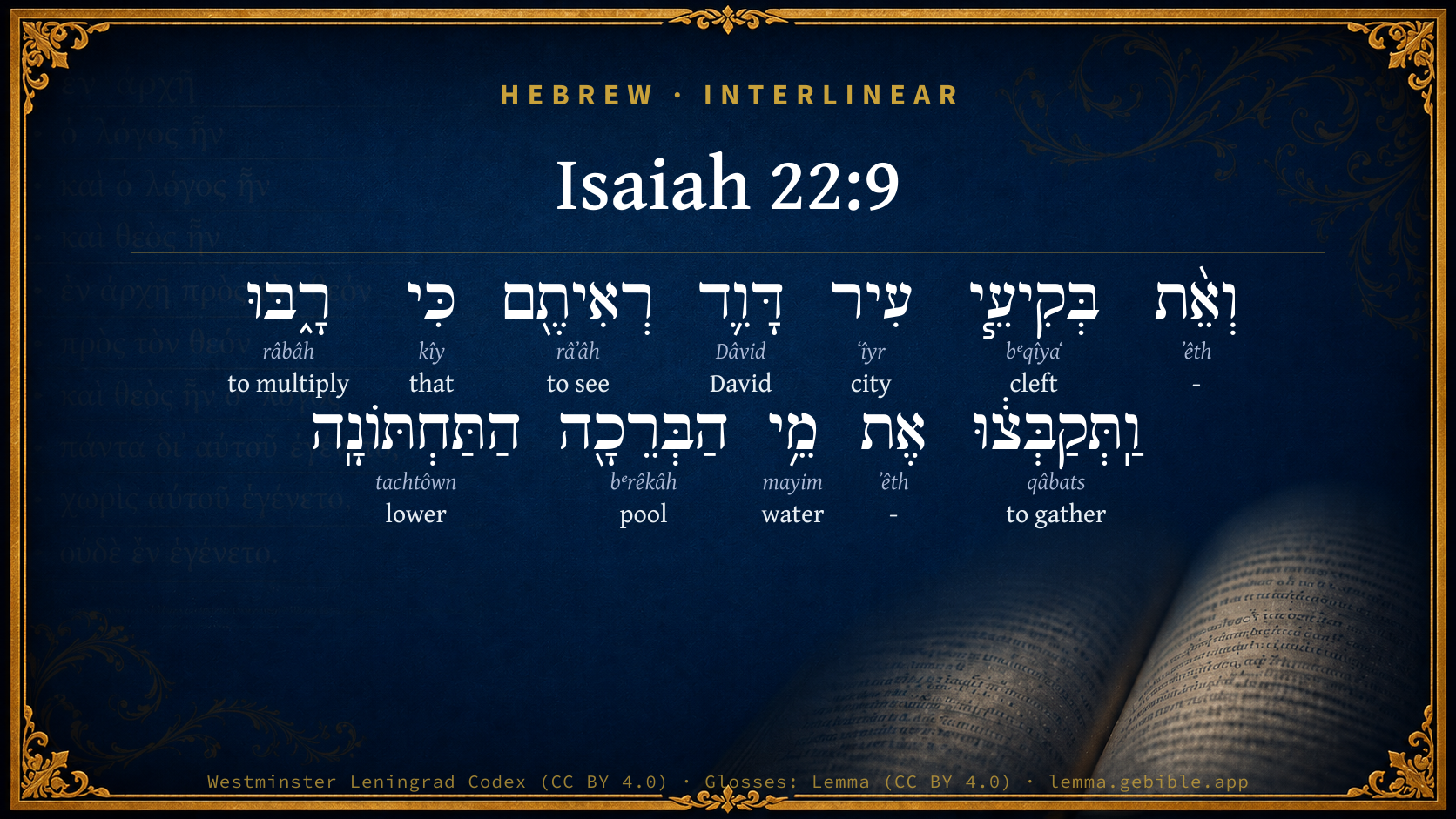
Isaiah 22:9

Hebrew (Westminster Leningrad Codex) Isaiah 22:9 appears in the Hebrew Old Testament. The text above is from the Westminster Leningrad Codex. Each word links to its Strong’s number, a concise gloss, and parsing drawn from the Open Scriptures Hebrew Bible morphology. Click any word for its full Brown-Driver-Briggs (BDB) entry.
Download image
Cite this verse

Isaiah 22:9 (World English Bible). Public Domain. Lemma interlinear Bible study tool, https://lemma.gebible.app/v/isaiah/22/9.

Show BibTeX & RIS
BibTeX
RIS
English Translation
You saw the breaches of the city of David, that they were many; and you gathered together the waters of the lower pool;
World English Bible · Public Domain
Highlights Full analysis ↓
Download a study sheet

One document with this verse’s original text, its word-by-word gloss line, the meaning frame, cross-references with their text, attributed commentary, and full source and license credits — printable, and it pastes into notes with its structure intact.

This verse Autodidact and up

Study sheet (.html) Plain text (.txt)

A passage Seminary Student

Up to 50 verses in one chapter. A passage sheet keeps up to 6 commentary sources and 12 cross-references per verse, in the order this page ranks them, and says so on the sheet whenever that leaves anything out. Ask for a single verse and you get the Autodidact verse sheet above.

Everything on this page stays free to read, with no account — the sheet is a download of what is already on screen, not access to it.

Want to remove ads? Support Godless Engineer
Compare translations 3

The same verse in 3 English versions, stacked beneath the original-language interlinear above. Click any original word for its lexicon entry.

Each is an independent rendering of the whole verse — the interlinear is not word-aligned to these translations.

Highlighted words mark where these versions differ — a whole-verse word diff, not a word-by-word alignment.

  • World English Bible Public Domain
    You saw the breaches of the city of David, that they were many; and you gathered together the waters of the lower pool;
  • King James Version Public Domain
    Ye have seen also the breaches of the city of David, that they are many: and ye gathered together the waters of the lower pool.
  • unfoldingWord Literal Text CC BY-SA 4.0
    And you saw the breaches of the city of David, for they were many, and you gathered the waters of the lower pool.

unfoldingWord Literal Text — © unfoldingWord, licensed CC BY-SA 4.0. Word-aligned USFM3 via Door43 (git.door43.org/unfoldingWord/en_ult).

Versions to compare (up to 4)

3 of 4 selected

Show all 18 translations

Every available English version of this verse, each an independent rendering of the whole verse.

  • World English Bible Public Domain
    You saw the breaches of the city of David, that they were many; and you gathered together the waters of the lower pool;
  • Berean Standard Bible Public Domain
    You saw that there were many breaches in the walls of the City of David. You collected water from the lower pool.
  • Majority Standard Bible Public Domain
    You saw that there were many breaches in the walls of the City of David. You collected water from the lower pool.
  • King James Version Public Domain
    Ye have seen also the breaches of the city of David, that they are many: and ye gathered together the waters of the lower pool.
  • American Standard Version (1901) Public Domain
    And ye saw the breaches of the city of David, that they were many; and ye gathered together the waters of the lower pool;
  • Revised Version (1885) Public Domain
    And ye saw the breaches of the city of David, that they were many: and ye gathered together the waters of the lower pool.
  • Geneva Bible (1599) Public Domain
    And ye haue seene the breaches of the citie of Dauid: for they were many, and ye gathered the waters of the lower poole.
  • Douay-Rheims (1899) Public Domain
    And you shall see the breaches of the city of David, that they are many: and you have gathered together the waters of the lower pool,
  • Young's Literal Translation Public Domain
    And the breaches of the city of David ye have seen, For they have become many, And ye gather the waters of the lower pool,
  • Literal Standard Version CC BY-SA 4.0
    And you have seen the breaches of the City of David, || For they have become many, || And you gather the waters of the lower pool,
  • Unlocked Literal Bible CC BY-SA 4.0
    You saw the breaches of the city of David, that they were many, and you collected the water of the lower pool.
  • unfoldingWord Literal Text CC BY-SA 4.0
    And you saw the breaches of the city of David, for they were many, and you gathered the waters of the lower pool.
  • Darby Bible Public Domain
    and ye have seen the breaches of the city of David, that they are many; and ye have gathered together the waters of the lower pool;
  • World Messianic Bible Public Domain
    You saw the breaches of David’s city, that they were many; and you gathered together the waters of the lower pool.
  • Webster's Bible Public Domain
    Ye have seen also the breaches of the city of David, that they are many: and ye collected the waters of the lower pool.
  • Free Bible Version CC BY-SA 4.0
    You examined the breaks in the walls of the City of David and found there were many. You had water collect in the lower pool.
  • Bible in Basic English Public Domain
    And you saw all the broken places in the wall of the town of David: and you got together the waters of the lower pool.
  • JPS Tanakh (1917) Public Domain
    And ye saw the breaches of the city of David, that they were many; and ye gathered together the waters of the lower pool.

Literal Standard Version (2020), Covenant Press — licensed CC BY-SA 4.0. Text via the HelloAO Bible API (eBible.org). Unlocked Literal Bible (unfoldingWord) — licensed CC BY-SA 4.0. Text via the HelloAO Bible API (eBible.org). unfoldingWord Literal Text — © unfoldingWord, licensed CC BY-SA 4.0. Word-aligned USFM3 via Door43 (git.door43.org/unfoldingWord/en_ult). Free Bible Version, Dr. Jonathan Gallagher — licensed CC BY-SA 4.0. Text via the HelloAO Bible API (eBible.org).

Word by word

More ways to search: Search by grammar → Find every occurrence → Compare this word →

Practice this passage: Drill this verse → Learn its vocabulary →

בְּקִיעֵ֧י
bᵉqîyaʻ
H1233
“clefts of”
Noun, Common, Masculine, Plural, Construct
Part of Speech
Noun
Type
Common
Gender
Masculine
Number
Plural
State
Construct
Full BDB Definition

Origin: from H1234

TWOT: 271c

fissure, breach, cleft
  1. וְאֵ֨ת ʼêth H853 “and · -” Conjunction + Particle, Direct Object
  2. עִיר ʻîyr H5892 “city of” Noun, Common, Feminine, Singular, Construct
  3. דָּוִ֛ד Dâvid H1732 “David” Noun, Proper
  4. רְאִיתֶ֖ם râʼâh H7200 “to see” Verb, Qal, Perfect, 2nd Person, Masculine, Plural
  5. כִּי kîy H3588 “that” Conjunction
  6. רָ֑בּוּ râbâh H7235 “to multiply” Verb, Qal, Perfect, 3rd Person, Common, Plural
  7. וַֽתְּקַבְּצ֔וּ qâbats H6908 “and · to gather” Conjunction + Verb, Piel, Sequential Imperfect, 2nd Person, Masculine, Plural
  8. אֶת ʼêth H853 “-” Particle, Direct Object
  9. מֵ֥י mayim H4325 “water(s) of” Noun, Common, Masculine, Plural, Construct
  10. הַבְּרֵכָ֖ה bᵉrêkâh H1295 “the · pool” Particle, Definite Article + Noun, Common, Feminine, Singular, Absolute
  11. הַתַּחְתּוֹנָֽה tachtôwn H8481 “the · lower” Particle, Definite Article + Adjective, Adjective, Feminine, Singular, Absolute

About this verse

These counts appear in no published source. They are computed here, from the morphology-tagged text and Lemma’s own curated glosses. What Lemma adds →

12
words
11
distinct lemmas
Prophets
section

Notable vocabulary

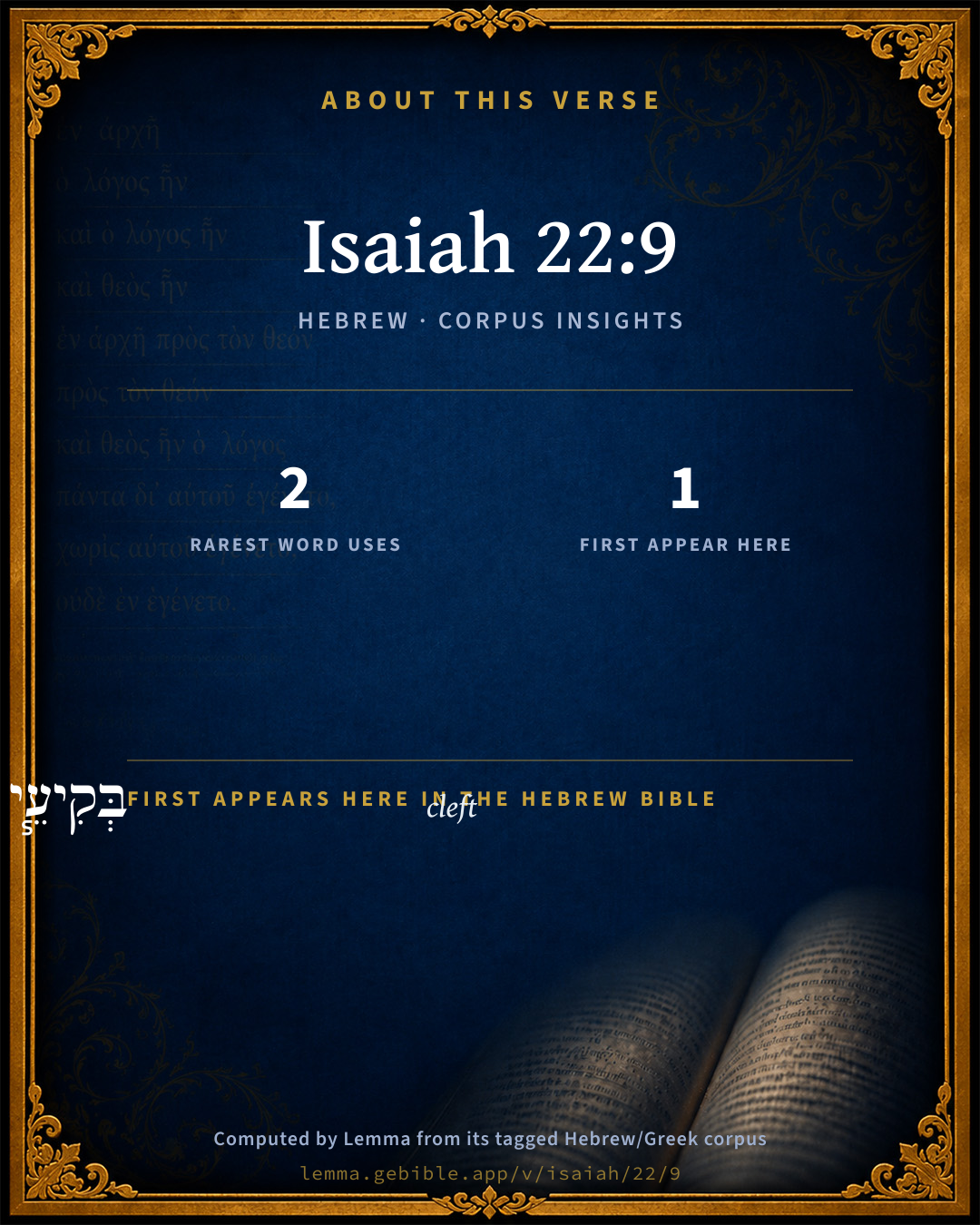
The rarest word here is בְּקִיעֵ֧י cleft H1233 — appearing just 2 times in the whole Hebrew Bible.

First appearance in Scripture

This word makes its first canonical appearance in the Hebrew Bible here:

  • בְּקִיעֵ֧י cleft H1233

Shared distinctive vocabulary

בְּקִיעֵ֧י cleft H1233 occurs in 2 verses of the Hebrew Bible. Also found in:

Grammatical profile

  • 3 verbs
  • 5 nouns
  • 1 adjective
  • 1 conjunction
  • 2 particles

Verb forms

  • רְאִיתֶ֖ם Qal · Perfect
  • רָ֑בּוּ Qal · Perfect
  • וַֽתְּקַבְּצ֔וּ Piel · Sequential Imperfect

Hebrew & Septuagint length

In English translation the verse runs 23 words from the Hebrew and 36 from the Septuagint (LXX English) — the Septuagint runs noticeably longer here. See the side-by-side →

A rough comparison of the two English renderings, which tokenize alike — not a word-level alignment.

Word counts can differ between the Hebrew and the Greek without any difference in meaning — e.g. the Hebrew direct-object marker אֵת has no separate Greek word, and Greek often adds the article ὁ.

Cross-references

4

Topical passages linked to Isaiah 22:9 in the Treasury of Scripture Knowledge — connected by theme and wording, ordered by reader-vote popularity; previews shown in the World English Bible.

  • 2 Kings 20:20 Now the rest of the acts of Hezekiah, and all his might, and how he made the pool, and the conduit, and brought water into the city, aren't they written in the book of the chronicles of the kings of Judah?
  • 2 Chronicles 32:1–6 After these things, and this faithfulness, Sennacherib king of Assyria came, and entered into Judah, and encamped against the fortified cities, and thought to win them for himself.
  • 2 Chronicles 32:30 This same Hezekiah also stopped the upper spring of the waters of Gihon, and brought them straight down on the west side of the city of David. Hezekiah prospered in all his works.
  • Nehemiah 3:16 After him repaired Nehemiah the son of Azbuk, the ruler of half the district of Beth Zur, to the place over against the tombs of David, and to the pool that was made, and to the house of the mighty men.

Cross-references courtesy of OpenBible.info (CC BY 4.0).

Hebrew and Greek witnesses Masoretic Hebrew ↔ Greek Septuagint

The same verse in the two great witnesses to the Old Testament, shown verse-for-verse.

Here the Septuagint runs noticeably longer than the Hebrew — LXX2012 (modern English Septuagint) 36 words vs World English Bible 23. A rough length comparison of the two English translations, not a word-level alignment — read both below.

These are two independent witnesses, not word-aligned to each other, and the Septuagint is shown in lemma (dictionary) form.

Hebrew Isaiah 22:9 Masoretic · Westminster Leningrad Codex

וְאֵ֨ת בְּקִיעֵ֧י עִיר דָּוִ֛ד רְאִיתֶ֖ם כִּי רָ֑בּוּ וַֽתְּקַבְּצ֔וּ אֶת מֵ֥י הַבְּרֵכָ֖ה הַתַּחְתּוֹנָֽה

You saw the breaches of the city of David, that they were many; and you gathered together the waters of the lower pool;

World English Bible · Public Domain

Greek LXX Isaiah 22:9 Septuagint · lemma form

καί ἀνακαλύπτω ὁ κρυπτός ὁ οἶκος ὁ ἄκρος δαυίδ καί ὁράω ὅτι πολύς εἰμί καί ὅτι ἀποστρέφω ὁ ὕδωρ ὁ ἀρχαῖος κολυμβήθρα εἰς ὁ πόλις

And they shall uncover the secret places of the houses of the citadel of David: and they saw that they were many, and that one had turned the water of the old pool into the city;

LXX2012 (modern English Septuagint) · Public Domain

On this verse, John Gill's Exposition discusses the Septuagint’s reading. Read the note in Commentary ↓

Hebrew: Westminster Leningrad Codex (CC BY 4.0). Greek: Septuagint (public domain); English from LXX2012 (modern English Septuagint) (Public Domain). How the Septuagint differs from the Hebrew →

Targum (Aramaic paraphrase)

1

The Targum is the ancient Jewish Aramaic paraphrase of the Hebrew Scriptures — an interpretive translation, not the Hebrew text itself. Onkelos (literal) and Pseudo-Jonathan (expansive) render the Torah, and Jonathan the Prophets. Coverage is partial: where no permissively-licensed English translation exists for a verse, only the Aramaic is shown. This is verse-level text, not a word-by-word alignment to the Hebrew.

  1. Targum Jonathan Prophets (Joshua–Malachi)
    וְיַת פְּלוּגַת קַרְתָּא דְדָוִד חֲזֵיתוּן אֲרֵי סַגִיאַת וְכַנֵישְׁתּוּן יַת עַמָא לְמֵי בְרִיכְתָּא אַרְעִיתָא:

    And the breaches of the city of David ye shall see, because they are many; and ye shall gather together the people to the lower pool.

    Targum Jonathan — Aramaic: “Mikraot Gedolot” (public domain). English: “Sefaria Community Translation” (CC0 1.0 (public-domain dedication)); “London "Chaldee Paraphrase," 1871” (public domain). Text via Sefaria.

Commentary

Notes on Isaiah 22:9 from classic Christian and Jewish commentators (each source and its license shown beneath its notes). The classic Christian expositions comment on the surrounding passage and are grouped to its opening verse, so a note may address several verses; the Jewish commentaries on the Tanakh (Rashi and others) are per-verse, so they appear only where the commentator wrote on this verse.

Lemma curates 59 commentaries, every one of them public domain or Creative Commons licensed, each selected and text-cleaned for this edition rather than reprinted as found. About our sources →

Trapp's Complete Commentary

John Trapp

Isa 22:9 Ye have seen also the breaches of the city of David, that they are many: and ye gathered together the waters of the lower pool.

Ver. 9. Ye have seen also … and ye gathered together, &c.] This they did when in distress, to prevent the enemy and provide for their own safety; and this they might well have done, had not God been neglected; this of all things he can least endure. "The wicked shall be turned into hell, and all the nations that forget God" (Psa 9:17; see Isa 30:1).

John Trapp, A Commentary or Exposition upon All the Books of the Old and New Testament (1647–1656) — public domain. Text from a community e-Sword module.

Tyndale Open Study Notes

Tyndale Open Resources

22:9 Jerusalem (literally the city of David): Calling Jerusalem “the city of David” evokes memories of Israel’s greatest king and God’s blessing upon him and the nation (see also 60:14). • You store up water in the lower pool: Hezekiah expended great energy in ensuring a constant supply of water (see 22:11; 2 Kgs 20:20).

Tyndale Open Study Notes — © Tyndale Open Resources, licensed CC BY-SA 4.0. Text via the HelloAO Bible API.

Geneva Bible (1599)

Geneva Bible translators

Ye forfeited the ruinous places which were neglected in times of peace: meaning, the whole City, and the City of David, which was within the compass of the other.

Geneva Bible (1599) marginal notes — public domain. Text via Bolls.life.

Jamieson, Fausset & Brown

Robert Jamieson, A. R. Fausset & David Brown

Ye have seen--rather, "Ye shall see."

city of David--the upper city, on Zion, the south side of Jerusalem (Sa2 5:7, Sa2 5:9; Kg1 8:1); surrounded by a wall of its own; but even in it there shall be "breaches." Hezekiah's preparations for defense accord with this (Ch2 32:5).

ye gathered--rather, "ye shall gather."

lower pool--(See on Isa 22:11). Ye shall bring together into the city by subterranean passages cut in the rock of Zion, the fountain from which the lower pool (only mentioned here) is supplied. See on Isa 7:3; Kg2 20:20; Ch2 32:3-5, represent Hezekiah as having stopped the fountains to prevent the Assyrians getting water. But this is consistent with the passage here. The superfluous waters of the lower pool usually flowed into Hinnom valley, and so through that of Jehoshaphat to the brook Kedron. Hezekiah built a wall round it, stopped the outflowing of its waters to debar the foe from the use of them, and turned them into the city.

Jamieson, Fausset & Brown — Commentary Critical and Explanatory on the Whole Bible (1871) — public domain (CC PDM 1.0). Text via the HelloAO Bible API.

Adam Clarke's Commentary

Verse 9. Ye gathered together the waters - "And ye shall collect the waters"] There were two pools in or near Jerusalem, supplied by springs: the upper pool, or the old pool, supplied by the spring called Gihon, 2Ch 32:30, towards the higher part of the city, near Sion, or the city of David, and the lower pool, probably supplied by Siloam, towards the lower part. When Hezekiah was threatened with a siege by Sennacherib, he stopped up all the waters of the fountains without the city; and brought them into the city by a conduit, or subterranean passage cut through the rock; those of the old pool, to the place where he had a double wall, so that the pool was between the two walls. This he did in order to distress the enemy, and to supply the city during the siege. This was so great a work that not only the historians have made particular mention of it, 2Kg 20:20; 2Ch 32:2-3; 2Ch 32:5; 2Ch 32:30; but the son of Sirach also has celebrated it in his encomium on Hezekiah. "Hezekiah fortified his city, and brought in water into the midst thereof: he digged the hard rock with iron, and made wells for water," Ecclus. xlviii.

Adam Clarke's Commentary on the Bible (1810–1826) — public domain. Text from a community e-Sword/MySword module.

Ellicott's Commentary for English Readers

(9) Ye have seen also the breaches . . .—The prophet paints the hasty preparations for defence. So in 2Ch_32:5 : “Hezekiah built up all the wall that was broken, and raised it up to the towers,” and added an outer line of defence. The “city of David” is, of course, the fortress of Zion.

The waters of the lower pool.—This was the Lower Gihon, now the Birket-es-Sultan. The operation is described more fully in 2Ch_32:3-4. Its object was to stop the outflow of the streams, and gather them into a reservoir, partly, of course, for the supply of the inhabitants during the siege, but still more that the Assyrian armies might find little or no water in the immediate neighbourhood of the city. Sargon, in his inscriptions, describes like preparations at Ashdod (Smith, Assyr. Discov., p. 291).

A Bible Commentary for English Readers, edited by Charles John Ellicott (1878–1897) — public domain. Text from a community e-Sword module.

The Cambridge Bible for Schools and Colleges

gen. ed. J. J. S. Perowne

9. The first half reads Ye saw (i.e. examined) the breaches of the city of David (the citadel of Zion, 2Sa_5:7; 2Sa_5:9) for they were many. Jerusalem was evidently quite unfit to stand a siege. The water supply was still defective, as it had been 34 years before (see ch. Isa_7:3). The lower pool is not elsewhere mentioned, although its existence is implied by ch. Isa_7:3. It was obviously within the walls, and probably lay near the mouth of the Tyropœon Valley.

The Cambridge Bible for Schools and Colleges (gen. ed. J. J. S. Perowne; Cambridge University Press, 1878–1918) — public domain. Text from a community e-Sword module.

John Gill's Exposition

Ye have seen also the breaches of the city of David, that they are many,.... Not Jerusalem in general, but that part of it which was called the stronghold of Zion, and in particular had the name of the city of David, Sa2 5:7 the fortifications of which, in times of peace, had gone to decay; and which they had seen before, but took no notice of, being in safety; but now besieged, and in great danger, they looked upon them in good earnest, in order to repair them, and secure themselves from the irruption of the enemy; for this is not to be understood of breaches now made by the Assyrian army, but of old ones, which had lain neglected; see Ch2 32:5,

and ye gathered together the waters of the lower pool: not to make mortar with, to be used in repairing the breaches, as Kimchi; but either that they might be as a wall round about the place, as Aben Ezra; or rather to deprive the enemy of them, and cut off all communications from him, and to supply the inhabitants of the city with them; see Ch2 32:3. The Septuagint version is, "and he turned the water of the old pool into the city": but the old pool was another pool hereafter mentioned, and was without the city, the same with the upper pool; whereas this was the lower, and was in the city. The Targum is,

"and ye gathered the people to the waters of the lower pool.''

John Gill's Exposition of the Whole Bible (1746–1763) — public domain (CC PDM 1.0). Text via the HelloAO Bible API.

Albert Barnes' Notes on the Bible

Ye have seen also the breaches - You who are inhabitants of the city. That such breaches were actually made, see 2Ch 32:5.

Of the city of David - Of Jerusalem, so called because it was the royal residence of David. Zion was usually called the city of David, but the name was given also to the entire city.

And ye gathered together ... - That is, Hezekiah and the people of the city collected those waters.

Of the lower pool - (For a description of the upper and lower pool, see the notes at Isa 7:3). The superfluous waters of the lower pool usually flowed into the valley of Hinnom, and thence, into the valley of Jehoshaphat, mingling with the waters of the brook Kedron. It would seem from the passage here that those waters were not usually retained for the use of the city, though it was possible to retain them in case of a drought or a siege. At present, the lower pool is without the walls, but Hezekiah appears to have extended a temporary wall around it so as to enclose it (see the note at Isa 22:11). This he did, probably for two purposes;

(1) to cut off the Assyrians from the supply of water; and

(2) to retain “all” the water in the city to supply the inhabitants during the siege; see 2Ch 32:4, where it is expressly declared that Hezekiah took this measure to distress the Assyrians.

Albert Barnes' Notes on the Bible (1834–1885) — public domain. Text from a community e-Sword/MySword module.

Haydock's Catholic Bible Commentary

Many, but you have neglected them, (Calmet) till it be too late. (Haydock) --- Pool, communicating with Gehon on the west.

George Leo Haydock (1774–1849), Haydock's Catholic Family Bible and Commentary, 1859 edition — public domain. Excludes Psalms (Douay-Rheims chapter numbering differs from Protestant) and Deuterocanonical books (Catholic canon only).

Matthew Poole's English Annotations

Ye have seen, i.e. observed or considered, as this word is used, Exo 32:9, and elsewhere, in order to the reparation of them, and to fortify the city, as the next words manifest.

Ye gathered together the waters of the lower pool, that you might both deprive the enemy of water, and supply the city with it; of which see on 2Ch 32:4,5.

Matthew Poole's English Annotations on the Holy Bible (1683–1685) — public domain. Text from a community e-Sword/MySword module.

The Pulpit Commentary

Ye have seen also.... are many; rather, ye saw also were many. The breaches of the city of David. "The city of David" may be here a name for Jerusalem generally, as "the city where David dwelt", (Isa_29:1) or it may designate the eastern hill, where David fixed his residence. (2Sa_5:7 Neh_3:15, Neh_3:16, 25 12:37) In 2Ch_32:5 we read that Hezekiah at this time "built up all the wall that was broken, and raised it up to the towers, and another wall without, and repaired Mille in the city of David," where a particular part of Jerusalem seems certainly to be meant. Ye gathered together the waters of the lower pool. The arrangements made by Hezekiah with respect to the water-supply at the time of Sennacherib"s invasion, seem to have been the following: He found on the north of the city, where the Assyrian attack was certain to be delivered, in the vicinity of the Damascus gate, a pool or reservoir, (Isa_7:3) fed by a conduit from some natural source, which lay open and patent to view. The superfluous water ran off from it by a "brook", (2Ch_32:4) which passed down the Tyropoeon valley, and joined the Kedron to the southeast of Ophel. His first step was to cover over and conceal the open reservoir, and also the" brook" which ran from it, at least as far as the northern city wall, to prevent their use by the Assyrians. He then further made a conduit underground (2Ch_32:30) within the city, along the Tyropoeon depression, to a second reservoir, or "pool," also within the city, which could be freely used by the inhabitants (see ver. 11; and comp. Ecc 48:17). Further, it is probable that he carried a conduit from this second pool, under the temple area, to the" fount of the Virgin" on the eastern side of Ophel, and thence further conveyed the water by a tunnel through Ophel to the "pool of Siloam." (This last may be the work here alluded to.) The inscription recently discovered at this peel is probably of Hezekiah"s time (see "Quarterly Statement" of Palest. Expl. Fund for April, 1881, p. 70).

The Pulpit Commentary (1880–1919), ed. H.D.M. Spence-Jones & Joseph S. Exell — public domain. Text from a community e-Sword module.

John Wesley's Explanatory Notes

Seen - That is, observed in order to the reparation of them. The waters - That you might both deprive the enemy of water, and supply the city with it.

John Wesley, Explanatory Notes Upon the Whole Bible (1754–1765) — public domain. Text via the GEBible commentary corpus.

J. A. Alexander on Isaiah

Joseph Addison Alexander

“And the breaches of the city of David ye saw, that they were many, and ye gathered the waters of the lower pool.” The breaches meant are not those made by the enemy in the siege here described, but those caused by previous neglect and decay. The city of David may be either taken as a poetical name for Jerusalem at large, or in its strict sense as denoting the upper town upon Mount Zion, which was surrounded by a wall of its own, and called the city of David because he took it from the Jebusites and afterwards resided there. ‘Ye saw’ may either mean, ye saw them for the first time, at length became aware of them, or, ye looked at them, examined them, with a view to their repair. The last is more probably implied than expressed. The last clause describes a measure of defence peculiarly important at Jerusalem where there are very few perennial springs. This precaution (as well as the one previously hinted at) was actually taken by Hezekiah in the prospect of Sennacherib’s approach (2Ch 32:4) and has perhaps been repeated in every siege of any length which Jerusalem has since experienced. The lower pool is probably the tank or reservoir still in existence in the valley of Hinnom opposite the western side of Mount Zion. This name, which occurs only here, has reference to the upper pool higher up in the same valley near the Jaffa gate. (See above, Isa 7:3. Compare Robinson’s Palestine, I 483-487.)

Joseph Addison Alexander, The Prophecies of Isaiah (1846–1847; New York: Scribner, 1870–1878) — public domain. Text from a community e-Sword module.

Rashi

Rabbi Shlomo Yitzchaki (Rashi)

the cracks of the city of David The cracks of the wall you saw that they had increased.

and you gathered the water of the lower pool Jonathan renders: And you gathered the people to the waters of the lower pool, which is near the cracks of the city of David, to fight there, because you saw that Jerusalem had a weak spot there and was vulnerable to conquest from there.

Rashi on the Tanakh — English translations: “The Judaica Press complete Tanach with Rashi, translated by A. J. Rosenberg” (CC BY 4.0); “Pentateuch with Rashi's commentary by M. Rosenbaum and A.M. Silbermann, 1929-1934” (public domain); “The Metsudah Tanach series, Lakewood, N.J” (CC BY 4.0); and “The Book of Joshua, Metsudah Publications, 1997” (CC BY 4.0). Text via Sefaria.

Ibn Ezra

Rabbi Abraham ibn Ezra

Ye have seen also, etc. They looked to the fortifications, and found that the breaches of the town of David were many; they were therefore obliged to collect the waters of the pool, that they might serve as a fence round the town.

Ibn Ezra on the Tanakh — English translations: “Sefaria Community Translation” (CC0 1.0 (public-domain dedication)); “Yalkut, Sifsei Chachomim Chumash, Metsudah Publications, 2009” (CC BY 4.0); and “Commentary of Ibn Ezra on Isaiah - trans. by M. Friedlander, 1873” (public domain). Text via Sefaria.

Lesson kit

Teaching starters — assembled from the data on this page, not authored interpretation. Every prompt links to the verse data it draws on. Edit before teaching.

Isaiah, in the Prophets, opens this verse with 12 words (11 distinct Hebrew lemmas). Its most distinctive word is bᵉqîyaʻ (“cleft”). The Greek Septuagint runs longer here. A historical commentator’s framing appears above. Read the whole chapter for the surrounding context.

Discussion questions

  1. The word bᵉqîyaʻ carries the sense “cleft.” How does it shape the verse?
  2. The word “cleft” first appears here in Scripture. What is being introduced at this debut?
  3. Amos 6:11 shares the word «cleft» with this verse. How do the two illuminate each other?
  4. Compared with the Hebrew, the Septuagint runs longer here. What questions does that raise?
  5. The translations on this page render this verse differently — a whole-verse word diff, not a word-by-word alignment. What might account for the different wordings?
  6. The verb «רְאִיתֶ֖ם» is Qal Perfect. How does its form color the action?
  7. Reading how Trapp's Complete Commentary and Tyndale Open Study Notes read this verse, where do the two commentators agree and where do they part?

Things to notice

  • 1 word makes its first canonical appearance in Scripture here.
  • These translations choose different wording for 6 words in this verse.
  • 11 distinct Hebrew lemmas span 12 words in this verse.

Reading settings

Reading text

Shown beneath each verse's original-language words.

Old Testament
Old Testament edition

Read the OT as the Masoretic Hebrew (MT) or the Greek Septuagint (LXX).

English shown for the Greek Septuagint (in the Hebrew ↔ Greek comparison).

Comparing translations? Open the Compare panel on any verse page to stack up to four side by side.