
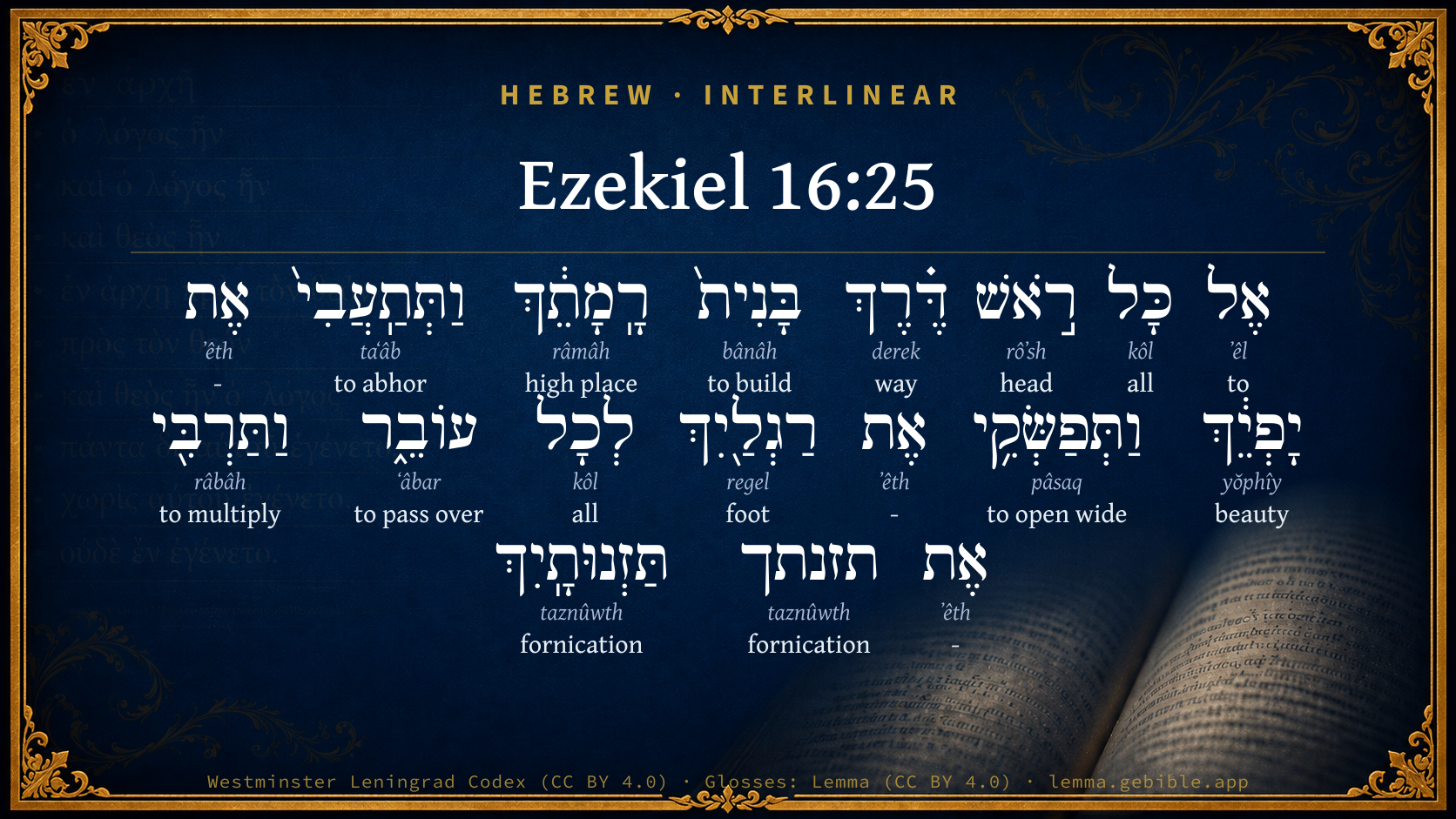
Ezekiel 16:25

Hebrew (Westminster Leningrad Codex) Ezekiel 16:25 appears in the Hebrew Old Testament. The text above is from the Westminster Leningrad Codex. Each word links to its Strong’s number, a concise gloss, and parsing drawn from the Open Scriptures Hebrew Bible morphology. Click any word for its full Brown-Driver-Briggs (BDB) entry.
Download image
Cite this verse

Ezekiel 16:25 (World English Bible). Public Domain. Lemma interlinear Bible study tool, https://lemma.gebible.app/v/ezekiel/16/25.

Show BibTeX & RIS
BibTeX
RIS
English Translation
You have built your lofty place at the head of every way, and have made your beauty an abomination, and have opened your feet to everyone who passed by, and multiplied your prostitution.
World English Bible · Public Domain
Download a study sheet

One document with this verse’s original text, its word-by-word gloss line, the meaning frame, cross-references with their text, attributed commentary, and full source and license credits — printable, and it pastes into notes with its structure intact.

This verse Autodidact and up

Study sheet (.html) Plain text (.txt)

A passage Seminary Student

Up to 50 verses in one chapter. A passage sheet keeps up to 6 commentary sources and 12 cross-references per verse, in the order this page ranks them, and says so on the sheet whenever that leaves anything out. Ask for a single verse and you get the Autodidact verse sheet above.

Everything on this page stays free to read, with no account — the sheet is a download of what is already on screen, not access to it.

Want to remove ads? Support Godless Engineer
Compare translations 3

The same verse in 3 English versions, stacked beneath the original-language interlinear above. Click any original word for its lexicon entry.

Each is an independent rendering of the whole verse — the interlinear is not word-aligned to these translations.

Highlighted words mark where these versions differ — a whole-verse word diff, not a word-by-word alignment.

  • World English Bible Public Domain
    You have built your lofty place at the head of every way, and have made your beauty an abomination, and have opened your feet to everyone who passed by, and multiplied your prostitution.
  • King James Version Public Domain
    Thou hast built thy high place at every head of the way, and hast made thy beauty to be abhorred, and hast opened thy feet to every one that passed by, and multiplied thy whoredoms.
  • unfoldingWord Literal Text CC BY-SA 4.0
    You built your high place at the head of every road and made your beauty a disgrace, and you spread your legs to anyone who passed by, and you multiplied your acts of prostitution.

unfoldingWord Literal Text — © unfoldingWord, licensed CC BY-SA 4.0. Word-aligned USFM3 via Door43 (git.door43.org/unfoldingWord/en_ult).

Versions to compare (up to 4)

3 of 4 selected

Show all 18 translations

Every available English version of this verse, each an independent rendering of the whole verse.

  • World English Bible Public Domain
    You have built your lofty place at the head of every way, and have made your beauty an abomination, and have opened your feet to everyone who passed by, and multiplied your prostitution.
  • Berean Standard Bible Public Domain
    At the head of every street you built your lofty shrines and degraded your beauty. With increasing promiscuity, you spread your legs to all who passed by.
  • Majority Standard Bible Public Domain
    At the head of every street you built your lofty shrines and degraded your beauty. With increasing promiscuity, you spread your legs to all who passed by.
  • King James Version Public Domain
    Thou hast built thy high place at every head of the way, and hast made thy beauty to be abhorred, and hast opened thy feet to every one that passed by, and multiplied thy whoredoms.
  • American Standard Version (1901) Public Domain
    Thou hast built thy lofty place at the head of every way, and hast made thy beauty an abomination, and hast opened thy feet to every one that passed by, and multiplied thy whoredom.
  • Revised Version (1885) Public Domain
    Thou hast built thy lofty place at every head of the way, and hast made thy beauty an abomination, and hast opened thy feet to every one that passed by, and multiplied thy whoredom.
  • Geneva Bible (1599) Public Domain
    Thou hast built thine hie place at euery corner of the way, and hast made thy beautie to be abhorred: thou hast opened thy feete to euery one that passed by, and multiplied thy whoredome.
  • Douay-Rheims (1899) Public Domain
    At every head of the way thou hast set up a sign of thy prostitution: and hast made thy beauty to be abominable: and hast prostituted thyself to every one that passed by, and hast multiplied thy fornications.
  • Young's Literal Translation Public Domain
    At every head of the way thou hast built thy high place, And thou dost make thy beauty abominable, And dost open wide thy feet to every passer by, And dost multiply thy whoredoms,
  • Literal Standard Version CC BY-SA 4.0
    At every head of the way you have built your high place, || And you make your beauty abominable, || And open wide your feet to everyone passing by, || And multiply your whoredoms,
  • Unlocked Literal Bible CC BY-SA 4.0
    You built your high place at the head of every road and made your beauty a disgrace, and you spread your legs to anyone who passed by, and you multiplied your acts of prostitution.
  • unfoldingWord Literal Text CC BY-SA 4.0
    You built your high place at the head of every road and made your beauty a disgrace, and you spread your legs to anyone who passed by, and you multiplied your acts of prostitution.
  • Darby Bible Public Domain
    thou didst build thy high place at every head of the way, and madest thy beauty to be abhorred, and thou didst open thy feet to every one that passed by, and multiply thy whoredom.
  • World Messianic Bible Public Domain
    You have built your lofty place at the head of every way, and have made your beauty an abomination, and have opened your feet to everyone who passed by, and multiplied your prostitution.
  • Webster's Bible Public Domain
    Thou hast built thy high place at every head of the way, and hast made thy beauty to be abhorred, and hast prostituted thyself to every one that passed by, and multiplied thy lewd deeds.
  • Free Bible Version CC BY-SA 4.0
    You made yourselves high places of idol worship at the top of every street; you degraded yourself, offering your beautiful body to anyone who passed by, opening your legs for them, becoming more and more promiscuous.
  • Bible in Basic English Public Domain
    You put up your high places at the top of every street, and made the grace of your form a disgusting thing, opening your feet to everyone who went by, increasing your loose ways.
  • JPS Tanakh (1917) Public Domain
    Thou hast built thy lofty place at every head of the way, and hast made thy beauty an abomination, and hast opened thy feet to every one that passed by, and multiplied thy harlotries.

Literal Standard Version (2020), Covenant Press — licensed CC BY-SA 4.0. Text via the HelloAO Bible API (eBible.org). Unlocked Literal Bible (unfoldingWord) — licensed CC BY-SA 4.0. Text via the HelloAO Bible API (eBible.org). unfoldingWord Literal Text — © unfoldingWord, licensed CC BY-SA 4.0. Word-aligned USFM3 via Door43 (git.door43.org/unfoldingWord/en_ult). Free Bible Version, Dr. Jonathan Gallagher — licensed CC BY-SA 4.0. Text via the HelloAO Bible API (eBible.org).

Word by word

More ways to search: Search by grammar → Find every occurrence → Compare this word →

Practice this passage: Drill this verse → Learn its vocabulary →

וַתְּפַשְּׂקִ֥י
pâsaq
H6589
“and · to open wide”
Conjunction + Verb, Piel, Sequential Imperfect, 2nd Person, Feminine, Singular
Part of Speech
Conjunction + Verb
Stem
Piel
Form
Sequential Imperfect
Person
2nd Person
Gender
Feminine
Number
Singular
Full BDB Definition

Origin: a primitive root

TWOT: 1842

to part, open wide - (Qal) - to open wide - to be talkative (of the mouth) - (Piel) to open wide
  1. אֶל ʼêl H413 “to” Preposition
  2. כָּל kôl H3605 “all of” Noun, Common, Masculine, Singular, Construct
  3. רֹ֣אשׁ rôʼsh H7218 “head of” Noun, Common, Masculine, Singular, Construct
  4. דֶּ֗רֶךְ derek H1870 “way” Noun, Common, Both, Singular, Absolute
  5. בָּנִית֙ bânâh H1129 “to build” Verb, Qal, Perfect, 2nd Person, Feminine, Singular
  6. רָֽמָתֵ֔ךְ râmâh H7413 “high place · your” Noun, Common, Feminine, Singular, Construct + Suffix, Personal, 2nd Person, Feminine, Singular
  7. וַתְּתַֽעֲבִי֙ taʻâb H8581 “and · to abhor” Conjunction + Verb, Piel, Sequential Imperfect, 2nd Person, Feminine, Singular
  8. אֶת ʼêth H853 “-” Particle, Direct Object
  9. יָפְיֵ֔ךְ yŏphîy H3308 “beauty · your” Noun, Common, Masculine, Singular, Construct + Suffix, Personal, 2nd Person, Feminine, Singular
  10. אֶת ʼêth H853 “-” Particle, Direct Object
  11. רַגְלַ֖יִךְ regel H7272 “feet · your” Noun, Common, Feminine, Dual, Construct + Suffix, Personal, 2nd Person, Feminine, Singular
  12. לְכָל kôl H3605 “to/for · all of” Preposition + Noun, Common, Masculine, Singular, Construct
  13. עוֹבֵ֑ר ʻâbar H5674 “passing over” Verb, Qal, Participle Active, Masculine, Singular, Absolute
  14. וַתַּרְבִּ֖י râbâh H7235 “and · to multiply” Conjunction + Verb, Hiphil, Sequential Imperfect, 2nd Person, Feminine, Singular
  15. אֶת ʼêth H853 “-” Particle, Direct Object
  16. תזנתך taznûwth H8457 “fornication · your” Noun, Common, Feminine, Singular, Construct + Suffix, Personal, 2nd Person, Feminine, Singular
  17. תַּזְנוּתָֽיִךְ taznûwth H8457 “fornications · your” Noun, Common, Feminine, Plural, Construct + Suffix, Personal, 2nd Person, Feminine, Singular

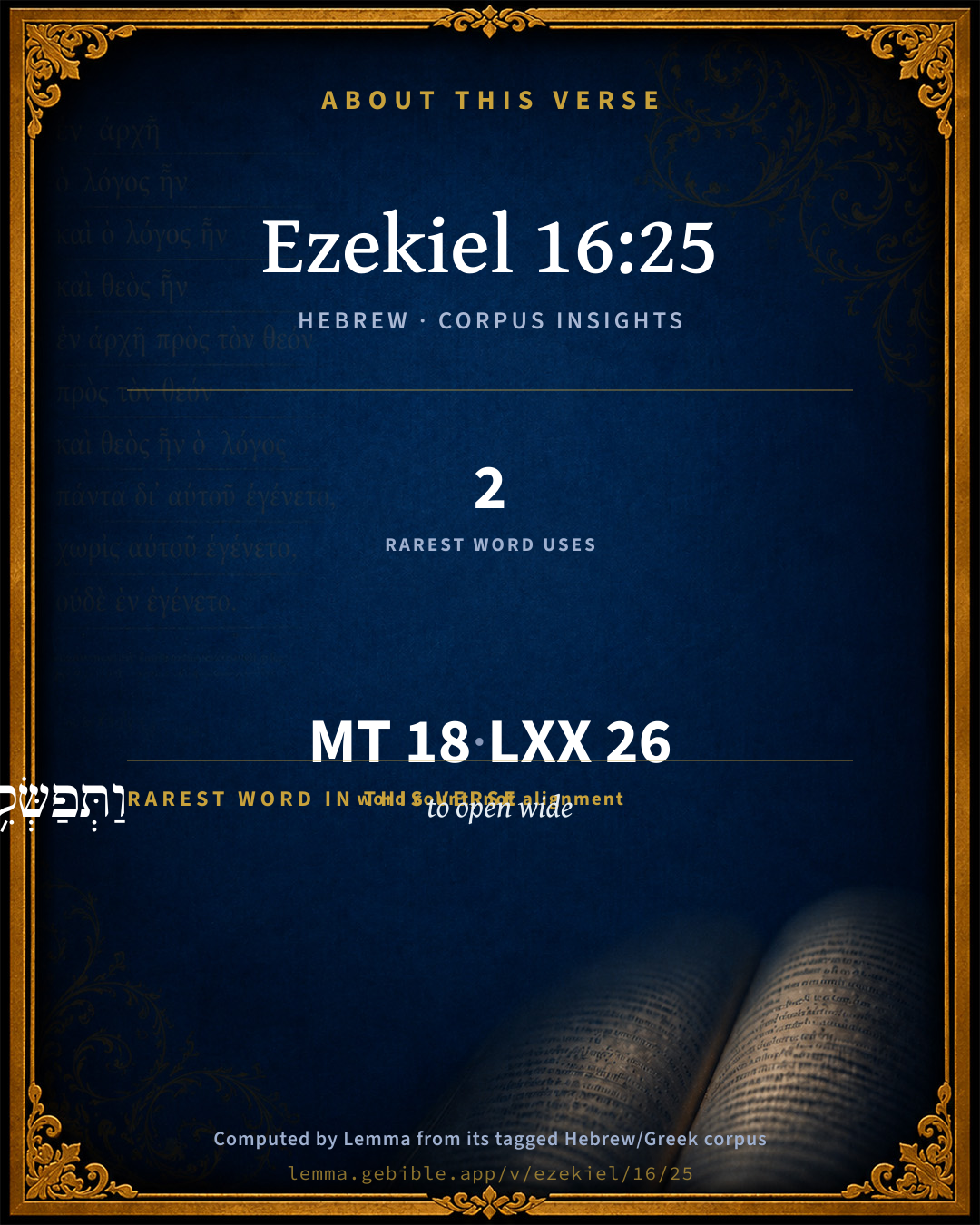
About this verse

These counts appear in no published source. They are computed here, from the morphology-tagged text and Lemma’s own curated glosses. What Lemma adds →

18
words
14
distinct lemmas
Prophets
section

Notable vocabulary

The rarest word here is וַתְּפַשְּׂקִ֥י to open wide H6589 — appearing just 2 times in the whole Hebrew Bible.

Shared distinctive vocabulary

וַתְּפַשְּׂקִ֥י to open wide H6589 occurs in 2 verses of the Hebrew Bible. Also found in:

Grammatical profile

  • 5 verbs
  • 9 nouns
  • 1 preposition
  • 3 particles

Verb forms

  • בָּנִית֙ Qal · Perfect
  • וַתְּתַֽעֲבִי֙ Piel · Sequential Imperfect
  • וַתְּפַשְּׂקִ֥י Piel · Sequential Imperfect
  • עוֹבֵ֑ר Qal · Participle Active
  • וַתַּרְבִּ֖י Hiphil · Sequential Imperfect

Repetition

Words recur within this verse — often emphatic in Hebrew:

  • כָּל all H3605 ×2
  • תזנתך fornication H8457 ×2

Hebrew & Septuagint length

In English translation the verse runs 33 words from the Hebrew and 32 from the Septuagint (LXX English) — closely comparable.

A rough comparison of the two English renderings, which tokenize alike — not a word-level alignment.

Word counts can differ between the Hebrew and the Greek without any difference in meaning — e.g. the Hebrew direct-object marker אֵת has no separate Greek word, and Greek often adds the article ὁ.

In the original languages it is 18 Hebrew tokens and 26 Greek tokens — but the two are counted differently (Hebrew bundles its prefixes and suffixes into one token; the Greek is in lemma form), so that isn’t a like-for-like length.

Cross-references

14

Topical passages linked to Ezekiel 16:25 in the Treasury of Scripture Knowledge — connected by theme and wording, ordered by reader-vote popularity; previews shown in the World English Bible.

  • Jeremiah 3:2 Lift up your eyes to the bare heights, and see; where have you not been lain with? By the ways have you sat for them, as an Arabian in the wilderness; and you have polluted the land with your prostitution and with your wickedness.
  • Ezekiel 16:31 in that you build your vaulted place at the head of every way, and make your lofty place in every street, and have not been as a prostitute, in that you scorn pay.
  • Genesis 38:14 She took off of her the garments of her widowhood, and covered herself with her veil, and wrapped herself, and sat in the gate of Enaim, which is by the way to Timnah; for she saw that Shelah was grown up, and she wasn't given to him as a wife.
  • Genesis 38:21 Then he asked the men of her place, saying, "Where is the prostitute, that was at Enaim by the road?" They said, "There has been no prostitute here."
  • Proverbs 9:14–15 She sits at the door of her house, On a seat in the high places of the city,
  • Isaiah 3:9 The look of their faces testify against them. They parade their sin like Sodom. They don't hide it. Woe to their soul! For they have brought disaster upon themselves.
  • Jeremiah 2:23–24 How can you say, I am not defiled, I have not gone after the Baals? see your way in the valley, know what you have done: [you are] a swift dromedary traversing her ways;
  • Jeremiah 6:15 Were they ashamed when they had committed abomination? nay, they were not at all ashamed, neither could they blush: therefore they shall fall among those who fall; at the time that I visit them they shall be cast down, says Yahweh.
  • Ezekiel 16:15 But you did trust in your beauty, and played the prostitute because of your renown, and poured out your prostitution on everyone who passed by; his it was.
  • Ezekiel 23:9–10 Therefore I delivered her into the hand of her lovers, into the hand of the Assyrians, on whom she doted.
  • Ezekiel 23:32 Thus says the Lord Yahweh: You shall drink of your sister's cup, which is deep and large; you shall ridiculed and had in derision; it contains much.
  • Revelation 17:1–5 One of the seven angels who had the seven bowls came and spoke with me, saying, "Come here. I will show you the judgment of the great prostitute who sits on many waters,
  • Revelation 17:12–13 The ten horns that you saw are ten kings who have received no kingdom as yet, but they receive authority as kings, with the beast, for one hour.
  • Revelation 17:16 The ten horns which you saw, and the beast, these will hate the prostitute, and will make her desolate, and will make her naked, and will eat her flesh, and will burn her utterly with fire.

Cross-references courtesy of OpenBible.info (CC BY 4.0).

Hebrew and Greek witnesses Masoretic Hebrew ↔ Greek Septuagint

The same verse in the two great witnesses to the Old Testament, shown verse-for-verse.

These are two independent witnesses, not word-aligned to each other, and the Septuagint is shown in lemma (dictionary) form.

Hebrew Ezekiel 16:25 Masoretic · Westminster Leningrad Codex

אֶל כָּל רֹ֣אשׁ דֶּ֗רֶךְ בָּנִית֙ רָֽמָתֵ֔ךְ וַתְּתַֽעֲבִי֙ אֶת יָפְיֵ֔ךְ וַתְּפַשְּׂקִ֥י אֶת רַגְלַ֖יִךְ לְכָל עוֹבֵ֑ר וַתַּרְבִּ֖י אֶת תזנתך תַּזְנוּתָֽיִךְ

You have built your lofty place at the head of every way, and have made your beauty an abomination, and have opened your feet to everyone who passed by, and multiplied your prostitution.

World English Bible · Public Domain

Greek LXX Ezekiel 16:25 Septuagint · lemma form

καί ἐπί ἀρχή πᾶς ὁδός οἰκοδομέω ὁ πορνεῖον σύ καί λυμαίνω ὁ κάλλος σύ καί διαἄγω ὁ σκέλος σύ πᾶς πάροδος καί πληθύνω ὁ πορνεία σύ

and on the head of every way you did set up your fornications, and did defile your beauty, and did open your feet to every passer by, and did multiply your fornication.

LXX2012 (modern English Septuagint) · Public Domain

Hebrew: Westminster Leningrad Codex (CC BY 4.0). Greek: Septuagint (public domain); English from LXX2012 (modern English Septuagint) (Public Domain). How the Septuagint differs from the Hebrew →

Targum (Aramaic paraphrase)

1

The Targum is the ancient Jewish Aramaic paraphrase of the Hebrew Scriptures — an interpretive translation, not the Hebrew text itself. Onkelos (literal) and Pseudo-Jonathan (expansive) render the Torah, and Jonathan the Prophets. Coverage is partial: where no permissively-licensed English translation exists for a verse, only the Aramaic is shown. This is verse-level text, not a word-by-word alignment to the Hebrew.

  1. Targum Jonathan Prophets (Joshua–Malachi)
    בְּרֵישׁ כָּל פָּרָשׁוּת אוֹרַח בְּנִית רָמָתַיִךְ וְאָחֵילְתְּ יַת קְדוּשְׁתִּיךְ וְאִיתְחַבַּרְתְּ לִיךְ לְמִפְלַח לְטַעֲוָתָיִךְ עִם כָּל דְעָדֵי וְאַסְגֵית יַת טַעֲוָתָיִךְ:

    (no public-domain English translation for this verse)

    Targum Jonathan — Aramaic: “Mikraot Gedolot” (public domain). English: “Sefaria Community Translation” (CC0 1.0 (public-domain dedication)); “London "Chaldee Paraphrase," 1871” (public domain). Text via Sefaria.

Commentary

Notes on Ezekiel 16:25 from classic Christian and Jewish commentators (each source and its license shown beneath its notes). The classic Christian expositions comment on the surrounding passage and are grouped to its opening verse, so a note may address several verses; the Jewish commentaries on the Tanakh (Rashi and others) are per-verse, so they appear only where the commentator wrote on this verse.

Lemma curates 59 commentaries, every one of them public domain or Creative Commons licensed, each selected and text-cleaned for this edition rather than reprinted as found. About our sources →

Trapp's Complete Commentary

John Trapp

Eze 16:25 Thou hast built thy high place at every head of the way, and hast made thy beauty to be abhorred, and hast opened thy feet to every one that passed by, and multiplied thy whoredoms.

Ver. 25. And hast made thy beauty to be abhorred.] By being made so cheap and common. Sin is a reproach to any people, {Pro 14:34} idolatry especially. {1Pe 4:3}

And hast opened thy feet.] See on Eze 16:15.

John Trapp, A Commentary or Exposition upon All the Books of the Old and New Testament (1647–1656) — public domain. Text from a community e-Sword module.

Geneva Bible (1599)

Geneva Bible translators

Or, head.

Geneva Bible (1599) marginal notes — public domain. Text via Bolls.life.

Jamieson, Fausset & Brown

Robert Jamieson, A. R. Fausset & David Brown

at every head of the way--in the most frequented places (Pro 9:14).

thy beauty . . . abhorred, . . . opened . . . feet to every one--The wanton advances were all on Israel's part; the idolatrous nations yielded to her nothing in return. She had yielded so much that, like a worn-out prostitute, her tempters became weary of her. When the Church lowers her testimony for God to the carnal tastes of the world, with a view to conciliation, she loses everything and gains nothing.

Jamieson, Fausset & Brown — Commentary Critical and Explanatory on the Whole Bible (1871) — public domain (CC PDM 1.0). Text via the HelloAO Bible API.

John Calvin's Commentaries

He now adds, that he made their beauty to be abhorred. I have no doubt that the Prophet alludes to the filthiness of abandoned women; and even the Latins called them “worn out,” whose foulness arises from their utterly giving themselves up to every wickedness. The Prophet then says that the people were not only like an abandoned woman who engages in impure amours, but that their conduct was gross in the extreme; for though many gratify improper desires through intemperate lust, yet they fastidiously reject those foul and shameless females who are notorious for profligacy. The Prophet means, then, that the people had come to such a pitch of abomination, just as the most abandoned of the sex. He now adds, you have spread thy feet to every passer-by, and have multiplied thy fornications. This is taken also from the conduct of harlots and confirms what we have already explained, that the Jews indulged not only in one kind of idolatry, but were prone to all abominations, like females who beset the paths, and address all they meet, and not only so, but shamelessly spread their feet everywhere to entice admirers.

John Calvin's Commentaries (1540-1563) — public domain. Text from the Calvin Translation Society English edition (1840s-50s) via the Christian Classics Ethereal Library (ccel.org). Calvin's coverage is partial (roughly two-thirds of the Bible); uncommented books and verses are honest gaps, never fabricated. The 19th-century editor's footnotes and remarks are omitted so the notes are faithfully Calvin's own voice.

The Cambridge Bible for Schools and Colleges

gen. ed. J. J. S. Perowne

25. thy high place] See Eze_16:24.

made … to be abhorred] This sense is doubtful; the word means to abominate, hence dishonour or disregard, or as we might say “prostitute thy beauty.”

The Cambridge Bible for Schools and Colleges (gen. ed. J. J. S. Perowne; Cambridge University Press, 1878–1918) — public domain. Text from a community e-Sword module.

John Gill's Exposition

Thou hast also committed fornication with the Egyptians,.... By entering into leagues and alliances with them, and seeking to them for help and assistance against their enemies; from whose bondage they had formerly been delivered, and whose society they were cautioned against; and yet they forsook the Lord, and joined themselves to them by solemn covenant; and not only so, but fell into the worship of their idols, who were a people of all others the most superstitious, and given to idolatry; and many of their idolatrous rites and ceremonies were received and retained by the Jews, as the worshipping of Tammuz, and other idols:

thy neighbours, great of flesh: being their neighbours, and full of power and strength to assist them, they courted their friendship and alliance; and their idolatries being many and monstrous, were the more courted by them: the allusion is to women of shameless impudence and insatiable lust, who covet men, whose flesh is as the flesh of asses, and their issue as horses, Eze 23:20; flesh here signifies the privy parts of men; so Ben Melech;

and hast increased thy whoredoms, to provoke my anger; multiplied their idolatries, which they learned of the Egyptians, a people much given thereunto; and which were abominable and highly provoking to God, Pe1 4:3. The Targum is,

"thou hast increased thine idols.''

John Gill's Exposition of the Whole Bible (1746–1763) — public domain (CC PDM 1.0). Text via the HelloAO Bible API.

Haydock's Catholic Bible Commentary

Sign; altars of idols. (Haydock) --- She makes no secret of her apostacy. The Greeks and Romans marked the houses of prostitutes, that honest men might avoid them. "The deemed the profession of such a crime a sufficient punishment to repress impure women." (Tacitus, Annal.)

George Leo Haydock (1774–1849), Haydock's Catholic Family Bible and Commentary, 1859 edition — public domain. Excludes Psalms (Douay-Rheims chapter numbering differs from Protestant) and Deuterocanonical books (Catholic canon only).

Matthew Poole's English Annotations

Not content with what was done in the city, she built her idol temples and shows in the country, in places where many ways or roads met, wheresoever it was likely passengers would come.

Hast made thy beauty to be abhorred, as the beauty of a shameless whore is abhorred by them to whom she offers herself. In her high places every passenger might meet his own god, and worship his own idol, and then satisfy his lust with lewd women, common as the street; and this made men abhor that beauty they would have admired, dressed in modesty, and dwelling retired.

Hast opened thy feet; a modest expressing of the most immodest practice of lewd and insatiable adulteresses and whores, which are ready for every comer, and tempt such as tempt not them, Eze 16:32,33.

Matthew Poole's English Annotations on the Holy Bible (1683–1685) — public domain. Text from a community e-Sword/MySword module.

Whedon's Commentary on the Bible

Daniel D. Whedon

25. To every one that passed by — This unfaithful wife has become a common prostitute (see Eze_16:15; Eze_23:40). The religion which was her beauty has become abhorrent since it has been mixed with the vile practices and superstitions of every false cult. “This description is certainly not to our taste, but it must be remembered that Ezekiel’s object was to excite this very feeling of disgust.” — Smend.

Daniel D. Whedon (gen. ed.), Commentary on the Old and New Testaments (1874–1909) — public domain. Text from a community e-Sword module.

John Wesley's Explanatory Notes

At every head of the way - Not content with what was done in the city, she built her idol temples in the country, wherever it was likely passengers would come.

John Wesley, Explanatory Notes Upon the Whole Bible (1754–1765) — public domain. Text via the GEBible commentary corpus.

unfoldingWord translationNotes

Door43 World Missions Community

General Information:

Yahweh continues to speak about Jerusalem as if the city were his unfaithful wife. The city represents the people who live there. (See: Metaphor and Metonymy)

at the head of every road

Yahweh speaks of the beginning of a road as if it were its head. AT: "at the beginning of every road" (See: Metaphor)

translationWords

high place

desecrate

Egypt

lust

neighbor

anger

unfoldingWord translationNotes — © Distant Shores Media and the Door43 World Missions Community, licensed CC BY-SA 4.0. Source: git.door43.org/Door43/en_tn.

Rashi

Rabbi Shlomo Yitzchaki (Rashi)

you spread your legs Since He compares her to a harlot, He speaks in terms of sexual activity, in which there is spreading of the legs, a cesmas in Old French, you spread wide apart.

Rashi on the Tanakh — English translations: “The Judaica Press complete Tanach with Rashi, translated by A. J. Rosenberg” (CC BY 4.0); “Pentateuch with Rashi's commentary by M. Rosenbaum and A.M. Silbermann, 1929-1934” (public domain); “The Metsudah Tanach series, Lakewood, N.J” (CC BY 4.0); and “The Book of Joshua, Metsudah Publications, 1997” (CC BY 4.0). Text via Sefaria.

Lesson kit

Teaching starters — assembled from the data on this page, not authored interpretation. Every prompt links to the verse data it draws on. Edit before teaching.

Ezekiel, in the Prophets, opens this verse with 18 words (14 distinct Hebrew lemmas). Its most distinctive word is pâsaq (“to open wide”). A historical commentator’s framing appears above. Read the whole chapter for the surrounding context.

Discussion questions

  1. The word pâsaq carries the sense “to open wide.” How does it shape the verse?
  2. How does Proverbs 13:3, which shares the word «to open wide», read alongside this verse?
  3. What does the repetition of “all” (2× in this one verse) do in this verse?
  4. The translations on this page render this verse differently — a whole-verse word diff, not a word-by-word alignment. What might account for the different wordings?
  5. «בָּנִית֙» is a Qal Perfect verb. How does that grammatical form shape the action described?
  6. Compare how Trapp's Complete Commentary and Geneva Bible (1599) read this verse. Where do they agree or differ?

Things to notice

Reading settings

Reading text

Shown beneath each verse's original-language words.

Old Testament
Old Testament edition

Read the OT as the Masoretic Hebrew (MT) or the Greek Septuagint (LXX).

English shown for the Greek Septuagint (in the Hebrew ↔ Greek comparison).

Comparing translations? Open the Compare panel on any verse page to stack up to four side by side.