Nehemiah 4:10

Hebrew (Westminster Leningrad Codex) Nehemiah 4:10 appears in the Hebrew Old Testament. The text above is from the Westminster Leningrad Codex. Each word links to its Strong’s number, a concise gloss, and parsing drawn from the Open Scriptures Hebrew Bible morphology. Click any word for its full Brown-Driver-Briggs (BDB) entry.
Download image
Cite this verse

Nehemiah 4:10 (World English Bible). Public Domain. Lemma interlinear Bible study tool, https://lemma.gebible.app/v/nehemiah/4/10.

Show BibTeX & RIS
BibTeX
RIS
English Translation
Judah said, The strength of the bearers of burdens is decayed, and there is much rubbish; so that we are not able to build the wall.
World English Bible · Public Domain
Download a study sheet

One document with this verse’s original text, its word-by-word gloss line, the meaning frame, cross-references with their text, attributed commentary, and full source and license credits — printable, and it pastes into notes with its structure intact.

This verse Autodidact and up

Study sheet (.html) Plain text (.txt)

A passage Seminary Student

Up to 50 verses in one chapter. A passage sheet keeps up to 6 commentary sources and 12 cross-references per verse, in the order this page ranks them, and says so on the sheet whenever that leaves anything out. Ask for a single verse and you get the Autodidact verse sheet above.

Everything on this page stays free to read, with no account — the sheet is a download of what is already on screen, not access to it.

Want to remove ads? Support Godless Engineer
Compare translations 3

The same verse in 3 English versions, stacked beneath the original-language interlinear above. Click any original word for its lexicon entry.

Each is an independent rendering of the whole verse — the interlinear is not word-aligned to these translations.

Highlighted words mark where these versions differ — a whole-verse word diff, not a word-by-word alignment.

  • World English Bible Public Domain
    Judah said, The strength of the bearers of burdens is decayed, and there is much rubbish; so that we are not able to build the wall.
  • King James Version Public Domain
    And Judah said, The strength of the bearers of burdens is decayed, and there is much rubbish; so that we are not able to build the wall.
  • unfoldingWord Literal Text CC BY-SA 4.0
    And Judah said, “The strength of the burden-bearers is failing, and there is much rubble. And as for us, we are not able to build the wall.”

unfoldingWord Literal Text — © unfoldingWord, licensed CC BY-SA 4.0. Word-aligned USFM3 via Door43 (git.door43.org/unfoldingWord/en_ult).

Versions to compare (up to 4)

3 of 4 selected

Show all 18 translations

Every available English version of this verse, each an independent rendering of the whole verse.

  • World English Bible Public Domain
    Judah said, The strength of the bearers of burdens is decayed, and there is much rubbish; so that we are not able to build the wall.
  • Berean Standard Bible Public Domain
    Meanwhile, the people of Judah said: “The strength of the laborer fails, and there is so much rubble that we will never be able to rebuild the wall.”
  • Majority Standard Bible Public Domain
    Meanwhile, the people of Judah said: “The strength of the laborer fails, and there is so much rubble that we will never be able to rebuild the wall.”
  • King James Version Public Domain
    And Judah said, The strength of the bearers of burdens is decayed, and there is much rubbish; so that we are not able to build the wall.
  • American Standard Version (1901) Public Domain
    And Judah said, The strength of the bearers of burdens is decayed, and there is much rubbish; so that we are not able to build the wall.
  • Revised Version (1885) Public Domain
    And Judah said, The strength of the bearers of burdens is decayed, and there is much rubbish; so that we are not able to build the wall.
  • Geneva Bible (1599) Public Domain
    And Iudah said, The strength of the bearers is weakened, and there is much earth, so that we are not able to build the wall.
  • Douay-Rheims (1899) Public Domain
    And Juda said: The strength of the bearer of burdens is decayed, and the rubbish is very much, and we shall not be able to build the wall.
  • Young's Literal Translation Public Domain
    And Judah saith, `The power of the burden-bearers hath become feeble, and the rubbish `is' abundant, and we are not able to build on the wall.'
  • Literal Standard Version CC BY-SA 4.0
    And Judah says, “The power of the burden-bearers has become feeble, and the rubbish [is] abundant, and we are not able to build on the wall.”
  • Unlocked Literal Bible CC BY-SA 4.0
    Then the people of Judah said, “The strength of those who carry the burdens is failing. There is too much rubble, and we are not able to rebuild the wall.”
  • unfoldingWord Literal Text CC BY-SA 4.0
    And Judah said, “The strength of the burden-bearers is failing, and there is much rubble. And as for us, we are not able to build the wall.”
  • Darby Bible Public Domain
    And Judah said, The strength of the bearers of burdens faileth, and there is much rubbish; so that we are not able to build at the wall.
  • World Messianic Bible Public Domain
    Judah said, “The strength of the bearers of burdens is fading and there is much rubble, so that we are not able to build the wall.”
  • Webster's Bible Public Domain
    And Judah said, The strength of the bearers of burdens is decayed, and there is much rubbish; so that we are not able to build the wall.
  • Free Bible Version CC BY-SA 4.0
    Then people of Judah started grumbling, saying, “The workmen are exhausted. There's just too much rubble to clear. We'll never be able to finish the wall.”
  • Bible in Basic English Public Domain
    And Judah said, The strength of the workmen is giving way, and there is much waste material; it is impossible for us to put up the wall.
  • JPS Tanakh (1917) Public Domain
    (4-4) And Judah said: 'The strength of the bearers of burdens is decayed, and there is much rubbish; so that we are not able to build the wall.'

Literal Standard Version (2020), Covenant Press — licensed CC BY-SA 4.0. Text via the HelloAO Bible API (eBible.org). Unlocked Literal Bible (unfoldingWord) — licensed CC BY-SA 4.0. Text via the HelloAO Bible API (eBible.org). unfoldingWord Literal Text — © unfoldingWord, licensed CC BY-SA 4.0. Word-aligned USFM3 via Door43 (git.door43.org/unfoldingWord/en_ult). Free Bible Version, Dr. Jonathan Gallagher — licensed CC BY-SA 4.0. Text via the HelloAO Bible API (eBible.org).

Word by word

More ways to search: Search by grammar → Find every occurrence → Compare this word →

Practice this passage: Drill this verse → Learn its vocabulary →

הַסַּבָּ֔ל
çabbâl
H5449
“the · bearer”
Particle, Definite Article + Noun, Common, Masculine, Singular, Absolute
Part of Speech
Particle + Noun
Type
Common
Gender
Masculine
Number
Singular
State
Absolute
Full BDB Definition

Origin: from H5445

TWOT: 1458b

burden-bearer
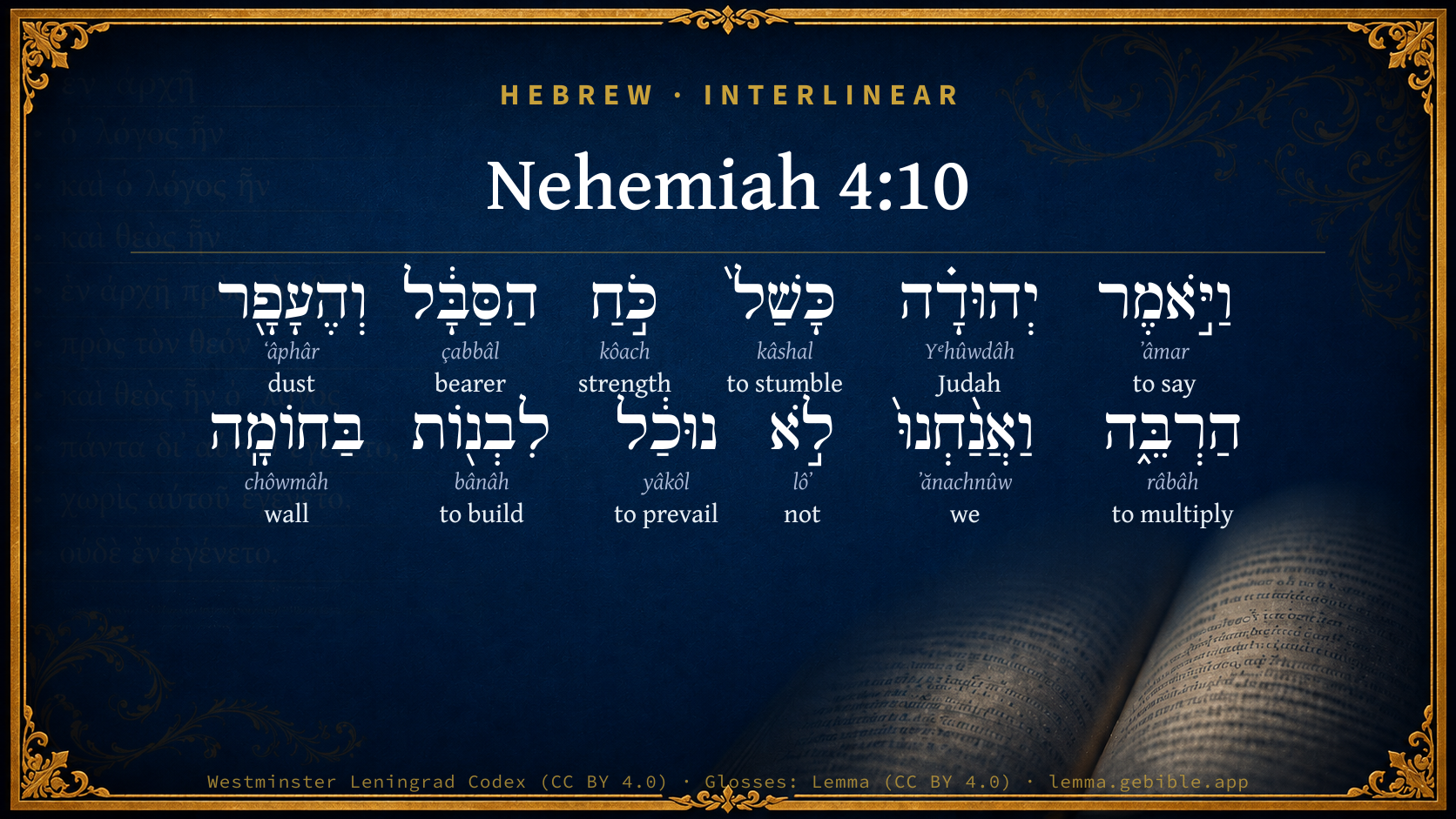
  1. וַיֹּ֣אמֶר ʼâmar H559 “and · to say” Conjunction + Verb, Qal, Sequential Imperfect, 3rd Person, Masculine, Singular
  2. יְהוּדָ֗ה Yᵉhûwdâh H3063 “Judah” Noun, Proper
  3. כָּשַׁל֙ kâshal H3782 “to stumble” Verb, Qal, Perfect, 3rd Person, Masculine, Singular
  4. כֹּ֣חַ kôach H3581 “strength of” Noun, Common, Masculine, Singular, Construct
  5. וְהֶעָפָ֖ר ʻâphâr H6083 “and · the · dust” Conjunction + Particle, Definite Article + Noun, Common, Masculine, Singular, Absolute
  6. הַרְבֵּ֑ה râbâh H7235 “to multiply” Verb, Hiphil, Infinitive Absolute
  7. וַאֲנַ֨חְנוּ֙ ʼănachnûw H587 “and · we” Conjunction + Pronoun, Personal, 1st Person, Common, Plural
  8. לֹ֣א lôʼ H3808 “not” Particle, Negative
  9. נוּכַ֔ל yâkôl H3201 “to prevail” Verb, Qal, Imperfect, 1st Person, Common, Plural
  10. לִבְנ֖וֹת bânâh H1129 “to build” Preposition + Verb, Qal, Infinitive Construct
  11. בַּחוֹמָֽה chôwmâh H2346 “in/at the · wall” Preposition, Determined + Noun, Common, Feminine, Singular, Absolute

About this verse

These counts appear in no published source. They are computed here, from the morphology-tagged text and Lemma’s own curated glosses. What Lemma adds →

12
words
12
distinct lemmas
Historical
section

Notable vocabulary

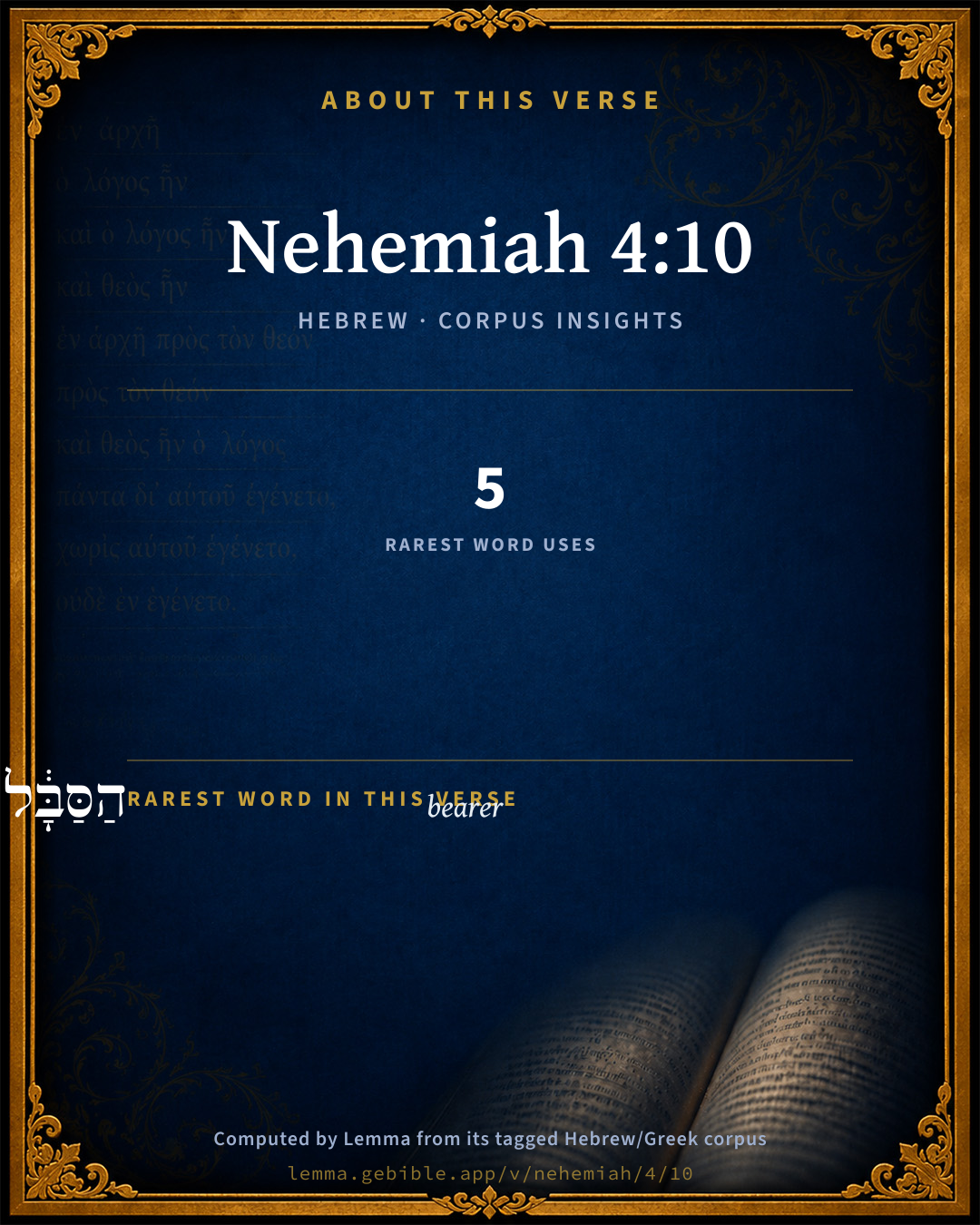
The rarest word here is הַסַּבָּ֔ל bearer H5449 — appearing just 5 times in the whole Hebrew Bible.

Shared distinctive vocabulary

הַסַּבָּ֔ל bearer H5449 occurs in 5 verses of the Hebrew Bible. Also found in:

Grammatical profile

  • 5 verbs
  • 5 nouns
  • 1 pronoun
  • 1 particle

Verb forms

  • וַיֹּ֣אמֶר Qal · Sequential Imperfect
  • כָּשַׁל֙ Qal · Perfect
  • הַרְבֵּ֑ה Hiphil · Infinitive Absolute
  • נוּכַ֔ל Qal · Imperfect
  • לִבְנ֖וֹת Qal · Infinitive Construct

Cross-references

6

Topical passages linked to Nehemiah 4:10 in the Treasury of Scripture Knowledge — connected by theme and wording, ordered by reader-vote popularity; previews shown in the World English Bible.

  • Numbers 13:31 But the men who went up with him said, We aren't able to go up against the people; for they are stronger than we.
  • Numbers 32:9 For when they went up to the valley of Eshcol, and saw the land, they discouraged the heart of the children of Israel, that they should not go into the land which Yahweh had given them.
  • 2 Chronicles 2:18 He set seventy thousand of them to bear burdens, and eighty thousand who were stone cutters in the mountains, and three thousand six hundred overseers to set the people at work.
  • Psalms 11:1–2 In Yahweh, I take refuge. How can you say to my soul, "Flee as a bird to your mountain!"
  • Ezekiel 29:18 Son of man, Nebuchadrezzar king of Babylon caused his army to serve a great service against Tyre: every head was made bald, and every shoulder was worn; yet had he no wages, nor his army, from Tyre, for the service that he had served against it.
  • Haggai 1:2 "This is what Yahweh of Hosts says: These people say, 'The time hasn't yet come, the time for Yahweh's house to be built.'"

Cross-references courtesy of OpenBible.info (CC BY 4.0).

Hebrew and Greek witnesses Masoretic Hebrew ↔ Greek Septuagint

The same verse in the two great witnesses to the Old Testament, shown verse-for-verse.

These are two independent witnesses, not word-aligned to each other, and the Septuagint is shown in lemma (dictionary) form.

Hebrew Nehemiah 4:10 Masoretic · Westminster Leningrad Codex

וַיֹּ֣אמֶר יְהוּדָ֗ה כָּשַׁל֙ כֹּ֣חַ הַסַּבָּ֔ל וְהֶעָפָ֖ר הַרְבֵּ֑ה וַאֲנַ֨חְנוּ֙ לֹ֣א נוּכַ֔ל לִבְנ֖וֹת בַּחוֹמָֽה

Judah said, The strength of the bearers of burdens is decayed, and there is much rubbish; so that we are not able to build the wall.

World English Bible · Public Domain

Greek LXX Structure differs

The Septuagint has no separate book of Nehemiah. Its Greek text is the second half of Esdras B (2 Esdras), chapters 11–23; Ezra is the first half (1–10).

A verse-for-verse comparison isn’t shown here because the chapters and verses don’t line up. Switch to the LXX edition with the MT / LXX toggle above to read the Greek directly.

On this verse, The Cambridge Bible for Schools and Colleges discusses the Septuagint’s reading. Read the note in Commentary ↓

Hebrew: Westminster Leningrad Codex (CC BY 4.0). Greek: Septuagint (public domain); English from a public-domain English Septuagint. How the Septuagint differs from the Hebrew →

Commentary

Notes on Nehemiah 4:10 from classic Christian and Jewish commentators (each source and its license shown beneath its notes). The classic Christian expositions comment on the surrounding passage and are grouped to its opening verse, so a note may address several verses; the Jewish commentaries on the Tanakh (Rashi and others) are per-verse, so they appear only where the commentator wrote on this verse.

Lemma curates 59 commentaries, every one of them public domain or Creative Commons licensed, each selected and text-cleaned for this edition rather than reprinted as found. About our sources →

Trapp's Complete Commentary

John Trapp

Neh 4:10 And Judah said, The strength of the bearers of burdens is decayed, and [there is] much rubbish; so that we are not able to build the wall.

Ver. 10. And Judah said] Here was επεμβολη, impedimenti domestici; aliud ex alio malum, a worse discouragement than the former. Judah (the chief labourers) begins to murmur and mutiny, to faint and fall off. A perilous practice in such a dangerous time, and enough to have undone all; as one coward in an army, breaking the array and running away, may set the rest a running, and the day be thereby lost. Lo, this was Judah, whose escutcheon was a lion; but here unlike himself.

The strength of the bearers of burdens is decayed] Very specious reasons they allege; their shoulders ached, their strength was gone, there was no end of their painstaking, their work grew upon them, &c. The truth was, deerat ignis, deerat animus, they were weary of well doing, and not valiant for the truth, Jer 9:3. More like they were to those fugitives of Ephraim, Jdg 12:4, than the lions of the tribe of Judah. Nehemiah therefore might well have said to them, as Alexander once did to a faint hearted soldier of his, that was of his own name, Either give up the name of Alexander, or be valiant. So, either hold out, and bear up under your burdens, or be Judah no more.

So that we are not able] Never was anything too hard for Alexander; because he never held anything impossible to be effected.

John Trapp, A Commentary or Exposition upon All the Books of the Old and New Testament (1647–1656) — public domain. Text from a community e-Sword module.

Joseph Benson's Commentary

Neh 4:10. And Judah said — That is, the Jews now dwelling in Judah; to wit, some of them, being partly terrified by their enemies, and partly wearied with continual labour: the strength of the bearers of burdens is decayed — The labourers have wrought so long and so hard that they are quite spent; and there is much rubbish — More than we are able soon to remove: so that we are not able to build the wall — Being forced to spend our time in removing the rubbish, and therefore we must desist for a season. Can Judah, that warlike, valiant tribe, speak thus? Active, leading men, have many times as much to do to grapple with the fears of their friends as with the terrors of their enemies.

Joseph Benson's Commentary on the Old and New Testaments (1811–1818) — public domain. Text from a community e-Sword module.

Adam Clarke's Commentary

Verse 10. The strength of the bearers of burdens is decayed] They worked both day and night, scarcely ever putting off their clothes, except for the purpose of being washed, Ne 4:21; Ne 4:23.

Much rubbish] The ruins they were obliged to clear away, before they could dig the foundation for a new wall: and in this labour they were nearly exhausted; see Ne 5:15.

Adam Clarke's Commentary on the Bible (1810–1826) — public domain. Text from a community e-Sword/MySword module.

Ellicott's Commentary for English Readers

(10) And Judah said.—As hereafter, in the case of the complaints of the people (Nehemiah 5), the writer gives a summary of difficulties. The Jews, or “Judah”—a significant term—complained of their growing feebleness, especially as so many were diverted to the watches.

A Bible Commentary for English Readers, edited by Charles John Ellicott (1878–1897) — public domain. Text from a community e-Sword module.

The Cambridge Bible for Schools and Colleges

gen. ed. J. J. S. Perowne

10. And Judah said] i.e. the Jewish community speaking, by their rulers or representatives, to Nehemiah.

The strength of the bearers of burdens, &c.] Literally ‘the strength of the bearer of burdens, &c.,’ referring to the whole class of the working population. The LXX. wrongly ἡ ἰσχὺς τῶν ἐχθρῶν.

so that we are not able, &c.] The complaint here described seems to be introduced at this point to show the variety of obstacles to the work. Besides the direct hostility of the Samaritans, the Jews themselves declared their strength to be giving way before the fatigue. The task of clearing away the accumulated rubbish before building the walls had exhausted their patience and their powers. It is not necessary to regard this declaration as mutinous. It was occasioned by the pressure felt by the whole community in consequence of the continuous labour upon the wall. There was no reserve to fall back upon in case of a sudden alarm. To Nehemiah at such a crisis the complaint must have greatly added to the difficulties of the moment. It had all the tone of disaffection, and reminded him that in the face of a hostile foe he could place little confidence either in the power or in the willingness of the Jewish citizens to defend themselves.

The Cambridge Bible for Schools and Colleges (gen. ed. J. J. S. Perowne; Cambridge University Press, 1878–1918) — public domain. Text from a community e-Sword module.

John Gill's Exposition

And Judah said,.... Several of the men of Judah:

the strength of the bearers of burdens is decayed; through much labour, in carrying heavy loads of stone and timber to the builders, and yet more through fear of the enemy:

and there is much rubbish; which ought to be removed, but that the labourers were so weak that they could not do it:

so that we are not able to build the wall; to finish it before the enemy comes to attack us.

John Gill's Exposition of the Whole Bible (1746–1763) — public domain (CC PDM 1.0). Text via the HelloAO Bible API.

Haydock's Catholic Bible Commentary

Juda. Some of the Jews, (Menochius) who were dispirited at the greatness of the work and the threats of the enemy. --- Burdens. Septuagint, "of the enemies." Arabic, "the Jews were strengthened, there were many porters, but they could not finish the work." (Calmet) --- Rubbish to be removed. (Tirinus)

George Leo Haydock (1774–1849), Haydock's Catholic Family Bible and Commentary, 1859 edition — public domain. Excludes Psalms (Douay-Rheims chapter numbering differs from Protestant) and Deuterocanonical books (Catholic canon only).

Matthew Poole's English Annotations

And Judah said, i.e. the Jews now dwelling in Judah, to wit, some of them, being partly terrified by their enemies, and partly wearied with hard and continual labours.

There is much rubbish; more than we are able suddenly to remove.

We are not able to build the wall; being forced to spend our time in removing the rubbish, and other works imposed upon us; and therefore we must desist at least for a season.

Matthew Poole's English Annotations on the Holy Bible (1683–1685) — public domain. Text from a community e-Sword/MySword module.

Whedon's Commentary on the Bible

Daniel D. Whedon

10. Judah said — By his representatives, heads of the tribe of Judah.

The strength… is decayed — They are worn-out and exhausted by excessive toil.

Much rubbish — This had been accumulating for more than a hundred years, and in some places presented to the builders insuperable difficulties.

Daniel D. Whedon (gen. ed.), Commentary on the Old and New Testaments (1874–1909) — public domain. Text from a community e-Sword module.

The Pulpit Commentary

The strength of the bearers of burdens is decayed. The complaint seems to be, that by the drawing off of men from the working parties to act as guards, those parties were so weakened that they could not continue the work, the quantity of rubbish being so great.

The Pulpit Commentary (1880–1919), ed. H.D.M. Spence-Jones & Joseph S. Exell — public domain. Text from a community e-Sword module.

John Wesley's Explanatory Notes

Judah - The Jews now dwelling in Judah, some of them being partly terrified by their enemies, and partly wearied with continual labour. Rubbish - More than we are able suddenly to remove. Not able - Being forced to spend our time in removing the rubbish, and therefore we must desist for a season.

John Wesley, Explanatory Notes Upon the Whole Bible (1754–1765) — public domain. Text via the GEBible commentary corpus.

Keil & Delitzsch

C. F. Keil & F. Delitzsch

The placing of the watch day and night, and the continuous labour, must have pressed heavily upon the people; therefore Judah said: "The strength of the bearers of burdens fails, and there is much rubbish; we are not able to build the wall." That is to say, the labour is beyond our power, we cannot continue it.

Keil & Delitzsch — Biblical Commentary on the Old Testament (1861–1891) — public domain (CC PDM 1.0). Text via the HelloAO Bible API. (Old Testament only.)

unfoldingWord translationNotes

Door43 World Missions Community

There is too much rubble

Rubble is "burned stone" or "broken rock" or "unusable stone."

They will not know or see until we come among them

"They will not see us coming until we are beside them"

translationWords

people group

kingdom of Judah

burden

know

works

unfoldingWord translationNotes — © Distant Shores Media and the Door43 World Missions Community, licensed CC BY-SA 4.0. Source: git.door43.org/Door43/en_tn.

Rashi

Rabbi Shlomo Yitzchaki (Rashi)

And it was from that day on And from that day on, half the mighty men worked at the building of the wall, and the remaining half of the mighty men were armed with weapons to guard their brethren who were doing the work.

spears Heb. וְהָרְמָחִים. The “vav” is superfluous, like the “vav” of (Gen. 36: 24): “And these are the sons of Zibeon: Aiah (וְאַיָה) and Anah.”

and the rulers were close behind the entire tribe of Judah to be cautious in the battle.

Rashi on the Tanakh — English translations: “The Judaica Press complete Tanach with Rashi, translated by A. J. Rosenberg” (CC BY 4.0); “Pentateuch with Rashi's commentary by M. Rosenbaum and A.M. Silbermann, 1929-1934” (public domain); “The Metsudah Tanach series, Lakewood, N.J” (CC BY 4.0); and “The Book of Joshua, Metsudah Publications, 1997” (CC BY 4.0). Text via Sefaria.

Lesson kit

Teaching starters — assembled from the data on this page, not authored interpretation. Every prompt links to the verse data it draws on. Edit before teaching.

Nehemiah, in the Historical, opens this verse with 12 words (12 distinct Hebrew lemmas). Its most distinctive word is çabbâl (“bearer”). A historical commentator’s framing appears above. Read the whole chapter for the surrounding context.

Discussion questions

  1. The word çabbâl carries the sense “bearer.” How does it shape the verse?
  2. 1 Kings 5:15 shares the word «bearer» with this verse. How do the two illuminate each other?
  3. These translations render this verse differently. What is at stake in choosing one wording over another?
  4. The verb «וַיֹּ֣אמֶר» is Qal Sequential Imperfect. How does its form color the action?
  5. Reading how Trapp's Complete Commentary and Joseph Benson's Commentary read this verse, where do the two commentators agree and where do they part?

Things to notice

Reading settings

Reading text

Shown beneath each verse's original-language words.

Old Testament
Old Testament edition

Read the OT as the Masoretic Hebrew (MT) or the Greek Septuagint (LXX).

English shown for the Greek Septuagint (in the Hebrew ↔ Greek comparison).

Comparing translations? Open the Compare panel on any verse page to stack up to four side by side.