
Job 9:17

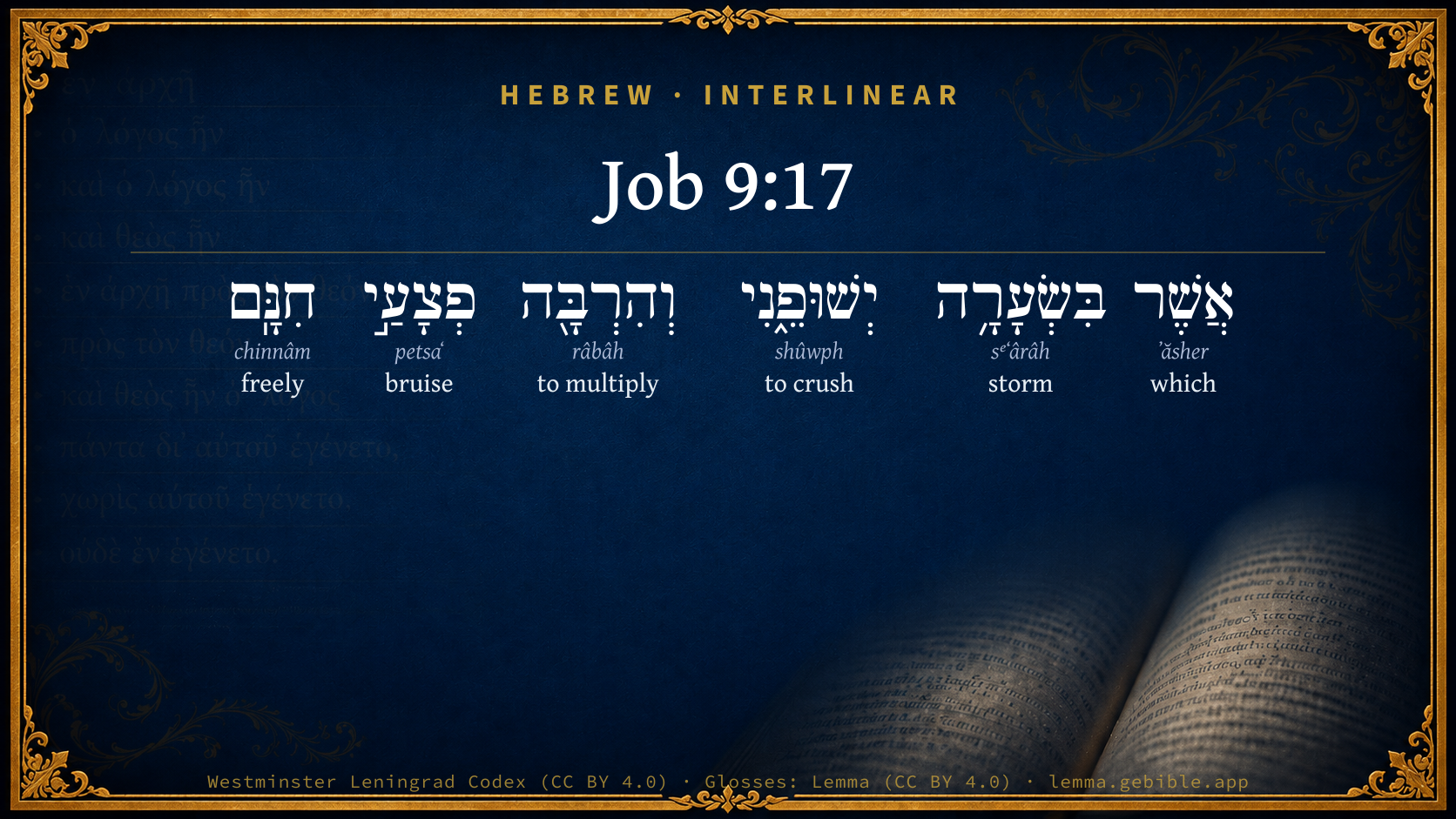
Hebrew (Westminster Leningrad Codex) Job 9:17 appears in the Hebrew Old Testament. The text above is from the Westminster Leningrad Codex. Each word links to its Strong’s number, a concise gloss, and parsing drawn from the Open Scriptures Hebrew Bible morphology. Click any word for its full Brown-Driver-Briggs (BDB) entry.
Download image
Cite this verse

Job 9:17 (World English Bible). Public Domain. Lemma interlinear Bible study tool, https://lemma.gebible.app/v/job/9/17.

Show BibTeX & RIS
BibTeX
RIS
English Translation
For he breaks me with a tempest, Multiplies my wounds without cause.
World English Bible · Public Domain
Highlights Full analysis ↓
Download a study sheet

One document with this verse’s original text, its word-by-word gloss line, the meaning frame, cross-references with their text, attributed commentary, and full source and license credits — printable, and it pastes into notes with its structure intact.

This verse Autodidact and up

Study sheet (.html) Plain text (.txt)

A passage Seminary Student

Up to 50 verses in one chapter. A passage sheet keeps up to 6 commentary sources and 12 cross-references per verse, in the order this page ranks them, and says so on the sheet whenever that leaves anything out. Ask for a single verse and you get the Autodidact verse sheet above.

Everything on this page stays free to read, with no account — the sheet is a download of what is already on screen, not access to it.

Want to remove ads? Support Godless Engineer
Compare translations 3

The same verse in 3 English versions, stacked beneath the original-language interlinear above. Click any original word for its lexicon entry.

Each is an independent rendering of the whole verse — the interlinear is not word-aligned to these translations.

Highlighted words mark where these versions differ — a whole-verse word diff, not a word-by-word alignment.

  • World English Bible Public Domain
    For he breaks me with a tempest, Multiplies my wounds without cause.
  • King James Version Public Domain
    For he breaketh me with a tempest, and multiplieth my wounds without cause.
  • unfoldingWord Literal Text CC BY-SA 4.0
    who would break me with a tempest and multiply my wounds for nothing.

unfoldingWord Literal Text — © unfoldingWord, licensed CC BY-SA 4.0. Word-aligned USFM3 via Door43 (git.door43.org/unfoldingWord/en_ult).

Versions to compare (up to 4)

3 of 4 selected

Show all 18 translations

Every available English version of this verse, each an independent rendering of the whole verse.

  • World English Bible Public Domain
    For he breaks me with a tempest, Multiplies my wounds without cause.
  • Berean Standard Bible Public Domain
    For He would crush me with a tempest and multiply my wounds without cause.
  • Majority Standard Bible Public Domain
    For He would crush me with a tempest and multiply my wounds without cause.
  • King James Version Public Domain
    For he breaketh me with a tempest, and multiplieth my wounds without cause.
  • American Standard Version (1901) Public Domain
    For he breaketh me with a tempest, And multiplieth my wounds without cause.
  • Revised Version (1885) Public Domain
    For he breaketh me with a tempest, and multiplieth my wounds without cause.
  • Geneva Bible (1599) Public Domain
    For he destroyeth mee with a tempest, and woundeth me without cause.
  • Douay-Rheims (1899) Public Domain
    For he shall crush me in a whirlwind, and multiply my wounds even without cause.
  • Young's Literal Translation Public Domain
    Because with a tempest He bruiseth me, And hath multiplied my wounds for nought.
  • Literal Standard Version CC BY-SA 4.0
    Because He bruises me with a storm, || And has multiplied my wounds for nothing.
  • Unlocked Literal Bible CC BY-SA 4.0
    For he breaks me with a tempest and multiplies my wounds without cause.
  • unfoldingWord Literal Text CC BY-SA 4.0
    who would break me with a tempest and multiply my wounds for nothing.
  • Darby Bible Public Domain
    He, who crusheth me with a tempest, and multiplieth my wounds without cause.
  • World Messianic Bible Public Domain
    For he breaks me with a storm, and multiplies my wounds without cause.
  • Webster's Bible Public Domain
    For he breaketh me with a tempest, and multiplieth my wounds without cause.
  • Free Bible Version CC BY-SA 4.0
    He pounds me with the winds of a storm; he wounds me time and again, without giving a reason.
  • Bible in Basic English Public Domain
    For I would be crushed by his storm, my wounds would be increased without cause.
  • JPS Tanakh (1917) Public Domain
    He that would break me with a tempest, and multiply my wounds without cause;

Literal Standard Version (2020), Covenant Press — licensed CC BY-SA 4.0. Text via the HelloAO Bible API (eBible.org). Unlocked Literal Bible (unfoldingWord) — licensed CC BY-SA 4.0. Text via the HelloAO Bible API (eBible.org). unfoldingWord Literal Text — © unfoldingWord, licensed CC BY-SA 4.0. Word-aligned USFM3 via Door43 (git.door43.org/unfoldingWord/en_ult). Free Bible Version, Dr. Jonathan Gallagher — licensed CC BY-SA 4.0. Text via the HelloAO Bible API (eBible.org).

Word by word

More ways to search: Search by grammar → Find every occurrence → Compare this word →

Practice this passage: Drill this verse → Learn its vocabulary →

About this verse

These counts appear in no published source. They are computed here, from the morphology-tagged text and Lemma’s own curated glosses. What Lemma adds →

6
words
6
distinct lemmas
Wisdom
section

Notable vocabulary

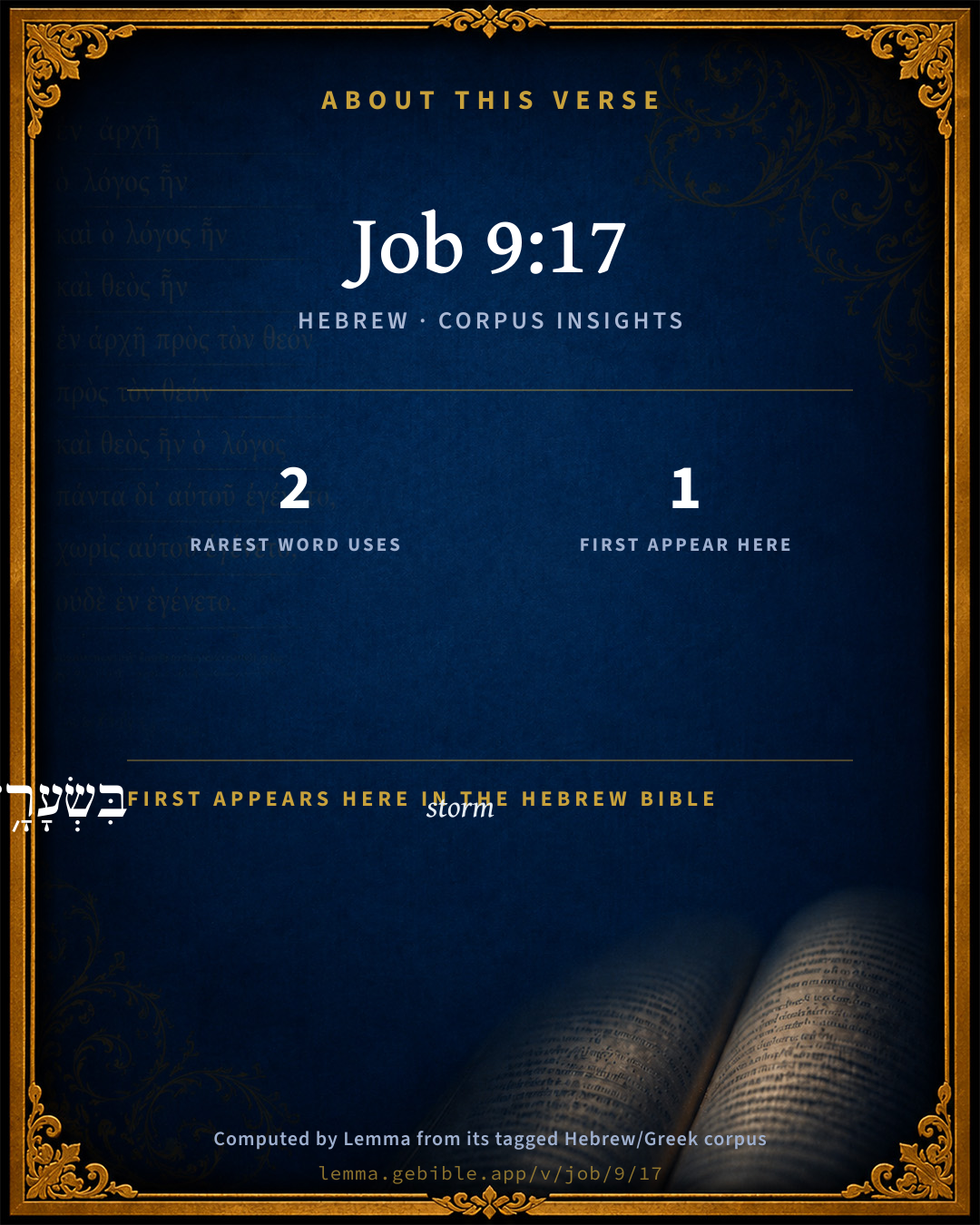
The rarest word here is בִּשְׂעָרָ֥ה storm H8183 — appearing just 2 times in the whole Hebrew Bible.

First appearance in Scripture

This word makes its first canonical appearance in the Hebrew Bible here:

  • בִּשְׂעָרָ֥ה storm H8183

Shared distinctive vocabulary

בִּשְׂעָרָ֥ה storm H8183 occurs in 2 verses of the Hebrew Bible. Also found in:

Grammatical profile

  • 2 verbs
  • 2 nouns
  • 1 adverb
  • 1 particle

Verb forms

  • יְשׁוּפֵ֑נִי Qal · Imperfect
  • וְהִרְבָּ֖ה Hiphil · Sequential Perfect

Hebrew & Septuagint length

In English translation the verse runs 12 words from the Hebrew and 18 from the Septuagint (LXX English) — the Septuagint runs noticeably longer here. See the side-by-side →

A rough comparison of the two English renderings, which tokenize alike — not a word-level alignment.

Word counts can differ between the Hebrew and the Greek without any difference in meaning — e.g. the Hebrew direct-object marker אֵת has no separate Greek word, and Greek often adds the article ὁ.

Cross-references

20

Topical passages linked to Job 9:17 in the Treasury of Scripture Knowledge — connected by theme and wording, ordered by reader-vote popularity; previews shown in the World English Bible.

  • Job 16:14 He breaks me with breach on breach. He runs on me like a giant.
  • Job 2:3 Yahweh said to Satan, "Have you considered my servant Job? For there is none like him in the earth, a blameless and an upright man, one who fears God, and turns away from evil. He still maintains his integrity, although you incited me against him, to ruin him without cause."
  • Job 34:6 Notwithstanding my right I am considered a liar; My wound is incurable, though I am without disobedience.'
  • Job 1:14–19 that there came a messenger to Job, and said, "The oxen were plowing, and the donkeys feeding beside them,
  • Job 2:7 So Satan went forth from the presence of Yahweh, and struck Job with painful sores from the sole of his foot to his head.
  • Job 2:13 So they sat down with him on the ground seven days and seven nights, and none spoke a word to him, for they saw that his grief was very great.
  • Job 16:12 I was at ease, and he broke me apart. Yes, he has taken me by the neck, and dashed me to pieces. He has also set me up for his target.
  • Job 16:17 Although there is no violence in my hands, And my prayer is pure.
  • Job 30:22 You lift me up to the wind, and drive me with it. You dissolve me in the storm.
  • Psalms 25:3 Yes, no one who waits for you shall be shamed. They shall be shamed who deal treacherously without cause.
  • Psalms 29:5 The voice of Yahweh breaks the cedars. Yes, Yahweh breaks in pieces the cedars of Lebanon.
  • Psalms 42:7 Deep calls to deep at the noise of your waterfalls. All your waves and your billows have swept over me.
  • Psalms 83:15 So pursue them with your tempest, And terrify them with your storm.
  • Isaiah 28:17 I will make justice the line, and righteousness the plummet; and the hail shall sweep away the refuge of lies, and the waters shall overflow the hiding-place.
  • Jeremiah 23:19 Behold, the tempest of Yahweh, [even his] wrath, is gone forth, yes, a whirling tempest: it shall burst on the head of the wicked.
  • Ezekiel 13:13 Therefore thus says the Lord Yahweh: I will even tear it with a stormy wind in my wrath; and there shall be an overflowing shower in my anger, and great hailstones in wrath to consume it.
  • Matthew 7:27 The rain came down, the floods came, and the winds blew, and beat on that house; and it fell--and great was its fall."
  • Matthew 12:20 He won't break a bruised reed. He won't quench a smoking flax, Until he leads justice to victory.
  • John 9:3 Jesus answered, "Neither did this man sin, nor his parents; but, that the works of God might be revealed in him.
  • John 15:25 But this happened so that the word may be fulfilled which was written in their law, 'They hated me without a cause.'

Cross-references courtesy of OpenBible.info (CC BY 4.0).

Hebrew and Greek witnesses Masoretic Hebrew ↔ Greek Septuagint

The same verse in the two great witnesses to the Old Testament, shown verse-for-verse.

Here the Septuagint runs noticeably longer than the Hebrew — LXX2012 (modern English Septuagint) 18 words vs World English Bible 12. A rough length comparison of the two English translations, not a word-level alignment — read both below.

These are two independent witnesses, not word-aligned to each other, and the Septuagint is shown in lemma (dictionary) form.

Hebrew Job 9:17 Masoretic · Westminster Leningrad Codex

אֲשֶׁר בִּשְׂעָרָ֥ה יְשׁוּפֵ֑נִי וְהִרְבָּ֖ה פְצָעַ֣י חִנָּֽם

For he breaks me with a tempest, Multiplies my wounds without cause.

World English Bible · Public Domain

Greek LXX Job 9:17 Septuagint · lemma form

μή γνόφος ἐγώ ἐκτρίβω πολύς δέ ἐγώ ὁ σύντριμμα ποιέω διά κενός

Let him not crush me with a dark storm: but he has made by bruises many without cause.

LXX2012 (modern English Septuagint) · Public Domain

Hebrew: Westminster Leningrad Codex (CC BY 4.0). Greek: Septuagint (public domain); English from LXX2012 (modern English Septuagint) (Public Domain). How the Septuagint differs from the Hebrew →

Commentary

Notes on Job 9:17 from classic Christian and Jewish commentators (each source and its license shown beneath its notes). The classic Christian expositions comment on the surrounding passage and are grouped to its opening verse, so a note may address several verses; the Jewish commentaries on the Tanakh (Rashi and others) are per-verse, so they appear only where the commentator wrote on this verse.

Lemma curates 59 commentaries, every one of them public domain or Creative Commons licensed, each selected and text-cleaned for this edition rather than reprinted as found. About our sources →

Trapp's Complete Commentary

John Trapp

Job 9:17 For he breaketh me with a tempest, and multiplieth my wounds without cause.

Ver. 17. For he breaketh me with a tempest] q.d. This is one thing also that maketh me think I am not heard, because I am not helped; but after my prayer I am in as bad a case as before and seem to have a repulse from God. Afflictions continued are no evidence that prayer is not heard; yet usually it is very inevident to an afflicted person that his prayer is heard. The Hebrew (and so the Vulgate) hath it, He will break me, that is, saith one, If I should plead before him as pure, although I might temporally, or for a time, be delivered, yet I should not finally escape destruction, although I should give him none other cause. Whereby we may see upon what danger of being torn in pieces by God’s judgments our justiciaries put themselves that will needs go to God in their own righteousness, as the proud Pharisee, Luk 18:11-12 The calamity of these merit mongers shall rise suddenly. Behold, a whirlwind, or a tempest of the Lord, goeth forth in fury, even a grievous whirlwind; it shall fall grievously upon th e head of these wicked ones, Jer 23:19. This St Paul knew, and, therefore, did his utmost that he might be found in Christ (sc. when sought for by the justice of God), not having his "own righteousness, which is of the law, but that which is through the faith of Christ, the righteousness which is of God by faith," Php 3:9.

And multiplieth my wounds without cause] i.e. Without any other cause than to try me, and prove my patience, which now Job began to perceive, as Philip gathereth; or, without any manifest cause, and perceivable by an afflicted man, so Aquinas senseth it. God hath not told me the reason of his chastenings; but, to increase my grief, he concealeth from me the cause of them; and yet he multiplieth still my sores and my sorrows. Or, without cause, that is, without any such cause as his friends alleged against him, viz. that he was a rank hypocrite.

John Trapp, A Commentary or Exposition upon All the Books of the Old and New Testament (1647–1656) — public domain. Text from a community e-Sword module.

Joseph Benson's Commentary

Job 9:17. For he breaketh me with a tempest — As with a tempest; that is, unexpectedly, violently, and irrecoverably. This is the reason of his forementioned diffidence, that even when God seemed to answer his supplication in words, yet the course of his actions toward him was of a quite contrary nature and tendency. And multiplieth my wounds without cause — He does not mean, simply without any desert of his, as if he had been free from all sin, and perfectly innocent and holy, the contrary to which he oft declares; but without any special cause of such singular afflictions; without any peculiar and extraordinary guilt, such as his friends charged him with.

Joseph Benson's Commentary on the Old and New Testaments (1811–1818) — public domain. Text from a community e-Sword module.

Whedon's Commentary on the Bible

Daniel D. Whedon

Strophe b — In the ravings of his despair, (see Job_6:3,) Job declares his sufferings to be a tangible proof that God may be almighty but not just, Job_9:17-20.

17. Breaketh me — שׁו, same as in Gen_3:15, bruise; the word also signifies “rub in pieces” — destroy. “He who would crush me in a tempest, and multiply my wounds without cause, will not suffer me to take my breath, but would surfeit me with bitterness.”

Daniel D. Whedon (gen. ed.), Commentary on the Old and New Testaments (1874–1909) — public domain. Text from a community e-Sword module.

Tyndale Open Study Notes

Tyndale Open Resources

9:17 with a storm: Perhaps the words translated “with a storm” (bis’arah) are a double entendre with besa‘arah (“for a hair”; i.e., “for the littlest thing”), which would parallel without cause.

Tyndale Open Study Notes — © Tyndale Open Resources, licensed CC BY-SA 4.0. Text via the HelloAO Bible API.

Geneva Bible (1599)

Geneva Bible translators

I am not able to feel my sins so great, as I feel the weight of his plagues; and this he speaketh to condemn his dullness, and to justify God.

Geneva Bible (1599) marginal notes — public domain. Text via Bolls.life.

Adam Clarke's Commentary

Verse 17. He breaketh me with a tempest] The Targum, Syriac, and Arabic have this sense: He powerfully smites even every hair of my head and multiplies my wounds without cause. That is, There is no reason known to myself, or to any man, why I should be thus most oppressively afflicted. It is, therefore, cruel, and inconsequent to assert that I suffer for my crimes.

Adam Clarke's Commentary on the Bible (1810–1826) — public domain. Text from a community e-Sword/MySword module.

Ellicott's Commentary for English Readers

(17) He breaketh me . . .—This is one of the three passages in which this word is found, the other two being Gen_3:15, “It shall bruise,” &c., and Psa_139:11, “If I say the darkness shall cover me.”

A Bible Commentary for English Readers, edited by Charles John Ellicott (1878–1897) — public domain. Text from a community e-Sword module.

The Cambridge Bible for Schools and Colleges

gen. ed. J. J. S. Perowne

17. he breaketh] Rather, he would break. Similarly, and multiply. The word translated break may mean to seize and swallow up, that is, to sweep away, cf. ch. Job_30:22.

17–21. These verses describe what would ensue in the supposed case that God had actually responded to Job’s citation. He would not listen to Job’s plea but would crush him with His infinite power. The words do not describe what Job actually suffers at present or has suffered, but what he would have to endure then, though the colours of the terrible picture are drawn from his actual sufferings.

The Cambridge Bible for Schools and Colleges (gen. ed. J. J. S. Perowne; Cambridge University Press, 1878–1918) — public domain. Text from a community e-Sword module.

John Gill's Exposition

He will not suffer me to take my breath,.... Which some think refers to Job's disease, which was either an asthma, or a quinsy in his throat, which occasioned great difficulty in breathing: I should rather think the allusion is to the hot burning winds in those countries before mentioned, which sometimes blew so strongly as almost to take away a man's breath; so the above traveller (u) reports, that between Suez and Cairo (in Egypt) they had for a day's time and more so hot a wind, that they were forced to turn their backs to it, to take a little breath. The design of Job is to show, that his afflictions were continued, and were without any intervals; they were repeated so fast, and came so thick upon him, one after another, that he had no breathing time; the import of the phrase is the same with that in Job 7:19,

but filleth me with bitterness; to the full, to satiety, to loathing, as a man may be with a bitter potion, with wormwood drink, and water of gall, with bitter afflictions comparable to such, whereby Job's life was embittered to him, see Jer 9:15.

(u) Travels. par. 1. B. 2. c. 34. p. 177.

John Gill's Exposition of the Whole Bible (1746–1763) — public domain (CC PDM 1.0). Text via the HelloAO Bible API.

Albert Barnes' Notes on the Bible

For he breaketh me - He is overwhelming me with a tempest; that is, with the storms of wrath. He shows me no mercy. The idea seems to be, that God acted toward him not as a judge determining matters by rule of law, but as a sovereign - determining them by his own will. If it were a matter of law; if he could come before him as a judge, and maintain his cause there; if the case could be fairly adjudicated whether he deserved the calamities that came upon him, he would be willing to enter into such a trial. But where the matter was determined solely by will, and God acted as a sovereign, doing as he pleased, and giving no account of his matters to anyone, then it would be useless to argue the cause. He would not know what to expect, or understand the principles on which an adjudication would be made. It is true that God acts as a sovereign, but he does not act without reference to law. He dispenses his favors and his judgments as he pleases, but he violates none of the rules of right. The error of Job was the common error which people commit, that if God acts as a sovereign, he must of course act regardless of law, and that it is vain to plead with him or try to please him. But sovereignty is not necessarily inconsistent with respect for law; and He who presides with the most absolute power over the universe, is He who is most directed by the rule of right. In Him sovereignty and law coincide; and to come to Him as a sovereign, is to come with the assurance that supreme rectitude will be done.

And multiplieth my wounds without cause - That is, without sufficient reason. This is in accordance with the views which Job had repeatedly expressed. The main ground of his complaint was, that his sufferings were disproportionate to his faults.

Albert Barnes' Notes on the Bible (1834–1885) — public domain. Text from a community e-Sword/MySword module.

Haydock's Catholic Bible Commentary

Without cause. That is, without my knowing the cause; or without any crime of mine. (Challoner) --- To argue from my afflictions, that I am a criminal, is unjust, chap. ii. 3. "Notions mistaken, reasonings ill apply’d,

And sophisms that conclude on either side." (Pope, Pleasures, &c.)

George Leo Haydock (1774–1849), Haydock's Catholic Family Bible and Commentary, 1859 edition — public domain. Excludes Psalms (Douay-Rheims chapter numbering differs from Protestant) and Deuterocanonical books (Catholic canon only).

Matthew Poole's English Annotations

This is the reason of his foregoing diffidence, that even when God seemed to answer him in words, yet the course of his actions towards him was of a quite contrary nature and tendency.

With a tempest; as with a tempest, i.e. unexpectedly, violently, and irrecoverably.

Without cause; not simply without any desert of his, or as if he had no sin in him, for he oft declares the contrary; but without any evident or special cause of such singular afflictions, i.e. any peculiar and extraordinary guilt, such as my friends charge me with.

Matthew Poole's English Annotations on the Holy Bible (1683–1685) — public domain. Text from a community e-Sword/MySword module.

The Pulpit Commentary

For he breaketh me with a tempest. God" that is, "would not be likely patiently to hear my justification, and calmly to weigh it, when he is already overwhelming me with his wrath, breaking and crushing me (Gen_3:15, where the same word pWv is used) with a very storm of calamity." The sentiment can scarcely be justified, since it breathes something of a contumacious spirit. But this only shows that Job was not yet" made perfect through sufferings". (Heb_2:10) And multiplieth my wounds without cause. A further assertion, not of absolute sinlessness, but of comparative innocence of the belief that he had done nothing to deserve such a terrible punishment as he is suffering. (comp. Job_6:24, Job_6:29)

The Pulpit Commentary (1880–1919), ed. H.D.M. Spence-Jones & Joseph S. Exell — public domain. Text from a community e-Sword module.

John Wesley's Explanatory Notes

Breaketh - Unexpectedly, violently, and irrecoverably. Cause - Not simply without any desert of his, but without any special cause of such singular afflictions; and peculiar and extraordinary guilt, such as his friends charged him with.

John Wesley, Explanatory Notes Upon the Whole Bible (1754–1765) — public domain. Text via the GEBible commentary corpus.

Rashi

Rabbi Shlomo Yitzchaki (Rashi)

He Who would crush me with a tempest My form was changed (other editions: my status) before Him.

would crush me Heb. ישופני, would crush me. “I crushed it and ground it” (Deut. 9:21) is translated into Aramaic as: ושפית יתֵה.

my wounds Heb. פצעי, a wound that oozes blood and pus.

Rashi on the Tanakh — English translations: “The Judaica Press complete Tanach with Rashi, translated by A. J. Rosenberg” (CC BY 4.0); “Pentateuch with Rashi's commentary by M. Rosenbaum and A.M. Silbermann, 1929-1934” (public domain); “The Metsudah Tanach series, Lakewood, N.J” (CC BY 4.0); and “The Book of Joshua, Metsudah Publications, 1997” (CC BY 4.0). Text via Sefaria.

Lesson kit

Teaching starters — assembled from the data on this page, not authored interpretation. Every prompt links to the verse data it draws on. Edit before teaching.

Job, in the Wisdom, opens this verse with 6 words (6 distinct Hebrew lemmas). Its most distinctive word is sᵉʻârâh (“storm”). The Greek Septuagint runs longer here. A historical commentator’s framing appears above. Read the whole chapter for the surrounding context.

Discussion questions

  1. How does “storm” (sᵉʻârâh) shape what this verse is saying?
  2. The word “storm” first appears here in Scripture. What is being introduced at this debut?
  3. Nahum 1:3 shares the word «storm» with this verse. How do the two illuminate each other?
  4. Compared with the Hebrew, the Septuagint runs longer here. What questions does that raise?
  5. These translations render this verse differently. What is at stake in choosing one wording over another?
  6. The verb «יְשׁוּפֵ֑נִי» is Qal Imperfect. How does its form color the action?
  7. Reading how Trapp's Complete Commentary and Joseph Benson's Commentary read this verse, where do the two commentators agree and where do they part?

Things to notice

Reading settings

Reading text

Shown beneath each verse's original-language words.

Old Testament
Old Testament edition

Read the OT as the Masoretic Hebrew (MT) or the Greek Septuagint (LXX).

English shown for the Greek Septuagint (in the Hebrew ↔ Greek comparison).

Comparing translations? Open the Compare panel on any verse page to stack up to four side by side.