Genesis 47:27

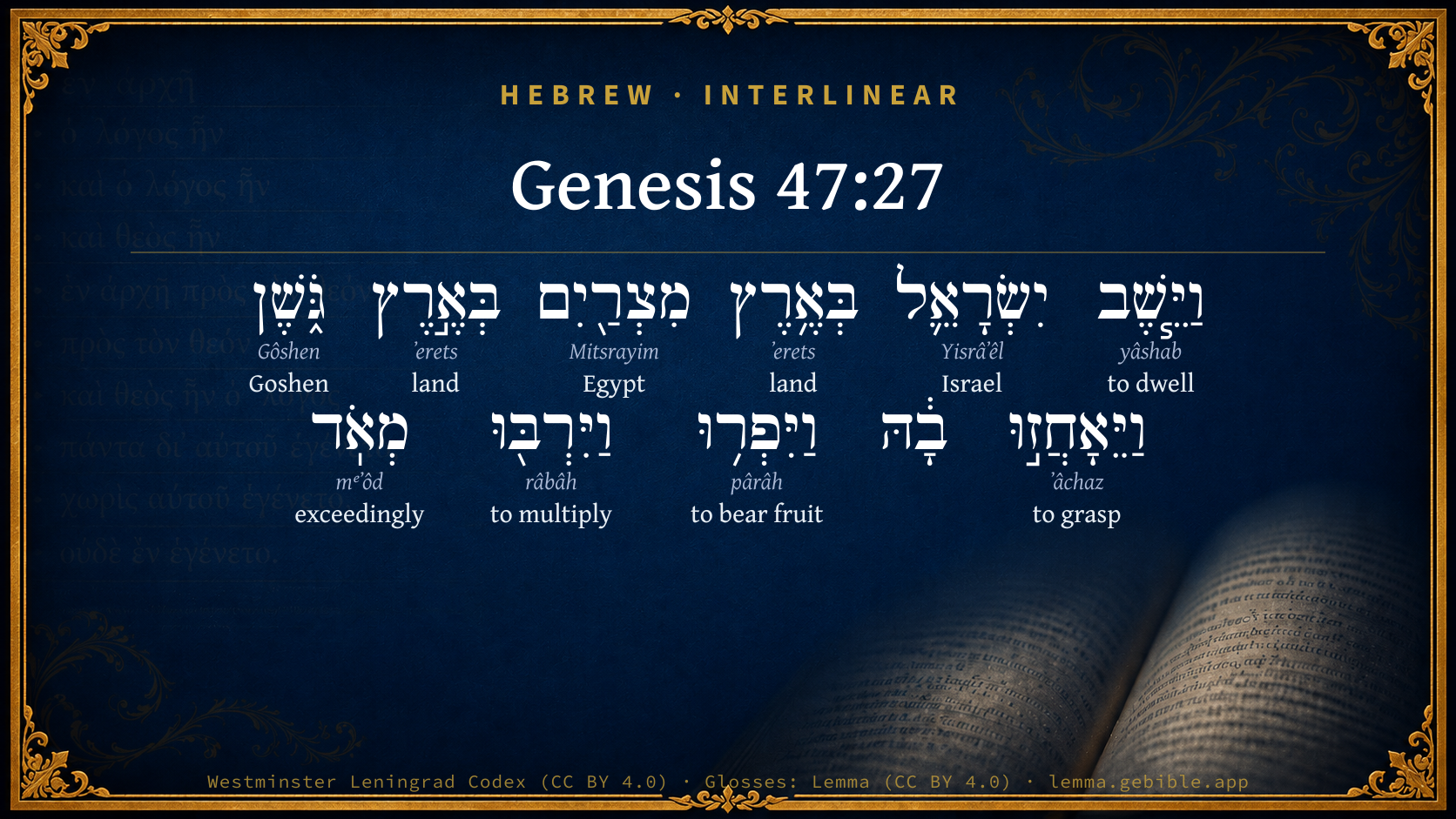
Hebrew (Westminster Leningrad Codex) Genesis 47:27 appears in the Hebrew Old Testament. The text above is from the Westminster Leningrad Codex. Each word links to its Strong’s number, a concise gloss, and parsing drawn from the Open Scriptures Hebrew Bible morphology. Click any word for its full Brown-Driver-Briggs (BDB) entry.
Download image
Cite this verse

Genesis 47:27 (World English Bible). Public Domain. Lemma interlinear Bible study tool, https://lemma.gebible.app/v/genesis/47/27.

Show BibTeX & RIS
BibTeX
RIS
English Translation
Israel lived in the land of Egypt, in the land of Goshen; and they got themselves possessions therein, and were fruitful, and multiplied exceedingly.
World English Bible · Public Domain
Download a study sheet

One document with this verse’s original text, its word-by-word gloss line, the meaning frame, cross-references with their text, attributed commentary, and full source and license credits — printable, and it pastes into notes with its structure intact.

This verse Autodidact and up

Study sheet (.html) Plain text (.txt)

A passage Seminary Student

Up to 50 verses in one chapter. A passage sheet keeps up to 6 commentary sources and 12 cross-references per verse, in the order this page ranks them, and says so on the sheet whenever that leaves anything out. Ask for a single verse and you get the Autodidact verse sheet above.

Everything on this page stays free to read, with no account — the sheet is a download of what is already on screen, not access to it.

Want to remove ads? Support Godless Engineer
Compare translations 3

The same verse in 3 English versions, stacked beneath the original-language interlinear above. Click any original word for its lexicon entry.

Each is an independent rendering of the whole verse — the interlinear is not word-aligned to these translations.

Highlighted words mark where these versions differ — a whole-verse word diff, not a word-by-word alignment.

  • World English Bible Public Domain
    Israel lived in the land of Egypt, in the land of Goshen; and they got themselves possessions therein, and were fruitful, and multiplied exceedingly.
  • King James Version Public Domain
    And Israel dwelt in the land of Egypt, in the country of Goshen; and they had possessions therein, and grew, and multiplied exceedingly.
  • unfoldingWord Literal Text CC BY-SA 4.0
    And Israel settled in the land of Egypt, in the land of Goshen, and they acquired in it. And they were fruitful and multiplied greatly.

unfoldingWord Literal Text — © unfoldingWord, licensed CC BY-SA 4.0. Word-aligned USFM3 via Door43 (git.door43.org/unfoldingWord/en_ult).

Versions to compare (up to 4)

3 of 4 selected

Show all 18 translations

Every available English version of this verse, each an independent rendering of the whole verse.

  • World English Bible Public Domain
    Israel lived in the land of Egypt, in the land of Goshen; and they got themselves possessions therein, and were fruitful, and multiplied exceedingly.
  • Berean Standard Bible Public Domain
    Now the Israelites settled in the land of Egypt, in the region of Goshen. They acquired property there and became fruitful and increased greatly in number.
  • Majority Standard Bible Public Domain
    Now the Israelites settled in the land of Egypt, in the region of Goshen. They acquired property there and became fruitful and increased greatly in number.
  • King James Version Public Domain
    And Israel dwelt in the land of Egypt, in the country of Goshen; and they had possessions therein, and grew, and multiplied exceedingly.
  • American Standard Version (1901) Public Domain
    And Israel dwelt in the land of Egypt, in the land of Goshen; and they gat them possessions therein, and were fruitful, and multiplied exceedingly.
  • Revised Version (1885) Public Domain
    And Israel dwelt in the land of Egypt, in the land of Goshen; and they gat them possessions therein, and were fruitful, and multiplied exceedingly.
  • Geneva Bible (1599) Public Domain
    And Israel dwelt in the lande of Egypt, in the countrey of Goshen: and they had their possessions therein, and grewe and multiplied exceedingly.
  • Douay-Rheims (1899) Public Domain
    So Israel dwelt in Egypt, that is, in the land of Gessen, and possessed it: and grew, and was multiplied exceedingly.
  • Young's Literal Translation Public Domain
    And Israel dwelleth in the land of Egypt, in the land of Goshen, and they have possession in it, and are fruitful, and multiply exceedingly;
  • Literal Standard Version CC BY-SA 4.0
    And Israel dwells in the land of Egypt, in the land of Goshen, and they have possession in it, and are fruitful, and multiply exceedingly;
  • Unlocked Literal Bible CC BY-SA 4.0
    So Israel lived in the land of Egypt, in the land of Goshen. His people gained possessions there. They were fruitful and multiplied greatly.
  • unfoldingWord Literal Text CC BY-SA 4.0
    And Israel settled in the land of Egypt, in the land of Goshen, and they acquired in it. And they were fruitful and multiplied greatly.
  • Darby Bible Public Domain
    And Israel dwelt in the land of Egypt, in the land of Goshen; and they had possessions in it, and were fruitful and multiplied exceedingly.
  • World Messianic Bible Public Domain
    Israel lived in the land of Egypt, in the land of Goshen; and they got themselves possessions therein, and were fruitful, and multiplied exceedingly.
  • Webster's Bible Public Domain
    And Israel dwelt in the land of Egypt, in the country of Goshen; and they had possessions in it and grew, and multiplied exceedingly.
  • Free Bible Version CC BY-SA 4.0
    The Israelites settled in Goshen in Egypt where they became prosperous landowners and rapidly increased in number.
  • Bible in Basic English Public Domain
    And so Israel was living among the Egyptians in the land of Goshen; and they got property there, and became very great in numbers and in wealth.
  • JPS Tanakh (1917) Public Domain
    And Israel dwelt in the land of Egypt, in the land of Goshen; and they got them possessions therein, and were fruitful, and multiplied exceedingly.

Literal Standard Version (2020), Covenant Press — licensed CC BY-SA 4.0. Text via the HelloAO Bible API (eBible.org). Unlocked Literal Bible (unfoldingWord) — licensed CC BY-SA 4.0. Text via the HelloAO Bible API (eBible.org). unfoldingWord Literal Text — © unfoldingWord, licensed CC BY-SA 4.0. Word-aligned USFM3 via Door43 (git.door43.org/unfoldingWord/en_ult). Free Bible Version, Dr. Jonathan Gallagher — licensed CC BY-SA 4.0. Text via the HelloAO Bible API (eBible.org).

Word by word

More ways to search: Search by grammar → Find every occurrence → Compare this word →

Practice this passage: Drill this verse → Learn its vocabulary →

גֹּ֑שֶׁן
Gôshen
H1657
“Goshen”
Noun, Proper
Part of Speech
Noun
Type
Proper
Full BDB Definition

Origin: probably of Egyptian origin

TWOT: 390

Goshen = "drawing near" - a region in northern Egypt, east of the lower Nile, where the children of Israel lived from the time of Joseph to the time of Moses - a district in southern Palestine between Gaza and Gibeon - a town in the mountains of Judah probably in the district of Goshen
  1. וַיֵּ֧שֶׁב yâshab H3427 “and · to dwell” Conjunction + Verb, Qal, Sequential Imperfect, 3rd Person, Masculine, Singular
  2. יִשְׂרָאֵ֛ל Yisrâʼêl H3478 “Israel” Noun, Proper
  3. בְּאֶ֥רֶץ ʼerets H776 “in/at · land of” Preposition + Noun, Common, Both, Singular, Construct
  4. מִצְרַ֖יִם Mitsrayim H4714 “Egypt” Noun, Proper
  5. בְּאֶ֣רֶץ ʼerets H776 “in/at · land of” Preposition + Noun, Common, Both, Singular, Construct
  6. וַיֵּאָחֲז֣וּ ʼâchaz H270 “and · to grasp” Conjunction + Verb, Niphal, Sequential Imperfect, 3rd Person, Masculine, Plural
  7. וַיִּפְר֥וּ pârâh H6509 “and · to bear fruit” Conjunction + Verb, Qal, Sequential Imperfect, 3rd Person, Masculine, Plural
  8. וַיִּרְבּ֖וּ râbâh H7235 “and · to multiply” Conjunction + Verb, Qal, Sequential Imperfect, 3rd Person, Masculine, Plural
  9. מְאֹֽד mᵉʼôd H3966 “exceedingly” Adverb

About this verse

These counts appear in no published source. They are computed here, from the morphology-tagged text and Lemma’s own curated glosses. What Lemma adds →

11
words
9
distinct lemmas
Pentateuch
section

Notable vocabulary

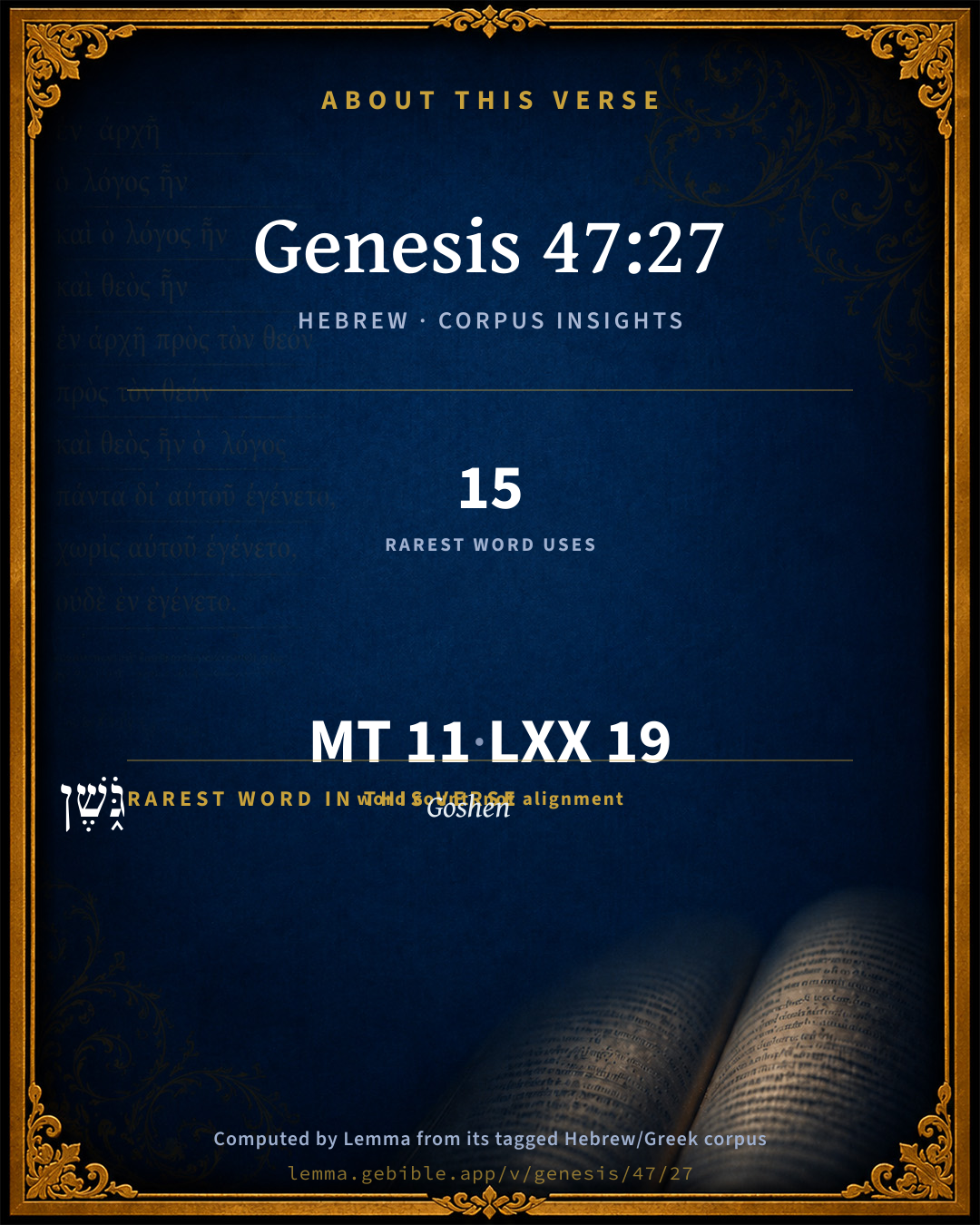
The rarest word here is גֹּ֑שֶׁן Goshen H1657 — appearing just 15 times in the whole Hebrew Bible.

Shared distinctive vocabulary

גֹּ֑שֶׁן Goshen H1657 occurs in 14 verses of the Hebrew Bible. Also found in:

Grammatical profile

  • 4 verbs
  • 5 nouns
  • 1 preposition
  • 1 adverb

Verb forms

  • וַיֵּ֧שֶׁב Qal · Sequential Imperfect
  • וַיֵּאָחֲז֣וּ Niphal · Sequential Imperfect
  • וַיִּפְר֥וּ Qal · Sequential Imperfect
  • וַיִּרְבּ֖וּ Qal · Sequential Imperfect

Repetition

A word recurs within this verse — often emphatic in Hebrew:

  • בְּאֶ֥רֶץ land H776 ×2

Hebrew & Septuagint length

In English translation the verse runs 24 words from the Hebrew and 24 from the Septuagint (LXX English) — the same length.

A rough comparison of the two English renderings, which tokenize alike — not a word-level alignment.

Word counts can differ between the Hebrew and the Greek without any difference in meaning — e.g. the Hebrew direct-object marker אֵת has no separate Greek word, and Greek often adds the article ὁ.

In the original languages it is 11 Hebrew tokens and 19 Greek tokens — but the two are counted differently (Hebrew bundles its prefixes and suffixes into one token; the Greek is in lemma form), so that isn’t a like-for-like length.

Cross-references

16

Topical passages linked to Genesis 47:27 in the Treasury of Scripture Knowledge — connected by theme and wording, ordered by reader-vote popularity; previews shown in the World English Bible.

  • Genesis 46:3 He said, "I am God, the God of your father. Don't be afraid to go down into Egypt; for there I will make of you a great nation.
  • Exodus 1:7 The children of Israel were fruitful, and increased abundantly, and multiplied, and grew exceedingly mighty; and the land was filled with them.
  • Acts 7:17 "But as the time of the promise came close which God had sworn to Abraham, the people grew and multiplied in Egypt,
  • Psalms 107:38 He blesses them also, so that they are multiplied greatly. He doesn't allow their cattle to decrease.
  • Genesis 26:4 I will multiply your seed as the stars of the sky, and will give to your seed all these lands. In your seed will all the nations of the earth be blessed,
  • Deuteronomy 26:5 You shall answer and say before Yahweh your God, A Syrian ready to perish was my father; and he went down into Egypt, and sojourned there, few in number; and he became there a nation, great, mighty, and populous.
  • Psalms 105:24 He increased his people greatly, And made them stronger than their adversaries.
  • Zechariah 10:8 I will signal for them, and gather them; For I have redeemed them; And they will increase as they have increased.
  • Genesis 8:7 and he sent forth a raven. It went back and forth, until the waters were dried up from off the earth.
  • Genesis 8:9 but the dove found no place to rest her foot, and she returned to him into the ark; for the waters were on the surface of the whole earth. He put forth his hand, and took her, and brought her to him into the ark.
  • Genesis 13:16 I will make your offspring as the dust of the earth, so that if a man can number the dust of the earth, then your seed may also be numbered.
  • Genesis 17:6 I will make you exceeding fruitful, and I will make nations of you. Kings will come out of you.
  • Genesis 28:14 Your seed will be as the dust of the earth, and you will spread abroad to the west, and to the east, and to the north, and to the south. In you and in your seed will all the families of the earth be blessed.
  • Exodus 1:12 But the more they afflicted them, the more they multiplied and the more they spread out. They were grieved because of the children of Israel.
  • Deuteronomy 10:22 Your fathers went down into Egypt with seventy persons; and now Yahweh your God has made you as the stars of the sky for multitude.
  • Nehemiah 9:23 Their children also multiplied you as the stars of the sky, and brought them into the land concerning which you did say to their fathers, that they should go in to possess it.

Cross-references courtesy of OpenBible.info (CC BY 4.0).

Hebrew and Greek witnesses Masoretic Hebrew ↔ Greek Septuagint

The same verse in the two great witnesses to the Old Testament, shown verse-for-verse.

These are two independent witnesses, not word-aligned to each other, and the Septuagint is shown in lemma (dictionary) form.

Hebrew Genesis 47:27 Masoretic · Westminster Leningrad Codex

וַיֵּ֧שֶׁב יִשְׂרָאֵ֛ל בְּאֶ֥רֶץ מִצְרַ֖יִם בְּאֶ֣רֶץ גֹּ֑שֶׁן וַיֵּאָחֲז֣וּ בָ֔הּ וַיִּפְר֥וּ וַיִּרְבּ֖וּ מְאֹֽד

Israel lived in the land of Egypt, in the land of Goshen; and they got themselves possessions therein, and were fruitful, and multiplied exceedingly.

World English Bible · Public Domain

Greek LXX Genesis 47:27 Septuagint · lemma form

καταοἰκέω δέ ἰσραήλ ἐν γῆ αἴγυπτος ἐπί ὁ γῆ γεσεμ καί κληρονομέω ἐπί αὐτός καί αὐξάνω καί πληθύνω σφόδρα

And Israel lived in Egypt, in the land of Gesem, and they gained an inheritance upon it; and they increased and multiplied very greatly.

LXX2012 (modern English Septuagint) · Public Domain

On this verse, The Pulpit Commentary discusses the Septuagint’s reading. Read the note in Commentary ↓

Hebrew: Westminster Leningrad Codex (CC BY 4.0). Greek: Septuagint (public domain); English from LXX2012 (modern English Septuagint) (Public Domain). How the Septuagint differs from the Hebrew →

Targum (Aramaic paraphrase)

2

The Targum is the ancient Jewish Aramaic paraphrase of the Hebrew Scriptures — an interpretive translation, not the Hebrew text itself. Onkelos (literal) and Pseudo-Jonathan (expansive) render the Torah, and Jonathan the Prophets. Coverage is partial: where no permissively-licensed English translation exists for a verse, only the Aramaic is shown. This is verse-level text, not a word-by-word alignment to the Hebrew.

  1. Targum Onkelos Torah (Genesis–Deuteronomy)
    וִיתֵיב יִשְׂרָאֵל בְּאַרְעָא דְמִצְרַיִם בְּאַרְעָא דְגשֶׁן וְאַחֲסִינוּ בַהּ וּנְפִישׁוּ וּסְגִיאוּ לַחֲדָא

    (no public-domain English translation for this verse)

    Targum Onkelos — Aramaic: “Onkelos Genesis” (public domain); “Onkelos Exodus” (public domain); “Onkelos Leviticus” (public domain); “Onkelos Numbers” (public domain); “Onkelos Deuteronomy” (public domain). English: “Sefaria Community Translation” (CC0 1.0 (public-domain dedication)); “J.W. Etheridge. The Targums of Onkelos and Jonathan Ben Uzziel on the Pentateuch. London: Longmans, Green, 1862” (public domain). Text via Sefaria.

  2. Targum Pseudo-Jonathan Torah (Genesis–Deuteronomy)
    וִיתֵיב יִשְרָאֵל בְּאַרְעָא דְמִצְרַיִם וּבְנוֹ לְהוֹן בָּתֵּי מֶדְרָשִׁין וּפַלְטִין בְּאַרְעָא דְגשֶׁן וְאַחְסִינוּ בָהּ אַחְסָנַת חַקְלִין וּכְרָמִין וּנְפִישׁוּ וּסְגִיאוּ לַחֲדָא

    And Israel dwelt in the land of Mizraim, and they built there schools and mansions in the land of Goshen, and inherited therein fields and vineyards; and they increased and multiplied greatly.

    Targum Pseudo-Jonathan — Aramaic: “Targum Jonathan on Genesis” (public domain); “Targum Jonathan on Exodus” (public domain); “Targum Jonathan on Leviticus” (public domain); “Targum Jonathan on Numbers” (public domain); “Targum Jonathan on Deuteronomy” (public domain). English: “The Targum of Jonathan ben Uzziel, trans. J. W. Etheridge, London, 1862” (public domain). Text via Sefaria.

Commentary

Notes on Genesis 47:27 from classic Christian and Jewish commentators (each source and its license shown beneath its notes). The classic Christian expositions comment on the surrounding passage and are grouped to its opening verse, so a note may address several verses; the Jewish commentaries on the Tanakh (Rashi and others) are per-verse, so they appear only where the commentator wrote on this verse.

Lemma curates 59 commentaries, every one of them public domain or Creative Commons licensed, each selected and text-cleaned for this edition rather than reprinted as found. About our sources →

Matthew Henry's Commentary

Observe, 1. The comfort Jacob lived in (Gen 47:27, Gen 47:28); while the Egyptians were impoverished in their own land, Jacob was replenished in a strange land. He lived seventeen years after he came into Egypt, far beyond his own expectation. Seventeen years he had nourished Joseph (for so old he was when he was sold from him, Gen 37:2), and now, by way of requital, seventeen years Joseph nourished him. Observe how kindly Providence ordered Jacob's affairs, that when he was old, and least able to bear care or fatigue, he had least occasion for it, being well provided for by his son without his own forecast. Thus God considers the frame of his people. 2. The care Jacob died in. At last the time drew nigh that Israel must die, Gen 47:29. Israel, a prince with God, that had power over the angel and prevailed, yet must yield to death. There is no remedy, he must die: it is appointed for all men, therefore for him; and there is no discharge in that war. Joseph supplied him with bread, that he might not die by famine; but this did not secure him from dying by age or sickness. He died by degrees; his candle was not blown out, but gradually burnt down to the socket, so that he saw, at some distance, the time drawing nigh. Note, It is an improvable advantage to see the approach of death before we feel its arrests, that we may be quickened to do what our hand finds to do with all our might: however, it is not far from any of us. Now Jacob's care, as he saw the day approaching, was about his burial, not the pomp of it (he was no way solicitous about that), but the place of it. (1.) He would be buried in Canaan. This he resolved on, not from mere humour, because Canaan was the land of his nativity, but in faith, because it was the land of promise (which he desired thus, as it were, to keep possession of, till the time should come when his posterity should be masters of it), and because it was a type of heaven, that better country which he that said these things declared plainly that he was in expectation of, Heb 11:14. He aimed at a good land, which would be his rest and bliss on the other side death. (2.) He would have Joseph sworn to bring him thither to be buried (Gen 47:29, Gen 47:31), that Joseph, being under such a solemn obligation to do it, might have that to answer to the objections which otherwise might have been made against it, and for the greater satisfaction of Jacob now in his dying minutes. Nothing will better help to make a death-bed easy than the certain prospect of a rest in Canaan after death. (3.) When this was done Israel bowed himself upon the bed's head, yielding himself, as it were, to the stroke of death ("Now let it come, and it shall be welcome"), or worshipping God, as it is explained, Heb 11:21, giving God thanks for all his favours, and particularly for this, that Joseph was ready, not only to put his hand upon his eyes to close them, but under his thigh to give him the satisfaction he desired concerning his burial. Thus those that go down to the dust should, with humble thankfulness, bow before God, the God of their mercies, Psa 22:29.

Matthew Henry's Commentary on the Whole Bible (1708–1710) — public domain (CC PDM 1.0). Text via the HelloAO Bible API.

Trapp's Complete Commentary

John Trapp

Gen 47:27 And Israel dwelt in the land of Egypt, in the country of Goshen; and they had possessions therein, and grew, and multiplied exceedingly.

Ver. 27. Grew and multiplied exceedingly.] Here that promise in Gen 46:3 began to be accomplished. God dies not in any man’s debt.

John Trapp, A Commentary or Exposition upon All the Books of the Old and New Testament (1647–1656) — public domain. Text from a community e-Sword module.

The Biblical Illustrator

Joseph S. Exell

Gen_47:27-28

And Israel dwelt in the land of Egypt, in the country of Goshen

The children of Israel in Goshen

I.

THEIR QUIET POSSESSION OF THE LAND.

1. They had the means and appliances of prosperity,

2. They enjoyed their freedom by a firm and honourable tenure.

II. THEIR PROSPERITY, (T. H. Leale.)

The Biblical Illustrator, edited by Joseph S. Exell (c. 1880s–1900s) — public domain. Text from a community e-Sword module.

The Preacher's Complete Homiletical Commentary

Joseph S. Exell (gen. ed.)

MAIN HOMILETICS OF THE PARAGRAPH.—Gen_47:27-28

THE CHILDREN OF ISRAEL IN GOSHEN

I. Their quiet possession of the land.

1. They had the means and appliances of prosperity. They were saved from great privations, and they dwelt in a fertile land, most favourably suited to their industry.

2. They enjoyed their freedom by a firm and honourable tenure. They were hampered by no relations of dependence upon Pharaoh that would be irksome to them.

II. Their prosperity. By the peculiar blessing of God, this people grew into the promise of a great nation. Several things contributed to this. They had a definite territory exactly suited to their calling. They were free from moral contamination by intermarriages with an idolatrous nation. But above all, God bestowed upon them the blessing of an extraordinary fruitfulness. Old Jacob lived with them for seventeen years, and saw the commencement of this wonderful history. Thus he survived the famine by twelve years, and saw prosperity with his children.

SUGGESTIVE COMMENTS ON THE VERSES

Gen_47:27-28. It is a remarkable circumstance that until now we read of only two daughters in the family of Jacob. The brothers could not marry their sisters, and it was not desirable that the females should form affinity with the heathen, as they had in general to follow the faith of their husbands.—(Murphy.)

Seventeen years. So long he had nourished Joseph; and so long Joseph nourished him. These were the sweetest days that ever Jacob saw. God reserved his best to the last. “Mark the perfect man, and behold the upright, for”—be his beginning, and his middle never so troublesome—“the end of that man is peace.” (Psa_37:37). A Goshen he shall have, either here or in heaven.—(Trapp.)

The Preacher's Complete Homiletical Commentary (gen. ed. Joseph S. Exell; Funk & Wagnalls, c. 1892) — public domain (pre-1929). A full-Bible homiletical/sermon-outline anthology covering 65 of 66 books (2 John is absent from the source module). Text from a community e-Sword module.

Tyndale Open Study Notes

Tyndale Open Resources

47:27 God blessed his people according to his promise to Abraham that his descendants would be innumerable (15:5; 22:17). They had to wait for the fulfillment of the second promise, that they would own the land of Canaan (17:8).

Tyndale Open Study Notes — © Tyndale Open Resources, licensed CC BY-SA 4.0. Text via the HelloAO Bible API.

John Calvin's Commentaries

27. And Israel dwelt in the land. Moses does not mean that Jacob and his sons were proprietors of that land which Pharaoh had granted them as a dwelling-place, in the same manner in which the other parts of Egypt were given to the inhabitants for a perpetual possession: but that they dwelt there commodiously for a time, and thus were in possession by favor, provided they continued to be peaceable. Hence the cause that they so greatly increased, in a very short space of time. Therefore, what is here related by Moses belongs to the history of the following period; and he now returns to the proper thread of his narrative, in which he purposed to show how God protected his Church from many deaths; and not that only, but wonderfully exalted it by his own secret power.

John Calvin's Commentaries (1540-1563) — public domain. Text from the Calvin Translation Society English edition (1840s-50s) via the Christian Classics Ethereal Library (ccel.org). Calvin's coverage is partial (roughly two-thirds of the Bible); uncommented books and verses are honest gaps, never fabricated. The 19th-century editor's footnotes and remarks are omitted so the notes are faithfully Calvin's own voice.

The Cambridge Bible for Schools and Colleges

gen. ed. J. J. S. Perowne

27. and they gat them, &c.] This clause concludes P’s narrative of the settlement of Jacob and his sons in Egypt.

The Cambridge Bible for Schools and Colleges (gen. ed. J. J. S. Perowne; Cambridge University Press, 1878–1918) — public domain. Text from a community e-Sword module.

John Gill's Exposition

And Jacob lived in the land of Egypt seventeen years,.... He lived just the same term of years with Joseph in Egypt as he had lived with him in Syria and Canaan, Gen 37:2; about two hours' walk from Fium are now to be seen the ruins of an ancient town, which the Coptics say was inhabited by the patriarch Jacob, and for this cause they name it, yet, Modsellet Jacub, or the tabernacle of Jacob (n), which place is supposed to be in the land of Goshen, see Gen 47:11,

so the whole age of Jacob was an hundred forty and seven years; he was one hundred and thirty when he stood before Pharaoh, Gen 47:9; and now had lived in Egypt seventeen years, as in the above clause, which together make up the sum; and this exact time of the years of his life is given by Polyhistor from Demetrius, an Heathen writer (o).

(n) Vansleb's Relation of a Voyage to Egypt, p. 167. (o) Apud Euseb. Praepar. Evangel. l. 9. c. 21. p. 425.

John Gill's Exposition of the Whole Bible (1746–1763) — public domain (CC PDM 1.0). Text via the HelloAO Bible API.

Matthew Poole's English Annotations

They had possessions, i.e. lands, not for the dominion or propriety of them, for that rested in Pharaoh, but for the use and profit of them for their present subsistence.

Matthew Poole's English Annotations on the Holy Bible (1683–1685) — public domain. Text from a community e-Sword/MySword module.

The Pulpit Commentary

And Israel (i.e. the people) dwelt in the land of Egypt, in the country of Goshen; and they had possessions therein (i.e. acquired holdings in it), and grew (or became fruitful), and multiplied exceedingly or became very numerous. This was the commencement of the promise. (Gen_46:3)

HOMILIES BY R.A. REDFORD Vers. 27-31.

The sunset of a long life.

There is a touching beauty in this scene between the veteran Israel and the prosperous Joseph.

I An illustration of HUMAN INFIRMITY. The supplanter, the prince of God, must succumb at last to the King of Terrors. Israel must die." Yet he is not afraid of death.

II STRENGTH IS MADE PERFECT IN WEAKNESS. Grace appears brightest at the end. His gray hairs have not been "brought with sorrow to the grave," although he feared they would. The lost son is the comforter of his last days; to him he commits his dust-to be laid with his fathers.

III PERSEVERANCE IS NOT THE FRUIT OF MAN"S PERFECTION, BUT OF GOD"S MERCY. Jacob is faithful to the covenant spirit to the end, although in many respects his character was a mingled one. Yet he clung to the Divine word. Seventeen years could not wear out his love for the promised land. He knew the Solemnity of an oath, for had he not himself sworn and changed not? He would leave behind him in his last wishes a testimony which would help to keep his children faithful. And Israel bowed himself upon the becks head." The LXX, and the Syriac, and the Itala versions, with the reference in Heb_11:21; by a slight change in the Hebrew vowels, have rendered the words "he worshipped upon the top of his staff" i.e. leaning on that which had borne him through his pilgrimage, and thus, as it were, declaring the long journey at an end. But whether he turned towards the bed"s head, as it were away from the world towards God, or leaned on his staff, the idea is the same he bowed himself, like Simeon, saying, "Now, Lord, lettest thou thy servant depart in peace." It was a lovely sunset after a day of many clouds and much weariness and fear. R.

The Pulpit Commentary (1880–1919), ed. H.D.M. Spence-Jones & Joseph S. Exell — public domain. Text from a community e-Sword module.

Kretzmann's Popular Commentary

Paul E. Kretzmann

Joseph’s Promise to Jacob

v. 27. And Israel dwelt in the land of Egypt, in the country of Goshen; and they had possessions therein, and grew and multiplied exceedingly. This statement summarizes the history of the children of Israel for the next four hundred years.

v. 28. And Jacob lived in the land of Egypt seventeen years, so long the Lord permitted him to share the happiness of his children; so the whole age of Jacob was one hundred forty and seven years.

v. 29. And the time drew nigh that Israel must die; and he called his son Joseph and said unto him, if now I have found grace in thy sight, if Joseph was willing to do him a last great favor, put, I pray thee, thy hand under my thigh, in a gesture accompanying a solemn oath, and deal kindly and truly with me; it would be an act of kindness and of faithfulness. Bury me not, I pray thee, in Egypt;

v. 30. but I will lie with my fathers, and thou shalt carry me out of Egypt, and bury me in their burying-place, in the cave in the field of Machpelah, which Abraham had bought after Sarah’s death, Gen 23:17-20. And he said, I will do as thou hast said. Joseph solemnly obligated himself to carry out this earnest wish of his father.

v. 31. And he said, Swear unto me. And he sware unto him. And Israel bowed himself upon the bed’s head. He was apparently sitting up on his couch and leaning on his staff, Heb 11:21. He now turned to the head of the bed in a prayer of thanksgiving that his last wish was to be fulfilled. Even on his death-bed Jacob did not forget the Land of Promise and the Messianic prophecy. Thus will Christians keep God’s Word and promise before their eyes especially at the time when death is near.

Paul E. Kretzmann, Popular Commentary of the Bible (1921–1924) — public domain. Text from a community e-Sword module.

unfoldingWord translationNotes

Door43 World Missions Community

They were fruitful and multiplied greatly

The word "multiplied" explains how they were "fruitful." AT: "They had very many children" (See: Doublet)

were fruitful

Here "fruitful" means to prosper or to have children. (See: Idiom)

seventeen years

"17 years" (See: Numbers)

so the years of Jacob's life were one hundred forty-seven years

"so Jacob lived to be 147 years old" (See: Numbers)

translationWords

Jacob

Goshen

possess

fruit

multiply

year

unfoldingWord translationNotes — © Distant Shores Media and the Door43 World Missions Community, licensed CC BY-SA 4.0. Source: git.door43.org/Door43/en_tn.

Rashi

Rabbi Shlomo Yitzchaki (Rashi)

וישב ישראל בארץ מצרים AND ISRAEL ABODE IN THE LAND OF EGYPT — and where in the land of Egypt? בארץ גשן IN THE LAND OF GOSHEN which is a part of the land Egypt.

ויאחזו בה means THEY ACQUIRED POSSESSIONS.

Rashi on the Tanakh — English translations: “The Judaica Press complete Tanach with Rashi, translated by A. J. Rosenberg” (CC BY 4.0); “Pentateuch with Rashi's commentary by M. Rosenbaum and A.M. Silbermann, 1929-1934” (public domain); “The Metsudah Tanach series, Lakewood, N.J” (CC BY 4.0); and “The Book of Joshua, Metsudah Publications, 1997” (CC BY 4.0). Text via Sefaria.

Radak

Rabbi David Kimhi (Radak)

וישב ישראל, the term is used to describe the entire family of Yaakov, as if the Torah had written בני ישראל.

ויאחזו בה, they bought land in it, additional to that which Joseph had allocated to them.

ויפרו וירבו מאד, both in children and in property.

Radak on the Tanakh — English translations: “Sefaria Community Translation” (CC0 1.0 (public-domain dedication)); “Eliyahu Munk, HaChut Hameshulash” (CC BY 4.0); “Rabbi Mike Feuer, Jerusalem Anthology” (CC BY 4.0); and “R. David Kimhi on the first book of Psalms, Translated by R.G. Finch, London, 1919” (public domain). Text via Sefaria.

Lesson kit

Teaching starters — assembled from the data on this page, not authored interpretation. Every prompt links to the verse data it draws on. Edit before teaching.

Genesis, in the Pentateuch, opens this verse with 11 words (9 distinct Hebrew lemmas). Its most distinctive word is Gôshen (“Goshen”). A historical commentator’s framing appears above. Read the whole chapter for the surrounding context.

Discussion questions

  1. The word Gôshen carries the sense “Goshen.” How does it shape the verse?
  2. Genesis 45:10 shares the word «Goshen» with this verse. How do the two illuminate each other?
  3. “land” occurs 2× in this one verse. What is the effect of the repetition?
  4. These translations render this verse differently. What is at stake in choosing one wording over another?
  5. The verb «וַיֵּ֧שֶׁב» is Qal Sequential Imperfect. How does its form color the action?
  6. Reading how Matthew Henry's Commentary and Trapp's Complete Commentary read this verse, where do the two commentators agree and where do they part?

Things to notice

Reading settings

Reading text

Shown beneath each verse's original-language words.

Old Testament
Old Testament edition

Read the OT as the Masoretic Hebrew (MT) or the Greek Septuagint (LXX).

English shown for the Greek Septuagint (in the Hebrew ↔ Greek comparison).

Comparing translations? Open the Compare panel on any verse page to stack up to four side by side.