
Joshua 24:3

Hebrew (Westminster Leningrad Codex) Joshua 24:3 appears in the Hebrew Old Testament. The text above is from the Westminster Leningrad Codex. Each word links to its Strong’s number, a concise gloss, and parsing drawn from the Open Scriptures Hebrew Bible morphology. Click any word for its full Brown-Driver-Briggs (BDB) entry.
Download image
Cite this verse

Joshua 24:3 (World English Bible). Public Domain. Lemma interlinear Bible study tool, https://lemma.gebible.app/v/joshua/24/3.

Show BibTeX & RIS
BibTeX
RIS
English Translation
I took your father Abraham from beyond the River, and led him throughout all the land of Canaan, and multiplied his seed, and gave him Isaac.
World English Bible · Public Domain
Download a study sheet

One document with this verse’s original text, its word-by-word gloss line, the meaning frame, cross-references with their text, attributed commentary, and full source and license credits — printable, and it pastes into notes with its structure intact.

This verse Autodidact and up

Study sheet (.html) Plain text (.txt)

A passage Seminary Student

Up to 50 verses in one chapter. A passage sheet keeps up to 6 commentary sources and 12 cross-references per verse, in the order this page ranks them, and says so on the sheet whenever that leaves anything out. Ask for a single verse and you get the Autodidact verse sheet above.

Everything on this page stays free to read, with no account — the sheet is a download of what is already on screen, not access to it.

Want to remove ads? Support Godless Engineer
Compare translations 3

The same verse in 3 English versions, stacked beneath the original-language interlinear above. Click any original word for its lexicon entry.

Each is an independent rendering of the whole verse — the interlinear is not word-aligned to these translations.

Highlighted words mark where these versions differ — a whole-verse word diff, not a word-by-word alignment.

  • World English Bible Public Domain
    I took your father Abraham from beyond the River, and led him throughout all the land of Canaan, and multiplied his seed, and gave him Isaac.
  • King James Version Public Domain
    And I took your father Abraham from the other side of the flood, and led him throughout all the land of Canaan, and multiplied his seed, and gave him Isaac.
  • unfoldingWord Literal Text CC BY-SA 4.0
    And I took your father Abraham from beyond the river and brought him into all of the land of Canaan. And I multiplied his seed and gave to him Isaac.

unfoldingWord Literal Text — © unfoldingWord, licensed CC BY-SA 4.0. Word-aligned USFM3 via Door43 (git.door43.org/unfoldingWord/en_ult).

Versions to compare (up to 4)

3 of 4 selected

Show all 18 translations

Every available English version of this verse, each an independent rendering of the whole verse.

  • World English Bible Public Domain
    I took your father Abraham from beyond the River, and led him throughout all the land of Canaan, and multiplied his seed, and gave him Isaac.
  • Berean Standard Bible Public Domain
    But I took your father Abraham from beyond the Euphrates and led him through all the land of Canaan, and I multiplied his descendants. I gave him Isaac,
  • Majority Standard Bible Public Domain
    But I took your father Abraham from beyond the Euphrates and led him through all the land of Canaan, and I multiplied his descendants. I gave him Isaac,
  • King James Version Public Domain
    And I took your father Abraham from the other side of the flood, and led him throughout all the land of Canaan, and multiplied his seed, and gave him Isaac.
  • American Standard Version (1901) Public Domain
    And I took your father Abraham from beyond the River, and led him throughout all the land of Canaan, and multiplied his seed, and gave him Isaac.
  • Revised Version (1885) Public Domain
    And I took your father Abraham from beyond the River, and led him throughout all the land of Canaan, and multiplied his seed, and gave him Isaac.
  • Geneva Bible (1599) Public Domain
    And I tooke your father Abraham from beyond the flood, and brought him through all the land of Canaan, and multiplied his seede, and gaue him Izhak.
  • Douay-Rheims (1899) Public Domain
    And I took your father Abraham from the borders of Mesopotamia: and brought him into the land of Chanaan: and I multiplied his seed,
  • Young's Literal Translation Public Domain
    and I take your father Abraham from beyond the River, and cause him to go through all the land of Canaan, and multiply his seed, and give to him Isaac.
  • Literal Standard Version CC BY-SA 4.0
    and I take your father Abraham from beyond the River, and cause him to go through all the land of Canaan, and multiply his seed, and give Isaac to him.
  • Unlocked Literal Bible CC BY-SA 4.0
    But I took your father from beyond the Euphrates and led him into the land of Canaan and gave him many descendants through his son Isaac.
  • unfoldingWord Literal Text CC BY-SA 4.0
    And I took your father Abraham from beyond the river and brought him into all of the land of Canaan. And I multiplied his seed and gave to him Isaac.
  • Darby Bible Public Domain
    And I took your father Abraham from the other side of the river, and led him throughout the land of Canaan, and multiplied his seed and gave him Isaac.
  • World Messianic Bible Public Domain
    I took your father Abraham from beyond the River, and led him throughout all the land of Canaan, and multiplied his offspring, and gave him Isaac.
  • Webster's Bible Public Domain
    And I took your father Abraham from the other side of the flood, and led him throughout all the land of Canaan, and multiplied his seed, and gave him Isaac.
  • Free Bible Version CC BY-SA 4.0
    I brought your father Abraham from beyond the Euphrates and led him through all the land of Canaan and gave him many descendants. I gave him Isaac.
  • Bible in Basic English Public Domain
    And I took your father Abraham from the other side of the River, guiding him through all the land of Canaan; I made his offspring great in number, and gave him Isaac.
  • JPS Tanakh (1917) Public Domain
    And I took your father Abraham from beyond the River, and led him throughout all the land of Canaan, and multiplied his seed, and gave him Isaac.

Literal Standard Version (2020), Covenant Press — licensed CC BY-SA 4.0. Text via the HelloAO Bible API (eBible.org). Unlocked Literal Bible (unfoldingWord) — licensed CC BY-SA 4.0. Text via the HelloAO Bible API (eBible.org). unfoldingWord Literal Text — © unfoldingWord, licensed CC BY-SA 4.0. Word-aligned USFM3 via Door43 (git.door43.org/unfoldingWord/en_ult). Free Bible Version, Dr. Jonathan Gallagher — licensed CC BY-SA 4.0. Text via the HelloAO Bible API (eBible.org).

Word by word

More ways to search: Search by grammar → Find every occurrence → Compare this word →

Practice this passage: Drill this verse → Learn its vocabulary →

מֵעֵ֣בֶר
ʻêber
H5676
“from · side of”
Preposition + Noun, Common, Masculine, Singular, Construct
Part of Speech
Preposition + Noun
Type
Common
Gender
Masculine
Number
Singular
State
Construct
Full BDB Definition

Origin: from H5674

TWOT: 1556a

region beyond or across, side - region across or beyond - side, opposite side
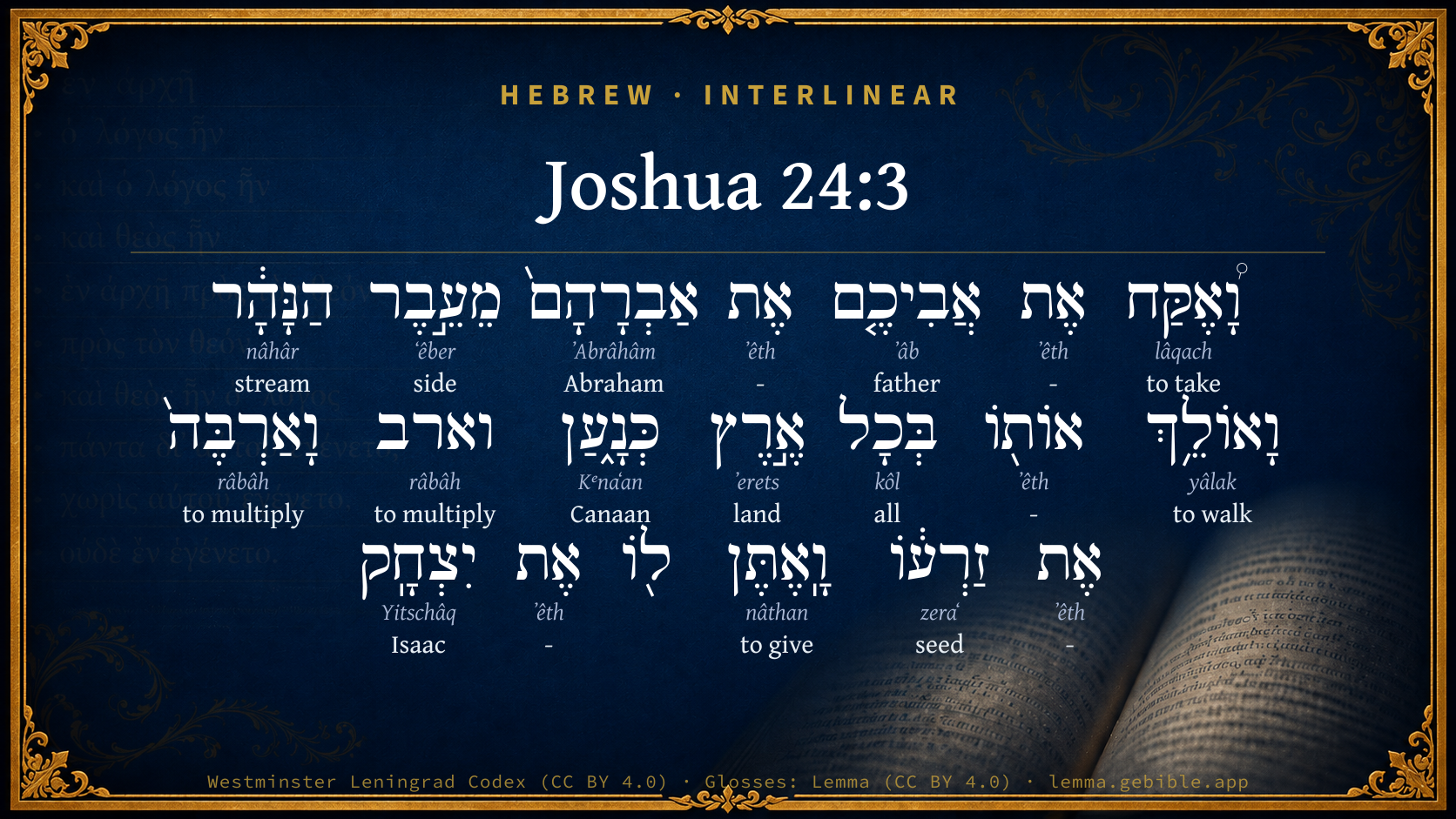
  1. וָ֠אֶקַּח lâqach H3947 “and · to take” Conjunction + Verb, Qal, Sequential Imperfect, 1st Person, Common, Singular
  2. אֶת ʼêth H853 “-” Particle, Direct Object
  3. אֲבִיכֶ֤ם ʼâb H1 “father · your” Noun, Common, Masculine, Singular, Construct + Suffix, Personal, 2nd Person, Masculine, Plural
  4. אֶת ʼêth H853 “-” Particle, Direct Object
  5. אַבְרָהָם֙ ʼAbrâhâm H85 “Abraham” Noun, Proper
  6. הַנָּהָ֔ר nâhâr H5104 “the · stream” Particle, Definite Article + Noun, Common, Masculine, Singular, Absolute
  7. וָאוֹלֵ֥ךְ yâlak H3212 “and · to walk” Conjunction + Verb, Hiphil, Sequential Imperfect, 1st Person, Common, Singular
  8. אוֹת֖וֹ ʼêth H853 “- · him” Particle, Direct Object + Suffix, Personal, 3rd Person, Masculine, Singular
  9. בְּכָל kôl H3605 “in/at · all of” Preposition + Noun, Common, Masculine, Singular, Construct
  10. אֶ֣רֶץ ʼerets H776 “land of” Noun, Common, Both, Singular, Construct
  11. כְּנָ֑עַן Kᵉnaʻan H3667 “Canaan” Noun, Proper
  12. וארב râbâh H7235 “and · to multiply” Conjunction + Verb, Hiphil, Sequential Imperfect, 1st Person, Common, Singular
  13. וָאַרְבֶּה֙ râbâh H7235 “and · to multiply” Conjunction + Verb, Hiphil, Sequential Imperfect, 1st Person, Common, Singular
  14. אֶת ʼêth H853 “-” Particle, Direct Object
  15. זַרְע֔וֹ zeraʻ H2233 “seed · his” Noun, Common, Masculine, Singular, Construct + Suffix, Personal, 3rd Person, Masculine, Singular
  16. וָֽאֶתֶּן nâthan H5414 “and · to give” Conjunction + Verb, Qal, Sequential Imperfect, 1st Person, Common, Singular
  17. אֶת ʼêth H853 “-” Particle, Direct Object
  18. יִצְחָֽק Yitschâq H3327 “Isaac” Noun, Proper

About this verse

These counts appear in no published source. They are computed here, from the morphology-tagged text and Lemma’s own curated glosses. What Lemma adds →

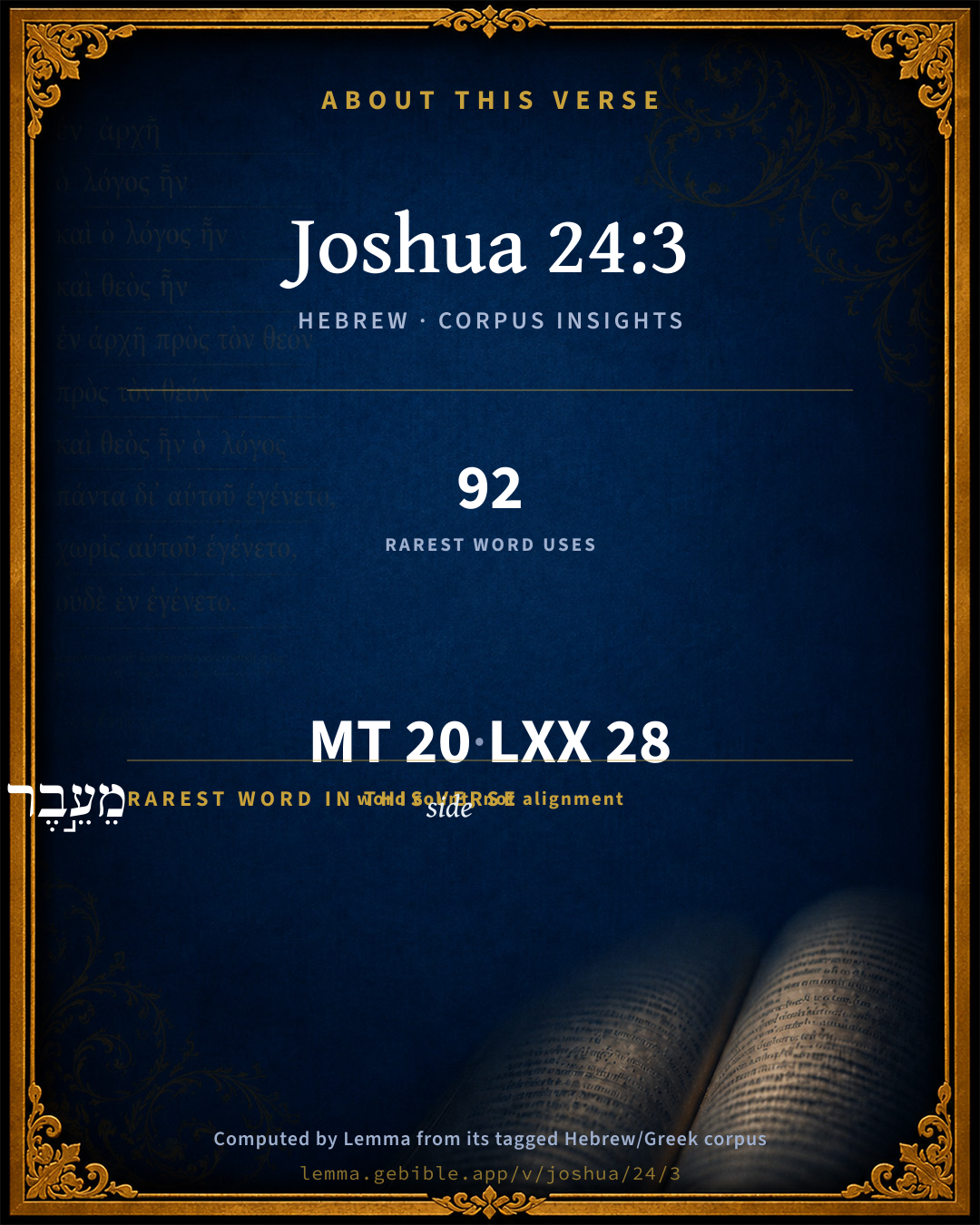
20
words
14
distinct lemmas
Historical
section

Grammatical profile

  • 5 verbs
  • 9 nouns
  • 1 preposition
  • 5 particles

Verb forms

  • וָ֠אֶקַּח Qal · Sequential Imperfect
  • וָאוֹלֵ֥ךְ Hiphil · Sequential Imperfect
  • וארב Hiphil · Sequential Imperfect
  • וָאַרְבֶּה֙ Hiphil · Sequential Imperfect
  • וָֽאֶתֶּן Qal · Sequential Imperfect

Repetition

A word recurs within this verse — often emphatic in Hebrew:

  • וארב to multiply H7235 ×2

Hebrew & Septuagint length

In English translation the verse runs 26 words from the Hebrew and 26 from the Septuagint (LXX English) — the same length.

A rough comparison of the two English renderings, which tokenize alike — not a word-level alignment.

Word counts can differ between the Hebrew and the Greek without any difference in meaning — e.g. the Hebrew direct-object marker אֵת has no separate Greek word, and Greek often adds the article ὁ.

In the original languages it is 20 Hebrew tokens and 28 Greek tokens — but the two are counted differently (Hebrew bundles its prefixes and suffixes into one token; the Greek is in lemma form), so that isn’t a like-for-like length.

Cross-references

6

Topical passages linked to Joshua 24:3 in the Treasury of Scripture Knowledge — connected by theme and wording, ordered by reader-vote popularity; previews shown in the World English Bible.

  • Genesis 12:1–4 Now Yahweh said to Abram, "Get out of your country, and from your relatives, and from your father's house, to the land that I will show you.
  • Genesis 21:2–3 Sarah conceived, and bore Abraham a son in his old age, at the set time of which God had spoken to him.
  • Acts 7:2–3 He said, "Brothers and fathers, listen. The God of glory appeared to our father Abraham, when he was in Mesopotamia, before he lived in Haran,
  • Genesis 15:5 Yahweh brought him outside, and said, "Look now toward the sky, and count the stars, if you are able to count them." He said to Abram, "So shall your seed be."
  • Nehemiah 9:7–8 You are Yahweh the God, who did choose Abram, and brought him forth out of Ur of the Chaldees, and gave him the name of Abraham,
  • Psalms 127:3 Behold, children are a heritage of Yahweh. The fruit of the womb is his reward.

Cross-references courtesy of OpenBible.info (CC BY 4.0).

Hebrew and Greek witnesses Masoretic Hebrew ↔ Greek Septuagint

The same verse in the two great witnesses to the Old Testament, shown verse-for-verse.

These are two independent witnesses, not word-aligned to each other, and the Septuagint is shown in lemma (dictionary) form.

Hebrew Joshua 24:3 Masoretic · Westminster Leningrad Codex

וָ֠אֶקַּח אֶת אֲבִיכֶ֤ם אֶת אַבְרָהָם֙ מֵעֵ֣בֶר הַנָּהָ֔ר וָאוֹלֵ֥ךְ אוֹת֖וֹ בְּכָל אֶ֣רֶץ כְּנָ֑עַן וארב וָאַרְבֶּה֙ אֶת זַרְע֔וֹ וָֽאֶתֶּן ל֖וֹ אֶת יִצְחָֽק

I took your father Abraham from beyond the River, and led him throughout all the land of Canaan, and multiplied his seed, and gave him Isaac.

World English Bible · Public Domain

Greek LXX Joshua 24:3 Septuagint · lemma form

καί λαμβάνω ὁ πατήρ σύ ὁ ἀβραάμ ἐκ ὁ πέραν ὁ ποταμός καί ὁδηγέω αὐτός ἐν πᾶς ὁ γῆ καί πληθύνω αὐτός σπέρμα καί δίδωμι αὐτός ὁ ισαακ

And I took your father Abraam from the other side of the river, and I guided him through all the land, and I multiplied his seed;

LXX2012 (modern English Septuagint) · Public Domain

On this verse, Haydock's Catholic Bible Commentary discusses the Septuagint’s reading. Read the note in Commentary ↓

Hebrew: Westminster Leningrad Codex (CC BY 4.0). Greek: Septuagint (public domain); English from LXX2012 (modern English Septuagint) (Public Domain). How the Septuagint differs from the Hebrew →

Targum (Aramaic paraphrase)

1

The Targum is the ancient Jewish Aramaic paraphrase of the Hebrew Scriptures — an interpretive translation, not the Hebrew text itself. Onkelos (literal) and Pseudo-Jonathan (expansive) render the Torah, and Jonathan the Prophets. Coverage is partial: where no permissively-licensed English translation exists for a verse, only the Aramaic is shown. This is verse-level text, not a word-by-word alignment to the Hebrew.

  1. Targum Jonathan Prophets (Joshua–Malachi)
    וְדַבְּרֵית יַת אֲבוּכוֹן יַת אַבְרָהָם מֵעִבַּר פְּרָת וְאוֹבֵלִית יָתֵיהּ בְּכָל אַרְעָא דִכְנָעַן וְאַסְגֵיתִי יַת בְּנוֹהִי וִיהָבִית לֵיהּ יַת יִצְחָק:

    (no public-domain English translation for this verse)

    Targum Jonathan — Aramaic: “Mikraot Gedolot” (public domain). English: “Sefaria Community Translation” (CC0 1.0 (public-domain dedication)); “London "Chaldee Paraphrase," 1871” (public domain). Text via Sefaria.

Commentary

Notes on Joshua 24:3 from classic Christian and Jewish commentators (each source and its license shown beneath its notes). The classic Christian expositions comment on the surrounding passage and are grouped to its opening verse, so a note may address several verses; the Jewish commentaries on the Tanakh (Rashi and others) are per-verse, so they appear only where the commentator wrote on this verse.

Lemma curates 59 commentaries, every one of them public domain or Creative Commons licensed, each selected and text-cleaned for this edition rather than reprinted as found. About our sources →

Trapp's Complete Commentary

John Trapp

Jos 24:3 And I took your father Abraham from the other side of the flood, and led him throughout all the land of Canaan, and multiplied his seed, and gave him Isaac.

Ver. 3. And gave him Isaac.] Effaetae fidei filium, the heir of the covenant, and therein more happy than his brother Ishmael, with all those twelve princes which he begot. {Gen 17:20-21}

John Trapp, A Commentary or Exposition upon All the Books of the Old and New Testament (1647–1656) — public domain. Text from a community e-Sword module.

Joseph Benson's Commentary

Jos 24:3. I took — I snatched him out of that idolatrous place, and took him into acquaintance and covenant with myself, which was the highest honour and happiness he was capable of. And led — That is, I brought him after his father’s death into Canaan, (Gen 12:1,) and I conducted and preserved him in all his travels through the several parts of Canaan. And multiplied — That is, gave him a numerous posterity, not only by Hagar and Keturah, but even by Sarah and Isaac. Gave him Isaac — By my special power and grace, to be heir of my covenant, and all my promises, and the seed in or by which all the nations were to be blessed.

Joseph Benson's Commentary on the Old and New Testaments (1811–1818) — public domain. Text from a community e-Sword module.

Tyndale Open Study Notes

Tyndale Open Resources

24:3-13 Israel’s faith was always the result of God’s initiative. Joshua’s repetition of God’s words I took . . . I gave . . . I sent . . . I brought reminded the Israelites why they should continue to be loyal to God.

24:3 Abraham lived at Haran in Mesopotamia beyond the Euphrates with his father Terah (Gen 11:31-32). • led him into . . . Canaan: See Gen 12:1-9.

Tyndale Open Study Notes — © Tyndale Open Resources, licensed CC BY-SA 4.0. Text via the HelloAO Bible API.

Jamieson, Fausset & Brown

Robert Jamieson, A. R. Fausset & David Brown

I took your father Abraham from the other side of the flood, and led him throughout all the land of Canaan--It was an irresistible impulse of divine grace which led the patriarch to leave his country and relatives, to migrate to Canaan, and live a "stranger and pilgrim" in that land.

Jamieson, Fausset & Brown — Commentary Critical and Explanatory on the Whole Bible (1871) — public domain (CC PDM 1.0). Text via the HelloAO Bible API.

John Calvin's Commentaries

3. And I took your father Abraham, etc This expression gives additional confirmation to what I lately showed, that Abraham did not emerge from profound ignorance and the abyss of error by his own virtue, but was drawn out by the hand of God. For it is not said that he sought God of his own accord, but that he was taken by God and transported elsewhere. Joshua then enlarges on the divine kindness in miraculously preserving Abraham safe during his long pilgrimage. What follows, however, begets some doubt, namely, that God multiplied the seed of Abraham, and yet gave him only Isaac, because no mention is made of any but him. But this comparison illustrates the singular grace of God towards them in that, while the offspring of Abraham was otherwise numerous, their ancestor alone held the place of lawful heir. In the same sense it is immediately added, that while Esau and Jacob were brothers and twins, one of the two was retained and the other passed over. We see, therefore, why as well in the case of Ishmael and his brother as in that of Esau, he loudly extols the divine mercy and goodness towards Jacob, just as if he were saying, that his race did not excel others in any respect except in that of being specially selected by God.

John Calvin's Commentaries (1540-1563) — public domain. Text from the Calvin Translation Society English edition (1840s-50s) via the Christian Classics Ethereal Library (ccel.org). Calvin's coverage is partial (roughly two-thirds of the Bible); uncommented books and verses are honest gaps, never fabricated. The 19th-century editor's footnotes and remarks are omitted so the notes are faithfully Calvin's own voice.

Ellicott's Commentary for English Readers

(3) The flood—i.e., the river, as in Jos_24:2; and so also in Jos_24:15.

A Bible Commentary for English Readers, edited by Charles John Ellicott (1878–1897) — public domain. Text from a community e-Sword module.

The Cambridge Bible for Schools and Colleges

gen. ed. J. J. S. Perowne

3. And I took] Joshua says nothing more of the life of Abraham than that Jehovah caused him to wander through the Land of Canaan, and finally gave him a son Isaac.

and gave him Isaac] Which means “Laughter” as one “born out of due time,” when Hope might have ceased to hope, and all fulfilment of the Promise seemed impossible. It was either at Gerar or Beersheba that Sarah gave birth to him (Gen_21:2).

The Cambridge Bible for Schools and Colleges (gen. ed. J. J. S. Perowne; Cambridge University Press, 1878–1918) — public domain. Text from a community e-Sword module.

John Gill's Exposition

And I took your father Abraham from the other side of the flood,.... The river Euphrates, as before: or "your father, to wit, Abraham", as Noldius (x); he took him not only in a providential way, and brought him from the other side of the Euphrates, out of an idolatrous country and family, but he apprehended him by his grace, and called and converted him by it, and brought him to a spiritual knowledge of himself, and of the Messiah that should spring from his seed, and of the Covenant of grace, and of the blessings of it, and of his interest therein; which was a peculiar and distinguishing favour:

and led him throughout all the land of Canaan; from the northern to the southern part of it; he led him as far as Shechem, where Israel was now assembled, and then to Bethel, and still onward to the south, Gen 12:6; that he might have a view of the land his posterity was to inherit, and, by treading on it and walking through it, take as it were a kind of possession of it:

and multiplied his seed, and gave him Isaac; he multiplied his seed by Hagar, by whom he had Ishmael, who begat twelve princes; and by Keturah, from whose sons several nations sprung; see Gen 17:20; and by Sarah, who bore him Isaac in old age, in whom his seed was called; and from whom, in the line of Jacob, sprung the twelve tribes of Israel, and which seed may be chiefly meant; and the sense is, that he multiplied his posterity after he had given him Isaac, and by him a numerous seed; so Vatablus: Ishmael is not mentioned, because, as Kimchi observes, he was born of an handmaid; but Abarbinel thinks only such are mentioned, who were born in a miraculous manner, when their parents were barren, as in this and also in the next instance.

(x) Concord. Ebr. Part. p. 119.

John Gill's Exposition of the Whole Bible (1746–1763) — public domain (CC PDM 1.0). Text via the HelloAO Bible API.

Haydock's Catholic Bible Commentary

From the. Hebrew and Septuagint, "other side of the flood or river," where Mesopotamia commences. (Haydock)

George Leo Haydock (1774–1849), Haydock's Catholic Family Bible and Commentary, 1859 edition — public domain. Excludes Psalms (Douay-Rheims chapter numbering differs from Protestant) and Deuterocanonical books (Catholic canon only).

Matthew Poole's English Annotations

I took your father; I apprehended him by my grace, and snatched him out of that idolatrous and wicked place, and took him into acquaintance and covenant with myself, which was the highest honour and happiness he was capable of.

Led him throughout all the land of Canaan, i.e. I brought him after his father’s death into Canaan, Gen 12:1, and I conducted and preserved him in safety in all his travels through the several parts of Canaan.

Multiplied his seed, i.e. gave him a numerous posterity, not only by Hagar and Keturah, but even by Sarah and by Isaac, as it follows.

Gave him Isaac, by my special power and grace, to be the heir of my covenant, and all my promises, and the seed in or by which all nations were to be blessed, Gen 12:3; 21:2.

Matthew Poole's English Annotations on the Holy Bible (1683–1685) — public domain. Text from a community e-Sword/MySword module.

Whedon's Commentary on the Bible

Daniel D. Whedon

3. And I took your father Abraham — There was nothing coercive in this taking. Abraham’s experience was like that of modern Christians who follow the Holy Spirit: “He drew me, and I followed on.” With this understanding we may adopt Calvin’s comment: “It is not said that he sought God of his own accord, but that he was taken by him and led to another place.”

Daniel D. Whedon (gen. ed.), Commentary on the Old and New Testaments (1874–1909) — public domain. Text from a community e-Sword module.

John Wesley's Explanatory Notes

I took - I snatched him out of that idolatrous place, and took him into acquaintance and covenant with myself, which was the highest honour and happiness he was capable of. And led - That is I brought him after his father's death into Canaan, Gen. xii, 1, and I conducted and preserved him in all his travels through the several parts of Canaan. And multiplied - That is, gave him a numerous posterity, not only by Hagar and Keturah, but even by Sarah and by Isaac. Gave Isaac - By my special power and grace to be heir of my covenant, and all my promises, and the seed in or by which all the nations were to be blessed.

John Wesley, Explanatory Notes Upon the Whole Bible (1754–1765) — public domain. Text via the GEBible commentary corpus.

unfoldingWord translationNotes

Door43 World Missions Community

General Information:

Joshua continues quoting what Yahweh said about his dealings with his people.

Seir

name of a place or location (See: How to Translate Names)

went down

Egypt was lower in elevation that the land of Canaan. AT: "traveled"

translationWords

ancestor

Canaan

descend

Isaac

Jacob

Esau

possess

Egypt

unfoldingWord translationNotes — © Distant Shores Media and the Door43 World Missions Community, licensed CC BY-SA 4.0. Source: git.door43.org/Door43/en_tn.

Rashi

Rabbi Shlomo Yitzchaki (Rashi)

I multiplied his descendants. The word אַרְבֶּ in the text lacks the letter ה, [from which we infer:] “How many troubles and tests did I bring upon him before I gave him a descendant.”

Rashi on the Tanakh — English translations: “The Judaica Press complete Tanach with Rashi, translated by A. J. Rosenberg” (CC BY 4.0); “Pentateuch with Rashi's commentary by M. Rosenbaum and A.M. Silbermann, 1929-1934” (public domain); “The Metsudah Tanach series, Lakewood, N.J” (CC BY 4.0); and “The Book of Joshua, Metsudah Publications, 1997” (CC BY 4.0). Text via Sefaria.

Lesson kit

Teaching starters — assembled from the data on this page, not authored interpretation. Every prompt links to the verse data it draws on. Edit before teaching.

Joshua, in the Historical, opens this verse with 20 words (14 distinct Hebrew lemmas). Its most distinctive word is ʻêber (“side”). A historical commentator’s framing appears above. Read the whole chapter for the surrounding context.

Discussion questions

  1. The word ʻêber carries the sense “side.” How does it shape the verse?
  2. How does Genesis 12:1–4, which shares this passage’s theme, read alongside this verse?
  3. What does the repetition of “to multiply” (2× in this one verse) do in this verse?
  4. These translations render this verse differently; the difference is in the English rendering, not the original. What questions does that raise?
  5. «וָ֠אֶקַּח» is a Qal Sequential Imperfect verb. How does that grammatical form shape the action described?
  6. Compare how Trapp's Complete Commentary and Joseph Benson's Commentary read this verse. Where do they agree or differ?

Things to notice

Reading settings

Reading text

Shown beneath each verse's original-language words.

Old Testament
Old Testament edition

Read the OT as the Masoretic Hebrew (MT) or the Greek Septuagint (LXX).

English shown for the Greek Septuagint (in the Hebrew ↔ Greek comparison).

Comparing translations? Open the Compare panel on any verse page to stack up to four side by side.