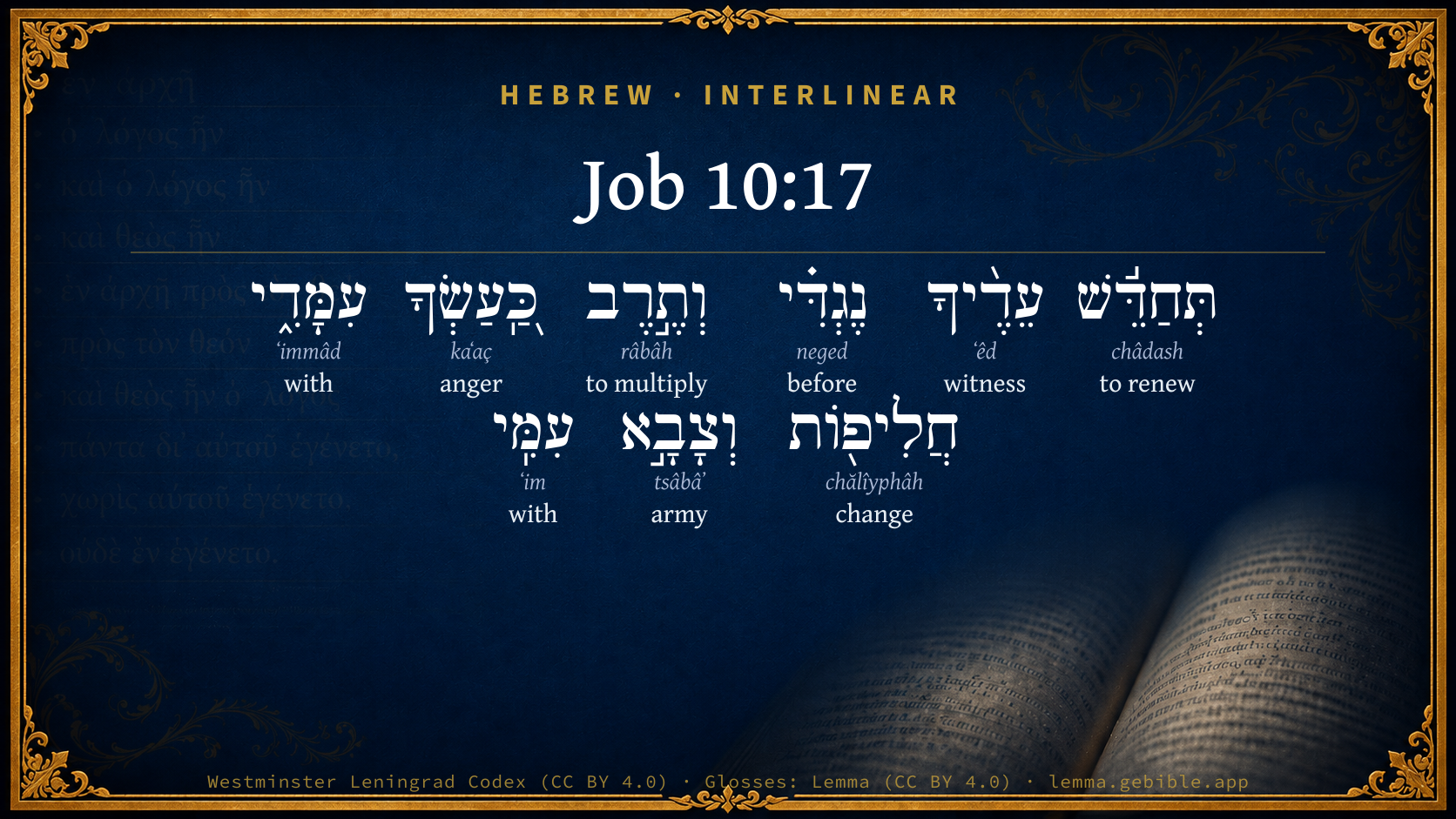
Job 10:17

Hebrew (Westminster Leningrad Codex) Job 10:17 appears in the Hebrew Old Testament. The text above is from the Westminster Leningrad Codex. Each word links to its Strong’s number, a concise gloss, and parsing drawn from the Open Scriptures Hebrew Bible morphology. Click any word for its full Brown-Driver-Briggs (BDB) entry.
Download image
Cite this verse

Job 10:17 (World English Bible). Public Domain. Lemma interlinear Bible study tool, https://lemma.gebible.app/v/job/10/17.

Show BibTeX & RIS
BibTeX
RIS
English Translation
You renew your witnesses against me, And increase your indignation on me. Changes and warfare are with me.
World English Bible · Public Domain
Download a study sheet

One document with this verse’s original text, its word-by-word gloss line, the meaning frame, cross-references with their text, attributed commentary, and full source and license credits — printable, and it pastes into notes with its structure intact.

This verse Autodidact and up

Study sheet (.html) Plain text (.txt)

A passage Seminary Student

Up to 50 verses in one chapter. A passage sheet keeps up to 6 commentary sources and 12 cross-references per verse, in the order this page ranks them, and says so on the sheet whenever that leaves anything out. Ask for a single verse and you get the Autodidact verse sheet above.

Everything on this page stays free to read, with no account — the sheet is a download of what is already on screen, not access to it.

Want to remove ads? Support Godless Engineer
Compare translations 3

The same verse in 3 English versions, stacked beneath the original-language interlinear above. Click any original word for its lexicon entry.

Each is an independent rendering of the whole verse — the interlinear is not word-aligned to these translations.

Highlighted words mark where these versions differ — a whole-verse word diff, not a word-by-word alignment.

  • World English Bible Public Domain
    You renew your witnesses against me, And increase your indignation on me. Changes and warfare are with me.
  • King James Version Public Domain
    Thou renewest thy witnesses against me, and increasest thine indignation upon me; changes and war are against me.
  • unfoldingWord Literal Text CC BY-SA 4.0
    You would renew your witnesses against me and you would increase your anger against me; changes and an army with me.

unfoldingWord Literal Text — © unfoldingWord, licensed CC BY-SA 4.0. Word-aligned USFM3 via Door43 (git.door43.org/unfoldingWord/en_ult).

Versions to compare (up to 4)

3 of 4 selected

Show all 18 translations

Every available English version of this verse, each an independent rendering of the whole verse.

  • World English Bible Public Domain
    You renew your witnesses against me, And increase your indignation on me. Changes and warfare are with me.
  • Berean Standard Bible Public Domain
    You produce new witnesses against me and multiply Your anger toward me. Hardships assault me in wave after wave.
  • Majority Standard Bible Public Domain
    You produce new witnesses against me and multiply Your anger toward me. Hardships assault me in wave after wave.
  • King James Version Public Domain
    Thou renewest thy witnesses against me, and increasest thine indignation upon me; changes and war are against me.
  • American Standard Version (1901) Public Domain
    Thou renewest thy witnesses against me, And increasest thine indignation upon me: Changes and warfare are with me.
  • Revised Version (1885) Public Domain
    Thou renewest thy witnesses against me, and increasest thine indignation upon me; changes and warfare are with me.
  • Geneva Bible (1599) Public Domain
    Thou renuest thy plagues against me, and thou increasest thy wrath against me: changes and armies of sorowes are against me.
  • Douay-Rheims (1899) Public Domain
    Thou renewest thy witnesses against me, and multipliest thy wrath upon me, and pains war against me.
  • Young's Literal Translation Public Domain
    Thou renewest Thy witnesses against me, And dost multiply Thine anger with me, Changes and warfare `are' with me.
  • Literal Standard Version CC BY-SA 4.0
    You renew Your witnesses against me, and multiply Your anger with me, || Changes and warfare [are] with me.
  • Unlocked Literal Bible CC BY-SA 4.0
    You bring new witnesses against me and increase your anger against me; you attack me with fresh armies.
  • unfoldingWord Literal Text CC BY-SA 4.0
    You would renew your witnesses against me and you would increase your anger against me; changes and an army with me.
  • Darby Bible Public Domain
    Thou renewest thy witnesses before me and increasest thy displeasure against me; successions [of evil] and a time of toil are with me.
  • World Messianic Bible Public Domain
    You renew your witnesses against me, and increase your indignation on me. Changes and warfare are with me.
  • Webster's Bible Public Domain
    Thou renewest thy witnesses against me, and increasest thy indignation upon me; changes and war are against me.
  • Free Bible Version CC BY-SA 4.0
    You repeat your arguments against me, you pour out more and more of your anger against me, you send fresh armies against me.
  • Bible in Basic English Public Domain
    That you would send new witnesses against me, increasing your wrath against me, and letting loose new armies on me.
  • JPS Tanakh (1917) Public Domain
    Thou renewest Thy witnesses against me, and increasest Thine indignation upon me; host succeeding host against me.

Literal Standard Version (2020), Covenant Press — licensed CC BY-SA 4.0. Text via the HelloAO Bible API (eBible.org). Unlocked Literal Bible (unfoldingWord) — licensed CC BY-SA 4.0. Text via the HelloAO Bible API (eBible.org). unfoldingWord Literal Text — © unfoldingWord, licensed CC BY-SA 4.0. Word-aligned USFM3 via Door43 (git.door43.org/unfoldingWord/en_ult). Free Bible Version, Dr. Jonathan Gallagher — licensed CC BY-SA 4.0. Text via the HelloAO Bible API (eBible.org).

Word by word

More ways to search: Search by grammar → Find every occurrence → Compare this word →

Practice this passage: Drill this verse → Learn its vocabulary →

תְּחַדֵּ֬שׁ
châdash
H2318
“to renew”
Verb, Piel, Imperfect, 2nd Person, Masculine, Singular
Part of Speech
Verb
Stem
Piel
Form
Imperfect
Person
2nd Person
Gender
Masculine
Number
Singular
Full BDB Definition

Origin: a primitive root

TWOT: 613

to be new, renew, repair - (Piel) - to renew, make anew - to repair - (Hithpael) to renew oneself
  1. עֵדֶ֨יךָ ʻêd H5707 “witnesses · your” Noun, Common, Masculine, Plural, Construct + Suffix, Personal, 2nd Person, Masculine, Singular
  2. נֶגְדִּ֗י neged H5048 “before · me” Preposition + Suffix, Personal, 1st Person, Common, Singular
  3. וְתֶ֣רֶב râbâh H7235 “and · to multiply” Conjunction + Verb, Hiphil, Jussive, 2nd Person, Masculine, Singular
  4. כַּֽ֭עַשְׂךָ kaʻaç H3708 “anger · your” Noun, Common, Masculine, Singular, Construct + Suffix, Personal, 2nd Person, Masculine, Singular
  5. עִמָּדִ֑י ʻimmâd H5978 “with · me” Preposition + Suffix, Personal, 1st Person, Common, Singular
  6. חֲלִיפ֖וֹת chălîyphâh H2487 “changes” Noun, Common, Feminine, Plural, Absolute
  7. וְצָבָ֣א tsâbâʼ H6635 “and · army” Conjunction + Noun, Common, Both, Singular, Absolute
  8. עִמִּֽי ʻim H5973 “with · me” Preposition + Suffix, Personal, 1st Person, Common, Singular

About this verse

These counts appear in no published source. They are computed here, from the morphology-tagged text and Lemma’s own curated glosses. What Lemma adds →

9
words
9
distinct lemmas
Wisdom
section

Notable vocabulary

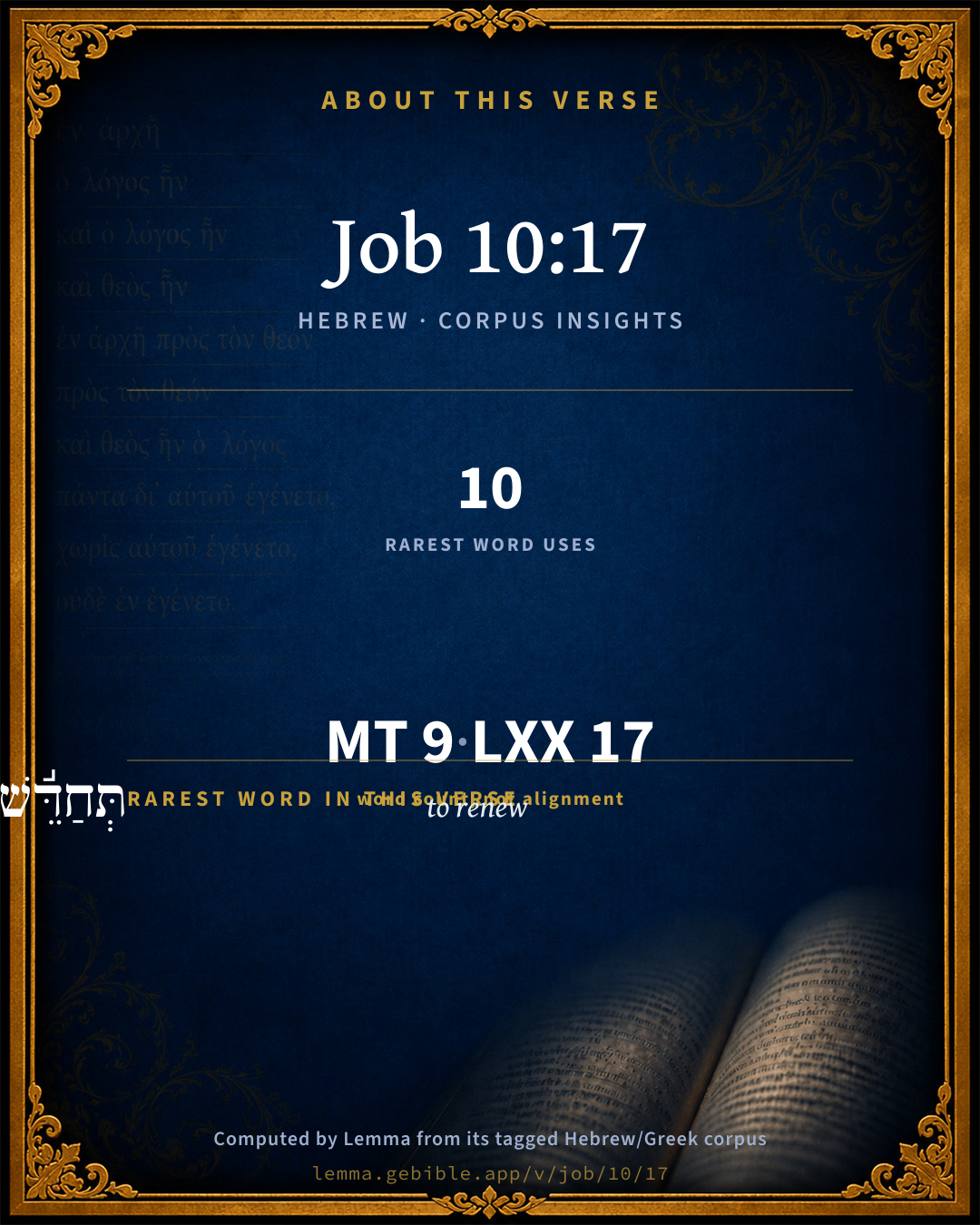
The rarest word here is תְּחַדֵּ֬שׁ to renew H2318 — appearing just 10 times in the whole Hebrew Bible.

Shared distinctive vocabulary

תְּחַדֵּ֬שׁ to renew H2318 occurs in 10 verses of the Hebrew Bible. Also found in:

Grammatical profile

  • 2 verbs
  • 4 nouns
  • 3 prepositions

Verb forms

  • תְּחַדֵּ֬שׁ Piel · Imperfect
  • וְתֶ֣רֶב Hiphil · Jussive

Hebrew & Septuagint length

In English translation the verse runs 18 words from the Hebrew and 21 from the Septuagint (LXX English) — closely comparable.

A rough comparison of the two English renderings, which tokenize alike — not a word-level alignment.

Word counts can differ between the Hebrew and the Greek without any difference in meaning — e.g. the Hebrew direct-object marker אֵת has no separate Greek word, and Greek often adds the article ὁ.

In the original languages it is 9 Hebrew tokens and 17 Greek tokens — but the two are counted differently (Hebrew bundles its prefixes and suffixes into one token; the Greek is in lemma form), so that isn’t a like-for-like length.

Cross-references

7

Topical passages linked to Job 10:17 in the Treasury of Scripture Knowledge — connected by theme and wording, ordered by reader-vote popularity; previews shown in the World English Bible.

  • Ruth 1:21 I went out full, and Yahweh has brought me home again empty; why do you call me Naomi, seeing Yahweh has testified against me, and the Almighty has afflicted me?"
  • Job 16:8 You have shriveled me up. This is a witness against me. My leanness rises up against me, It testifies to my face.
  • Job 16:11–16 God delivers me to the ungodly, And casts me into the hands of the wicked.
  • Job 19:6–11 Know now that God has subverted me, And has surrounded me with his net.
  • Psalms 55:19 God, who is enthroned forever, Will hear, and answer them. Selah. They never change, Who don't fear God.
  • Jeremiah 48:11 Moab has been at ease from his youth, and he has settled on his lees, and has not been emptied from vessel to vessel, neither has he gone into captivity: therefore his taste remains in him, and his scent is not changed.
  • Zephaniah 1:12 It will happen at that time, that I will search Jerusalem with lamps, and I will punish the men who are settled on their dregs, who say in their heart, "Yahweh will not do good, neither will he do evil."

Cross-references courtesy of OpenBible.info (CC BY 4.0).

Hebrew and Greek witnesses Masoretic Hebrew ↔ Greek Septuagint

The same verse in the two great witnesses to the Old Testament, shown verse-for-verse.

These are two independent witnesses, not word-aligned to each other, and the Septuagint is shown in lemma (dictionary) form.

Hebrew Job 10:17 Masoretic · Westminster Leningrad Codex

תְּחַדֵּ֬שׁ עֵדֶ֨יךָ נֶגְדִּ֗י וְתֶ֣רֶב כַּֽ֭עַשְׂךָ עִמָּדִ֑י חֲלִיפ֖וֹת וְצָבָ֣א עִמִּֽי

You renew your witnesses against me, And increase your indignation on me. Changes and warfare are with me.

World English Bible · Public Domain

Greek LXX Job 10:17 Septuagint · lemma form

ἐπι ἀνακαινίζω ἐπί ἐγώ ὁ ἔτασις ἐγώ ὀργή δέ μέγας ἐγώ χράω ἐπιἄγω δέ ἐπί ἐγώ πειρατήριον

renewing against me my torture: and you have dealt with me in great anger, and you have brought trials upon me.

LXX2012 (modern English Septuagint) · Public Domain

On this verse, Albert Barnes' Notes on the Bible discusses the Septuagint’s reading. Read the note in Commentary ↓

Hebrew: Westminster Leningrad Codex (CC BY 4.0). Greek: Septuagint (public domain); English from LXX2012 (modern English Septuagint) (Public Domain). How the Septuagint differs from the Hebrew →

Commentary

Notes on Job 10:17 from classic Christian and Jewish commentators (each source and its license shown beneath its notes). The classic Christian expositions comment on the surrounding passage and are grouped to its opening verse, so a note may address several verses; the Jewish commentaries on the Tanakh (Rashi and others) are per-verse, so they appear only where the commentator wrote on this verse.

Lemma curates 59 commentaries, every one of them public domain or Creative Commons licensed, each selected and text-cleaned for this edition rather than reprinted as found. About our sources →

The Cambridge Bible for Schools and Colleges

gen. ed. J. J. S. Perowne

17. thou renewest] wouldst renew. Similarly, and increase. All the verbs in these verses (Job_10:14-17) are to be translated from the point of view of God’s intention cherished beforehand with regard to Job. This intention has, of course, been carried out, and has been fulfilled in Job’s present condition, and this condition supplies the colours in which the intention is painted. God’s “witnesses” are His plagues and afflictions, as the margin explains, which testified to Job’s guilt, cf. ch. Job_16:8.

changes and war are against me] Or, changes and a host with me. The words are either an exclamation, in which the preceding statements of Job_10:17 are summed up; or are in apposition to “indignation,” being a description of how this indignation shews itself. The expression “changes and a host” means most naturally, an ever-changing, or, renewed host, the figure being that of an attacking army which makes continually fresh and renewed assaults. This army is composed of his afflictions sent against him by God, ch. Job_6:4, Job_16:14, Job_19:12. Others regard the “changes” as the successive new attacks, and the “host” as the abiding old army of afflictions,—which seems artificial and puerile. The word “change” occurs ch. Job_14:14 in the sense of release, and the word “host” in the general meaning of warfare, ch. Job_7:1, Job_14:14. If these meanings were adopted here the sense would be: releases and warfare with me, i. e. brief intervals and then terrible conflict. Job, however, usually represents his afflictions as without intermission.

The Cambridge Bible for Schools and Colleges (gen. ed. J. J. S. Perowne; Cambridge University Press, 1878–1918) — public domain. Text from a community e-Sword module.

Trapp's Complete Commentary

John Trapp

Job 10:17 Thou renewest thy witnesses against me, and increasest thine indignation upon me; changes and war [are] against me.

Ver. 17. Thou renewest thy witnesses against me] These fresh witnesses were devils, say some; Job’s friends, say others; his dolorous sufferings rather, saith Austin; those open witnesses of some secret wickedness in Job, as the world would esteem them. See Job 16:8 Rth 1:21. Thus the Jews censured our Saviour, Isa 53:3-4; the barbarians Paul, Act 28:4; and those in the Gospel them that perished by the fall of the tower of Siloam. And how many precious men as well as Job have been cast upon this evidence for traitors and rebels against the highest majesty? Junius thinks that when Job uttered the words of this text he felt some new pains growing upon him and increasing.

Thou increasest thine indignation upon me] Or within me, as Job 6:4, and this was it that put a sting into his sufferings; God’s heavy displeasure seemed to be kindled against him. Be not thou a terror unto me, O Lord, said Jeremiah, and then I shall do well enough with the rest.

Changes and war (or armies) are upon me, or against me] Variety of troubles come trooping aud treading, as it were, on the heels of one another: fluctus fluctum trudit, there is a continual succession of my sorrows, fresh forces sent against me, &c. We see, then, that Job complained not without cause, though he kept not always within compass, as appeareth by that which followeth.

John Trapp, A Commentary or Exposition upon All the Books of the Old and New Testament (1647–1656) — public domain. Text from a community e-Sword module.

Joseph Benson's Commentary

Job 10:17. Thou renewest thy witnesses — Thy judgments, which are the evidences both of my sins and of thy wrath; and increasest thine indignation — That is, my miseries, the effects of thine indignation. Changes and war — Or, changes and an army, that is, many miseries succeeding one another, like companies of soldiers successively coming on to the attack in a battle. Or, changes may signify the various kinds, and an army the great number of his afflictions.

Joseph Benson's Commentary on the Old and New Testaments (1811–1818) — public domain. Text from a community e-Sword module.

Geneva Bible (1599)

Geneva Bible translators

That is, diversity of diseases and in great abundance: showing that God hath infinite means to punish man.

Geneva Bible (1599) marginal notes — public domain. Text via Bolls.life.

Jamieson, Fausset & Brown

Robert Jamieson, A. R. Fausset & David Brown

witnesses--His accumulated trials were like a succession of witnesses brought up in proof of his guilt, to wear out the accused.

changes and war--rather, "(thou settest in array) against me host after host" (literally, "changes and a host," that is, a succession of hosts); namely, his afflictions, and then reproach upon reproach from his friends.

Jamieson, Fausset & Brown — Commentary Critical and Explanatory on the Whole Bible (1871) — public domain (CC PDM 1.0). Text via the HelloAO Bible API.

Adam Clarke's Commentary

Verse 17. Thou renewest thy witnesses] In this speech of Job he is ever referring to trials in courts of judicature, and almost all his terms are forensic. Thou bringest witnesses in continual succession to confound and convict me.

Changes and war] I am as if attacked by successive troops; one company being wearied, another succeeds to the attack, so that I am harassed by continual warfare.

Adam Clarke's Commentary on the Bible (1810–1826) — public domain. Text from a community e-Sword/MySword module.

Ellicott's Commentary for English Readers

(17) Thou renewest thy witnesses against me.—Some understand this of the sores on Job’s person, which his friends regarded as witnesses—proofs of his guilt; but it seems more probable that the figure is forensic: “Thou still bringest fresh witnesses against me, and multipliest thine anger against me, so that relays of them, even a host, are against me; for they come upon me host after host—these witnesses of Thine anger, the ministers of Thy vengeance.” The sublimity of this indictment against God is only equalled by the sense of terrific awe with which one reads it. The language is Job’s, and so far has the sanction of Holy Writ; but we may surely learn therefrom the condescension as well as the loving-kindness of the Most High.

A Bible Commentary for English Readers, edited by Charles John Ellicott (1878–1897) — public domain. Text from a community e-Sword module.

John Gill's Exposition

Wherefore then hast thou brought me forth out of the womb?.... Into this world; this act is rightly ascribed by Job to the Lord, as it is by David, Psa 22:9; which kind act of God Job complains of, and wishes it had never been, seeing his life was now so miserable and uncomfortable; here he returns to his former complaints, wishes, and expostulations, expressed with so much vehemence and passion in Job 10:3; and for which his friends blamed him, and endeavoured to convince him of his error in so doing; but it does not appear that their arguments carried any force in them with him, or had any effect upon him; he still continues in the same mind, and by repeating justifies what he had said; and thought he had sufficient reason to wish he had never been born, that he had died in the womb, since his afflictions were so very great and increasing, and since God pursued him as a fierce lion; and, according to his sense of things, his indignation against him appeared more and more, and his life was a continued succession of trouble and distress:

and that I had given up the ghost; that is, in the womb, and had never been brought out of it, at least alive; or it may be rendered not as a wish, but as an affirmation, "I should have given up the ghost"; or, "so or then I should have expired" (e); if such care had not been taken of me, if God had not been so officious to me as to take me out of my mother's womb at the proper time, I should have died in it, and that would have been my grave; and which would have been more eligible than to come into the world, and live such a miserable life as I now live:

and no eye had seen me! no eye would have seen him, had he not been taken out of the womb; or however if he had died directly, would not have seen him alive; and an abortive or stillborn child few see, or care to see; and had he been such an one, he had never been seen in the circumstances he now was; and by this he suggests, that he was now such a shocking sight as was not fit to be seen by men, and which would have been prevented had he died in the womb.

(e) "expirabo", Montanus; "expirassem", Mercerus, Cocceius, Schmidt, Schultens.

John Gill's Exposition of the Whole Bible (1746–1763) — public domain (CC PDM 1.0). Text via the HelloAO Bible API.

Albert Barnes' Notes on the Bible

Thou renewest thy witnesses against me - Margin, “that is, plagues.” The Hebrew is, “thy witnesses” - עדיך ‛ēdeykā. So the Vulgate. The Septuagint is, “renewing against me my examination,” τὴν ἐξέτασίν μου tēn ecetasin mou. Rabbi Levi supposes that the plague of the leprosy is intended. But the true meaning seems to be, that God sent upon him calamities which were regarded by his friends as “proofs” or “witnesses” that he was wicked, the public and solemn attestation of God, as they supposed, to the truth that he was eminently a bad man. New proofs of this kind were constantly occurring in his augmenting and protracted sorrows, and he could not answer the arguments which were brought from them by his friends.

Changes and war are against me - Or rather, are “with me,” עמי ‛ı̂my. There were with him such reverses of condition as laid the foundation for the argument which they had urged with so much pertinacity and force that he was punished by God. The word rendered “changes” (חליפה chălı̂yphâh) means properly “changes,” or exchanges, and is applied to garments, 2Ki 5:5, 2Ki 5:22-23. It may be used also of soldiers keeping watch until they are relieved by a succeeding guard; see the note at Job 14:14. Here it is not improbably employed in the sense of a succession of attacks made on him. One succeeds another, as if platoon after platoon, to use the modern terms, or phalanx after phalanx, should come up against him. As soon as one had discharged its arrows, another succeeded in its place; or as soon as one became ex hausted, it was followed by a fresh recruit. All this Job could not endure. The succession wearied him, and he could not bear it. Dr. Good supposes that the word refers to the skirmishes by which a battle is usually introduced, in which two armies attempt to gall each other before they are engaged. But the true idea, as it seems to me, is, that afflictions succeeded each other as soldiers on a watch, or in a battle, relieve each other. When one set is exhausted on duty, it is succeeded by another. Or, when in battle one company has discharged its weapons, or is exhausted, it is succeeded by those who are brought fresh into the field. The word rendered “war” (צבא tsâbâ') properly means an army or a host; see the note at Job 7:1. Here it means that a whole host had rushed upon him. Not only had he been galled by the succession, the relief-guard of calamities, the attacks which had followed each other from an advanced guard, or from scouts sent out to skirmish, but the whole army was upon him. A whole host of calamities came rushing upon him alone, and he could not endure them.

Albert Barnes' Notes on the Bible (1834–1885) — public domain. Text from a community e-Sword/MySword module.

Haydock's Catholic Bible Commentary

Witnesses, afflictions; (Menochius) "wounds." (Pagnin) (Tirinus)

George Leo Haydock (1774–1849), Haydock's Catholic Family Bible and Commentary, 1859 edition — public domain. Excludes Psalms (Douay-Rheims chapter numbering differs from Protestant) and Deuterocanonical books (Catholic canon only).

Matthew Poole's English Annotations

Thy witnesses, i.e. thy judgments, which are the witnesses and evidences, both of my sins, and of thy wrath. Thy indignation, i.e. my miseries, the effects of thine anger. These words are added to explain what he meant by renewing witnesses.

Changes and war; or, changes and an army; which may be a figure called hendiadis, for the changes of an army, i.e. many miseries succeeding one another, like companies of the soldiers of an army in battle; or changes may note the various kinds, and an army the great numbers, of his afflictions.

Matthew Poole's English Annotations on the Holy Bible (1683–1685) — public domain. Text from a community e-Sword/MySword module.

Whedon's Commentary on the Bible

Daniel D. Whedon

17. Thy witnesses — The verbal form of the word in the Arabic also signifies attack, which may have led to the marginal reading, “plagues.” Job here means “afflictions,” “sorrows,” tokens of divine displeasure. Contemplated aright they are, for the good man, witnesses of heavenly love.

Changes and war — Literally, Exchanges and an army. He means the re-enforcements of an army — host succeeding host. The singular form of the word חליפות (exchanges) reappears in Job_14:14, for the relief of a sentry. As sentries are relieved in an army, so one host succeeds another against me. In Job_19:12, he compares himself to a fortress which God besieges.

Daniel D. Whedon (gen. ed.), Commentary on the Old and New Testaments (1874–1909) — public domain. Text from a community e-Sword module.

The Pulpit Commentary

Thou renewest thy witnesses against me. Each fresh calamity that Job suffers is a new witness that God is displeased with him, both in his own eyes, and in those of his "comforters." Hie disease was no doubt continually progressing, and going from bad to worse, so that every day a new calamity seemed to befall him. And increasest thine indignation upon me; i.e. "makest it more and more evidently to appear, that thou art angry with me." Changes and war are against me; rather, changes and a host; i.e. attacks that are continually changing a whole host of them, or "host after host" (Revised Version margin), come against me.

The Pulpit Commentary (1880–1919), ed. H.D.M. Spence-Jones & Joseph S. Exell — public domain. Text from a community e-Sword module.

John Wesley's Explanatory Notes

Witnesses - Thy judgments, which are the evidences both of my sins, and of thy wrath. Indignation - My miseries are the effects of thine anger. Army - Changes may denote the various kinds, and an army the great number of his afflictions.

John Wesley, Explanatory Notes Upon the Whole Bible (1754–1765) — public domain. Text via the GEBible commentary corpus.

unfoldingWord translationNotes

Door43 World Missions Community

You bring new witnesses against me

Job's troubles from God are spoken of as if they were people who were witnesses against him. (See: Metaphor)

increase your anger against me

The abstract noun "anger" can be translated as the adjective "angry." AT: "are more and more angry with me" (See: Abstract Nouns)

you attack me with fresh armies

God sending troubles against Job is spoken of as if God was constantly sending new armies against him. (See: Metaphor)

translationWords

testimony

anger

unfoldingWord translationNotes — © Distant Shores Media and the Door43 World Missions Community, licensed CC BY-SA 4.0. Source: git.door43.org/Door43/en_tn.

Rashi

Rabbi Shlomo Yitzchaki (Rashi)

Your witnesses to testify about the changes of the ailments and the pains.

with set times are with me Times set for these my tortures, which serve (once) and [then] repeatedly shift with changes different from these, and serve again.

Rashi on the Tanakh — English translations: “The Judaica Press complete Tanach with Rashi, translated by A. J. Rosenberg” (CC BY 4.0); “Pentateuch with Rashi's commentary by M. Rosenbaum and A.M. Silbermann, 1929-1934” (public domain); “The Metsudah Tanach series, Lakewood, N.J” (CC BY 4.0); and “The Book of Joshua, Metsudah Publications, 1997” (CC BY 4.0). Text via Sefaria.

Lesson kit

Teaching starters — assembled from the data on this page, not authored interpretation. Every prompt links to the verse data it draws on. Edit before teaching.

Job, in the Wisdom, opens this verse with 9 words (9 distinct Hebrew lemmas). Its most distinctive word is châdash (“to renew”). A historical commentator’s framing appears above. Read the whole chapter for the surrounding context.

Discussion questions

  1. The word châdash carries the sense “to renew.” How does it shape the verse?
  2. 1 Samuel 11:14 shares the word «to renew» with this verse. How do the two illuminate each other?
  3. These translations render this verse differently; the difference is in the English rendering, not the original. What questions does that raise?
  4. The verb «תְּחַדֵּ֬שׁ» is Piel Imperfect. How does its form color the action?
  5. Reading how The Cambridge Bible for Schools and Colleges and Trapp's Complete Commentary read this verse, where do the two commentators agree and where do they part?

Things to notice

Reading settings

Reading text

Shown beneath each verse's original-language words.

Old Testament
Old Testament edition

Read the OT as the Masoretic Hebrew (MT) or the Greek Septuagint (LXX).

English shown for the Greek Septuagint (in the Hebrew ↔ Greek comparison).

Comparing translations? Open the Compare panel on any verse page to stack up to four side by side.