Hosea 12:10

Hebrew (Westminster Leningrad Codex) Hosea 12:10 appears in the Hebrew Old Testament. The text above is from the Westminster Leningrad Codex. Each word links to its Strong’s number, a concise gloss, and parsing drawn from the Open Scriptures Hebrew Bible morphology. Click any word for its full Brown-Driver-Briggs (BDB) entry.
Download image
Cite this verse

Hosea 12:10 (World English Bible). Public Domain. Lemma interlinear Bible study tool, https://lemma.gebible.app/v/hosea/12/10.

Show BibTeX & RIS
BibTeX
RIS
English Translation
I have also spoken to the prophets, And I have multiplied visions; And by the ministry of the prophets I have used parables.
World English Bible · Public Domain
Download a study sheet

One document with this verse’s original text, its word-by-word gloss line, the meaning frame, cross-references with their text, attributed commentary, and full source and license credits — printable, and it pastes into notes with its structure intact.

This verse Autodidact and up

Study sheet (.html) Plain text (.txt)

A passage Seminary Student

Up to 50 verses in one chapter. A passage sheet keeps up to 6 commentary sources and 12 cross-references per verse, in the order this page ranks them, and says so on the sheet whenever that leaves anything out. Ask for a single verse and you get the Autodidact verse sheet above.

Everything on this page stays free to read, with no account — the sheet is a download of what is already on screen, not access to it.

Want to remove ads? Support Godless Engineer
Compare translations 3

The same verse in 3 English versions, stacked beneath the original-language interlinear above. Click any original word for its lexicon entry.

Each is an independent rendering of the whole verse — the interlinear is not word-aligned to these translations.

Highlighted words mark where these versions differ — a whole-verse word diff, not a word-by-word alignment.

  • World English Bible Public Domain
    I have also spoken to the prophets, And I have multiplied visions; And by the ministry of the prophets I have used parables.
  • King James Version Public Domain
    I have also spoken by the prophets, and I have multiplied visions, and used similitudes, by the ministry of the prophets.
  • unfoldingWord Literal Text CC BY-SA 4.0
    And I spoke through the prophets, and I, I multiplied visions, and by the hand of the prophets I gave parables.”

unfoldingWord Literal Text — © unfoldingWord, licensed CC BY-SA 4.0. Word-aligned USFM3 via Door43 (git.door43.org/unfoldingWord/en_ult).

Versions to compare (up to 4)

3 of 4 selected

Show all 18 translations

Every available English version of this verse, each an independent rendering of the whole verse.

  • World English Bible Public Domain
    I have also spoken to the prophets, And I have multiplied visions; And by the ministry of the prophets I have used parables.
  • Berean Standard Bible Public Domain
    I spoke through the prophets and multiplied their visions; I gave parables through the prophets.
  • Majority Standard Bible Public Domain
    I spoke through the prophets and multiplied their visions; I gave parables through the prophets.
  • King James Version Public Domain
    I have also spoken by the prophets, and I have multiplied visions, and used similitudes, by the ministry of the prophets.
  • American Standard Version (1901) Public Domain
    I have also spoken unto the prophets, and I have multiplied visions; and by the ministry of the prophets have I used similitudes.
  • Revised Version (1885) Public Domain
    I have also spoken unto the prophets, and I have multiplied visions; and by the ministry of the prophets have I used similitudes.
  • Geneva Bible (1599) Public Domain
    I haue also spoken by the Prophets, and I haue multiplied visions, and vsed similitudes by the ministerie of the Prophets.
  • Douay-Rheims (1899) Public Domain
    And I have spoken by the prophets, and I have multiplied visions, and I have used similitudes by the ministry of the prophets.
  • Young's Literal Translation Public Domain
    And I have spoken unto the prophets, And I have multiplied vision, And by the hand of the prophets I use similes.
  • Literal Standard Version CC BY-SA 4.0
    And I have spoken to the prophets, || And I have multiplied vision, || And by the hand of the prophets I use allegories.
  • Unlocked Literal Bible CC BY-SA 4.0
    I spoke to the prophets, and I gave them many visions for you. By the hand of the prophets I gave parables.”
  • unfoldingWord Literal Text CC BY-SA 4.0
    And I spoke through the prophets, and I, I multiplied visions, and by the hand of the prophets I gave parables.”
  • Darby Bible Public Domain
    And I have spoken to the prophets, and I have multiplied visions, and by means of the prophets have I used similitudes.
  • World Messianic Bible Public Domain
    I have also spoken to the prophets, and I have multiplied visions; and by the ministry of the prophets I have used parables.
  • Webster's Bible Public Domain
    \\12:9\\And I that am the LORD thy God from the land of Egypt will yet make thee to dwell in tabernacles, as in the days of the solemn feast.
  • Free Bible Version CC BY-SA 4.0
    I spoke through the prophets. I myself gave many visions and parables through the prophets.
  • Bible in Basic English Public Domain
    But I am the Lord your God from the land of Egypt; I will give you tents for your living-places again as in the days of the holy meeting.
  • JPS Tanakh (1917) Public Domain
    (12-11) I have also spoken unto the prophets, and I have multiplied visions; and by the ministry of the prophets have I used similitudes.

Literal Standard Version (2020), Covenant Press — licensed CC BY-SA 4.0. Text via the HelloAO Bible API (eBible.org). Unlocked Literal Bible (unfoldingWord) — licensed CC BY-SA 4.0. Text via the HelloAO Bible API (eBible.org). unfoldingWord Literal Text — © unfoldingWord, licensed CC BY-SA 4.0. Word-aligned USFM3 via Door43 (git.door43.org/unfoldingWord/en_ult). Free Bible Version, Dr. Jonathan Gallagher — licensed CC BY-SA 4.0. Text via the HelloAO Bible API (eBible.org).

Word by word

More ways to search: Search by grammar → Find every occurrence → Compare this word →

Practice this passage: Drill this verse → Learn its vocabulary →

אֲדַמֶּֽה
dâmâh
H1819
“to resemble”
Verb, Piel, Imperfect, 1st Person, Common, Singular
Part of Speech
Verb
Stem
Piel
Form
Imperfect
Person
1st Person
Gender
Common
Number
Singular
Full BDB Definition

Origin: a primitive root

TWOT: 437

to be like, resemble - (Qal) to be like, resemble - (Piel) - to liken, compare - to imagine, think - (Hithpael) to make oneself like - (Niphal)
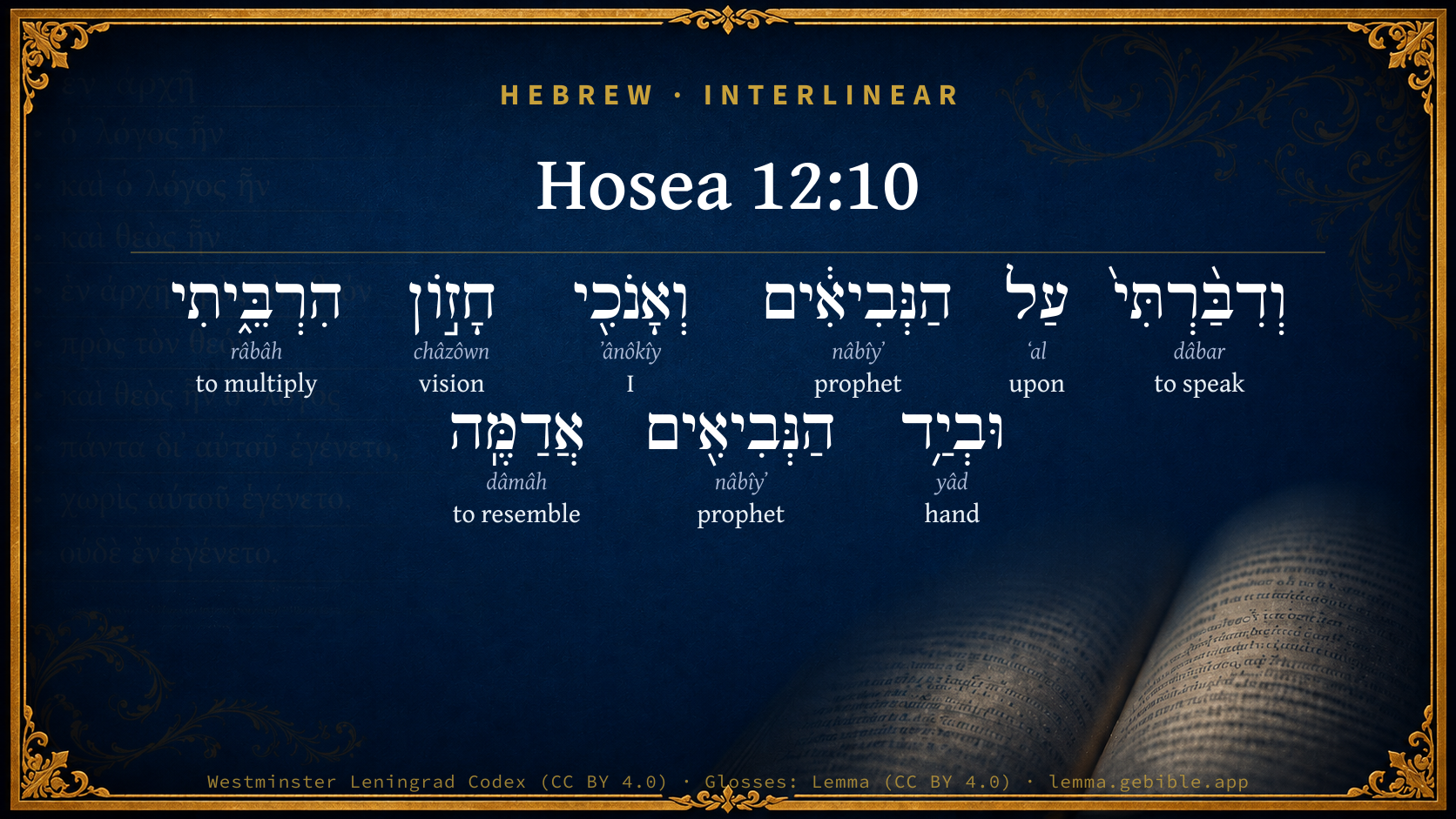
  1. וְדִבַּ֨רְתִּי֙ dâbar H1696 “and · to speak” Conjunction + Verb, Piel, Sequential Perfect, 1st Person, Common, Singular
  2. עַל ʻal H5921 “upon” Preposition
  3. הַנְּבִיאִ֔ים nâbîyʼ H5030 “the · prophets” Particle, Definite Article + Noun, Common, Masculine, Plural, Absolute
  4. וְאָנֹכִ֖י ʼânôkîy H595 “and · I” Conjunction + Pronoun, Personal, 1st Person, Common, Singular
  5. חָז֣וֹן châzôwn H2377 “vision” Noun, Common, Masculine, Singular, Absolute
  6. הִרְבֵּ֑יתִי râbâh H7235 “to multiply” Verb, Hiphil, Perfect, 1st Person, Common, Singular
  7. וּבְיַ֥ד yâd H3027 “and · in/at · hand of” Conjunction + Preposition + Noun, Common, Both, Singular, Construct
  8. הַנְּבִיאִ֖ים nâbîyʼ H5030 “the · prophets” Particle, Definite Article + Noun, Common, Masculine, Plural, Absolute

About this verse

These counts appear in no published source. They are computed here, from the morphology-tagged text and Lemma’s own curated glosses. What Lemma adds →

9
words
8
distinct lemmas
Prophets
section

Shared distinctive vocabulary

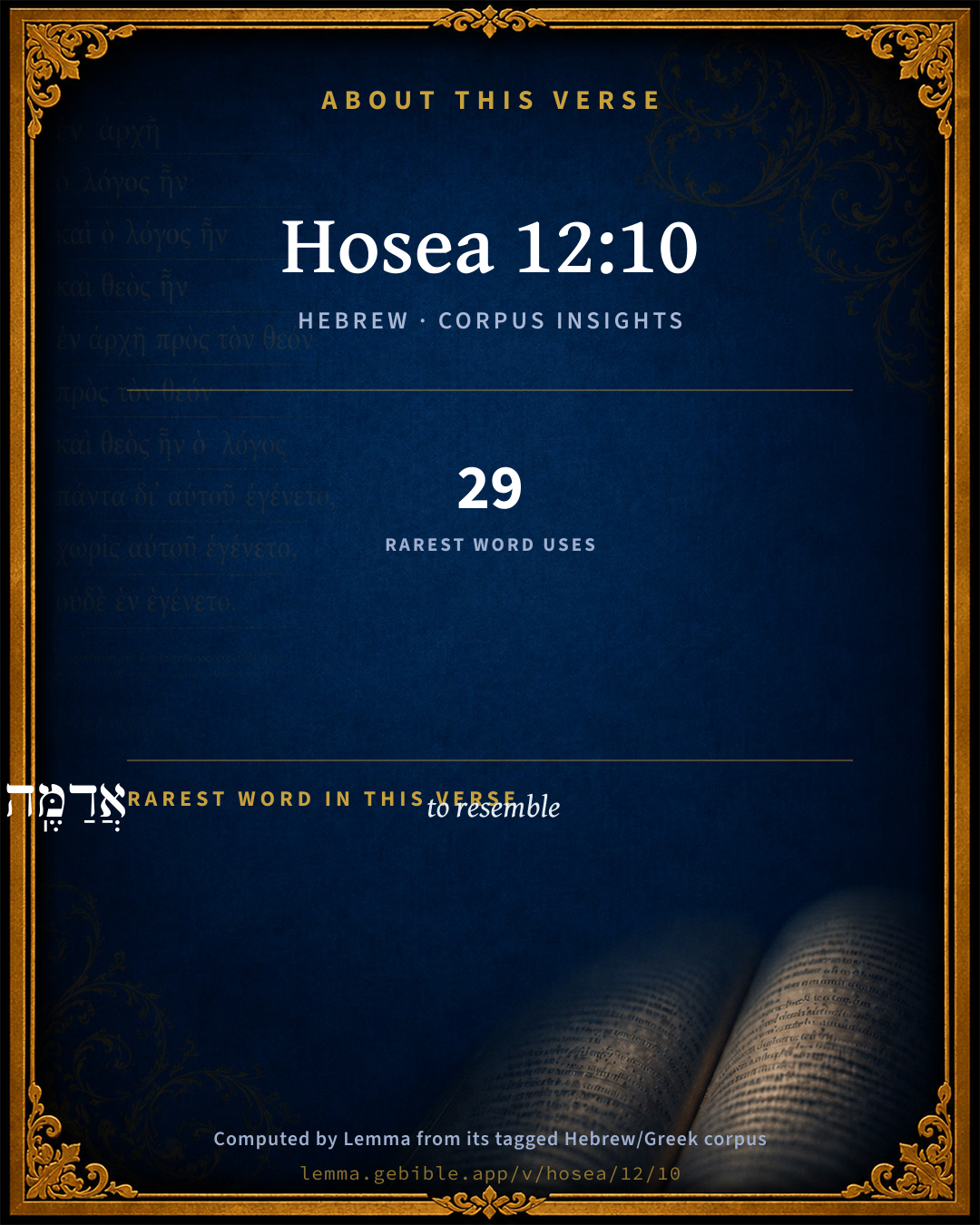
אֲדַמֶּֽה to resemble H1819 occurs in 27 verses of the Hebrew Bible. Also found in:

Grammatical profile

  • 3 verbs
  • 4 nouns
  • 1 pronoun
  • 1 preposition

Verb forms

  • וְדִבַּ֨רְתִּי֙ Piel · Sequential Perfect
  • הִרְבֵּ֑יתִי Hiphil · Perfect
  • אֲדַמֶּֽה Piel · Imperfect

Repetition

A word recurs within this verse — often emphatic in Hebrew:

  • הַנְּבִיאִ֔ים prophet H5030 ×2

Hebrew & Septuagint length

In English translation the verse runs 23 words from the Hebrew and 22 from the Septuagint (LXX English) — closely comparable.

A rough comparison of the two English renderings, which tokenize alike — not a word-level alignment.

Word counts can differ between the Hebrew and the Greek without any difference in meaning — e.g. the Hebrew direct-object marker אֵת has no separate Greek word, and Greek often adds the article ὁ.

Cross-references

25

Topical passages linked to Hosea 12:10 in the Treasury of Scripture Knowledge — connected by theme and wording, ordered by reader-vote popularity; previews shown in the World English Bible.

  • 2 Kings 17:13 Yet Yahweh testified to Israel, and to Judah, by every prophet, and every seer, saying, Turn you from your evil ways, and keep my commandments and my statutes, according to all the law which I commanded your fathers, and which I sent to you by my servants the prophets.
  • Ezekiel 20:49 Then said I, Ah Lord Yahweh! they say of me, Isn't he a speaker of parables?
  • Isaiah 20:2–5 at that time Yahweh spoke by Isaiah the son of Amoz, saying, Go, and loose the sackcloth from off your loins, and put your shoe from off your foot. He did so, walking naked and barefoot.
  • Jeremiah 7:25 Since the day that your fathers came forth out of the land of Egypt to this day, I have sent to you all my servants the prophets, daily rising up early and sending them:
  • Jeremiah 19:1 Thus said Yahweh, Go, and buy a potter's earthen bottle, and [take] of the elders of the people, and of the elders of the priests;
  • Joel 2:28 "It will happen afterward, that I will pour out my Spirit on all flesh; And your sons and your daughters will prophesy. Your old men will dream dreams. Your young men will see visions.
  • Numbers 12:6 He said, Hear now my words: if there be a prophet among you, I Yahweh will make myself known to him in a vision, I will speak with him in a dream.
  • 1 Kings 13:1 Behold, there came a man of God out of Judah by the word of Yahweh to Beth El: and Jeroboam was standing by the altar to burn incense.
  • 1 Kings 14:7–16 Go, tell Jeroboam, Thus says Yahweh, the God of Israel: Because I exalted you from among the people, and made you prince over my people Israel,
  • 1 Kings 17:1 Elijah the Tishbite, who was of the foreigners of Gilead, said to Ahab, As Yahweh, the God of Israel, lives, before whom I stand, there shall not be dew nor rain these years, but according to my word.
  • 1 Kings 18:21–40 Elijah came near to all the people, and said, "How long will you waver between the two sides? If Yahweh is God, follow him; but if Baal, then follow him." The people answered him not a word.
  • 1 Kings 19:10 He said, I have been very jealous for Yahweh, the God of hosts; for the children of Israel have forsaken your covenant, thrown down your altars, and slain your prophets with the sword: and I, even I only, am left; and they seek my life, to take it away.
  • Nehemiah 9:30 Yet many years did you bear with them, and testified against them by your Spirit through your prophets: yet would they not give ear: therefore gave you them into the hand of the peoples of the lands.
  • Isaiah 5:1–7 Let me sing for my well beloved a song of my beloved about his vineyard. My beloved had a vineyard on a very fruitful hill.
  • Jeremiah 13:1–14 Thus says Yahweh to me, Go, and buy you a linen belt, and put it on your loins, and don't put it in water.
  • Jeremiah 19:10 Then shall you break the bottle in the sight of the men who go with you,
  • Jeremiah 25:4 Yahweh has sent to you all his servants the prophets, rising up early and sending them, (but you have not listened, nor inclined your ear to hear),
  • Ezekiel 4:1–5 You also, son of man, take a tile, and lay it before you, and portray on it a city, even Jerusalem:
  • Ezekiel 15:1–8 The word of Yahweh came to me, saying,
  • Hosea 1:2–5 When Yahweh spoke at the first by Hosea, Yahweh said to Hosea, "Go, take for yourself a wife of prostitution and children of unfaithfulness; for the land commits great adultery against from Yahweh."
  • Hosea 3:1 Yahweh said to me, "Go again, love a woman loved by another, and an adulteress, even as Yahweh loves the children of Israel, though they turn to other gods, and love cakes of raisins."
  • Amos 7:14 Then Amos answered Amaziah, "I was no prophet, neither was I a prophet's son; but I was a herdsman, and a farmer of sycamore trees;
  • Acts 2:17 'It will be in the last days, says God, That I will pour out my Spirit on all flesh. Your sons and your daughters will prophesy. Your young men will see visions. Your old men will dream dreams.
  • 2 Corinthians 12:1 It is doubtless not profitable for me to boast. For I will come to visions and revelations of the Lord.
  • 2 Corinthians 12:7 By reason of the exceeding greatness of the revelations, that I should not be exalted excessively, there was given to me a thorn in the flesh, a messenger of Satan to buffet me, that I should not be exalted excessively.

Cross-references courtesy of OpenBible.info (CC BY 4.0).

Hebrew and Greek witnesses Masoretic Hebrew ↔ Greek Septuagint

The same verse in the two great witnesses to the Old Testament, shown verse-for-verse.

These are two independent witnesses, not word-aligned to each other, and the Septuagint is shown in lemma (dictionary) form.

Hebrew Hosea 12:10 Masoretic · Westminster Leningrad Codex

וְדִבַּ֨רְתִּי֙ עַל הַנְּבִיאִ֔ים וְאָנֹכִ֖י חָז֣וֹן הִרְבֵּ֑יתִי וּבְיַ֥ד הַנְּבִיאִ֖ים אֲדַמֶּֽה

I have also spoken to the prophets, And I have multiplied visions; And by the ministry of the prophets I have used parables.

World English Bible · Public Domain

Greek LXX Hosea 12:10 Septuagint · lemma form

ἐγώ δέ κύριος ὁ θεός σύ ἀναἄγω σύ ἐκ γῆ αἴγυπτος ἔτι καταοἰκίζω σύ ἐν σκηνή καθώς ἡμέρα ἑορτή

And I will speak to the prophets, and I have multiplied visions, and by the means of the prophets I was represented.

LXX2012 (modern English Septuagint) · Public Domain

On this verse, The Pulpit Commentary discusses the Septuagint’s reading. Read the note in Commentary ↓

Hebrew: Westminster Leningrad Codex (CC BY 4.0). Greek: Septuagint (public domain); English from LXX2012 (modern English Septuagint) (Public Domain). How the Septuagint differs from the Hebrew →

Targum (Aramaic paraphrase)

1

The Targum is the ancient Jewish Aramaic paraphrase of the Hebrew Scriptures — an interpretive translation, not the Hebrew text itself. Onkelos (literal) and Pseudo-Jonathan (expansive) render the Torah, and Jonathan the Prophets. Coverage is partial: where no permissively-licensed English translation exists for a verse, only the Aramaic is shown. This is verse-level text, not a word-by-word alignment to the Hebrew.

  1. Targum Jonathan Prophets (Joshua–Malachi)
    וַאֲנָא יְיָ אֱלָהָךְ דְאַפֵּיקְתָּךְ מֵאַרְעָא דְמִצְרַיִם עוֹד אוֹתְבִינָךְ בְּמַשְׁכְּנִין כְּיוֹמֵי קָדָם:

    (no public-domain English translation for this verse)

    Targum Jonathan — Aramaic: “Mikraot Gedolot” (public domain). English: “Sefaria Community Translation” (CC0 1.0 (public-domain dedication)); “London "Chaldee Paraphrase," 1871” (public domain). Text via Sefaria.

Commentary

Notes on Hosea 12:10 from classic Christian and Jewish commentators (each source and its license shown beneath its notes). The classic Christian expositions comment on the surrounding passage and are grouped to its opening verse, so a note may address several verses; the Jewish commentaries on the Tanakh (Rashi and others) are per-verse, so they appear only where the commentator wrote on this verse.

Lemma curates 59 commentaries, every one of them public domain or Creative Commons licensed, each selected and text-cleaned for this edition rather than reprinted as found. About our sources →

Trapp's Complete Commentary

John Trapp

Hos 12:10 I have also spoken by the prophets, and I have multiplied visions, and used similitudes, by the ministry of the prophets.

Ver. 10. I have also spoken by the prophets] And not suffered you to walk in your own ways, as did all other nations, Act 14:16. The ministry is a singular mercy, however now vilipended, {critized} Isa 30:20.

And I have multiplied visions] Whereby I have discovered thy present sins and imminent dangers, though thou hast said, "They shall find none iniquity in me," &c. The wit of mammonists will better serve them to palliate and plead for their dilectum delictum, their beloved sin, than their pride will suffer them once to confess and forsake it, though never so plainly and plentifully set forth unto them.

And used similitudes by the ministry of the prophets] Heb. by the hand, which is the instrument of instruments (οργανον οργανων), saith the philosopher; so is the ministry of the word for the good of souls. It is called a hand, because it sets upon men’s souls with the strength of God, and a certain vehemence. "Did not my word lay hold upon your fathers?" Zec 1:6. {See Trapp on "Zec 1:6"} It is said, Luk 5:17, that as Christ was teaching the power of the Lord was present. "The gospel of Christ is the power of God," Rom 1:16; it is his mighty arm, Isa 53:1. Now it was ordinary with the prophets to use similitudes, as Isa 5:2 Eze 16:3, which is an excellent way of preaching and prevailing; as that which doth both notably illustrate the truth, and insinuate into men’s affections. Galeatius Caraeciolus, an Italian Marquis, and nephew to Pope Paul V, was converted by Peter Martyr, reading on 1Co 1:1-31. and using an apt similitude. Ministers must turn themselves into all forms and shapes, both of spirit and of speech, for the reaching of their hearers’ hearts; they must come unto them in the most wooing, winning, and convincing way that may be. Only in using of similes, they must, 1. Bring them from things known and familiar, things that their hearers are most acquainted with and accustomed to. Thus the prophets draw comparisons from fishes to the Egyptians, vineyards to the Jews, droves of cattle to the Arabians, trade and traffic to the Egyptians. And thus that great apostle, 1Co 9:24, fetcheth similes from runners and wrestlers, exercises that they were well acquainted with in the Isthmian games, instituded by Theseus, not far from their city. 2. Similes must be very natural, plain, and proper. 3. They must not be too far urged; we must not wit wanton it in using them: and let it be remembered, that though they much illustrate a truth, yet theologia parabolica nihil probat. theologial comparisions prove nothing. There are interpreters of good note that read this whole verse in the future tense and make a continuation of that promise in the verse before. I will speak by the prophets, sc. in the days of the gospel, when "great was the company of those that published it," Psa 68:11. I will multiply visions. See this fulfilled Act 2:17 cf. Joe 2:28. I will use similitudes, teach in parables, and illustrate therewith grave sentences and doctrines, as Christ and his apostles did, and as the best preachers still do, that they may thereby set forth things to the life, and make them as plain as if written with the sunbeams.

John Trapp, A Commentary or Exposition upon All the Books of the Old and New Testament (1647–1656) — public domain. Text from a community e-Sword module.

The Biblical Illustrator

Joseph S. Exell

Hos_12:10

I have also spoken by the prophets.

The responsibility of having the revealed Word of God

This is a further declaration of Gods goodness to this people, and an upbraiding of them for their wickedness, when they have had so many means.

1. It is God who speaks by the prophets. Though the prophets and the messengers of God are mean, yet so long as they speak to you in His name, the authority of what they say is above any. They may be under their auditors in many ways, but the message they bring is above them; though they are weak, the power of God goes along with what they speak, to make it good. The Word does little good till men come to apprehend this, that it is God who speaks by His messengers.

2. It is a great mercy to a people for God to reveal His mind to them by His prophets. What would all the world be but as a dungeon of darkness, were it not for the prophets and ministers of God?

3. God will take account of what becomes of the word, labour, and pains of His prophets. So He here upbraids Ephraim with them. God will take account of all the spirits that His ministers spend, of every drop of their sweat, and of all their watchings in the night; I sent My prophets, rising early. God will take account of all, and you shall know that there has been a prophet among you; the ministers shall be brought out to say and testify, Lord, I was in such a place, and I revealed Thy mind thus unto them; they could not but be convinced, and yet still they continued in their wickedness. (Jeremiah Burroughs.)

And used similitudes.

The figurative and literal in Scripture

There is a strong tendency of the mind to delight in figurative descriptions above literal statements. Unless all the powers of the mind are equally cultivated; unless there is a due balance of the faculties preserved in all mental operations, the imagination will certainly prevail; and there will be felt a reluctance to relinquish the splendid object of contemplation in which the imagination is interested, for what might be called a cold contemplation of truth in its literality. We never rise to the fountain-head of truth till we have seen it literally; till we have stripped it of all figurative dress, till we have seen it in its own soberness and its own simplicity, we have never seen it as it is; and figurative language is employed for the purpose of giving to the mind such an interest in the truth to be understood, as will lead to the literal contemplation of it. Many things operate in the production of figurative language. Such as the limited vocabulary of uncivilised and early nations. The state of things in Eastern countries, luxurious vegetation, etc. What are we to lay down as the principles on which we are to deal with figurative language? We have to inquire whether the language is employed in reference to a vision, or whether it is the mere result of prophetic inspiration. Figurative language in visions is not to be taken literally. A great number of predictions are delivered in figurative language. By a similitude we under stand something resembling what it is desired to describe. Orientals frequently selected things to be the signs of words, instead of words themselves. Parables, though often taken literally, are nothing more than similitudes. Parables are sometimes intended to illustrate simply one idea, and meaning should not be forced into the mere parts of a parable. A safe rule would be, always to take the language of Scripture literally, except when that would involve an absurdity. How often has the cause of God been traduced by its adversaries, how often burlesqued by the infidel, in consequence of the extravagant and figurative interpretations Of its own friends! The figurative interpretation, that is, taking figures for liberalities, began with a pagan school of philosophers, who, when converted, brought their mystical philosophy into their interpretation of Scripture. Unfortunately this method has come to be styled spiritual interpretation. Those who offer these interpretations to the people, and often bewilder their minds by them, interpret by no rule, and on no principle: just what they like they deem to be meant; just what they feel to be beautiful is accepted by them; just what they feel to be interesting is declared, to be true. (John Burnet.)

Everybodys sermon

Among the rest of God s agencies for striking the attention and con science of the people, was the use of similitudes. The prophets were accustomed not only to preach, but to be themselves as signs and wonders to the people. God is every day preaching to us by similitudes. Providence is Gods sermon.

I. Begin with the early morning. This morning you awaked, and put on your garments. By a similitude God reminded you that you needed a garment for your soul. Taking meals. Going to business. Returning home in the evening, all are similitudes.

II. All the year round god doth preach to man by similitudes. Seed-time. Then the time of blade; of ear, of full corn in the ear. The migration of birds. The wind, heat, etc.

III. Every place to which you journey, every animal you see, every spot you visit, has a sermon for you. Journeying, the mountains, the sea, all have their lesson for us.

IV. Every man in his calling has a sermon preached to him. Illustrate from the farmer, the baker, the butcher, the brewer, the salesman, the writer, the doctor, the builder, the jeweller, etc. (C. H. Spurgeon.)

Despising Gods Word

God speaks after the manner of men. It is enough to take away every excuse from men to allege the fact, that they obey not the Word, and offer not themselves to God as submissive and teachable, when He by His prophets exhorts them to repentance. It is an enhancing of sin when God says He has uselessly spent all His efforts to collect the dispersed Israel, through the labours of His prophets. (John Calvin.)

Gods method in teaching the great teachers of the world

God is the great Teacher of mankind. He teaches the best lessons in the best way and for the best purpose. God has always employed prophets in His great school for humanity. The text indicates His method of teaching them.

I. By visions. He gives to these men inner revelations, unfolds to them spiritual realities, opens their spiritual eyes, and bids them look. What wonderful visions Isaiah, Ezekiel, Daniel, Paul, and John had. These visions serve to show three things.

1. The distinguishing glory of the human mind.

2. The accessibility of the human mind to God.

3. The reality of spiritual things.

II. By similitude. He showed them the invisible by the visible, the spiritual by the sensuous. He gave them parables. There are good reasons for this mode of teaching spiritual truth.

1. It makes the spiritual more attractive.

2. It makes the material appear more Divine. (Homilist.)

Take heed how you hear

The Lord takes account of the manner of mens preaching as well as the things they preach. Men may have their sins aggravated, not only for standing out against the Word, but against the Word so and so delivered. The main necessary truths of God are made known to all, but to some they are given in a more sweet and winning way, in a more convincing manner than to others. (Jeremiah Burroughs.)

The Biblical Illustrator, edited by Joseph S. Exell (c. 1880s–1900s) — public domain. Text from a community e-Sword module.

The Preacher's Complete Homiletical Commentary

Joseph S. Exell (gen. ed.)

HOMILETICS

CRITICAL NOTES.]

Hos_12:10. By prophets] who left no means untried, speaking in metaphors and methods adapted to rouse the attention (Num_12:6; Num_12:8; Joe_2:28).

GOD’S METHOD OF TEACHING THE PEOPLE.—Hos_12:10

Hos_12:10 expands Hos_12:9, and further proves that the people had no excuse for their ignorance and sin. God had taught them from the first, “at sundry times and in divers manners,” by the prophets. Prophet succeeded prophet, and precept upon precept, line upon line, were given to impress Israel, and wean them from their sin. God speaks to men now by his word and providence.

I. The ministry of the prophets. “I have also spoken by the prophets.” Israel at Sinai requested that God would speak to them through human messengers, and from Moses to Malachi they had proofs of mercy and condescension The ministry of the gospel is a singular mercy (Isa_30:20), and suffers us not to walk in our own ways as other nations do (Act_14:16). The prophets were “holy men of God,” exalted to dignity and consecrated to office. They had Divine teaching and Divine authority in their message. To reject them was to despise God. The eminence of their position and the solemnity of their words, aggravate the guilt of sinners. God reveals his will and speaks to us in his word, and by his servants now. Time after time, by minister after minister, does he urge men to repent and turn to him. Fearful will be the punishment of those who disobey his voice. “The Lord hath sent unto you all his servants the prophets, rising early and sending them, but ye have not hearkened, nor inclined your ear to hear.”

II. Visions of the night. The prophets were seers, highly privileged, and favoured with visions and dreams of the night, “when deep sleep falleth upon men” (Job_4:13). These visions were—

1. Continual. “I have repeatedly and continually” instructed them by visions. Ezekiel and Daniel, Paul and John, had wonderful visions. “If there be a prophet among you, I the Lord will make myself known unto him in a vision, and will speak unto him in a dream” (Num_12:6-8).

2. Multiplied. “I have multiplied visions.” No age was left without its vision of the future. There were manifold dreams, and often a repetition of the same. If men disregard, God speaks once, yea twice, that he may bless them with light and truth. Such communications prove the dignity of our nature, the weakness of our fallen condition, and the connection of our souls with the invisible world. They are only given in secret, and require special strength and preparation to receive them (Dan_10:7-8; Dan_10:17-19).

III. Similitudes of nature. “And used similitudes.” All nature is a similitude or parable. Christ directs our attention to the grass of the field and the face of the sky, the earthly and heavenly sides of creation. God himself employed them (Isa_54:5; Isa_5:1), and taught the prophets to use them. Christ taught by parables, and his servants cannot do better than imitate him. The manner as well as the matter of preaching must commend itself to the people. Material signs symbolize spiritual truths. “Things take the signature of thought,” and we may find theology “wrought in each flower, inscribed on every tree.”

Tongues in trees; books in the running brooks;

Sermons in stones; and good in everything.

This method is simple and attractive, impressive and successful. The great teacher sanctions and commends it, and “the common people heard him gladly.”

HOMILETIC HINTS AND OUTLINES

The frequency and continuance of a ministry indicate God’s care and kindness to a people. But the more means of grace we have, the more earnest and powerful the sermons we hear, the greater our account if we persist in sin. “Ministers must turn themselves into all forms and shapes, both of spirit and speech, for the reaching of their hearer’s hearts; they must come unto them in the most wooing, winning, and convincing way that may be. Only in using of similes, they must—

1. Bring them from things known and familiar, things that their hearers are most acquainted with and accustomed to.

2. Similes must be very natural, plain, and proper.

3. They must not be too far urged [Trapp].

ILLUSTRATIONS TO CHAPTER 12

Hos_12:10. Similitudes. I remember well, how once God preached to me by a similitude in the depth of winter. The earth had been black, and there was scarcely a green thing or flower to be seen. There was nothing but blackness as you looked around—bare hedges, leafless trees, and black, black earth wherever you looked. On a sudden God spake and unlocked the treasures of snow, and white flakes descended, until there was no blackness to be seen, all was one sheet of dazzling whiteness. I was seeking the Saviour, and it was then I found him. I remember well that sermon. “Come now and let us reason together; though your sins be as scarlet, they shall be as snow; though they be red like crimson, they shall be whiter than wool” [Spurgeon].

The Preacher's Complete Homiletical Commentary (gen. ed. Joseph S. Exell; Funk & Wagnalls, c. 1892) — public domain (pre-1929). A full-Bible homiletical/sermon-outline anthology covering 65 of 66 books (2 John is absent from the source module). Text from a community e-Sword module.

Jamieson, Fausset & Brown

Robert Jamieson, A. R. Fausset & David Brown

by . . . the prophets--literally, "upon," that is, My spirit resting on them. I deposited with them My instructions which ought to have brought you to the right way. An aggravation of your guilt, that it was not through ignorance you erred, but in defiance of God and His prophets [CALVIN]. Ahijah the Shilonite, Shemaiah, Iddo, Azariah, Hanani, Jehu, Elijah, Elisha, Micaiah, Joel, and Amos were "the prophets" before Hosea.

visions . . . similitudes--I adopted such modes of communication, adapted to man's capacities, as were calculated to arouse attention: I left no means untried to reform you. The first, second, and third chapters contain examples of "similitudes."

Jamieson, Fausset & Brown — Commentary Critical and Explanatory on the Whole Bible (1871) — public domain (CC PDM 1.0). Text via the HelloAO Bible API.

Adam Clarke's Commentary

Verse 10. I have also spoken] I have used every means, and employed every method, to instruct and save you. I have sent prophets, who spake plainly, exhorting, warning, and beseeching you to return to me. They have had Divine visions, which they have declared and interpreted. They have used similitudes, symbols, metaphors, allegories, c., in order to fix your attention, and bring you back to your duty and interest. And, alas! all is in vain you have not profited by my condescension. This text St. Paul seems to have had full in view, when he wrote, Heb 1:1: "God who, at SUNDRY TIMES and in DIVERS MANNERS, spake in time past unto the FATHERS by the PROPHETS." See the note on the above.

Dr. Dodd supposes that there are three distinct kinds of prophecy mentioned here:

1. Immediate inspiration, when God declares the very words.

2. Vision; a representation of external objects to the mind, in as lively a manner as if they were conveyed by the senses.

3. Parables and apt resemblances.

Adam Clarke's Commentary on the Bible (1810–1826) — public domain. Text from a community e-Sword/MySword module.

John Calvin's Commentaries

The Prophet amplifies the sin of the people in having always obstinately opposed God, so that they were without any pretext of ignorance: for men, we know, evade God’s dreadful judgement as long as they can plead either ignorance or thoughtlessness. The Prophet denies that the people had fallen through want of information, for they had been often, nay, continually warned by the Prophets. It then appears that this people were become, as it were, wilfully rebellious against God; for they had ever despised the Prophets, not once or twice, but when the Lord sent them in succession: I have spoken, he says, upon my prophets, or, by my Prophets; for על, ol, is variously taken: ‘I have spoken upon my Prophets,’ that is, I have deposited with them the doctrine which ought to have restored you to the right way; and not only so, but I have multiplied visions; it has not been in one way that I have tried to gather you, but I have accumulated many visions: and then he says, In the hand of Prophets I have placed similitudes; that is, I have endeavoured in every way possible to restore you to a sound mind; for God speaks after the manner of men. He might indeed, if he chose, effect this by the secret movement of his Spirit; but it is enough to take away every excuse from men to allege the fact, that they obey not the word, and offer not themselves to God as submissive and teachable, when he by his Prophets cohorts them to repentance. It is then an enhancing of sin worthy of being noticed, when God remonstrates, and says, that he had uselessly spent all his efforts to collect the dispersed Israel, though he had constantly employed the labours of his Prophets.

But this reproach may be also applied to us at this day; yea, whatever the Prophet has hitherto said may justly be turned against us. For we see how the world hardens itself against all warnings; and we see also how long the Lord suspends his judgements, and tolerates men who scoff at his forbearance. Then the same depravity rages now in the world, which the Prophet describes in this place. Besides, God has not only redeemed us from Egypt, but from the lowest hell, and we know that we have been redeemed by Christ for this end, — that we may be wholly devoted to God; for Christ died and rose again for this purpose, — that he might be the Lord of the living and of the dead. But we see how much is the perverseness of men, and how with impunity they grow wanton against God. Who among us remember that they are no longer their own, because they have been purchased by the blood of Christ? Few think of this. And not only this only true and perpetual redemption ought to be kept in mind by us; for the Lord again redeemed us when we were sunk in the gulf of Popery; and daily also does he renew the same kindness towards us; and yet we are so forgetful, that often the grace of God is not remembered by us. We now see how necessary is this doctrine even for our age.

Besides, God, as I have already said, ceases not daily to stimulate and urge us; he multiplies prophecies and similitudes; that is, he in various ways accommodates himself to us; for by similitudes he means all forms of teaching. And doubtless we see that God in a manner transforms himself in his word, for he speaks not according to his own majesty, but as he sees to be suitable to our capacities and weakness; for the Scriptures set before us various representations, which show to us the face of God. Since God then thus accommodates himself to our rudeness, how great is our ingratitude, when no fruit follows? Let us then remember that the Prophet so reproved the men of his age, that he also speaks to us at this day. Let us now proceed —

John Calvin's Commentaries (1540-1563) — public domain. Text from the Calvin Translation Society English edition (1840s-50s) via the Christian Classics Ethereal Library (ccel.org). Calvin's coverage is partial (roughly two-thirds of the Bible); uncommented books and verses are honest gaps, never fabricated. The 19th-century editor's footnotes and remarks are omitted so the notes are faithfully Calvin's own voice.

The Cambridge Bible for Schools and Colleges

gen. ed. J. J. S. Perowne

10. It is not for want of warnings that this calamity comes upon the Israelites. In the most various ways has Jehovah spoken, not to, but by the prophets.

Visions … similitudes] A prophetic vision is, properly speaking, an intuition of some divinely revealed truth clothed in ‘outward and visible signs’, but the term is also extended (e.g. Isa_1:1; Oba_1:1; Nah_1:1) to the entire contents of a prophecy. ‘Similitudes’, i.e. parables whether implicit (as Hos_9:10) or explicit (as Hos_7:4-7; Isa_5:1-7).

The Cambridge Bible for Schools and Colleges (gen. ed. J. J. S. Perowne; Cambridge University Press, 1878–1918) — public domain. Text from a community e-Sword module.

John Gill's Exposition

I have also spoken to the prophets,.... Or, "I will speak" (b); for this respects not the Lord's speaking by the prophets of the Old Testament who spoke as they were moved by the Holy Ghost; though all they said were for the use of, and profitable unto, Christian churches; but his speaking by the apostles, prophets, and teachers, under the Gospel dispensation; by whom the doctrines of grace have been more clearly dispensed, and which are no other than the voice of Christ speaking in them; and which it is both a privilege to hear, and a duty to attend unto; see Eph 4:11;

and I have multiplied visions: or, "will multiply visions" (c); more than under the former dispensation, as was foretold by Joel, Joe 2:28; see Act 2:16; witness the visions of the Apostles Peter, Paul, John, and others: or this may respect the more clear sight and knowledge of Gospel truths in the times of the Messiah, then under the Mosaic economy; see Co2 3:13;

and used similitudes by the ministry of the prophets: or, "will use similitudes" (d); for this is to be understood, not of the types and figures used by the Lord under the legal dispensation, to represent spiritual things, as the brasen serpent, passover lamb, manna, and the sacrifices of the law; nor of the similitudes used by the prophet Hosea, taking a wife and children of whoredoms, to set forth the case and condition of Israel, and of the comparisons he makes of God, to a lion, leopard, bear, &c. or by any other of the former prophets; but of parables and similitudes used in Gospel times; not only such as Christ used himself, who seldom spoke without a parable; see Mat 13:11; but which he used by the ministry of his apostles and prophets, and which are to be met with in their discourses and writings; see Co1 3:6; and especially such seem to be meant that respect the conversion of the Jews, and the glory of the church in the latter day, Rom 11:16.

(b) "et loquar", Piscator, Liveleus, Drusius, Cocceius, Schmidt. (c) "visionem multiplicabo", Vatablus, Liveleus, Drusius, Schmidt. (d) "assimilabo", Montanus, Schmidt; "similitudinibus utar", Castalio, Liveleus.

John Gill's Exposition of the Whole Bible (1746–1763) — public domain (CC PDM 1.0). Text via the HelloAO Bible API.

Albert Barnes' Notes on the Bible

I have also spoken by the prophets - Literally, “upon the prophets,” the revelation coming down from heaven upon them. Somewhat like this, is what Ezekiel says, “the hand of the Lord was strong upon me” (Eze 3:14, ...). God declares, in what way He had been their God “from the land of Egypt.” Their ignorance of Him was without excuse, for He had always taught them, although they ever sought the false prophets, and persecuted the true. He taught them continually and in divers ways, if so be any impression might be made upon them. He taught them, either in plain words, or in the “visions” which He “multiplied” to the prophets; or in the “similitudes” or parables, which He taught through their ministry. In the “vision,” God is understood to have represented the things to come, as a picture, to the prophet’s mind, , “whether the picture were presented to his bodily eyes, or impressed on his imagination, and that, either in a dream, or without a dream.”

The “similitude,” which God says that He repeatedly, continually, used, seems to have been the parable, as when God compared His people to a vine, Himself to the Lord of the vineyard, or when He directed His prophets to do acts which should shadow forth some truth, as in the marriage of Hosea himself. God had said to Aaron, that He would thus make Himself known by the prophets. “If there be a prophet among you, I, the Lord, will make Myself known unto him in a vision, and will speak unto him in a dream. My servant Moses is not so, who is faithful in all My house. With him will I speak mouth to mouth, even apparently, and not in dark speeches” Num 12:6-8. “The dark speech” in Moses answers to the “similitude” of Hosea; the “vision” and “dream” in Moses are comprehended in “visions,” as used by Hosea. The prophet Joel also says, “your old men shall dream dreams, your young men shall see visions” Joe 2:28. So little ground then have they, who speak of the visions of Daniel and Zechariah, as if they belonged to a later age. : “I have instructed,” God saith, “men of God, to form thee to piety, enlightening their minds with manifold knowledge of the things of God. And because the light of divine wisdom could not otherwise shine on people placed here below in the prison-house of the body, I had them taught through figures and corporeal images, that, through them, they might rise to the incorporeal, and receive some knowledge of divine and heavenly things. And thou, how didst thou requite me? How didst thou shew thy teachableness? It follows;”

Albert Barnes' Notes on the Bible (1834–1885) — public domain. Text from a community e-Sword/MySword module.

Haydock's Catholic Bible Commentary

Prophets. They have represented me as it were under visible forms, that you cannot plead ignorance. The prophets prefigured Christ, the end of the law, &c. (Calmet)

George Leo Haydock (1774–1849), Haydock's Catholic Family Bible and Commentary, 1859 edition — public domain. Excludes Psalms (Douay-Rheims chapter numbering differs from Protestant) and Deuterocanonical books (Catholic canon only).

Matthew Poole's English Annotations

I have also spoken by the prophets; Heb. and, i.e. since I would have continued Ephraim’s peaceful state, I have spoken to them by my prophets, who have warned them of their danger, reproved them for their sins, entreated them to repent and do their duty; so I would have established them, my prophets spake plainly to them.

I have multiplied visions; by many visions and representations of my mind, the duty of the people, what would be safe, what dangerous, by lively emblems set before the prophets, and by them told to Israel, I have advised and warned that I might yet settle them. I would have had them dwelt still in the peace, safety, and joy of festivals, therefore I have sent such as Hosea, Isaiah, Joel, &c.

Used similitudes; parables, examples, actions: Isaiah goes barefoot, names his son Maher-shalal-hash-baz, to warn Israel. Betharbel’s desolation is mentioned to prevent Samaria’s. Hosea takes an adulteress to wife to bring Israel to sight and sense of their sin. All this and much more by my prophets, because I had compassion and would have made them dwell in peace and safety under my government. And yet uncounselable and unthankful Israel will not understand and comply, will not own their sins and repent.

Matthew Poole's English Annotations on the Holy Bible (1683–1685) — public domain. Text from a community e-Sword/MySword module.

Whedon's Commentary on the Bible

Daniel D. Whedon

10, 11. In manifold ways Jehovah sought to warn the people.

By the prophets — This is better than R.V. “unto” (compare Amo_2:11; Jer_7:25).

Visions — One of the means whereby the prophets received divine revelations (Num_12:6; see on Oba_1:1). (Compare the articles “Vision” and “Prophecy and Prophets” in Hastings’s Dictionary of the Bible.)

Similitudes — Literally, I have made comparisons, that is, have spoken in similes and parables (Hos_7:4 ff.; Hos_9:10; compare Isa_5:1-7). To all these warnings Israel remained deaf; the result is ruin, and no one but Israel is to blame.

Gilead — See on Hos_6:8.

Gilgal — See on Hos_4:15. Both were religious centers; both were seats of corruption; and both will be destroyed for their sins. It has been claimed sometimes that the two centers are intended to represent the entire kingdom — Gilead the territory east of the Jordan, Gilgal the territory west of that river. Whether this is so or not, the fate of the two cities will be the fate of the entire nation.

Is there iniquity in Gilead — R.V., “Is Gilead iniquity?”

Surely they are vanity — R.V., “they are altogether false.” Neither translation reproduces the sense of the original, which should be rendered, “If Gilead is worthless (that is, morally), nothing but vanity (nothingness) shall they (the Gileadites) become.” Those who disregard Jehovah’s warnings and remain moral and religious apostates can expect nothing but utter destruction. In a similar manner Gilgal must reap that which it has sown. Sacrifice bullocks. “Bullocks marks the sumptuousness of offerings.” That this passage proves that “the sacrificing of bullocks at Gilgal must have seemed to the prophet wrong in itself” is at least doubtful (see Introduction, p. 32f.). It is quite conceivable that he condemned Gilgal and its worship only because of the corruption prevalent there (Hos_4:11 ff; Hos_9:15).

Are as heaps — The tense is the prophetic perfect, equivalent to “shall be.”

Heaps — Heaps of stones piled up in the fields, which are entirely worthless. In the original there are two plays upon words: between Gilgal (Heap-town) and heaps, and between sacrifice and altars.

Hos_12:12-13 present a contrast between the fortunes of the patriarch Jacob and those of the nation Israel. The latter experienced wonderful manifestations of the divine mercy. Jacob fled into the country of Syria [“field (territory) of Aram”] — Which to him was a strange country (Gen_27:43). On the other hand, Israel was delivered from a strange country and restored to the land of its forefathers (13).

Israel served — The patriarch Jacob, here called Israel (Gen_32:28), had to render service; the nation, on the contrary, was freed from servitude and bondage.

Kept sheep — Jacob had to endure the hardships of a shepherd’s life, Israel was the flock under the tender care of a loving shepherd.

For a wife — Gen_29:18-20. Though this may have been an adequate reward, it is insignificant when compared with the countless blessings held out to Israel by Jehovah.

By a prophet — Moses (compare Deu_34:10); and from the time of Moses, Jehovah continued to raise up prophets to exercise a shepherd’s care over Israel (Amo_2:11).

Daniel D. Whedon (gen. ed.), Commentary on the Old and New Testaments (1874–1909) — public domain. Text from a community e-Sword module.

The Pulpit Commentary

Vers. 10 and 11 prove God"s continual care for the spiritual welfare and best interests of Israel all along, and, at the same time, the inexcusableness of Israel in forgetting God and in arrogating to themselves the power of controlling their own destinies in the matter of wealth and prosperity; while multiplied prophecies and visions testified to both, vie. to God"s care and Israel"s recklessness of warnings. Moreover, their persistence in sin prepared them for and precipitated the punishment.

I have also spoken to the prophets, and I have multiplied visions, and used similitudes, by the ministry of the prophets. The vau before the verb in the beginning of the verse is copulative, and the verb is in the preterit as the accent is on the penult; if the vau were conversive of the preterit into the future, the verb would have the accent on the ultimate. The preterit denotes what has been taking place up to the present. li is explained

(1) by Knobel to denote that the Divine revelation or inspiration descended on the prophets from heaven; but

(2) Kimchi explains it as equivalent to with; thus: "Upon (li) the prophets is the same as "with ( the prophets, as, (in Exo_35:32) "And they came both men and women literally, men, l with, or rather in addition to, women". He (Jehovah) says, "What could I do to you and I did not do it, so that ye should not forget me? And what did I do with your fathers? I spoke constantly with the prophets to admonish you from me, and I multiplied visions to you many days. The Authorized Version

(3) employs "by" as the equivalent of l here. The pronoun vanoki is emphatic, viz. "I even I," as though he said, "I and not another;" while the preterit proves Jehovah to have continued his visions to the very moment at which the prophet speaks. To the word hMda,

(a) use similitudes, some supply a verbal noun of corporate sense, twtWmd or This, however, is unnecessary, as a verb often includes its cognate noun, of which we have several similar ellipses, e.g. Gen_6:4, "They bare children understood to them;" also Jer_1:9, "They shall set themselves in array hkrh understood against her." The LXX

(b) has wmoiwyhn , "I was represented; "and Jerome renders it assimilatus sum. The three modes of Divine communication here referred to are prediction, vision, and similitude. The word for vision, wOzj, is used here as a collective; it differs from the dream in being higher degree of Divine revelation, also the senses of the receiver are awake and active, while in the dream they are inoperative and passive. Of the similitude, again, we have examples in Isaiah"s parable of a vineyard (Isaiah 5), and in Ezekiel"s similitude of a wretched infant, to represent the natural state of Jerusalem. Aben Ezra remarks, I have established emblems and comparisons that ye might understand me;" and Kimchi, "I have given emblems and parables by means of the prophets, as Isaiah says, "My well-beloved hath a vineyard;" and Ezekiel, "Thy birth and thy nativity is of the land of Canaan." And the explanation of dyb is that by their hand he sends them emblems and similitudes as (Lev_10:11) "which the Lord hath spoken unto them by the hand of Moses Thus God, as Rosenm observes, "left no means of admonishing them untried.

Visions and similitudes.

In two ways Jehovah showed himself to be in an especial manner favorable towards the descendants of Abraham, Isaac, and Jacob. The first was by his providential care of the nation throughout its history. And the second was that mentioned in this verse: God sent continually to his chosen people prophets, whose communications were the means of instructing, warning, and guiding them. Observe the twofold description of the Divine revelation vouchsafed.

I VISIONS.

1. The name given to the class of inspired teachers and guides of the nation is significant, and is harmonious with this passage. They were seers.

2. By an illumined faculty these Hebrew prophets saw Divine realities. Intuition, insight, inspiration, such are the terms by which spiritual vision is designated. "The vision and the faculty Divine" has been attributed to genius; but the order of men in question were distinguished by their perception of spiritual truth.

3. These visions of Divine realities the prophets, by language or otherwise, conveyed to the people.

II SIMILITUDES. There is a natural and ordained correspondence between things natural and things spiritual, which accounts for the prevalence and the efficiency of pictorial, metaphorical, and allegorical methods of instruction and admonition.

1. Sometimes the prophets were directed to make use of parabolic action. We have several instances of this kind recorded in the books of Isaiah, Ezekiel, etc.

2. Similitude often took the form of parabolic language: e.g. Isaiah"s comparison of Israel to an unfruitful vine; Ezekiel"s comparison of the return from captivity to the revival of the dry bones, etc.

3. In both these prophetic methods there is a sacred purpose. Condescension to the ignorance and unspirituality of many of the people was one reason.

4. Our Lord Jesus himself used similitudes," and sanctioned this interesting and impressive method in his parables and allegories.

APPLICATION. When God has deigned to communicate with us by visions and similitudes, how great is the responsibility of listening to the inspired prophetic Word! T.

God"s method in teaching the great teachers of the world.

"I have also spoken by the prophets, and I have multiplied visions, and used similitudes, by the ministry of the prophets." God is the great Teacher of mankind. "Who teaches like him?" He teaches the best lessons, in the best way and for the best purpose; he teaches man through the works of nature, and through the best of men. God has always employed prophets in his great school for humanity. Into every age he has sent men above the average of the race men gifted with high intellect, lofty genius, and special inspiration. They are evermore his prophets, and these he himself teaches; they are in his "normal school." He teaches them that they may teach others. The text indicates his method of teaching them.

I BY VISIONS. He gives to those men inner revelations, unfolds to them spiritual realities, opens their spiritual eyes, and bids them look. What wonderful visions Isaiah, Ezekiel, Daniel, Paul, and the Apostle John had! They saw wonderful things; but what they saw was not with the outward eye, but with the eye of the soul. These visions serve to show three things.

1. The distinguishing glory of the human mind. What is that? It is a power to see the sensuously invisible, the universe that lies beyond the ken of mortal sight. What a universe came to the eye of the sightless bard of England! In some this visual organ is keener and more active than in others. He who has it in the highest extent is the poet, the prophet, emphatically the seer.

2. The accessibility of the human mind to God. Man can only address the mind through the senses; the Almighty can do it when all the senses are closed up, in the "visions of the night." He can take into it at his pleasure a whole universe, and bid it gaze on its objects and listen to its sounds.

3. The reality of spiritual things. The bodily eye does not see realities, but nacre forms and shadows. The soul alone can see the real, hence God brings the real into it. By visions I think the Almighty has ever taught the great thinkers of mankind, not only in ancient but in modern times. All the true discoveries of men of science, all the creations of sacred bards, all the flashes of the true evangel, are but visions from God. "In visions of the night.

II BY SIMILITUDE. "And used similitudes." By this is meant, he showed them the invisible by the visible, the spiritual by the sensuous. He gave them parables. "Without a parable spake he not unto them." Hence the prophets spoke in parables; and the great Prophet of the world, who was like unto Moses. There are good reasons for this mode of teaching spiritual truth. Two may be mentioned.

1. It makes the spiritual more attractive. All men, whether they will or not, from their very bodily constitutions are vitally interested in material objects. They live in them and by them; and without direct impressions from God, we can scarcely conceive of spiritual truth being made clear to them but by their means.

2. It makes the material appear more Divine. Flowers, trees, streams, and stars, when they have become emblems to the soul of spiritual truth, become invested with a mystic charm. The picture that has hung in your room for years, and on which your eyes have rested a thousand times, becomes invested with a strange fascination after you have made the acquaintance and come to love the person whom it represents. Thank God for his parabolic method of teaching. D.T.

The Pulpit Commentary (1880–1919), ed. H.D.M. Spence-Jones & Joseph S. Exell — public domain. Text from a community e-Sword module.

John Wesley's Explanatory Notes

Spoken - To warn them of their danger.

John Wesley, Explanatory Notes Upon the Whole Bible (1754–1765) — public domain. Text via the GEBible commentary corpus.

Rashi

Rabbi Shlomo Yitzchaki (Rashi)

I will yet make you dwell in tents I will cut off from your midst deceitful traffickers, and I will cause you to dwell in tents. I will set up from among you students engaging in the Torah.

as in the days of the [early] times As in the days of the early times, when Jacob, the unpretentious man, was sitting in tents.

Rashi on the Tanakh — English translations: “The Judaica Press complete Tanach with Rashi, translated by A. J. Rosenberg” (CC BY 4.0); “Pentateuch with Rashi's commentary by M. Rosenbaum and A.M. Silbermann, 1929-1934” (public domain); “The Metsudah Tanach series, Lakewood, N.J” (CC BY 4.0); and “The Book of Joshua, Metsudah Publications, 1997” (CC BY 4.0). Text via Sefaria.

Lesson kit

Teaching starters — assembled from the data on this page, not authored interpretation. Every prompt links to the verse data it draws on. Edit before teaching.

Hosea, in the Prophets, opens this verse with 9 words (8 distinct Hebrew lemmas). Its most distinctive word is dâmâh (“to resemble”). A historical commentator’s framing appears above. Read the whole chapter for the surrounding context.

Discussion questions

  1. The word dâmâh carries the sense “to resemble.” How does it shape the verse?
  2. Numbers 33:56 shares the word «to resemble» with this verse. How do the two illuminate each other?
  3. “prophet” occurs 2× in this one verse. What is the effect of the repetition?
  4. The translations on this page render this verse differently — a whole-verse word diff, not a word-by-word alignment. What might account for the different wordings?
  5. The verb «וְדִבַּ֨רְתִּי֙» is Piel Sequential Perfect. How does its form color the action?
  6. Reading how Trapp's Complete Commentary and The Biblical Illustrator read this verse, where do the two commentators agree and where do they part?

Things to notice

Reading settings

Reading text

Shown beneath each verse's original-language words.

Old Testament
Old Testament edition

Read the OT as the Masoretic Hebrew (MT) or the Greek Septuagint (LXX).

English shown for the Greek Septuagint (in the Hebrew ↔ Greek comparison).

Comparing translations? Open the Compare panel on any verse page to stack up to four side by side.