Exodus 36:5

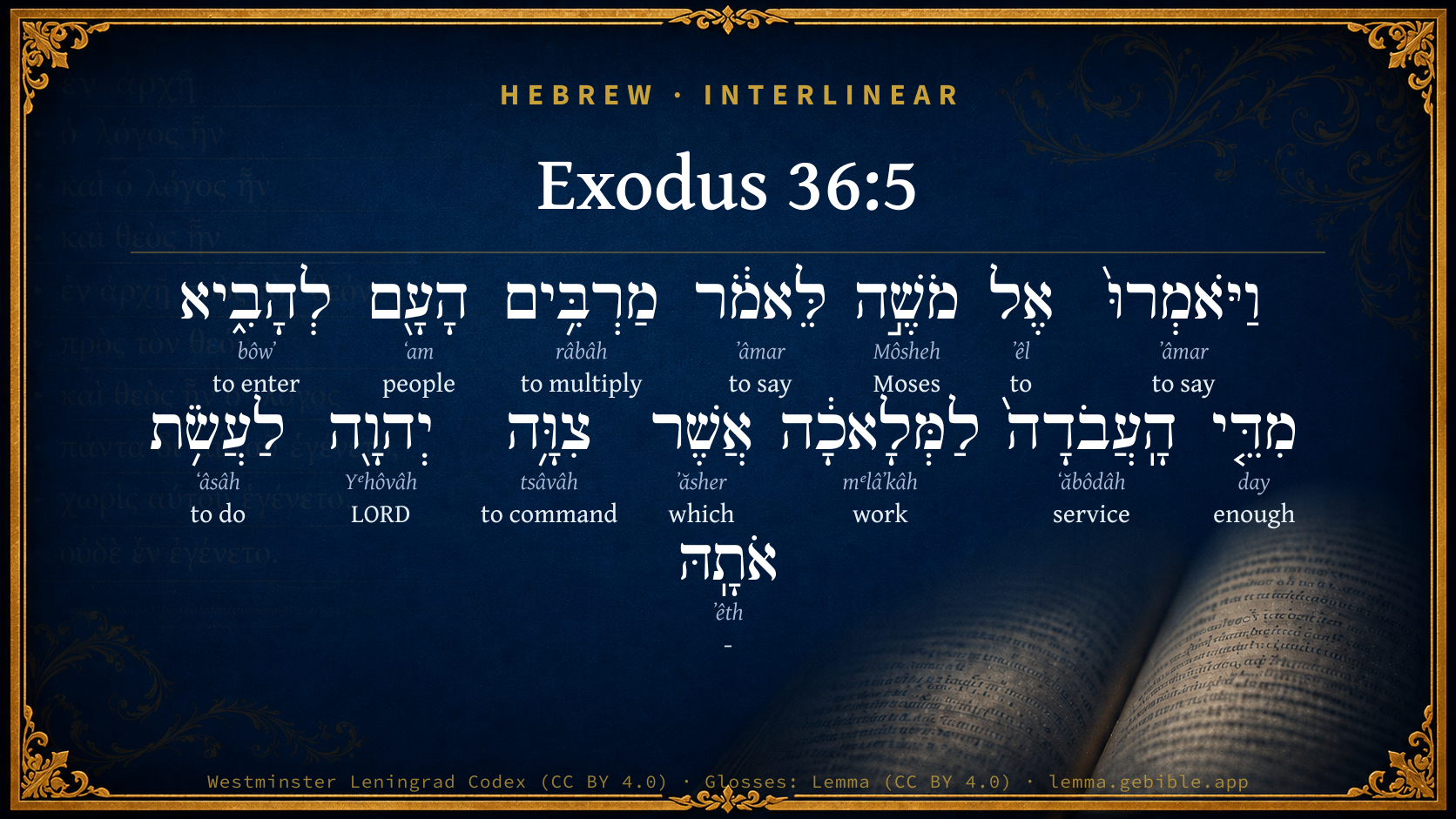
Hebrew (Westminster Leningrad Codex) Exodus 36:5 appears in the Hebrew Old Testament. The text above is from the Westminster Leningrad Codex. Each word links to its Strong’s number, a concise gloss, and parsing drawn from the Open Scriptures Hebrew Bible morphology. Click any word for its full Brown-Driver-Briggs (BDB) entry.
Download image
Cite this verse

Exodus 36:5 (World English Bible). Public Domain. Lemma interlinear Bible study tool, https://lemma.gebible.app/v/exodus/36/5.

Show BibTeX & RIS
BibTeX
RIS
English Translation
They spoke to Moses, saying, "The people bring much more than enough for the service of the work which Yahweh commanded to make."
World English Bible · Public Domain
Highlights
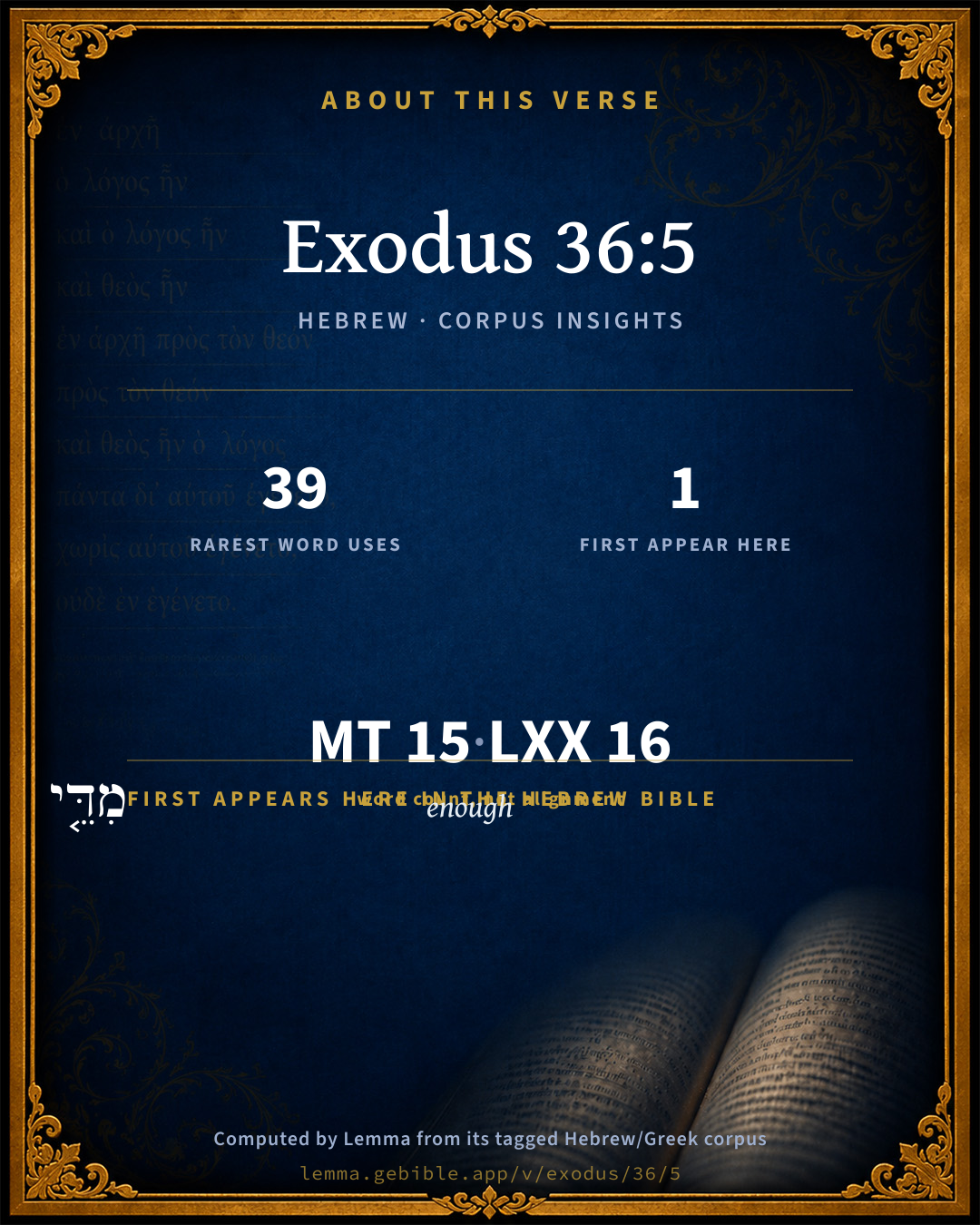
  • 1 first appearance in the Hebrew Bible
Full analysis ↓
Download a study sheet

One document with this verse’s original text, its word-by-word gloss line, the meaning frame, cross-references with their text, attributed commentary, and full source and license credits — printable, and it pastes into notes with its structure intact.

This verse Autodidact and up

Study sheet (.html) Plain text (.txt)

A passage Seminary Student

Up to 50 verses in one chapter. A passage sheet keeps up to 6 commentary sources and 12 cross-references per verse, in the order this page ranks them, and says so on the sheet whenever that leaves anything out. Ask for a single verse and you get the Autodidact verse sheet above.

Everything on this page stays free to read, with no account — the sheet is a download of what is already on screen, not access to it.

Want to remove ads? Support Godless Engineer
Compare translations 3

The same verse in 3 English versions, stacked beneath the original-language interlinear above. Click any original word for its lexicon entry.

Each is an independent rendering of the whole verse — the interlinear is not word-aligned to these translations.

Highlighted words mark where these versions differ — a whole-verse word diff, not a word-by-word alignment.

  • World English Bible Public Domain
    They spoke to Moses, saying, "The people bring much more than enough for the service of the work which Yahweh commanded to make."
  • King James Version Public Domain
    And they spake unto Moses, saying, The people bring much more than enough for the service of the work, which the LORD commanded to make.
  • unfoldingWord Literal Text CC BY-SA 4.0
    and they said to Moses, saying, “The people bringing much more than enough for the service of the work that Yahweh has commanded to do.”

unfoldingWord Literal Text — © unfoldingWord, licensed CC BY-SA 4.0. Word-aligned USFM3 via Door43 (git.door43.org/unfoldingWord/en_ult).

Versions to compare (up to 4)

3 of 4 selected

Show all 18 translations

Every available English version of this verse, each an independent rendering of the whole verse.

  • World English Bible Public Domain
    They spoke to Moses, saying, "The people bring much more than enough for the service of the work which Yahweh commanded to make."
  • Berean Standard Bible Public Domain
    and said to Moses, “The people are bringing more than enough for doing the work the LORD has commanded us to do.”
  • Majority Standard Bible Public Domain
    and said to Moses, “The people are bringing more than enough for doing the work the LORD has commanded us to do.”
  • King James Version Public Domain
    And they spake unto Moses, saying, The people bring much more than enough for the service of the work, which the LORD commanded to make.
  • American Standard Version (1901) Public Domain
    And they spake unto Moses, saying, The people bring much more than enough for the service of the work which Jehovah commanded to make.
  • Revised Version (1885) Public Domain
    and they spake unto Moses, saying, The people bring much more than enough for the service of the work, which the LORD commanded to make.
  • Geneva Bible (1599) Public Domain
    And spake to Moses, saying, The people bring too much, and more then ynough for the vse of the worke, which the Lord hath commanded to be made.
  • Douay-Rheims (1899) Public Domain
    Said to Moses: The people offereth more than is necessary.
  • Young's Literal Translation Public Domain
    and speak unto Moses, saying, `The people are multiplying to bring in more than sufficient for the service of the work which Jehovah commanded to make.'
  • Literal Standard Version CC BY-SA 4.0
    and speak to Moses, saying, “The people are multiplying to bring in more than sufficient for the service of the work which YHWH commanded [us] to do.”
  • Unlocked Literal Bible CC BY-SA 4.0
    The craftsmen told Moses, “The people are bringing much more than enough for doing the work that Yahweh has commanded us to do.”
  • unfoldingWord Literal Text CC BY-SA 4.0
    and they said to Moses, saying, “The people bringing much more than enough for the service of the work that Yahweh has commanded to do.”
  • Darby Bible Public Domain
    and spoke to Moses, saying, The people bring much more than enough for the service of the work that Jehovah commanded to be done.
  • World Messianic Bible Public Domain
    They spoke to Moses, saying, “The people have brought much more than enough for the service of the work which the LORD commanded to make.”
  • Webster's Bible Public Domain
    And they spoke to Moses, saying, The people bring much more than enough for the service of the work, which the LORD commanded to make.
  • Free Bible Version CC BY-SA 4.0
    and went and told Moses, “The people have already brought enough to complete the work the Lord has ordered us to do.”
  • Bible in Basic English Public Domain
    And said to Moses, The people are giving much more than is needed for the work which the Lord has given us orders to do.
  • JPS Tanakh (1917) Public Domain
    And they spoke unto Moses, saying: 'The people bring much more than enough for the service of the work, which the LORD commanded to make.'

Literal Standard Version (2020), Covenant Press — licensed CC BY-SA 4.0. Text via the HelloAO Bible API (eBible.org). Unlocked Literal Bible (unfoldingWord) — licensed CC BY-SA 4.0. Text via the HelloAO Bible API (eBible.org). unfoldingWord Literal Text — © unfoldingWord, licensed CC BY-SA 4.0. Word-aligned USFM3 via Door43 (git.door43.org/unfoldingWord/en_ult). Free Bible Version, Dr. Jonathan Gallagher — licensed CC BY-SA 4.0. Text via the HelloAO Bible API (eBible.org).

Word by word

More ways to search: Search by grammar → Find every occurrence → Compare this word →

Practice this passage: Drill this verse → Learn its vocabulary →

מִדֵּ֤י
day
H1767
“from · enough of”
Preposition + Noun, Common, Masculine, Singular, Construct
Part of Speech
Preposition + Noun
Type
Common
Gender
Masculine
Number
Singular
State
Construct
Full BDB Definition

Origin: of uncertain derivation

TWOT: 425

sufficiency, enough - enough - for, according to the abundance of, out of the abundance of, as often as
  1. וַיֹּאמְרוּ֙ ʼâmar H559 “and · to say” Conjunction + Verb, Qal, Sequential Imperfect, 3rd Person, Masculine, Plural
  2. אֶל ʼêl H413 “to” Preposition
  3. מֹשֶׁ֣ה Môsheh H4872 “Moses” Noun, Proper
  4. לֵּאמֹ֔ר ʼâmar H559 “to say” Preposition + Verb, Qal, Infinitive Construct
  5. מַרְבִּ֥ים râbâh H7235 “multiplying” Verb, Hiphil, Participle Active, Masculine, Plural, Absolute
  6. הָעָ֖ם ʻam H5971 “the · people” Particle, Definite Article + Noun, Common, Masculine, Singular, Absolute
  7. לְהָבִ֑יא bôwʼ H935 “to enter” Preposition + Verb, Hiphil, Infinitive Construct
  8. הָֽעֲבֹדָה֙ ʻăbôdâh H5656 “the · service” Particle, Definite Article + Noun, Common, Feminine, Singular, Absolute
  9. לַמְּלָאכָ֔ה mᵉlâʼkâh H4399 “to/for the · work” Preposition, Determined + Noun, Common, Feminine, Singular, Absolute
  10. אֲשֶׁר ʼăsher H834 “which” Particle, Relative
  11. צִוָּ֥ה tsâvâh H6680 “to command” Verb, Piel, Perfect, 3rd Person, Masculine, Singular
  12. יְהוָ֖ה Yᵉhôvâh H3068 “LORD” Noun, Proper
  13. לַעֲשֹׂ֥ת ʻâsâh H6213 “to do” Preposition + Verb, Qal, Infinitive Construct
  14. אֹתָֽהּ ʼêth H853 “- · her” Particle, Direct Object + Suffix, Personal, 3rd Person, Feminine, Singular

About this verse

These counts appear in no published source. They are computed here, from the morphology-tagged text and Lemma’s own curated glosses. What Lemma adds →

15
words
14
distinct lemmas
Pentateuch
section

First appearance in Scripture

This word makes its first canonical appearance in the Hebrew Bible here:

  • מִדֵּ֤י enough H1767

Shared distinctive vocabulary

מִדֵּ֤י enough H1767 occurs in 35 verses of the Hebrew Bible. Also found in:

Grammatical profile

  • 6 verbs
  • 6 nouns
  • 1 preposition
  • 2 particles

Verb forms

  • וַיֹּאמְרוּ֙ Qal · Sequential Imperfect
  • לֵּאמֹ֔ר Qal · Infinitive Construct
  • מַרְבִּ֥ים Hiphil · Participle Active
  • לְהָבִ֑יא Hiphil · Infinitive Construct
  • צִוָּ֥ה Piel · Perfect
  • לַעֲשֹׂ֥ת Qal · Infinitive Construct

Repetition

A word recurs within this verse — often emphatic in Hebrew:

  • וַיֹּאמְרוּ֙ to say H559 ×2

Hebrew & Septuagint length

In English translation the verse runs 23 words from the Hebrew and 26 from the Septuagint (LXX English) — closely comparable.

A rough comparison of the two English renderings, which tokenize alike — not a word-level alignment.

Word counts can differ between the Hebrew and the Greek without any difference in meaning — e.g. the Hebrew direct-object marker אֵת has no separate Greek word, and Greek often adds the article ὁ.

In the original languages it is 15 Hebrew tokens and 16 Greek tokens — but the two are counted differently (Hebrew bundles its prefixes and suffixes into one token; the Greek is in lemma form), so that isn’t a like-for-like length.

Cross-references

6

Topical passages linked to Exodus 36:5 in the Treasury of Scripture Knowledge — connected by theme and wording, ordered by reader-vote popularity; previews shown in the World English Bible.

  • 2 Chronicles 31:6–10 The children of Israel and Judah, who lived in the cities of Judah, they also brought in the tithe of oxen and sheep, and the tithe of dedicated things which were consecrated to Yahweh their God, and laid them by heaps.
  • 2 Chronicles 24:14 When they had made an end, they brought the rest of the money before the king and Jehoiada, of which were made vessels for the house of Yahweh, even vessels with which to minister and to offer, and spoons, and vessels of gold and silver. They offered burnt offerings in the house of Yahweh continually all the days of Jehoiada.
  • 2 Corinthians 8:2–3 how that in much proof of affliction the abundance of their joy and their deep poverty abounded to the riches of their liberality.
  • Exodus 32:3 All the people took off the golden rings which were in their ears, and brought them to Aaron.
  • Philippians 2:21 For they all seek their own, not the things of Jesus Christ.
  • Philippians 4:17–18 Not that I seek for the gift, but I seek for the fruit that increases to your account.

Cross-references courtesy of OpenBible.info (CC BY 4.0).

Hebrew and Greek witnesses Masoretic Hebrew ↔ Greek Septuagint

The same verse in the two great witnesses to the Old Testament, shown verse-for-verse.

These are two independent witnesses, not word-aligned to each other, and the Septuagint is shown in lemma (dictionary) form.

Hebrew Exodus 36:5 Masoretic · Westminster Leningrad Codex

וַיֹּאמְרוּ֙ אֶל מֹשֶׁ֣ה לֵּאמֹ֔ר מַרְבִּ֥ים הָעָ֖ם לְהָבִ֑יא מִדֵּ֤י הָֽעֲבֹדָה֙ לַמְּלָאכָ֔ה אֲשֶׁר צִוָּ֥ה יְהוָ֖ה לַעֲשֹׂ֥ת אֹתָֽהּ

They spoke to Moses, saying, "The people bring much more than enough for the service of the work which Yahweh commanded to make."

World English Bible · Public Domain

Greek LXX Exodus 36:5 Septuagint · lemma form

καί εἶπον πρός μωυσῆς ὅτι πλῆθος φέρω ὁ λαός παρά ὁ ἔργον ὅσος συντάσσω κύριος ποιέω

And one said to Moses, The people bring an abundance too great in proportion to all the works which the Lord has appointed them to do.

LXX2012 (modern English Septuagint) · Public Domain

Hebrew: Westminster Leningrad Codex (CC BY 4.0). Greek: Septuagint (public domain); English from LXX2012 (modern English Septuagint) (Public Domain). How the Septuagint differs from the Hebrew →

Targum (Aramaic paraphrase)

2

The Targum is the ancient Jewish Aramaic paraphrase of the Hebrew Scriptures — an interpretive translation, not the Hebrew text itself. Onkelos (literal) and Pseudo-Jonathan (expansive) render the Torah, and Jonathan the Prophets. Coverage is partial: where no permissively-licensed English translation exists for a verse, only the Aramaic is shown. This is verse-level text, not a word-by-word alignment to the Hebrew.

  1. Targum Onkelos Torah (Genesis–Deuteronomy)
    וַאֲמָרוּ לְמשֶׁה לְמֵימַר מַסְגַן עַמָא לְאַיְתָאָה מִסַת פָּלְחָנָא לְעִבִדְתָּא דְפַקֵד יְיָ לְמֶעְבַּד יָתַהּ:

    (no public-domain English translation for this verse)

    Targum Onkelos — Aramaic: “Onkelos Genesis” (public domain); “Onkelos Exodus” (public domain); “Onkelos Leviticus” (public domain); “Onkelos Numbers” (public domain); “Onkelos Deuteronomy” (public domain). English: “Sefaria Community Translation” (CC0 1.0 (public-domain dedication)); “J.W. Etheridge. The Targums of Onkelos and Jonathan Ben Uzziel on the Pentateuch. London: Longmans, Green, 1862” (public domain). Text via Sefaria.

  2. Targum Pseudo-Jonathan Torah (Genesis–Deuteronomy)
    וַאֲמָרוּ לְמשֶׁה מַסְגְּיַין עַמָּא לְמַיְיתַיָא מִיסַת פּוּלְחָנָא לְעִיבִידְתָּא דְפַקֵּיד יְיָ לְמֶעֱבַד יָתָהּ

    and they said to Mosheh, The people abound in bringing (more) than is enough for the service of the work, which the Lord hath ordained.

    Targum Pseudo-Jonathan — Aramaic: “Targum Jonathan on Genesis” (public domain); “Targum Jonathan on Exodus” (public domain); “Targum Jonathan on Leviticus” (public domain); “Targum Jonathan on Numbers” (public domain); “Targum Jonathan on Deuteronomy” (public domain). English: “The Targum of Jonathan ben Uzziel, trans. J. W. Etheridge, London, 1862” (public domain). Text via Sefaria.

Commentary

Notes on Exodus 36:5 from classic Christian and Jewish commentators (each source and its license shown beneath its notes). The classic Christian expositions comment on the surrounding passage and are grouped to its opening verse, so a note may address several verses; the Jewish commentaries on the Tanakh (Rashi and others) are per-verse, so they appear only where the commentator wrote on this verse.

Lemma curates 59 commentaries, every one of them public domain or Creative Commons licensed, each selected and text-cleaned for this edition rather than reprinted as found. About our sources →

Geneva Bible (1599)

Geneva Bible translators

A rare example and notable to see the people so ready to serve God with their goods.

Geneva Bible (1599) marginal notes — public domain. Text via Bolls.life.

Jamieson, Fausset & Brown

Robert Jamieson, A. R. Fausset & David Brown

they spake unto Moses, saying, The people bring much more than enough, &c.--By the calculations which the practised eyes of the workmen enabled them to make, they were unanimously of the opinion that the supply already far exceeded the demand and that no more contributions were required. Such a report reflects the highest honor on their character as men of the strictest honor and integrity, who, notwithstanding they had command of an untold amount of the most precious things and might, without any risk of human discovery, have appropriated much to their own use, were too high principled for such acts of peculation. Forthwith, a proclamation was issued to stop further contributions [Exo 36:6].

Jamieson, Fausset & Brown — Commentary Critical and Explanatory on the Whole Bible (1871) — public domain (CC PDM 1.0). Text via the HelloAO Bible API.

Adam Clarke's Commentary

Verse 5. The people bring much more than enough] With what a liberal spirit do these people bring their free-will offerings unto the Lords! Moses is obliged to make a proclamation to prevent them from bringing any more, as there was at present more than enough! Had Moses been intent upon gain, and had he not been perfectly disinterested, he would have encouraged them to continue their contributions, as thereby he might have multiplied to himself gold, silver, and precious stones. But he was doing the Lord's work, under the inspiration of the Divine Spirit, and therefore he sought no secular gain. Indeed, this one circumstance is an ample proof of it. Every thing necessary for the worship of God will be cheerfully provided by a people whose hearts are in that worship. In a state where all forms of religion and modes of worship are tolerated by the laws, it would be well to find out some less exceptionable way of providing for the national clergy than by tithes. Let them by all means have the provision allowed them by the law; but let them not be needlessly exposed to the resentment of the people by the mode in which this provision is made, as this often alienates the affections of their flocks from them, and exceedingly injures their usefulness. See Clarke on Ge 28:22, in fine, where the subject is viewed on all sides.

Adam Clarke's Commentary on the Bible (1810–1826) — public domain. Text from a community e-Sword/MySword module.

The Cambridge Bible for Schools and Colleges

gen. ed. J. J. S. Perowne

5. bring] are bringing.

There follows now (Exo_36:8 to Exo_39:31) an enumeration and full description of the things made, repeated for the most part verbally—with of course the necessary change of tense—from chs. 25–28, 30, 31 (for ch. 29, see Leviticus 8). The order is in certain cases different: thus the Dwelling (Exo_36:8-38) is made before the articles (the Ark, &c.), which it is to contain (Exo_37:1-24): and the altar of incense then follows immediately (Exo_37:25-29), instead of coming, as in chs. 25–31, in the appendix (Exo_30:1-10). See further above, pp. 377, 378.

8–19 (Exo_26:1-14). The curtains forming the Dwelling (vv. 8–13); the tent over it (vv. 14–18); and the two protective coverings above this (v. 19). Mutatis mutandis, the text agrees almost verbally with Exo_26:1-14, except in the Heb. idiom for ‘one to another’ in vv. 10, 12, 13 (so v. 22), and in the omission of the clauses relating to the erection of the Dwelling in Exo_26:9 b, 12, 13 (without, however, their being introduced in Exo_40:17 ff.).

The Cambridge Bible for Schools and Colleges (gen. ed. J. J. S. Perowne; Cambridge University Press, 1878–1918) — public domain. Text from a community e-Sword module.

John Gill's Exposition

And they spake unto Moses, saying,.... One in the name of the rest:

the people bring much more than enough for the service of the work, which the Lord commanded to make; they had taken an estimate of what was to be done, and of what was necessary for the doing of it, and of what the people brought for this service; and they found there was a great deal more brought than would be wanted, and therefore they thought proper to advise Moses of it, that no more might be brought: it is hard to say which is most to be wondered at, the great liberality of the people in contributing so freely and bountifully, and continuing to do so without being urged, or even asked; or the honesty of the workmen, one and all, who might have gone on to have received the gifts of the people by the hands of Moses, and what was superfluous might have converted to their own use; but instead of this, they agree as one man to let Moses know how the state of things was, and prevent the people from making any more contributions.

John Gill's Exposition of the Whole Bible (1746–1763) — public domain (CC PDM 1.0). Text via the HelloAO Bible API.

unfoldingWord translationNotes

Door43 World Missions Community

The craftsmen told Moses ... commanded us to do."

The can be stated as an indirect quote. AT: "The craftsmen told Moses that the people were bringing much more than enough for doing the work that Yahweh has commanded them to do" (See: Direct and Indirect Quotations)

The craftsmen told Moses

"The men working on the sanctuary told Moses"

translationWords

Moses

Yahweh

command

sacrifice

holy place

gift

unfoldingWord translationNotes — © Distant Shores Media and the Door43 World Missions Community, licensed CC BY-SA 4.0. Source: git.door43.org/Door43/en_tn.

Rashi

Rabbi Shlomo Yitzchaki (Rashi)

מדי העבדה means more than is sufficient for the needs of the work.

Rashi on the Tanakh — English translations: “The Judaica Press complete Tanach with Rashi, translated by A. J. Rosenberg” (CC BY 4.0); “Pentateuch with Rashi's commentary by M. Rosenbaum and A.M. Silbermann, 1929-1934” (public domain); “The Metsudah Tanach series, Lakewood, N.J” (CC BY 4.0); and “The Book of Joshua, Metsudah Publications, 1997” (CC BY 4.0). Text via Sefaria.

Lesson kit

Teaching starters — assembled from the data on this page, not authored interpretation. Every prompt links to the verse data it draws on. Edit before teaching.

Exodus, in the Pentateuch, opens this verse with 15 words (14 distinct Hebrew lemmas). Its most distinctive word is day (“enough”). A historical commentator’s framing appears above. Read the whole chapter for the surrounding context.

Discussion questions

  1. The word day carries the sense “enough.” How does it shape the verse?
  2. The word “enough” first appears here in Scripture. What is being introduced at this debut?
  3. Exodus 36:7 shares the word «enough» with this verse. How do the two illuminate each other?
  4. “to say” occurs 2× in this one verse. What is the effect of the repetition?
  5. These translations render this verse differently; the difference is in the English rendering, not the original. What questions does that raise?
  6. The verb «וַיֹּאמְרוּ֙» is Qal Sequential Imperfect. How does its form color the action?
  7. Reading how Geneva Bible (1599) and Jamieson, Fausset & Brown read this verse, where do the two commentators agree and where do they part?

Things to notice

Reading settings

Reading text

Shown beneath each verse's original-language words.

Old Testament
Old Testament edition

Read the OT as the Masoretic Hebrew (MT) or the Greek Septuagint (LXX).

English shown for the Greek Septuagint (in the Hebrew ↔ Greek comparison).

Comparing translations? Open the Compare panel on any verse page to stack up to four side by side.