

Job 39:4

Hebrew (Westminster Leningrad Codex) Job 39:4 appears in the Hebrew Old Testament. The text above is from the Westminster Leningrad Codex. Each word links to its Strong’s number, a concise gloss, and parsing drawn from the Open Scriptures Hebrew Bible morphology. Click any word for its full Brown-Driver-Briggs (BDB) entry.
Download image
Cite this verse

Job 39:4 (World English Bible). Public Domain. Lemma interlinear Bible study tool, https://lemma.gebible.app/v/job/39/4.

Show BibTeX & RIS
BibTeX
RIS
English Translation
Their young ones become strong. They grow up in the open field. They go forth, and don't return again.
World English Bible · Public Domain
Download a study sheet

One document with this verse’s original text, its word-by-word gloss line, the meaning frame, cross-references with their text, attributed commentary, and full source and license credits — printable, and it pastes into notes with its structure intact.

This verse Autodidact and up

Study sheet (.html) Plain text (.txt)

A passage Seminary Student

Up to 50 verses in one chapter. A passage sheet keeps up to 6 commentary sources and 12 cross-references per verse, in the order this page ranks them, and says so on the sheet whenever that leaves anything out. Ask for a single verse and you get the Autodidact verse sheet above.

Everything on this page stays free to read, with no account — the sheet is a download of what is already on screen, not access to it.

Want to remove ads? Support Godless Engineer
Compare translations 3

The same verse in 3 English versions, stacked beneath the original-language interlinear above. Click any original word for its lexicon entry.

Each is an independent rendering of the whole verse — the interlinear is not word-aligned to these translations.

Highlighted words mark where these versions differ — a whole-verse word diff, not a word-by-word alignment.

  • World English Bible Public Domain
    Their young ones become strong. They grow up in the open field. They go forth, and don't return again.
  • King James Version Public Domain
    Their young ones are in good liking, they grow up with corn; they go forth, and return not unto them.
  • unfoldingWord Literal Text CC BY-SA 4.0
    Their sons become strong, they grow up in the field; they go out, and they do not return to them.

unfoldingWord Literal Text — © unfoldingWord, licensed CC BY-SA 4.0. Word-aligned USFM3 via Door43 (git.door43.org/unfoldingWord/en_ult).

Versions to compare (up to 4)

3 of 4 selected

Show all 18 translations

Every available English version of this verse, each an independent rendering of the whole verse.

  • World English Bible Public Domain
    Their young ones become strong. They grow up in the open field. They go forth, and don't return again.
  • Berean Standard Bible Public Domain
    Their young ones thrive and grow up in the open field; they leave and do not return.
  • Majority Standard Bible Public Domain
    Their young ones thrive and grow up in the open field; they leave and do not return.
  • King James Version Public Domain
    Their young ones are in good liking, they grow up with corn; they go forth, and return not unto them.
  • American Standard Version (1901) Public Domain
    Their young ones become strong, they grow up in the open field; They go forth, and return not again.
  • Revised Version (1885) Public Domain
    Their young ones are in good liking, they grow up in the open field; they go forth, and return not again,
  • Geneva Bible (1599) Public Domain
    Knowest thou the time when the wilde goates bring foorth yong? or doest thou marke when the hindes doe calue?
  • Douay-Rheims (1899) Public Domain
    Their young are weaned and go to feed: they go forth, and return not to them.
  • Young's Literal Translation Public Domain
    Safe are their young ones, They grow up in the field, they have gone out, And have not returned to them.
  • Literal Standard Version CC BY-SA 4.0
    Their young ones are safe, || They grow up in the field, they have gone out, || And have not returned to them.
  • Unlocked Literal Bible CC BY-SA 4.0
    Their young ones become strong and grow up in the open fields; they go out and do not come back again.
  • unfoldingWord Literal Text CC BY-SA 4.0
    Their sons become strong, they grow up in the field; they go out, and they do not return to them.
  • Darby Bible Public Domain
    Their young ones become strong, they grow up in the open field, they go forth, and return not unto them.
  • World Messianic Bible Public Domain
    Their young ones become strong. They grow up in the open field. They go out, and don’t return again.
  • Webster's Bible Public Domain
    \\39:1\\Knowest thou the time when the wild goats of the rock bring forth? or canst thou mark when the hinds do calve?
  • Free Bible Version CC BY-SA 4.0
    Their young grow strong in the open countryside; they leave and never return.
  • Bible in Basic English Public Domain
    Have you knowledge of the rock-goats? or do you see the roes giving birth to their young?
  • JPS Tanakh (1917) Public Domain
    Their young ones wax strong, they grow up in the open field; they go forth, and return not again.

Literal Standard Version (2020), Covenant Press — licensed CC BY-SA 4.0. Text via the HelloAO Bible API (eBible.org). Unlocked Literal Bible (unfoldingWord) — licensed CC BY-SA 4.0. Text via the HelloAO Bible API (eBible.org). unfoldingWord Literal Text — © unfoldingWord, licensed CC BY-SA 4.0. Word-aligned USFM3 via Door43 (git.door43.org/unfoldingWord/en_ult). Free Bible Version, Dr. Jonathan Gallagher — licensed CC BY-SA 4.0. Text via the HelloAO Bible API (eBible.org).

Word by word

More ways to search: Search by grammar → Find every occurrence → Compare this word →

Practice this passage: Drill this verse → Learn its vocabulary →

About this verse

These counts appear in no published source. They are computed here, from the morphology-tagged text and Lemma’s own curated glosses. What Lemma adds →

8
words
7
distinct lemmas
Wisdom
section

Notable vocabulary

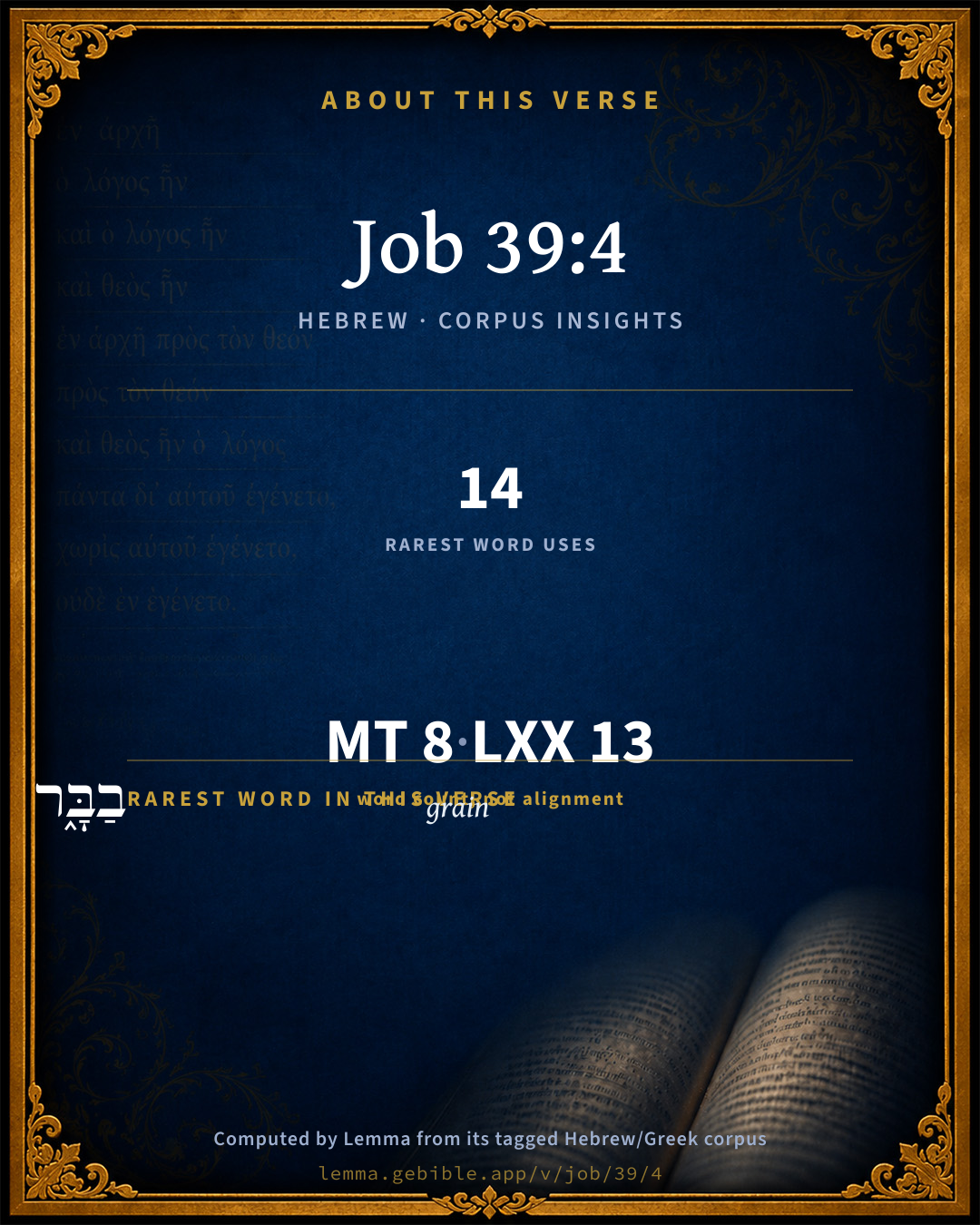
The rarest word here is בַבָּ֑ר grain H1250 — appearing just 14 times in the whole Hebrew Bible.

Shared distinctive vocabulary

בַבָּ֑ר grain H1250 occurs in 14 verses of the Hebrew Bible. Also found in:

Grammatical profile

  • 4 verbs
  • 2 nouns
  • 1 preposition
  • 1 particle

Verb forms

  • יַחְלְמ֣וּ Qal · Imperfect
  • יִרְבּ֣וּ Qal · Imperfect
  • יָ֝צְא֗וּ Qal · Perfect
  • שָׁ֥בוּ Qal · Perfect

Hebrew & Septuagint length

In English translation the verse runs 19 words from the Hebrew and 22 from the Septuagint (LXX English) — closely comparable.

A rough comparison of the two English renderings, which tokenize alike — not a word-level alignment.

Word counts can differ between the Hebrew and the Greek without any difference in meaning — e.g. the Hebrew direct-object marker אֵת has no separate Greek word, and Greek often adds the article ὁ.

In the original languages it is 8 Hebrew tokens and 13 Greek tokens — but the two are counted differently (Hebrew bundles its prefixes and suffixes into one token; the Greek is in lemma form), so that isn’t a like-for-like length.

Hebrew and Greek witnesses Masoretic Hebrew ↔ Greek Septuagint

The same verse in the two great witnesses to the Old Testament, shown verse-for-verse.

These are two independent witnesses, not word-aligned to each other, and the Septuagint is shown in lemma (dictionary) form.

Hebrew Job 39:4 Masoretic · Westminster Leningrad Codex

יַחְלְמ֣וּ בְ֭נֵיהֶם יִרְבּ֣וּ בַבָּ֑ר יָ֝צְא֗וּ וְלֹא שָׁ֥בוּ לָֽמוֹ

Their young ones become strong. They grow up in the open field. They go forth, and don't return again.

World English Bible · Public Domain

Greek LXX Job 39:4 Septuagint · lemma form

ἀποῥήσσω ὁ τέκνον αὐτός πληθύνω ἐν γένημα ἐκἔρχομαι καί οὐ μή ἀνακάμπτω αὐτός

Their young will break forth; they will be multiplied with offspring: their young will go forth, and will not return to them.

LXX2012 (modern English Septuagint) · Public Domain

Hebrew: Westminster Leningrad Codex (CC BY 4.0). Greek: Septuagint (public domain); English from LXX2012 (modern English Septuagint) (Public Domain). How the Septuagint differs from the Hebrew →

Commentary

Notes on Job 39:4 from classic Christian and Jewish commentators (each source and its license shown beneath its notes). The classic Christian expositions comment on the surrounding passage and are grouped to its opening verse, so a note may address several verses; the Jewish commentaries on the Tanakh (Rashi and others) are per-verse, so they appear only where the commentator wrote on this verse.

Lemma curates 59 commentaries, every one of them public domain or Creative Commons licensed, each selected and text-cleaned for this edition rather than reprinted as found. About our sources →

Trapp's Complete Commentary

John Trapp

Job 39:4 Their young ones are in good liking, they grow up with corn; they go forth, and return not unto them.

Ver. 4. Their young ones are in good liking] Or, they recover; revalescent {begin to grow well}, as Isa 58:14, notwithstanding the hardness of their birth, by reason of their dam’s exceeding dry temperature, Psa 42:1. As the hind brayeth after the water brooks, as being naturally hot and dry, when in pain especially; and this the young are sensible of in their coming into the world, which yet they soon recover and grow sleek and fat, η ελαφος (Sept.). Let God be trusted for the welfare of our children, though weak and wearish when newly born, and hard put to it in the birth.

They grow up with corn] Or, in the field; after that they have been nourished a while with their dam’s milk, they forage for themselves; being calved about autumn, as Aristotle noteth, that is, in seed time; others say, about harvest, when grain is in the field, and God’s great barn door open, as the proverb is. This is here brought as an argument for the Divine providence.

They go forth, and return not unto them] That is, to their dams; as finding food enough abroad. Thus other creatures, as soon as they are born almost, can shift for themselves; only poor shiftless man is long ere he can do anything, or comes to any proof, to be able to provide for himself.

John Trapp, A Commentary or Exposition upon All the Books of the Old and New Testament (1647–1656) — public domain. Text from a community e-Sword module.

Joseph Benson's Commentary

Job 39:4. Their young ones are in good liking — Notwithstanding their great weakness caused by their hard entrance into the world. They grow up with corn — As with corn; that is, as if they were fed with corn. They go forth and return not — Finding sufficient provisions abroad by the care of God’s providence.

Joseph Benson's Commentary on the Old and New Testaments (1811–1818) — public domain. Text from a community e-Sword module.

Geneva Bible (1599)

Geneva Bible translators

He chiefly maketh mention of wild goats and hinds, because they bring forth their young with most difficulty.

Geneva Bible (1599) marginal notes — public domain. Text via Bolls.life.

Jamieson, Fausset & Brown

Robert Jamieson, A. R. Fausset & David Brown

are in good liking--in good condition, grow up strong.

with corn--rather, "in the field," without man's care.

return not--being able to provide for themselves.

Jamieson, Fausset & Brown — Commentary Critical and Explanatory on the Whole Bible (1871) — public domain (CC PDM 1.0). Text via the HelloAO Bible API.

Adam Clarke's Commentary

Verse 4. In good liking] After the fawns have sucked for some time, the dam leads them to the pastures, where they feed on different kinds of herbage; but not on corn, for they are not born before harvest-time in Arabia and Palestine, and the stag does not feed on corn, but on grass, moss, and the shoots of the fir, beech, and other trees: therefore the word bar, here translated corn, should be translated the open field or country. See Parkhurst. Their nurslings bound away. - Mr. Good. In a short time they become independent of the mother, leave her, and return no more. The spirit of the questions in these verses appears to be the following: - Understandest thou the cause of breeding of the mountain goats, &c.? Art thou acquainted with the course and progress of the parturition, and the manner in which the bones grow, and acquire solidity in the womb? See Mr. Good's observations.

Houbigant's version appears very correct: (Knowest thou) "how their young ones grow up, increase in the fields, and once departing, return to them no more?"

Adam Clarke's Commentary on the Bible (1810–1826) — public domain. Text from a community e-Sword/MySword module.

Ellicott's Commentary for English Readers

XXXIX.

(4) They grow up with corn.—Or more probably, perhaps, in the open field, as the word means according to some.

A Bible Commentary for English Readers, edited by Charles John Ellicott (1878–1897) — public domain. Text from a community e-Sword module.

The Cambridge Bible for Schools and Colleges

gen. ed. J. J. S. Perowne

4. in good liking] i. e. in good condition, strong.

grow up with corn] Rather, they grow up in the open field.

These shy, solitary creatures, inhabiting the rocks, are without the care and help in bearing their young which domesticated creatures enjoy; yet their bearing is light and speedy; their young are robust; they grow up in the desert and rapidly provide for themselves. The care of God suffices for them.

The Cambridge Bible for Schools and Colleges (gen. ed. J. J. S. Perowne; Cambridge University Press, 1878–1918) — public domain. Text from a community e-Sword module.

John Gill's Exposition

Their young ones are in good liking,.... Plump, fat, and sleek, as fawns are:

they grow up with corn; by which they grow, or without in the field, as the word also signifies; and their growth and increase is very quick, as Aristotle observes (l);

they go forth, and return not unto them: they go forth into the fields, and shift and provide for themselves, and trouble their dams no more; and return not to them, nor are they known by them.

(l) Ib. (Aristot. Hist. Animal.) l. 6. c. 29.

John Gill's Exposition of the Whole Bible (1746–1763) — public domain (CC PDM 1.0). Text via the HelloAO Bible API.

Albert Barnes' Notes on the Bible

Their young ones are in good liking - Hebrew “they are fat;” and hence, it means that they are strong and robust.

They grow up with corn - Herder, Gesenius, Noyes, Umbreit, and Rosenmuller render this, “in the wilderness,” or “field.” The proper and usual meaning of the word used here (בר bâr) is corn (grain); but in Chaldee it has the sense of open fields, or country. The same idea is found in the Arabic, and this sense seems to be required by the connection. The idea is not that they are nurtured with grain, which would require the care of man, but that they are nurtured under the direct eye of God far away from human dwellings, and even when they go away from their dam and return no more to the place of their birth. This is one of the instances, therefore, in which the connection seems to require us to adopt a signification that does not elsewhere occur in the Hebrew, but which is found in the cognate languages.

They go forth, and return not unto them - God guards and preserves them, even when they wander away from their dam, and are left helpless. Many of the young of animals require long attention from man, many are kept for a considerable period by the side of the mother, but the idea here seems to be, that the young of the wild goat and of the fawn are thrown early on the providence of God, and are protected by him alone. The particular care of Providence over these animals seems to be specified because there are no others that are exposed to so many dangers in their early life. “Every creature then is a formidable enemy. The eagle, the falcon, the osprey, the wolf, the dog, and all the rapacious animals of the cat kind, are in continual employment to find out their retreat. But what is more unnatural still, the stag himself is a professed enemy, and she, the hind, is obliged to use all her arts to conceal her young from him, as from the most dangerous of her pursuers.” “Goldsmith’s Nat. His.”

Albert Barnes' Notes on the Bible (1834–1885) — public domain. Text from a community e-Sword/MySword module.

Haydock's Catholic Bible Commentary

Feed. Being weaned very soon. (Pliny, [Natural History?] viii. 32.)

George Leo Haydock (1774–1849), Haydock's Catholic Family Bible and Commentary, 1859 edition — public domain. Excludes Psalms (Douay-Rheims chapter numbering differs from Protestant) and Deuterocanonical books (Catholic canon only).

Matthew Poole's English Annotations

Are in good liking; or, grow strong, or fat; notwithstanding their great weakness caused by their hard entrance into the world.

With corn; which they find and feed upon in the fields. Or, as with corn, i.e. as if they were fed with corn; the particle as being oft deficient, and to be supplied. Or, in the field, as this word in the Chaldee or Syriac dialect signifies.

Return not unto them; finding sufficient provisions abroad by the care and conduct of God’s providence.

Matthew Poole's English Annotations on the Holy Bible (1683–1685) — public domain. Text from a community e-Sword/MySword module.

Whedon's Commentary on the Bible

Daniel D. Whedon

4. Are in good liking — Become strong.

With corn — Rather, in the wilderness.

Unto them — To their parents. A suggestive trait of the brute creation, that the offspring, when grown, is forever alienated from the parent as parent. The tender links that bind the child of a human being to its parent as long as life shall last, are unknown in the creation beneath us. The affection of the one race is eloquent and prophetic of immortality; the want of it in the other seems to indicate that this present life answers all the ends, and subserves all the purposes, of brute being.

Daniel D. Whedon (gen. ed.), Commentary on the Old and New Testaments (1874–1909) — public domain. Text from a community e-Sword module.

The Pulpit Commentary

Their young ones are in good liking; i.e. healthy and strong. (comp. Dan_1:10) They grow up with corn; rather, they grow up out of doors, or in the open air (see Professor Lee, ad loc; and Buxtorf, "Lex. Hebr. et Chald.," p. 87). They go forth, and return not unto them. They quit their dams early, and "go forth" to provide for themselves an indication of health and strength.

The Pulpit Commentary (1880–1919), ed. H.D.M. Spence-Jones & Joseph S. Exell — public domain. Text from a community e-Sword module.

John Wesley's Explanatory Notes

Young ones - Notwithstanding their great weakness caused by their hard entrance into the world. Grow up - As with corn, that is, as if they were fed with corn. Go forth - Finding sufficient provisions abroad by the care of God's providence.

John Wesley, Explanatory Notes Upon the Whole Bible (1754–1765) — public domain. Text via the GEBible commentary corpus.

Rashi

Rabbi Shlomo Yitzchaki (Rashi)

and do not return to them When they have grown a little, they are raised on the grain, on seeds and grasses, and they do not require the raising of their father or mother.

Rashi on the Tanakh — English translations: “The Judaica Press complete Tanach with Rashi, translated by A. J. Rosenberg” (CC BY 4.0); “Pentateuch with Rashi's commentary by M. Rosenbaum and A.M. Silbermann, 1929-1934” (public domain); “The Metsudah Tanach series, Lakewood, N.J” (CC BY 4.0); and “The Book of Joshua, Metsudah Publications, 1997” (CC BY 4.0). Text via Sefaria.

Lesson kit

Teaching starters — assembled from the data on this page, not authored interpretation. Every prompt links to the verse data it draws on. Edit before teaching.

Job, in the Wisdom, opens this verse with 8 words (7 distinct Hebrew lemmas). Its most distinctive word is bâr (“grain”). A historical commentator’s framing appears above. Read the whole chapter for the surrounding context.

Discussion questions

  1. How does “grain” (bâr) shape what this verse is saying?
  2. How does Genesis 41:35, which shares the word «grain», read alongside this verse?
  3. The translations on this page render this verse differently — a whole-verse word diff, not a word-by-word alignment. What might account for the different wordings?
  4. «יַחְלְמ֣וּ» is a Qal Imperfect verb. How does that grammatical form shape the action described?
  5. Compare how Trapp's Complete Commentary and Joseph Benson's Commentary read this verse. Where do they agree or differ?

Things to notice

Reading settings

Reading text

Shown beneath each verse's original-language words.

Old Testament
Old Testament edition

Read the OT as the Masoretic Hebrew (MT) or the Greek Septuagint (LXX).

English shown for the Greek Septuagint (in the Hebrew ↔ Greek comparison).

Comparing translations? Open the Compare panel on any verse page to stack up to four side by side.