1 Chronicles 5:9

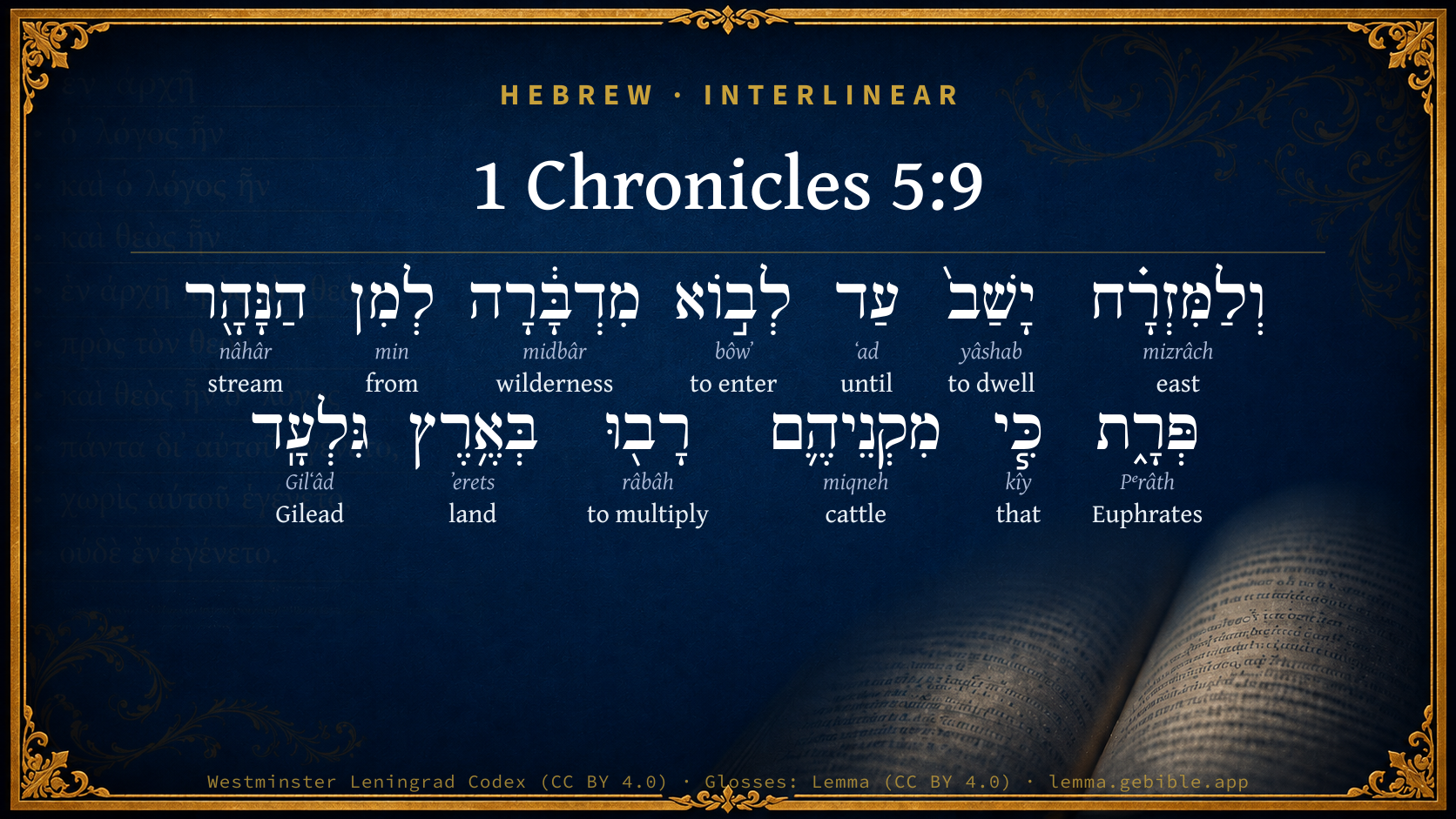
Hebrew (Westminster Leningrad Codex) 1 Chronicles 5:9 appears in the Hebrew Old Testament. The text above is from the Westminster Leningrad Codex. Each word links to its Strong’s number, a concise gloss, and parsing drawn from the Open Scriptures Hebrew Bible morphology. Click any word for its full Brown-Driver-Briggs (BDB) entry.
Download image
Cite this verse

1 Chronicles 5:9 (World English Bible). Public Domain. Lemma interlinear Bible study tool, https://lemma.gebible.app/v/1-chronicles/5/9.

Show BibTeX & RIS
BibTeX
RIS
English Translation
and eastward he lived even to the entrance of the wilderness from the river Euphrates, because their cattle were multiplied in the land of Gilead.
World English Bible · Public Domain
Download a study sheet

One document with this verse’s original text, its word-by-word gloss line, the meaning frame, cross-references with their text, attributed commentary, and full source and license credits — printable, and it pastes into notes with its structure intact.

This verse Autodidact and up

Study sheet (.html) Plain text (.txt)

A passage Seminary Student

Up to 50 verses in one chapter. A passage sheet keeps up to 6 commentary sources and 12 cross-references per verse, in the order this page ranks them, and says so on the sheet whenever that leaves anything out. Ask for a single verse and you get the Autodidact verse sheet above.

Everything on this page stays free to read, with no account — the sheet is a download of what is already on screen, not access to it.

Want to remove ads? Support Godless Engineer
Compare translations 3

The same verse in 3 English versions, stacked beneath the original-language interlinear above. Click any original word for its lexicon entry.

Each is an independent rendering of the whole verse — the interlinear is not word-aligned to these translations.

Highlighted words mark where these versions differ — a whole-verse word diff, not a word-by-word alignment.

  • World English Bible Public Domain
    and eastward he lived even to the entrance of the wilderness from the river Euphrates, because their cattle were multiplied in the land of Gilead.
  • King James Version Public Domain
    And eastward he inhabited unto the entering in of the wilderness from the river Euphrates: because their cattle were multiplied in the land of Gilead.
  • unfoldingWord Literal Text CC BY-SA 4.0
    and to the east he dwelled unto the entrance of the wilderness, to near the Euphrates River, for their livestock multiplied in the land of Gilead.

unfoldingWord Literal Text — © unfoldingWord, licensed CC BY-SA 4.0. Word-aligned USFM3 via Door43 (git.door43.org/unfoldingWord/en_ult).

Versions to compare (up to 4)

3 of 4 selected

Show all 18 translations

Every available English version of this verse, each an independent rendering of the whole verse.

  • World English Bible Public Domain
    and eastward he lived even to the entrance of the wilderness from the river Euphrates, because their cattle were multiplied in the land of Gilead.
  • Berean Standard Bible Public Domain
    They also settled in the east as far as the edge of the desert that extends to the Euphrates River, because their livestock had increased in the land of Gilead.
  • Majority Standard Bible Public Domain
    They also settled in the east as far as the edge of the desert that extends to the Euphrates River, because their livestock had increased in the land of Gilead.
  • King James Version Public Domain
    And eastward he inhabited unto the entering in of the wilderness from the river Euphrates: because their cattle were multiplied in the land of Gilead.
  • American Standard Version (1901) Public Domain
    and eastward he dwelt even unto the entrance of the wilderness from the river Euphrates, because their cattle were multiplied in the land of Gilead.
  • Revised Version (1885) Public Domain
    and eastward he dwelt even unto the entering in of the wilderness from the river Euphrates: because their cattle were multiplied in the land of Gilead.
  • Geneva Bible (1599) Public Domain
    Also Eastwarde he inhabited vnto the entring in of the wildernes from the riuer Perath for they had much cattel in the land of Gilead.
  • Douay-Rheims (1899) Public Domain
    And eastward he had his habitation as far as the entrance of the desert, and the river Euphrates. For they possessed a great number of cattle in the land of Galaad.
  • Young's Literal Translation Public Domain
    and at the east he dwelt even unto the entering in of the wilderness, even from the river Phrat, for their cattle were multiplied in the land of Gilead.
  • Literal Standard Version CC BY-SA 4.0
    and he dwelt at the east even to the entering in of the wilderness, even from the Euphrates River, for their livestock were multiplied in the land of Gilead.
  • Unlocked Literal Bible CC BY-SA 4.0
    and eastward to the start of the wilderness that extends to the Euphrates River. This was because they had many cattle in the land of Gilead.
  • unfoldingWord Literal Text CC BY-SA 4.0
    and to the east he dwelled unto the entrance of the wilderness, to near the Euphrates River, for their livestock multiplied in the land of Gilead.
  • Darby Bible Public Domain
    and eastward he dwelt as far as the entrance to the wilderness from the river Euphrates; for their cattle were multiplied in the land of Gilead.
  • World Messianic Bible Public Domain
    and he lived eastward even to the entrance of the wilderness from the river Euphrates, because their livestock were multiplied in the land of Gilead.
  • Webster's Bible Public Domain
    And eastward he inhabited to the entrance of the wilderness from the river Euphrates: because their cattle were multiplied in the land of Gilead.
  • Free Bible Version CC BY-SA 4.0
    On the eastern side they expanded into the land right up to the edge of the desert that continues to the Euphrates River, because their flocks had grown so big in Gilead.
  • Bible in Basic English Public Domain
    And to the east his limits went as far as the starting point of the waste land, ending at the river Euphrates, because their cattle were increased in number in the land of Gilead.
  • JPS Tanakh (1917) Public Domain
    and eastward he dwelt even unto the entrance of the wilderness from the river Euphrates; because their cattle were multiplied in the land of Gilead.

Literal Standard Version (2020), Covenant Press — licensed CC BY-SA 4.0. Text via the HelloAO Bible API (eBible.org). Unlocked Literal Bible (unfoldingWord) — licensed CC BY-SA 4.0. Text via the HelloAO Bible API (eBible.org). unfoldingWord Literal Text — © unfoldingWord, licensed CC BY-SA 4.0. Word-aligned USFM3 via Door43 (git.door43.org/unfoldingWord/en_ult). Free Bible Version, Dr. Jonathan Gallagher — licensed CC BY-SA 4.0. Text via the HelloAO Bible API (eBible.org).

Word by word

More ways to search: Search by grammar → Find every occurrence → Compare this word →

Practice this passage: Drill this verse → Learn its vocabulary →

פְּרָ֑ת
Pᵉrâth
H6578
“Euphrates”
Noun, Proper
Part of Speech
Noun
Type
Proper
Full BDB Definition

Origin: from an unused root meaning to break forth

TWOT: None

Euphrates = "fruitfulness" - the largest and longest river of western Asia; rises from two chief sources in the Armenian mountains and flows into the Persian Gulf
  1. וְלַמִּזְרָ֗ח mizrâch H4217 “and · to/for the · east” Conjunction + Preposition, Determined + Noun, Common, Masculine, Singular, Absolute
  2. יָשַׁב֙ yâshab H3427 “to dwell” Verb, Qal, Perfect, 3rd Person, Masculine, Singular
  3. עַד ʻad H5704 “until” Preposition
  4. לְב֣וֹא bôwʼ H935 “to enter” Preposition + Verb, Qal, Infinitive Construct
  5. מִדְבָּ֔רָה midbâr H4057 “wilderness · toward” Noun, Common, Masculine, Singular, Absolute + Suffix, Demonstrative
  6. לְמִן min H4480 “to/for · from” Preposition + Preposition
  7. הַנָּהָ֖ר nâhâr H5104 “the · stream” Particle, Definite Article + Noun, Common, Masculine, Singular, Absolute
  8. כִּ֧י kîy H3588 “that” Conjunction
  9. מִקְנֵיהֶ֛ם miqneh H4735 “cattle · their” Noun, Common, Masculine, Singular, Construct + Suffix, Personal, 3rd Person, Masculine, Plural
  10. רָב֖וּ râbâh H7235 “to multiply” Verb, Qal, Perfect, 3rd Person, Common, Plural
  11. בְּאֶ֥רֶץ ʼerets H776 “in/at · land of” Preposition + Noun, Common, Both, Singular, Construct
  12. גִּלְעָֽד Gilʻâd H1568 “Gilead” Noun, Proper

About this verse

These counts appear in no published source. They are computed here, from the morphology-tagged text and Lemma’s own curated glosses. What Lemma adds →

13
words
13
distinct lemmas
Historical
section

Notable vocabulary

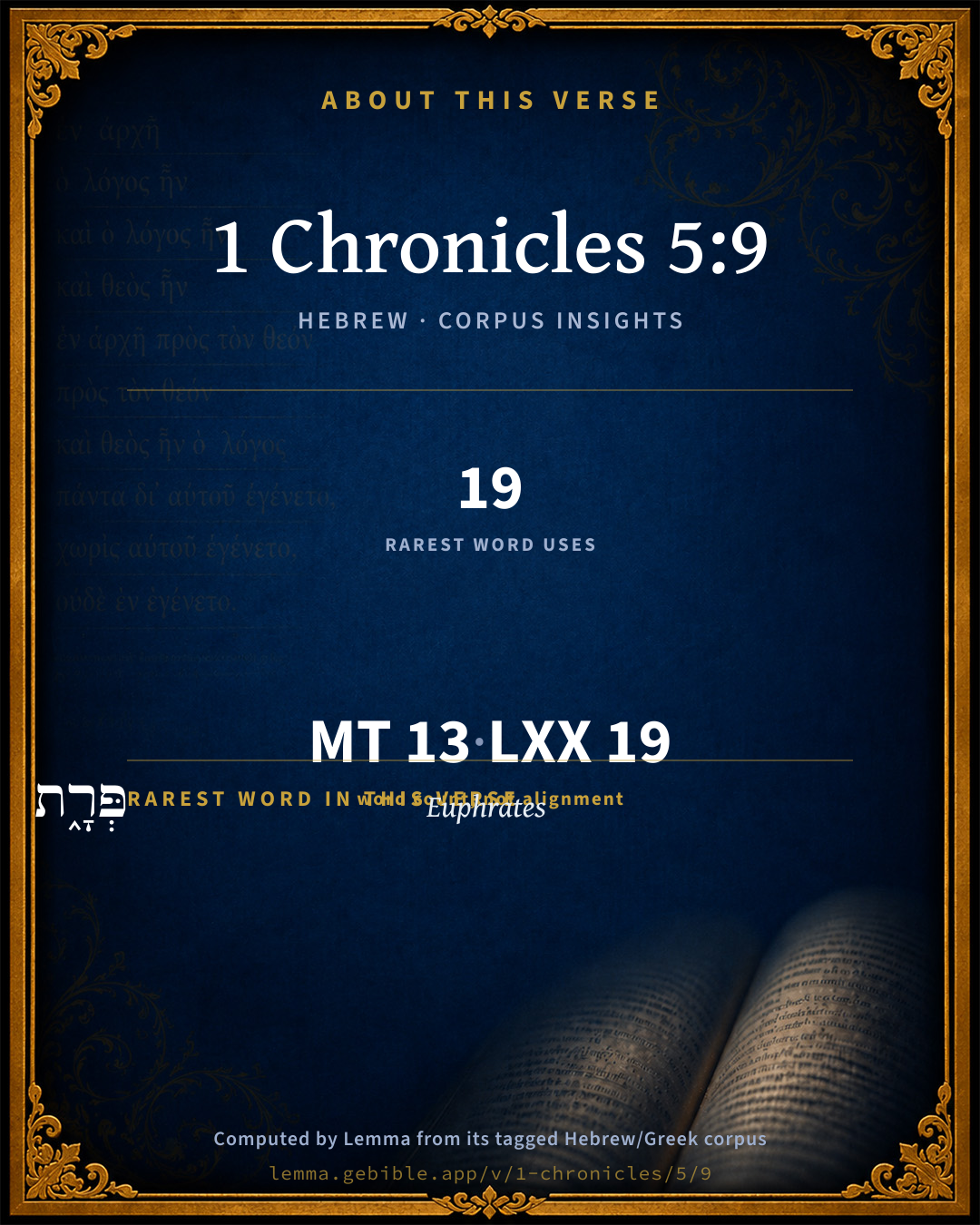
The rarest word here is פְּרָ֑ת Euphrates H6578 — appearing just 19 times in the whole Hebrew Bible.

Shared distinctive vocabulary

פְּרָ֑ת Euphrates H6578 occurs in 19 verses of the Hebrew Bible. Also found in:

Grammatical profile

  • 3 verbs
  • 7 nouns
  • 2 prepositions
  • 1 conjunction

Verb forms

  • יָשַׁב֙ Qal · Perfect
  • לְב֣וֹא Qal · Infinitive Construct
  • רָב֖וּ Qal · Perfect

Hebrew & Septuagint length

In English translation the verse runs 25 words from the Hebrew and 24 from the Septuagint (LXX English) — closely comparable.

A rough comparison of the two English renderings, which tokenize alike — not a word-level alignment.

Word counts can differ between the Hebrew and the Greek without any difference in meaning — e.g. the Hebrew direct-object marker אֵת has no separate Greek word, and Greek often adds the article ὁ.

In the original languages it is 13 Hebrew tokens and 19 Greek tokens — but the two are counted differently (Hebrew bundles its prefixes and suffixes into one token; the Greek is in lemma form), so that isn’t a like-for-like length.

Cross-references

1

Topical passages linked to 1 Chronicles 5:9 in the Treasury of Scripture Knowledge — connected by theme and wording, ordered by reader-vote popularity; previews shown in the World English Bible.

  • Joshua 22:8–9 and spoke to them, saying, Return with much wealth to your tents, and with very much cattle, with silver, and with gold, and with brass, and with iron, and with very much clothing: divide the spoil of your enemies with your brothers.

Cross-references courtesy of OpenBible.info (CC BY 4.0).

Hebrew and Greek witnesses Masoretic Hebrew ↔ Greek Septuagint

The same verse in the two great witnesses to the Old Testament, shown verse-for-verse.

These are two independent witnesses, not word-aligned to each other, and the Septuagint is shown in lemma (dictionary) form.

Hebrew 1 Chronicles 5:9 Masoretic · Westminster Leningrad Codex

וְלַמִּזְרָ֗ח יָשַׁב֙ עַד לְב֣וֹא מִדְבָּ֔רָה לְמִן הַנָּהָ֖ר פְּרָ֑ת כִּ֧י מִקְנֵיהֶ֛ם רָב֖וּ בְּאֶ֥רֶץ גִּלְעָֽד

and eastward he lived even to the entrance of the wilderness from the river Euphrates, because their cattle were multiplied in the land of Gilead.

World English Bible · Public Domain

Greek LXX 1 Chronicles 5:9 Septuagint · lemma form

καί πρός ἀνατολή καταοἰκέω ἕως ἔρχομαι ὁ ἔρημος ἀπό ὁ ποταμός εὐφράτης ὅτι κτῆνος αὐτός πολύς ἐν γῆ γαλαάδ

And he lived eastward to the borders of the wilderness, from the river Euphrates: for they had much cattle in the land of Galaad.

LXX2012 (modern English Septuagint) · Public Domain

Hebrew: Westminster Leningrad Codex (CC BY 4.0). Greek: Septuagint (public domain); English from LXX2012 (modern English Septuagint) (Public Domain). How the Septuagint differs from the Hebrew →

Commentary

Notes on 1 Chronicles 5:9 from classic Christian and Jewish commentators (each source and its license shown beneath its notes). The classic Christian expositions comment on the surrounding passage and are grouped to its opening verse, so a note may address several verses; the Jewish commentaries on the Tanakh (Rashi and others) are per-verse, so they appear only where the commentator wrote on this verse.

Lemma curates 59 commentaries, every one of them public domain or Creative Commons licensed, each selected and text-cleaned for this edition rather than reprinted as found. About our sources →

Joseph Benson's Commentary

1Ch 5:9. And eastward he inhabited — That is, the tribe of Reuben. Unto the entering in of the wilderness, &c. — From Jordan and the wilderness, beyond it unto Euphrates. Or, of the wilderness, which lies toward, or reacheth to the river Euphrates — Namely, the great wilderness of Kedemoth, (Deu 2:26,) which was extended far and wide toward Euphrates: for that was the eastern border of Reuben’s possession, and not Euphrates, to which their habitation never reached. Because their cattle were multiplied — Which forced them to enlarge their habitation as far as they could toward Euphrates.

Joseph Benson's Commentary on the Old and New Testaments (1811–1818) — public domain. Text from a community e-Sword module.

Geneva Bible (1599)

Geneva Bible translators

Or, Euphrates.

Geneva Bible (1599) marginal notes — public domain. Text via Bolls.life.

Jamieson, Fausset & Brown

Robert Jamieson, A. R. Fausset & David Brown

Eastward he inhabited unto the entering in of the wilderness from the river Euphrates--The settlement was on the east of Jordan, and the history of this tribe, which never took any part in the public affairs or movements of the nation, is comprised in "the multiplication of their cattle in the land of Gilead," in their wars with the Bedouin sons of Hagar, and in the simple labors of pastoral life. They had the right of pasture over an extensive mountain range--the great wilderness of Kedemoth (Deu 2:26) and the Euphrates being a security against their enemies.

Jamieson, Fausset & Brown — Commentary Critical and Explanatory on the Whole Bible (1871) — public domain (CC PDM 1.0). Text via the HelloAO Bible API.

Ellicott's Commentary for English Readers

(9) And eastward he inhabited unto the entering in of the wilderness.—As their flocks and herds increased, the Reubenites gradually spread eastward, to the great desert lying between the Euphrates and Syria. This desert was a painful memory to the restored exiles. Ezra took four months to cross it (Ezr_7:9; Ezr_8:22). The form of the expression, “unto the entrance into the wilderness from the river Euphrates,” seems to indicate that this account was written originally in Babylonia.

Because their cattle were (had) multiplied in the land of Gilead.—Gilead, in Old Testament usage, means all Israelite territory east of the Jordan.

A Bible Commentary for English Readers, edited by Charles John Ellicott (1878–1897) — public domain. Text from a community e-Sword module.

John Gill's Exposition

And in the days of Saul they made war with the Hagarites,.... Not with the Hungarians, as the Targum, a people not then in being; but the Ishmaelites, so called because they descended from Hagar (s), Sarah's maid; the same that are placed by Pliny (t) and Ptolemy (u) in Arabia, near the Batanaeans, or inhabitants of Bashan; with those the Reubenites made war, in conjunction with the Gadites and half tribe of Manasseh, Ch1 5:18, perhaps this war might be much about the time Saul relieved Jabeshgilead, and beat the Ammonites, Sa1 11:1 by which the tribes on that side Jordan might be encouraged to it:

who fell by their hand; were worsted and conquered by them:

and they dwelt in their tents; in which the Arabians used to dwell, because of their flocks; hence some of them were called Scenites:

throughout all the east land of Gilead; or rather throughout all the land of the Hagarites, which lay to the east of Gilead, as the Vulgate Latin version; or otherwise the land of Gilead itself was their original possession.

(s) So David de Pomis, Lexic. fol. 45. 4. (t) Nat. Hist. l. 6. c. 28. (u) Geograph. l. 5. c. 19.

John Gill's Exposition of the Whole Bible (1746–1763) — public domain (CC PDM 1.0). Text via the HelloAO Bible API.

Albert Barnes' Notes on the Bible

He inhabited - i. e. Reuben. Eastward the Reubenites inhabited as far as the commencement of the great Syrian Desert, which extended all the way from the river Euphrates to their borders.

Albert Barnes' Notes on the Bible (1834–1885) — public domain. Text from a community e-Sword/MySword module.

Haydock's Catholic Bible Commentary

Cattle, for which reason they desired to have this country, Numbers xxxii. 4. (Menochius)

George Leo Haydock (1774–1849), Haydock's Catholic Family Bible and Commentary, 1859 edition — public domain. Excludes Psalms (Douay-Rheims chapter numbering differs from Protestant) and Deuterocanonical books (Catholic canon only).

Matthew Poole's English Annotations

He inhabited, i.e. the tribe of Reuben.

From the river Euphrates; from Jordan and the wilderness beyond it unto Euphrates. Or,

of the wilderness, which lies towards or reacheth to the river Euphrates, namely, the great wilderness of Kedemoth, Deu 2:26, which was extended far and wide towards Euphrates; for that was the eastern border of Reuben’s possession, and not Euphrates, to which their habitation never reached.

Their cattle were multiplied; which forced them to enlarge their habitation as far as they could eastward towards Euphrates.

Matthew Poole's English Annotations on the Holy Bible (1683–1685) — public domain. Text from a community e-Sword/MySword module.

Whedon's Commentary on the Bible

Daniel D. Whedon

9. Unto the entering in of the wilderness — That is, the Reubenites spread eastward from their original territory beyond Jordan, and occupied the borders of the great Arabian and Syrian deserts that extend between the uplands just east of the Jordan and the great river Euphrates.

Daniel D. Whedon (gen. ed.), Commentary on the Old and New Testaments (1874–1909) — public domain. Text from a community e-Sword module.

The Pulpit Commentary

Keil and others refer this verse to the people of Bela; yet others apply it to Joel It would seem nearest the facts to apply it to the main subject of the paragraph Reuben. Gilead (Deu_3:12-16) had for its boundaries, on the north Bashan, on the south Moab, on the east the Arabian desert. Its situation evidently exposed it to Assyrian invasion and frequent encounter with desert tribes (Jos_17:1; Num_26:29, Num_26:30)

The Pulpit Commentary (1880–1919), ed. H.D.M. Spence-Jones & Joseph S. Exell — public domain. Text from a community e-Sword module.

John Wesley's Explanatory Notes

Euphrates - From Jordan and the wilderness beyond it unto Euphrates. Or, of the wilderness, which lies towards or reacheth to the river Euphrates, namely, the great wilderness of Kedemoth, Deut. ii, 26, which was extended far and wide towards Euphrates: for that was the eastern border of Reuben's possession, and not Euphrates, to which their habitation never reached. Multiplied - Which forced them to enlarge their habitation as far as they could towards Euphrates.

John Wesley, Explanatory Notes Upon the Whole Bible (1754–1765) — public domain. Text via the GEBible commentary corpus.

Keil & Delitzsch

C. F. Keil & F. Delitzsch

And in the days of Saul they made war with the Hagarites,.... Not with the Hungarians, as the Targum, a people not then in being; but the Ishmaelites, so called because they descended from Hagar (s), Sarah's maid; the same that are placed by Pliny (t) and Ptolemy (u) in Arabia, near the Batanaeans, or inhabitants of Bashan; with those the Reubenites made war, in conjunction with the Gadites and half tribe of Manasseh, Ch1 5:18, perhaps this war might be much about the time Saul relieved Jabeshgilead, and beat the Ammonites, Sa1 11:1 by which the tribes on that side Jordan might be encouraged to it:

who fell by their hand; were worsted and conquered by them:

and they dwelt in their tents; in which the Arabians used to dwell, because of their flocks; hence some of them were called Scenites:

throughout all the east land of Gilead; or rather throughout all the land of the Hagarites, which lay to the east of Gilead, as the Vulgate Latin version; or otherwise the land of Gilead itself was their original possession.

(s) So David de Pomis, Lexic. fol. 45. 4. (t) Nat. Hist. l. 6. c. 28. (u) Geograph. l. 5. c. 19.

Keil & Delitzsch — Biblical Commentary on the Old Testament (1861–1891) — public domain (CC PDM 1.0). Text via the HelloAO Bible API. (Old Testament only.)

Lesson kit

Teaching starters — assembled from the data on this page, not authored interpretation. Every prompt links to the verse data it draws on. Edit before teaching.

1 Chronicles, in the Historical, opens this verse with 13 words (13 distinct Hebrew lemmas). Its most distinctive word is Pᵉrâth (“Euphrates”). A historical commentator’s framing appears above. Read the whole chapter for the surrounding context.

Discussion questions

  1. What does “Euphrates” (Pᵉrâth) contribute to the verse as a whole?
  2. How does Genesis 2:14, which shares the word «Euphrates», read alongside this verse?
  3. These translations render this verse differently; the difference is in the English rendering, not the original. What questions does that raise?
  4. «יָשַׁב֙» is a Qal Perfect verb. How does that grammatical form shape the action described?
  5. Compare how Joseph Benson's Commentary and Geneva Bible (1599) read this verse. Where do they agree or differ?

Things to notice

Reading settings

Reading text

Shown beneath each verse's original-language words.

Old Testament
Old Testament edition

Read the OT as the Masoretic Hebrew (MT) or the Greek Septuagint (LXX).

English shown for the Greek Septuagint (in the Hebrew ↔ Greek comparison).

Comparing translations? Open the Compare panel on any verse page to stack up to four side by side.