
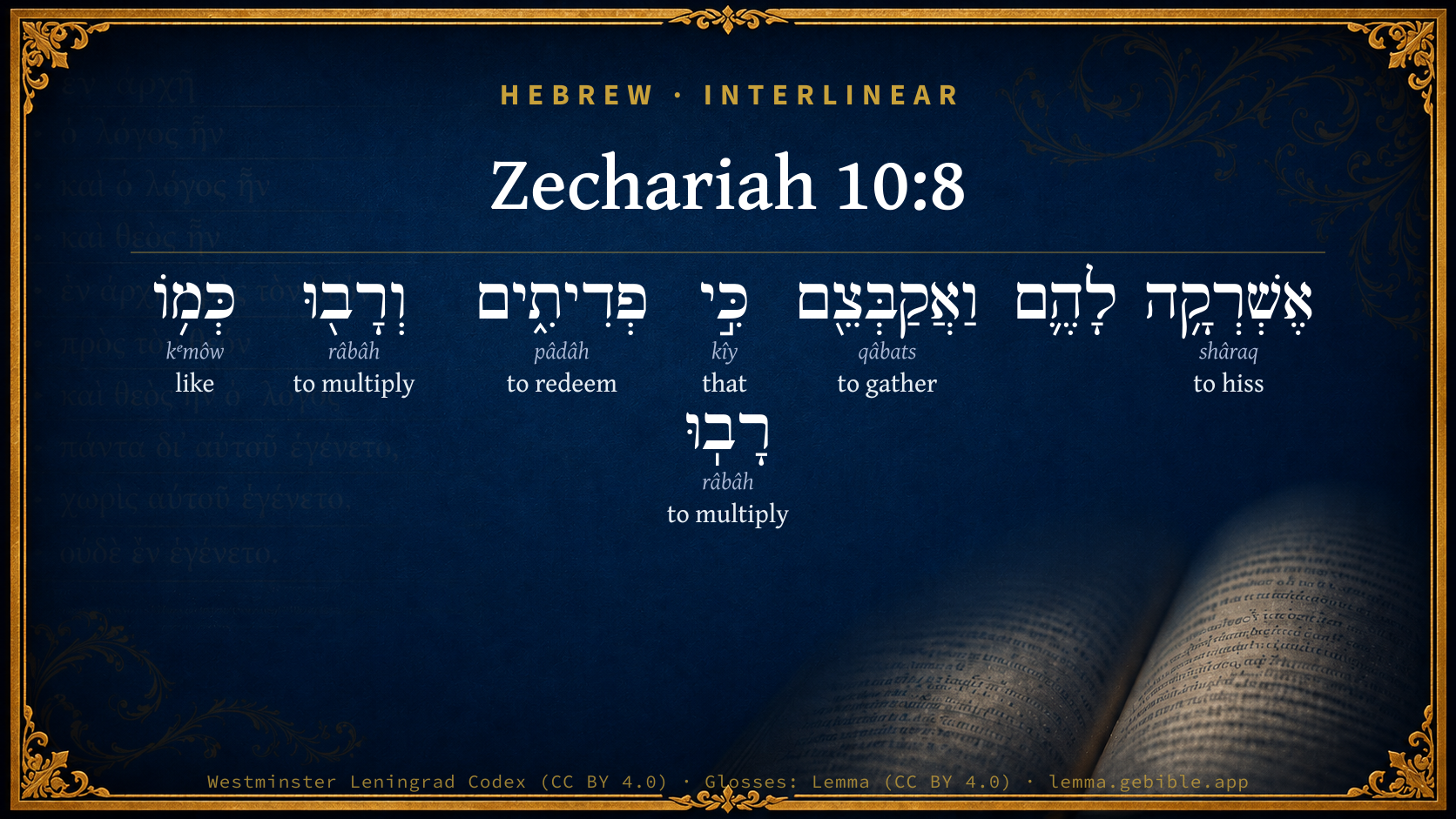
Zechariah 10:8

Hebrew (Westminster Leningrad Codex) Zechariah 10:8 appears in the Hebrew Old Testament. The text above is from the Westminster Leningrad Codex. Each word links to its Strong’s number, a concise gloss, and parsing drawn from the Open Scriptures Hebrew Bible morphology. Click any word for its full Brown-Driver-Briggs (BDB) entry.
Download image
Cite this verse

Zechariah 10:8 (World English Bible). Public Domain. Lemma interlinear Bible study tool, https://lemma.gebible.app/v/zechariah/10/8.

Show BibTeX & RIS
BibTeX
RIS
English Translation
I will signal for them, and gather them; For I have redeemed them; And they will increase as they have increased.
World English Bible · Public Domain
Download a study sheet

One document with this verse’s original text, its word-by-word gloss line, the meaning frame, cross-references with their text, attributed commentary, and full source and license credits — printable, and it pastes into notes with its structure intact.

This verse Autodidact and up

Study sheet (.html) Plain text (.txt)

A passage Seminary Student

Up to 50 verses in one chapter. A passage sheet keeps up to 6 commentary sources and 12 cross-references per verse, in the order this page ranks them, and says so on the sheet whenever that leaves anything out. Ask for a single verse and you get the Autodidact verse sheet above.

Everything on this page stays free to read, with no account — the sheet is a download of what is already on screen, not access to it.

Want to remove ads? Support Godless Engineer
Compare translations 3

The same verse in 3 English versions, stacked beneath the original-language interlinear above. Click any original word for its lexicon entry.

Each is an independent rendering of the whole verse — the interlinear is not word-aligned to these translations.

Highlighted words mark where these versions differ — a whole-verse word diff, not a word-by-word alignment.

  • World English Bible Public Domain
    I will signal for them, and gather them; For I have redeemed them; And they will increase as they have increased.
  • King James Version Public Domain
    I will hiss for them, and gather them; for I have redeemed them: and they shall increase as they have increased.
  • unfoldingWord Literal Text CC BY-SA 4.0
    I will whistle for them and gather them, for I will rescue them, and they will become as great as they previously were!

unfoldingWord Literal Text — © unfoldingWord, licensed CC BY-SA 4.0. Word-aligned USFM3 via Door43 (git.door43.org/unfoldingWord/en_ult).

Versions to compare (up to 4)

3 of 4 selected

Show all 18 translations

Every available English version of this verse, each an independent rendering of the whole verse.

  • World English Bible Public Domain
    I will signal for them, and gather them; For I have redeemed them; And they will increase as they have increased.
  • Berean Standard Bible Public Domain
    I will whistle for them to gather, for I have redeemed them; and they will be as numerous as they once were.
  • Majority Standard Bible Public Domain
    I will whistle for them to gather, for I have redeemed them; and they will be as numerous as they once were.
  • King James Version Public Domain
    I will hiss for them, and gather them; for I have redeemed them: and they shall increase as they have increased.
  • American Standard Version (1901) Public Domain
    I will hiss for them, and gather them; for I have redeemed them; and they shall increase as they have increased.
  • Revised Version (1885) Public Domain
    I will hiss for them, and gather them; for I have redeemed them: and they shall increase as they have increased.
  • Geneva Bible (1599) Public Domain
    I will hisse for them, and gather them: for I haue redeemed them: and they shall encrease, as they haue encreased.
  • Douay-Rheims (1899) Public Domain
    I will whistle for them, and I will gather them together, because I have redeemed them: and I will multiply them as they were multiplied before.
  • Young's Literal Translation Public Domain
    I hist for them, and I gather them, For I have redeemed them, And they have multiplied as they did multiply.
  • Literal Standard Version CC BY-SA 4.0
    I hiss for them, and I gather them, || For I have redeemed them, || And they have multiplied as they multiplied.
  • Unlocked Literal Bible CC BY-SA 4.0
    I will whistle for them and gather them, for I will rescue them, and they will become as great as they previously were!
  • unfoldingWord Literal Text CC BY-SA 4.0
    I will whistle for them and gather them, for I will rescue them, and they will become as great as they previously were!
  • Darby Bible Public Domain
    I will hiss for them, and gather them; for I have redeemed them: and they shall multiply as they used to multiply.
  • World Messianic Bible Public Domain
    I will signal for them and gather them, for I have redeemed them. They will increase as they were before.
  • Webster's Bible Public Domain
    I will hiss for them, and gather them: for I have redeemed them: and they shall increase as they have increased.
  • Free Bible Version CC BY-SA 4.0
    I will whistle to them and they will run to me. I will rescue them, and there will be as many as there were before.
  • Bible in Basic English Public Domain
    With the sound of the pipe I will get them together; for I have given the price to make them free: and they will be increased as they were increased.
  • JPS Tanakh (1917) Public Domain
    I will hiss for them, and gather them, for I have redeemed them; and they shall increase as they have increased.

Literal Standard Version (2020), Covenant Press — licensed CC BY-SA 4.0. Text via the HelloAO Bible API (eBible.org). Unlocked Literal Bible (unfoldingWord) — licensed CC BY-SA 4.0. Text via the HelloAO Bible API (eBible.org). unfoldingWord Literal Text — © unfoldingWord, licensed CC BY-SA 4.0. Word-aligned USFM3 via Door43 (git.door43.org/unfoldingWord/en_ult). Free Bible Version, Dr. Jonathan Gallagher — licensed CC BY-SA 4.0. Text via the HelloAO Bible API (eBible.org).

Word by word

More ways to search: Search by grammar → Find every occurrence → Compare this word →

Practice this passage: Drill this verse → Learn its vocabulary →

About this verse

These counts appear in no published source. They are computed here, from the morphology-tagged text and Lemma’s own curated glosses. What Lemma adds →

8
words
6
distinct lemmas
Prophets
section

Notable vocabulary

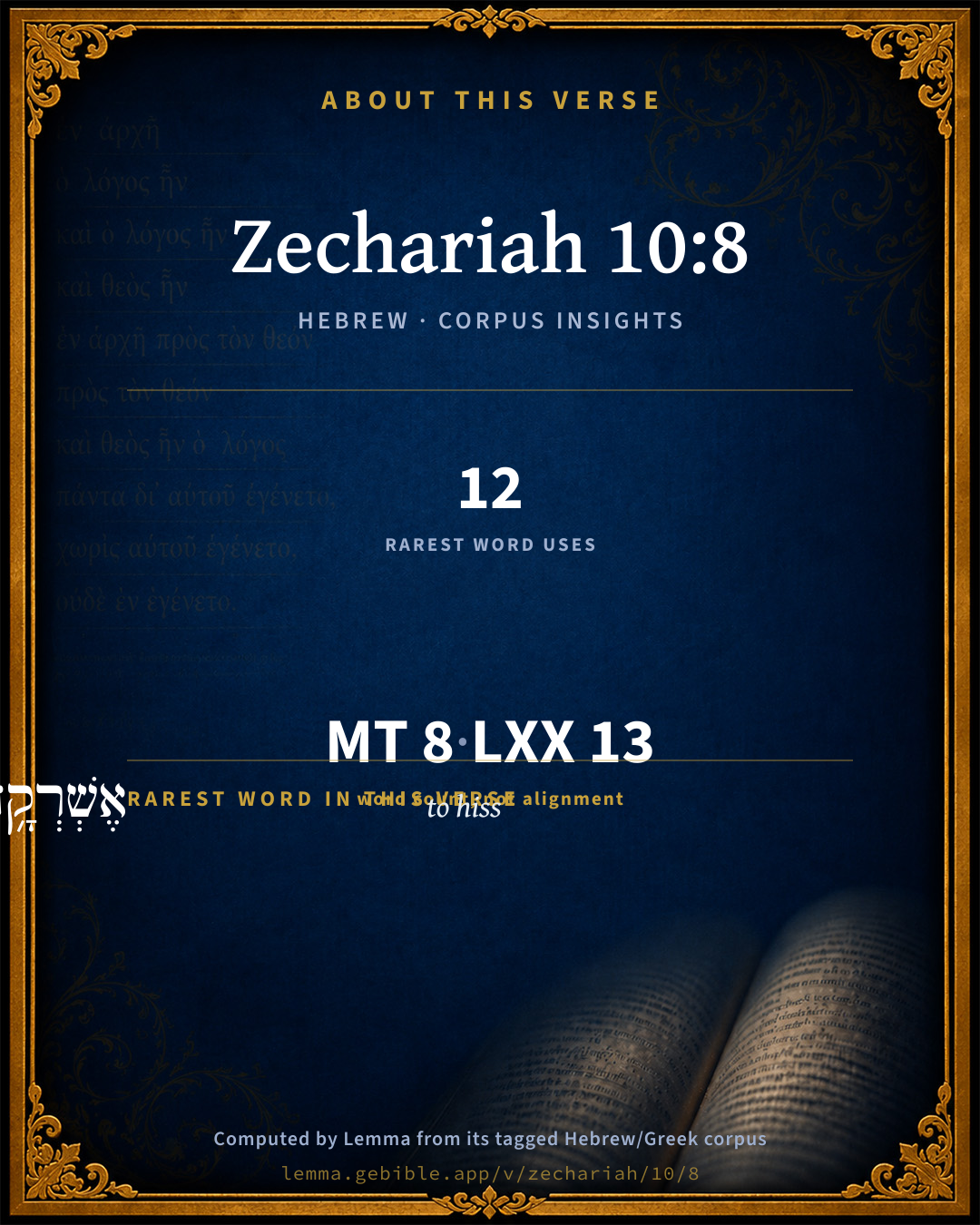
The rarest word here is אֶשְׁרְקָ֥ה to hiss H8319 — appearing just 12 times in the whole Hebrew Bible.

Shared distinctive vocabulary

אֶשְׁרְקָ֥ה to hiss H8319 occurs in 12 verses of the Hebrew Bible. Also found in:

Grammatical profile

  • 5 verbs
  • 2 prepositions
  • 1 conjunction

Verb forms

  • אֶשְׁרְקָ֥ה Qal · Imperfect
  • וַאֲקַבְּצֵ֖ם Piel · Imperfect
  • פְדִיתִ֑ים Qal · Perfect
  • וְרָב֖וּ Qal · Perfect
  • רָבֽוּ Qal · Perfect

Repetition

A word recurs within this verse — often emphatic in Hebrew:

  • וְרָב֖וּ to multiply H7235 ×2

Hebrew & Septuagint length

In English translation the verse runs 21 words from the Hebrew and 26 from the Septuagint (LXX English) — closely comparable.

A rough comparison of the two English renderings, which tokenize alike — not a word-level alignment.

Word counts can differ between the Hebrew and the Greek without any difference in meaning — e.g. the Hebrew direct-object marker אֵת has no separate Greek word, and Greek often adds the article ὁ.

In the original languages it is 8 Hebrew tokens and 13 Greek tokens — but the two are counted differently (Hebrew bundles its prefixes and suffixes into one token; the Greek is in lemma form), so that isn’t a like-for-like length.

Cross-references

21

Topical passages linked to Zechariah 10:8 in the Treasury of Scripture Knowledge — connected by theme and wording, ordered by reader-vote popularity; previews shown in the World English Bible.

  • Isaiah 5:26 He will lift up a banner to the nations from far, And he will whistle for them from the end of the earth. Behold, they will come speedily and swiftly.
  • Isaiah 7:18 It will happen in that day that Yahweh will whistle for the fly that is in the uttermost part of the rivers of Egypt, and for the bee that is in the land of Assyria.
  • Jeremiah 33:22 As the host of the sky can't be numbered, neither the sand of the sea measured; so will I multiply the seed of David my servant, and the Levites who minister to me.
  • Isaiah 55:1–3 Ho, everyone who thirsts, come you to the waters, and he who has no money; come you, buy, and eat; yes, come, buy wine and milk without money and without price.
  • Jeremiah 31:10–11 Hear the word of Yahweh, you nations, and declare it in the isles afar off; and say, He who scattered Israel will gather him, and keep him, as shepherd does his flock.
  • Ezekiel 36:10–11 and I will multiply men on you, all the house of Israel, even all of it; and the cities shall be inhabited, and the waste places shall be built;
  • Hosea 1:10 Yet the number of the children of Israel will be as the sand of the sea, which can't be measured nor numbered; and it will come to pass that, in the place where it was said to them, 'You are not my people,' they will be called 'sons of the living God.'
  • Matthew 11:28 "Come to me, all you who labor and are heavily burdened, and I will give you rest.
  • Revelation 22:17 The Spirit and the bride say, "Come!" He who hears, let him say, "Come!" He who is thirsty, let him come. He who desires, let him take the water of life freely.
  • Exodus 1:7 The children of Israel were fruitful, and increased abundantly, and multiplied, and grew exceedingly mighty; and the land was filled with them.
  • 1 Kings 4:20 Judah and Israel were many as the sand which is by the sea in multitude, eating and drinking and making merry.
  • Isaiah 11:11–12 It shall happen in that day, that the Lord will set his hand again the second time to recover the remnant of his people, who shall remain, from Assyria, and from Egypt, and from Pathros, and from Cush, and from Elam, and from Shinar, and from Hamath, and from the islands of the sea.
  • Isaiah 27:12–13 It shall happen in that day, that Yahweh will beat off [his fruit] from the flood of the River to the brook of Egypt; and you shall be gathered one by one, you children of Israel.
  • Isaiah 44:22 I have blotted out, as a thick cloud, your transgressions, and, as a cloud, your sins: return to me; for I have redeemed you.
  • Isaiah 49:19–22 For, as for your waste and your desolate places, and your land that has been destroyed, surely now shall you be too small for the inhabitants, and those who swallowed you up shall be far away.
  • Isaiah 51:11 The ransomed of Yahweh shall return, and come with singing to Zion; and everlasting joy shall be on their heads: they shall obtain gladness and joy; [and] sorrow and sighing shall flee away.
  • Isaiah 52:1–3 Awake, awake, put on your strength, Zion; put on your beautiful garments, Jerusalem, the holy city: for henceforth there shall no more come into you the uncircumcised and the unclean.
  • Jeremiah 30:19–20 Out of them shall proceed thanksgiving and the voice of those who make merry: and I will multiply them, and they shall not be few; I will also glorify them, and they shall not be small.
  • Ezekiel 36:37–38 Thus says the Lord Yahweh: For this, moreover, will I be inquired of by the house of Israel, to do it for them: I will increase them with men like a flock.
  • Zechariah 9:11 As for you also, Because of the blood of your covenant, I have set free your prisoners from the pit in which is no water.
  • 1 Timothy 2:4–6 who desires all people to be saved and come to full knowledge of the truth.

Cross-references courtesy of OpenBible.info (CC BY 4.0).

Hebrew and Greek witnesses Masoretic Hebrew ↔ Greek Septuagint

The same verse in the two great witnesses to the Old Testament, shown verse-for-verse.

These are two independent witnesses, not word-aligned to each other, and the Septuagint is shown in lemma (dictionary) form.

Hebrew Zechariah 10:8 Masoretic · Westminster Leningrad Codex

אֶשְׁרְקָ֥ה לָהֶ֛ם וַאֲקַבְּצֵ֖ם כִּ֣י פְדִיתִ֑ים וְרָב֖וּ כְּמ֥וֹ רָבֽוּ

I will signal for them, and gather them; For I have redeemed them; And they will increase as they have increased.

World English Bible · Public Domain

Greek LXX Zechariah 10:8 Septuagint · lemma form

σημαίνω αὐτός καί εἰςδέχομαι αὐτός διότι λυτρόω αὐτός καί πληθύνω καθότι εἰμί πολύς

I will make a sign to them, and gather them in; for I will redeem them, and they shall be multiplied according to their number before.

LXX2012 (modern English Septuagint) · Public Domain

On this verse, Whedon's Commentary on the Bible discusses the Septuagint’s reading. Read the note in Commentary ↓

Hebrew: Westminster Leningrad Codex (CC BY 4.0). Greek: Septuagint (public domain); English from LXX2012 (modern English Septuagint) (Public Domain). How the Septuagint differs from the Hebrew →

Targum (Aramaic paraphrase)

1

The Targum is the ancient Jewish Aramaic paraphrase of the Hebrew Scriptures — an interpretive translation, not the Hebrew text itself. Onkelos (literal) and Pseudo-Jonathan (expansive) render the Torah, and Jonathan the Prophets. Coverage is partial: where no permissively-licensed English translation exists for a verse, only the Aramaic is shown. This is verse-level text, not a word-by-word alignment to the Hebrew.

  1. Targum Jonathan Prophets (Joshua–Malachi)
    אַכְלֵי לְכַנָשָׁא גָלוּתְהוֹן וַאֲקָרְבִינוּן אֲרֵי פְרַקְתִּינוּן וְיִסְגוּן כְּמָא דִי אֲמַר עֲלֵיהוֹן יִסְגוּן:

    (no public-domain English translation for this verse)

    Targum Jonathan — Aramaic: “Mikraot Gedolot” (public domain). English: “Sefaria Community Translation” (CC0 1.0 (public-domain dedication)); “London "Chaldee Paraphrase," 1871” (public domain). Text via Sefaria.

Commentary

Notes on Zechariah 10:8 from classic Christian and Jewish commentators (each source and its license shown beneath its notes). The classic Christian expositions comment on the surrounding passage and are grouped to its opening verse, so a note may address several verses; the Jewish commentaries on the Tanakh (Rashi and others) are per-verse, so they appear only where the commentator wrote on this verse.

Lemma curates 59 commentaries, every one of them public domain or Creative Commons licensed, each selected and text-cleaned for this edition rather than reprinted as found. About our sources →

Ellicott's Commentary for English Readers

THE FURTHER REDEMPTION OF ISRAEL (Zec_10:8-12).

(8) A yet further redemption of Israel was to take place before the consummation of these victorious promises. Some critics have considered this passage as conclusive against the assumption of a post-exilic origin of these latter chapters. But Zec_8:8 speaks in similar terms: “And I will bring them, and they shall dwell in the midst of Jerusalem;” and yet the genuineness of that passage has never been called in question. The fact is that the restoration under Zerubbabel was most incomplete: only some 42,360 returned from exile under him. There was a further return of exiles under Ezra, in 458 B.C., some twenty years posterior to the probable date of the prophecies contained in these last chapters, and numbers, no doubt, returned at various other times.

I have redeemed.—The decree had gone forth, and had been already, in part, executed.

As they have increased.—viz., in times past (e.g., Exo_1:8). Jeremiah communicates a similar promise (Jer_30:19-20).

A Bible Commentary for English Readers, edited by Charles John Ellicott (1878–1897) — public domain. Text from a community e-Sword module.

Trapp's Complete Commentary

John Trapp

Zec 10:8 I will hiss for them, and gather them; for I have redeemed them: and they shall increase as they have increased.

Ver. 8. I will hiss for them and gather them] As a shepherd hisseth or whistleth for his flock. See Jdg 5:16, where it should not be translated the bleatings of the flocks, but the hissings or whistlings of the shepherds to their flocks, when they would get them together. God, who hath all creatures at his beck and call, can easily bring back his banished, gather together his dispersed with a turn of a hand, Zec 13:7, with a blast of his mouth, as here; as if any offer to oppose him herein, he can blow them to destruction, Job 4:9. He can frown them to death, Psa 80:16. He can crush them between his fingers, as men do a moth, Psa 39:11, and crumble them to crattle, Psa 146:4 "Like sheep they are laid in the grave; death shall feed on them; and the upright shall have dominion over them in the morning; and their beauty shall consume in the grave from their dwelling," Psa 49:14.

For I have redeemed them] I have in part, and that is a pledge of the whole; my hands also shall finish it, as Zec 4:9. God doth not his work to the halves, neither must we; but if he shall be All in All unto us, we must be altogether his, Son 2:16. His is a covenant of mercy, ours of obedience; which must be therefore full and final, as Christ hath obtained for us an entire and everlasting redemption, Heb 9:12.

And they shall increase as they have increased] By virtue of that promise to Abraham, Gen 13:16. I will multiply thy seed as the dust of the earth, and Gen 15:5, as the stars of heaven. This promise was not presently fulfilled; for when they came into Egypt they were but seventy souls of them. But under the Egyptian servitude they increased abundantly, Exo 1:7, they spawned (as the word signifies), and bred swiftly; so that they went thence 600,000 strong, Exo 12:37; so that they soon became a mighty and populous nation, Deu 26:5. Judea was not moer than 200 miles long and 50 miles broad, not near the half of England by much; yet what huge armies had they, when the two tribes and the other ten met in the field, one against another! And even at this day (whatever is become of the ten tribes, whether they are in China or America) the Jews are a very great and numerous people. It is thought that there is not any one nation under heaven so great in number as that is, if the dispersed Jews might all be gathered together into one place. And who knows what we may (some of us) yet live to see? The late Clavis Apocalyptica promiseth great matters to occur within these three or four years.

John Trapp, A Commentary or Exposition upon All the Books of the Old and New Testament (1647–1656) — public domain. Text from a community e-Sword module.

The Biblical Illustrator

Joseph S. Exell

Zec_10:8

I will hiss for them, and gather them; for I have redeemed them

Gathering the redeemed

I.

The persons. The redeemed. Redeemed in consequence of Gods everlasting love towards them; for had they not been loved of the Father, they would never have been given to Christ, in order to be redeemed by Him. Redeemed from the laws curse; and from all iniquity; from the wrath to come.

II. The promise. I will gather them. This implies that the redeemed are by nature in a scattered state, or in a state of alienation from God. How universal is the departure. We have turned everyone to his own way, which is a sinful way, a God-dishonouring, and a soul-distressing way. The gathering work is accomplished in regeneration, at which time they are gathered to Christ for life and salvation: they are gathered or folded together in Church fellowship; and shall by and by be gathered as wheat into the garner.

III. The mean to be made use of. I will hiss for them; i.e., I will call for them; make the peculiar sound which they will heed, as a shepherd does to call his sheep around him. Shepherds used a whistle. The Redeemer called for His people, by the prophets of old; by John the Baptist; He Called them Himself when He was here upon earth. He called them by His apostles; He calls them now by His ministers. (S. Barnard.)

The interposition of mercy

This passage refers to Gods ancient people, who, for their crimes, had been scattered, but whom He here promises shall be gathered and blessed.

I. The interposition of mercy realised. I have redeemed them. By this I understand the redemption by the Son of God. The mediation of Jesus Christ is the meritorious cause of all good to sinful man. All the peace and happiness we possess is due to this mediation. It is the medium of all spiritual good to men individually.

II. The interposition of mercy designed. I will hiss for them, and gather them.

1. The end proposed. They are to be gathered. This leads us to reflect on their past condition.

2. The place of their assembling. They shall come to the Cross of the Saviour, to receive from Him all the blessings they need. They shall come to the bosom of the Church.

3. The result of their gathering will be their blessedness and the Divine honour.

4. The instrumentality God will employ. I will hiss for them. The allusion is to the shepherds pipe or whistle. It has pleased the Lord, in all ages of time, to gather men by means of human agency.

III. The churchs future prosperity. The convulsions of nations, the revolutions of empires shall but contribute to the establishment of His kingdom. His signature is inscribed on every part of the earth; all is His, and He shall soon take possession. (W. Lucy.)

The Biblical Illustrator, edited by Joseph S. Exell (c. 1880s–1900s) — public domain. Text from a community e-Sword module.

Joseph Benson's Commentary

Zec 10:8-10. I will hiss for them — Rather, whistle, as the word שׁרקshould be here translated. I will call them from distant countries, as a shepherd calls his flock together with his whistle. For I have redeemed them — For I have, and will, by the workings of my divine providence, deliver and redeem them out of their enemies’ hands, and from those who hold them captives. And they shall increase as they have increased — Namely, in the most flourishing times, such as were the reigns of David and Solomon. I will sow — Rather, I have sown, them among the people — Or nations, for it appears beyond a doubt that what had been formerly done is here spoken of. And they shall remember me in far countries — Whithersoever they were driven. I will bring them again also out of the land of Egypt — Ptolemy Philadelphus, one of the kings of Egypt, redeemed no fewer than 100,000 of the Jews, and sent them home; God, no doubt, inclining him to be thus remarkably favourable and kind to them. For this, we have the testimony of Josephus’s history; as also, that other kings released many of those who still remained slaves, or servants in Egypt, and sent them back to their own land. And gather them out of Assyria — This was done by Alexander, the son of Antiochus Epiphanes, and by both the Demetriuses, as Josephus relates. This redeeming and releasing of the Jews, who were captives or servants in divers countries, by several kings, and sending them home at their charge or expense, which Josephus affirms to have been done, is a fact so very extraordinary that it deserves to be attended to; for it is a certain proof that the divine providence can accomplish whatever it pleases. And as this extraordinary particular was repeatedly foretold and promised by God’s prophets, long before it took place, and when there was not the least human probability of it, it is a striking proof of the truth and divine inspiration of the Holy Scriptures. I will bring them unto the land of Gilead and Lebanon — Gilead was taken by the arms of the Maccabees, and the cities of Syria, (here signified by Lebanon, a famous mountain in Syria,) by Hyrcanus and his successors. Gilead and Lebanon were countries remarkable for their fruitfulness. And place shall not be found for them — The land shall be too narrow for them. But this verse, and indeed the whole paragraph, has a further and mystical meaning. It relates to the success of the gospel, and the bringing in of the Jews and Gentiles into the Christian Church; and probably also to the restoration of the Jews, and of the whole remnant of the house of Israel from their present dispersions to their own land, as has been observed on Zec 10:6.

Joseph Benson's Commentary on the Old and New Testaments (1811–1818) — public domain. Text from a community e-Sword module.

Whedon's Commentary on the Bible

Daniel D. Whedon

Restoration of the exiles from Assyria and Egypt, 8-12.

These verses describe more minutely the deliverance of Ephraim. 8.

I will hiss — Give the signal to return (compare Isa_5:26; Isa_7:18).

Have redeemed — The redemption is already decreed, though its execution is still future.

As they have increased — As they were great in numbers before the calamity fell upon them, so they will be again. 9.

I will sow — An obscure and much-discussed expression. The marginal reading, “though I sow,” is to be preferred; but even that leaves it an open question whether the sowing is already passed or still in the future, nor does it indicate the exact force of sow. The meaning scatter seems most suitable, though Hebrew usage may not support it. The Hebrew, if interpreted naturally, places the sowing in the future; a change of one vowel point would throw it in the past, and to the past it seems to refer — “Though I scattered them among the peoples,” that is, during the exile. The succeeding clause is the apodosis.

They shall remember me — With the above suggested translation of the first clause, the verb here should not be rendered as a simple future but as a past tense expressing the idea of continuation (G.-K., 107d) — “though I scattered them, yet they continued to remember me.”

Far countries — The lands of exile, here Egypt and Assyria (Zec_10:10).

Shall live with their children — With this clause begins the promise. Those who are now in exile shall not perish, but they and their children shall live (Hos_6:2; Eze_37:1 ff.) and return to their old home. LXX. reads, “bring up their children”; which is probably meant to express a similar idea. They will raise families, which are considered a gift from God (Psa_127:3-5), and with them they will return home.

Zec_10:10 takes up the promise of restoration from Zec_10:8.

Egypt,… Assyria — The two long-time enemies of the people of Israel (see on Hos_8:13; Hos_9:3; compare Isa_11:11-12). On the use of these names here and their bearing on the date of the prophecy see Introduction, p. 584.

Gilead… Lebanon — The former is the territory east of the Jordan (see on Amo_1:3), the latter is the mountain range in the north of the territory west of the Jordan (compare Hos_14:4-8). Gilead was rich in pasture land, Lebanon in forests; hence the two districts might be named as types of extreme fertility. If so, the thought would be that the restored exiles will be settled in the most fertile regions of Palestine. Or the two districts might represent all the territory east and west of the Jordan respectively; then the promise would be that the restored exiles will occupy all the ancient territory of Israel; and even then the land will not be able to hold them (Isa_49:19-20).

Zec_10:11 elaborates upon the promise of 10a. The prophet describes the future deliverance in language which is strongly colored by the memory of the exodus. The details of interpretation are uncertain.

He — LXX., “they”; the exiles. The pronoun in Hebrew refers to Jehovah, which is, perhaps, to be preferred (see below).

Shall pass through the sea with affliction — He will bring affliction upon the sea (the Red Sea), so that it will dry up and let the exiles pass through. R.V., “he will pass through the sea of affliction”; literally, the sea, affliction (in apposition), which expresses a similar thought, namely, the sea which caused affliction, that is, at the time of the exodus — the Red Sea. The expression is peculiar. Von Orelli, following some of the ancient versions, takes affliction as the subject and renders “affliction shall pass over the sea,” which expresses a thought similar to that of A.V. Some take affliction in a physical sense — narrowness — and read “the sea of narrowness” — the narrow sea, the Red Sea. If the present Hebrew text is correct, R.V. is to be preferred. Jehovah will pass through the sea to smite it, so that the exiles may be able to cross dry-shod (compare Isa_11:15). Various emendations have been suggested. Marti, for example, reads 11a, “and they shall pass through the Sea of Egypt, and dry up shall all the depths of the Nile.”

The waves in the sea — Another very peculiar construction.

The deeps of the river shall dry up — R.V. rightly understands “river” of the Nile (see on Amo_8:8, where the same word is used). The Nile will dry up to permit the exiles to return. Passages like Isa_11:15, and even the context here might lead one to understand river of the Euphrates, though the word river used in the Isaiah passage and elsewhere is not the one used here. The Red Sea will dry up to let the exiles return from Egypt, the Euphrates to let them return from Assyria.

Pride — The blow which will fall upon the nation will result in its utter humiliation.

Scepter — The symbol of power. The taking away of the scepter symbolizes the withdrawal of power and authority; Egypt also will be humbled.

12. Strengthen them in Jehovah — Jehovah himself will be the strength, that is, the source of the strength, of the exiles. With Jehovah on their side they need not fear.

Walk… in his name — See on Mic_4:5. Up and down would better be omitted; it is a useless and confusing addition by the English translators. Practically all the Hebrew prophets expect the restoration of the scattered Jews; hence from this promise the date of this utterance cannot be determined.

Daniel D. Whedon (gen. ed.), Commentary on the Old and New Testaments (1874–1909) — public domain. Text from a community e-Sword module.

The Preacher's Complete Homiletical Commentary

Joseph S. Exell (gen. ed.)

CRITICAL NOTES.]

Zec_10:8. Hiss] Whistle as bee-keepers call back swarms to the hive. The extraordinary increase of Jews after this is a familiar fact of history (cf. Josephus’ Wars, Bk. 3 ch. 3. § 2).

Zec_10:9. Sow] broadcast, with a design to multiply (Hos_2:2-5; Jer_31:27). Remember] Return to right mind (cf. Luk_15:17; Psa_22:27). Live] in political and spiritual life.

Zec_10:10. Egypt] the house of bondage, and Assyria] the scene of captivity, represent all lands in which they are now scattered. Gilead and Lebanon] Their old dwellings east and west of Jordan. This territory, though fertile and large, should not be able to support them.

Zec_10:11. The sea] personified, shall not hinder their return. God will march at their head, trample down all its proud waves, and the depths shall become dry. Assyria’s pride] and Egypt’s sceptre] (rod of task-master), shall be smitten.

Zec_10:12. I] God will strengthen Ephraim. They will walk] in his name, and enjoy his protection; find the past a pledge of the future, and see the Divine perfections more illustrious than ever.

HOMILETICS

THE RESTORATION, SETTLEMENT, AND INCREASE OF GOD’S PEOPLE.—Zec_10:8-12

To remove all doubt concerning the promises just given the restoration is more minutely described.

I. The restoration of God’s people. “I will gather them.”

1. From different places. From “the land of Egypt,” a type of all lands of bondage. “Out of Assyria,” a type of all lands of exile. They shall be sought and found in all quarters of the world.

2. By Divine call. “I will hiss for them and gather them.” As bee-keepers whistle back the bees to the hive, or as sheep flock together at the well-known call of the shepherd, so God will bring them back to himself and their inheritance. “He will lift up an ensign to the nations from far, and will hiss unto them from the end of the earth; and, behold, they shall come with speed swiftly” (Isa_5:26).

3. Without hindrance. (a) Distance shall not keep them back. Out of lands far and near. (b) Distress shall not hinder them. At the Red Sea Israel thought they were lost. The sea of affliction shall be opened up. Its smitten waves shall overwhelm the foe, “for the Lord fighteth for them against the Egyptians” (Exo_14:24-25); or sink into silence at the command of its Maker and Ruler. “All the deeps of the river shall dry up.” (c) Enemies shall not impede them. “The pride of Assyria shall be brought down.” The rod of Egypt shall be broken. The wonders of old shall be repeated, and the first deliverance shall be eclipsed by the last.

II. The settlement of God’s people. “I will bring them into the land of Gilead” beyond Jordan, the eastern, “and Lebanon,” the northern, boundary.

1. Settled them in Divine strength. “I will strengthen them in the Lord.” Strengthen them to resist temptation, discharge duty, and endure trial. “Be strong in the Lord, and in the power of his might.”

2. Settled them in delightful freedom. “I have redeemed them” (Zec_10:8): spiritually and temporally, the type of the true Israel. “I gave Egypt for their ransom, Ethiopia and Seba for thee.”

III. The increase of God’s people. “And they shall increase as they have increased.”

1. Increase by sowing them in other nations. As seed sown in the ground they were scattered, not merely to spread the knowledge of God, but to be quickened in themselves, and to quicken others. “The word is used of sowing to multiply,” says Pusey, “never of mere scattering. A rich harvest was to spring from them.” “I will sow the house of Israel and the house of Judah with the seed of man, and with the seed of beast.”

2. Increase with unparalleled degree. “Place shall not be found for them.” “A promise of such increase is a promise that includes much more than it expresses. It implies in it all that contributes to such rapid multiplication.” “The children of thy bereaved estate shall yet say in thine ears, The place is too strait for me: give place, that I may dwell.”

3. Increase in permanent duration. “They shall live with their children and turn again.” The gift would be a continual gift. “They and their children, and their children’s children for ever” (Eze_37:14). The blessing would not be transient, but abiding; the chartered privileges would be as before the dispersion. “The promise is unto you and to your children.”

HOMILETIC HINTS AND SUGGESTIONS

Zec_10:9. Here we seem to have their dispersions, their penitent recognition of God, and their consequent preservation and return [Wardlaw]. Sow them, partly to keep them as winter seed in the ground till the spring-time of their conversion and restitution; and partly making them seed to bring in an increase of the fulness of the Gentiles at their conversion. Further, the Lord promiseth that scattering should not hinder their conversion, for the veil shall be taken away, and they shall remember the Lord, and they and their children being preserved shall return to God [Hutcheson].

They shall remember me—

1. May be applied to the Jews; and

2. to the conversion of sinners. It indicates—

1. That men have forgotten God, wandered into distance from him.

2. That true conversion is a “turning again” to God in humility and duty. A state of unregeneration is one of forgetfulness. Sinners have lost all sense of God’s glory, authority, and mercy. The first religious exercise of the mind is reflection, fitly represented in the prodigal when he came to himself. Then a return to God the Father. “All the ends of the world shall remember and turn unto the Lord.”

Zec_10:12. Security and happiness under Divine protection.

1. Christian knowledge; a knowledge of God’s name revealed to direct and encourage in duty. “The name of Jehovah is a comprehensive expression denoting his glory as manifested in history” (Hengs.)

2. Christian profession. To walk in his name, or maintain a course of life in harmony with God’s will and word.

3. Christian freedom. “They shall walk up and down.” “The expression seems further to imply a state of felt peace, and freedom, and confidence of safety, and happy social intercommunion, arising from faith in God—from unshaken reliance on his power and wisdom, faithfulness and love” [Wardlaw]. I will strengthen them in the Lord. The very assurance we want in the duties and trials of life. Confidently rely upon it, for it comes from the lips of Faithfulness and Truth. But we may err as to manner of fulfilment; our expectation therefore to be regulated accordingly. Observe, that the fulfilment of the promise will not exempt us from all ground of complaint. It will keep us in work, but not cause us to cease—secures help in conflict, but war lasts for ever. It will also be seasonable. “As thy days, so shall thy strength be.” Look for grace, not for imaginary but real purposes, not for future but present difficulties, to “help in time of need.” These supplies of strength to be sought in God’s own way. In the use of appointed means. Foolish to avoid religious exercises, even when not in a proper, spiritual, and lively frame. Then the means most necessary, as fire when we are cold, and excitement when dull [Jay].

Zec_10:10-12. Messianic mercies. Survey the whole promise from ch. Zec_9:11 onwards; there are two leading thoughts developed in it. (a) That those members of the covenant nation who were still scattered among the heathen should be redeemed out of their misery, and gathered together in the kingdom of Messiah. (b) That the Lord would endow all his people with power for the conquest of the heathen. They were both fulfilled in weak commencements only in the times immediately following, and down to the coming of Christ, by the return of many Jews out of captivity and into the land of their fathers, particularly when Galilee was strongly peopled by Israelites; and also by the protection and care which God bestowed upon the people in the contests between the powers of the world for supremacy in Palestine. The principal fulfilment is of a spiritual kind, and was effected through the gathering of Jews into the kingdom of Christ, which commenced in the times of the apostles, and will continue till the remnant of Israel is converted to Christ its Saviour [Keil].

ILLUSTRATIONS TO CHAPTER 10

Zec_10:7-8. “The house of Judah, and the house of Joseph,” spoken of in the first of these verses, signify respectively, the two tribes and the ten tribes—unitedly, the whole house of Israel—the posterity of Abraham, Isaac, and Jacob. The declaration, “I will save them, and bring them again and place them,” cannot refer to the return from Babylon; seeing, in that respect, they had been already “saved,” and “brought again,” and “placed.” And the language is much too strong to have reference to any such remaining partial deliverances and returnings—additions only to that from Babylon—which might take place under the Maccabean princes, or at any period of their history between the prophet’s days and the coming of Christ. And if it refers to a period subsequent to the coming of Christ, to what else can the reference be but to their recovery from their present long-continued outcast and scattered condition? [Wardlaw].

Zec_10:9-12. The victory described is followed by a large increase of population, not confined to Judah, but also including Israel. Nor is there reason to doubt that the independence achieved by the Maccabees attracted very many of the exiles from the northern kingdom, who forgot the old causes of dissension, and united earnestly in maintaining the re-established national centre in Jerusalem. This fusion at home led to a similar fusion abroad, and wherever Jews were found, who preserved their hereditary faith at all, they still remembered Jehovah as one who had chosen Zion, and considered themselves as constituent parts of one covenant people. So far the predictions of the chapter were fulfilled historically in the period extending from the establishment of Jewish independence to the time of the advent. In the last three verses the prophet describes a far greater, because spiritual, blessing in terms borrowed from the old experience of the people. The drying up of the sea, the humiliation of Assyria, the overthrow of Egypt, simply set forth the removal of all possible obstacles in the way of a spiritual return to God. The Lord will reclaim and bless them by procedures as marvellous as any that ever occurred in their former history [Lange].

The Preacher's Complete Homiletical Commentary (gen. ed. Joseph S. Exell; Funk & Wagnalls, c. 1892) — public domain (pre-1929). A full-Bible homiletical/sermon-outline anthology covering 65 of 66 books (2 John is absent from the source module). Text from a community e-Sword module.

Keil & Delitzsch

C. F. Keil & F. Delitzsch

In order to remove all doubt as to the realization of this promise, the deliverance of Ephraim is described still more minutely in Zac 10:8-12. Zac 10:8. "I will hiss to them, and gather them; for I have redeemed them: and they will multiply as they have multiplied. Zac 10:9. And I will sow them among the nations: and in the far-off lands will they remember me; and will live with their sons, and return. Zac 10:10. And I will bring them back out of the land of Egypt, and gather them out of Asshur, and bring them into the land of Gilead and of Lebanon; and room will not be found for them." That these verses do not treat of a fresh (second) dispersion of Ephraim, or represent the carrying away as still in the future (Hitzig), is evident from the words themselves, when correctly interpreted. Not only are the enticing and gathering together (Zac 10:8) mentioned before the sowing or dispersing (Zac 10:9), but they are both expressed by similar verbal forms (אשׁרקה and אזרעם); and the misinterpretation is thereby precluded, that events occurring at different times are referred to. We must also observe the voluntative form אשׁרקה, "I will (not I shall) hiss to them, i.e., entice them" (shâraq being used for alluring, as in Isa 5:26 and Isa 7:18), as well as the absence of a copula. They both show that the intention here is simply to explain with greater clearness what is announced in Zac 10:6, Zac 10:7. The perfect פּדיתים is prophetic, like רחמתּים in Zac 10:6. The further promise, "they will multiply," etc., cannot be taken as referring either merely to the multiplication of Israel in exile (Hengst., Koehler, etc.), or merely to the future multiplication after the gathering together. According to the position in which the words stand between אקבּצם and אזרעם, they must embrace both the multiplication during the dispersion, and the multiplication after the gathering together. The perfect כּמו רבוּ points to the increase which Israel experienced in the olden time under the oppression of Egypt (Exo 1:7, Exo 1:12). This increase, which is also promised in Eze 36:10-11, is effected by God's sowing them broadcast among the nations. זרע does not mean to scatter, but to sow, to sow broadcast (see at Hos 2:23). Consequently the reference cannot be to a dispersion of Israel inflicted as a punishment. The sowing denotes the multiplication (cf. Jer 31:27), and is not to be interpreted, as Neumann and Kliefoth suppose, as signifying that the Ephraimites are to be scattered as seed-corn among the heathen, to spread the knowledge of Jehovah among the nations. This thought is quite foreign to the context; and even in the words, "in far-off lands will they remember me," it is neither expressed nor implied. These words are to be connected with what follows: Because they remember the Lord in far-off lands, they will live, and return with their children. In Zac 10:10 the gathering together and leading back of Israel are more minutely described, and indeed as taking place out of the land of Asshur and out of Egypt. The fact that these two lands are mentioned, upon which modern critics have principally founded their arguments in favour of the origin of this prophecy before the captivity, cannot be explained "from the circumstance that in the time of Tiglath-pileser and Shalmaneser many Ephraimites had fled to Egypt" (Koehler and others); for history knows nothing of this, and the supposition is merely a loophole for escaping from a difficulty. Such passages as Hos 8:13; Hos 9:3, Hos 9:6; Hos 11:11; Mic 7:12; Isa 11:11; Isa 27:13, furnish no historical evidence of such thing. Even if certain Ephraimites had fled to Egypt, these could not be explained as relating to a return or gathering together of the Ephraimites of Israelites out of Egypt and Assyria, because the announcement presupposes that the Ephraimites had been transported to Egypt in quite as large numbers as to Assyria, - a fact which cannot be established either in relation to the times before or to those after the captivity. Egypt, as we have already shown at Hos 9:3 (cf. Zac 8:13), is rather introduced in all the passages mentioned simply as a type of the land of bondage, on account of its having been the land in which Israel lived in the olden time, under the oppression of the heathen world. And Asshur is introduced in the same way, as the land into which the ten tribes had been afterwards exiled. This typical significance is placed beyond all doubt by Zac 10:1, since the redemption of Israel out of the countries named is there exhibited under the type of the liberation of Israel out of the bondage of Egypt under the guidance of Moses. (Compare also Delitzsch on Isa 11:11.) The Ephraimites are to return into the land of Gilead and Lebanon; the former representing the territory of the ten tribes in the olden time to the east of the Jordan, the latter that to the west (cf. Mic 7:14). לא ימּצא, there is not found for them, sc. the necessary room: equivalent to, it will not be sufficient for them (as in Jos 17:16).

Keil & Delitzsch — Biblical Commentary on the Old Testament (1861–1891) — public domain (CC PDM 1.0). Text via the HelloAO Bible API. (Old Testament only.)

Tyndale Open Study Notes

Tyndale Open Resources

10:8 When I whistle to them: Shepherds in biblical times herded their flocks by whistling or piping to them (see Judg 5:16). • Redeemed can also mean “ransomed”—buying slaves out of their servitude or indentured status (see Deut 15:15; 24:18). • numerous as . . . before: The proliferation of the Hebrew people was one of God’s covenant promises to Abraham (Gen 12:1-3; 22:17; 32:12).

Tyndale Open Study Notes — © Tyndale Open Resources, licensed CC BY-SA 4.0. Text via the HelloAO Bible API.

Geneva Bible (1599)

Geneva Bible translators

Whereby he declareth the power of God, who needeth no great preparation when he will deliver his: for with a beck or hiss he can call them from all places suddenly.

Geneva Bible (1599) marginal notes — public domain. Text via Bolls.life.

Jamieson, Fausset & Brown

Robert Jamieson, A. R. Fausset & David Brown

hiss for them--Keepers of bees by a whistle call them together. So Jehovah by the mere word of His call shall gather back to Palestine His scattered people (Zac 10:10; Isa 5:26; Eze 36:11). The multitudes mentioned by JOSEPHUS [Wars of the Jews, 3:2], as peopling Galilee two hundred years after this time, were a pledge of the future more perfect fulfilment of the prophecy.

for I have redeemed them--namely, in My covenant purpose "redeemed" both temporally and spiritually.

as they have increased--in former times.

Jamieson, Fausset & Brown — Commentary Critical and Explanatory on the Whole Bible (1871) — public domain (CC PDM 1.0). Text via the HelloAO Bible API.

Adam Clarke's Commentary

Verse 8. I will hiss for them] אשרקה eshrekah, "I will shriek for them;" call them with such a shrill strong voice, that they shall hear me, and find that it is the voice of their redemption.

Adam Clarke's Commentary on the Bible (1810–1826) — public domain. Text from a community e-Sword/MySword module.

John Calvin's Commentaries

The same is the object of this verse. By the word whistle, Zechariah means what it imports in other passages, — that it will not be an arduous world for God; for we are wont to measure his works by what our flesh understands. Since then the Jews might have easily raised this objection, — that their brethren were dispersed through various countries and among many nations, so that the assembling of them was incredible, the Prophet meets this objection and says, that God was able by mere whistling or by a single nod to restore them to their country. God is sometimes said to whistle for the wicked, when he constrains them unwillingly to do him service, and employs them as instruments to execute his hidden purposes; for when great armies daily assemble, it is no doubt through the secret appointment of God. When therefore trumpets sound and drums beat, the Lord whistles from heaven, to lead the reprobate here and there as it pleases him. But in this passage the Prophet simply means, that though God may not have many heralds nor an equipped army to open a way for his people, he will be satisfied with whistling only; for when it should please him, a free passage would be made for captives, though the whole world were to hinder their return. These two words then are to be joined together, I will whistle for them and gather them; as though Zechariah had said, that the nod of God would alone be sufficient, whenever he designed to gather the people.

He then adds, For I have redeemed them. Here also I retain the past time, as the verb is in the past tense: for God speaks of redemption already begun, as though he had said, “I have promised that your exile would only be for a time; I have already appeared in part as your Redeemer, and I will not discontinue my work until it be completed.” God then no doubt confirms here what I have stated, — that as he had begun in some measure to redeem his people, a complete redemption was to be expected, though the distressed could hardly believe this. But they ought to have felt assured, that God, as it is said in Psalm 138:1, would not forsake the work of his hands. Hence by the consideration of what had commenced he encourages the Jews here to entertain confidence, so that they might with composed minds look for the end, and doubt not but that the whole people would be saved; for the Lord had already proved himself to be their Redeemer. It is indeed true that this had not been fulfilled as to all the Israelites: but we must ever remember, that gratuitous election so existed as to the whole people, that God had notwithstanding but a small flock, as Paul teaches us. (Romans 11:5.) The Prophet at the same time intimates that Christ would be the head of the Church, and would gather from all parts of the earth the Jews who had been before scattered; and thus the promised restoration is to be extended to all the tribes. It afterwards follows —

John Calvin's Commentaries (1540-1563) — public domain. Text from the Calvin Translation Society English edition (1840s-50s) via the Christian Classics Ethereal Library (ccel.org). Calvin's coverage is partial (roughly two-thirds of the Bible); uncommented books and verses are honest gaps, never fabricated. The 19th-century editor's footnotes and remarks are omitted so the notes are faithfully Calvin's own voice.

The Cambridge Bible for Schools and Colleges

gen. ed. J. J. S. Perowne

8. I will hiss for them] “Formerly God had so spoken of His summoning the enemies of His people to chastise them (Isa_7:18-19; Isa_5:26-27). He would gather them like the countless numbers of the insect creation, which if united would irresistibly desolate life. He would summon them as the bee-owner, by his shrill call, summons and unites his own swarm. Now, contrariwise, God would summon with the same His own people. The fulfilment of the chastisement was the earnest of the ease of the fulfilment of the mercy.” Pusey.

as they have increased] i.e. formerly in Egypt. Exo_1:7; Exo_1:12. “Multiplicabuntur in exsilio, ut multiplicati fuerunt in Ægypto.” Jarchi, quoted by Maurer. Comp. Eze_36:10-11.

The Cambridge Bible for Schools and Colleges (gen. ed. J. J. S. Perowne; Cambridge University Press, 1878–1918) — public domain. Text from a community e-Sword module.

John Gill's Exposition

I will hiss for them,.... Or "whistle for them" (p); the word signifies, as Kimchi and Ben Melech observe, the motion of the lips with the voice, and is a sign of calling; and so the Targum renders it, I will cry or call for them; and it denotes the call of them by the Gospel, which is the voice of Christ, which is soft, sweet, and melodious; is a sound of love, grace, and mercy; of peace, pardon, life, and salvation: the allusion seems to be to the shepherd gathering his sheep together with his pipe or whistle, and which was a reed; and so may denote the weakness of the instrument, the ministry of the word in itself, which is made the power of God unto salvation:

and gather them; from the places where they are scattered, into their land; or, by effectual calling, out from the state and condition in which they are, and from among the men of the world, to the Lord himself, as their Redeemer and Saviour; and to him for pardon and righteousness; and into his churches, and communion with him there: Kimchi observes, that some interpret this verse of future time; and Jarchi says it relates to it; and in the Talmud (q) it is applied to the times of the Messiah; where they speak of a bird called "racham", which we translate the gier eagle, Deu 14:17 and they say it is so called, because, when that comes, mercies come into the world, which this word signifies. R. Bibi bar Abi says, when it sits, it makes a whistling or hissing, from whence it is called "sarakrak", a word derived from what is here used; and when it sits on the ground, and hisses or whistles, the Messiah will come, as it is said, "I will hiss for them", &c.; the gloss is, when it stands not, but sits and chirps, it is a sign of good news. The design, seems to be to show, that the Messiah's coming is owing mercy, and would be good news, which the Gospel publishes.

For I have redeemed them; from sin, Satan, the law, death, and hell, and every enemy, by his precious blood, and the sacrifice of himself when here on earth; and this is the foundation of the effectual calling of any and every sinner; and will be the reason of the conversion and ingathering of the Jews in the latter day; they being a people redeemed and purchased by the blood of Christ, Isa 43:1,

and they shall increase as they have increased; either when in Egypt, or in the days of Solomon; their number shall be as the sand of the sea, Hos 1:10 a nation shall be born at once; they shall be multiplied, and not be few, and glorified, and not be small; yea, the place shall be too strait for them to dwell in, Jer 31:18.

(p) "sibilabo", i. e. "fistula pastorali", Grotius, Burkius. (q) T. Bab. Cholin, fol. 63. 1.

John Gill's Exposition of the Whole Bible (1746–1763) — public domain (CC PDM 1.0). Text via the HelloAO Bible API.

Albert Barnes' Notes on the Bible

I will hiss for them - Formerly God had so spoken of His summoning the enemies of His people to chastise them. “It shall be in that day, that the Lord shall hiss for the fly, that is in the uttermost part of the rivers of Egypt, and for the bee that is in the land of Assyria, and they shall come, and shall rest all of them in. the desolate valleys, and in the holes of the rocks, and upon all thorns and upon all bushes” Isa 7:18-19. “He will hiss unto them from the ends of the earth, and behold they shall come with speed swiftly; none shall be weary or stumble among them” . He would gather them, like the countless numbers of the insect creation, which, if united, would irresistibly desolate life. He would summon them, as the bee-owner, by his shrill call, summons and unites his own swarm. Now, contrariwise God would summon with the same His own people. The fulfillment of the chastisement was the earnest of the ease of the fulfillment of the mercy.

For I have redeemed them - Then they are His, being redeemed at so dear a price. Dionysius: “For Christ, as far as in Him lay, redeemed all.” God had done this in purpose, as John speaks of “the Lamb slain from the foundation of the world” Rev 13:8.

And they shall increase as they increased - Kimchi: “As they increased in Egypt, so shall they increase at that time.” The marvels of God’s favor in Egypt shall be repeated. The increase there had been promised beforehand. “Fear not to go down into Egypt; for I will there make of thee a great nation” Gen 46:3. The fulfillment is recorded, “the children of Israel were fruitful, and increased abundantly, and multiplied, and waxed exceeding mighty; and the land was filled with them” Exo 1:7. God appointed that this should be part of their confession at their yearly prosperity, the offering of the basket of first-fruits; “A Syrian ready to perish was my father, and he went into Egypt and sojourned there with a few, and became there a nation, great, mighty, and populous” Deu 26:5. The Psalmist dwelt upon it. “He increased His people greatly, and made them stronger than their enemies” Psa 105:24. It became then one of the resemblances between the first deliverance and the last. Dionysius: “For the Apostles and others converted from Judaism, had more spiritual children, all those whom they begat in Christ, than the synagogue ever had after the flesh.”

Albert Barnes' Notes on the Bible (1834–1885) — public domain. Text from a community e-Sword/MySword module.

Haydock's Catholic Bible Commentary

Whistle. Christians are sweetly drawn by inspirations, without clamorous words. (St. Cyril) (Worthington) --- This expression shews the sovereign dominion of God. (Calmet) --- Septuagint, "I will give them a sign." (Haydock)

George Leo Haydock (1774–1849), Haydock's Catholic Family Bible and Commentary, 1859 edition — public domain. Excludes Psalms (Douay-Rheims chapter numbering differs from Protestant) and Deuterocanonical books (Catholic canon only).

Matthew Poole's English Annotations

I will hiss for them; though they are now scattered far off, I will cause them to return; I will whistle, as a shepherd, and they, as scattered sheep, shall run with sped back to the flock: I called their enemies so once, and they came, Isa 5:26; 7:18,19; and

my people will come when thus I call to them.

And gather them; this shall be enough to bring them together; or it shall be done as soon as spoke, so soon as I whistle they shall return.

I have redeemed them; I have been at the care and charge of redeeming, I raised Cyrus to do it; I bestowed all nations and kingdoms on him, and afterwards on Darius Hystaspes, to do this, to restore my exiles, to replant Judah, to rebuild the city and temple; and I will do this also, which is much less, I will, as a shepherd with his pastoral whistle, call them in.

They shall increase as they have increased; a promise made Jer 33:22, and Eze 36:1,11,37,38, which see.

Matthew Poole's English Annotations on the Holy Bible (1683–1685) — public domain. Text from a community e-Sword/MySword module.

The Pulpit Commentary

Vers. 8-12. The scattered people shall be gathered from all parts of the world, and dwell in their own land, under the protection of Jehovah.

I will him for them; shmanw autoiv , "I will signal to them" (Septuagint); sibilabo eis (Vulgate). The slightest summons will bring them when God wills the return of the dispersed. The "hissing" is the whistling or tinkling with which bees are allured to swarm. (Isa_5:26 Isa_7:18, Isa_7:19) I have redeemed them. They were virtually delivered from captivity and exile, though all had not taken advantage of the deliverance. They shall increase as they have increased. The same promise is made in Eze_36:10, Eze_36:11. The allusion is to the marvellous growth of the Israelite nation in Egypt. (Exo_1:7, Exo_1:12) The prophets often announce this fulfilment of the promise made to Abraham (Gen_13:16 Gen_15:5, etc.) after the return. (see Isa_54:2 Hos_1:10 Mic_2:12)

The Pulpit Commentary (1880–1919), ed. H.D.M. Spence-Jones & Joseph S. Exell — public domain. Text from a community e-Sword module.

John Wesley's Explanatory Notes

I will hiss - Though they are now scattered far off, I will call them as a shepherd, and they shall run with speed back to the flock. As they have increased - As they did of old time.

John Wesley, Explanatory Notes Upon the Whole Bible (1754–1765) — public domain. Text via the GEBible commentary corpus.

Scofield Reference Notes

C. I. Scofield

redeemed

Isa 59:20; Exo 14:30. (See Scofield "Isa 59:20"). See Scofield "Exo 14:30"

The Scofield Reference Bible (1917 edition), notes by C. I. Scofield — public domain. Text from a community e-Sword module.

unfoldingWord translationNotes

Door43 World Missions Community

General Information:

In verses 6-12, Yahweh is speaking to the people of Israel.

I will whistle

To whistle is to produce a high, shrill sound with air through narrowed lips. It is often done to give a signal to other people, as here.

I sowed them among the peoples

The exile of the people is spoken of as if they were seed that Yahweh had planted in a distant land. (See: Metaphor)

until there is no more room for them

The people will continue to go back to Judah and it will become crowded with no room for any more people to live there. This can be stated in positive form. AT: "and they will completely fill the land"

translationWords

Egypt

Assyria

Gilead

Lebanon

unfoldingWord translationNotes — © Distant Shores Media and the Door43 World Missions Community, licensed CC BY-SA 4.0. Source: git.door43.org/Door43/en_tn.

Rashi

Rabbi Shlomo Yitzchaki (Rashi)

I will whistle to them in the manner of those who whistle as a sign and a signal for those straying on their way to him.

and I will gather them at the time of the end in the future.

for I have redeemed them When I will redeem them.

And they shall multiply in exile as they multiplied in Egypt.

Rashi on the Tanakh — English translations: “The Judaica Press complete Tanach with Rashi, translated by A. J. Rosenberg” (CC BY 4.0); “Pentateuch with Rashi's commentary by M. Rosenbaum and A.M. Silbermann, 1929-1934” (public domain); “The Metsudah Tanach series, Lakewood, N.J” (CC BY 4.0); and “The Book of Joshua, Metsudah Publications, 1997” (CC BY 4.0). Text via Sefaria.

Lesson kit

Teaching starters — assembled from the data on this page, not authored interpretation. Every prompt links to the verse data it draws on. Edit before teaching.

Zechariah, in the Prophets, opens this verse with 8 words (6 distinct Hebrew lemmas). Its most distinctive word is shâraq (“to hiss”). A historical commentator’s framing appears above. Read the whole chapter for the surrounding context.

Discussion questions

  1. The word shâraq carries the sense “to hiss.” How does it shape the verse?
  2. 1 Kings 9:8 shares the word «to hiss» with this verse. How do the two illuminate each other?
  3. “to multiply” occurs 2× in this one verse. What is the effect of the repetition?
  4. These translations render this verse differently. What is at stake in choosing one wording over another?
  5. The verb «אֶשְׁרְקָ֥ה» is Qal Imperfect. How does its form color the action?
  6. Reading how Ellicott's Commentary for English Readers and Trapp's Complete Commentary read this verse, where do the two commentators agree and where do they part?

Things to notice

Reading settings

Reading text

Shown beneath each verse's original-language words.

Old Testament
Old Testament edition

Read the OT as the Masoretic Hebrew (MT) or the Greek Septuagint (LXX).

English shown for the Greek Septuagint (in the Hebrew ↔ Greek comparison).

Comparing translations? Open the Compare panel on any verse page to stack up to four side by side.