
Habakkuk 2:6

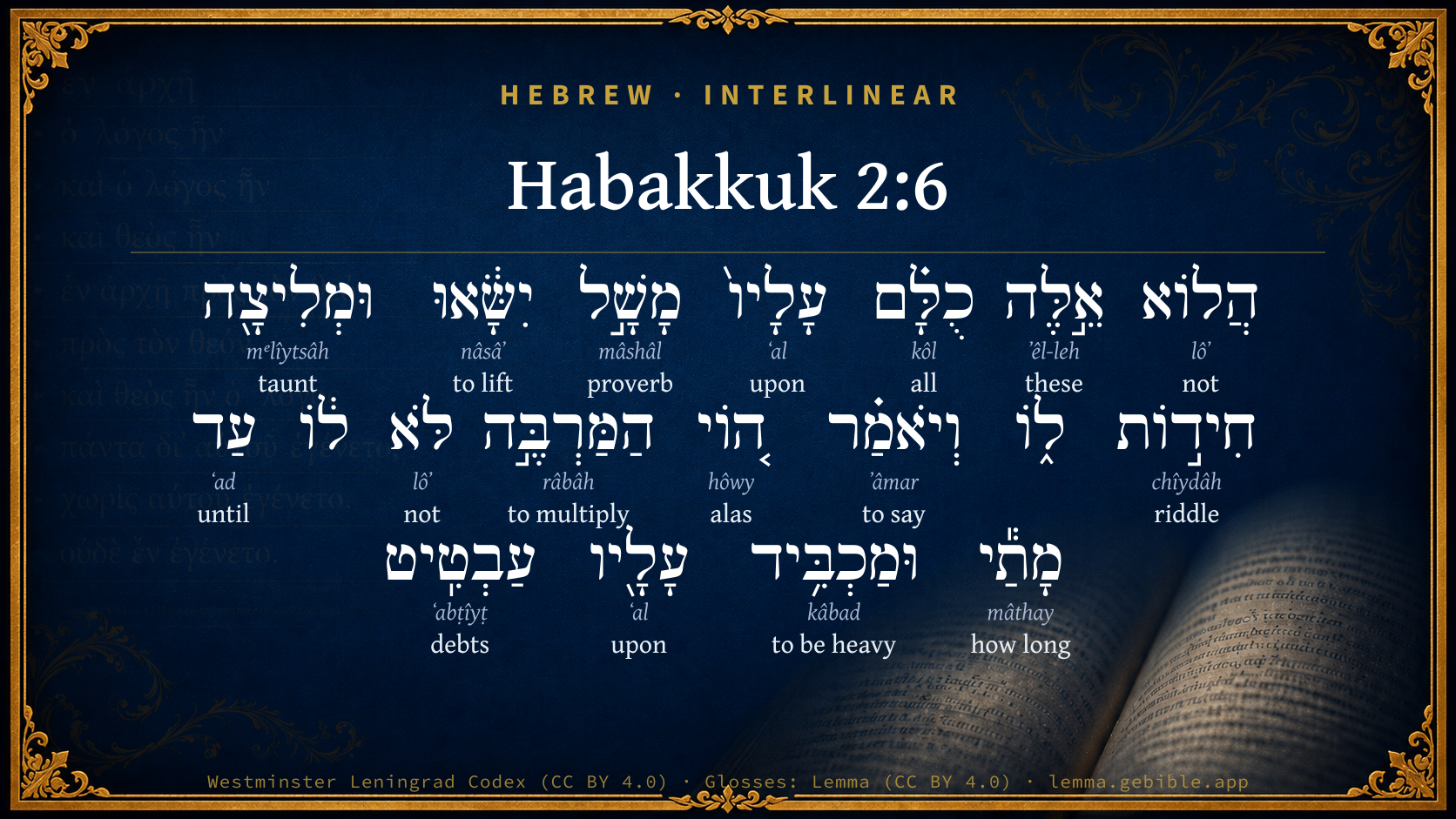
Hebrew (Westminster Leningrad Codex) Habakkuk 2:6 appears in the Hebrew Old Testament. The text above is from the Westminster Leningrad Codex. Each word links to its Strong’s number, a concise gloss, and parsing drawn from the Open Scriptures Hebrew Bible morphology. Click any word for its full Brown-Driver-Briggs (BDB) entry.
Download image
Cite this verse

Habakkuk 2:6 (World English Bible). Public Domain. Lemma interlinear Bible study tool, https://lemma.gebible.app/v/habakkuk/2/6.

Show BibTeX & RIS
BibTeX
RIS
English Translation
Won't all these take up a parable against him, and a taunting proverb against him, and say, 'Woe to him who increases that which is not his, and who enriches himself by extortion! How long?'
World English Bible · Public Domain
Highlights
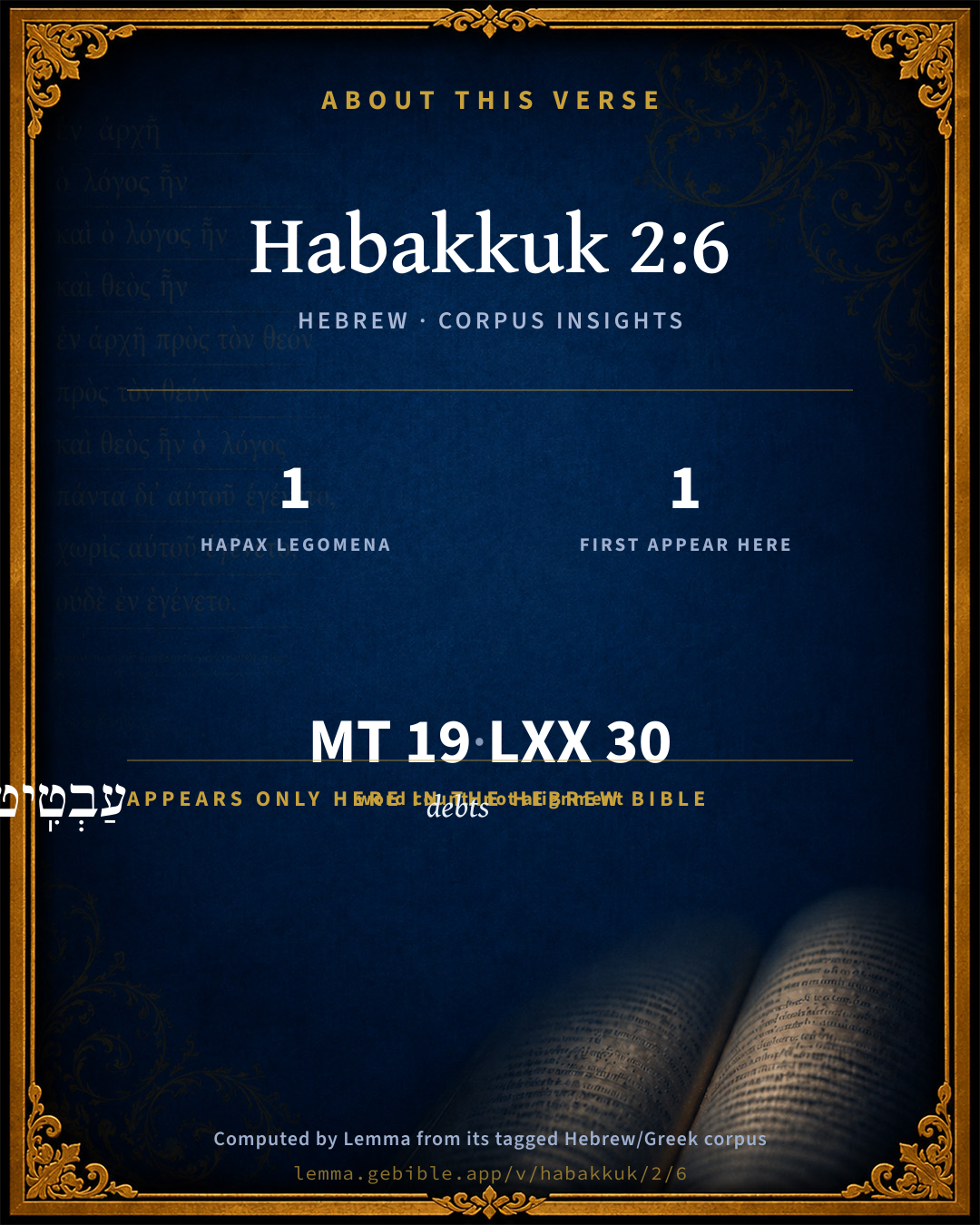
  • 1 hapax legomenon — only here in the Hebrew Bible
  • 1 first appearance in the Hebrew Bible
Full analysis ↓
Download a study sheet

One document with this verse’s original text, its word-by-word gloss line, the meaning frame, cross-references with their text, attributed commentary, and full source and license credits — printable, and it pastes into notes with its structure intact.

This verse Autodidact and up

Study sheet (.html) Plain text (.txt)

A passage Seminary Student

Up to 50 verses in one chapter. A passage sheet keeps up to 6 commentary sources and 12 cross-references per verse, in the order this page ranks them, and says so on the sheet whenever that leaves anything out. Ask for a single verse and you get the Autodidact verse sheet above.

Everything on this page stays free to read, with no account — the sheet is a download of what is already on screen, not access to it.

Want to remove ads? Support Godless Engineer
Compare translations 3

The same verse in 3 English versions, stacked beneath the original-language interlinear above. Click any original word for its lexicon entry.

Each is an independent rendering of the whole verse — the interlinear is not word-aligned to these translations.

Highlighted words mark where these versions differ — a whole-verse word diff, not a word-by-word alignment.

  • World English Bible Public Domain
    Won't all these take up a parable against him, and a taunting proverb against him, and say, 'Woe to him who increases that which is not his, and who enriches himself by extortion! How long?'
  • King James Version Public Domain
    Shall not all these take up a parable against him, and a taunting proverb against him, and say, Woe to him that increaseth that which is not his! how long? and to him that ladeth himself with thick clay!
  • unfoldingWord Literal Text CC BY-SA 4.0
    Will not these, all of them, take up a proverb against him, and ridicule, a riddle about him, so that it says, ‘Woe to the one increasing not his’—until when? ‘and loading onto himself pledges’!

unfoldingWord Literal Text — © unfoldingWord, licensed CC BY-SA 4.0. Word-aligned USFM3 via Door43 (git.door43.org/unfoldingWord/en_ult).

Versions to compare (up to 4)

3 of 4 selected

Show all 18 translations

Every available English version of this verse, each an independent rendering of the whole verse.

  • World English Bible Public Domain
    Won't all these take up a parable against him, and a taunting proverb against him, and say, 'Woe to him who increases that which is not his, and who enriches himself by extortion! How long?'
  • Berean Standard Bible Public Domain
    Will not all of these take up a taunt against him, speaking with mockery and derision: ‘Woe to him who amasses what is not his and makes himself rich with many loans! How long will this go on?’
  • Majority Standard Bible Public Domain
    Will not all of these take up a taunt against him, speaking with mockery and derision: ‘Woe to him who amasses what is not his and makes himself rich with many loans! How long will this go on?’
  • King James Version Public Domain
    Shall not all these take up a parable against him, and a taunting proverb against him, and say, Woe to him that increaseth that which is not his! how long? and to him that ladeth himself with thick clay!
  • American Standard Version (1901) Public Domain
    Shall not all these take up a parable against him, and a taunting proverb against him, and say, Woe to him that increaseth that which is not his! how long? and that ladeth himself with pledges!
  • Revised Version (1885) Public Domain
    Shall not all these take up a parable against him, and a taunting proverb against him, and say, Woe to him that increaseth that which is not his! how long? and that ladeth himself with pledges!
  • Geneva Bible (1599) Public Domain
    Shall not all these take vp a parable against him, and a tanting prouerbe against him, and say, Ho, he that increaseth that which is not his? howe long? and hee that ladeth himselfe with thicke clay?
  • Douay-Rheims (1899) Public Domain
    Shall not all these take up a parable against him, and a dark speech concerning him: and it shall be said: Woe to him that heapeth together that which is not his own? how long also doth he load himself with thick clay?
  • Young's Literal Translation Public Domain
    Do not these -- all of them -- against him a simile taken up, And a moral of acute sayings for him, And say, Wo `to' him who is multiplying `what is' not his? Till when also is he multiplying to himself heavy pledges?
  • Literal Standard Version CC BY-SA 4.0
    Are these not—all of them—an allegory taken up against him, || And a moral of acute sayings for him, || And say, Woe [to] him who is multiplying [what is] not his? Until when also is he multiplying to himself heavy pledges?
  • Unlocked Literal Bible CC BY-SA 4.0
    Will not all these create a saying to ridicule him and a taunting song about him, saying, 'Woe to the one increasing what is not his! For how long will you increase the weight of the pledges you have taken?'
  • unfoldingWord Literal Text CC BY-SA 4.0
    Will not these, all of them, take up a proverb against him, and ridicule, a riddle about him, so that it says, ‘Woe to the one increasing not his’—until when? ‘and loading onto himself pledges’!
  • Darby Bible Public Domain
    Shall not all these take up a proverb about him, and a taunting riddle against him, and say, Woe to him that increaseth that which is not his! how long? -- and to him that loadeth himself with pledges!
  • World Messianic Bible Public Domain
    Won’t all these take up a parable against him, and a taunting proverb against him, and say, ‘Woe to him who increases that which is not his, and who enriches himself by extortion! How long?’
  • Webster's Bible Public Domain
    Shall not all these take up a parable against him, and a taunting proverb against him, and say, Woe to him that increaseth that which is not his! how long? and to him that ladeth himself with thick clay!
  • Free Bible Version CC BY-SA 4.0
    Won't all these peoples taunt them? They will ridicule them, saying, “What disaster is coming to you who pile up things that don't belong to you! You make yourselves rich by forcing debtors to pay! How long can you go on doing this?”
  • Bible in Basic English Public Domain
    Will not all these take up a word of shame against him and a bitter saying against him, and say, A curse on him who goes on taking what is not his and is weighted down with the property of debtors!
  • JPS Tanakh (1917) Public Domain
    Shall not all these take up a parable against him, and a taunting riddle against him, and say: 'Woe to him that increaseth that which is not his! how long? and that ladeth himself with many pledges!'

Literal Standard Version (2020), Covenant Press — licensed CC BY-SA 4.0. Text via the HelloAO Bible API (eBible.org). Unlocked Literal Bible (unfoldingWord) — licensed CC BY-SA 4.0. Text via the HelloAO Bible API (eBible.org). unfoldingWord Literal Text — © unfoldingWord, licensed CC BY-SA 4.0. Word-aligned USFM3 via Door43 (git.door43.org/unfoldingWord/en_ult). Free Bible Version, Dr. Jonathan Gallagher — licensed CC BY-SA 4.0. Text via the HelloAO Bible API (eBible.org).

Word by word

More ways to search: Search by grammar → Find every occurrence → Compare this word →

Practice this passage: Drill this verse → Learn its vocabulary →

עַבְטִֽיט
ʻabṭîyṭ
H5671
“debts”
Noun, Common, Masculine, Singular, Absolute
Part of Speech
Noun
Type
Common
Gender
Masculine
Number
Singular
State
Absolute
Full BDB Definition

Origin: from H5670

TWOT: 1555b

weight of pledges, heavy debts
  1. הֲלוֹא lôʼ H3808 “not” Particle, Interrogative + Particle, Negative
  2. אֵ֣לֶּה ʼêl-leh H428 “these” Pronoun, Demonstrative, Common, Plural
  3. כֻלָּ֗ם kôl H3605 “all · their” Noun, Common, Masculine, Singular, Construct + Suffix, Personal, 3rd Person, Masculine, Plural
  4. עָלָיו֙ ʻal H5921 “upon · him” Preposition + Suffix, Personal, 3rd Person, Masculine, Singular
  5. מָשָׁ֣ל mâshâl H4912 “proverb” Noun, Common, Masculine, Singular, Absolute
  6. יִשָּׂ֔אוּ nâsâʼ H5375 “to lift” Verb, Qal, Imperfect, 3rd Person, Masculine, Plural
  7. וּמְלִיצָ֖ה mᵉlîytsâh H4426 “and · taunt” Conjunction + Noun, Common, Feminine, Singular, Absolute
  8. חִיד֣וֹת chîydâh H2420 “riddles” Noun, Common, Feminine, Plural, Absolute
  9. וְיֹאמַ֗ר ʼâmar H559 “and · to say” Conjunction + Verb, Qal, Imperfect, 3rd Person, Masculine, Singular
  10. ה֚וֹי hôwy H1945 “alas” Particle, Interjection
  11. הַמַּרְבֶּ֣ה râbâh H7235 “the · multiplying” Particle, Definite Article + Verb, Hiphil, Participle Active, Masculine, Singular, Absolute
  12. לֹּא lôʼ H3808 “not” Particle, Negative
  13. עַד ʻad H5704 “until” Preposition
  14. מָתַ֕י mâthay H4970 “how long” Particle, Interrogative
  15. וּמַכְבִּ֥יד kâbad H3513 “and · being heavy” Conjunction + Verb, Hiphil, Participle Active, Masculine, Singular, Absolute
  16. עָלָ֖יו ʻal H5921 “upon · him” Preposition + Suffix, Personal, 3rd Person, Masculine, Singular

About this verse

These counts appear in no published source. They are computed here, from the morphology-tagged text and Lemma’s own curated glosses. What Lemma adds →

19
words
15
distinct lemmas
Prophets
section

Notable vocabulary

1 hapax legomenon — a word that appears only here in the entire Hebrew Bible:

  • עַבְטִֽיט debts H5671

First appearance in Scripture

This word makes its first canonical appearance in the Hebrew Bible here:

  • עַבְטִֽיט debts H5671

Shared distinctive vocabulary

וּמְלִיצָ֖ה taunt H4426 occurs in 2 verses of the Hebrew Bible. Also found in:

Grammatical profile

  • 4 verbs
  • 5 nouns
  • 1 pronoun
  • 5 prepositions
  • 4 particles

Verb forms

  • יִשָּׂ֔אוּ Qal · Imperfect
  • וְיֹאמַ֗ר Qal · Imperfect
  • הַמַּרְבֶּ֣ה Hiphil · Participle Active
  • וּמַכְבִּ֥יד Hiphil · Participle Active

Repetition

Words recur within this verse — often emphatic in Hebrew:

  • עָלָיו֙ upon H5921 ×2
  • הֲלוֹא not H3808 ×2

Hebrew & Septuagint length

In English translation the verse runs 35 words from the Hebrew and 42 from the Septuagint (LXX English) — closely comparable.

A rough comparison of the two English renderings, which tokenize alike — not a word-level alignment.

Word counts can differ between the Hebrew and the Greek without any difference in meaning — e.g. the Hebrew direct-object marker אֵת has no separate Greek word, and Greek often adds the article ὁ.

In the original languages it is 19 Hebrew tokens and 30 Greek tokens — but the two are counted differently (Hebrew bundles its prefixes and suffixes into one token; the Greek is in lemma form), so that isn’t a like-for-like length.

Cross-references

21

Topical passages linked to Habakkuk 2:6 in the Treasury of Scripture Knowledge — connected by theme and wording, ordered by reader-vote popularity; previews shown in the World English Bible.

  • Numbers 23:7 He took up his parable, and said, From Aram has Balak brought me, The king of Moab from the mountains of the East: Come, curse me Jacob, Come, defy Israel.
  • Job 20:15–29 He has swallowed down riches, and he shall vomit them up again. God will cast them out of his belly.
  • Isaiah 14:4–19 that you shall take up this parable against the king of Babylon, and say, How has the oppressor ceased! the golden city ceased!
  • Jeremiah 29:22 and of them shall be taken up a curse by all the captives of Judah who are in Babylon, saying, Yahweh make you like Zedekiah and like Ahab, whom the king of Babylon roasted in the fire;
  • Jeremiah 50:13 Because of the wrath of Yahweh she shall not be inhabited, but she shall be wholly desolate: everyone who goes by Babylon shall be astonished, and hiss at all her plagues.
  • Micah 2:4 In that day they will take up a parable against you, And lament with a doleful lamentation, saying, 'We are utterly ruined! My people's possession is divided up. Indeed he takes it from me and assigns our fields to traitors!'"
  • Numbers 23:18 He took up his parable, and said, Rise up, Balak, and hear; Listen to me, you son of Zippor:
  • Job 22:6–10 For you have taken pledges from your brother for nothing, And stripped the naked of their clothing.
  • Psalms 94:3 Yahweh, how long will the wicked, How long will the wicked triumph?
  • Proverbs 22:16 Whoever oppresses the poor for his own increase and whoever gives to the rich, Both come to poverty.
  • Isaiah 44:20 He feeds on ashes; a deceived heart has turned him aside; and he can't deliver his soul, nor say, Is there not a lie in my right hand?
  • Isaiah 55:2 Why do you spend money for that which is not bread? and your labor for that which doesn't satisfy? listen diligently to me, and eat you that which is good, and let your soul delight itself in fatness.
  • Jeremiah 51:34–35 Nebuchadrezzar the king of Babylon has devoured me, he has crushed me, he has made me an empty vessel, he has, like a monster, swallowed me up, he has filled his maw with my delicacies; he has cast me out.
  • Ezekiel 32:21 The strong among the mighty shall speak to him out of the midst of Sheol with those who help him: they are gone down, they lie still, even the uncircumcised, slain by the sword.
  • Habakkuk 1:9–10 All of them come for violence. Their hordes face the desert. He gathers prisoners like sand.
  • Habakkuk 1:15 He takes up all of them with the hook. He catches them in his net, and gathers them in his dragnet. Therefore he rejoices and is glad.
  • Habakkuk 2:13 Behold, isn't it of Yahweh of Hosts that the peoples labor for the fire, and the nations weary themselves for vanity?
  • Luke 12:20 "But God said to him, 'You foolish one, tonight your soul is required of you. The things which you have prepared--whose will they be?'
  • 1 Corinthians 7:29–31 But I say this, brothers: the time is short, that from now on, both those who have wives may be as though they had none;
  • James 5:1–4 Come now, you rich, weep and howl for your miseries that are coming on you.
  • 1 Peter 4:7 But the end of all things is near. Therefore be of sound mind, self-controlled, and sober in prayer.

Cross-references courtesy of OpenBible.info (CC BY 4.0).

Hebrew and Greek witnesses Masoretic Hebrew ↔ Greek Septuagint

The same verse in the two great witnesses to the Old Testament, shown verse-for-verse.

These are two independent witnesses, not word-aligned to each other, and the Septuagint is shown in lemma (dictionary) form.

Hebrew Habakkuk 2:6 Masoretic · Westminster Leningrad Codex

הֲלוֹא אֵ֣לֶּה כֻלָּ֗ם עָלָיו֙ מָשָׁ֣ל יִשָּׂ֔אוּ וּמְלִיצָ֖ה חִיד֣וֹת ל֑וֹ וְיֹאמַ֗ר ה֚וֹי הַמַּרְבֶּ֣ה לֹּא ל֔וֹ עַד מָתַ֕י וּמַכְבִּ֥יד עָלָ֖יו עַבְטִֽיט

Won't all these take up a parable against him, and a taunting proverb against him, and say, 'Woe to him who increases that which is not his, and who enriches himself by extortion! How long?'

World English Bible · Public Domain

Greek LXX Habakkuk 2:6 Septuagint · lemma form

οὐ οὗτος πᾶς παραβολή κατά αὐτός λαμβάνω καί πρόβλημα εἰς διήγησις αὐτός καί εἶπον οὐαί ὁ πληθύνω ἑαυτοῦ ὁ οὐ εἰμί αὐτός ἕως τίς καί βαρύνω ὁ κλοιός αὐτός στιβαρῶς

Shall not all these take up a parable against him? and a proverb to tell against him? and they shall say, Woe to him that multiplies to himself the possessions which are not his! how long? and who heavily loads his yoke.

LXX2012 (modern English Septuagint) · Public Domain

On this verse, Keil & Delitzsch discusses the Septuagint’s reading. Read the note in Commentary ↓

Hebrew: Westminster Leningrad Codex (CC BY 4.0). Greek: Septuagint (public domain); English from LXX2012 (modern English Septuagint) (Public Domain). How the Septuagint differs from the Hebrew →

Targum (Aramaic paraphrase)

1

The Targum is the ancient Jewish Aramaic paraphrase of the Hebrew Scriptures — an interpretive translation, not the Hebrew text itself. Onkelos (literal) and Pseudo-Jonathan (expansive) render the Torah, and Jonathan the Prophets. Coverage is partial: where no permissively-licensed English translation exists for a verse, only the Aramaic is shown. This is verse-level text, not a word-by-word alignment to the Hebrew.

  1. Targum Jonathan Prophets (Joshua–Malachi)
    הֲלָא אִלֵין כּוּלְהוֹן עֲלוֹהִי מַתְלָן יִטְלוֹן וְשׁוּעֵי חוּדִין יֵימְרוּן לֵיהּ וְיֵימַר וַי דְמַסְגֵי נִכְסִין דְלָא דִילֵיהּ עַד אֵימָתַי אַתְּ מַתְקַף עֲלָךְ תְּקוֹף חוֹבִין:

    (no public-domain English translation for this verse)

    Targum Jonathan — Aramaic: “Mikraot Gedolot” (public domain). English: “Sefaria Community Translation” (CC0 1.0 (public-domain dedication)); “London "Chaldee Paraphrase," 1871” (public domain). Text via Sefaria.

Commentary

Notes on Habakkuk 2:6 from classic Christian and Jewish commentators (each source and its license shown beneath its notes). The classic Christian expositions comment on the surrounding passage and are grouped to its opening verse, so a note may address several verses; the Jewish commentaries on the Tanakh (Rashi and others) are per-verse, so they appear only where the commentator wrote on this verse.

Lemma curates 59 commentaries, every one of them public domain or Creative Commons licensed, each selected and text-cleaned for this edition rather than reprinted as found. About our sources →

The Cambridge Bible for Schools and Colleges

gen. ed. J. J. S. Perowne

6–8. First woe: the Chaldean lust of conquest

6. Shall not all these] i.e. all the nations whom he has drawn into his net, and heaped together as his own possession.

take up a parable] The word may mean originally a saying containing a comparison or similitude; in a wider sense, a figurative speech or song. For the phrase “take up a parable” cf. Num_23:7; Num_23:18; Job_27:1.

taunting proverb against him] Or, in regard to him. Taunting proverb is lit. an enigma, riddles, Pro_1:6; Psa_49:4; Dan_8:23. Both words suggest a song or poem with concealed taunting allusions.

increaseth that which is not his] The reference is to his insatiable lust of conquest and robbery of the nations.

that ladeth himself with thick clay] and that ladeth himself with pledges. That which he compels the nations to give him or takes from them by force is compared to pledges which he heaps up upon himself. The day will come when their restitution shall be exacted of him. Job_20:10; Job_20:15; Job_20:20. The rendering “thick clay” is obtained by taking the word “pledges” as a compound; cf. Exo_19:9, thick cloud.

6–20. Five woes pronounced against the Chaldean From the mouth of the nations whom he has desolated

Hab_2:5 does not belong to the vision Hab_2:4, but forms the transition to the taunting proverb taken up against the Chaldean by the nations. This proverb is in the form of a prophecy in which woes are pronounced on the lust of conquest, rapacity, selfish pride and idolatry of the people, and their ruin is predicted, for their vices carry in them their own recompense. The woes are five in number, beginning with Hab_2:6; Hab_2:9; Hab_2:12; Hab_2:15; Hab_2:18. Though the nations take up the woes, as the passage proceeds the prophet himself appears to speak.

The Cambridge Bible for Schools and Colleges (gen. ed. J. J. S. Perowne; Cambridge University Press, 1878–1918) — public domain. Text from a community e-Sword module.

Trapp's Complete Commentary

John Trapp

Hab 2:6 Shall not all these take up a parable against him, and a taunting proverb against him, and say, Woe to him that increaseth [that which is] not his! how long? and to him that ladeth himself with thick clay!

Ver. 6. Shall not all these take up a parable against him?] Shall not the Babylonian, who is now a terror, be ere long a scorn? shall he not inherit with ignominy, reproach?

And a taunting proverb against him] Heb. An interpretation, and riddles. For example, Woe to him that increaseth that which is not his, that is both a proverb (because in many men’s mouths) and an interpretation, because it is plain and perspicuous. But that which followeth is a riddle. "That ladeth himself with thick clay!" This nut must be broken up ere the kernel can be come at. See Jdg 7:15.

Woe to him that increaseth that which is not his!] Heb. Lo, lo. Some render it he, he that multiplieth not for himself but for another, sc. for the Medes and Persians, not woe, but he, a note of insulting and upbraiding, answerable to the Latin Vah, Vah, tunc ille es, &c. Ah sirrah, are you he that increaseth that which is not yours, &c. Eugo, ευρι θεος τον αλιτρον.

How long?] This is the common complaint of the oppressed nations, groaning out their grievances, and longing for deliverance from those troublers of the world. Neither is this usque quo in vain; for God is gracious, and may better style himself, than the Great Turk, Awlem Penawh, that is, The world’s refuge: the poor man’s king, as James IV of Scotland was called.

And to him that ladeth himself with thick clay!] With gold and silver, that guts and garbage of the earth, fitly called clay, because of the clogging and polluting property, and said to load people as a sumpter horse laden with treasure all day, but at night turned into a stinking stable, with his back full of galls and bruises. He that first called riches bona, goods, was mistaken; the Scripture calleth them thorns, snares, thick clay, &c., a great burden to the owner, according to the proverb, Magna navis, magna cura, a great ship is a great care, and the lading oft proves no better than that which Captain Frobisher brought back with him after his voyage to discover the Straits, viz. a great quantity of stones, which he thought to be minerals, from which, when there could be drawn neither gold nor silver, nor any other metal, they were cast forth to repair the highways. This was labour in vain, pressure to no purpose; and no less is theirs that heap up riches without right, Jer 17:11, or, if by right means, yet set their hearts upon them, Psa 62:10, still striving (as they say the toad doth) to die with as much earth in their mouths as may be, till at length their never enough be requited with fire enough in the bottom of hell. Nenessan the lawyer was wont to say, He that will not venture his body shall never be valiant, he that will not venture his soul never rich. O curvae in terras animae, et coelestium inanes. Is it nothing to lose an immortal soul? to purchase an everlasting death? to sink into the bottomless lake under this thick clay?

John Trapp, A Commentary or Exposition upon All the Books of the Old and New Testament (1647–1656) — public domain. Text from a community e-Sword module.

The Biblical Illustrator

Joseph S. Exell

Hab_2:6

Him that ladeth himself with thick clay.

Heavy clay

It is the glory of the religion of the Lord Jesus Christ when it is regarded in its moral aspect, that it is not the religion merely of transcendental and unpractical truths, but that its motives and precepts go down to the minutest details of everyday duty. Note--

1. The danger of a false start and a false aim in life. God has given us a complex nature, and He has given us the use of our reason and the other faculties, physical and mental, which He bestows upon men. And the great end of man is to glorify God. If a man uses his powers only to found a family or amass wealth, we earnestly warn that man. He has mistaken the great end of his being.

2. A form in which the lading of thick clay is found is greed of money. Covetousness in some one or other of its forms or specious disguises is one of the besetting idolatries of the day. This greed of money manifests itself in money-getting and in money-losing, and also in money-spending. Comparatively few recognise the principle of stewardship to God in the expenditure of their income.

3. Another form in which this heavy clay is sometimes found is anxiety. What our Lord and His apostles tell us to avoid is the carking, distracting care which turns a mans mind away from God, and keeps him continually on the rack, forgetting the loving Father who is willing to be the bearer of all his cares.

4. Another form of this clay among business men is sharp practice. Sharp practice is in our manufactories, upon the exchange, with lawyers, and not only among the little petty hucksters, but among tradesmen who make a much fairer show in our streets.

5. Another form is a worldly tone and spirit. To be a Christian, there is no necessity to leave your work and to lead the life of a recluse. Go into the world and make your money, but do not worship it. (Canon Miller, D. D.)

Under a heap of clay

The avaricious accumulate on themselves thick clay. Hardly, indeed, an avaricious man can be found who is not a burden to himself, and to whom his wealth is not a source of trouble. Everyone who has accumulated much, when he comes to old age, is afraid to use what he has got, being ever solicitous lest he should lose anything; and then, as he thinks nothing is sufficient, the more he possesses the more grasping he becomes, and frugality is the name given to that sordid and, so to speak, that servile restraint within which the rich confine themselves. In short, when any one forms a judgment of all the avaricious of this world, and is himself free from all avarice, having a free and unbiassed mind, he will easily apprehend what the prophet says here,--that all the wealth of this world is nothing else but a heap of clay, as when any one puts himself of his own accord under a great heap which he had collected together. The general truth to be drawn from the expression is, that all the avaricious, the more they heap together, the more they lade themselves, and as it were, bury themselves under a great load. Riches acquired by frauds and plunders are nothing else than a heavy and cumbrous lump of earth; for God returns on the heads of those who thus seek to enrich themselves whatever they have plundered from others. Had they been contented with some moderate portion, they might have lived cheerfully and happily, as we see to be the case with all the godly, who, though they possess but little, are yet cheerful; for they live in hope, and know that their supplies are in Gods hands, and expect everything from His blessing. (John Calvin.)

Making money

Whatever we do to please ourselves, and only for the sake of the pleasure, not for an ultimate object, is play, the pleasing thing, not the useful thing The first of all Enish games is making money. That is an all-absorbing game; and we knock each other down oftener in playing at that than at football or any other rougher sport; and it is absolutely without purpose. No one who engages heavily in that game ever knows why. Ask a great money-maker what he wants to do with his money; he never knows. He doesnt make it to do anything with it. He gets it only that he may get it. What will you make of what you have got? you ask. Well, Ill get more, he says. Just as at cricket you get more runs. Theres no use in the runs, but to get more of them than other people is the game. And theres no use in the money, but to have more of it than other people is the game. (John Ruskin.)

The Biblical Illustrator, edited by Joseph S. Exell (c. 1880s–1900s) — public domain. Text from a community e-Sword module.

Joseph Benson's Commentary

Hab 2:6. Shall not these take up a parable against (or, concerning) him, and a taunting proverb — A parable, or proverb, signifies a metaphorical or figurative saying, out of the common way. And say, Wo to him that increaseth, &c. — Wo to him that is still increasing his own dominions, by invading those of his neighbours. How long? — Namely, will he be permitted to do this? Surely he will not be suffered to continue to act thus, without some remarkable check from Providence: and so what he thus increases will not be his, or for himself, (for so the words in the former part of the sentence may be translated,) but for the Medes and Persians, who shall conquer him, and enrich themselves with his spoils: see the following verse. And to him that ladeth himself with thick clay — Gold and silver, so called, being nothing originally but earth, or clay, and what should not turn to his benefit, but rather be his burden; adding weight to his sins and punishment.

Joseph Benson's Commentary on the Old and New Testaments (1811–1818) — public domain. Text from a community e-Sword module.

Whedon's Commentary on the Bible

Daniel D. Whedon

TAUNT-SONG OVER THE FALL OF THE CHALDEANS, Hab_2:6-20.

In Hab_2:6-20, the prophet introduces the nations that are now suffering from the oppressions of the Chaldeans as taking up a parable or song against the oppressor about to be crushed. The song is in the form of five woes upon (1) lust of conquest and plunder; (2) rapacity; (3) self-glorification; (4) oppression; (5) idolatry. These woes are placed in the mouth of the nations; in reality the prophet is the speaker.

First woe — upon lust of conquest and plunder, Hab_2:6-8.

Hab_2:6 a introduces the oppressed who will pronounce the woes. The utterances begin with “woe” in 6b. Throughout the song the Chaldean power is personified as an individual (see Introduction, p. 472). The nations will not submit forever.

All these — All the wronged nations.

Against him — The Chaldean oppressor.

Parable — The primary meaning of the Hebrew word seems to be “likeness” or “identity”; hence it came to be applied to any saying containing a comparison or similitude. In a more general sense it is used of any figurative speech or song — in some places of a taunt-song (Isa_14:4); so here.

Taunting proverb — Literally, a dark saying; margin, “riddle”; here practically synonymous with the preceding, a taunt-song. The thought is that the nations will make the Chaldeans, as examples of fallen greatness and pride, objects of taunting proverbs and comparisons, such as are found in Hab_2:6-20.

Woe — With this word begins the first “parable.” Each of the five is directed against a specific crime, the first against lust of conquest and plunder.

Increaseth that which is not his — He seizes the lands and possessions of other nations (compare Hab_1:6; Hab_1:9; Hab_1:15).

How long? — “A sigh appended to the woe.” How long will he be permitted to carry out this policy?

Ladeth himself with thick clay — This is a possible translation, but the context favors the reading of R.V., “with pledges.” The wealth accumulated by the Chaldeans is represented as a mass of pledges which they have taken from the nations like merciless usurers. But the time will come when the plundered nations will rise in wrath and compel the Chaldeans to return these pledges to their proper owners. In this connection it may be interesting to compare the boast of Nebuchadnezzar: “I have amassed silver, gold, metals, precious stones of all kinds and of all values, a collection of objects of great price, immense treasures.”

Daniel D. Whedon (gen. ed.), Commentary on the Old and New Testaments (1874–1909) — public domain. Text from a community e-Sword module.

The Preacher's Complete Homiletical Commentary

Joseph S. Exell (gen. ed.)

CRITICAL NOTES.]

Hab_2:6. These] “nations” and “people” (Hab_2:4). Parable] A derisive song (Isa_14:4; Mic_2:4), some; ode, given by others, enigmatical in character. Woes] fivefold given, a song raised by the oppressed over the fall of the oppressor. First woe, ill-gotten gains. Increaseth] i.e. seizes what does not belong to him. How long] will he do this with impunity? Ladeth] To make heavy by a weight or load upon one. Thick clay] (mass of dirt) Lit. a cloud of clay, which will cause her ruin. Many render “a burden of pledges gained by usury,” taken by an unmerciful usurer, which he will be compelled to give up (Deu_24:10).

Hab_2:7. Shall] Answer to question, How long? Bite] of a snake; the enemy like savage vipers (Jer_8:17). Rise] Shake or rouse up from possession.

Hab_2:8. Because] Reason for woe. Many] Boundless the spoil. Remnant] Only a remnant left, will be sufficient to punish. “Blood, land, and city] Understood generally, and not restricted to the Jews with their country and its metropolis” [Hend.].

THE SIN OF THE AVARICIOUS.—Hab_2:6-8

The first woe is pronounced, and the sentence passed, upon avaricious men in these words. The fundamental thought is like that expressed concerning the Chaldæan, in Isa_14:12-14. Ambition manifests itself in cruelty, and proud edifices built upon the ruins of others.

I. Avaricious men increase their guilt. The covetous and those who thrive unlawfully in the world are under woe. They multiply their sins and their judgments. They break God’s commands, and add injustice to their apostasy (1Ti_6:10). “Great abundance of riches cannot of any man,” says Erasmus, “be both gathered and kept without sin.” “A faithful man shall abound with blessings; but he that maketh haste to be rich shall not be innocent.”

II. Avaricious men increase their enemies. “Shall they not rise up suddenly that shall bite thee?” &c. God will not long permit their conduct to prosper. Enemies will suddenly rise up to disturb their rest. When they are most secure and least prepared nations will retaliate; “the remnant of the people,” whom they have despised, or whom God has hid from their fury, will rise against them. Those whom they have oppressed shall taunt them. Nations and “many nations” will destroy them. Covetous and ambitious men turn God and their fellow-creatures into their enemies. “For many nations and great kings shall serve themselves of them also, and I will recompense them according to their deeds, and according to the works of their own hands.”

III. Avaricious men increase their dangers. Men haste to be rich and rush into danger.

1. They heap up booty for others. “Thou shalt be for booties unto them.” Notwithstanding their labour and strength, the enemy will easily overcome them. Their wealth gotten by vanity will be diminished. Men collect and foster what they cannot keep. They brood over ill-gotten gains which forsake and disappoint them. “As the partridge sitteth on eggs, and hatcheth them not; so he that getteth riches, and not by right, shall leave them in the midst of his days, and at his end shall be a fool.”

2. They insure fearful retribution. As they had spoiled others, they would be spoiled themselves. “Refrain from covetousness,” says Plato, “and thy estate shall prosper.” Innocent blood which they had shed would be avenged upon the land, the city, and the people (Hab_2:8). “When thou shalt cease to spoil, thou shalt be spoiled; and when thou shalt make an end to deal treacherously, they shall deal treacherously with thee.”

HOMILETIC HINTS AND OUTLINES

Hab_2:6.

1. Ambitious men become contemptible to others. They are ignominious, a taunting proverb, a public derision. “Shall not these take up a parable against him?”

2. Ambitious men have no right to the possession of that which they illegally acquire. Unjust conquest brings a curse. “Woe to him that increaseth that which is not his.”

3. Ambitious men will be stripped of all their unjust acquisitions. To what end does the conqueror sweep all nations together. Not for himself, but for others. “Riches do not exhilarate us so much with their possession as they torment us with their loss” [Gregory].

Riches are often—

1. Connected with covetousness.

2. With violence,—oppression, robbery, cruelty.

3. With folly. What is that heaped up?—only “clay.” What results from all toil and vexation?—a burden for themselves; “ladeth himself.” “A bag of gold from a Western steamer was found bound to the neck of the robber, his treasure having sunk him” [Van Doren]. “A great fortune is a great slavery” [Seneca].

Hab_2:8. People shall spoil thee. Avaricious men are spoiled:

1. In their friends; who fall away, taunt, and help to strip them.

2. In their dignities; which are tainted by sin and fall into dust.

3. In their reputations; their names are a proverb in the land, and hated by all men.

4. In their posterity; who are cursed by the sins of their fathers, and cut off from the earth. “God loves to retaliate, to spoil the spoilers by a remnant of the people, by such as were of no note, and much unlikely to do such exploits. Thus he spoiled these Babylonians, by Cyrus and his Medes; the Persians, by Alexander and his Macedonians. So the Roman empire was miserably rent and torn by the Goths, Vandals, Huns, Lombards, people not before heard of, and the Greek empire by Turks, Tartars, Saracens, Scythians” [Trapp].

ILLUSTRATIONS TO CHAPTER 2

Hab_2:5-6. Desire. Could you change the solid earth into a single lump of gold, and drop it into the gaping mouth of avarice, it would only be a crumb of transient comfort, a cordial drop, enabling it to cry a little louder, “Give, give” [Royal Preacher].

The Preacher's Complete Homiletical Commentary (gen. ed. Joseph S. Exell; Funk & Wagnalls, c. 1892) — public domain (pre-1929). A full-Bible homiletical/sermon-outline anthology covering 65 of 66 books (2 John is absent from the source module). Text from a community e-Sword module.

Keil & Delitzsch

C. F. Keil & F. Delitzsch

In Hab 2:6-20 the destruction of the Chaldaean, which has been already intimated in Hab 2:4, Hab 2:5, is announced in the form of a song composed of threatening sentences, which utters woes in five strophes consisting of three verses each: (1) upon the rapacity and plundering of the Chaldaean (Hab 2:6-8); (2) upon his attempt to establish his dynasty firmly by means of force and cunning (Hab 2:9-11); (3) upon his wicked ways of building (Hab 2:12-14); (4) upon his base treatment of the subjugated nations (Hab 2:15-17); and (5) upon his idolatry (Hab 2:18-20). These five strophes are connected together, so as to form two larger divisions, by a refrain which closes the first and fourth, as well as by the promise explanatory of the threat in which the third and fifth strophes terminate; of which two divisions the first threatens the judgment of retribution upon the insatiableness of the Chaldaean in three woes (Hab 2:5), and the second in two woes the judgment of retribution upon his pride. Throughout the whole of the threatening prophecy the Chaldaean nation is embraced, as in Hab 2:4, Hab 2:5, in the ideal person of its ruler.

(Note: The unity of the threatening prophecy, which is brought out in the clearest manner in this formal arrangement, has been torn in pieces in the most violent manner by Hitzig, through his assumption that the oracle of God includes no more than Hab 2:4-8, and that a second part is appended to it in Hab 2:9-20, in which the prophet expresses his own thoughts and feelings, first of all concerning king Jehoiakim (Hab 2:9-14), and then concerning the Egyptians (Hab 2:15-20). This hypothesis, of which Maurer observes quite correctly, Qua nulla unquam excogitata est infelicior, rests upon nothing more than the dogmatic assumption, that there is no such thing as prophecy effected by supernatural causality, and therefore Habakkuk cannot have spoken of Nebuchadnezzar's buildings before they were finished, or at any rate in progress. The two strophes in Hab 2:9-14 contain nothing whatever that would not apply most perfectly to the Chaldaean, or that is not covered by what precedes and follows (compare Hab 2:9 with 6b and 8a, and Hab 2:10 with 5b and 8a). "The strophe in Hab 2:9-11 contains the same fundamental thought as that expressed by Isaiah in Isa 14:12-14 respecting the Chaldaean, viz., the description of his pride, which manifests itself in ambitious edifices founded upon the ruins of the prosperity of strangers" (Delitzsch). The resemblance between the contents of this strophe and the woe pronounced upon Jehoiakim by Jeremiah in Jer 12:13-17 may be very simply explained from the fact that Jehoiakim, like the Chaldaean, was a tyrant who occupied himself with the erection of large state buildings and fortifications, whereas the extermination of many nations does not apply in any respect to Jehoiakim. Lastly, there is no plausible ground whatever for referring the last two strophes (Hab 2:15-20) to the Egyptian, for the assertion that Habakkuk could not pass over the Egyptian in silence, unless he meant to confine himself to the Chaldaean, is a pure petitio principii; and to any unprejudiced mind the allusion to the Chaldaean in this verse is placed beyond all possible doubt by Isa 14:8, where the devastation of Lebanon is also attributed to him, just as it is in Hab 2:17 of our prophecy.)

Hab 2:6-8

Introduction of the ode and first strophe. - Hab 2:6. "Will not all these lift up a proverb upon him, and a song, a riddle upon him? And men will say, Woe to him who increases what is not his own! For how long? and who loadeth himself with the burden of pledges. Hab 2:7. Will not thy biters rise up suddenly, and thy destroyers wake up, and thou wilt become booty to them? Hab 2:8. For thou hast plundered many nations, all the rest of the nations will plunder thee, for the blood of men and wickedness on the earth, the city, and all its inhabitants." הלוא is here, as everywhere else, equivalent to a confident assertion. "All these:" this evidently points back to "all nations" and "all people." Nevertheless the nations as such, or in pleno, are not meant, but simply the believers among them, who expect Jehovah to inflict judgment upon the Chaldaeans, and look forward to that judgment for the revelation of the glory of God. For the ode is prophetical in its nature, and is applicable to all times and all nations. Mâshâl is a sententious poem, as in Mic 2:4 and Isa 14:4, not a derisive song, for this subordinate meaning could only be derived from the context, as in Isa 14:4 for example; and there is nothing to suggest it here. So, again, melı̄tsâh neither signifies a satirical song, nor an obscure enigmatical discourse, but, as Delitzsch has shown, from the first of the two primary meanings combined in the verb לוּץ, lucere and lascivire, a brilliant oration, oratio splendida, from which מליץ is used to denote an interpreter, so called, not from the obscurity of the speaking, but from his making the speech clear or intelligible. חידות לו is in apposition to מליצה and משׁל, adding the more precise definition, that the sayings contain enigmas relating to him (the Chaldaean). The enigmatical feature comes out more especially in the double meaning of עבטיט in Hab 2:6, נשׁכיך in Hab 2:7, and קיקלון in Hab 2:16. לאמר serves, like לאמר elsewhere, as a direct introduction to the speech. The first woe applies to the insatiable rapacity of the Chaldaean. המּרבּה לא־לו, who increases what does not belong to him, i.e., who seizes upon a large amount of the possessions of others. עד־מתי, for how long, sc. will he be able to do this with impunity; not "how long has he already done this" (Hitzig), for the words do not express exultation at the termination of the oppression, but are a sign appended to the woe, over the apparently interminable plunderings on the part of the Chaldaean. וּמכבּיד is also dependent upon hōi, since the defined participle which stands at the head of the cry of woe is generally followed by participles undefined, as though the former regulated the whole (cf. Isa 5:20 and Isa 10:1). At the same time, it might be taken as a simple declaration in itself, though still standing under the influence of the hōi; in which case הוּא would have to be supplied in thought, like וחוטא in Hab 2:10. And even in this instance the sentence is not subordinate to the preceding one, as Luther follows Rashi in assuming ("and still only heaps much slime upon himself"); but is co-ordinate, as the parallelism of the clauses and the meaning of עבטיט require. The ἁπ. λεγ. עבטיט is probably chosen on account of the resemblance in sound to מכבּיד, whilst it also covers an enigma or double entendre. Being formed from עבט (to give a pledge) by the repetition of the last radical, עבטיט signifies the mass of pledges (pignorum captorum copia: Ges., Maurer, Delitzsch), not the load of guilt, either in a literal or a tropico-moral sense. The quantity of foreign property which the Chaldaean has accumulated is represented as a heavy mass of pledges, which he has taken from the nations like an unmerciful usurer (Deu 24:10), to point to the fact that he will be compelled to disgorge them in due time. הכבּיד, to make heavy, i.e., to lay a heavy load upon a person. The word עבטיט, however, might form two words so far as the sound is concerned: עב טיט, cloud (i.e., mass) of dirt, which will cause his ruin as soon as it is discharged. This is the sense in which the Syriac has taken the word; and Jerome does the same, observing, considera quam eleganter multiplicatas divitias densum appellaverit lutum, no doubt according to a Jewish tradition, since Kimchi, Rashi, and Ab. Ezra take the word as a composite one, and merely differ as to the explanation of עב. Grammatically considered, this explanation is indeed untenable, since the Hebrew language has formed no appellative nomina composita; but the word is nevertheless enigmatical, because, when heard from the lips, it might be taken as two words, and understood in the sense indicated.

In Hab 2:7 the threatening hōi is still further developed. Will not thy biters arise? נשׁכיך = נשׁכתם אתך, those who bite thee. In the description here given of the enemy as savage vipers (cf. Jer 8:17) there is also an enigmatical double entendre, which Delitzsch has admirably interpreted thus: "המּרבּה," he says, "pointed to תּרבּית (interest). The latter, favoured by the idea of the Chaldaean as an unmerciful usurer, which is concentrated in עבטיט, points to נשׁך, which is frequently connected with תּרבּית, and signifies usurious interest; and this again to the striking epithet נשׁכתם, which is applied to those who have to inflict the divine retribution upon the Chaldaean. The prophet selected this to suggest the thought that there would come upon the Chaldaean those who would demand back with interest (neshek) the capital of which he had unrighteously taken possession, just as he had unmercifully taken the goods of the nations from them by usury and pawn." יקצוּ, from יקץ, they will awake, viz., מזעזעך, those who shake or rouse thee up. זעזע, pilel of זוּע, σείω, is used in Arabic of the wind (to shake the tree); hence, as in this case, it was employed to denote shaking up or scaring away from a possession, as is often done, for example, by a creditor (Hitzig, Delitzsch). משׁסּות is an intensive plural.

So far as this threat applies to the Chaldaeans, it was executed by the Medes and Persians, who destroyed the Chaldaean empire. But the threat has a much more extensive application. This is evident, apart from other proofs, from Hab 2:8 itself, according to which the whole of the remnant of the nations is to inflict the retribution. Gōyı̄m rabbı̄m, "many nations:" this is not to be taken as an antithesis to kol-haggōyı̄m (all nations) in Hab 2:5, since "all nations" are simply many nations, as kol is not to be taken in its absolute sense, but simply in a relative sense, as denoting all the nations that lie within the prophet's horizon, as having entered the arena of history. Through ישׁלּוּך, which is placed at the head of the concluding clause without a copula, the antithesis to שׁלּות is sharply brought out, and the idea of the righteous retaliation distinctly expressed. כּל־יתר עמּים, the whole remnant of the nations, is not all the rest, with the exception of the one Chaldaean, for yether always denotes the remnant which is left after the deduction of a portion; nor does it mean all the rest of the nations, who are spared and not subjugated, in distinction from the plundered and subjugated nations, as Hitzig with many others imagine, and in proof of which he adduces the fact that the overthrow of the Chaldaeans was effected by nations that had not been subdued. But, as Delitzsch has correctly observed, this view makes the prophet contradict not only himself, but the whole of the prophetic view of the world-wide dominion of Nebuchadnezzar. According to Hab 2:5, the Chaldaean has grasped to himself the dominion over all nations, and consequently there cannot be any nations left that he has not plundered. Moreover, the Chaldaean, or Nebuchadnezzar as the head of the Chaldaean kingdom, appears in prophecy (Jer 27:7-8), as he does in history (Dan 2:38; 3:31; Dan 5:19) throughout, as the ruler of the world in the highest sense, who has subjugated all nations and kingdoms round about, and compelled them to serve him. These nations include the Medes and Elamites (= Persians), to whom the future conquest of Babylon is attributed in Isa 13:17; Isa 21:2; Jer 51:11, Jer 51:28. They are both mentioned in Jer 25:25 among the nations, to whom the prophet is to reach the cup of wrath from the hand of Jehovah; and the kingdom of Elam especially is threatened in Jer 49:34. with the destruction of its power, and dispersion to all four winds. In these two prophecies, indeed, Nebuchadnezzar is not expressly mentioned by name as the executor of the judgment of wrath; but in Jeremiah 25 this may plainly be inferred from the context, partly from the fact that, according to Jer 25:9, Judah with its inhabitants, and all nations round about, are to be given into the hand of Nebuchadnezzar, and partly from the fact that in the list of the nations enumerated in Jer 25:18-26 the king of Sesach (i.e., Babel) is mentioned as he who is to drink the cup "after them" (Jer 25:26). The expression 'achărēhem (after them) shows very clearly that the judgment upon the nations previously mentioned, and therefore also upon the kings of Elam and Media, is to occur while the Chaldaean rule continues, i.e., is to be executed by the Chaldaeans. This may, in fact, be inferred, so far as the prophecy respecting Elam in Jer 49:34. is concerned, from the circumstance that Jeremiah's prophecies with regard to foreign nations in Jeremiah 46-51 are merely expansions of the summary announcement in Jer 25:19-26, and is also confirmed by Eze 32:24, inasmuch as Elam is mentioned there immediately after Asshur in the list of kings and nations that have sunk to the lower regions before Egypt. And if even this prophecy has a much wider meaning, like that concerning Elam in Jer 49:34, and the elegy over Egypt, which Ezekiel strikes up, is expanded into a threatening prophecy concerning the heathen generally (see Kliefoth, Ezech. p. 303), this further reference presupposes the historical fulfilment which the threatening words of prophecy have received through the judgment inflicted by the Chaldaeans upon all the nations mentioned, and has in this its real foundation and soil.

History also harmonizes with this prophetic announcement. The arguments adduced by Hvernick (Daniel, p. 547ff.) to prove that Nebuchadnezzar did not extend his conquests to Elam, and neither subdued this province nor Media, are not conclusive. The fact that after the fall of Nineveh the conquerors, Nabopolassar of Babylonia, and Cyaxares the king of Media, divided the fallen Assyrian kingdom between them, the former receiving the western provinces, and the latter the eastern, does not preclude the possibility of Nebuchadnezzar, the founder of the Chaldaean empire, having made war upon the Median kingdom, and brought it into subjection. There is no historical testimony, however, to the further assertion, that Nebuchadnezzar was only concerned to extend his kingdom towards the west, that his conquests were all of them in the lands situated there, and gave him so much to do that he could not possibly think of extending his eastern frontier. It is true that the opposite of this cannot be inferred from Strabo, xvi. 1, 18;

(Note: This passage is quoted by Hitzig (Ezech. p. 251) as a proof that Elam made war upon the Babylonians, and, indeed, judging from Jer 49:34, an unsuccessful war. But Strabo speaks of a war between the Elymaeans (Elamites) and the Babylonians and Susians, which M. v. Niebuhr (p. 210) very properly assigns to the period of the alliance between Media (as possessor of Susa) and Babylon.)

but it may be inferred, as M. v. Niebuhr (Gesch. Assurs, pp. 211-12) has said, from the fact that according to Jeremiah 27 and 28, at the beginning of Zedekiah's reign, and therefore not very long after Nebuchadnezzar had conquered Jerusalem in the time of Jehoiachin, and restored order in southern Syria in the most energetic manner, the kings of Edom, Moab, Ammon, Tyre, and Zidon, entered into negotiations with Zedekiah for a joint expedition against Nebuchadnezzar. M. v. Niebuhr infers from this that troublous times set in at that period for Nebuchadnezzar, and that this sudden change in the situation of affairs was connected with the death of Cyaxares, and leads to the conjecture that Nebuchadnezzar, who had sworn fealty to Cyaxares, refused at his death to do homage to his successor; for fidelity to a father-in-law, with whose help the kingdom was founded, would assume a very different character if it was renewed to his successor. Babel was too powerful to accept any such enfeoffment as this. And even if Nebuchadnezzar was not a vassal, there could not be a more suitable opportunity for war with Media than that afforded by a change of government, since kingdoms in the East are so easily shaken by the death of a great prince. And there certainly was no lack of inducement to enter upon a war with Media. Elam, for example, from its very situation, and on account of the restlessness of its inhabitants, must have been a constant apple of discord. This combination acquires extreme probability, partly from the fact that Jeremiah's prophecy concerning Elam, in which that nation is threatened with the destruction of its power and dispersion to all four winds, was first uttered at the commencement of Zedekiah's reign (Jer 49:34), whereas the rest of his prophecies against foreign nations date from an earlier period, and that against Babel is the only one which falls later, namely, in the fourth year of Zedekiah (Jer 51:59), which appears to point to the fact that at the commencement of Zedekiah's reign things were brewing in Elam which might lead to his ruin. And it is favoured in part by the account in the book of Judith of a war between Nabuchodonosor (Nebuchadnezzar) and Media, which terminated victoriously according to the Rec. vulg. in the twelfth year of his reign, since this account is hardly altogether a fictitious one. These prophetic and historical testimonies may be regarded as quite sufficient, considering the universally scanty accounts of the Chaldaean monarchy given by the Greeks and Romans, to warrant us in assuming without hesitation, as M. v. Niebuhr has done, that between the ninth and twentieth years of Nebuchadnezzar's reign - namely, at the commencement of Zedekiah's reign - the former had to make war not only with Elam, but with Media also, and that it is to this eastern war that we should have to attribute the commotion in Syria.

From all this we may see that there is no necessity to explain "all the remnant of the nations" as relating to the remainder of the nations that had not been subjugated, but that we may understand it as signifying the remnant of the nations plundered and subjugated by the Chaldaeans (as is done by the lxx, Theodoret, Delitzsch, and others), which is the only explanation in harmony with the usage of the language. For in Jos 23:12 yether haggōyı̄m denotes the Canaanitish nations left after the war of extermination; and in Zac 14:2 yether hâ‛âm signifies the remnant of the nation left after the previous conquest of the city, and the carrying away of half its inhabitants. In Zep 2:9 yether gōi is synonymous with שׁארית עמּי, and our יתר עמּים is equivalent to שׁארית הגּוים in Eze 36:3-4. מדּמי אדם: on account of the human blood unjustly shed, and on account of the wickedness on the earth (chămas with the Genesis obj. as in Joe 3:19 and Oba 1:10). 'Erets without an article is not the holy land, but the earth generally; and so the city (qiryâh, which is still dependent upon chămas) is not Jerusalem, nor any one particular city, but, with indefinite generality, "cities." The two clauses are parallel, cities and their inhabitants corresponding to men and the earth. The Chaldaean is depicted as one who gathers men and nations in his net (Hab 1:14-17). And so in Jer 50:23 he is called a hammer of the whole earth, in Jer 51:7 a cup of reeling, and in Jer 51:25 the destroyer of the whole earth.

Keil & Delitzsch — Biblical Commentary on the Old Testament (1861–1891) — public domain (CC PDM 1.0). Text via the HelloAO Bible API. (Old Testament only.)

Tyndale Open Study Notes

Tyndale Open Resources

2:6-20 Five taunt songs (2:6-8, 9-11, 12-14, 15-17, 18-20) portray God’s future judgment of the Babylonians (and others who, like the Babylonians, indulge in violence and injustice). God allows them to seal their own doom. Those who suffer will be able to repeat these taunts when the wicked come to judgment (see 1:14-17). Each taunt contains a pronouncement of sorrow, a judgment, and the reason for God’s judgment.

2:6-8 In the first of Habakkuk’s taunt songs, he condemns the Babylonians for despoiling the nations. • thieves . . . extortion: The imagery compares the Babylonians to creditors whose oppressive measures cause their debtors to rise up against them. Greed can easily mar an individual’s or nation’s spiritual fiber (Luke 12:15; Eph 5:3).

Tyndale Open Study Notes — © Tyndale Open Resources, licensed CC BY-SA 4.0. Text via the HelloAO Bible API.

Geneva Bible (1599)

Geneva Bible translators

Signifying, that all the world shall wish the destruction of tyrants, and that by their oppression and covetousness, they heap but upon themselves more heavy burdens: for the more they get, the more are they troubled.

Geneva Bible (1599) marginal notes — public domain. Text via Bolls.life.

Jamieson, Fausset & Brown

Robert Jamieson, A. R. Fausset & David Brown

Shall not all these--the "nations" and "peoples" (Hab 2:5) "heaped unto him" by the Chaldean.

take up a parable--a derisive song. Habakkuk follows Isaiah (Isa 14:4) and Micah (Mic 2:4) in the phraseology.

against him--when dislodged from his former eminence.

Woe--The "derisive song" here begins, and continues to the end of the chapter. It is a symmetrical whole, and consists of five stanzas, the first three consisting of three verses each, the fourth of four verses, and the last of two. Each stanza has its own subject, and all except the last begin with "Woe"; and all have a closing verse introduced with "for," "because," or "but."

how long?--how long destined to retain his ill-gotten gains? But for a short time, as his fall now proves [MAURER]. "Covetousness is the greatest bane to men. For they who invade others' goods, often lose even their own" [MENANDER]. CALVIN makes "how long?" to be the cry of those groaning under the Chaldean oppression while it still lasted: How long shall such oppression be permitted to continue? But it is plainly part of the derisive song, after the Chaldean tyranny had passed away.

ladeth himself with thick clay--namely, gold and silver dug out of the "clay," of which they are a part. The covetous man in heaping them together is only lading himself with a clay burden, as he dares not enjoy them, and is always anxious about them. LEE and FULLER translate the Hebrew as a reduplicated single noun, and not two words, "an accumulation of pledges" (Deu 24:10-13). The Chaldean is compared to a harsh usurer, and his ill-gotten treasures to heaps of pledges in the hands of a usurer.

Jamieson, Fausset & Brown — Commentary Critical and Explanatory on the Whole Bible (1871) — public domain (CC PDM 1.0). Text via the HelloAO Bible API.

Adam Clarke's Commentary

Verse 6. Shall not all these take up a parable against him] His ambition, derangement, and the final destruction of his mighty empire by the Persians, shall form the foundation of many sententious sayings among the people. "He who towered so high, behold how low he is fallen!" "He made himself a god; behold, he herds with the beasts of the field!" "The disturber of the peace of the world is now a handful of dust!"

Adam Clarke's Commentary on the Bible (1810–1826) — public domain. Text from a community e-Sword/MySword module.

John Calvin's Commentaries

Now at length the Prophet denounces punishment on the Babylonian king and the Chaldeans; for the Lord would render them a sport to all. But some think that a punishment is also expressed in the preceding verse, such as awaits violent robbers, who devour the whole world. But I, on the contrary, think that the Prophet spoke before of proud cruelty, and simply showed what a destructive evil it is, being an insatiable cupidity; and now, as I have stated, he comes to its punishment; and he says first, that all the people who had been collected as it were into a heap, would take up a parable or a taunt, in order to scoff at the king of Babylon. When therefore the Chaldeans should possess the empire of almost the whole world, and subject to their power all their neighboring nations, all these would at length take up against them parables and taunts; and what would be said everywhere would be this—Woe to him who increases and enriches himself by things not his own. How long? that is, Is this to be perpetual? All then who thus increase themselves heap on themselves thick clay, by which they shall at last be overthrown.

With regard to the words, משל, meshil is a short saying or a pithy sentence, and worthy to be remembered, as we have noticed elsewhere. Some render it parable. As to the word מליצה, melitse, it probably signifies a scoff or a taunt, by which any one is reproved; for it comes from לוף, luts, which means to laugh at one or to deride him. It is indeed true, that the Hebrews call a rhetorician or an interpreter מליף, melits; and hence some render מליצה, melitse, interpretation; but it is not suitable to this passage; for the Prophet speaks here of taunts that would be cast against the king of Babylon. For as he had as with an open mouth swallowed up all, so also all would eagerly prick him with their goads, and disdainfully deride him. The word he afterwards adds חידות, chidut, is to be read, I have no doubt, in the genitive case. I therefore do not approve of adding a copulative, as many do, and read thus—“a taunt and an enigma.” This word comes from the verb חוד, chud, which is to speak enigmatically; hence חידות, chidut, are enigmas, or metaphors, or obscure sentences; and we know that when we wish to touch a man to the quick, there is more sharpness when we use an obscure word, which contains a metaphor or ambiguity, or something of this kind. It is not therefore without reason that the Prophet calls taunts, enigmas, חידות, chidut, that is, obscure words, which bite or prick men sharply, as it were with goads. Hence in all scoffs a figurative language ought to be used; and except the expression be ambiguous or alliterative, or, in short, contain such metaphors as it is not necessary to recite here, there would be in it no beauty, no aptness. When therefore men wish to form biting taunts, they obscure what might be plainly said by some indirect metaphor; and this is the reason why the Prophet speaks here of a taunt that is enigmatical, for it is on that account more severe.

And he shall say. There is a change of number in this verb, but it does not obscure the sense. The particle הוי may be rendered “woe”; or it may be an exclamation, as when one is attracted by some particular sight, caca or sus; and so it is taken often by the Hebrews, and the context seems to favor this meaning, for “woe” would be frigid. When the Prophets pronounce a curse on the wicked, it is no doubt a dreadful threat; but what is found here is a taunt, by which the whole world would deride those haughty tyrants who thought that they ought to have been worshipped as gods. He! they say, where is he who multiplies himself by what belongs to another? and then, How long is this to be? even such accumulate on themselves thick clay; that is, they sink themselves in deep caverns, and heap on themselves mountains, by which they become overwhelmed. We now understand the meaning of the Prophet’s words.

What seems here to be the singing of triumph before the victory is no matter of wonder; for our faith, as it is well known, depends not on the judgement of the flesh, nor regards what is openly evident; but it is a vision of hidden things, as it is called in Hebrews 11:1, and the substance of things not seen. As then the firmness of faith is the same, though what it apprehends is remote, and as faith ceases not to see things hidden,—for through the mirror of God’s word it ascends above heaven and earth, and penetrates into the spiritual kingdom of God,—as faith, then, possesses a view so distant, it is not to be wondered that the Prophet here boldly triumphs over the Babylonians, and now prescribes a derisive song for all nations, that the proud, who had previously with so much cruelty exalted themselves, might be scoffed at and derided.

But were any to ask, whether it be right to assail even the wicked with scoffs and railleries, the question is unsuitable here; for the Prophet does not here refer to what is lawful for the faithful to do, but speaks only of what is commonly done by men: and we know that it is almost natural to men, that when those whom they had feared and dared not to blame as long as they were in power, are overthrown, they break forth against them not only with many complaints and accusations, but also with wanton rudeness. As, then, it usually happens, that all triumph over fallen tyrants, and throw forth their taunts, and all seek in this way to bite, the Prophet describes this regular course of things. It is not, however, to be doubted, but that he composed this song according to the nature of the case, when he says, that they were men who multiplied their own by what belonged to others; that is, that they gathered the wealth of others. It is indeed true, that many things are commonly spread abroad, for which there is no reason nor justice; but as some principles of equity and justice remain in the hearts of men, the consent of all nations is as it were the voice of nature, or the testimony of that equity which is engraven on the hearts of men, and which they can never obliterate. Such is the reason for this saying; for Habakkuk, by introducing the people as the speakers, propounded, as it were, the common law of nature, in which all agree; and that is,—that whosoever enriches himself by another’s wealth, shall at length fall, and that when one accumulates great riches, these will become like a heap to cover and overwhelm him. And if any one of us will consult his own mind, he will find that this is engraven on his very nature.

How, then, does it happen, that many should yet labor to get for themselves the wealth of others, and strive for nothing else through their whole life, but to spoil others that they may enrich themselves? It hence appears that men’s minds are deprived of reason by sottishness, whenever they thus addict themselves to unjust gain, or when they give themselves loose reins to commit frauds, robberies, and plunders. And thus we perceive that the Prophet had not without reason represented all the proud and the cruel as drunken.

Then follow the words, עד-מתי, od-mati, how long? This also is the dictate of nature; that is, that an end will some time be to unjust plunders, though God may not immediately check plunderers and wicked men, who proceed and effect their purposes by force and slaughters, and frauds and evil-doings. In the mean time the Prophet also intimates, that tyrants and their cruelty cannot be endured without great weariness and sorrow; for indignity on account of evil deeds kindles within the breasts of all, so that they become wearied when they see that wicked men are not soon restrained. Hence almost the whole world sound forth these words, How long, how long? When any one disturbs the whole world by his ambition and avarice, or everywhere commits plunders, or oppresses miserable nations,—when he distresses the innocent, all cry out, How long? And this cry, proceeding as it does from the feeling of nature and the dictate of justice, is at length heard by the Lord. For how comes it that all, being touched with weariness, cry out, How long? except that they know that this confusion of order and justice is not to be endured? And this feeling, is it not implanted in us by the Lord? It is then the same as though God heard himself, when he hears the cries and greenings of those who cannot bear injustice.

But let us in the meantime see that no one of us should have to say the same thing to himself, which he brings forward against others. For when any avaricious man proceeds through right or wrong, as they say, when an ambitious man, by unfair means, advances himself, we instantly cry, How long? and when any tyrant violently oppresses helpless men, we always say, How long? Though every one says this as to others, yet no one as to himself. Let us therefore take heed that, when we reprove injustice in others, we come without delay to ourselves, and be impartial judges. Self love so blinds us, that we seek to absolve ourselves from that fault which we freely condemn in others. In general things men are always more correct in their judgement, that is, in matters in which they themselves are not concerned; but as soon as they come to themselves, they become blind, and all rectitude vanishes, and all judgement is gone. Let us then know, that this song is set forth here by the Prophet, drawn, as it were, from the common feeling of nature, in order that every one of us may put a restraint on himself when he discharges the office of a judge in condemning others, and that he may also condemn himself, and restrain his desires, when he finds them advancing beyond just bounds.

We must also observe what he subjoins,—that the avaricious accumulate on themselves thick clay. This at first may appear incredible; but the subject itself plainly shows what the Prophet teaches here, provided our minds are not so blinded as not to see plain things. Hardly indeed an avaricious man can be found who is not a burden to himself, and to whom his wealth is not a source of trouble. Every one who has accumulated much, when he comes to old age, is afraid to use what he has got, being ever solicitous lest he should lose any thing; and then, as he thinks nothing is sufficient, the more he possesses the more grasping he becomes, and frugality is the name given to that sordid, and, so to speak, that servile restraint within which the rich confine themselves. In short, when any one forms a judgement of all the avaricious of this world, and is himself free from all avarice, having a free and unblessed mind, he will easily apprehend what the Prophet says here,—that all the wealth of this world is nothing else but a heap of clay, as when any one puts himself of his own accord under a great heap which he had collected together.

Some refer this to the walls of Babylon, which were built of baked bricks, as it is well known; but this is too farfetched. Others think that the Prophet speaks of the last end of us all; for they who possess the greatest riches, being at last thrown into the grave, are covered with earth: but this also is not suitable here, any more than when they apply it to Nebuchadnezzar, that is, to that sottishness by which he had inebriated himself almost through his whole life; or when others apply it to Belshazzar, his grandson, because when he drank from the sacred vessels of the temple, he uttered slanders and blasphemies against God. These explanations are by no means suitable; for the Prophet does not here speak of the person of the king alone, but, as it has been said, he, on the contrary, summons to judgement the whole nation, which had given itself up to plunders and frauds and other evil deeds.

Then a general truth is to be drawn from this expression that all the avaricious, the more they heap together, the more they lade themselves, and, as it were, bury themselves under a great load. Whence is this? Because riches, acquired by frauds and plunders, are nothing else than a heavy and cumbrous lump of earth: for God returns on the heads of those who thus seek to enrich themselves, whatever they have plundered from others. Had they been contented with some moderate portion, they might have lived cheerfully and happily, as we see to be the case with all the godly; who though they possess but little, are yet cheerful, for they live in hope, and know that their supplies are in God’s hand, and expect everything from his blessing. Hence, then, their cheerfulness, because they have no anxious fears. But they who inebriate themselves with riches, find that they carry a useless burden, under which they lie down, as it were, sunk and buried.

John Calvin's Commentaries (1540-1563) — public domain. Text from the Calvin Translation Society English edition (1840s-50s) via the Christian Classics Ethereal Library (ccel.org). Calvin's coverage is partial (roughly two-thirds of the Bible); uncommented books and verses are honest gaps, never fabricated. The 19th-century editor's footnotes and remarks are omitted so the notes are faithfully Calvin's own voice.

Ellicott's Commentary for English Readers

(6) How long?—i.e., how long shall this continual annexation be witnessed?

That ladeth himself with thick clay.—Better, That accumulates to himself usury. So the Targum. The rendering “thick clay” originates in a false etymology of the word abtêt, which the student will find in Rashi’s Commentary. For the true derivation see Fürst’s Lexicon.

(6-8) Woe on the reckless rapacity which has spared neither life nor property.

(6-20) The destruction of the Chaldæans has hitherto been only implied. It is now plainly foretold in a denunciatory song, put into the mouths of the invader’s victims. In this song there are five strophes, of three verses each, 6-8; 9-11; 12-14; 15-17; 18-20.

A Bible Commentary for English Readers, edited by Charles John Ellicott (1878–1897) — public domain. Text from a community e-Sword module.

John Gill's Exposition

Shall not all these take up a parable against him,.... A proverbial expression, a short sentence, a laconic speech, delivered in a few words, which contains much in them concerning the vices of these emperors, and imprecating judgments upon them for them; took up and expressed by the nations brought into subjection unto them, and especially by the Christians in those nations spoiled and persecuted by them:

and a taunting proverb against him; or, "whose explanation are riddles to him" (y); the proverb, when explained, would be a riddle to him, which he could not understand, nor would give any credit to; taking it not to belong to him or them, and in which they had no concern; though afterwards would find they had, to their great mortification:

and say, Woe to him that increaseth that which is not his! substance or goods, not his own, as the Targum explains it; which they had no right unto, nor property in, but were another's; and therefore guilty of great injustice in taking it from them, and might justly expect vengeance would pursue them for it; such were the goods they spoiled the Christians of for not worshipping their idols, and for professing and abiding by the Christian religion:

how long? that is, how long shall they go on increasing their substance by such unjust and unlawful methods? how long shall they keep that which they have so unjustly got? this suggests as if it was a long time, which, as Cocceius observes, does not so well agree with the Babylonian as the Roman empire, which stood much longer:

and to him that ladeth himself with thick clay: such is gold and silver, no other than yellow and white dust and dirt; and may be called clay, because dug out of the earth, as that; and as clay is defiling, so are gold and silver, when ill gotten, or ill used, or the heart set too much upon them; and as that is very ponderous and troublesome to carry, so an abundance of riches bring much care with them, and often are very troublesome to the owners of them, and frequently hinder their sleep, rest, and ease; and as clay when it sticks to the heels hinders walking, so riches, when the affections are too much set on them, are great obstacles in the way of true religion and godliness; hence our Lord observes, "how hard it is them, that trust in riches to enter into the kingdom of God", Mar 10:24 they are even a weight, a clog to good men. The phrase seems to point at the meanness of them, as well as the hurt that sometimes comes by them, and the contempt they should be had in, in comparison of the true riches; hence, agreeable to this way of speaking, a good man Drusius makes mention of used to call gold "yellow earth": and a certain Greek writer (z) says gold is ashes, and so is silver. The word used is a compound; and, as Kimchi observes, signifies an abundance of riches; but our countryman Mr. Fuller (a) chooses rather to render it an "abundance of pledges"; and thinks it has respect to the many pledges which the person here spoken of, by whom he supposes is meant the Babylonian monarch, had in an unjust manner took of several nations, and heaped up like an usurer; and which should in due time be taken from him, by those whom he had plundered of them: but this expresses the greedy desire of the Romans after money, as well as the unlawful methods they took to acquire wealth, and the vast sums they became masters of, so that they were even loaded with it; but, getting it in an unrighteous manner, it brought the curses and imprecations of the people upon them, especially those they defrauded of it. Joseph Kimchi, as his son David observes, interprets it,

"he shall make thick clay lie heavy on his grave;''

and it was a custom with the Romans, as Drusius (b) relates, that when one imprecated evil upon another, he used to wish a heavy load of earth upon him, that is, when he was dead; as, on the contrary, when one was wished well after death, it was desired he might have a light earth upon him: so Julian the emperor, speaking of Constantius, says (c),

"when he is become happy, or departs out of this life, may the earth be light upon him;''

which is wishing all felicity, and freedom from punishment; whereas the contrary, to have a load of earth or thick clay, is an imprecation of the heaviest punishment.

(y) "et interpretationem aenigmata ei", Drusius, Burkius; "et interpretatio erit aenigmata ipsi", Cocceius; "cujus explicatio illi erit aenigmatum loco", Van Till. (z) , , Naumachius apud Grotium in loc. (a) Miscel. Sacr. l. 5. c. 8. (b) Observat. l. 15. c. 18. (c) Epist. Hermogeni, Ep. 23. p. 141.

John Gill's Exposition of the Whole Bible (1746–1763) — public domain (CC PDM 1.0). Text via the HelloAO Bible API.

Albert Barnes' Notes on the Bible

Shall not all these take up a parable against him, and a taunting proverb against him? - Nebuchadnezzar gathered, Dan 3:4-5, “all people, nations, and languages, to worship the golden image which he had set up.” The second Babylon, pagan Rome, sought to blot out the very Christian Name; but mightier were the three children than the King of Babylon; mightier, virgins, martyrs, and children than Nero or Decius. These shall rejoice over Babylon, that, Rev 18:20, “God hath avenged them on her.”

Woe to him that increaseth that which is not his! - Truly wealth ill-gotten by fraud or oppression, “is not his,” who winneth it, before he had it, nor when he hath it, but a woe. It is not his; the woe is his. “Woe unto him.” He shall have no joy in what he gaineth, and what he hath he shall lose.

How long? - What is the measure of thine impiety and greediness and cruelty? Yet if these are like hell, without measure, there remains another “How long?” How long will the forbearance of God endure thee, which thou art daily exhausting?

This is then the end of all. The conqueror sweeps to him “all nations” and gathereth to him “all peoples.” To what end? As one vast choir in one terrible varied chant of all those thousand thousand voices, to sing a dirge over him of the judgments of God which his ill-doings to them should bring upon him, a fivefold Woe, woe, woe, woe, woe! Woe for its rapacity! Woe for its covetousness! Woe for its oppression! Woe for its insolence to the conquered! Woe to it in its rebellion against God! It is a more measured rhythm than any besides in Holy Scripture; each of the fivefold woes comprised in three verses, four of them closing with the ground, because, for. The opening words carry the mind back to the fuller picture of Isaiah. But Isaiah sees Babylon as already overthrown; Habakkuk pronounces the words upon it, not by name, but as certainly to come, upon it and every like enemy of God’s kingdom. With each such fall, unto the end of all things, the glory of God is increased and made known. Having, for their own ends, been unconscious and even unwilling promoters of God’s end, they, when they had accomplished it, are themselves flung away. The pride of human ambition, when successful, boasts “woe to the conquered.” Since “whom the Lord loveth He chasteneth,” the ungodly saying of the pagan is reversed, and it stands, “Man sympathizes with the conquering side, God with the conquered.” It is a terrible thought that people should have been the instruments of God, that they should, through ambition or other ends short of God, have promoted His ends which they thought not of, and then should be “weighed in the balance and found wanting,” and themselves be flung away.

Cyr: “Gentiles also departed from their worship under Satan, and having deserted him who aforetime called them, ran unto Christ. For Satan gathered what was not his; but Christ received what was His. For, as God, He is Lord of all.”

And to him that ladeth himself with thick clay - It is the character of these proverbs to say much in few words, sometimes in one, and more than appears. So the word translated “thick-clay,” as if it were two words, in another way means in an intensive sense, “a strong deep pledge.” At best gold and silver are, as they have been called, red and white earth. Bern. Serm. 4. in Adv: “What are gold and silver but red and white earth, which the error of man alone maketh, or accounteth precious? What are gems, but stones of the earth? What silk, but webs of worms?” These he “maketh heavy upon” or “against himself” (so the words strictly mean). “For He weigheth himself down with thick clay, who, by avarice multiplying earthly things, hems himself in by the oppressiveness of his own sin, imprisons and, as it were, buries the soul, and heaps up sin as he heaps up wealth.” With toil they gather what is not worthless only, but is a burden upon the soul, weighing it down that it should not rise Heavenwards, but should be bowed down to Hell. And so in that other sense while, as a hard usurer, he heaps up the pledges of these whom he oppresses and impoverishes, and seems to increase his wealth, he does in truth “increase against himself a strong pledge,” whereby not others are debtors to him, but he is a debtor to Almighty God who careth for the oppressed Jer 17:11 “He that gathereth riches had not by right, shall leave them in the midst of his days and at his end shall be a fool.”

Albert Barnes' Notes on the Bible (1834–1885) — public domain. Text from a community e-Sword/MySword module.

Haydock's Catholic Bible Commentary

Parable. Literally, "marvel," or wonderful speech; parabolam. --- Dark. Protestants, "a taunting proverb;" (Haydock) when Nabuchodonosor became like a beast, and his empire was soon after divided. (Calmet) --- Clay. Ill-gotten goods, that like mire both burden and defile the soul. (Challoner) --- Gold and silver are only a sort of earth, Job xxvi. 16., and Zacharias ix. 2. Habacuc does not even name riches, out of contempt. Some think (Calmet) that he alludes to the grave. People prayed for their deceased friend: Sit tibi terra levis. (Drusius)

George Leo Haydock (1774–1849), Haydock's Catholic Family Bible and Commentary, 1859 edition — public domain. Excludes Psalms (Douay-Rheims chapter numbering differs from Protestant) and Deuterocanonical books (Catholic canon only).

Matthew Poole's English Annotations

Shall not? the prediction is moulded thus in a question, to give it emphasis, and make it more affective.

All these, who have been oppressed, contumeliously used, and perfidiously deceived; all the people who have feared the power and policy of Babylon.

Take up a parable; turn him and his state into a by-word and scorn.

Against him; the king of Babylon, awhile since the terror, now the scorn of nations.

Taunting; short, but smart, wounding scoffs; and whereas men usually bewail and condole the mishaps of great, brave, and just kings or kingdoms, all people shall exult and triumph in the miseries of this oppressive, luxurious, and base kingdom.

Woe! either it is a threat of like vengeance on all such transgressors, or it may be a publishing the miseries come upon Babylon.

To him that increaseth; by rapine, frauds, and injurious dealings multiplieth his treasures, as the king of Babylon did.

Not his; it was not his though he had it; it was not his right though it was in his possession. Or else thus, one misery of the Babylonians shall be, they increase wealth, but not for themselves, but for the Medes and Persians.

How long? this seems to be the sigh of the oppressed, who think it long ere the oppressor fall.

To him that ladeth himself; woe to him that is a burden to others, while he burdens himself with amassed treasures gathered by extortion and grievous, unjust taxes!

With thick clay; gold and silver, so called to lower the over-value of them, and perhaps to mind the tyrant of a clay-bed.

Matthew Poole's English Annotations on the Holy Bible (1683–1685) — public domain. Text from a community e-Sword/MySword module.

The Pulpit Commentary

Vers. 6-88. The destruction of the Babylonians is announced by the mouth of the vanquished nations, who utter five woes against their oppressor. The first woe: for their rapacity.

All these. All the nations and peoples who have been subjugated and barbarously treated by the Babylonians. (comp. Isa_14:4) A parable. A sententious song. (see note on Mic_2:4) A taunting proverb. The Anglican Version combines the two Hebrew words, which stand unconnected, into one notion. So the Vulgate, loquelam aenigmatum. The latter of the two generally means "riddle," "enigma;" the other word (melitzah) is by some translated, "a derisive satirical song," or "an obscure, dark saying;" but, as Keil and Delitzsch have shown, is better understood of a bright, clear, brilliant speech. So the two terms signify "a speech containing enigmas," or a song which has double or ambiguous meanings. (comp. Pro_1:6) Septuagint, Problhma eijv dihghsiv, aujtou. Woe. (Nah_3:1) This is the first of the five "woes," which consist of three verses each, arranged in strophical form. Increaseth that which is not his. He continues to add to his conquests and possessions, which are not his, because they are acquired by injustice and violence. This is the first denunciation of the Chaldeans for their insatiable rapacity. How long? The question comes in interjectionally How long is this state of things to continue unpunished? (comp. Psa_6:3 Psa_90:13) That ladeth himself with thick clay; Septuagint, barunwn ton kloion aujtou stibarwv, "who loadeth his yoke heavily;" Vulgate, aggravat contra se densum lutum. The renderings of the Anglican and Latin Versions signify that the riches and spoils with which the conquerors load themselves are no more than burdens of clay, which are in themselves worthless, and only harass the bearers. The Greek Version seems to point to the weight of the yoke imposed by the Chaldeans on them; but Jerome explains it differently, "Ad hoc tantum saevit ut devoret et iniquitatis et praedarum onere quasi gravissima torque se deprimat." The difficulty lies in the apax legomenon abtit, which forms an enigma, or dark saying, because, taken as two words, it might pass current for "thick clay," or "a mass of dirt," while regarded as one word it means "a mass of pledges," "many pledges." That the latter is the signification primarily intended is the view of many modern commentators, who explain the clause thus: The quantity of treasure and booty amassed by the Chaldeans is regarded as a mass of pledges taken from the conquered nations a burden of debt to be discharged one day with heavy retribution. Pusey, "He does in truth increase against himself a strong pledge, whereby not others are debtors to him, but he is a debtor to Almighty God, who careth for the oppressed." (Jer_17:11)

Vers. 6-8Covetousness.

In the remaining portion of this chapter the prophet dwells upon the sins prevailing amongst the Chaldeans, and indicates the misery these should entail. His utterances, taken together, form a satirical ode directed against the Chaldeans, who, though not named, are yet most clearly personified. In the general statement respecting them in ver. 5 allusion is made to their rapacity, and the first stanza in the song is specially directed to this greed, which was so characteristic of that nation. The words of the prophet suggest to us respecting the sin of covetousness, that

I IT IS UNSATISFYING IN ITS NATURE. It is compared (ver. 5) to Hades and death, that crave continually for more. "The covetous man is like Tantalus, up to the chin in water, yet thirsty." Necessarily it must be so, for "a man"s life consisteth not in the abundance of the things that he possesseth". (Luk_12:15) Wealth can only yield satisfaction in proportion as it is acquired, not for its own sake, but to be consecrated to high and holy purposes. George Herbert sings

Be thrifty, but not covetous. Get, to live; Then live and use it: else it is not true That thou hast gotten.

II IT LEADS TO INJUSTICE AND OPPRESSION. The covetous man "increaseth that which is not his" (ver. 6). He disregards the rights of others. He uses all who come within his power with a view to his own aggrandizement. Self is the primary consideration with him, and influences all his movements. "He oppresseth the poor to increase his riches," and out of their grinding poverty and want he grows fat. He is ready to take any mean advantage so as to add to his own stores. He demands heavy security of the debtor, and exacts crushing interest, and "ladeth himself with thick clay" (ver. 6), i.e. "loadeth himself with the burden of pledges.

III IT INCURS SURE RETRIBUTION. Whether this sin is committed by individuals or nations, it is alike "woe" unto such; for there shall assuredly follow Divine judgments. Habakkuk represents the Chaldeans as one who had gathered men and nations into his net, (Hab_1:14-17) and as having "spoiled many nations" (ver. 8), and Jeremiah confirms these representations of their rapacity by describing them as "the hammer" (Jer_50:23) and the destroyer (Jer_51:25) of the whole earth; and they also declare that there should overtake them certain retribution for the wrongs they had thus done and the sorrows they had thus occasioned, and that the spoiler should be at length spoiled (vers. 7, 8). In the destruction of the Chaldean empire by the Medes and Persians we have the fulfilment of the threatenings, whilst, at the same time, we hear the voice of God speaking to us in the events of history and saying, "Take heed, and beware of covetousness! S.D.H.

Vers. 6-8National wrongs ending in national woes. No. 1.

"Shall not all these take up a parable against him, and a taunting proverb against him, and say, Woe to him that increaseth that which is not his! how long? and to him that ladeth himself with thick clay! Shall they not rise up suddenly that shall bite thee, and awake that shall vex thee, and thou shalt be for booties unto them?" etc. In these verses, up to the nineteenth inclusive, the prophet denounces upon the Chaldeans and Babylonians five different woes. One for their pride and insatiableness (vers. 6-8); another for their covetousness, etc., which would become the cause of their corruption (vers. 9-11); another for the bloody and cruel means which they had employed for gratifying their thirst for acquiring possessions not their own (vers. 12-14); and fourth, for their wickedness, etc., which would be recompensed to them (vers. 15-17); and the fifth, for their trust in idols, which would redound to their shame (vers. 18, 19). We shall take each of the five sections separately under the title, National wrongs ending in national woes. Notice

I THE NATIONAL WRONGS.

1. Dishonest accumulation. "Woe to him that increaseth that which is not his!" Babylon grew wealthy. Its treasures were varied and all but inexhaustible. But whence came they? Came they by honest industry? Were they the home produce of diligent and righteous labour? No; from other lands. They were wrested from other countries by violence and fraud. Even the golden and silver vessels used at the royal feast were taken out of the temple which was at Jerusalem. "No more," says an old writer, "of what we have is to be reckoned ours than what we came honestly by. Nor will it long be ours, for wealth gotten by vanity will soon diminish." Take away the ill-gotten wealth of the nations of Europe wealth gotten by fraud and violence and how greatly will they be pauperized! How much of our national wealth has come to us honestly? A question this worth the impartial investigation of every man, and which must be gone into sooner or later.

2. Dominant materialism. "And to him that ladeth himself with thick clay." Although some render this "ladeth himself with many pledges," our version, which gives the word "clay," will cover all. The burning and insatiable desire of Babylon was for material wealth; and the men or the nation who succeed in this, only lade themselves with "thick clay" It is a bad thing for moral spirits to be laden with "thick clay." See the individual man who so pampers his animal appetites until he becomes a Falstaff. His spirit is laden with "thick clay." See the nation whose inspiration is that of avaricious merchandise, and whose god is mammon; its spirit is laden with "thick clay." Ah me! what millions are to be found in all civilized countries who are buried in "thick clay"! Clay is everything to them.

3. Extensive plunder. "Thou hast spoiled many nations." The first monarchy we read of in Holy Scripture is that of the Assyrians, begun by Ninus, of whom Nineveh took name, and by Nimrod, whom histories call Belus, and after him succeeded Semiramis his wife. This monarchy grew, by continual wars and violences on their neighbours, to an exceeding height and strength; so that the exaltation of that monarchy was the ruin of many nations, and this monarchy lasted, as some write, annos 1300.

4. Ruthless violence. "Because of men"s blood, and for the violence of the land, of the city, and of all that dwell therein." "The terms "men," "land," "earth," "city, says Henderson, "are to be understood generally, not restricted to the Jews, their country and its metropolis." What oceans of the blood of all countries were shed by these ruthless tyrants of Babylon!

II THE NATIONAL WOES. All these wrongs, as all other wrongs, run into woes. Crimes lead to calamities. What are the woes connected with these wrongs, as given in these verses?

1. The contempt of the injured. "Shall not all these take up a parable against him, and a taunting proverb against him, and say, Woe to him that increaseth that which is not his! how long? and to him that ladeth himself with thick clay!" The woe comes out in a derisive song, which continues to the end of the chapter. Dishonesty and low animalism must ever sink the people amongst whom they prevail into bitter contempt. Scarcely can there be anything more painful than the contempt of others when it is felt to be deserved. To be sneered at, laughed at, ridiculed, scorned, is not this bitterly affictive? Jeremiah predicted that one part of the punishment should be that he should be laughed to scorn.

2. The avenging of the spoiled. "Because thou hast spoiled many nations, all the remnant of the people shall spoil thee." Here is retaliation plunder for plunder, blood for blood. Divine retribution often pays man back in his own coin. "With what measure ye mete, it shall be measured to you again.

CONCLUSION. Ever under the righteous administration of Heaven woes tread closely on the heel of wrongs. More certainly than the waves of the ocean follow the moon must suffering follow sin. To every crime there is linked a curse, to every sin a suffering, to every wrong a woe. Be sure that "your sins will find you out. D.T.

The Pulpit Commentary (1880–1919), ed. H.D.M. Spence-Jones & Joseph S. Exell — public domain. Text from a community e-Sword module.

unfoldingWord translationNotes

Door43 World Missions Community

General Information:

Yahweh continues to answer Habakkuk and to speak of the Chaldeans as if they were one man. (See: Metaphor)

Will not all these create

The words "all these" refer to the nations and peoples from Habakkuk 2:5. This negative rhetorical question emphasizes the positive answer. It can be translated as a statement. AT: "All of these nations and peoples will certainly create" (See: Rhetorical Question)

Woe to the one increasing what is not his

It is implicit that he is increasing his possession of things that do not belong to him. AT: "Woe to the one who claims for himself more and more things that do not belong to him" (See: Assumed Knowledge and Implicit Information)

For how long will you increase the weight of the pledges you have taken?

The word "pledges" refers to objects that people give to others from whom they have borrowed money as a guarantee that they will repay their debt. As the man collects more and more pledges, the total weight of the pledges that he carries increases.

For how long will you increase the weight of the pledges you have taken?

The Chaldeans robbing the people of the nations of their wealth is spoken of as if the Chaldeans were a person who forces others to give him pledges and to pay him what they do not owe. AT: "For how long will you make yourself rich by extorting others?" (See: Metaphor)

Will the ones biting at you not rise up suddenly, and the ones terrifying you awaken?

This negative rhetorical question emphasizes the positive answer. It can be translated as a statement. AT: "The ones biting at you will certainly rise up suddenly, and the ones terrifying you will awaken." (See: Rhetorical Question)

the ones biting at you

The Hebrew word translated here as "the ones biting" can also mean "the ones paying interest" or "debtors." In this context, the word probably has both meanings. The phrase is a metaphor in which those whom the man has oppressed and made debtors by forcing them to give him pledges will now oppress him, which is spoken of as if they were biting him. (See: Metaphor)

the ones terrifying you

This refers to the same debtors. They will terrify the Chaldeans by attacking them in revenge for the pledges that they were forced to give.

rise up ... awaken

The people of the nations beginning to act against the Chaldeans is spoken of as if they were to "rise up" and to "awaken" from sleep. (See: Metaphor)

plunder

to rob or take things by force

you have shed human blood

The idiom "to shed blood" means "to murder." AT: "you have murdered people" (See: Idiom)

translationWords

pledge

raise

nation

remnant

people group

blood

unfoldingWord translationNotes — © Distant Shores Media and the Door43 World Missions Community, licensed CC BY-SA 4.0. Source: git.door43.org/Door43/en_tn.

Rashi

Rabbi Shlomo Yitzchaki (Rashi)

Shall not all these whom he [Belshazzar] collected for himself to pay himself tribute?

take up a parable against him and a figure they shall take up in their mouth an expression of a riddle concerning him. against him like עָלָיו, upon him.

And he shall say The one who says the figure of the riddle

Woe to him who increases what is not his! This is the figure: Woe to him who increases wealth and kingdom, and it is not his, for the kings of Media shall come and take everything.

How long? will he continue to increase when he is only loading upon himself a burden of iniquity like a beam of mud? עַב is an expression of a heavy beam, as we find concerning the Tabernacle of Ezekiel (Ezek. 41: 25): “And a wooden beam (וְעָב),” and (ibid. 26) “The casings of the House and the beams (וְהָעֻבִּים).”

Rashi on the Tanakh — English translations: “The Judaica Press complete Tanach with Rashi, translated by A. J. Rosenberg” (CC BY 4.0); “Pentateuch with Rashi's commentary by M. Rosenbaum and A.M. Silbermann, 1929-1934” (public domain); “The Metsudah Tanach series, Lakewood, N.J” (CC BY 4.0); and “The Book of Joshua, Metsudah Publications, 1997” (CC BY 4.0). Text via Sefaria.

Lesson kit

Teaching starters — assembled from the data on this page, not authored interpretation. Every prompt links to the verse data it draws on. Edit before teaching.

Habakkuk, in the Prophets, opens this verse with 19 words (15 distinct Hebrew lemmas). Its most distinctive word is ʻabṭîyṭ (“debts”). A historical commentator’s framing appears above. Read the whole chapter for the surrounding context.

Discussion questions

  1. The word ʻabṭîyṭ carries the sense “debts.” How does it shape the verse?
  2. This verse holds 1 word here found nowhere else in the Hebrew Bible. What might the rare word draw attention to?
  3. The word “debts” first appears here in Scripture. What is being introduced at this debut?
  4. Proverbs 1:6 shares the word «taunt» with this verse. How do the two illuminate each other?
  5. “upon” occurs 2× in this one verse. What is the effect of the repetition?
  6. These translations render this verse differently. What is at stake in choosing one wording over another?
  7. The verb «יִשָּׂ֔אוּ» is Qal Imperfect. How does its form color the action?
  8. Reading how The Cambridge Bible for Schools and Colleges and Trapp's Complete Commentary read this verse, where do the two commentators agree and where do they part?

Things to notice

  • 1 word in this verse appears nowhere else in the Hebrew Bible.
  • 1 word makes its first canonical appearance in Scripture here.
  • This verse counts 19 Hebrew ↔ 30 Greek words.
  • These translations choose different wording for 28 words in this verse.
  • “upon” occurs 2× in this single verse.

Reading settings

Reading text

Shown beneath each verse's original-language words.

Old Testament
Old Testament edition

Read the OT as the Masoretic Hebrew (MT) or the Greek Septuagint (LXX).

English shown for the Greek Septuagint (in the Hebrew ↔ Greek comparison).

Comparing translations? Open the Compare panel on any verse page to stack up to four side by side.