
2 Samuel 12:30

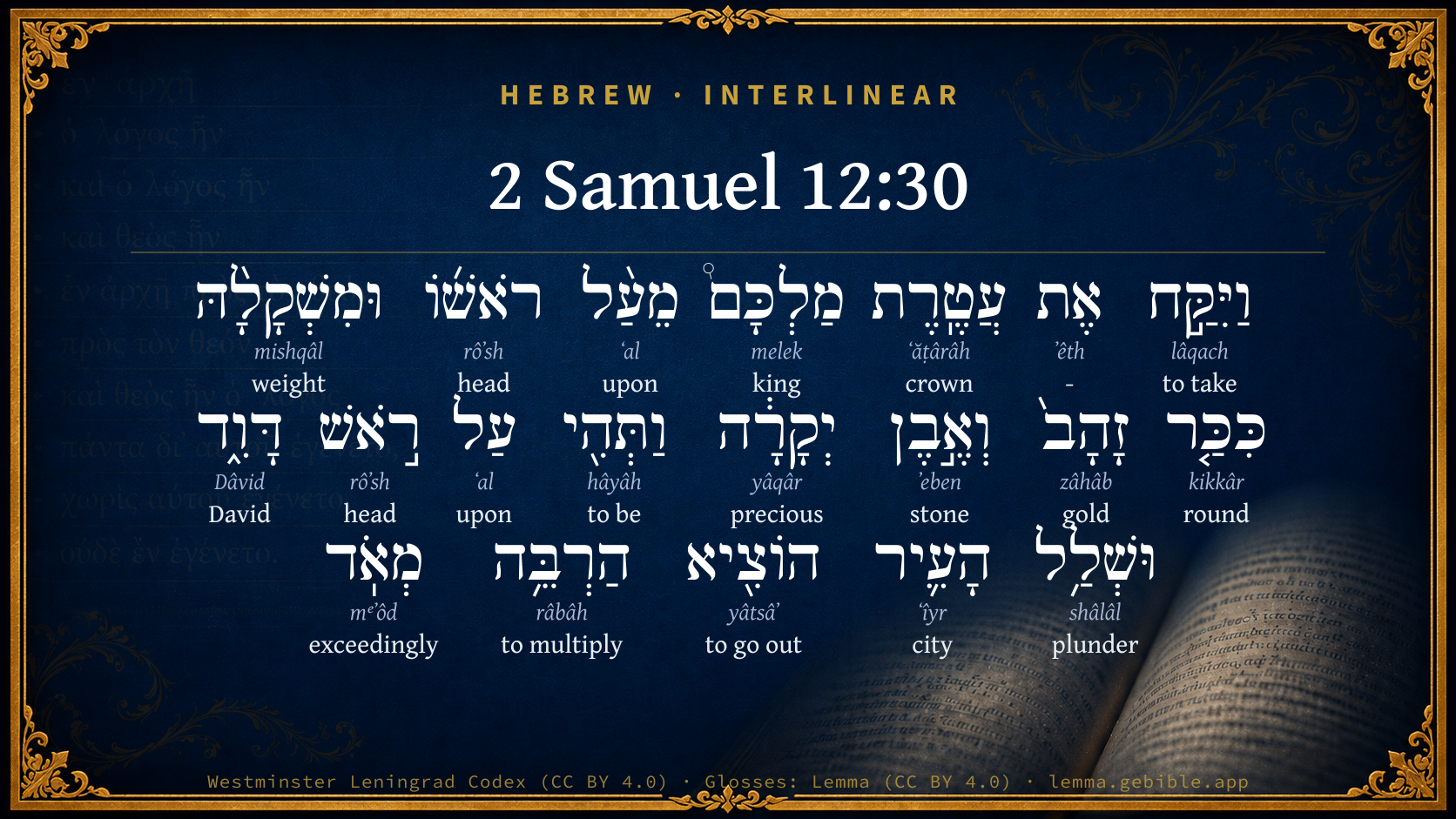
Hebrew (Westminster Leningrad Codex) 2 Samuel 12:30 appears in the Hebrew Old Testament. The text above is from the Westminster Leningrad Codex. Each word links to its Strong’s number, a concise gloss, and parsing drawn from the Open Scriptures Hebrew Bible morphology. Click any word for its full Brown-Driver-Briggs (BDB) entry.
Download image
Cite this verse

2 Samuel 12:30 (World English Bible). Public Domain. Lemma interlinear Bible study tool, https://lemma.gebible.app/v/2-samuel/12/30.

Show BibTeX & RIS
BibTeX
RIS
English Translation
He took the crown of their king from off his head; and the weight of it was a talent of gold, and [in it were] precious stones; and it was set on David's head. He brought forth the spoil of the city, exceeding much.
World English Bible · Public Domain
Highlights
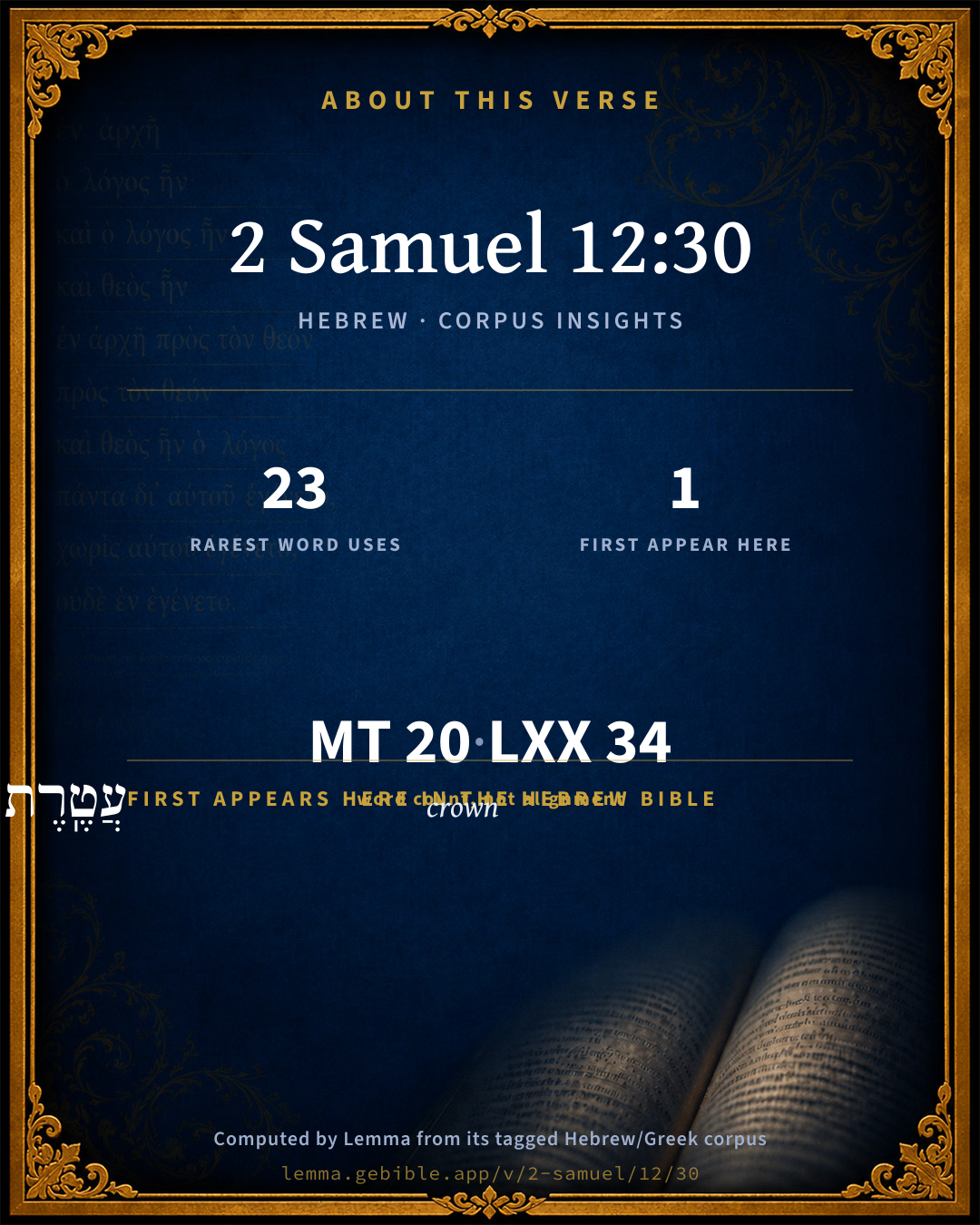
  • 1 first appearance in the Hebrew Bible
Full analysis ↓
Download a study sheet

One document with this verse’s original text, its word-by-word gloss line, the meaning frame, cross-references with their text, attributed commentary, and full source and license credits — printable, and it pastes into notes with its structure intact.

This verse Autodidact and up

Study sheet (.html) Plain text (.txt)

A passage Seminary Student

Up to 50 verses in one chapter. A passage sheet keeps up to 6 commentary sources and 12 cross-references per verse, in the order this page ranks them, and says so on the sheet whenever that leaves anything out. Ask for a single verse and you get the Autodidact verse sheet above.

Everything on this page stays free to read, with no account — the sheet is a download of what is already on screen, not access to it.

Want to remove ads? Support Godless Engineer
Compare translations 3

The same verse in 3 English versions, stacked beneath the original-language interlinear above. Click any original word for its lexicon entry.

Each is an independent rendering of the whole verse — the interlinear is not word-aligned to these translations.

Highlighted words mark where these versions differ — a whole-verse word diff, not a word-by-word alignment.

  • World English Bible Public Domain
    He took the crown of their king from off his head; and the weight of it was a talent of gold, and [in it were] precious stones; and it was set on David's head. He brought forth the spoil of the city, exceeding much.
  • King James Version Public Domain
    And he took their king's crown from off his head, the weight whereof was a talent of gold with the precious stones: and it was set on David's head. And he brought forth the spoil of the city in great abundance.
  • unfoldingWord Literal Text CC BY-SA 4.0
    And he took the crown of their king from his head, and its weight a talent of gold, and a precious stone, and it became on the head of David. And he brought out the plunder of the city, very much.

unfoldingWord Literal Text — © unfoldingWord, licensed CC BY-SA 4.0. Word-aligned USFM3 via Door43 (git.door43.org/unfoldingWord/en_ult).

Versions to compare (up to 4)

3 of 4 selected

Show all 18 translations

Every available English version of this verse, each an independent rendering of the whole verse.

  • World English Bible Public Domain
    He took the crown of their king from off his head; and the weight of it was a talent of gold, and [in it were] precious stones; and it was set on David's head. He brought forth the spoil of the city, exceeding much.
  • Berean Standard Bible Public Domain
    Then he took the crown from the head of their king. It weighed a talent of gold and was set with precious stones, and it was placed on David’s head. And David took a great amount of plunder from the city.
  • Majority Standard Bible Public Domain
    Then he took the crown from the head of their king. It weighed a talent of gold and was set with precious stones, and it was placed on David’s head. And David took a great amount of plunder from the city.
  • King James Version Public Domain
    And he took their king's crown from off his head, the weight whereof was a talent of gold with the precious stones: and it was set on David's head. And he brought forth the spoil of the city in great abundance.
  • American Standard Version (1901) Public Domain
    And he took the crown of their king from off his head; and the weight thereof was a talent of gold, and `in it were' precious stones; and it was set on David's head. And he brought forth the spoil of the city, exceeding much.
  • Revised Version (1885) Public Domain
    And he took the crown of their king from off his head; and the weight thereof was a talent of gold, and in it were precious stones; and it was set on David’s head. And he brought forth the spoil of the city, exceeding much.
  • Geneva Bible (1599) Public Domain
    And he tooke their Kings crowne from his head, (which weighed a talent of golde, with precious stones) and it was set on Dauids head: and he brought away the spoyle of the citie in exceeding great abundance.
  • Douay-Rheims (1899) Public Domain
    And he took the crown of their king from his head, the weight of which was a talent of gold, set with most precious stones, and it was put upon David's head, and the spoils of the city which were very great he carried away.
  • Young's Literal Translation Public Domain
    and he taketh the crown of their king from off his head, and its weight `is' a talent of gold, and precious stones, and it is on the head of David; and the spoil of the city he hath brought out, very much;
  • Literal Standard Version CC BY-SA 4.0
    and he takes the crown of their king from off his head, and its weight [is] a talent of gold, and precious stones, and it is on the head of David; and he has brought out the spoil of the city—very much;
  • Unlocked Literal Bible CC BY-SA 4.0
    David took the crown from their king's head—it weighed a talent of gold, and there was a precious stone in it. The crown was placed on David's own head. Then he brought out the plunder of the city in large quantities.
  • unfoldingWord Literal Text CC BY-SA 4.0
    And he took the crown of their king from his head, and its weight a talent of gold, and a precious stone, and it became on the head of David. And he brought out the plunder of the city, very much.
  • Darby Bible Public Domain
    And he took the crown of their king from off his head, the weight of which was a talent of gold with [the] precious stones; and it was [set] on David's head; and he brought forth the spoil of the city in great abundance.
  • World Messianic Bible Public Domain
    He took the crown of their king from off his head; and its weight was a talent of gold, and in it were precious stones; and it was set on David’s head. He brought a great quantity of plunder out of the city.
  • Webster's Bible Public Domain
    And he took their king's crown from off his head, the weight of which was a talent of gold with the precious stones: and it was set on David's head. And he brought forth the spoil of the city in great abundance.
  • Free Bible Version CC BY-SA 4.0
    He took the crown from the head of their king, and it was placed on David's head. It weighed a talent of gold and was decorated with precious stones. David took a large amount of plunder from the town.
  • Bible in Basic English Public Domain
    And he took the crown of Milcom from his head; the weight of it was a talent of gold, and in it were stones of great price; and it was put on David's head. And he took a great store of goods from the town.
  • JPS Tanakh (1917) Public Domain
    And he took the crown of Malcam from off his head; and the weight thereof was a talent of gold, and in it were precious stones; and it was set on David's head. And he brought forth the spoil of the city, exceeding much.

Literal Standard Version (2020), Covenant Press — licensed CC BY-SA 4.0. Text via the HelloAO Bible API (eBible.org). Unlocked Literal Bible (unfoldingWord) — licensed CC BY-SA 4.0. Text via the HelloAO Bible API (eBible.org). unfoldingWord Literal Text — © unfoldingWord, licensed CC BY-SA 4.0. Word-aligned USFM3 via Door43 (git.door43.org/unfoldingWord/en_ult). Free Bible Version, Dr. Jonathan Gallagher — licensed CC BY-SA 4.0. Text via the HelloAO Bible API (eBible.org).

Word by word

More ways to search: Search by grammar → Find every occurrence → Compare this word →

Practice this passage: Drill this verse → Learn its vocabulary →

עֲטֶֽרֶת
ʻăṭârâh
H5850
“crown of”
Noun, Common, Feminine, Singular, Construct
Part of Speech
Noun
Type
Common
Gender
Feminine
Number
Singular
State
Construct
Full BDB Definition

Origin: from H5849

TWOT: 1608a

crown, wreath
  1. וַיִּקַּ֣ח lâqach H3947 “and · to take” Conjunction + Verb, Qal, Sequential Imperfect, 3rd Person, Masculine, Singular
  2. אֶת ʼêth H853 “-” Particle, Direct Object
  3. מַלְכָּם֩ melek H4428 “king · their” Noun, Common, Masculine, Singular, Construct + Suffix, Personal, 3rd Person, Masculine, Plural
  4. מֵעַ֨ל ʻal H5921 “from · upon” Preposition + Preposition
  5. רֹאשׁ֜וֹ rôʼsh H7218 “head · his” Noun, Common, Masculine, Singular, Construct + Suffix, Personal, 3rd Person, Masculine, Singular
  6. וּמִשְׁקָלָ֨הּ mishqâl H4948 “and · weight · her” Conjunction + Noun, Common, Masculine, Singular, Construct + Suffix, Personal, 3rd Person, Feminine, Singular
  7. כִּכַּ֤ר kikkâr H3603 “round of” Noun, Common, Both, Singular, Construct
  8. זָהָב֙ zâhâb H2091 “gold” Noun, Common, Masculine, Singular, Absolute
  9. וְאֶ֣בֶן ʼeben H68 “and · stone” Conjunction + Noun, Common, Feminine, Singular, Absolute
  10. יְקָרָ֔ה yâqâr H3368 “precious” Adjective, Adjective, Feminine, Singular, Absolute
  11. וַתְּהִ֖י hâyâh H1961 “and · to be” Conjunction + Verb, Qal, Sequential Imperfect, 3rd Person, Feminine, Singular
  12. עַל ʻal H5921 “upon” Preposition
  13. רֹ֣אשׁ rôʼsh H7218 “head of” Noun, Common, Masculine, Singular, Construct
  14. דָּוִ֑ד Dâvid H1732 “David” Noun, Proper
  15. וּשְׁלַ֥ל shâlâl H7998 “and · plunder of” Conjunction + Noun, Common, Masculine, Singular, Construct
  16. הָעִ֛יר ʻîyr H5892 “the · city” Particle, Definite Article + Noun, Common, Feminine, Singular, Absolute
  17. הוֹצִ֖יא yâtsâʼ H3318 “to go out” Verb, Hiphil, Perfect, 3rd Person, Masculine, Singular
  18. הַרְבֵּ֥ה râbâh H7235 “to multiply” Verb, Hiphil, Infinitive Absolute
  19. מְאֹֽד mᵉʼôd H3966 “exceedingly” Adverb

About this verse

These counts appear in no published source. They are computed here, from the morphology-tagged text and Lemma’s own curated glosses. What Lemma adds →

20
words
18
distinct lemmas
Historical
section

Notable vocabulary

The rarest word here is עֲטֶֽרֶת crown H5850 — appearing just 23 times in the whole Hebrew Bible.

First appearance in Scripture

This word makes its first canonical appearance in the Hebrew Bible here:

  • עֲטֶֽרֶת crown H5850

Shared distinctive vocabulary

עֲטֶֽרֶת crown H5850 occurs in 23 verses of the Hebrew Bible. Also found in:

Grammatical profile

  • 4 verbs
  • 11 nouns
  • 1 adjective
  • 2 prepositions
  • 1 adverb
  • 1 particle

Verb forms

  • וַיִּקַּ֣ח Qal · Sequential Imperfect
  • וַתְּהִ֖י Qal · Sequential Imperfect
  • הוֹצִ֖יא Hiphil · Perfect
  • הַרְבֵּ֥ה Hiphil · Infinitive Absolute

Repetition

Words recur within this verse — often emphatic in Hebrew:

  • מֵעַ֨ל upon H5921 ×2
  • רֹאשׁ֜וֹ head H7218 ×2

Hebrew & Septuagint length

In English translation the verse runs 44 words from the Hebrew and 44 from the Septuagint (LXX English) — the same length.

A rough comparison of the two English renderings, which tokenize alike — not a word-level alignment.

Word counts can differ between the Hebrew and the Greek without any difference in meaning — e.g. the Hebrew direct-object marker אֵת has no separate Greek word, and Greek often adds the article ὁ.

In the original languages it is 20 Hebrew tokens and 34 Greek tokens — but the two are counted differently (Hebrew bundles its prefixes and suffixes into one token; the Greek is in lemma form), so that isn’t a like-for-like length.

Cross-references

1

Topical passages linked to 2 Samuel 12:30 in the Treasury of Scripture Knowledge — connected by theme and wording, ordered by reader-vote popularity; previews shown in the World English Bible.

  • 1 Chronicles 20:2 David took the crown of their king from off his head, and found it to weigh a talent of gold, and there were precious stones in it; and it was set on David's head: and he brought forth the spoil of the city, exceeding much.

Cross-references courtesy of OpenBible.info (CC BY 4.0).

Hebrew and Greek witnesses Masoretic Hebrew ↔ Greek Septuagint

The same verse in the two great witnesses to the Old Testament, shown verse-for-verse.

These are two independent witnesses, not word-aligned to each other, and the Septuagint is shown in lemma (dictionary) form.

Hebrew 2 Samuel 12:30 Masoretic · Westminster Leningrad Codex

וַיִּקַּ֣ח אֶת עֲטֶֽרֶת מַלְכָּם֩ מֵעַ֨ל רֹאשׁ֜וֹ וּמִשְׁקָלָ֨הּ כִּכַּ֤ר זָהָב֙ וְאֶ֣בֶן יְקָרָ֔ה וַתְּהִ֖י עַל רֹ֣אשׁ דָּוִ֑ד וּשְׁלַ֥ל הָעִ֛יר הוֹצִ֖יא הַרְבֵּ֥ה מְאֹֽד

He took the crown of their king from off his head; and the weight of it was a talent of gold, and [in it were] precious stones; and it was set on David's head. He brought forth the spoil of the city, exceeding much.

World English Bible · Public Domain

Greek LXX 2 Samuel 12:30 Septuagint · lemma form

καί λαμβάνω ὁ στέφανος μελχολ ὁ βασιλεύς αὐτός ἀπό ὁ κεφαλή αὐτός καί ὁ σταθμός αὐτός ταλάντον χρυσίον καί λίθος τίμιος καί εἰμί ἐπί ὁ κεφαλή δαυίδ καί σκῦλον ὁ πόλις ἐκφέρω πολύς σφόδρα

And he took the crown of Molchom their king from off his head, and the weight of it was a talent of gold, with precious stones, and it was upon the head of David; and he carried forth very much spoil of the city.

LXX2012 (modern English Septuagint) · Public Domain

On this verse, Whedon's Commentary on the Bible discusses the Septuagint’s reading. Read the note in Commentary ↓

Hebrew: Westminster Leningrad Codex (CC BY 4.0). Greek: Septuagint (public domain); English from LXX2012 (modern English Septuagint) (Public Domain). How the Septuagint differs from the Hebrew →

Targum (Aramaic paraphrase)

1

The Targum is the ancient Jewish Aramaic paraphrase of the Hebrew Scriptures — an interpretive translation, not the Hebrew text itself. Onkelos (literal) and Pseudo-Jonathan (expansive) render the Torah, and Jonathan the Prophets. Coverage is partial: where no permissively-licensed English translation exists for a verse, only the Aramaic is shown. This is verse-level text, not a word-by-word alignment to the Hebrew.

  1. Targum Jonathan Prophets (Joshua–Malachi)
    וּנְסִיב יַת כְּלִילָא דְמַלְכְּהוֹן מֵעַל רֵישֵׁיהּ וּמַתְקְלָהּ כִּכְּרָא דְדַהֲבָא וּבָהּ אֲבַן טָבָא וַהֲוָה עַל רֵישָׁא דְדָוִד וַעֲדַת קַרְתָּא אַפֵיק סַגִי לַחֲדָא:

    (no public-domain English translation for this verse)

    Targum Jonathan — Aramaic: “Mikraot Gedolot” (public domain). English: “Sefaria Community Translation” (CC0 1.0 (public-domain dedication)); “London "Chaldee Paraphrase," 1871” (public domain). Text via Sefaria.

Commentary

Notes on 2 Samuel 12:30 from classic Christian and Jewish commentators (each source and its license shown beneath its notes). The classic Christian expositions comment on the surrounding passage and are grouped to its opening verse, so a note may address several verses; the Jewish commentaries on the Tanakh (Rashi and others) are per-verse, so they appear only where the commentator wrote on this verse.

Lemma curates 59 commentaries, every one of them public domain or Creative Commons licensed, each selected and text-cleaned for this edition rather than reprinted as found. About our sources →

Trapp's Complete Commentary

John Trapp

2Sa 12:30 And he took their king’s crown from off his head, the weight whereof [was] a talent of gold with the precious stones: and it was [set] on David’s head. And he brought forth the spoil of the city in great abundance.

Ver. 30. And he took their king’s crown from off his head.] After that it had been first put on by others, to show that he was now degraded of his royal dignity. So our Richard II, when to be deposed, was brought forth in a royal robe, with a crown upon his head, &c. Never, saith the historian, was prince so gorgeous with less glory and more grief.

The weight whereof was a talent of gold.] Too heavy and weighty to be worn ordinarily; held it was perhaps, or hung at solemn times, over the king’s head as he sat in a chair of state. The crown of glory is much more weighty; so that if the body were not upheld by the power of God, it were impossible it should bear it. It is "an exceeding excessive eternal weight of glory." {2Co 4:17}

With the precious stones.] It is said of our Queen Mary, that at her coronation, her head was so laden with pearls and precious stones, that she could not look up.

And it was set on David’s head.] So our Edward III was crowned in Paris, and set there a viceroy; like as David here did Shobi the son of Nahash, who therefore helped David when he fled from Absalom. {2Sa 17:27-28} Let us set the crown on Christ’s head, by whom we are more than conquerors. See Son 3:11 Rev 4:10. Canutus set his crown upon the crucifix, according to the course of those dark times, and proclaimed, saying, Let all the inhabitants of the world know that there is no mortal man worthy the name of a king, but he to whose beck heaven, earth, and sea by his laws eternal are obedient. {a}

{a} Hen. Bunting.

John Trapp, A Commentary or Exposition upon All the Books of the Old and New Testament (1647–1656) — public domain. Text from a community e-Sword module.

Joseph Benson's Commentary

2Sa 12:30. He took the king’s crown from off his head — This was the king’s part of the spoil. The weight thereof was a talent of gold — Or, rather, the price or value of it, as the Hebrew frequently signifies, and not only weight; and so it is to be taken here; for who could be able to carry on his head such a weight as a talent; which is computed to be one hundred and twenty-five pounds. With precious stones — Which made the value of it so great. Josephus says that there was a stone of great price in the middle of the crown, which he calls a sardonyx. And it was set on David’s head — To show the inhabitants that they were to submit to him as their king.

Joseph Benson's Commentary on the Old and New Testaments (1811–1818) — public domain. Text from a community e-Sword module.

Tyndale Open Study Notes

Tyndale Open Resources

12:30 David removed the crown: David had, in effect, become the Ammonites’ king. • a vast amount of plunder: Instructions against taking such booty during a conquest (Deut 7:25-26) show how dangerous David’s actions were. Such wealth might seduce the king’s heart away from God.

Tyndale Open Study Notes — © Tyndale Open Resources, licensed CC BY-SA 4.0. Text via the HelloAO Bible API.

Geneva Bible (1599)

Geneva Bible translators

That is: threescore pounds after the weight of the common talent.

Geneva Bible (1599) marginal notes — public domain. Text via Bolls.life.

Jamieson, Fausset & Brown

Robert Jamieson, A. R. Fausset & David Brown

he took their king's crown from off his head--While the treasures of the city were given as plunder to his soldiers, David reserved to himself the crown, which was of rarest value. Its great weight makes it probable that it was like many ancient crowns, not worn, but suspended over the head, or fixed on a canopy on the top of the throne.

the precious stones--Hebrew, "stone"; was a round ball composed of pearls and other jewels, which was in the crown, and probably taken out of it to be inserted in David's own crown.

Jamieson, Fausset & Brown — Commentary Critical and Explanatory on the Whole Bible (1871) — public domain (CC PDM 1.0). Text via the HelloAO Bible API.

Adam Clarke's Commentary

Verse 30. The weight whereof was a talent of gold] If this talent was only seven pounds, as Whiston says, David might have carried it on his head with little difficulty; but this weight, according to common computation, would amount to more than one hundred pounds!

If, however, משקלה mishkalah be taken for the value, not the weight then all is plain as the worth of the crown will be about £5075 15s. 7d. sterling. Now this seems to be the true sense, because of the added words with the precious stones; i.e., the gold of the crown, and the jewels with which it was adorned, were equal in value to a talent of gold.

Adam Clarke's Commentary on the Bible (1810–1826) — public domain. Text from a community e-Sword/MySword module.

Ellicott's Commentary for English Readers

(30) Their king’s crown.—The same Hebrew letters, translated their king, form the name of Milcom, the chief idol of the Ammonites, and hence some writer have quite unnecessarily supposed that the idol’s crown is meant.

A talent of gold.—If this is according to the Hebrew weights, the amount is extraordinary, for the silver talent was above a hundred pounds, the gold talent twice as much. But there were various other Eastern talents, as the Babylonian and Persian, of much smaller weight, and it is not unlikely that a light talent may have been in use among the Ammonites. The weight, however, on any reasonable supposition, would have been too great to allow of this crown being commonly worn.

A Bible Commentary for English Readers, edited by Charles John Ellicott (1878–1897) — public domain. Text from a community e-Sword module.

The Cambridge Bible for Schools and Colleges

gen. ed. J. J. S. Perowne

30. their king’s crown] The word Malcham, rendered their king, may also be taken as a proper name. It occurs in Zep_1:5; Jer_49:1; Jer_49:3 (marg.), as a form of the name of the Ammonite deity, Moloch or Milcom. The Sept. now reads Molchom their king, “their king” being probably a gloss, and “Molchom” the original reading. A Jewish tradition recorded by Jerome tells how the crown was snatched from the head of Milcom by Ittai the Gittite, because it was unlawful for a Hebrew to take spoil from an idol (Quaest. Hebr. on 1Ch_20:2). But while it was natural for David to take and wear the king’s crown, as the symbol of the subjection of the Ammonites to his rule, would he not have regarded the idol’s crown with abhorrence, and have shrunk from wearing it?

a talent of gold] Estimated at more than 100 pounds. If this estimate is correct, it can never have been habitually worn, and must have been placed on David’s head for a few moments only.

The Cambridge Bible for Schools and Colleges (gen. ed. J. J. S. Perowne; Cambridge University Press, 1878–1918) — public domain. Text from a community e-Sword module.

John Gill's Exposition

And he brought forth the people that were therein,.... Not all the inhabitants of the place, but the princes of the children of Ammon, the counsellors of Hattun, who advised him to use David's ambassadors in so shameful a manner, and others that expressed their pleasure and satisfaction in it:

and put them under saws, and under harrows of iron, and under axes of iron; whereby they were cut asunder, as some were by the Romans and others (n), or their flesh torn to pieces, and they put to extreme pain and agony, and so died most miserably; see Ch1 20:3,

and made them pass through the brickkiln; where they burnt their bricks, by which they were not only scorched and blistered, but burnt to death; so the word in the "Keri", or margin, signifies, which we follow; but in the text it is, they caused them to pass through Malcem, the same with Milcom or Molech, the abomination of the children of Ammon, Kg1 11:5; unto which they made their children pass through the fire, and burnt them; and now in the same place they themselves are made to pass through, and be burnt, as a righteous punishment of them for their barbarous and wicked idolatry. The word used in the Greek version, according to Suidas (o), signifies an army, or a battalion of men drawn up in a quadrangular form, like a brick; and in the same sense Josephus (p) uses it; hence a learned man (q) conjectures that David's army was drawn up in the like form, through which the Ammonites were obliged to pass, and as they passed were assailed with darts, and killed; a like punishment to which is what the Italians call "passing through the pikes":

and thus did he unto all the cities of the children of Ammon; to the inhabitants of them; that is, the chief, who bad expressed their joy at the ill usage of his ambassadors: this he did to strike terror into other nations, that they might fear to use his ambassadors in such like manner. This action of David's showing so much severity, is thought by most to be done when under the power of his lust with Bathsheba, in an hardened and impenitent state, when he had no sense of mercy himself, and so showed none; which is too injurious to his character; for this was a righteous retaliation of this cruel people, Sa1 11:2. Which may be observed in other instances, Jdg 8:6; but the charge of cruelty in David will be easily removed by following the translation of a learned (r) man, and which I think the words will bear, "and he obliged the people that were in it to go out, and put them to the saw", to cut stones; "and to the iron mines", to dig there; "and to the axes of iron", to cut wood, with; "after he had made them to pass with their king" out of the city.

So David and all the people returned unto Jerusalem; in triumph, and with great spoil.

(n) Suetonius in Vita Caii, c. 27. Vid. Herodot. l. 2. c. 139. (o) In voce (p) Antiqu. l. 13. c. 4. sect. 4. (q) Menochius de Repub. Heb. l. 8. c. 3. col 752. (r) Danzii Commentat. de miligat. David in Ammon. crudel. Jenae 1710, apud Michael. in 1 Chron. xx. 3. Vid. Stockium, p. 392.

Next: 2 Samuel Chapter 13

John Gill's Exposition of the Whole Bible (1746–1763) — public domain (CC PDM 1.0). Text via the HelloAO Bible API.

Albert Barnes' Notes on the Bible

Their king’s crown - The word rendered their king (Malcham) is also the name of the national idol of the Ammonites (Jer 49:1, Jer 49:3 margin; Amo 1:15; Zep 1:5). Moreover, the weight of the crown, which is calculated to be equal to 100 or 125 pounds weight, is far too great for a man to wear. On the whole, it seems most probable that the idol Malcam is here meant.

Albert Barnes' Notes on the Bible (1834–1885) — public domain. Text from a community e-Sword/MySword module.

Haydock's Catholic Bible Commentary

King. Hebrew, Malcam, "their king." Moloc, "king," or the chief idol of the Ammonites. It was forbidden to use the ornaments of the idols on Chanaan, but not of other nations. This crown might be worth a talent, on account of the gold and precious stones; (1 Paralipomenon xx. 2.; Sanchez; Bochart,) or it might weigh so much as almost 87 pounds, (Calmet) or above 113 pounds English. (Haydock) --- such immence crowns were sometimes suspended for ornament, over the throne; as Benjamin of Tudela says was done by the emperor Commenes. Pliny describes one of nine pounds; and Athenæus (v. 8,) another of 80 cubits, or 40 yards (Haydock) in circumference. (Calmet) --- The idol, or the king of Ammon, (Menochius) might have one of the like nature, suspended. The Rabbins say David caused it to hand in the air by means of a load-stone; as if it would attract gold! (Calmet)

George Leo Haydock (1774–1849), Haydock's Catholic Family Bible and Commentary, 1859 edition — public domain. Excludes Psalms (Douay-Rheims chapter numbering differs from Protestant) and Deuterocanonical books (Catholic canon only).

Matthew Poole's English Annotations

The weight whereof was a talent of gold, or rather, the price whereof, &c. For as the Hebrew shekel signifies both a weight, and a piece of money of a certain price; so also may mishkal, as proceeding from the same root. And, in general, the same words both in Hebrew, Greek, and Latin are promiscuously used, to signify either weight or price, as is well known to the learned. And the addition of

precious stones, which are never valued by the weight of gold, makes this signification here most proper and probable. Moreover, the weight might seem too great, either for the king of Ammon or for David, to wear it upon his head. Although, if this were meant of the weight, it might be said that this was not a crown to be worn ordinarily, but merely to be put on upon the king’s head at his coronation, or upon solemn occasions, as here where this was done, in token of the translation of this kingdom to David; and, it may be, it was held up or supported by two officers of state, that it might not be too burdensome to him, and after a little while taken off.

Matthew Poole's English Annotations on the Holy Bible (1683–1685) — public domain. Text from a community e-Sword/MySword module.

Whedon's Commentary on the Bible

Daniel D. Whedon

30. Took their king’s crown — Some take מלכם, malcam, rendered their king, as a proper name, Milcom, (compare 1Ki_11:5; 2Ki_23:23, and Zep_1:5,) the great Ammonite idol, elsewhere called Molech. The Septuagint reads, took the crown of Molcom their king. But David would hardly have suffered the crown of that abominable idol to be put upon his head.

The weight… a talent of gold — More than one hundred pounds. This seems incredibly heavy for a crown worn upon the head, and so many interpreters have explained the meaning as worth the weight of a gold talent. But this explanation hardly accords with the natural meaning of the words. Pfeiffer, without sufficient evidence, understands here the weight not of a Hebrew but a Syriac talent. It is better to regard the statement as an inexact but popular estimate of the weight of a crown unusually large and heavy. Sir Harford Jones Brydges describes the Persian crown of state as excessively heavy, and relates that, happening to look back, on quitting the audience chamber, he saw the king lifting his crown from his head, as if anxious to relieve himself from its oppressive weight.

With the precious stones — The meaning is, according to 1Ch_20:2, that the crown was set with precious stones.

Daniel D. Whedon (gen. ed.), Commentary on the Old and New Testaments (1874–1909) — public domain. Text from a community e-Sword module.

The Pulpit Commentary

Their king; Hebrew, Malcam. This is another mode of spelling Milcom, the god of the Ammonites, and is found also in Zep_1:5, and probably in Jer_49:1, Jer_49:3; Amo_1:15. Strictly, Milcom or Malcom is a proper name for the supreme deity, formed from the word melec, a king, or, as it was pronounced in other Semitic dialects, Moloch. Grammatically, Malcam also means "their king," and even so belongs to Milcom. For the crown weighed a hundred pounds, a ponderous mass, which no man could possibly bear, and, least of all, when making, as was the case with the Ammonite king, his last stand for his life. But after the capture of the city, it was lifted from the head of the idol, and placed formally upon David"s head, and held there for a few moments, as a sign of victory and of rejoicing over the fall of the false god. There is no reason for supposing that there is any exaggeration in the weight, nor will the Hebrew allow us to understand the talent of gold as referring to its value.

The Pulpit Commentary (1880–1919), ed. H.D.M. Spence-Jones & Joseph S. Exell — public domain. Text from a community e-Sword module.

John Wesley's Explanatory Notes

The weight - Or rather, the price whereof, &c. For the same words both in Hebrew, Greek and Latin, are used, to signify either weight, or price. And the addition of precious stones, which are never valued by the weight of gold, makes this signification most probable. Moreover, the weight might seem too great either for the king of Ammon, or for David to wear it upon his head.

John Wesley, Explanatory Notes Upon the Whole Bible (1754–1765) — public domain. Text via the GEBible commentary corpus.

Keil & Delitzsch

C. F. Keil & F. Delitzsch

He then took their king's crown ("their king," viz., the king of the Ammonites) from off his (the king's) head; so that he had either been taken prisoner or slain at the capture of the city. The weight of the crown was "a talent of gold, and precious stones" (sc., were upon it): as the writer of the Chronicles has correctly explained it by supplying בּהּ. The Hebrew talent (equal to 3000 shekels) was 83 1/2 Dresden pounds. But the strongest man could hardly have borne a crown of this weight upon his head for however short a time; and David could scarcely have placed it upon his own head. We must therefore assume that the account of the weight is not founded upon actual weighing, but simply upon an approximative estimate, which is somewhat too high. David also took a great quantity of booty out of the city.

Keil & Delitzsch — Biblical Commentary on the Old Testament (1861–1891) — public domain (CC PDM 1.0). Text via the HelloAO Bible API. (Old Testament only.)

Rashi

Rabbi Shlomo Yitzchaki (Rashi)

The crown of Malkom. The abomination [idol] of the people of Ammon's name was Malkom. Denoting [the word] Moleich.

It was [hung over] Dovid's head. Itai the Gitite annulled it.

Rashi on the Tanakh — English translations: “The Judaica Press complete Tanach with Rashi, translated by A. J. Rosenberg” (CC BY 4.0); “Pentateuch with Rashi's commentary by M. Rosenbaum and A.M. Silbermann, 1929-1934” (public domain); “The Metsudah Tanach series, Lakewood, N.J” (CC BY 4.0); and “The Book of Joshua, Metsudah Publications, 1997” (CC BY 4.0). Text via Sefaria.

Lesson kit

Teaching starters — assembled from the data on this page, not authored interpretation. Every prompt links to the verse data it draws on. Edit before teaching.

2 Samuel, in the Historical, opens this verse with 20 words (18 distinct Hebrew lemmas). Its most distinctive word is ʻăṭârâh (“crown”). A historical commentator’s framing appears above. Read the whole chapter for the surrounding context.

Discussion questions

  1. How does “crown” (ʻăṭârâh) shape what this verse is saying?
  2. This is the first place “crown” appears in Scripture (first appears here). What does its debut here establish?
  3. How does 1 Chronicles 20:2, which shares the word «crown», read alongside this verse?
  4. What does the repetition of “upon” (2× in this one verse) do in this verse?
  5. The translations on this page render this verse differently — a whole-verse word diff, not a word-by-word alignment. What might account for the different wordings?
  6. «וַיִּקַּ֣ח» is a Qal Sequential Imperfect verb. How does that grammatical form shape the action described?
  7. Compare how Trapp's Complete Commentary and Joseph Benson's Commentary read this verse. Where do they agree or differ?

Things to notice

Reading settings

Reading text

Shown beneath each verse's original-language words.

Old Testament
Old Testament edition

Read the OT as the Masoretic Hebrew (MT) or the Greek Septuagint (LXX).

English shown for the Greek Septuagint (in the Hebrew ↔ Greek comparison).

Comparing translations? Open the Compare panel on any verse page to stack up to four side by side.